
Subtraction Fun: Counting and Subtracting Worksheet for Kids
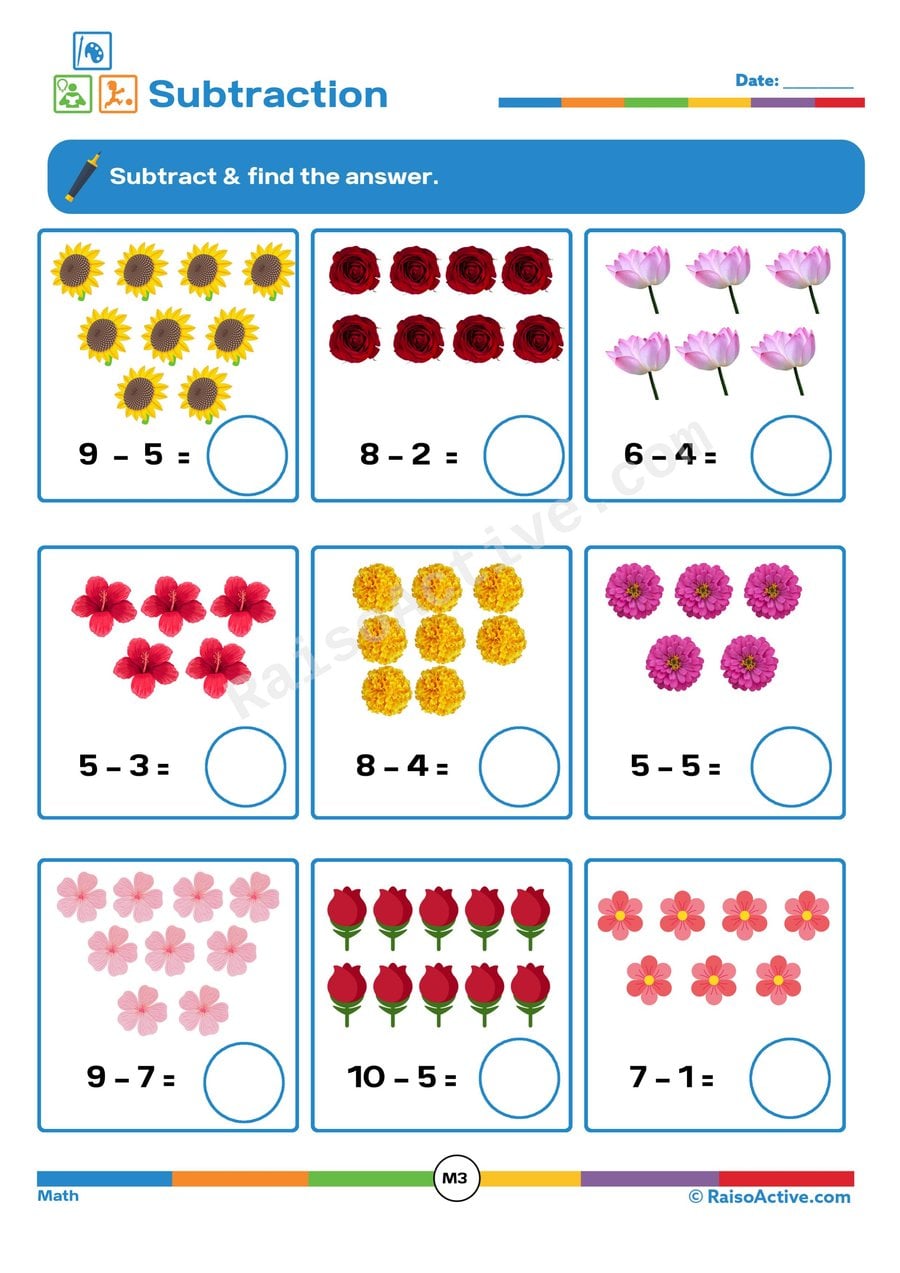
This worksheet gives 3-5 year olds direct practice subtracting the smaller number from the larger one, using accompanying pictures to make each subtraction problem visible and countable rather than purely abstract. Working through picture-supported subtraction repeatedly at this age builds the number sense needed before children can subtract using numerals alone, without a picture to lean on.
Part of the pack
Month 5: Essential English, Math, Science | Ages 6-7Curriculum
How to use this worksheet
Look at the first set of pictures and the two numbers shown together. Ask your child which number is bigger and which is smaller, and confirm they understand they need to subtract the smaller from the larger. Have them count the pictures to check their thinking, then write the answer in the box. Repeat for each remaining problem, encouraging your child to check their answer against the picture before moving on.
Materials needed
- Pencil
- Eraser
Extension activities
- •Use real toys or snacks to act out each subtraction problem physically.
- •Have your child create new subtraction problems using different small objects around the house.
- •Play a quick game where you hold up two different amounts and your child has to say the difference.
- •Draw a simple number line and use it together to hop backward and solve a subtraction problem.
- •Turn subtraction into a snack-time activity, eating a few crackers and counting what's left.
Tips for parents and teachers
Encourage your child to say the full subtraction sentence out loud, like 'two take away one equals one,' since verbalizing the math language reinforces understanding alongside the written answer. Manipulatives — actual objects your child can move and count — make the subtraction concept far more concrete than numbers and pictures alone. Be patient with subtracting the smaller from the larger, since understanding which number to start from is still a developing skill at this age.

Written by
Hemsweta Jain · Teacher Cheena
MBA and Early Childhood Educator, teaching since 2014 · Founder of RaisoActive, Mumbai
Every RaisoActive worksheet is designed and checked by the founder before publishing.
Published · Last reviewed
Related worksheets

Subtraction Fun: Count and Subtract with Cute Animals!
Counting a group of animal pictures and then crossing out or removing a specified number teaches children ages 4-6 the concept of subtraction as taking away from a starting quantity, which is easier to grasp visually than through numbers alone. Writing the remaining total after the take-away step reinforces that subtraction results in a smaller, specific number, connecting the physical act of removing objects to a written numeral. Using cute animal pictures as the countable objects keeps a potentially tricky math concept approachable and fun.
Flower Power Subtraction Worksheet for Kids
This worksheet gives children ages 4-6 hands-on subtraction practice using a flower-themed counting context, asking them to count pictured objects, subtract a given amount, and write the difference in a circle. The visual, countable format helps make subtraction concrete rather than abstract, reinforcing that 'taking away' reduces a group's total in a way children can see and verify by recounting.

Subtraction Fun: Candy and Treats Worksheet for Kids!
This worksheet gives children ages 4-6 concrete practice with subtraction by counting pictured candies and treats, then taking away a stated amount to find the difference. Using a visually appealing, countable context like candy makes the abstract idea of 'taking away' easier to grasp than numbers alone, helping children build the one-to-one counting and comparison skills that subtraction depends on.

Subtraction Fun: Count and Subtract with Hands and Objects!
This worksheet introduces basic subtraction by having children count a starting group of objects and then 'take away' a smaller amount indicated by the minus sign, connecting the abstract concept of subtraction to something they can see and count. For four- to six-year-olds, visualizing subtraction as physically removing objects from a group — rather than just manipulating numbers — makes the concept concrete before they move to solving subtraction problems with numbers alone.

Subtraction Fun: Counting Fingers Worksheet for Kids
Children ages 4-5 use their own fingers as a built-in counting tool to practice subtraction, connecting an abstract number sentence to something they can physically see and touch. This bridges the gap between counting objects and solving take-away problems with numbers alone.

Subtraction Fun: Counting and Subtracting Worksheet for Kids
This worksheet teaches children ages 4-6 the concept of subtraction by having them count a group of stars, cross out a specified number, and write how many remain — making the abstract idea of 'taking away' visible and countable rather than purely symbolic. Physically crossing out objects before writing the answer helps children understand subtraction as an action, which is more intuitive at this age than memorizing subtraction facts.

Subtraction Worksheet: Counting and Subtracting for Preschoolers
This worksheet introduces children ages 4-5 to the concept of subtraction as 'taking away' by having them count a group of objects, cross out the number indicated, and write how many remain. Building this concrete, visual understanding of subtraction before introducing abstract number sentences helps children grasp what the minus sign actually means rather than just memorizing a procedure.

Subtraction Worksheet: Count and Subtract with Fun Objects!
This worksheet grounds subtraction in something 4-6 year olds can actually see and count — a group of objects being taken away — rather than starting with abstract numerals and symbols. Because your child has to count the starting group, physically account for the number being subtracted, and then count what's left, this builds real number sense about what subtraction means, not just a memorized fact.
Guides for this topic
Number Formation Rhymes 0–9 and How to Fix Reversals
Original number formation rhymes for 0–9, the correct stroke order for each digit, why 3, 5 and 7 get reversed most often, and multisensory fixes that work.
Documenting Learning Without Drowning in Data: A Practical Guide for Parents and Teachers
Learn practical ways to document your child's learning without overwhelm. Simple portfolios, observation tips, and printable trackers for ages 1-8.
Coding Activities for Preschoolers: Building Tomorrow's Thinkers Today
Discover 15+ unplugged and screen-based coding activities for preschoolers that build sequencing, logic, and problem-solving skills through play. NEP 2020 aligned.
Reviews
Every worksheet for ages 3–5, no watermark
Members download the full library of 1,000+ worksheets and every activity pack without watermarks or daily limits. One year costs ₹1,000 in India or $20 elsewhere.
See membership plansOr download any worksheet free with a watermark (5 a day).