Learn the Sight Word 'Can' - Fun Tracing and Coloring Worksheet
This worksheet gives children ages 3-5 repeated, multi-format practice with the sight word 'can,' a common verb that appears frequently in early reading, through tracing, coloring, and a cut-and-paste spelling activity. Because 'can' is a short, high-frequency word that shows up constantly in beginning readers, building instant recognition of it now pays off across nearly every book your child picks up next.
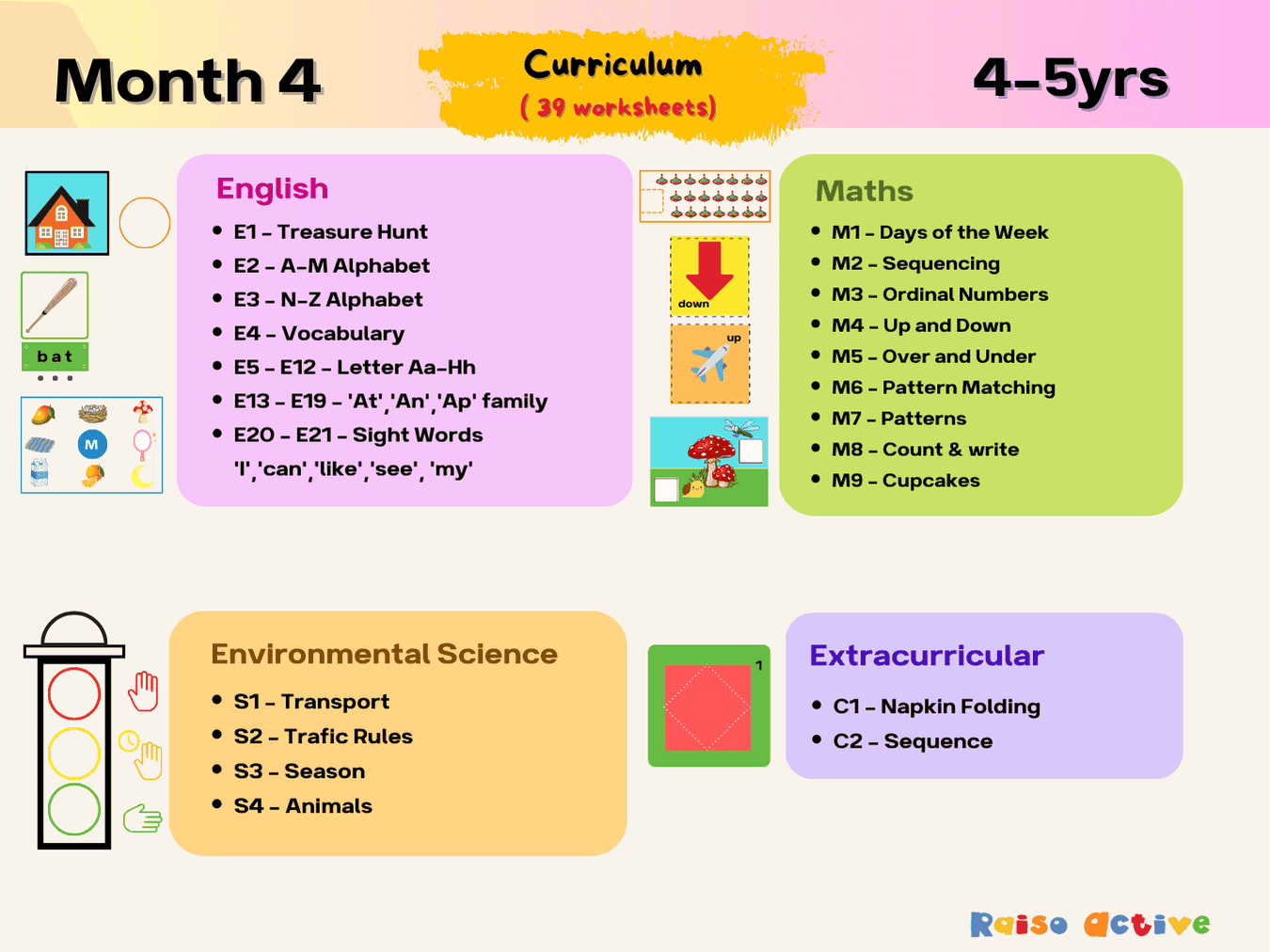
Part of the pack
Month 4: Learning & Development | Ages 4-5
This is page 24 of the pack. Ages 4-5 · Pre-KAges 4-5 · ReceptionAges 4-5 · LKGAges 4-5
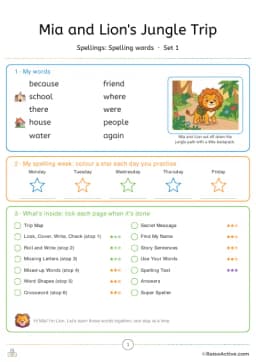
Made for your child
Spelling practice, made for your child
Their own spelling words turned into a pack: trace or look-cover-write-check, roll and write, a secret picture code, a word search, a crossword and a test, with their name in it.
Make a spelling packFree preview · free for members
Or start free: a word search with sight wordsCurriculum
- Fluency > Sight Words
How to use this worksheet
Have your child trace the word 'can' several times with a pencil, saying it aloud each time. Next, have them color the word 'can' in the boxes provided. Then have your child cut out the individual letters and paste them in order to spell the word 'can' correctly. Finish by using the word in a few simple spoken sentences together, like 'I can jump.'
Materials needed
- Pencil
- Crayons
- Scissors
- Glue (optional)
Extension activities
- 1Find the word 'can' in a book and point to it together.
- 2Write the word 'can' on a piece of paper several times for extra practice.
- 3Use the word 'can' in a sentence describing something your child is proud of being able to do.
- 4Play a game listing things you 'can' do, taking turns adding to the list.

Written by
Hemsweta Jain · Teacher Cheena
MBA and Early Childhood Educator, teaching since 2014 · Founder of RaisoActive, Mumbai
Every RaisoActive worksheet is designed and checked by the founder before publishing.
Published · Last reviewed
More from Month 4: Learning & Development | Ages 4-5
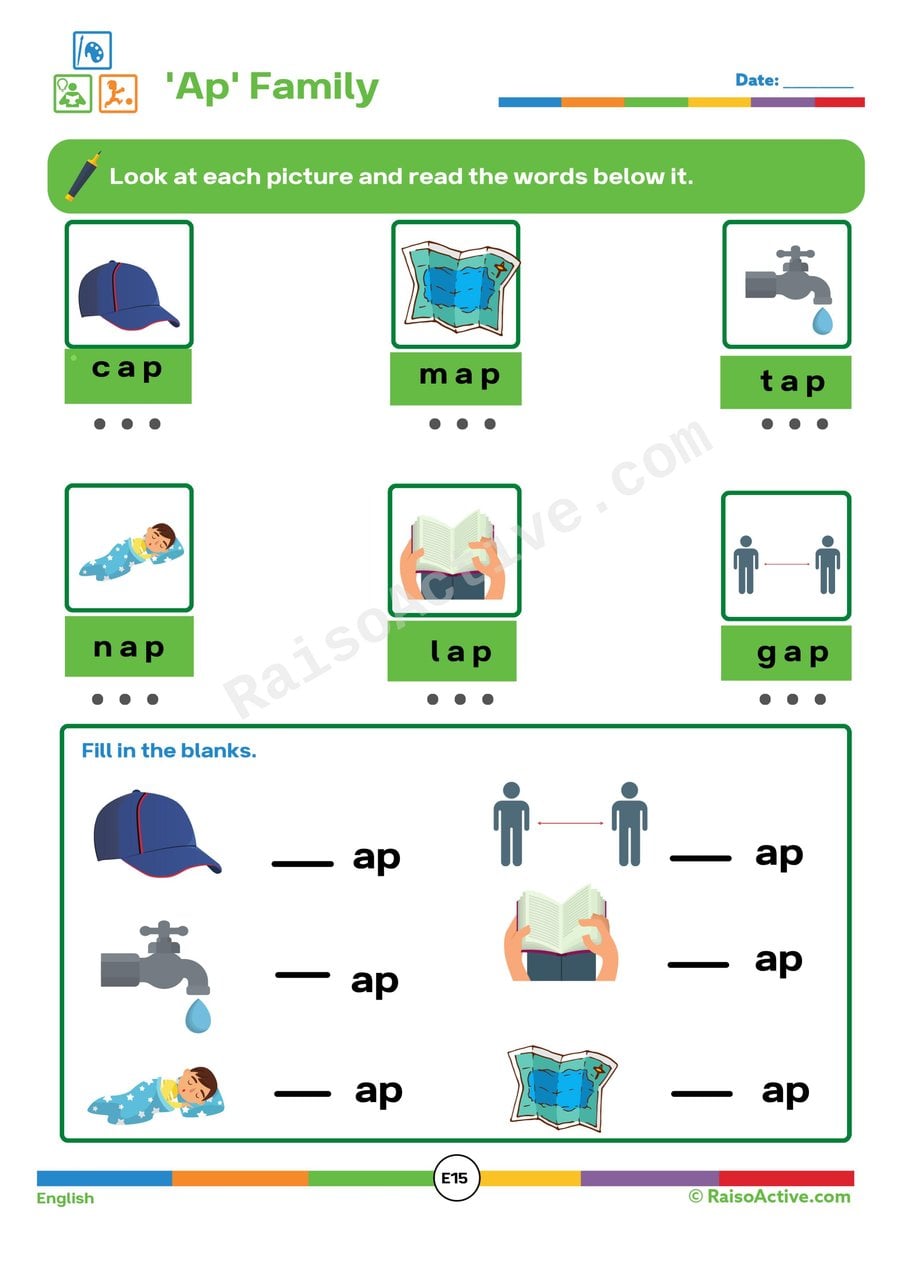
Ap Family Worksheet: Read and Fill in the Blanks!
Ages 4-5 · Pre-KAges 4-5 · ReceptionAges 4-5 · LKGAges 4-5
Continuing the word-family approach, this worksheet helps children ages 4-5 read and complete 'ap' words such as cap, map, and tap by filling in a missing letter, reinforcing the pattern that a shared ending sound can appear across many different words. This kind of practice builds decoding speed and phonics confidence ahead of more independent reading.

Letter Aa Tracing and Matching Worksheet for Preschoolers
Ages 3-5 · Preschool–Pre-KAges 3-5 · Nursery–ReceptionAges 3-5 · Nursery–LKGAges 3-5
This worksheet combines tracing practice for the letter Aa with a letter-hunt task, where children ages 3-5 scan a grid to circle every instance of Aa before also identifying pictures that start with the letter. Practicing both uppercase and lowercase forms together, alongside visual search and picture matching, builds a rounded understanding of what the letter A looks like in its different appearances.

Count and Write: Fun Counting Worksheet for Preschoolers
Ages 3-5 · Preschool–Pre-KAges 3-5 · Nursery–ReceptionAges 3-5 · Nursery–LKGAges 3-5
This counting worksheet has children ages 3-5 count small groups of objects and write the matching numeral in a box, directly linking the physical act of counting to the written symbol that represents a quantity. Writing the number immediately after counting — rather than just counting aloud — reinforces that numerals are a shorthand for real, countable amounts.

Cut and Paste 'An' Family Worksheet for Preschoolers
Ages 4-5 · Pre-KAges 4-5 · ReceptionAges 4-5 · LKGAges 4-5
This cut-and-paste worksheet has children ages 4-5 build simple 'an' family words, like 'can,' 'man,' and 'pan,' by gluing the correct beginning letter in front of the shared 'an' ending. Practicing a word family this way teaches children that changing just one letter creates a whole new word — a foundational pattern-recognition skill in early reading known as rhyming or word-family instruction.
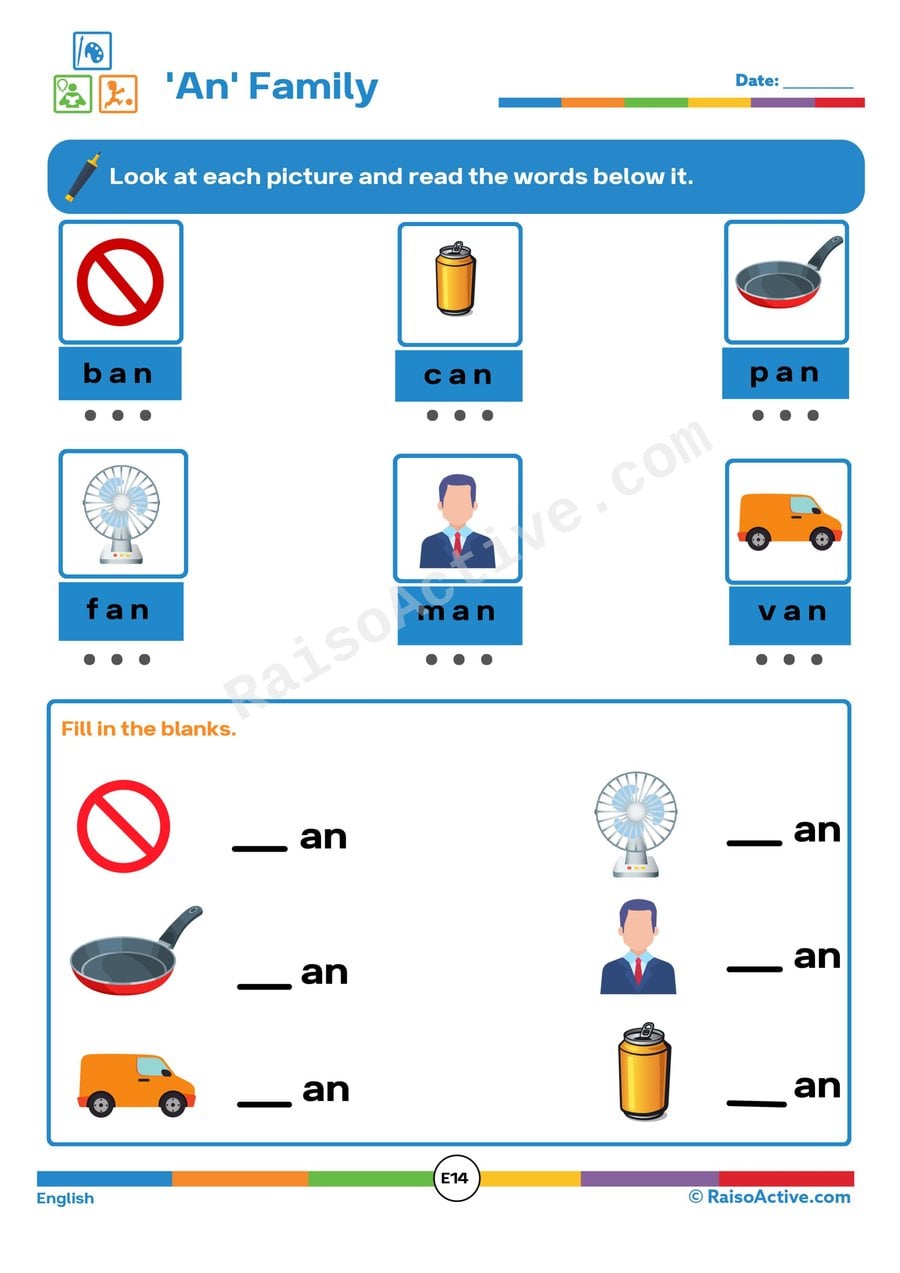
An Family Word Worksheet: Read, Match, and Write!
Ages 4-6 · Pre-K–KindergartenAges 4-6 · Reception–Year 1Ages 4-6 · LKG–UKGAges 4-6
This worksheet builds on word-family recognition by focusing on 'an' words like can, fan, and man, helping children ages 4-6 see that swapping the first letter of a familiar ending creates a whole new word. Practicing this pattern strengthens decoding skills and builds reading confidence, since children start recognizing chunks of words rather than sounding out every single letter.
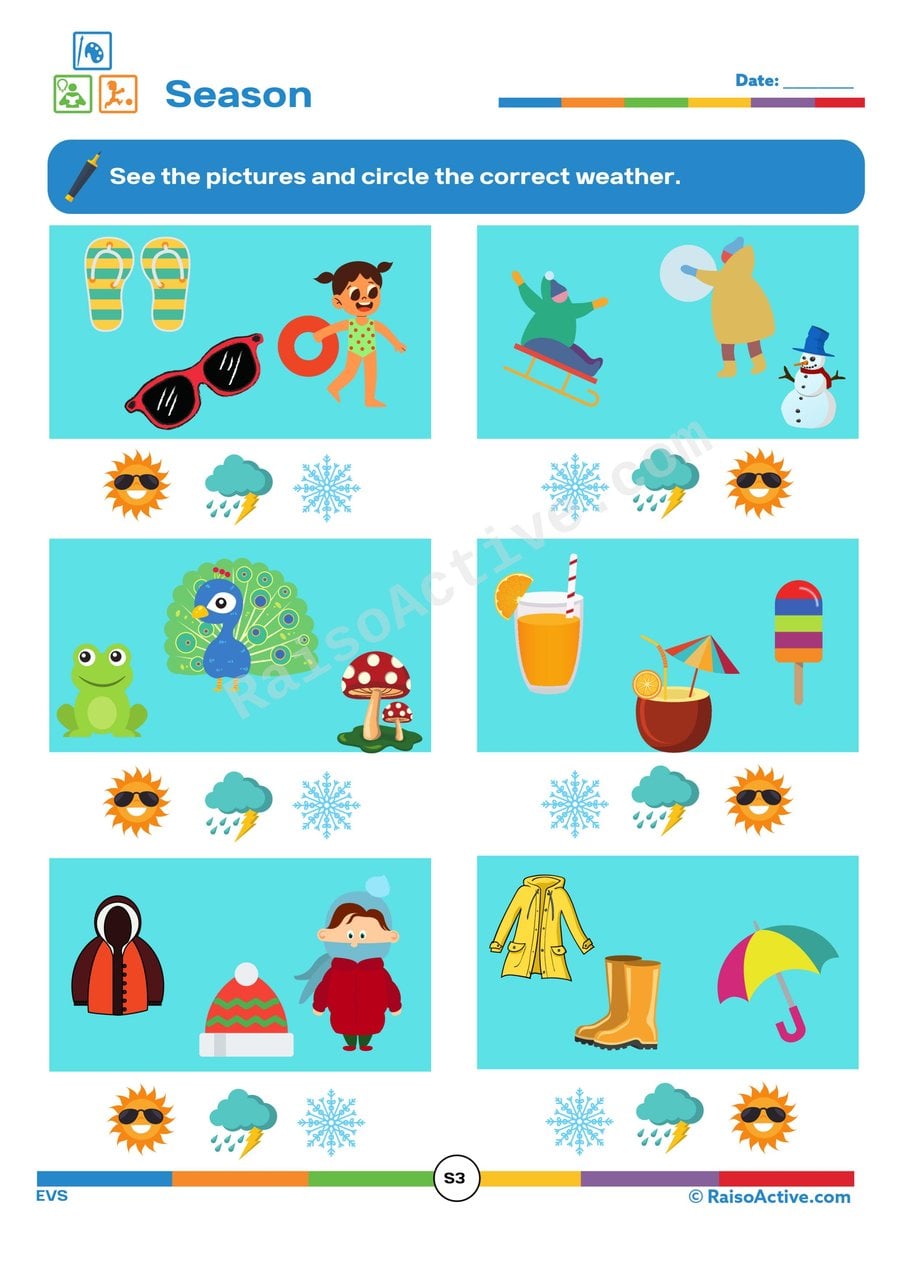
Seasons Worksheet: Circle the Correct Weather!
Ages 3-5 · Preschool–Pre-KAges 3-5 · Nursery–ReceptionAges 3-5 · Nursery–LKGAges 3-5
This worksheet asks children ages 3-5 to look at a seasonal scene and circle the weather that correctly matches it, building an early understanding of how seasons connect to specific weather patterns like snow, rain, or sunshine. Making this connection between a season and its typical weather is an early science concept that also supports vocabulary growth around weather and clothing.

Learn to Read and Write the Sight Word 'Like' - Fun Worksheet for Kids!
Ages 3-5 · Preschool–Pre-KAges 3-5 · Nursery–ReceptionAges 3-5 · Nursery–LKGAges 3-5
Children ages 3-5 build sight-word fluency with the word 'like,' a common word used to express preference, through tracing, coloring, a word search, and sentence reading. Because 'like' doesn't follow simple phonics rules and appears constantly in early books and everyday speech, repeated multi-format exposure like this worksheet provides is exactly how young readers commit it to memory.

Cut and Paste 'At' Family Worksheet: Practice Beginning Sounds!
Ages 4-5 · Pre-KAges 4-5 · ReceptionAges 4-5 · LKGAges 4-5
Working through the 'at' word family — cat, hat, bat, mat, rat — sharpens the specific phonics skill of blending a beginning consonant with a familiar rime to build a real word. For four- and five-year-olds, this rime-based approach is one of the fastest routes into independent reading, since recognizing the 'at' chunk lets them decode dozens of words without sounding out every letter individually.
Related worksheets

Sight Word 'Your' Worksheet: Tracing, Coloring, and Sentence Practice
Ages 4-5 · Pre-KAges 4-5 · ReceptionAges 4-5 · LKGAges 4-5
Children ages 4-5 build sight word automaticity for 'your' — a word that can't be sounded out with basic phonics rules and must instead be recognized instantly for fluent reading. Multiple exposure formats (coloring, tracing, searching, and using it in a sentence) help move the word from short-term recognition into long-term memory, a rehearsal strategy that is especially important for high-frequency 'trick' words.

Sight Words Worksheet: Practice with 'is', 'we', and 'my'
Ages 4-6 · Pre-K–KindergartenAges 4-6 · Reception–Year 1Ages 4-6 · LKG–UKGAges 4-6
This worksheet challenges children ages 4-6 to choose the correct sight word from a small word bank — 'is,' 'we,' or 'my' — to complete a sentence, rather than simply tracing or copying a single word. Selecting the right word based on sentence meaning requires a deeper level of reading comprehension than earlier single-word practice, since children must understand what each sentence is saying before choosing correctly. Writing the chosen word from memory also builds spelling recall for these common words.

Sight Word Fun: 'Yes' Word Activities Worksheet for Preschoolers
Ages 3-5 · Preschool–Pre-KAges 3-5 · Nursery–ReceptionAges 3-5 · Nursery–LKGAges 3-5
Practicing the sight word 'yes' through tracing, writing, circling, and underlining gives children ages 3-5 several different ways to encounter the same high-frequency word, which builds the instant word recognition that supports early reading fluency. Repetition across different formats, rather than just one activity, helps the word move from a puzzle to be solved into a word recognized on sight.

Color the Sight Words! A Fun Sight Word Coloring Worksheet
Ages 3-5 · Preschool–Pre-KAges 3-5 · Nursery–ReceptionAges 3-5 · Nursery–LKGAges 3-5
This worksheet turns sight word recognition into a color-matching game, asking children ages 3-5 to read a sight word and then color a shape with the color that corresponds to it, which keeps repeated word exposure feeling playful rather than like drilling. Because children must actually read each word correctly before knowing which color to use, the coloring choice becomes a built-in check on whether the word was recognized accurately. Repeating this recognize-and-respond pattern across many candies or shapes gives children dozens of low-pressure reps with common sight words in a single sitting.
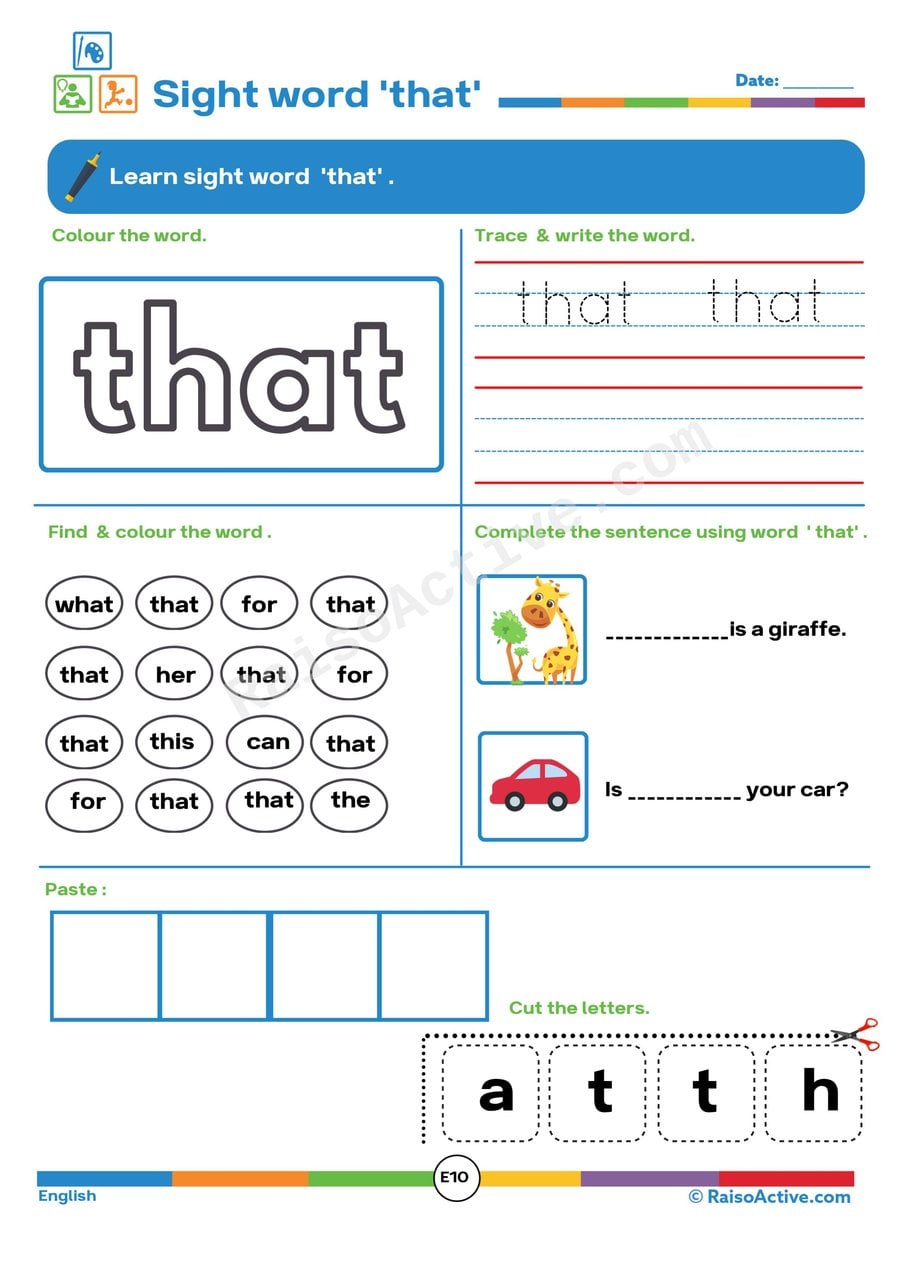
Sight Word 'That' Worksheet: Trace, Find, and Write!
Ages 4-5 · Pre-KAges 4-5 · ReceptionAges 4-5 · LKGAges 4-5
As one of the most frequently used words in early reading texts, 'that' needs to be recognized instantly rather than sounded out letter by letter, and this worksheet gives children ages 4-5 several different ways to practice that recognition. Combining tracing, visual searching, sentence completion, and cutting letters to spell the word reinforces the same target through multiple senses and formats, which strengthens memory retention for tricky sight words.

Color the Sight Words: 'She' and 'He' Worksheet for Preschoolers
Ages 3-5 · Preschool–Pre-KAges 3-5 · Nursery–ReceptionAges 3-5 · Nursery–LKGAges 3-5
This worksheet helps children ages 3-5 build instant sight-word recognition for the common pronouns 'she' and 'he' by having them scan a page and color each word according to a color code. Because sight words like these can't be sounded out easily, repeated visual exposure through an engaging coloring task helps children recognize them instantly by shape, which is essential for early reading fluency. Differentiating between two similar short words also sharpens visual discrimination.

Sight Word 'HE' Worksheet: Trace, Color, and Practice!
Ages 3-5 · Preschool–Pre-KAges 3-5 · Nursery–ReceptionAges 3-5 · Nursery–LKGAges 3-5
This worksheet helps children ages 3-5 learn to recognize, write, and use the sight word 'HE' in simple sentences, giving repeated exposure to a short, high-frequency word that appears in nearly every early reader book. Practicing the word across six different formats, tracing, coloring, circling, writing, filling in, and cutting and pasting, builds recognition through many different types of practice in one sitting.

Jump into Learning: Sight Word 'Jump' Worksheet for Preschoolers
Ages 4-5 · Pre-KAges 4-5 · ReceptionAges 4-5 · LKGAges 4-5
This worksheet builds sight word recognition for the word 'jump' through several different activities, tracing, coloring, finding it in a list, connecting letters, and cutting and pasting, giving children multiple ways to encounter and memorize the same word. For ages 4-5, repeated exposure to a high-frequency word across varied formats is one of the most effective ways to build automatic word recognition, a key building block of fluent reading.
Guides for this topic

Sight Words by Age: The First 50 Words and How to Teach Them Without Flashcard Fatigue
Which sight words to teach first and why, the heart-word method, a read-trace-write-find routine, games, and a by-age table of typical sight-word progress.
How to Teach CVC Blending: A Step-by-Step Method That Works in Two Weeks
A step-by-step method for teaching CVC blending, covering continuous sounds, word families, common errors, and a 14-day plan that most children finish reading CVC words.

Best Worksheets for 3-Year-Olds: What Works and What to Avoid
What works on worksheets for 3-year-olds: short sessions, crayons, tracing lines, matching, cutting, a free weekly plan, and signs one is too advanced.
Reviews
Every worksheet for ages 3–5, no watermark
Members download the full library of 1,000+ worksheets and every activity pack without watermarks or daily limits. One year costs ₹999 in India or $20 elsewhere.
See membership plansOr download any worksheet free with a watermark (5 a day).