
Cut and Paste 'At' Family Worksheet: Practice Beginning Sounds!
Working through the 'at' word family — cat, hat, bat, mat, rat — sharpens the specific phonics skill of blending a beginning consonant with a familiar rime to build a real word. For four- and five-year-olds, this rime-based approach is one of the fastest routes into independent reading, since recognizing the 'at' chunk lets them decode dozens of words without sounding out every letter individually.
Part of the pack
Month 4: Learning & Development | Ages 4-5Curriculum
How to use this worksheet
Start by cutting out the letter tiles at the bottom of the page together. Point to the first picture and ask your child to name it aloud — for example, 'cat.' Have them find the letter that makes the beginning sound they hear, then glue it into the blank space in front of '-at' to complete the word. Repeat picture by picture, checking each finished word by reading it back together before moving to the next.
Materials needed
- Scissors
- Glue
- Pencil
Extension activities
- •Set out small objects or toy figures (a cat, a bat, a hat) and ask your child to sort them by whether their name belongs in the 'at' family.
- •Make a set of letter cards (b, c, f, h, m, p, r, s) and take turns sliding each one in front of '-at' to see which make real words.
- •Write 'at' family words on sticky notes and hide them around the room for a phonics scavenger hunt.
- •Read a simple rhyming book built around 'at' words, like a story about a cat in a hat, and pause to point out the family pattern.
- •Have your child draw a picture for one 'at' word and label it themselves using the letters they just learned.
Tips for parents and teachers
Watch whether your child is truly listening for the beginning sound or just guessing from the picture — ask them to say the word slowly before choosing a letter. Mixing up visually similar letters like b and d is common at this age and isn't a sign of trouble; just have them trace the letter shape with a finger while naming it. Celebrate each completed word before moving on so the activity stays rewarding rather than repetitive.

Written by
Hemsweta Jain · Teacher Cheena
MBA and Early Childhood Educator, teaching since 2014 · Founder of RaisoActive, Mumbai
Every RaisoActive worksheet is designed and checked by the founder before publishing.
Published · Last reviewed
Related worksheets
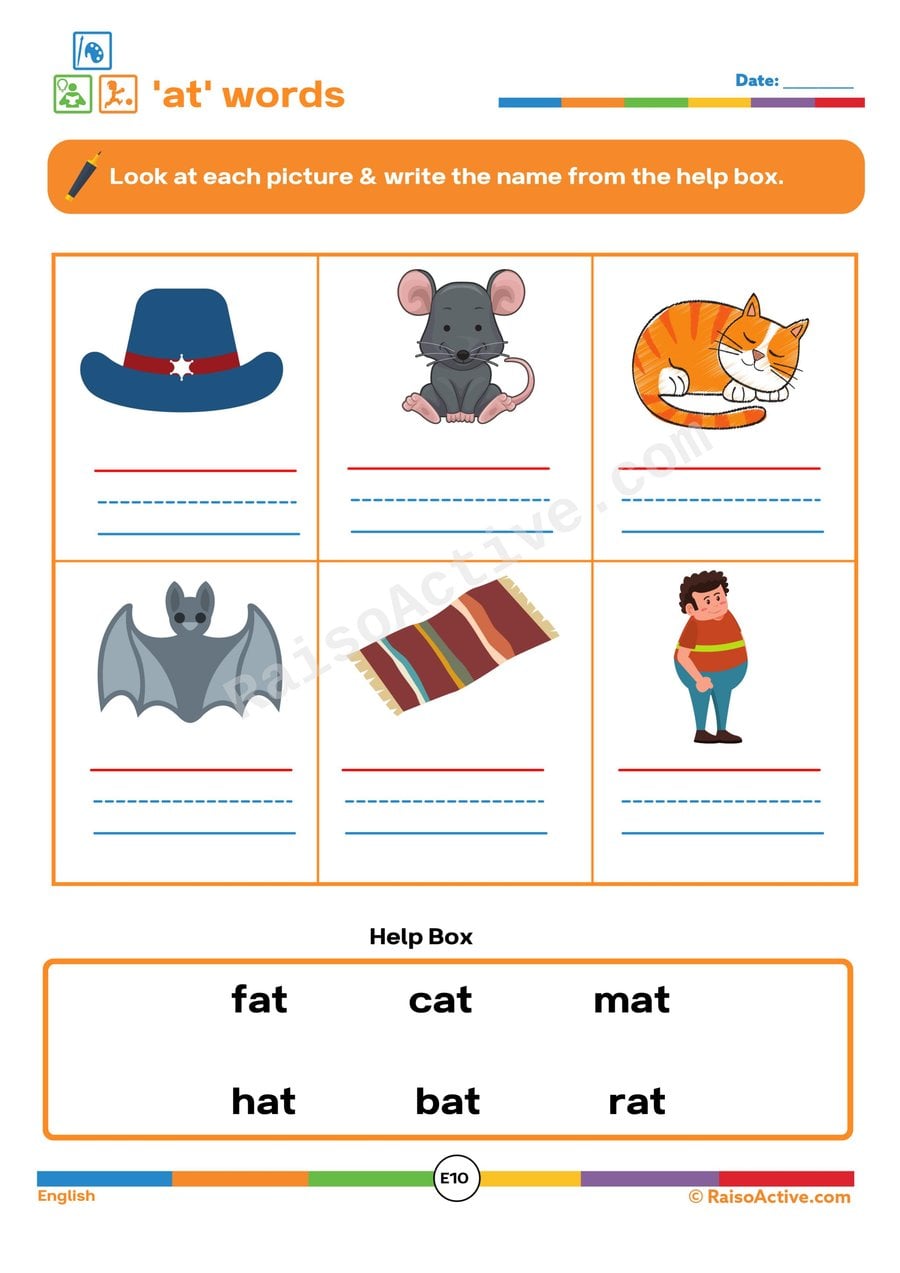
Fun 'at' Word Worksheet for Preschoolers
The 'at' word family (cat, hat, bat) is often one of the very first CVC patterns children ages 4-5 encounter, and this worksheet asks them to go a step further than simple reading by identifying and writing the correct word to match each picture themselves. Choosing the right word from a word bank and writing it out, rather than just reading a word that's already printed, requires children to actively recall spelling rather than passively recognize it. This active recall step is an important bridge between reading CVC words and eventually spelling them independently from memory.
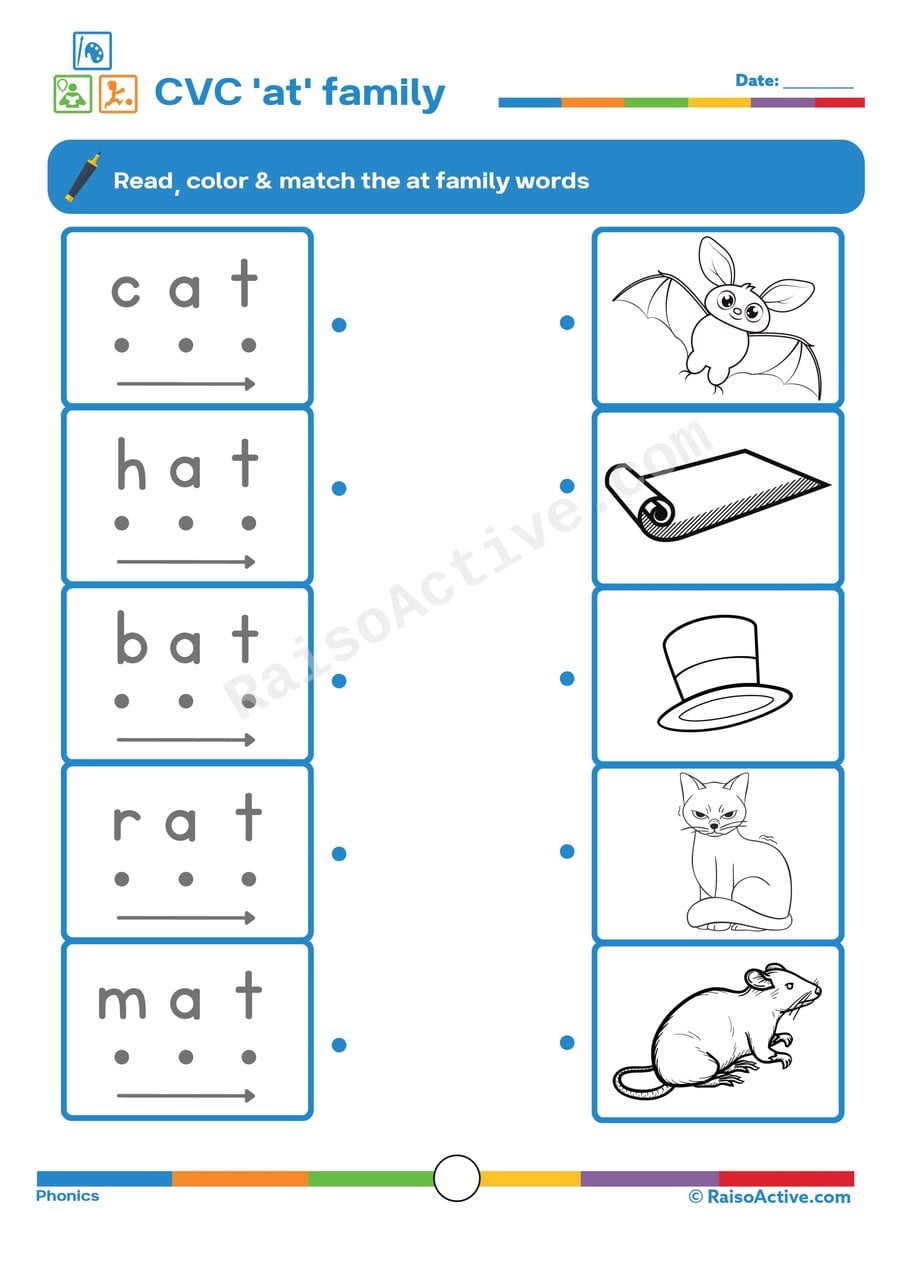
CVC 'at' Family Words Matching Worksheet for Kids
This worksheet introduces children ages 3-5 to the 'at' word family — cat, bat, hat, mat, and similar words that share the same ending sound — helping them notice that once they know how 'at' sounds, they can read many new words just by swapping the first letter. Word family practice is one of the most efficient ways young readers build a large sight vocabulary quickly, since the pattern transfers across dozens of words. Matching each word to its picture confirms real understanding, not just mechanical sounding-out.
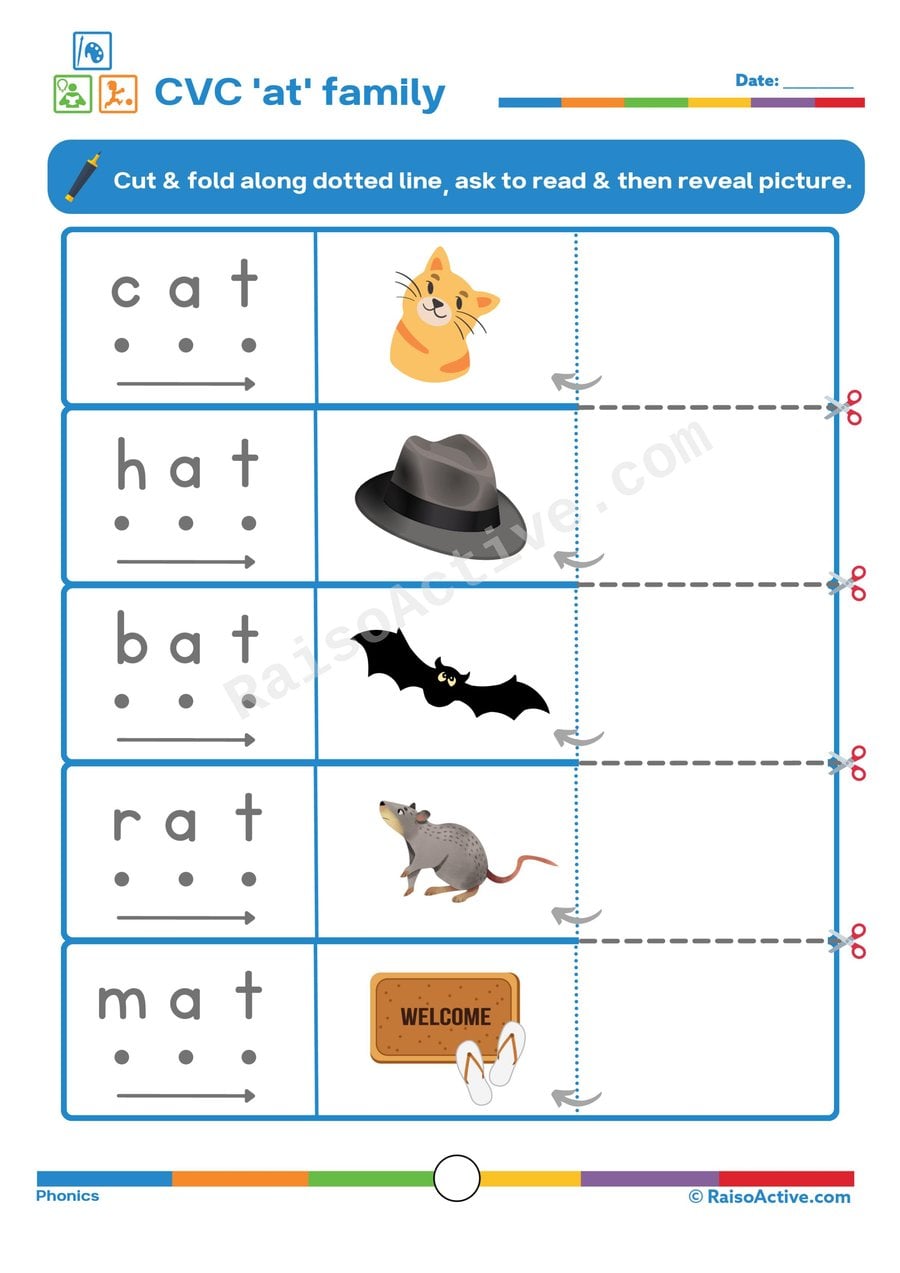
CVC 'at' Family Worksheet: Read, Match, and Reveal!
This worksheet has children ages 4-5 read CVC words from the 'at' family — like 'cat', 'hat', and 'mat' — then match and reveal pictures to check their reading. Because every word ends in the same 'at' chunk, children begin to recognize the pattern as a whole unit, which speeds up decoding and builds the confidence needed to tackle new word families.
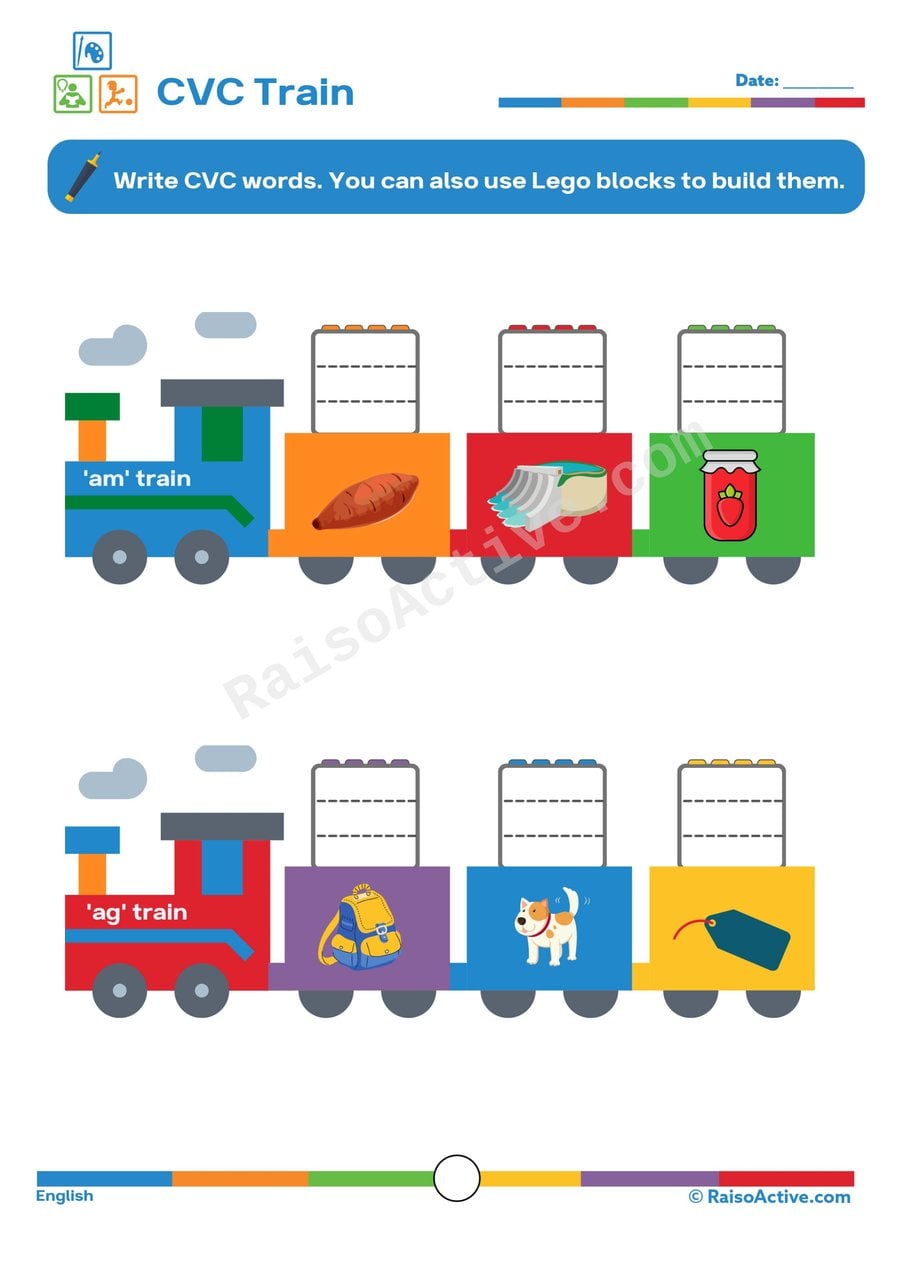
CVC Train Worksheet: Write and Build CVC Words!
This worksheet gives children ages 4-6 focused practice blending letter sounds into consonant-vowel-consonant words, using train-car pictures as clues for words like 'dog,' 'hen,' or 'cup.' Because children both write the word and can optionally build it with Lego blocks, this worksheet reinforces the same phonics skill through two different physical actions — handwriting and hands-on construction — which helps the spelling patterns stick.
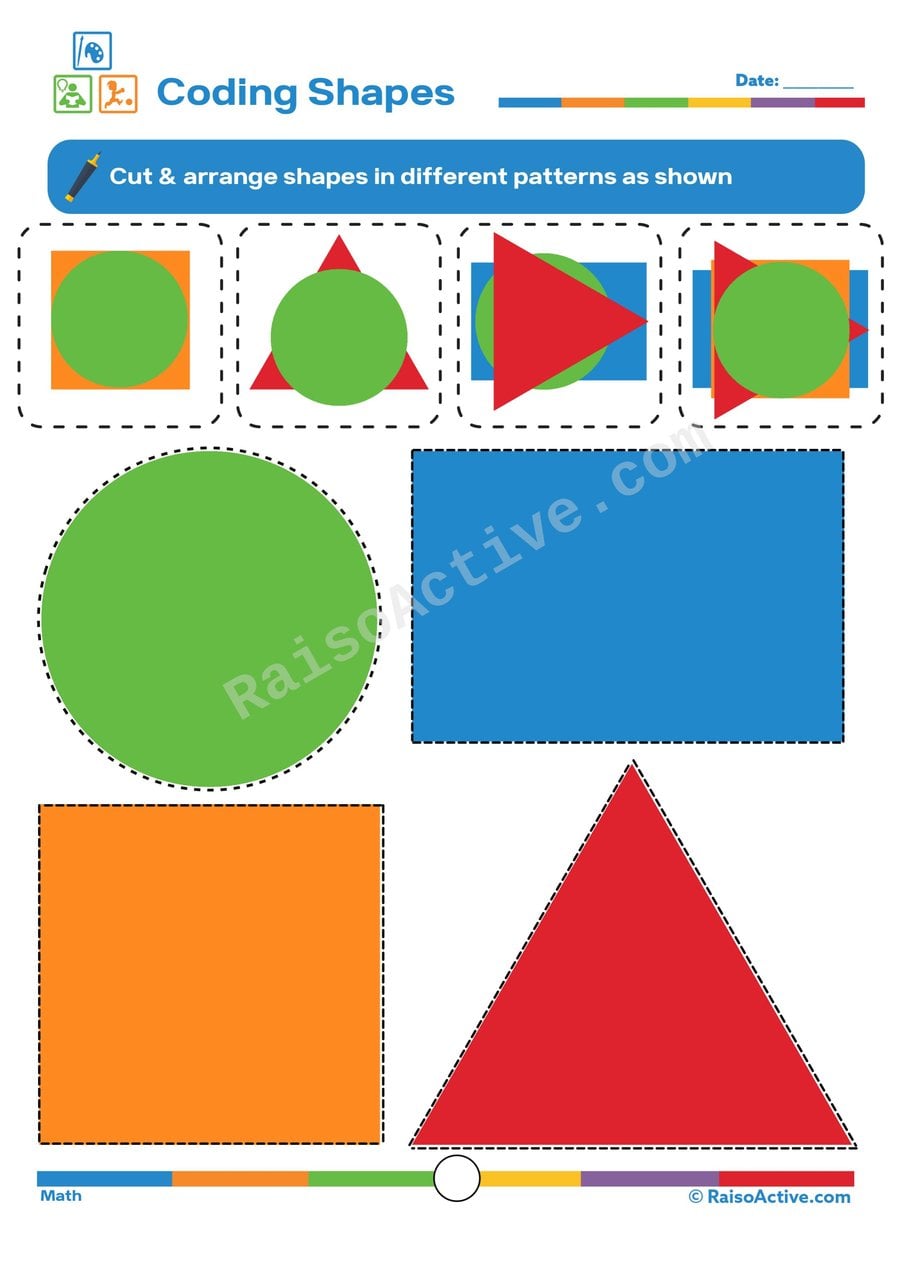
Coding Shapes Worksheet: Cut and Arrange Shapes!
This cut-and-paste worksheet has children ages 3-5 recreate example shape sequences by cutting out individual pieces and arranging them to match, combining shape recognition with the ordered, step-by-step thinking used in early coding and pattern logic. The physical act of cutting and precisely placing each piece also strengthens fine motor control and spatial planning.
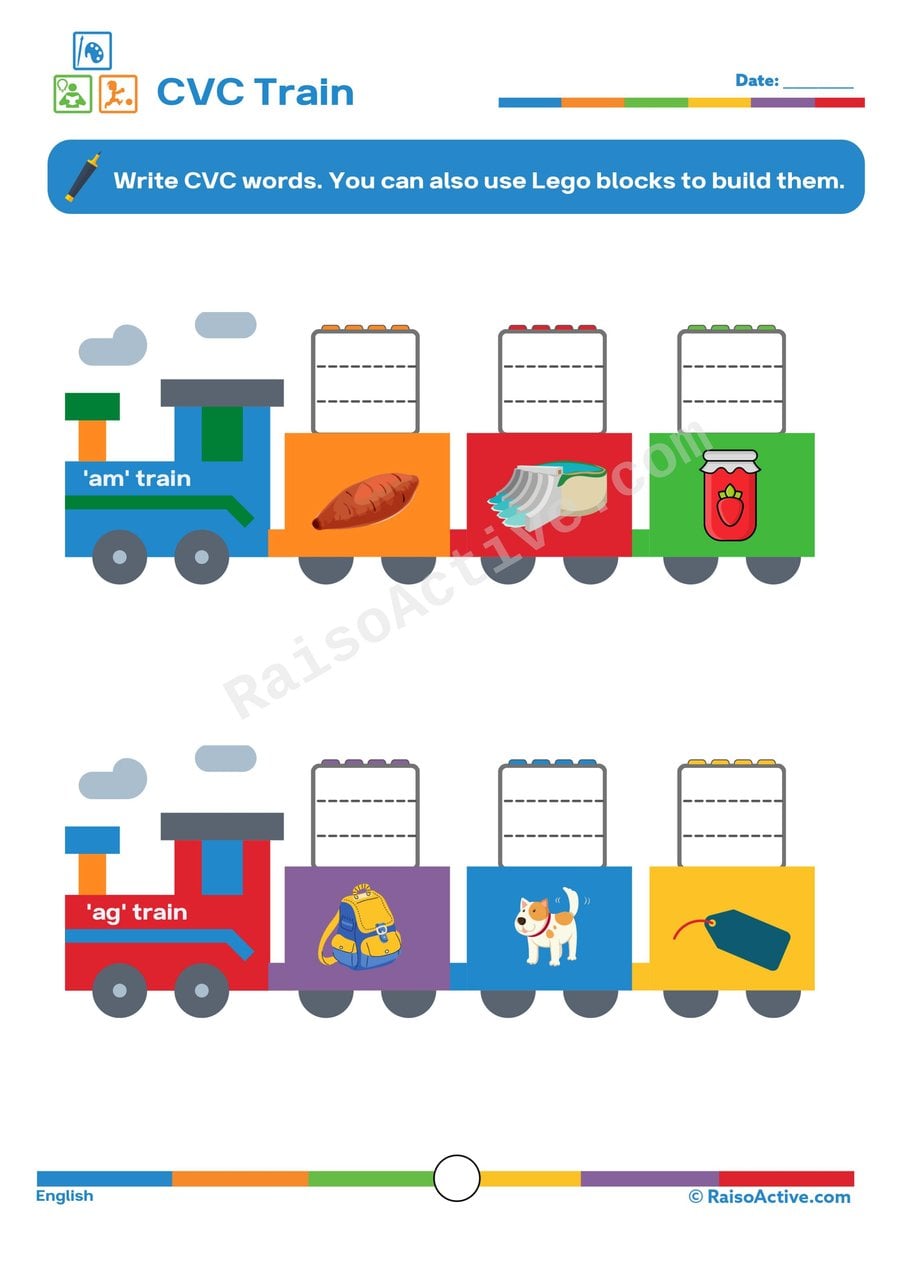
CVC Train Worksheet: Write CVC Words!
Writing consonant-vowel-consonant words like 'cat,' 'sun,' or 'pig' under matching pictures gives children ages 4-6 direct practice with letter-sound blending, a core phonics skill that underpins independent reading. Because each train car pairs a picture clue with a blank space, children also practice translating a spoken word they can sound out into its correctly spelled written form.

Coding Shapes Worksheet for Preschoolers: Cut and Paste Patterns
This cut-and-paste activity has children ages 3-5 recreate shape sequences shown in sample boxes, combining shape recognition with the same ordered, step-by-step thinking used in beginner coding concepts. Cutting out individual shapes and arranging them in the correct sequence also builds fine motor precision and spatial planning.

Christmas Cut and Paste Worksheet for Preschoolers
Cutting out a moon, snowman, gifts, and trees and arranging them inside a circle builds scissor precision and compositional thinking in children ages 3-5. Because there's no single 'correct' layout, children also practice early creative decision-making — choosing where each element belongs within a bordered space, which supports spatial awareness.
Guides for this topic
How to Teach CVC Blending: A Step-by-Step Method That Works in Two Weeks
A step-by-step method for teaching CVC blending, covering continuous sounds, word families, common errors, and a 14-day plan that most children finish reading CVC words.
Phase 2 Phonics at Home: Sound Order, Blending Games, Worksheets
Phase 2 phonics at home: the five sound sets in order, oral blending, tricky words, a two-week routine, common mistakes, and free worksheets.
Reception Year Explained: EYFS Learning and How to Help at Home
A teacher's plain-English guide to the Reception Year: the seven areas of learning, Early Learning Goals, Phase 2/3 phonics, the RBA and home routines.
Reviews
Every worksheet for ages 4–5, no watermark
Members download the full library of 1,000+ worksheets and every activity pack without watermarks or daily limits. One year costs ₹1,000 in India or $20 elsewhere.
See membership plansOr download any worksheet free with a watermark (5 a day).