Trace the Paths: A Fun Path Tracing Worksheet for Preschoolers!
This worksheet develops fine motor control and hand-eye coordination as children ages 3-5 trace a variety of dotted paths from a starting point to an end point, an essential pre-writing skill that builds the pencil control needed for forming letters. Following a winding line with steady pressure also strengthens visual tracking, which supports reading readiness.
Part of the pack
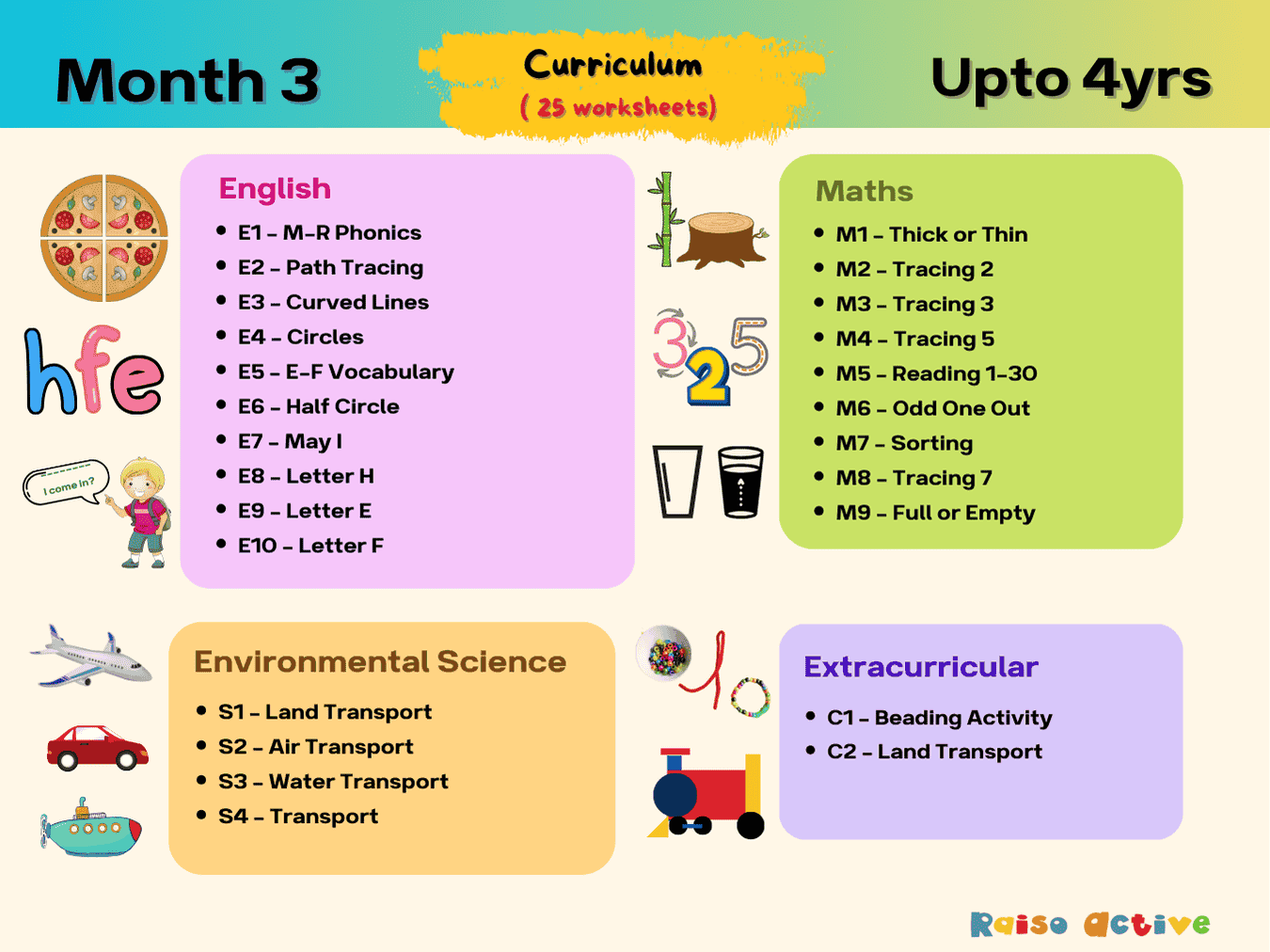
Month 3: Learning & Development | Ages Up to 4
This is page 5 of the pack. Ages 3-4 · PreschoolAges 3-4 · NurseryAges 3-4
Made for your child
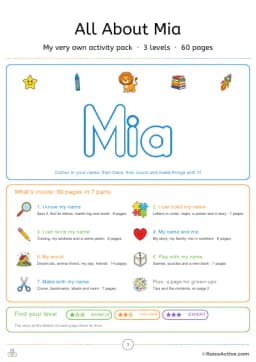
A whole activity pack made with their name
60 pages to spot, build, trace and write their own name, plus pages about their favourites, feelings and family. See a free preview with their name.
Make an All About Me packFree preview · free for members
Or start free: a name tracing sheet with their nameCurriculum
- Pre-Writing > Straight Lines
How to use this worksheet
Point out the starting point and ending point of the first path together. Have your child place their pencil on the starting dot and slowly trace along the dotted line, staying as close to the path as possible. Encourage them to keep their eyes on the line ahead rather than the pencil tip. Move to the next path once the first is complete, taking a short break between paths if their hand gets tired.
Materials needed
- Pencil
- Coloring Pencils or Crayons
Extension activities
- 1Have your child draw their own winding path on blank paper for you to trace.
- 2Use different colored pencils for each path to make tracing more engaging.
- 3Encourage your child to describe what they imagine is at the end of each path.
- 4Practice tracing large paths in the air with a finger before using a pencil on paper.

Written by
Hemsweta Jain · Teacher Cheena
MBA and Early Childhood Educator, teaching since 2014 · Founder of RaisoActive, Mumbai
Every RaisoActive worksheet is designed and checked by the founder before publishing.
Published · Last reviewed
More from Month 3: Learning & Development | Ages Up to 4

Letter E Tracing Worksheet for Preschoolers: Learn to Write!
Ages 3-5 · Preschool–Pre-KAges 3-5 · Nursery–ReceptionAges 3-5 · Nursery–LKGAges 3-5
Children ages 3-5 use this worksheet to build the specific motor pattern for capital E — three horizontal strokes branching off one vertical line — while reinforcing the /e/ sound through picture recognition. Repeated tracing in a dashed-box format also trains children to keep letters a consistent size, an important pre-writing skill before they move to unlined paper.
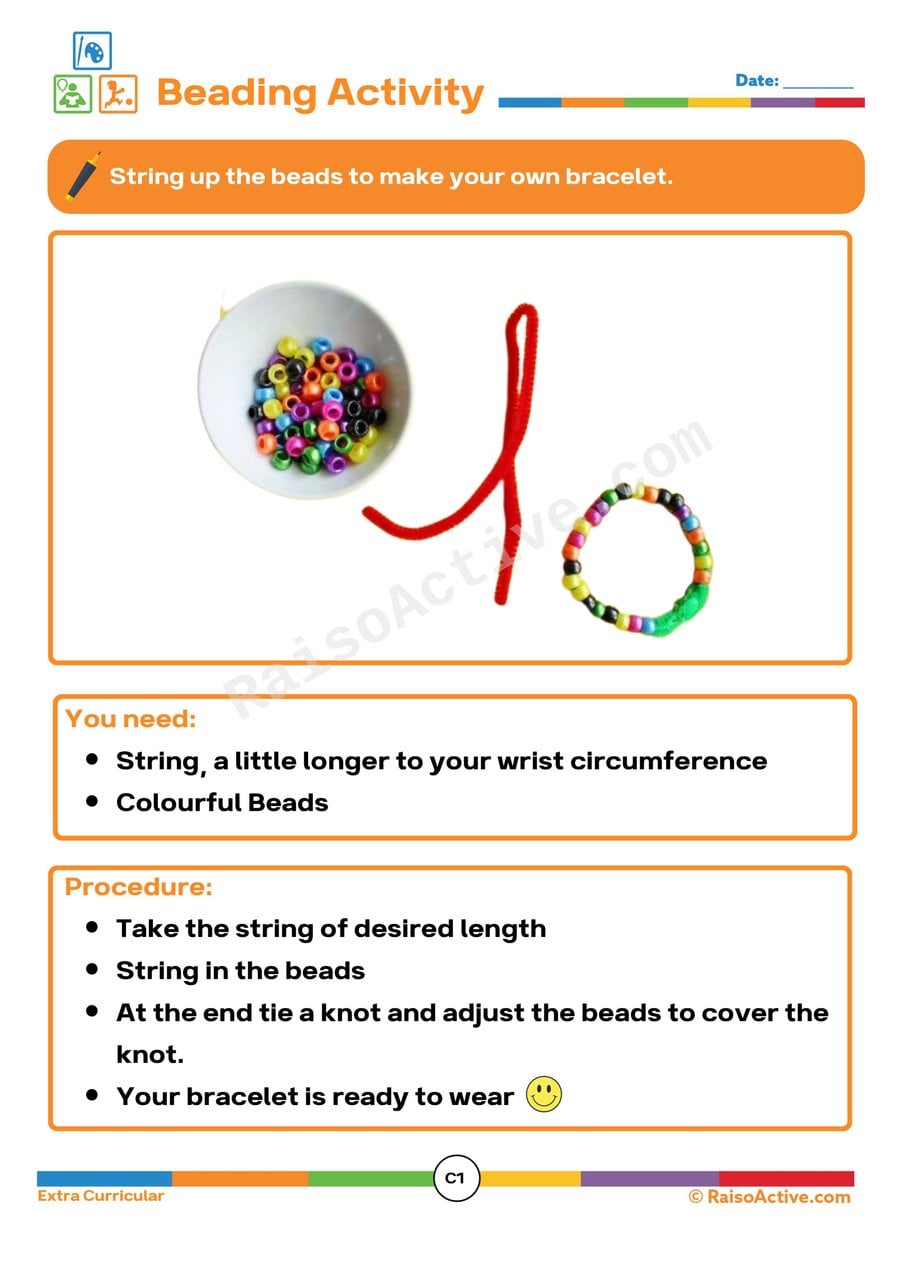
Beading Fun: Make Your Own Bracelet Worksheet
Ages 3-5 · Preschool–Pre-KAges 3-5 · Nursery–ReceptionAges 3-5 · Nursery–LKGAges 3-5
This beading craft has children ages 3-5 string beads onto a cord and tie it off to make a wearable bracelet, building bilateral coordination as one hand holds the string steady while the other threads beads — a genuinely demanding fine motor task at this age. Completing a sequence of small, repeated actions toward a finished, wearable product also builds patience and a sense of accomplishment.

Transport Cut and Paste Worksheet for Preschoolers
Ages 3-5 · Preschool–Pre-KAges 3-5 · Nursery–ReceptionAges 3-5 · Nursery–LKGAges 3-5
This cut-and-paste worksheet asks children ages 3-5 to sort vehicle pictures into air, water, and land categories, building classification skills alongside scissor control and glue placement. Sorting by transport type is an early exercise in the broader thinking skill of grouping objects by a shared property, which underlies later science and math reasoning.
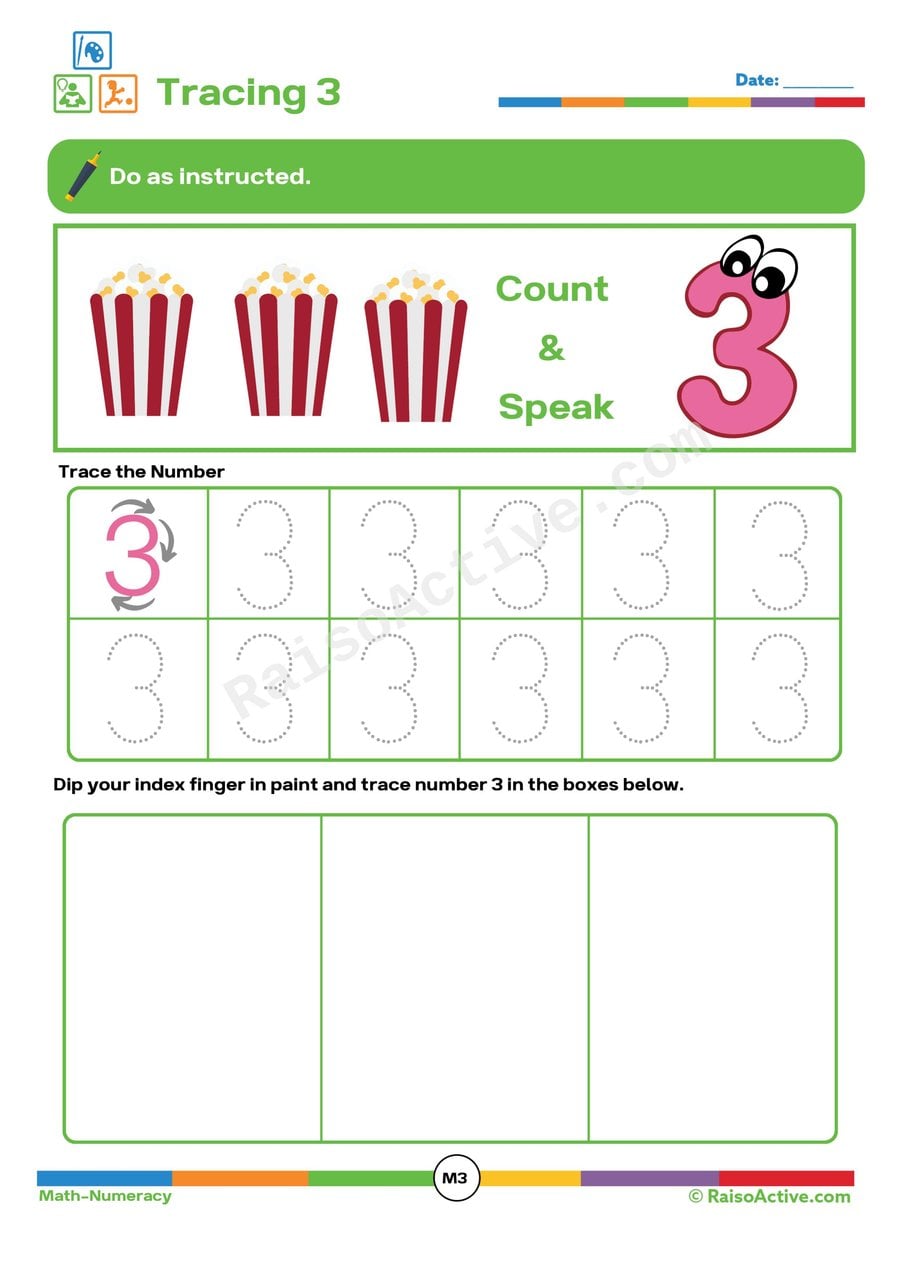
Tracing the Number 3 Worksheet for Preschoolers
Ages 3-5 · Preschool–Pre-KAges 3-5 · Nursery–ReceptionAges 3-5 · Nursery–LKGAges 3-5
This worksheet gives children ages 3-5 repeated practice forming the numeral 3, first with a pencil and then with a fingerpaint-dipped finger, using the curved double-bump stroke that makes 3 tricky for many young writers. Practicing the same numeral through two different tactile methods — pencil and paint — reinforces the motor memory of the shape through varied sensory experience.
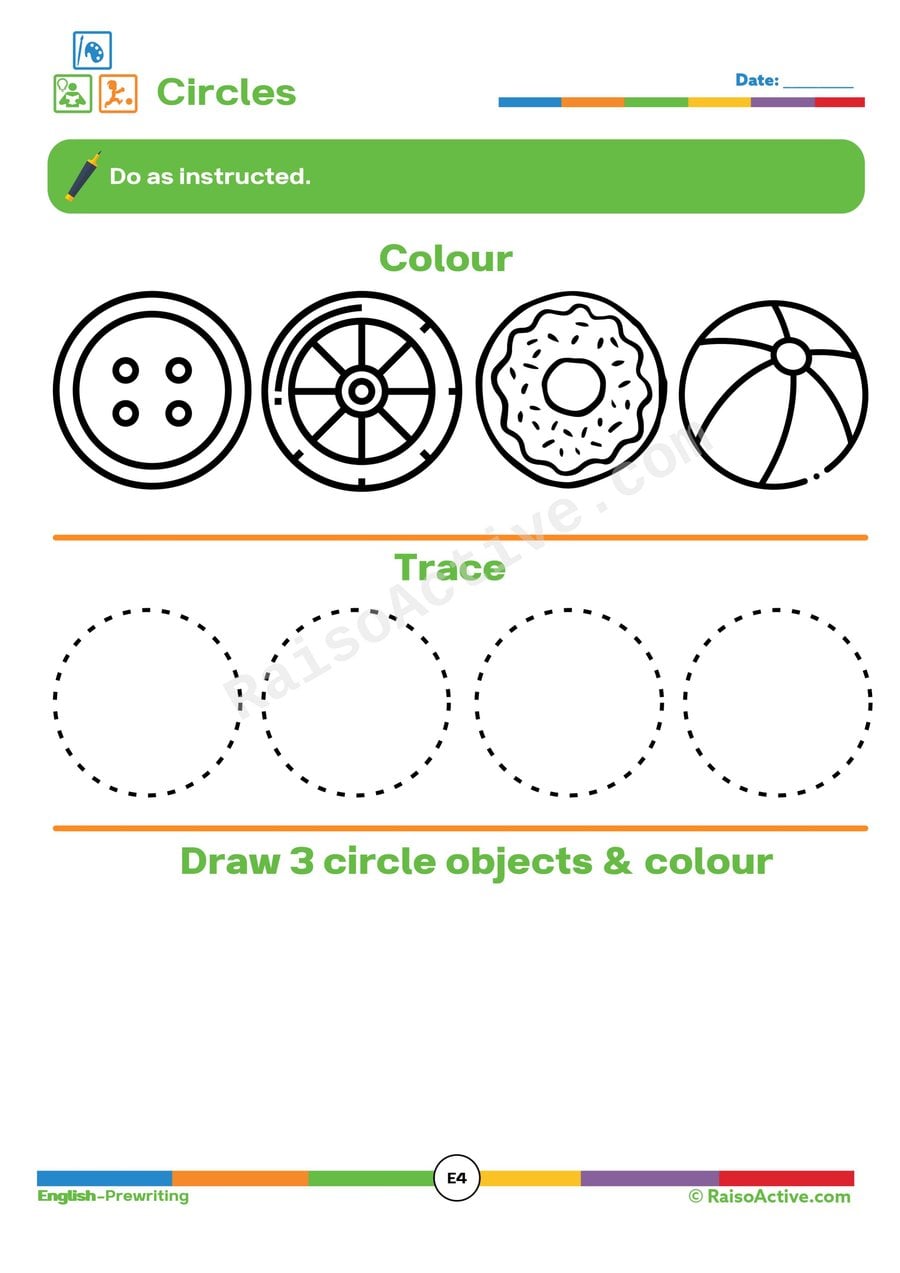
Circle Shapes Worksheet: Trace, Color, and Draw!
Ages 3-5 · Preschool–Pre-KAges 3-5 · Nursery–ReceptionAges 3-5 · Nursery–LKGAges 3-5
This worksheet builds shape recognition and drawing skills as children ages 3-5 trace dotted circles, color pictures of circular objects, and then draw three circle-shaped objects entirely on their own. Moving from tracing to independent drawing tracks a real developmental progression — first following a guide, then applying the shape from memory — which builds true shape mastery rather than just copying.
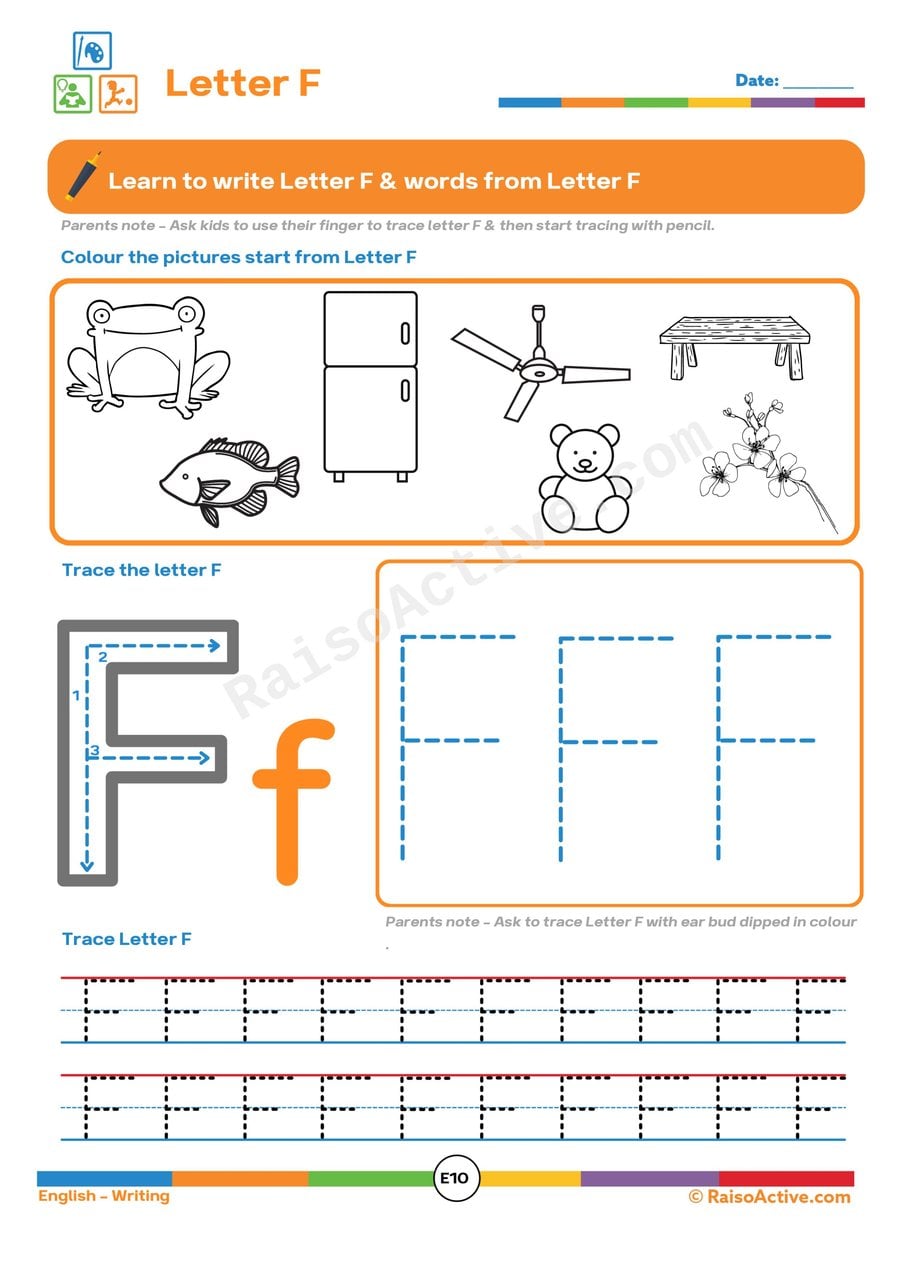
Letter F Worksheet: Trace, Color, and Learn!
Ages 3-5 · Preschool–Pre-KAges 3-5 · Nursery–ReceptionAges 3-5 · Nursery–LKGAges 3-5
This worksheet builds children's ability to reproduce capital F — a vertical line with two horizontal branches — through repeated tracing, while the matching coloring activity trains them to connect the letter shape to its beginning sound in real words. For 3-5 year olds, this dual practice of motor formation plus sound recognition is exactly the combination that prepares a child to write and read independently.

Full and Empty Worksheet: Matching Activity for Preschoolers
Ages 3-5 · Preschool–Pre-KAges 3-5 · Nursery–ReceptionAges 3-5 · Nursery–LKGAges 3-5
This matching worksheet has children ages 3-5 draw lines connecting pictures to the labels 'Full' or 'Empty,' building comparative vocabulary around volume and quantity that goes beyond counting into descriptive reasoning about how much of something is present. Understanding full and empty as opposites is an early step toward later concepts like more, less, and measurement.

Dot-to-Dot Snail Worksheet: Counting Numbers 1-30!
Ages 3-5 · Preschool–Pre-KAges 3-5 · Nursery–ReceptionAges 3-5 · Nursery–LKGAges 3-5
This dot-to-dot worksheet challenges children ages 3-5 to count and connect numbers from 1 to 30 in sequence, extending their number-order knowledge well past the more common 1-10 range while also building fine motor control as they draw connecting lines. Successfully completing a longer sequence like this gives children a real sense of accomplishment tied directly to numeracy.
Related worksheets
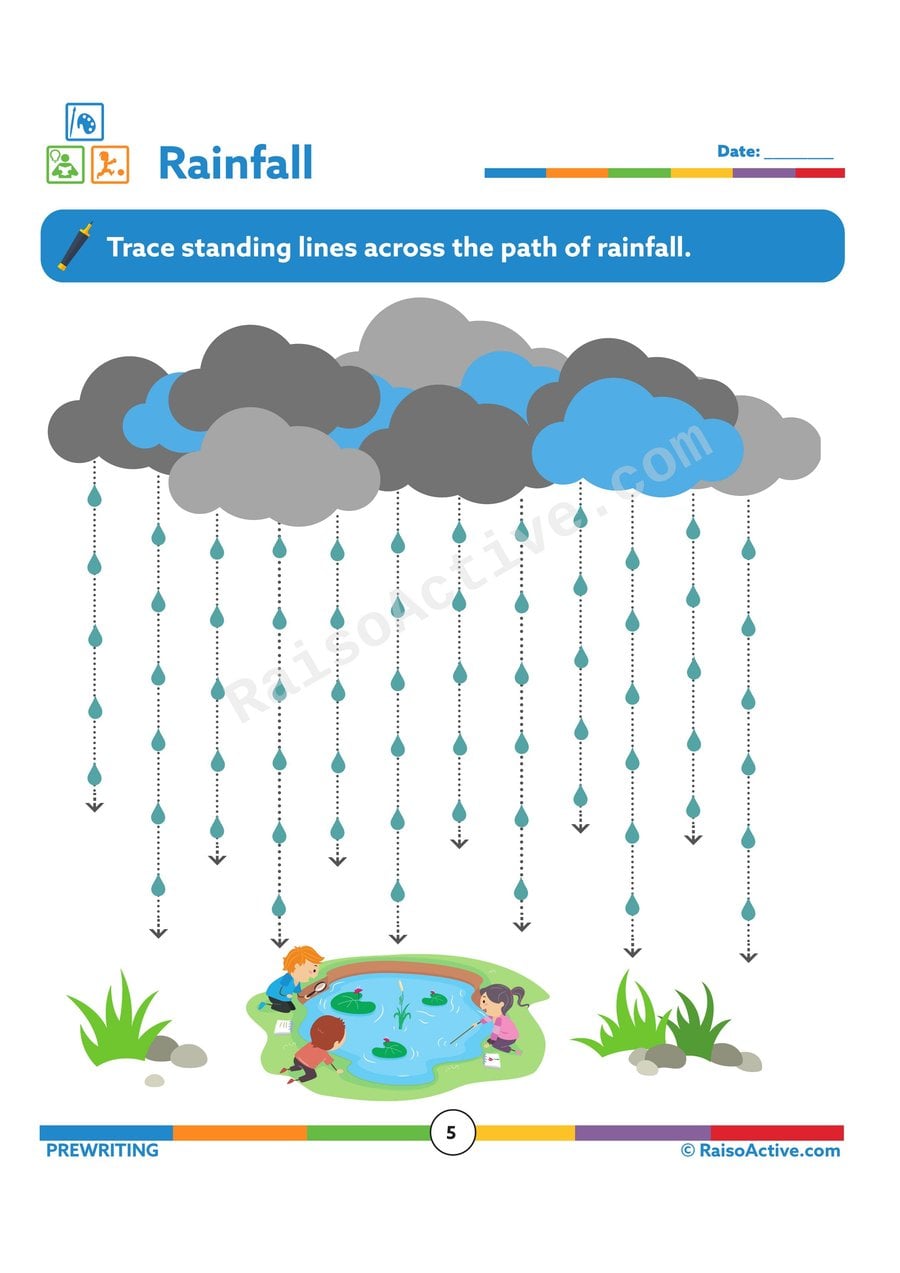
Rainfall Tracing Worksheet for Preschoolers
Ages 3-5 · Preschool–Pre-KAges 3-5 · Nursery–ReceptionAges 3-5 · Nursery–LKGAges 3-5
Tracing straight vertical lines representing falling rain gives children ages 3-5 focused practice with the simple top-to-bottom pencil stroke that forms the basis of letters like l, i, and t. Repeating this single motion across several rain lines on one page builds consistency, helping a child produce evenly spaced, similarly sized strokes rather than lines that vary wildly in length and direction.

Join the Dots: Standing Lines Worksheet for Preschoolers
Ages 3-5 · Preschool–Pre-KAges 3-5 · Nursery–ReceptionAges 3-5 · Nursery–LKGAges 3-5
This dot-to-dot worksheet asks children ages 3-5 to connect dots forming vertical lines, sometimes called 'standing lines' because they stand upright, building the bottom-to-top or top-to-bottom pencil control needed for letters like l, t, and i. Connecting dots precisely, rather than simply tracing a continuous line, adds an extra layer of accuracy practice on top of the basic straight-line motion.

Join the Dots: Sleeping Lines Worksheet for Preschoolers
Ages 3-5 · Preschool–Pre-KAges 3-5 · Nursery–ReceptionAges 3-5 · Nursery–LKGAges 3-5
This dot-to-dot worksheet has children ages 3-5 connect dots to form horizontal lines, sometimes called 'sleeping lines' because they lie flat rather than standing upright, building the left-to-right pencil motion that also mirrors the direction of reading and writing English text. Dot-to-dot tracing adds an extra layer of precision beyond simple line tracing, since the child has to land exactly on each dot rather than following a continuous guide.

Climb the Ladder: Pre-Writing Practice Worksheet for Kids
Ages 3-5 · Preschool–Pre-KAges 3-5 · Nursery–ReceptionAges 3-5 · Nursery–LKGAges 3-5
Tracing the rungs of a ladder gives children ages 3-5 focused practice with horizontal and vertical straight lines, the two most basic pencil strokes and the building blocks for letters like L, T, E, F, and H. Because a ladder has repeated, evenly spaced rungs, this worksheet also builds a sense of rhythm and spacing that carries over into writing letters at a consistent size later on.

Trace the Numbers 1-9 Worksheet for Preschoolers
Ages 3-5 · Preschool–Pre-KAges 3-5 · Nursery–ReceptionAges 3-5 · Nursery–LKGAges 3-5
Tracing the numerals 1 through 9 gives children ages 3-5 repeated, guided practice with the specific pencil strokes each number requires, building the fine motor control and muscle memory needed for independent number writing. Because tracing follows a fixed, correct path, it also reinforces accurate numeral recognition, helping children tell visually similar digits apart.
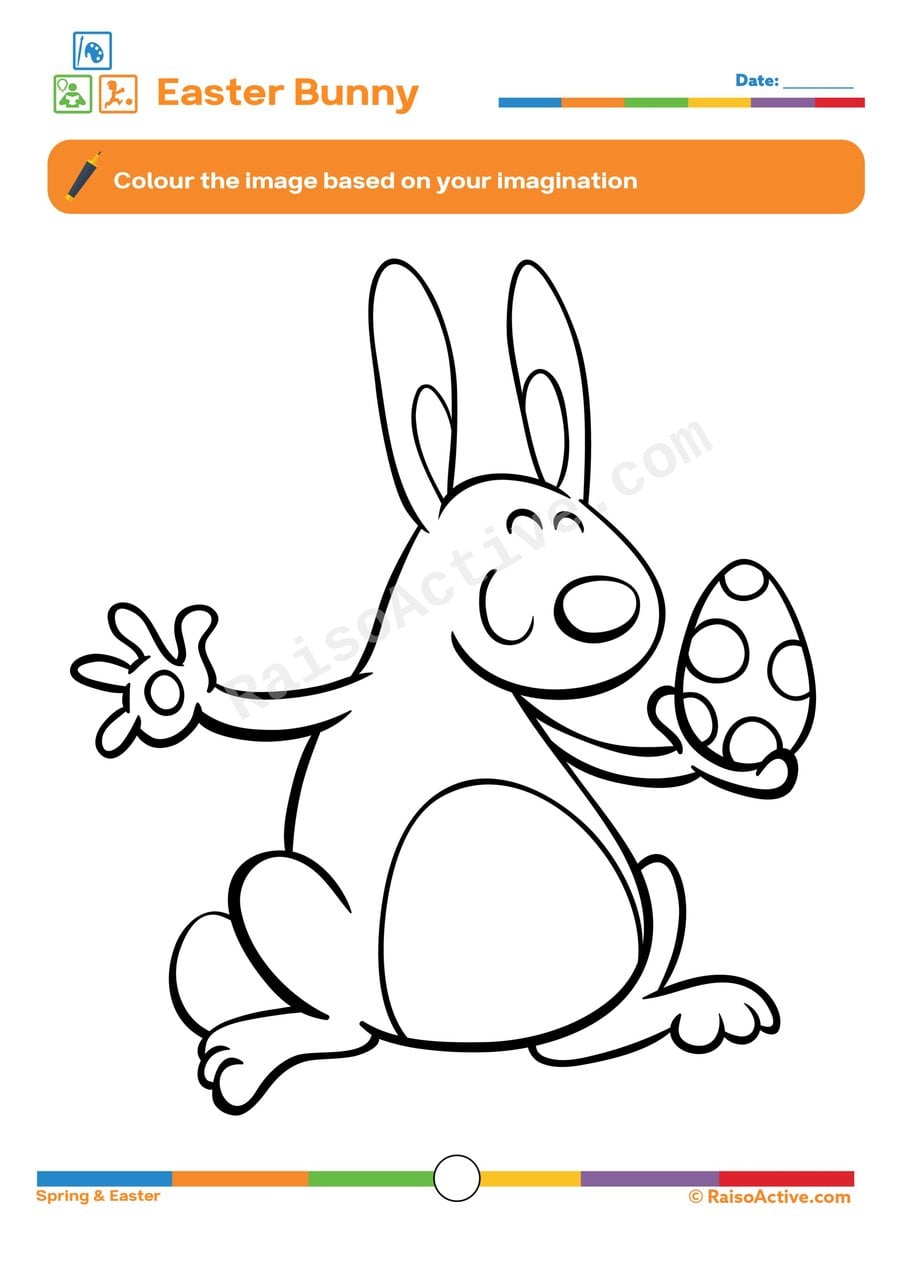
Easter Bunny Coloring Worksheet for Kids
Ages 3-5 · Preschool–Pre-KAges 3-5 · Nursery–ReceptionAges 3-5 · Nursery–LKGAges 3-5
Children ages 3-5 build fine motor control and creative expression while coloring an Easter bunny and egg using crayons or colored pencils. Open-ended coloring tasks like this one, without a strict color code, give children room to make independent choices while still practicing the pencil grip and control needed for later writing.

Gingerbread Man Coloring Worksheet for Preschoolers
Ages 3-5 · Preschool–Pre-KAges 3-5 · Nursery–ReceptionAges 3-5 · Nursery–LKGAges 3-5
This gingerbread man worksheet gives children ages 3-5 practice coloring within a simple, familiar outline while also adding their own decorative details like buttons and a bow, encouraging creative choices within a structured shape. Deciding where to place each decoration also builds early spatial awareness, since buttons and a bow need to be positioned in specific spots on the body.

Happy Easter Coloring Card Worksheet for Preschoolers
Ages 3-5 · Preschool–Pre-KAges 3-5 · Nursery–ReceptionAges 3-5 · Nursery–LKGAges 3-5
Coloring the Easter egg and bunny images on this fold-into-a-card worksheet gives children ages 3-5 practice with controlled crayon strokes and color choice, while the act of turning their artwork into a card for someone else introduces an early sense of purpose and gift-giving. Because the finished piece becomes a keepsake rather than just a worksheet, children also build pride and motivation to complete their coloring carefully. This blends fine motor practice with a first taste of creating something meaningful for another person.
Guides for this topic

Activities That Help with Pencil Grip Development: A Complete Guide for Parents and Teachers
Discover fun, research-backed activities to develop pencil grip in young children. Age-wise exercises, play ideas, and expert tips for parents and teachers.
My Child Can't Trace Dotted Lines — What Activities Can Help? A Complete Guide to Pre-Writing Skills
Struggling to trace dotted lines? Learn why tracing is hard for young children, which skills must come first, and the best activities to build pre-writing readiness.

What's the Right Age for My Child to Start Writing? A Developmental Guide for Parents
Discover the right age for children to start writing, developmental milestones from scribbling to letters, and why rushing can backfire — with activities that help.
Reviews
Every worksheet for ages 3–5, no watermark
Members download the full library of 1,000+ worksheets and every activity pack without watermarks or daily limits. One year costs ₹999 in India or $20 elsewhere.
See membership plansOr download any worksheet free with a watermark (5 a day).