Join the Dots: Sleeping Lines Worksheet for Preschoolers
This dot-to-dot worksheet has children ages 3-5 connect dots to form horizontal lines, sometimes called 'sleeping lines' because they lie flat rather than standing upright, building the left-to-right pencil motion that also mirrors the direction of reading and writing English text. Dot-to-dot tracing adds an extra layer of precision beyond simple line tracing, since the child has to land exactly on each dot rather than following a continuous guide.
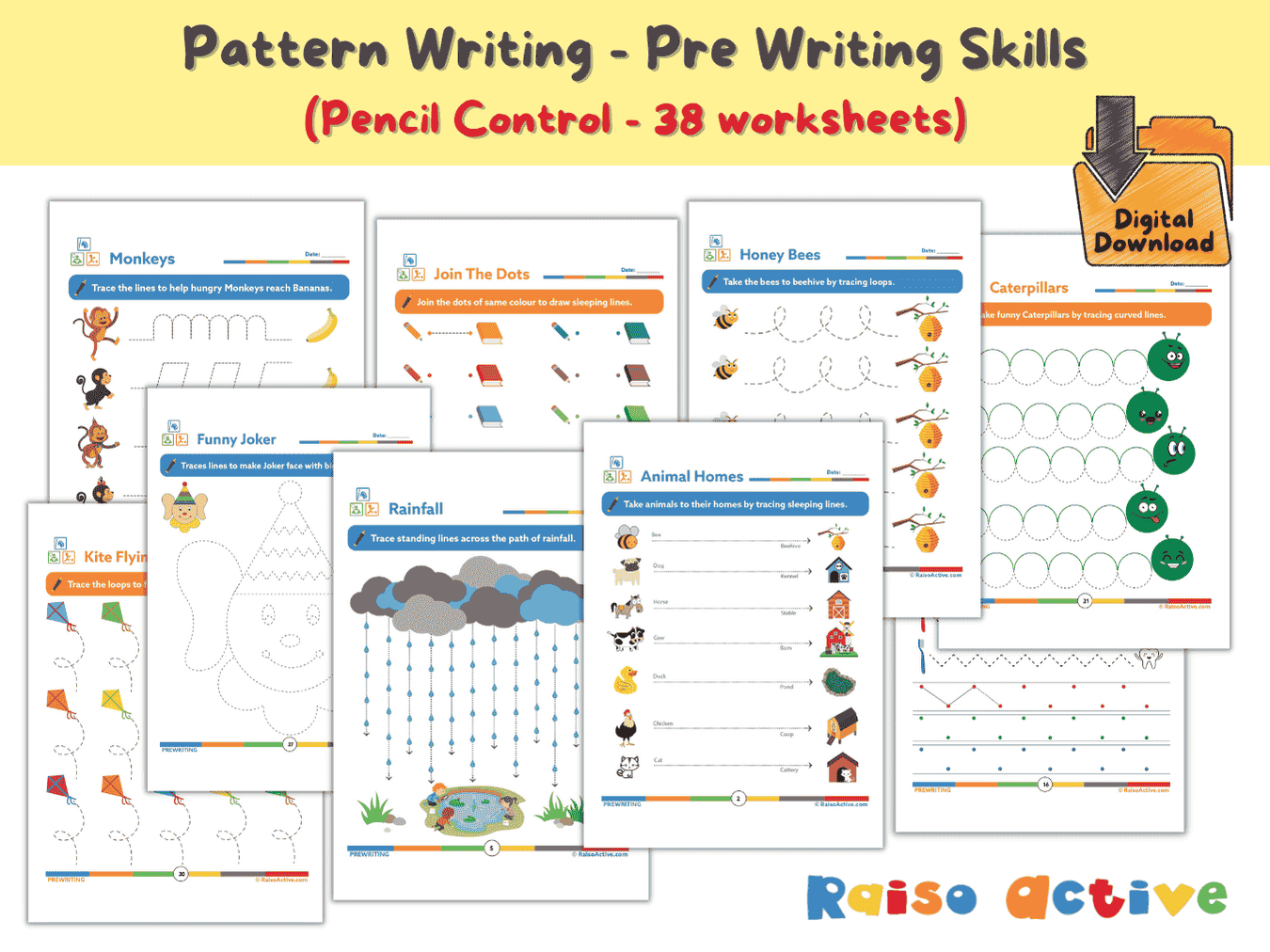
Part of the pack
Pattern Writing Pre-writing Skills Activity Book for 3-4 Year Olds
This is page 8 of the pack. Ages 3-4 · PreschoolAges 3-4 · NurseryAges 3-4
Made for your child
A whole activity pack made with their name
60 pages to spot, build, trace and write their own name, plus pages about their favourites, feelings and family. See a free preview with their name.
Make an All About Me packFree preview · free for members
Or start free: a name tracing sheet with their nameCurriculum
- Pre-Writing > Straight Lines
How to use this worksheet
Point out that the dots form a straight line lying down, like someone sleeping, rather than standing up. Have your child connect each dot in order with a pencil, moving from left to right and stopping precisely at each one before continuing. Encourage a steady pace rather than rushing between dots, since accuracy matters more than speed here. Color the finished picture once every sleeping line is connected.
Materials needed
- Pencil
- Crayons
Extension activities
- 1Lie down flat on the floor together to physically demonstrate what a 'sleeping line' looks like with your body.
- 2Look around the house for horizontal lines, like a tabletop edge, a shelf, or the spine of a book lying flat.
- 3Practice connecting dots with sidewalk chalk outside on a larger scale.
- 4Paint horizontal stripes on paper using a ruler or straight edge as a guide.
- 5Sort pictures of lines into 'sleeping' (horizontal) and 'standing' (vertical) groups.

Written by
Hemsweta Jain · Teacher Cheena
MBA and Early Childhood Educator, teaching since 2014 · Founder of RaisoActive, Mumbai
Every RaisoActive worksheet is designed and checked by the founder before publishing.
Published · Last reviewed
More from Pattern Writing Pre-writing Skills Activity Book for 3-4 Year Olds
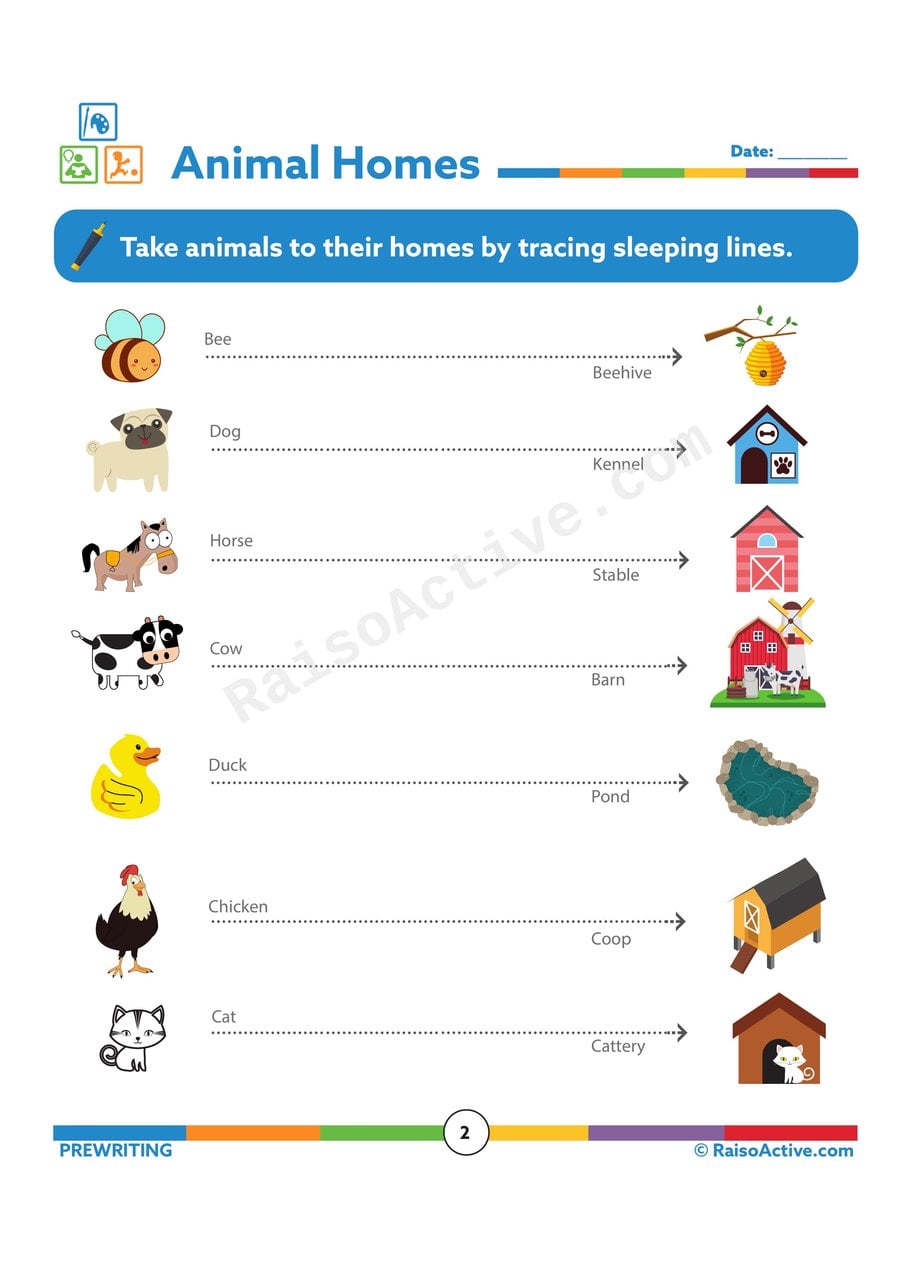
Animal Homes Tracing Worksheet for Preschoolers
Ages 3-5 · Preschool–Pre-KAges 3-5 · Nursery–ReceptionAges 3-5 · Nursery–LKGAges 3-5
Tracing a line from each animal to its home helps children ages 3-5 build pencil control while also introducing an early science concept: that different animals live in different kinds of homes, like a bird's nest or a dog's kennel. Saying the animal and its home aloud while tracing connects the physical tracing motion to new vocabulary, reinforcing both skills at once.

Trace and Color the Funny Joker Face Worksheet for Preschoolers
Ages 3-5 · Preschool–Pre-KAges 3-5 · Nursery–ReceptionAges 3-5 · Nursery–LKGAges 3-5
Tracing the curved and circular shapes that make up a funny, exaggerated face gives children ages 3-5 practice with rounded strokes while the silly theme, a joker or clown face, adds humor that tends to boost engagement on what could otherwise feel like a repetitive shape-tracing task. Placing and tracing multiple facial features also reinforces facial feature vocabulary and proportion, similar to other face-based worksheets but with a playful, exaggerated twist.

Pre-Writing Skills Practice Worksheet for Preschoolers
Ages 3-5 · Preschool–Pre-KAges 3-5 · Nursery–ReceptionAges 3-5 · Nursery–LKGAges 3-5
This general pre-writing practice worksheet has children ages 3-5 work through a mix of stroke types, likely lines, curves, and simple shapes, in one sitting, giving a broad review of the foundational motions used across nearly all letters and numbers. Practicing several different stroke types together, rather than focusing on just one, helps consolidate pre-writing readiness as a whole rather than skill by skill.

Join the Dots: Standing Lines Worksheet for Preschoolers
Ages 3-5 · Preschool–Pre-KAges 3-5 · Nursery–ReceptionAges 3-5 · Nursery–LKGAges 3-5
This dot-to-dot worksheet asks children ages 3-5 to connect dots forming vertical lines, sometimes called 'standing lines' because they stand upright, building the bottom-to-top or top-to-bottom pencil control needed for letters like l, t, and i. Connecting dots precisely, rather than simply tracing a continuous line, adds an extra layer of accuracy practice on top of the basic straight-line motion.

Trace the Funny Caterpillars Worksheet for Preschoolers
Ages 3-5 · Preschool–Pre-KAges 3-5 · Nursery–ReceptionAges 3-5 · Nursery–LKGAges 3-5
Tracing the rounded segments that make up each caterpillar's body helps children ages 3-5 practice circular and curved pencil strokes while also reinforcing shape recognition, since each segment is essentially a circle or oval joined to the next. This combination of shape tracing and sequencing, moving from one segment to the next in order, builds the same left-to-right, in-order habits that later support reading and writing.

Pattern Writing Pre-writing Skills Activity Book for 3-4 Year Olds - Page 40
Ages 3-4 · PreschoolAges 3-4 · NurseryAges 3-4
As one of the later pages in the pre-writing patterns activity book, this page asks 3-4 year olds to apply everything practiced on earlier pages, steady pressure, consistent spacing, and accurate prediction, to a pattern that combines skills built up gradually through the book. Reaching this stage of the book is itself a marker of growing stamina, since completing a full row of repeated strokes reliably takes more sustained focus than the simpler early pages required.

Trace the Train Engine Worksheet for Preschoolers
Ages 3-5 · Preschool–Pre-KAges 3-5 · Nursery–ReceptionAges 3-5 · Nursery–LKGAges 3-5
Tracing the shapes that make up a train engine, like rectangles for the body and circles for the wheels, gives children ages 3-5 practice with mixed straight and curved strokes while reinforcing the idea that complex objects are built from combinations of simple shapes. The train theme also introduces sequencing awareness, since trains are made of connected cars that follow one after another along a track.

Shape Tracing Fun: Trace & Color the Shapes Worksheet for Preschoolers!
Ages 3-5 · Preschool–Pre-KAges 3-5 · Nursery–ReceptionAges 3-5 · Nursery–LKGAges 3-5
Tracing and coloring several different shapes on one page gives children ages 3-5 practice switching between distinct stroke patterns, since a circle requires a continuous curved motion while a square or triangle requires straight lines and sharp corners. Naming each shape while tracing it also reinforces shape vocabulary alongside the physical practice, connecting the word to the motion that draws it.
Related worksheets

Trace the Paths: A Fun Path Tracing Worksheet for Preschoolers!
Ages 3-5 · Preschool–Pre-KAges 3-5 · Nursery–ReceptionAges 3-5 · Nursery–LKGAges 3-5
This worksheet develops fine motor control and hand-eye coordination as children ages 3-5 trace a variety of dotted paths from a starting point to an end point, an essential pre-writing skill that builds the pencil control needed for forming letters. Following a winding line with steady pressure also strengthens visual tracking, which supports reading readiness.
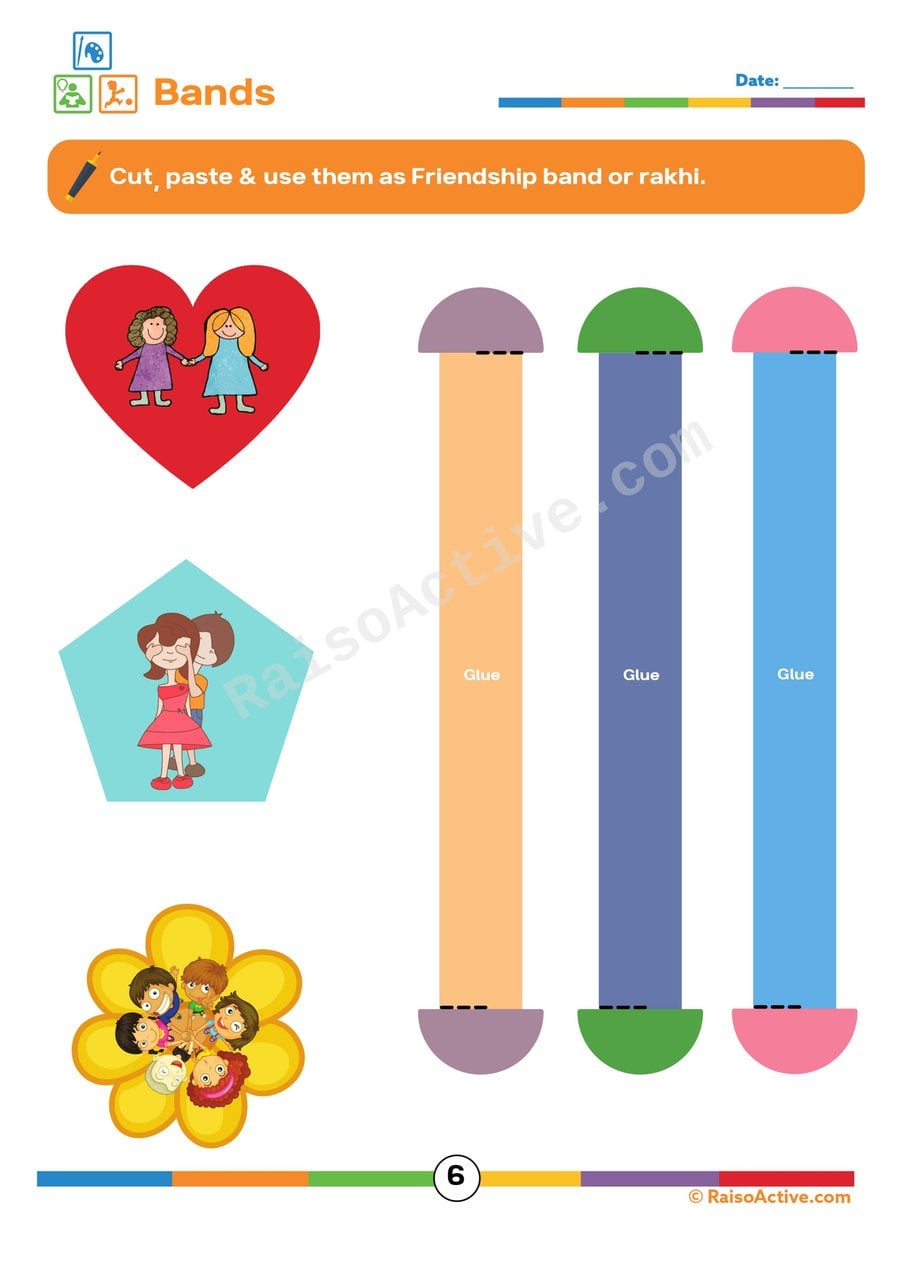
Friendship Band Craft: Cut, Paste, and Create!
Ages 3-5 · Preschool–Pre-KAges 3-5 · Nursery–ReceptionAges 3-5 · Nursery–LKGAges 3-5
This worksheet gives children ages 3-5 additional practice with scissor control and sequential assembly as they cut, join, and decorate their own friendship band or rakhi. Repeating a craft with a new set of shapes reinforces the multi-step process of cutting, arranging, and gluing until it becomes a comfortable, repeatable routine.

Letter E Tracing and Coloring Worksheet for Preschoolers
Ages 3-5 · Preschool–Pre-KAges 3-5 · Nursery–ReceptionAges 3-5 · Nursery–LKGAges 3-5
This tracing and coloring worksheet teaches children ages 3-5 to recognize and write both the uppercase and lowercase letter E, while also identifying pictures of objects that begin with that letter's sound. Practicing a letter in both its capital and lowercase forms helps children see that they represent the same sound despite looking different, an important early literacy concept. Circling matching pictures alongside the tracing also connects the visual letter shape to its corresponding beginning sound in spoken words.

Learn the Sight Word 'My' - Tracing, Writing, and Matching Worksheet
Ages 3-5 · Preschool–Pre-KAges 3-5 · Nursery–ReceptionAges 3-5 · Nursery–LKGAges 3-5
This worksheet builds sight-word fluency for the word 'my' in children ages 3-5 through a combination of tracing, independent writing, fill-in-the-blank sentences, and a matching activity. Working with the same word across several different formats helps cement recognition, since 'my' is a high-frequency word that appears constantly in early reading material but doesn't follow simple phonics patterns. The matching component adds a visual-recognition check to confirm the word sticks even without tracing cues.

Letter I Tracing and Coloring Worksheet for Preschoolers
Ages 3-5 · Preschool–Pre-KAges 3-5 · Nursery–ReceptionAges 3-5 · Nursery–LKGAges 3-5
This worksheet helps children ages 3-5 build fine motor skills and letter recognition by tracing both the uppercase and lowercase forms of the letter I, then applying that recognition in a coloring task and a letter-hunt word search. Practicing a short, simple letter like I builds early writing confidence, while the letter-hunt component adds a visual-scanning challenge that pushes recognition beyond just copying a shape. Coloring pictures that start with I connects the shape to its beginning sound.

Spider Count Worksheet: Finger Painting Fun for Halloween!
Ages 3-5 · Preschool–Pre-KAges 3-5 · Nursery–ReceptionAges 3-5 · Nursery–LKGAges 3-5
Dabbing fingertips or Q-tips in paint to create the exact number of spiders shown on each web gives children ages 3-5 hands-on practice with one-to-one counting while also strengthening the small hand muscles needed for pencil control later on. Because each web has a target number, children must count as they paint rather than just decorating freely, which reinforces number recognition in a playful, low-pressure way. The messy, sensory nature of finger painting also supports focus and engagement at an age when seated paper-and-pencil tasks can be hard to sustain.

Trace the Numbers 1-9 Worksheet for Preschoolers
Ages 3-5 · Preschool–Pre-KAges 3-5 · Nursery–ReceptionAges 3-5 · Nursery–LKGAges 3-5
Tracing the numerals 1 through 9 gives children ages 3-5 repeated, guided practice with the specific pencil strokes each number requires, building the fine motor control and muscle memory needed for independent number writing. Because tracing follows a fixed, correct path, it also reinforces accurate numeral recognition, helping children tell visually similar digits apart.

Decorate the Christmas Tree! Cut and Paste Worksheet
Ages 3-5 · Preschool–Pre-KAges 3-5 · Nursery–ReceptionAges 3-5 · Nursery–LKGAges 3-5
This cut-and-paste activity builds scissor control and hand strength in children ages 3-5 as they snip out ornaments, stars, and lights to decorate their own Christmas tree. Deciding where each decoration goes also develops spatial planning and following a visual guide, since children compare their tree to the sample image while placing pieces.
Guides for this topic

Pre-Writing Strokes in Order: From Standing Lines to Loops (With Printable Patterns)
The developmental order of pre-writing strokes, from vertical lines to loops, and why practicing them in sequence makes letter formation much easier to learn.

Portfolio Assessment with Young Children: A Comprehensive Guide to Meaningful Documentation
Learn how portfolio assessment captures your child's growth through meaningful documentation. Practical tips, templates, and age-appropriate strategies for ages 1-8.
What Makes a Good Worksheet vs. a Poor One: A Parent's Guide to Quality Educational Materials
Learn what separates high-quality educational worksheets from poor busy work. Discover design principles, red flags, and how to evaluate free worksheets online for your child aged 1-8.
Reviews
Every worksheet for ages 3–5, no watermark
Members download the full library of 1,000+ worksheets and every activity pack without watermarks or daily limits. One year costs ₹999 in India or $20 elsewhere.
See membership plansOr download any worksheet free with a watermark (5 a day).