Animal Homes Tracing Worksheet for Preschoolers
Tracing a line from each animal to its home helps children ages 3-5 build pencil control while also introducing an early science concept: that different animals live in different kinds of homes, like a bird's nest or a dog's kennel. Saying the animal and its home aloud while tracing connects the physical tracing motion to new vocabulary, reinforcing both skills at once.
Part of the pack
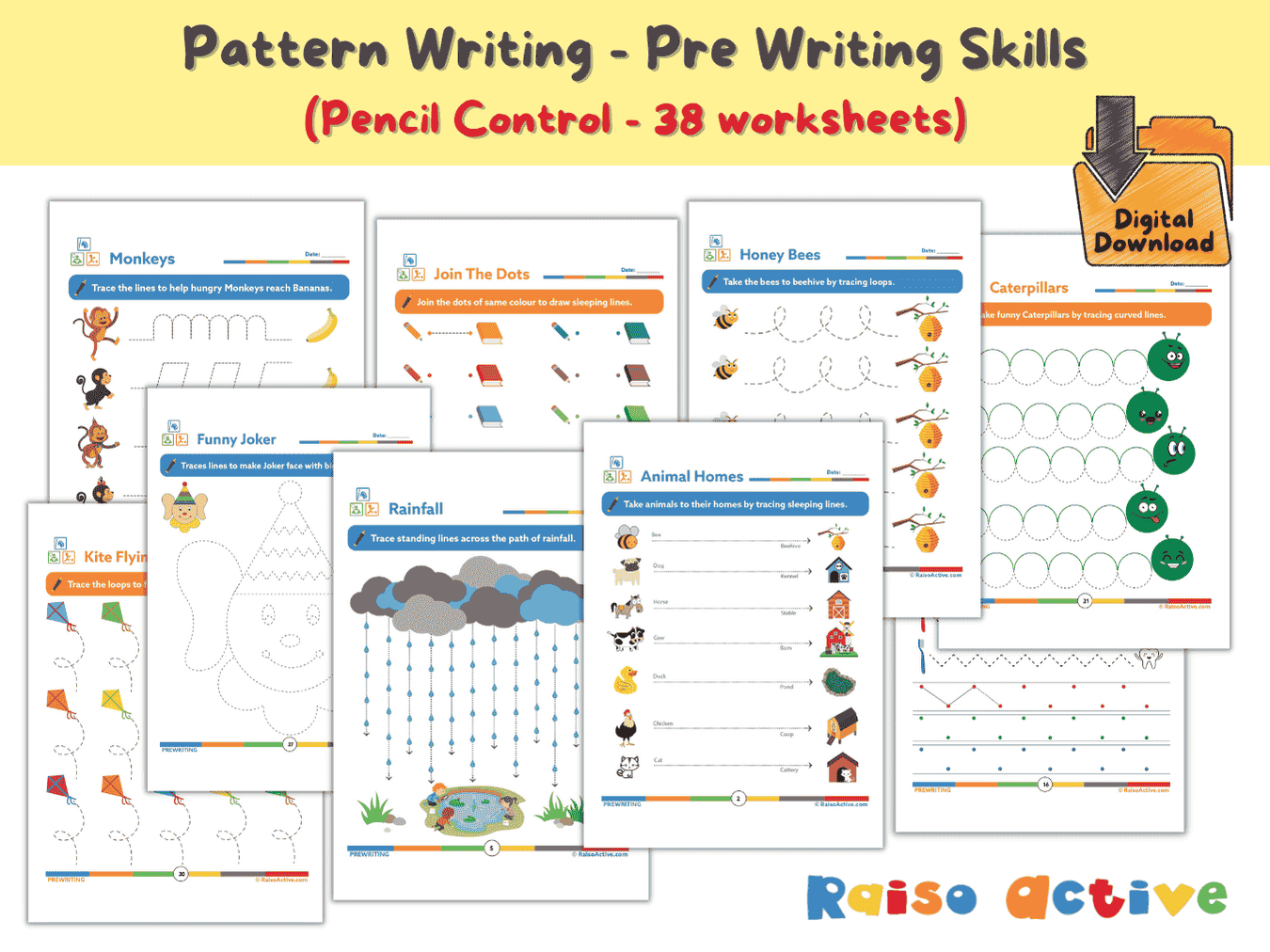
Pattern Writing Pre-writing Skills Activity Book for 3-4 Year Olds
This is page 6 of the pack. Ages 3-4 · PreschoolAges 3-4 · NurseryAges 3-4
Made for your child
A whole activity pack made with their name
60 pages to spot, build, trace and write their own name, plus pages about their favourites, feelings and family. See a free preview with their name.
Make an All About Me packFree preview · free for members
Or start free: a name tracing sheet with their nameCurriculum
- Pre-Writing > Themed Tracing
How to use this worksheet
Look at each animal on the page with your child and ask if they know where it lives before tracing. Guide their pencil along the dotted line from the animal to its matching home, saying both words out loud as they go, such as 'bird... nest.' Encourage them to trace slowly and stay on the line rather than rushing to the end. Once all the lines are traced, let them color the animals and their homes.
Materials needed
- Pencil
- Crayons
Extension activities
- 1Sort toy animals into groups based on where they would live, like a barn, a pond, or a forest.
- 2Build a simple animal home, like a nest from twigs or a den from a cardboard box.
- 3Take a nature walk and look for real animal homes, such as a bird's nest in a tree or an ant hill.
- 4Play a matching game with printed or drawn cards pairing animals to their homes.
- 5Read a book about animal habitats and ask your child to name each animal's home as it appears.

Written by
Hemsweta Jain · Teacher Cheena
MBA and Early Childhood Educator, teaching since 2014 · Founder of RaisoActive, Mumbai
Every RaisoActive worksheet is designed and checked by the founder before publishing.
Published · Last reviewed
More from Pattern Writing Pre-writing Skills Activity Book for 3-4 Year Olds
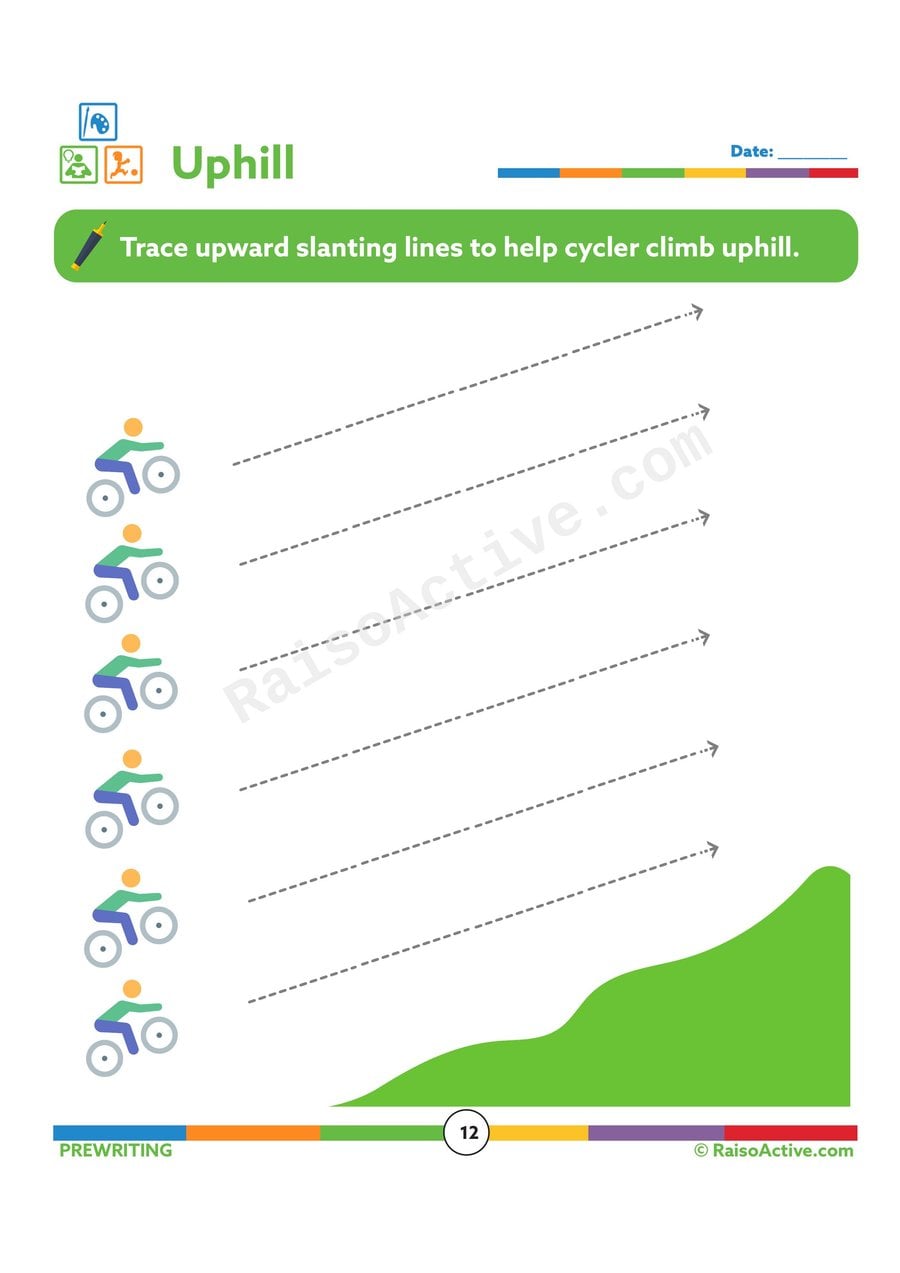
Uphill Tracing Worksheet: Help the Cyclist!
Ages 3-5 · Preschool–Pre-KAges 3-5 · Nursery–ReceptionAges 3-5 · Nursery–LKGAges 3-5
Tracing an uphill diagonal line to help a cyclist reach the top gives children ages 3-5 focused practice with slanting strokes that angle upward, a motion that requires more deliberate wrist control than a downward slant. This worksheet builds on general diagonal-line practice by tying the direction of the line to a concrete idea, going uphill, which helps children understand why the line slants the way it does rather than tracing an abstract shape.
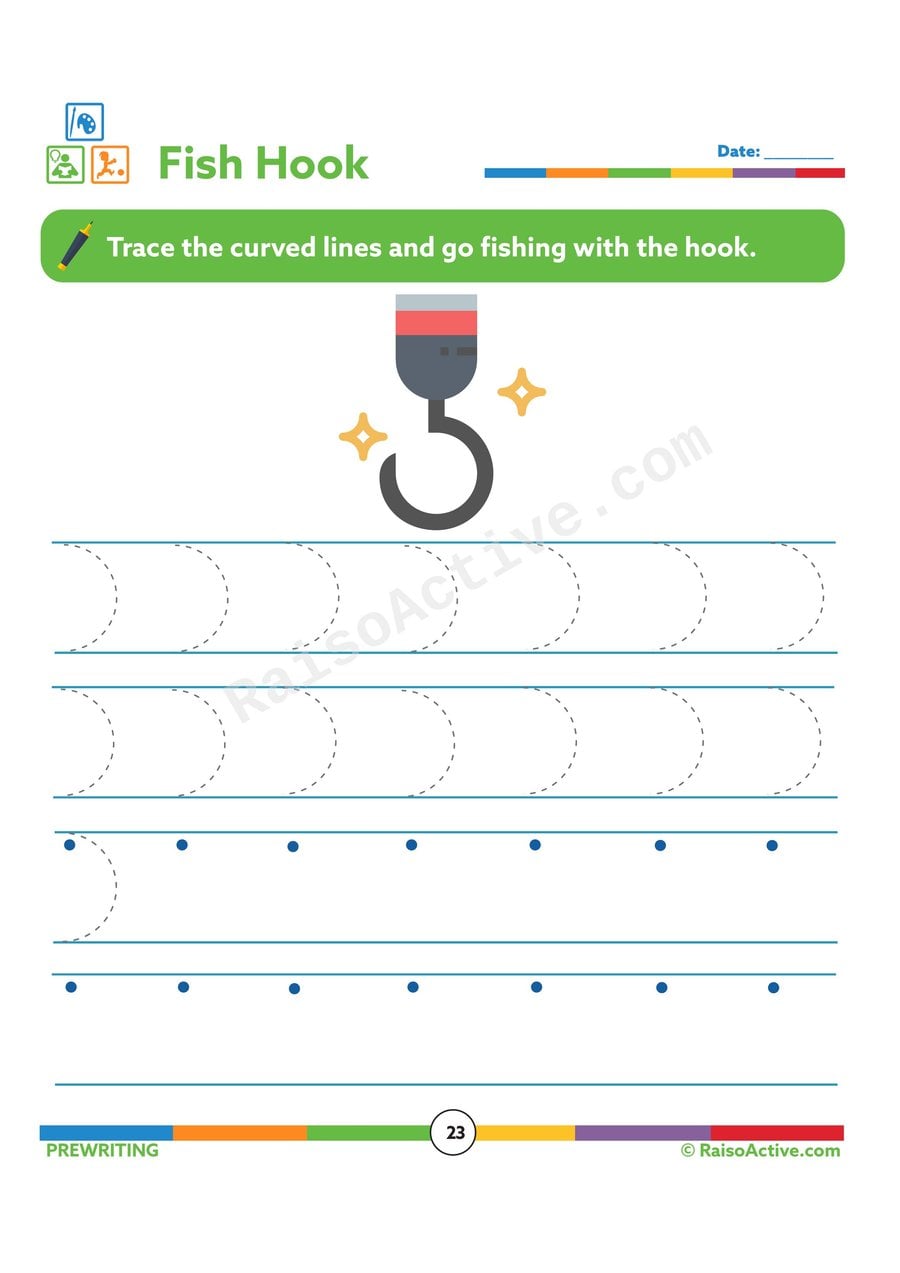
Fish Hook Tracing Worksheet for Preschoolers
Ages 3-5 · Preschool–Pre-KAges 3-5 · Nursery–ReceptionAges 3-5 · Nursery–LKGAges 3-5
Tracing a hook-shaped fishing line curve gives children ages 3-5 practice with a tight, small curved stroke, different from the wide, sweeping curves used in other worksheets, which builds fine control over shorter pencil motions. This particular curve shape is also an early building block for letters like j, which end in a small hook, making this good preparatory practice.

Trace the Mixed Lines Worksheet: Help the Animals Find Their Babies!
Ages 3-5 · Preschool–Pre-KAges 3-5 · Nursery–ReceptionAges 3-5 · Nursery–LKGAges 3-5
This worksheet combines straight, curved, and zigzag lines on a single page, asking children ages 3-5 to trace whichever type of path connects each animal to its baby. Mixing line types in one activity is more demanding than a single-line-type worksheet because the hand has to switch motion patterns line by line, which builds flexibility in pencil control alongside early vocabulary about animal families, like cow and calf or cat and kitten.
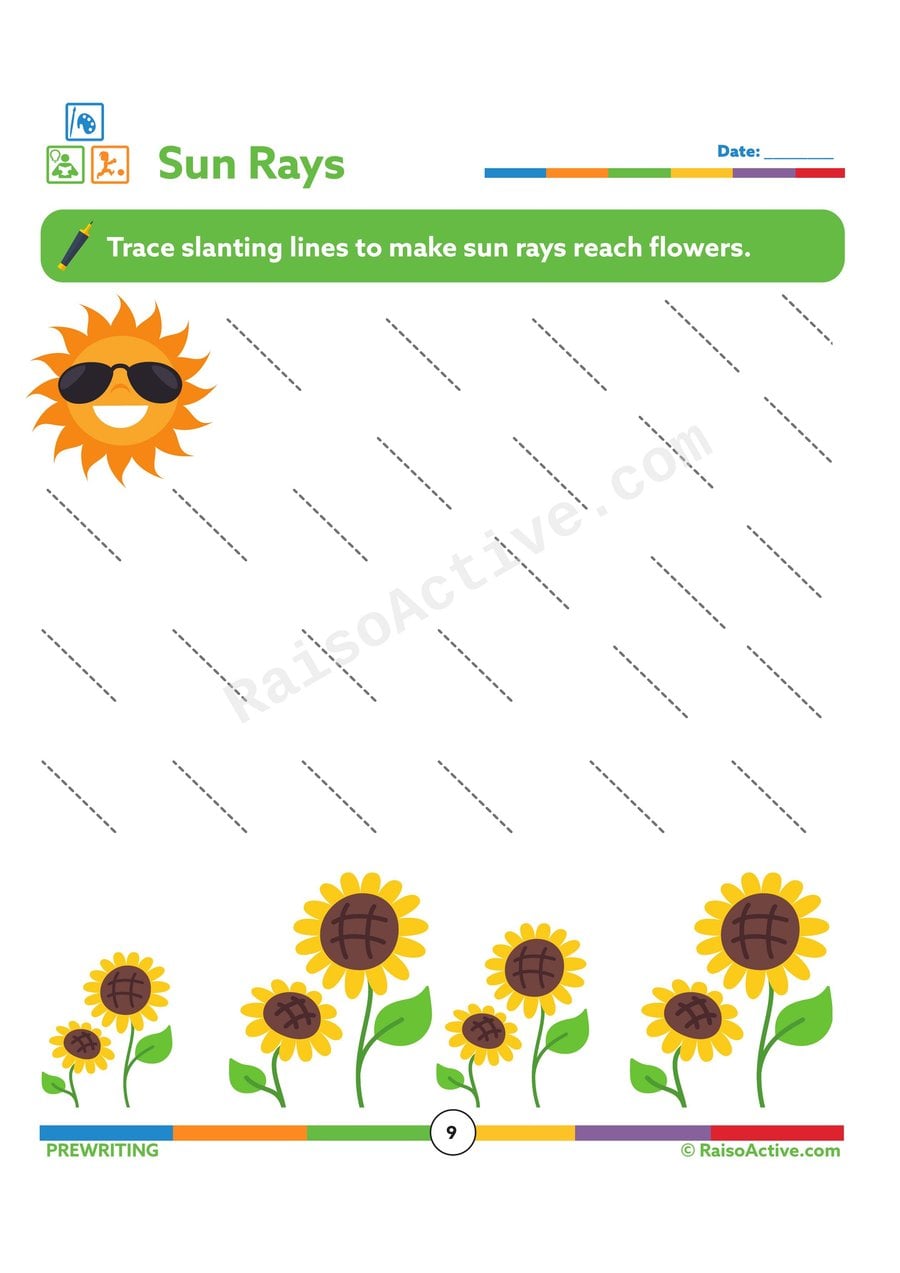
Sun Ray Tracing Worksheet for Preschoolers
Ages 3-5 · Preschool–Pre-KAges 3-5 · Nursery–ReceptionAges 3-5 · Nursery–LKGAges 3-5
Tracing sun rays radiating outward from a circular center gives children ages 3-5 practice changing pencil direction repeatedly within one page, since each ray points a different way from the center, unlike a worksheet where every line runs the same direction. This builds flexible wrist and hand control, along with early spatial awareness of how lines can radiate outward from a single point.

Trace and Build a Castle Worksheet for Preschoolers
Ages 3-5 · Preschool–Pre-KAges 3-5 · Nursery–ReceptionAges 3-5 · Nursery–LKGAges 3-5
Tracing the geometric shapes that form a castle, like triangles for turrets and rectangles for towers, gives children ages 3-5 practice with straight-line shape tracing while also introducing the idea that complex structures are made by combining simple shapes. This spatial reasoning, seeing how basic shapes stack and combine into something bigger, supports both early geometry understanding and imaginative building play.

Trace the Train Engine Worksheet for Preschoolers
Ages 3-5 · Preschool–Pre-KAges 3-5 · Nursery–ReceptionAges 3-5 · Nursery–LKGAges 3-5
Tracing the shapes that make up a train engine, like rectangles for the body and circles for the wheels, gives children ages 3-5 practice with mixed straight and curved strokes while reinforcing the idea that complex objects are built from combinations of simple shapes. The train theme also introduces sequencing awareness, since trains are made of connected cars that follow one after another along a track.
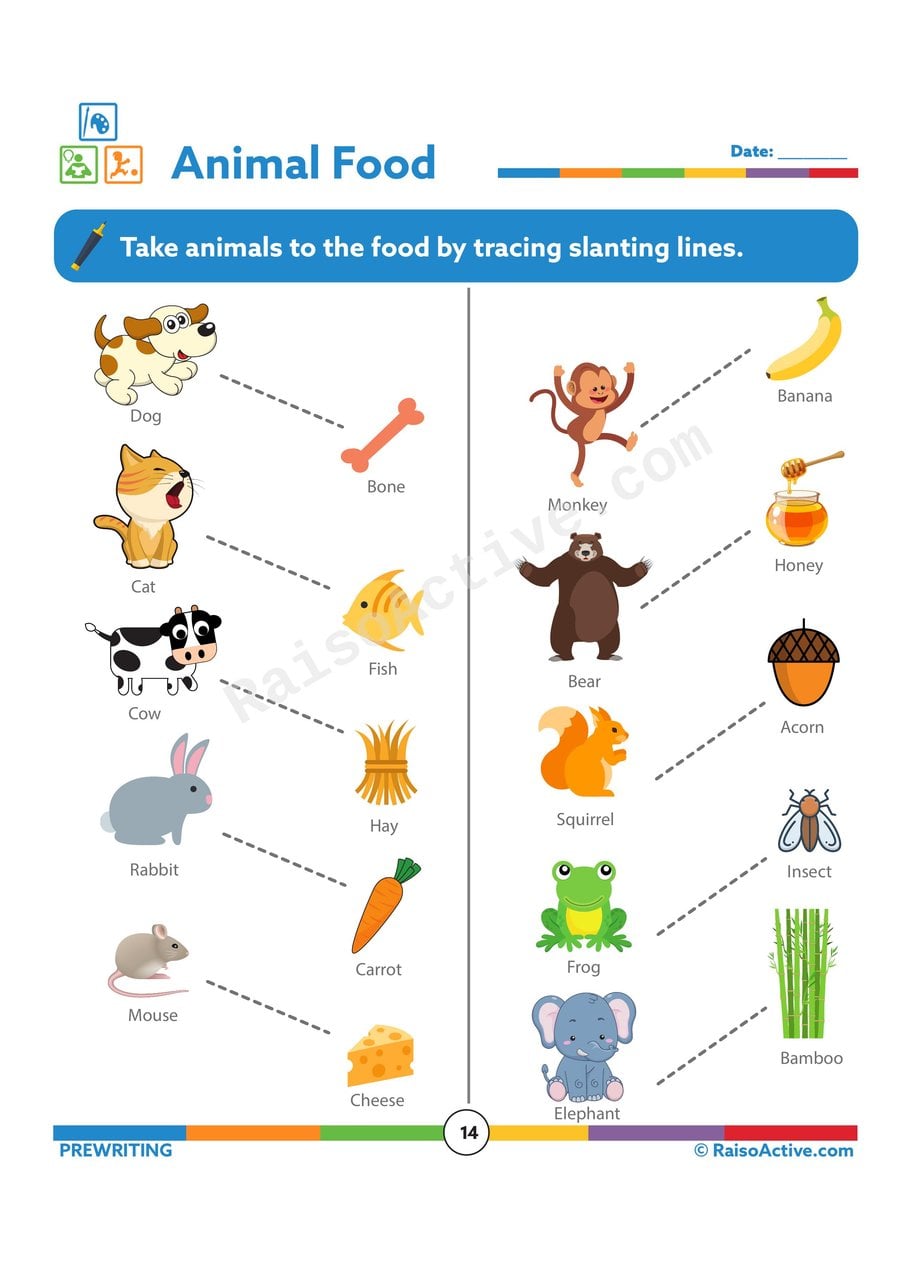
Animal Food Matching Worksheet for Preschoolers
Ages 3-5 · Preschool–Pre-KAges 3-5 · Nursery–ReceptionAges 3-5 · Nursery–LKGAges 3-5
Tracing a line from each animal to the food it eats helps children ages 3-5 build pencil control while learning an early biology concept: that different animals eat different things based on what they are. Connecting a rabbit to a carrot or a bird to a worm also builds simple reasoning skills, since children start to notice why a particular pairing makes sense rather than memorizing it by rote.

Sledge Fun: Trace Slanting Lines to the Snowmen Worksheet
Ages 3-5 · Preschool–Pre-KAges 3-5 · Nursery–ReceptionAges 3-5 · Nursery–LKGAges 3-5
Tracing diagonal lines from a sledge down to waiting snowmen gives children ages 3-5 practice with slanting strokes, a motion that's harder to control than straight up-and-down or side-to-side lines because it requires the wrist to angle and rotate. Mastering this diagonal control now lays groundwork for letters like A, K, X, and Y, which all rely on slanted strokes.
Related worksheets

Learn India's National Symbols: A Dot-to-Dot Worksheet
Ages 3-5 · Preschool–Pre-KAges 3-5 · Nursery–ReceptionAges 3-5 · Nursery–LKGAges 3-5
Connecting numbered dots to reveal each national symbol builds fine motor control and number-sequence recognition in children ages 3-5, since they must find and connect dots in the correct numerical order to form a recognizable picture. As each symbol emerges from the dots, children also gain early familiarity with important national imagery and its name.
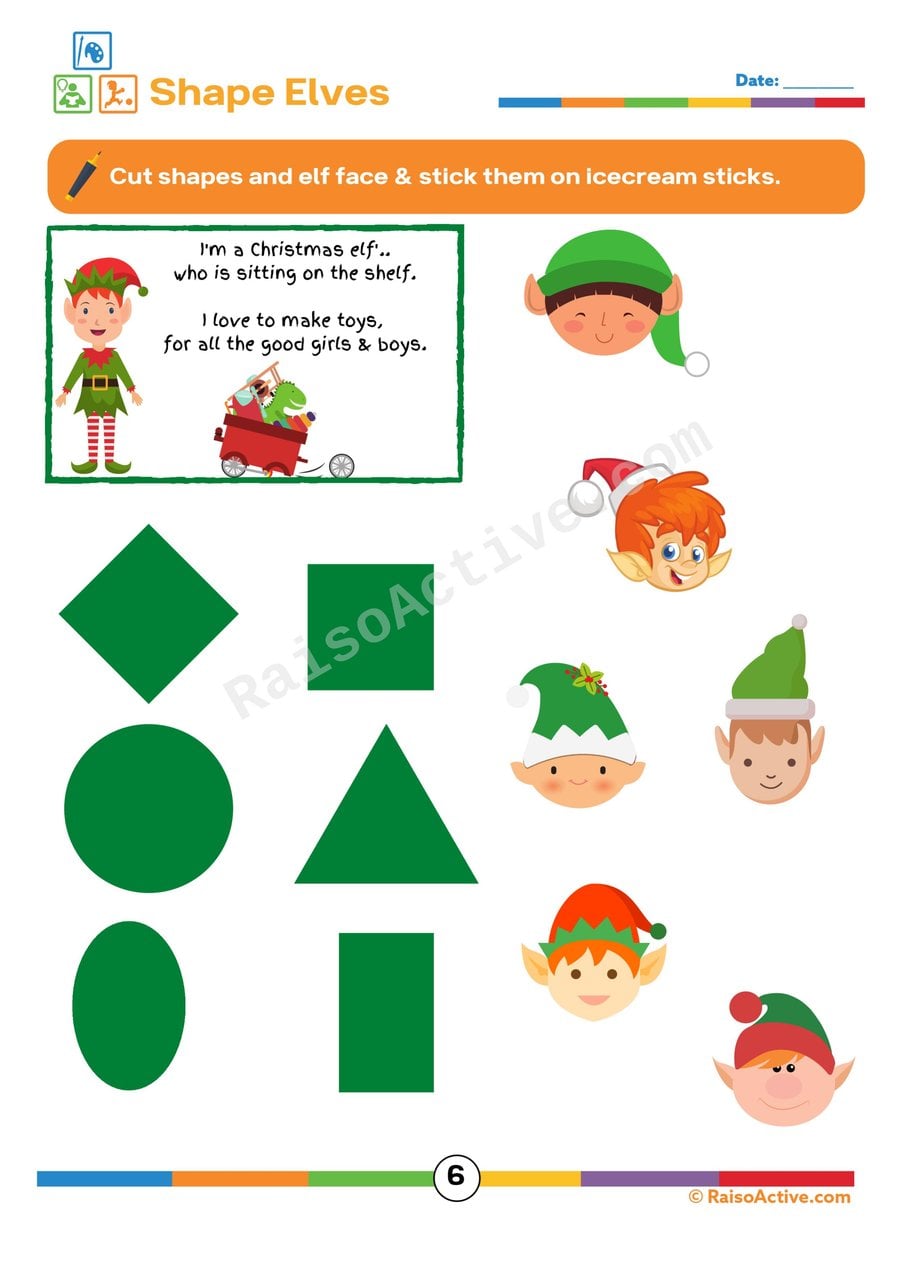
Shape Elves Worksheet: Cut, Paste, and Create!
Ages 3-5 · Preschool–Pre-KAges 3-5 · Nursery–ReceptionAges 3-5 · Nursery–LKGAges 3-5
Cutting out circles, triangles, and rectangles to assemble an elf face teaches children ages 3-5 to recognize and name basic 2D shapes while practicing scissor control along both straight and curved lines. Because each shape has to go in a specific spot to form a recognizable face, children also build spatial reasoning as they figure out which shape works as eyes, a nose, or a hat. Turning geometry into a craft project makes an abstract math concept feel like creative play.

Color Santa Claus for Christmas! A Fun Coloring Worksheet
Ages 3-5 · Preschool–Pre-KAges 3-5 · Nursery–ReceptionAges 3-5 · Nursery–LKGAges 3-5
This Santa Claus coloring page lets children ages 3-5 practice crayon control and color selection on a large, familiar holiday figure, building confidence with fine motor coloring skills before moving to smaller or more detailed pictures. Choosing colors for Santa's suit, hat, and beard also opens up conversation about the holiday season and familiar seasonal symbols.

Symmetry Worksheet for Kids: Mirror Halves and Shadow Match
Ages 4-7 · Pre-K–Grade 1Ages 4-7 · Reception–Year 2Ages 4-7 · LKG–Class 1Ages 4-7
Children complete the other half of a butterfly and a house on a dot grid so both sides match like a mirror, then draw lines to match eight pictures to their shadows. This builds spatial reasoning and visual discrimination.
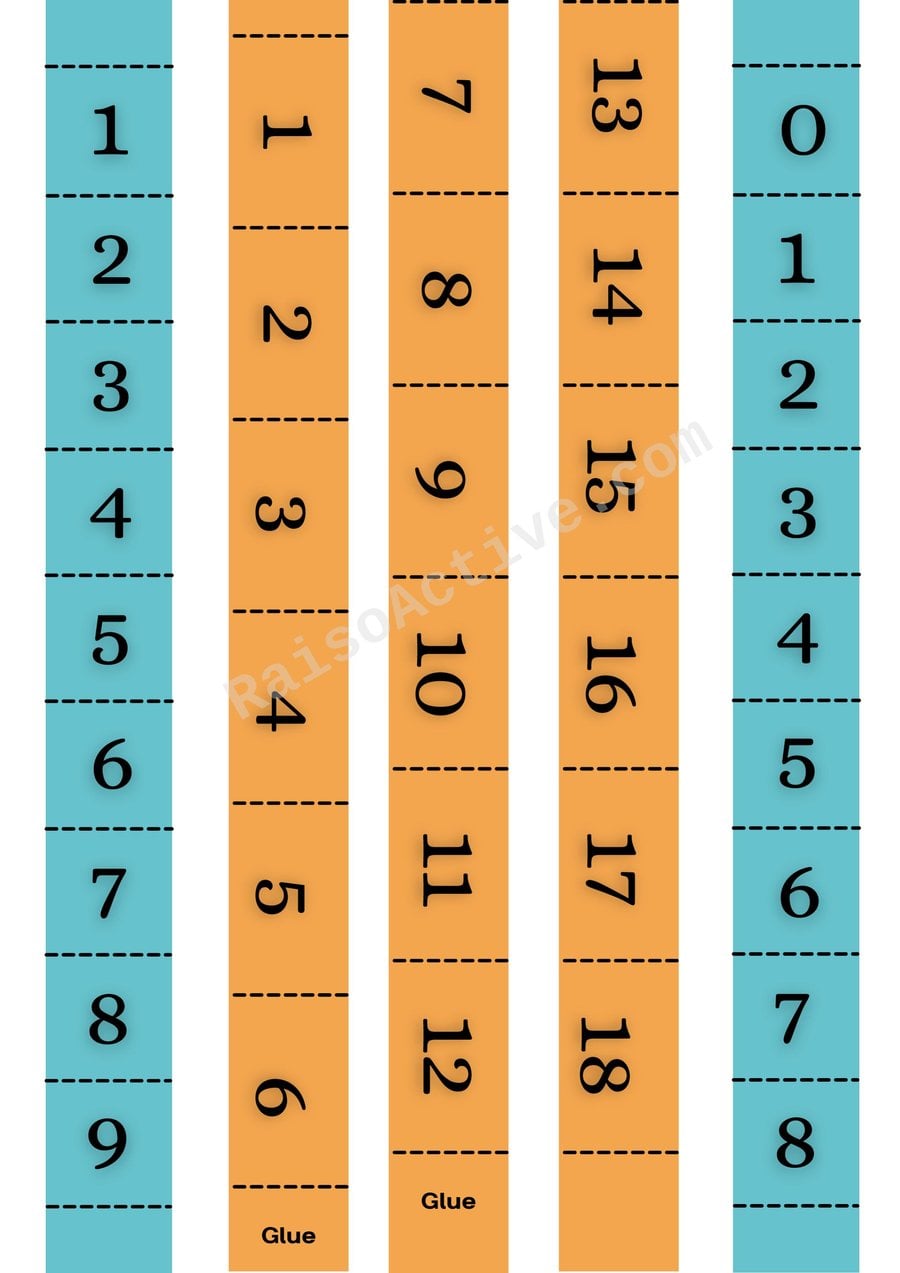
Number Matching Worksheet: 0-18
Ages 3-5 · Preschool–Pre-KAges 3-5 · Nursery–ReceptionAges 3-5 · Nursery–LKGAges 3-5
This activity strengthens numeral recognition for children ages 3-5 by having them find and pair matching numbers from 0 to 18 printed on separate strips. Because the numbers are scattered rather than in order, children must recognize each digit shape on its own rather than relying on counting sequence, which builds true number recognition instead of rote list-reciting.

Clothing Pattern Matching Worksheet for Preschoolers
Ages 3-5 · Preschool–Pre-KAges 3-5 · Nursery–ReceptionAges 3-5 · Nursery–LKGAges 3-5
By comparing clothing items and connecting each one to its pattern match, children ages 3-5 build visual discrimination skills, learning to notice fine differences in stripes, dots, or repeated shapes. This close-looking practice supports the same attention-to-detail children will later need to tell similar-looking letters and numbers apart.
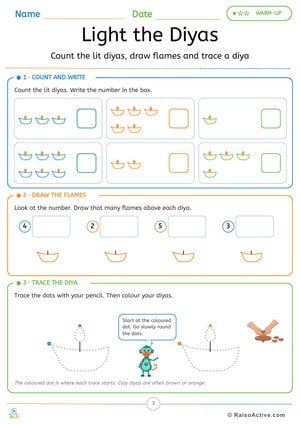
Diwali Diya Counting, Flame Drawing and Tracing Worksheet
Ages 4-6 · Pre-K–KindergartenAges 4-6 · Reception–Year 1Ages 4-6 · LKG–UKGAges 4-6
Children count groups of up to six lit diyas and write the number, then draw the matching number of flames above each lamp. They finish by tracing the dotted outline of a diya with a steady pencil.

Decorate the Christmas Tree! Cut and Paste Worksheet
Ages 3-5 · Preschool–Pre-KAges 3-5 · Nursery–ReceptionAges 3-5 · Nursery–LKGAges 3-5
This cut-and-paste activity builds scissor control and hand strength in children ages 3-5 as they snip out ornaments, stars, and lights to decorate their own Christmas tree. Deciding where each decoration goes also develops spatial planning and following a visual guide, since children compare their tree to the sample image while placing pieces.
Guides for this topic

Pre-Writing Strokes in Order: From Standing Lines to Loops (With Printable Patterns)
The developmental order of pre-writing strokes, from vertical lines to loops, and why practicing them in sequence makes letter formation much easier to learn.

Best Worksheets for 3-Year-Olds: What Works and What to Avoid
What works on worksheets for 3-year-olds: short sessions, crayons, tracing lines, matching, cutting, a free weekly plan, and signs one is too advanced.
Portfolio Assessment with Young Children: A Comprehensive Guide to Meaningful Documentation
Learn how portfolio assessment captures your child's growth through meaningful documentation. Practical tips, templates, and age-appropriate strategies for ages 1-8.
Reviews
Every worksheet for ages 3–5, no watermark
Members download the full library of 1,000+ worksheets and every activity pack without watermarks or daily limits. One year costs ₹999 in India or $20 elsewhere.
See membership plansOr download any worksheet free with a watermark (5 a day).