Sun Ray Tracing Worksheet for Preschoolers
Tracing sun rays radiating outward from a circular center gives children ages 3-5 practice changing pencil direction repeatedly within one page, since each ray points a different way from the center, unlike a worksheet where every line runs the same direction. This builds flexible wrist and hand control, along with early spatial awareness of how lines can radiate outward from a single point.
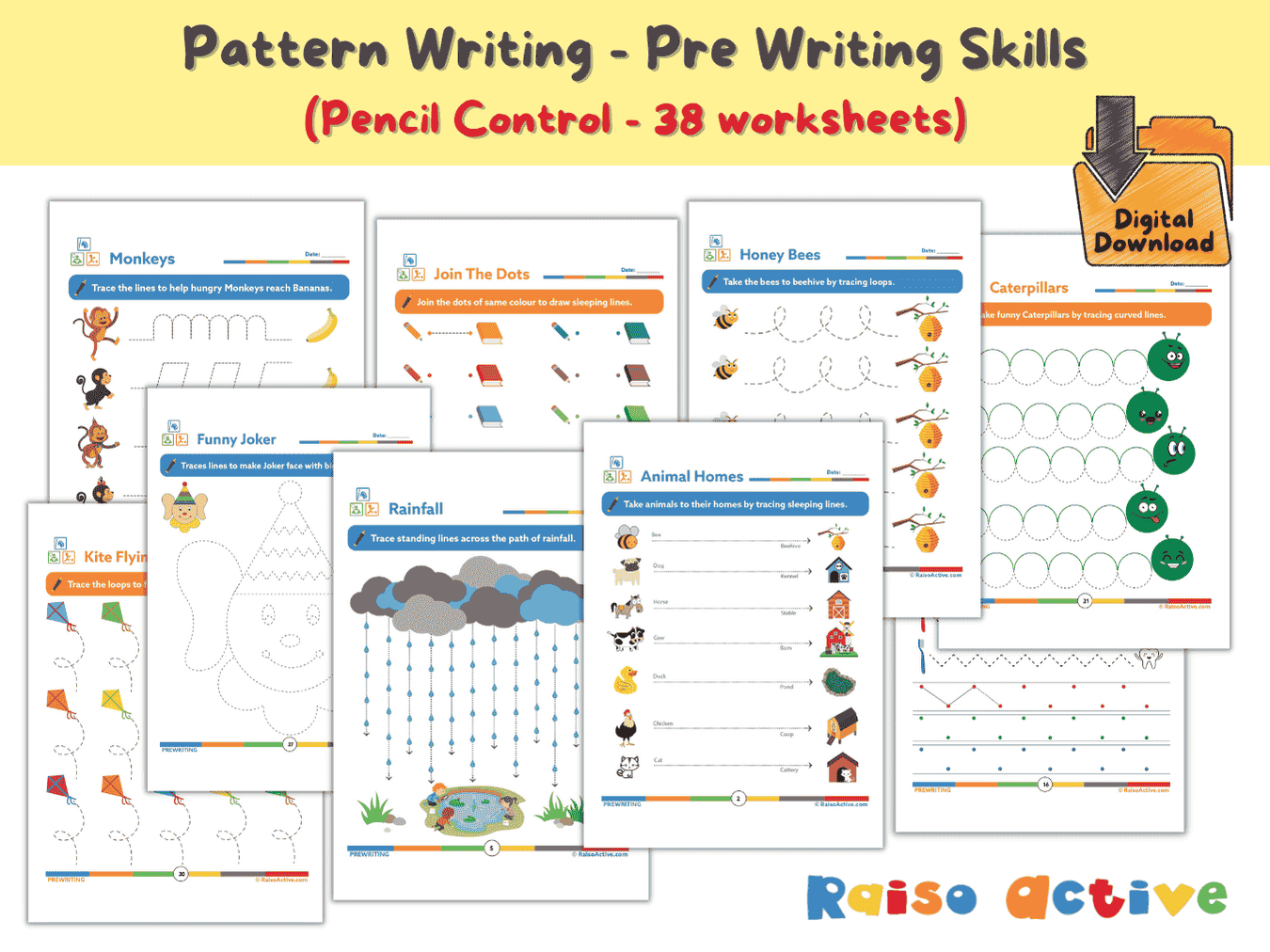
Part of the pack
Pattern Writing Pre-writing Skills Activity Book for 3-4 Year Olds
This is page 13 of the pack. Ages 3-4 · PreschoolAges 3-4 · NurseryAges 3-4
Made for your child
A whole activity pack made with their name
60 pages to spot, build, trace and write their own name, plus pages about their favourites, feelings and family. See a free preview with their name.
Make an All About Me packFree preview · free for members
Or start free: a name tracing sheet with their nameCurriculum
- Pre-Writing > Curved Lines
How to use this worksheet
Point out the sun's round center and ask your child to notice how each ray points a different direction outward from it. Guide their pencil along each dotted ray line, starting from the center and moving outward, pausing briefly before starting the next ray in a new direction. Work around the sun ray by ray rather than skipping between opposite sides. Color the sun and rays once every line is traced.
Materials needed
- Pencil
- Crayons
Extension activities
- 1Make a paper plate sun craft by gluing ribbon or paper strip rays around the edge of a yellow circle.
- 2Go outside on a sunny day and trace your own shadow with chalk, noticing how it changes through the day.
- 3Do a simple sun salutation yoga sequence together, stretching arms outward like sun rays.
- 4Make a sun catcher using tissue paper and contact paper to hang in a window.
- 5Sing a sunshine song with hand motions that spread outward like rays.

Written by
Hemsweta Jain · Teacher Cheena
MBA and Early Childhood Educator, teaching since 2014 · Founder of RaisoActive, Mumbai
Every RaisoActive worksheet is designed and checked by the founder before publishing.
Published · Last reviewed
More from Pattern Writing Pre-writing Skills Activity Book for 3-4 Year Olds

Pattern Writing Pre-writing Skills Activity Book for 3-4 Year Olds - Page 19
Ages 3-4 · PreschoolAges 3-4 · NurseryAges 3-4
This page from the pre-writing patterns activity book asks 3-4 year olds to keep their pencil pressure steady and consistent while repeating a stroke across a full row, a subtler skill than simply getting the shape right. Learning to apply even, moderate pressure prevents the tearing or overly faint lines common in early writing attempts, and this kind of repeated practice builds that control gradually.

Trace and Build a Castle Worksheet for Preschoolers
Ages 3-5 · Preschool–Pre-KAges 3-5 · Nursery–ReceptionAges 3-5 · Nursery–LKGAges 3-5
Tracing the geometric shapes that form a castle, like triangles for turrets and rectangles for towers, gives children ages 3-5 practice with straight-line shape tracing while also introducing the idea that complex structures are made by combining simple shapes. This spatial reasoning, seeing how basic shapes stack and combine into something bigger, supports both early geometry understanding and imaginative building play.

Monkey Banana Tracing Worksheet for Preschoolers
Ages 3-5 · Preschool–Pre-KAges 3-5 · Nursery–ReceptionAges 3-5 · Nursery–LKGAges 3-5
Tracing a path connecting a monkey to a banana builds pencil control in children ages 3-5 while reinforcing a simple, well-known animal-and-food pairing that most children already recognize, which keeps the activity approachable and motivating. This worksheet also gives extra practice with whatever line type the path uses, whether a swinging curve or a straighter reach, building on the same skills developed in other animal-food and animal-home tracing worksheets.

Smile with Smiley Face! A Fun Tracing Worksheet for Preschoolers
Ages 3-5 · Preschool–Pre-KAges 3-5 · Nursery–ReceptionAges 3-5 · Nursery–LKGAges 3-5
Tracing a smiling mouth teaches children ages 3-5 the upward curved stroke used in letters like u and later cursive forms, while also tying that curve to something personally meaningful, a smile. Because the shape mirrors an expression children make and recognize every day, this worksheet connects fine motor practice to social-emotional awareness about what a smile looks like and means.

Fly Airplanes Tracing Worksheet for Preschoolers
Ages 3-5 · Preschool–Pre-KAges 3-5 · Nursery–ReceptionAges 3-5 · Nursery–LKGAges 3-5
Unlike letter tracing, this worksheet has children follow long, curving flight-path lines from a globe down to the ground, which builds sustained hand-eye coordination and the ability to keep a pencil moving smoothly over a longer distance than a single letter requires. For 3-5 year olds, this kind of extended line tracing is an important bridge between short scribbles and the longer, controlled strokes needed for writing full letters and words.

Move the Cars! Pre-Writing Tracing Worksheet for Preschoolers
Ages 3-5 · Preschool–Pre-KAges 3-5 · Nursery–ReceptionAges 3-5 · Nursery–LKGAges 3-5
Tracing a road-shaped path for a car gives children ages 3-5 pencil control practice disguised as a familiar, motivating theme, since most young children have pushed a toy car along an imaginary road before. The winding or straight path on this worksheet builds the same steady, controlled pencil movement needed for handwriting, while the driving theme keeps attention high through an activity that might otherwise feel repetitive.

Trace and Color the Funny Joker Face Worksheet for Preschoolers
Ages 3-5 · Preschool–Pre-KAges 3-5 · Nursery–ReceptionAges 3-5 · Nursery–LKGAges 3-5
Tracing the curved and circular shapes that make up a funny, exaggerated face gives children ages 3-5 practice with rounded strokes while the silly theme, a joker or clown face, adds humor that tends to boost engagement on what could otherwise feel like a repetitive shape-tracing task. Placing and tracing multiple facial features also reinforces facial feature vocabulary and proportion, similar to other face-based worksheets but with a playful, exaggerated twist.

Join the Dots: Sleeping Lines Worksheet for Preschoolers
Ages 3-5 · Preschool–Pre-KAges 3-5 · Nursery–ReceptionAges 3-5 · Nursery–LKGAges 3-5
This dot-to-dot worksheet has children ages 3-5 connect dots to form horizontal lines, sometimes called 'sleeping lines' because they lie flat rather than standing upright, building the left-to-right pencil motion that also mirrors the direction of reading and writing English text. Dot-to-dot tracing adds an extra layer of precision beyond simple line tracing, since the child has to land exactly on each dot rather than following a continuous guide.
Related worksheets
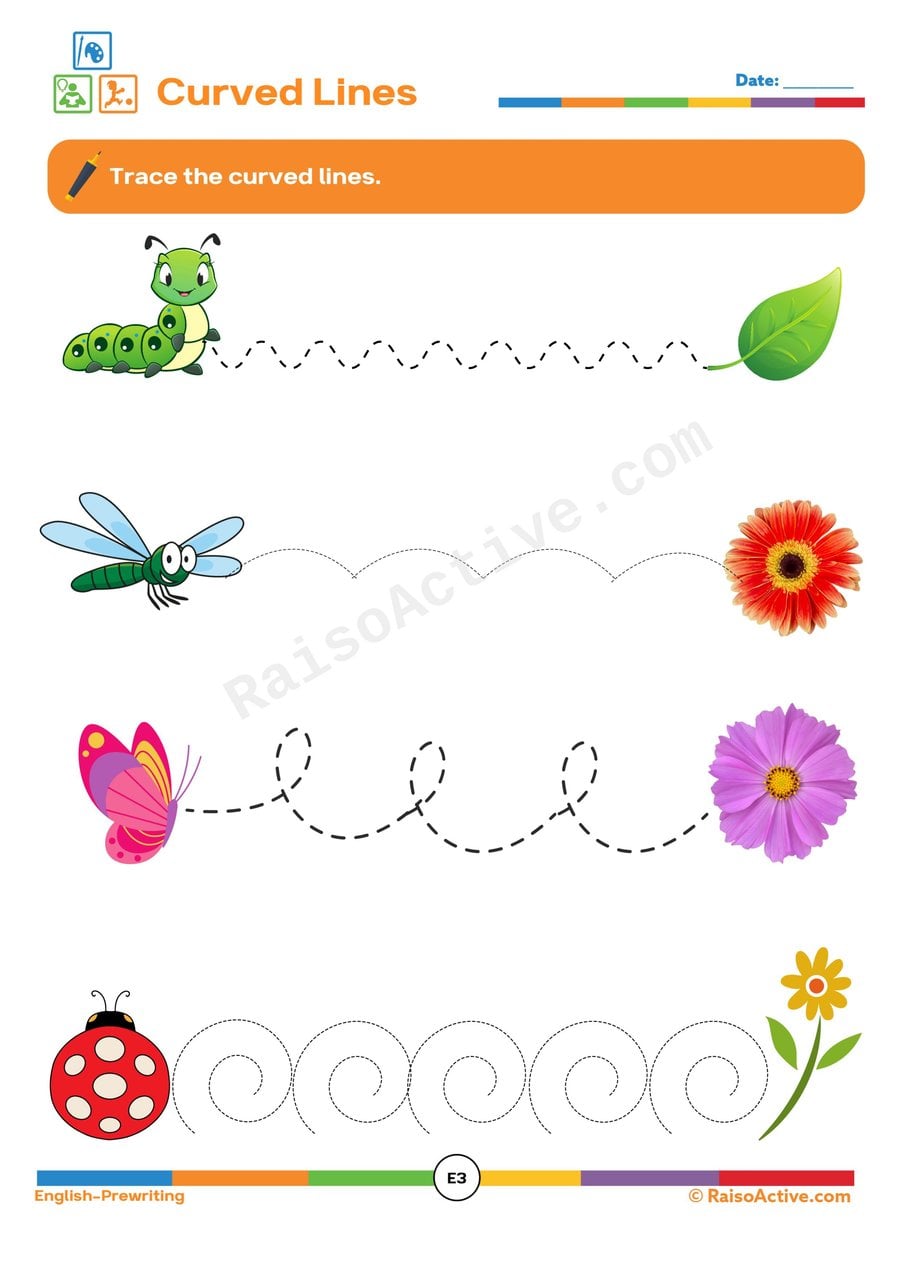
Curved Lines Tracing Worksheet for Preschoolers
Ages 3-5 · Preschool–Pre-KAges 3-5 · Nursery–ReceptionAges 3-5 · Nursery–LKGAges 3-5
Children ages 3-5 practice tracing curved lines in various directions, building the specific hand-eye coordination and wrist flexibility needed to later form curved letters like c, o, and s. Curved-line control is a distinct pre-writing skill from straight-line tracing, since it requires a smoother, more continuous pencil motion.

Ordinal Numbers Coloring Worksheet for Preschoolers
Ages 3-5 · Preschool–Pre-KAges 3-5 · Nursery–ReceptionAges 3-5 · Nursery–LKGAges 3-5
This coloring worksheet introduces children ages 3-5 to ordinal numbers — 1st, 2nd, 3rd, 4th, 5th — by having them identify and color the picture in a row that matches a given ordinal position. Ordinal numbers describe order and rank rather than quantity, which is a meaningfully different concept from the cardinal counting children usually practice first. This distinction is an important step toward understanding sequences, rankings, and everyday language like 'first place' or 'third in line.'

Merry Christmas Coloring Worksheet for Preschoolers
Ages 3-5 · Preschool–Pre-KAges 3-5 · Nursery–ReceptionAges 3-5 · Nursery–LKGAges 3-5
Filling in Christmas-themed pictures with crayons or colored pencils helps children ages 3-5 refine their pencil grip and hand control while practicing the concept of staying within a defined boundary. Because the pictures include multiple familiar holiday objects, this worksheet also gives children a chance to build vocabulary by naming each item as they color it. Repeated coloring practice at this age steadily improves the wrist and finger strength needed for later writing tasks.

Letter T Tracing and Coloring Worksheet for Preschoolers
Ages 3-5 · Preschool–Pre-KAges 3-5 · Nursery–ReceptionAges 3-5 · Nursery–LKGAges 3-5
This worksheet helps children ages 3-5 build the fine motor control and directional awareness needed to form the letter T correctly, tracing both its uppercase and lowercase forms along guided dotted lines. Repeated tracing builds the muscle memory in small hand muscles that eventually allows children to write letters independently without a guide. Coloring pictures that begin with T and hunting for the letter in a grid also reinforce letter-sound and letter-shape recognition side by side.

Gingerbread Man Coloring Worksheet for Preschoolers
Ages 3-5 · Preschool–Pre-KAges 3-5 · Nursery–ReceptionAges 3-5 · Nursery–LKGAges 3-5
This gingerbread man worksheet gives children ages 3-5 practice coloring within a simple, familiar outline while also adding their own decorative details like buttons and a bow, encouraging creative choices within a structured shape. Deciding where to place each decoration also builds early spatial awareness, since buttons and a bow need to be positioned in specific spots on the body.

Stick Man Emotions Worksheet: Happy, Sad, Angry, and Surprised!
Ages 4-6 · Pre-K–KindergartenAges 4-6 · Reception–Year 1Ages 4-6 · LKG–UKGAges 4-6
Children ages 4-6 practice reading facial expressions on this worksheet, matching stick-figure faces to their correct emotion labels by noticing details like mouth shape and eyebrow position. This strengthens emotional literacy — the ability to name and recognize feelings in others — which supports empathy and smoother social interactions as children move into more group play and classroom settings.
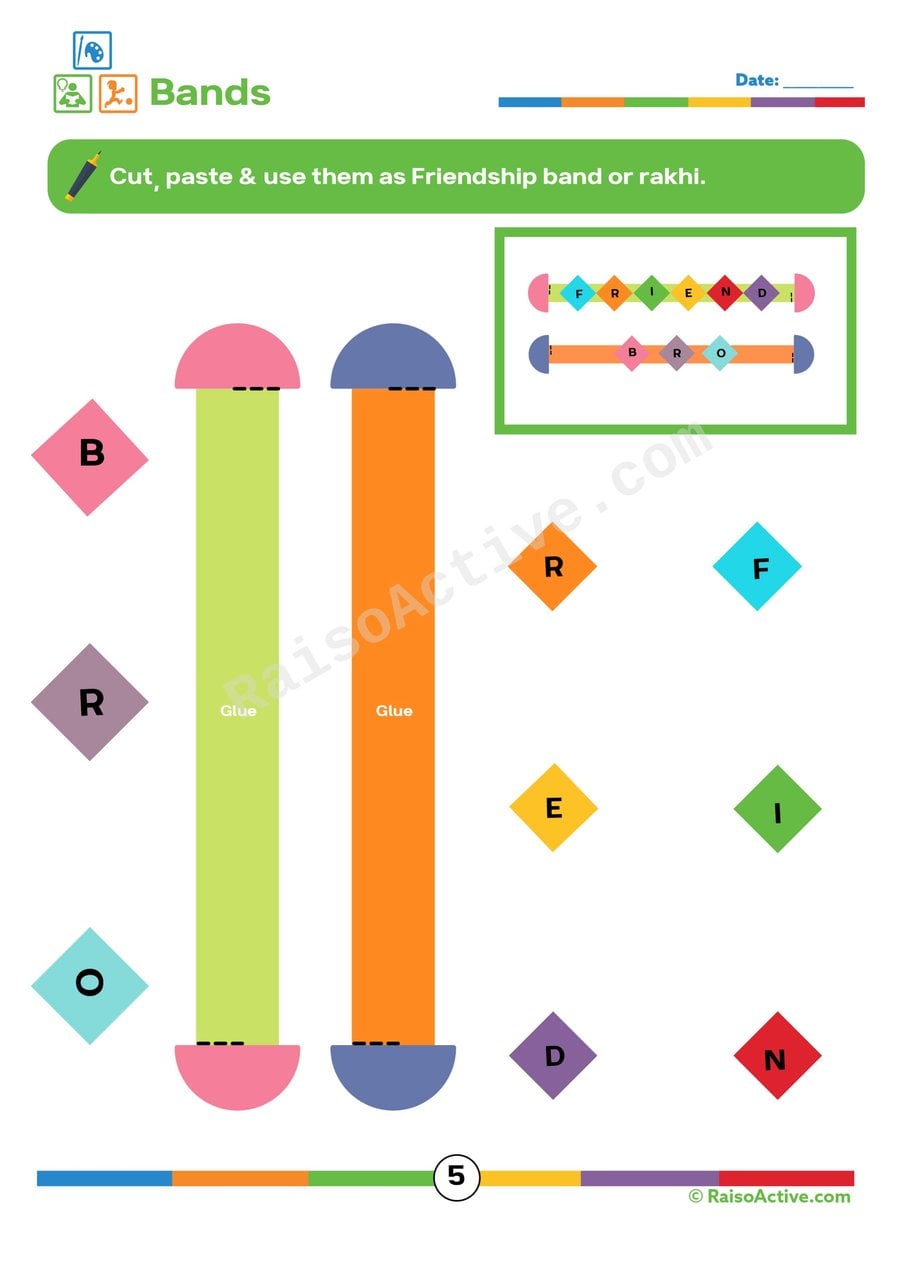
Friendship Band Craft Worksheet for Kids
Ages 3-5 · Preschool–Pre-KAges 3-5 · Nursery–ReceptionAges 3-5 · Nursery–LKGAges 3-5
This worksheet builds fine motor precision as children ages 3-5 cut out individual shapes and glue them onto a paper strip in a sequence of their choosing, creating a personalized friendship band or rakhi. Deciding where each shape goes along the strip also introduces early spatial planning and pattern-making, since children must space the shapes evenly to fill the band.

Butterfly Cutting Practice Worksheet for Preschoolers
Ages 3-5 · Preschool–Pre-KAges 3-5 · Nursery–ReceptionAges 3-5 · Nursery–LKGAges 3-5
This cutting-practice worksheet gives children ages 3-5 dedicated repetition in guiding scissors along a straight or gently curved dotted line, a core pre-writing and self-help skill that strengthens hand strength and bilateral coordination. Framing the goal as 'reaching the butterflies' gives children a visual reward for careful, controlled cutting rather than treating scissor practice as an isolated drill. Building this scissor control early supports later success with more complex cut-and-paste crafts.
Guides for this topic

Pre-Writing Strokes in Order: From Standing Lines to Loops (With Printable Patterns)
The developmental order of pre-writing strokes, from vertical lines to loops, and why practicing them in sequence makes letter formation much easier to learn.

Portfolio Assessment with Young Children: A Comprehensive Guide to Meaningful Documentation
Learn how portfolio assessment captures your child's growth through meaningful documentation. Practical tips, templates, and age-appropriate strategies for ages 1-8.
What Makes a Good Worksheet vs. a Poor One: A Parent's Guide to Quality Educational Materials
Learn what separates high-quality educational worksheets from poor busy work. Discover design principles, red flags, and how to evaluate free worksheets online for your child aged 1-8.
Reviews
Every worksheet for ages 3–5, no watermark
Members download the full library of 1,000+ worksheets and every activity pack without watermarks or daily limits. One year costs ₹999 in India or $20 elsewhere.
See membership plansOr download any worksheet free with a watermark (5 a day).