Curved Lines Tracing Worksheet for Preschoolers
Children ages 3-5 practice tracing curved lines in various directions, building the specific hand-eye coordination and wrist flexibility needed to later form curved letters like c, o, and s. Curved-line control is a distinct pre-writing skill from straight-line tracing, since it requires a smoother, more continuous pencil motion.
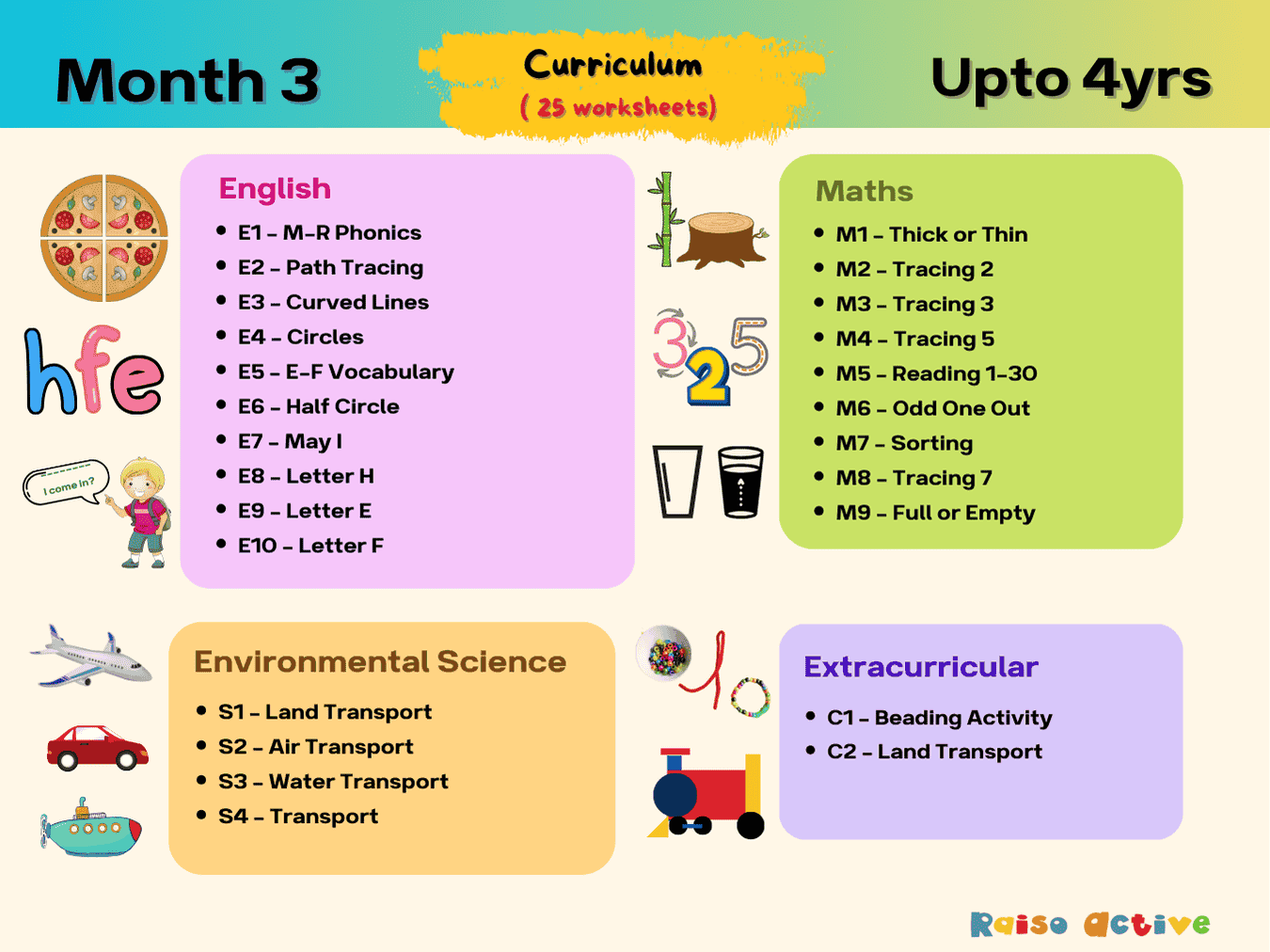
Part of the pack
Month 3: Learning & Development | Ages Up to 4
This is page 6 of the pack. Ages 3-4 · PreschoolAges 3-4 · NurseryAges 3-4
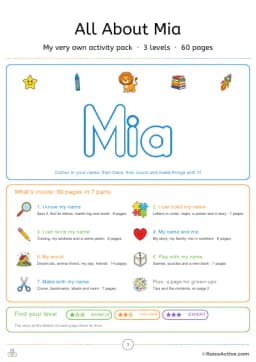
Made for your child
A whole activity pack made with their name
60 pages to spot, build, trace and write their own name, plus pages about their favourites, feelings and family. See a free preview with their name.
Make an All About Me packFree preview · free for members
Or start free: a name tracing sheet with their nameCurriculum
- Pre-Writing > Curved Lines
How to use this worksheet
Point to the starting dot of the first curved line and have your child place their pencil there. Guide them to trace slowly along the dotted curve from start to finish, following the direction of the arrow if one is shown. Move through each curved line on the page the same way, encouraging steady, unhurried strokes. Praise their effort after each completed line before moving to the next.
Materials needed
- Pencil
- Crayons
Extension activities
- 1Encourage your child to draw their own curved lines and simple curved shapes on blank paper.
- 2Use playdough to roll and shape curved lines and loops.
- 3Go on a nature walk and spot curved lines in leaves, flower petals, or tree branches.
- 4Trace large curves in the air with a finger or a wand before practicing on paper.

Written by
Hemsweta Jain · Teacher Cheena
MBA and Early Childhood Educator, teaching since 2014 · Founder of RaisoActive, Mumbai
Every RaisoActive worksheet is designed and checked by the founder before publishing.
Published · Last reviewed
More from Month 3: Learning & Development | Ages Up to 4

Letter E Tracing Worksheet for Preschoolers: Learn to Write!
Ages 3-5 · Preschool–Pre-KAges 3-5 · Nursery–ReceptionAges 3-5 · Nursery–LKGAges 3-5
Children ages 3-5 use this worksheet to build the specific motor pattern for capital E — three horizontal strokes branching off one vertical line — while reinforcing the /e/ sound through picture recognition. Repeated tracing in a dashed-box format also trains children to keep letters a consistent size, an important pre-writing skill before they move to unlined paper.

Water Transport Matching Worksheet for Preschoolers
Ages 3-5 · Preschool–Pre-KAges 3-5 · Nursery–ReceptionAges 3-5 · Nursery–LKGAges 3-5
This worksheet builds visual matching and vocabulary skills as children connect the two halves of different water vehicles — like a boat, ship, or submarine — and learn their names. Piecing together a whole object from its parts also sharpens visual discrimination, helping children notice small differences in shape and detail that matter for later reading skills.

M-R Phonic Beginning Sound Worksheet: Circle the Correct Letter!
Ages 4-6 · Pre-K–KindergartenAges 4-6 · Reception–Year 1Ages 4-6 · LKG–UKGAges 4-6
This phonics worksheet focuses children ages 4-6 on distinguishing between five similar beginning sounds — M, P, O, R, and N — by having them look at a picture, say its name, and circle the correct starting letter from those choices. Including several letters as answer options, rather than just one, makes this a meaningfully harder discrimination task than a single-letter worksheet, since children must rule out close-sounding alternatives.

Parent's Guide: Fine Motor Skills and Early Concepts Worksheet
Ages 3-5 · Preschool–Pre-KAges 3-5 · Nursery–ReceptionAges 3-5 · Nursery–LKGAges 3-5
This parent-led guide combines fine motor skill development with early concept learning for children ages 3-5, covering ideas like full/empty and thick/thin alongside pre-writing practice using everyday materials like water, shaving foam, and small objects. Bundling sensory, motor, and conceptual learning together gives children multiple entry points into the same ideas, which builds understanding more thoroughly than a single worksheet page.

Tracing and Writing the Number 5 Worksheet for Preschoolers
Ages 3-5 · Preschool–Pre-KAges 3-5 · Nursery–ReceptionAges 3-5 · Nursery–LKGAges 3-5
This worksheet targets the specific pencil-control needed to form the numeral 5 correctly, while linking that written symbol to the quantity it represents through counting the apples on the page. Practicing number formation alongside counting at this age helps children connect the abstract symbol '5' to a concrete amount they can see and touch.

Dot-to-Dot Snail Worksheet: Counting Numbers 1-30!
Ages 3-5 · Preschool–Pre-KAges 3-5 · Nursery–ReceptionAges 3-5 · Nursery–LKGAges 3-5
This dot-to-dot worksheet challenges children ages 3-5 to count and connect numbers from 1 to 30 in sequence, extending their number-order knowledge well past the more common 1-10 range while also building fine motor control as they draw connecting lines. Successfully completing a longer sequence like this gives children a real sense of accomplishment tied directly to numeracy.

Color the Air Transport Vehicles Worksheet for Preschoolers
Ages 3-5 · Preschool–Pre-KAges 3-5 · Nursery–ReceptionAges 3-5 · Nursery–LKGAges 3-5
This coloring worksheet builds vocabulary and visual recognition around air transport — planes, helicopters, and other flying vehicles — while giving children ages 3-5 sustained practice with crayon control and staying within outlines. Naming each vehicle as they color it also strengthens category thinking, helping children understand 'air transport' as a group distinct from things that travel by road or water.
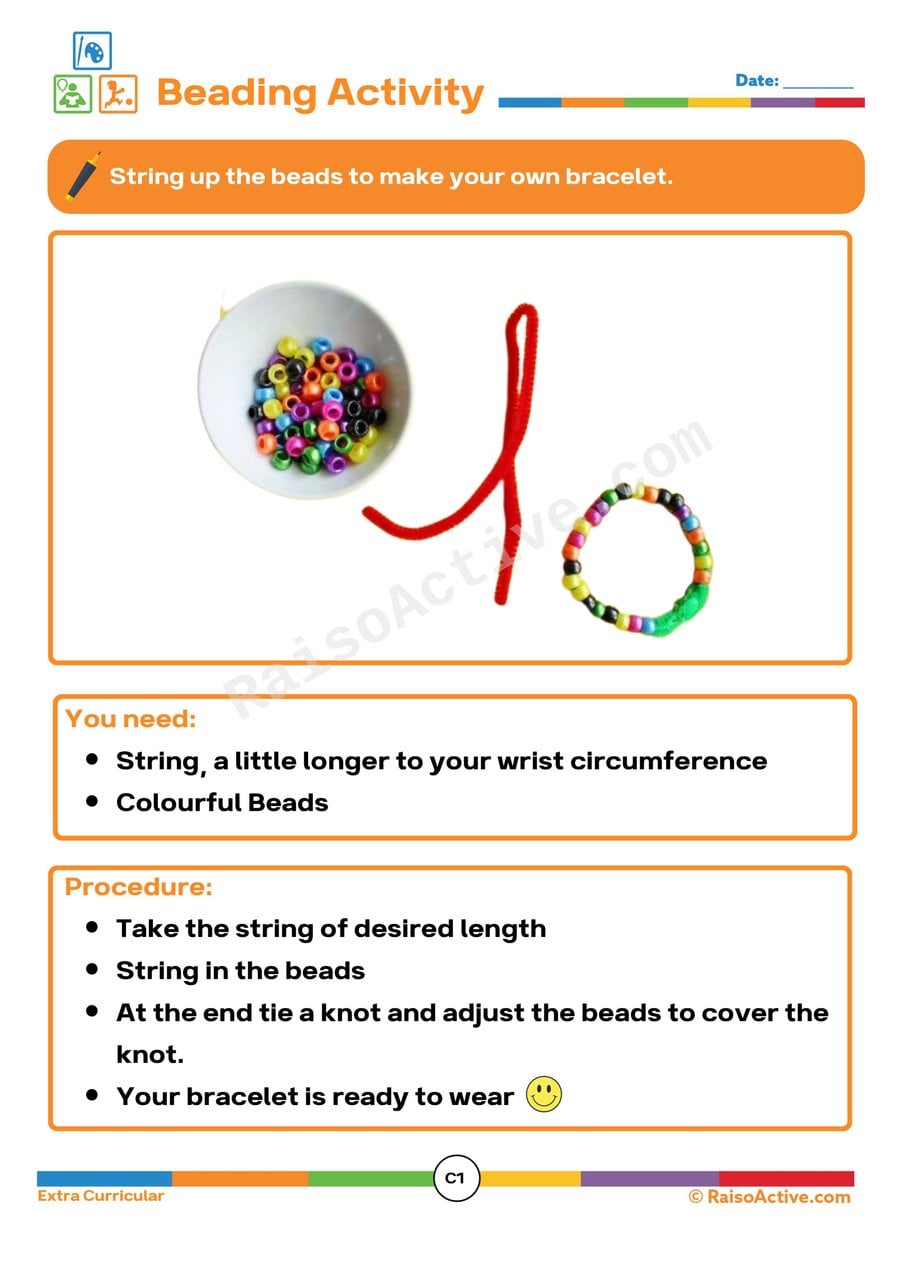
Beading Fun: Make Your Own Bracelet Worksheet
Ages 3-5 · Preschool–Pre-KAges 3-5 · Nursery–ReceptionAges 3-5 · Nursery–LKGAges 3-5
This beading craft has children ages 3-5 string beads onto a cord and tie it off to make a wearable bracelet, building bilateral coordination as one hand holds the string steady while the other threads beads — a genuinely demanding fine motor task at this age. Completing a sequence of small, repeated actions toward a finished, wearable product also builds patience and a sense of accomplishment.
Related worksheets
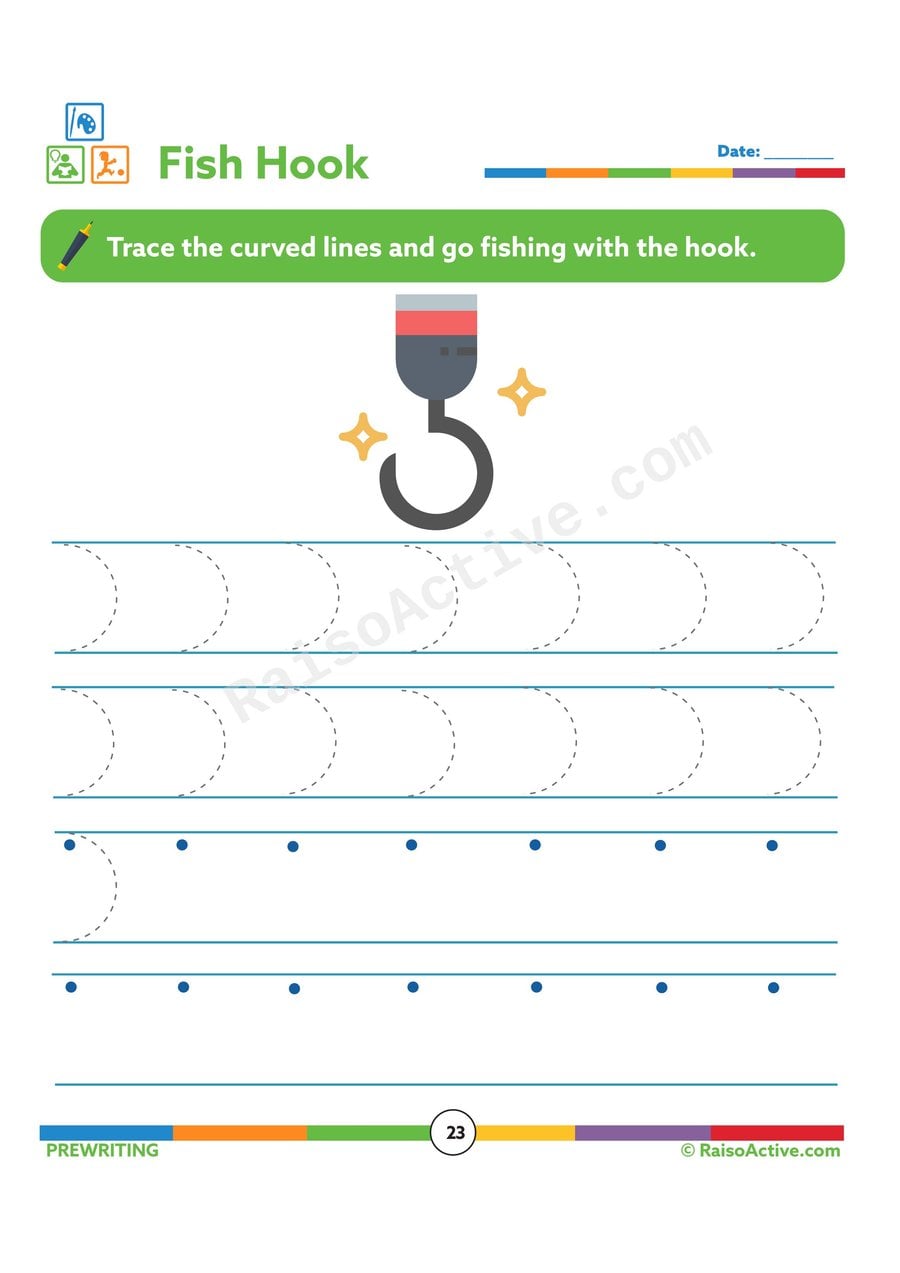
Fish Hook Tracing Worksheet for Preschoolers
Ages 3-5 · Preschool–Pre-KAges 3-5 · Nursery–ReceptionAges 3-5 · Nursery–LKGAges 3-5
Tracing a hook-shaped fishing line curve gives children ages 3-5 practice with a tight, small curved stroke, different from the wide, sweeping curves used in other worksheets, which builds fine control over shorter pencil motions. This particular curve shape is also an early building block for letters like j, which end in a small hook, making this good preparatory practice.

Smile with Smiley Face! A Fun Tracing Worksheet for Preschoolers
Ages 3-5 · Preschool–Pre-KAges 3-5 · Nursery–ReceptionAges 3-5 · Nursery–LKGAges 3-5
Tracing a smiling mouth teaches children ages 3-5 the upward curved stroke used in letters like u and later cursive forms, while also tying that curve to something personally meaningful, a smile. Because the shape mirrors an expression children make and recognize every day, this worksheet connects fine motor practice to social-emotional awareness about what a smile looks like and means.
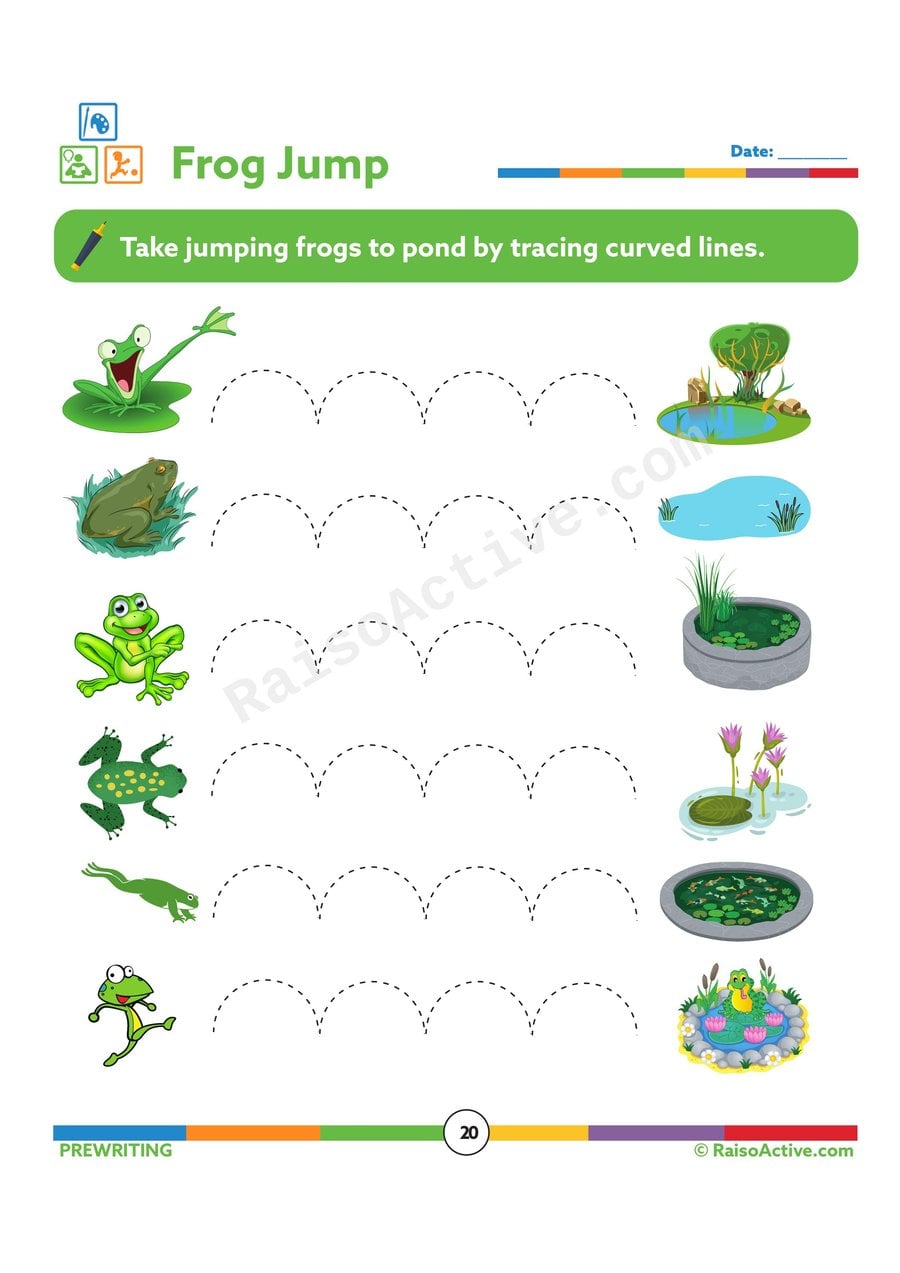
Frog Jump Tracing Worksheet for Preschoolers
Ages 3-5 · Preschool–Pre-KAges 3-5 · Nursery–ReceptionAges 3-5 · Nursery–LKGAges 3-5
Tracing the arc-shaped path of a frog's jump from one lily pad to the next gives children ages 3-5 practice with curved strokes tied to a real physical motion, a hop, which makes the abstract line feel grounded in something they've done themselves. Repeating this jump-shaped arc across several lily pads also builds consistency, helping a child produce similarly sized curves rather than arcs that vary widely from one to the next.
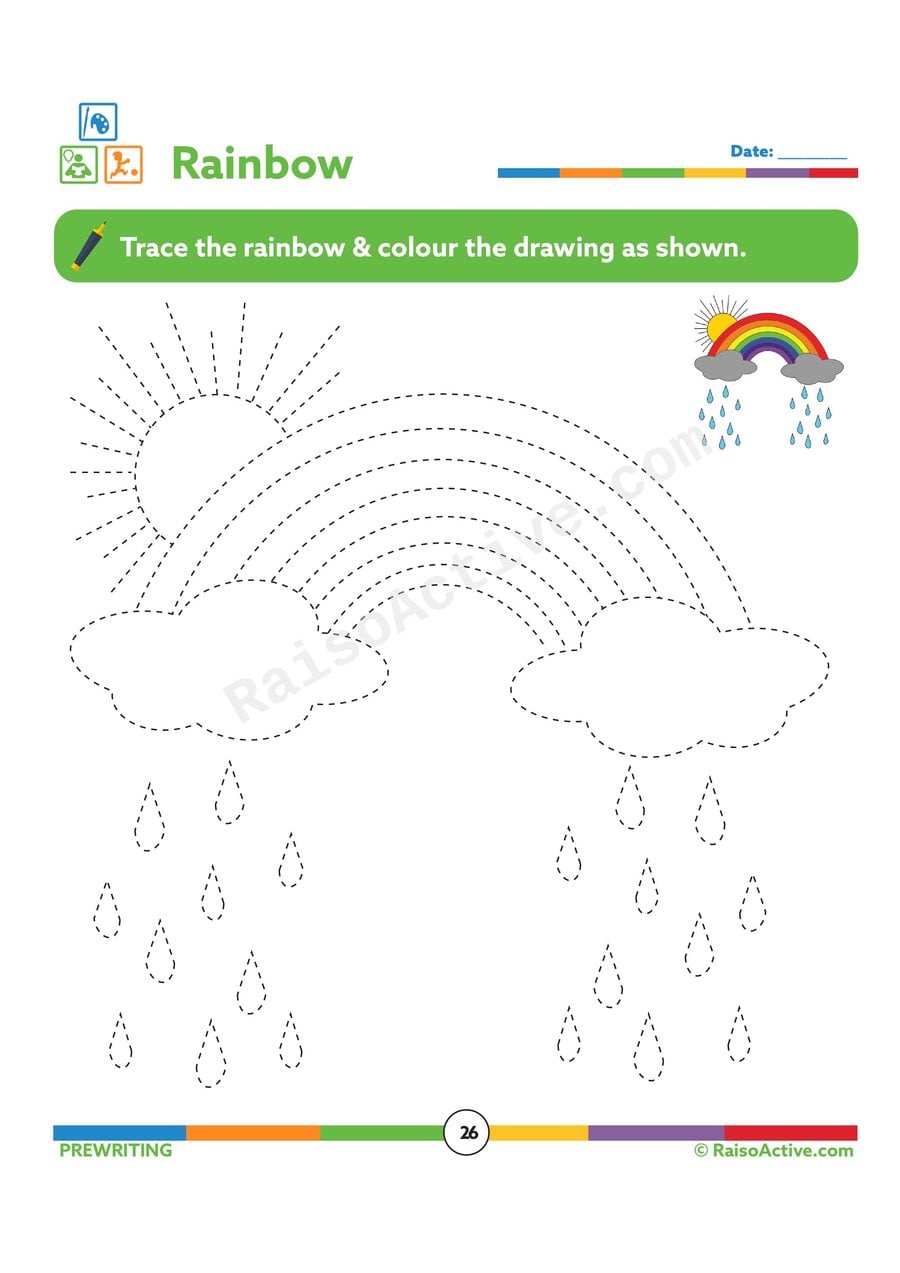
Trace the Rainbow Worksheet for Preschoolers
Ages 3-5 · Preschool–Pre-KAges 3-5 · Nursery–ReceptionAges 3-5 · Nursery–LKGAges 3-5
Tracing the concentric arcs of a rainbow gives children ages 3-5 practice with several nested curved lines of increasing size, a step up from tracing a single curve because each new arc has to sit a consistent distance from the one before it. Coloring the bands afterward also introduces simple color naming and sequencing, since rainbow colors typically appear in the same recognizable order.

Trace the Moon: A Prewriting Worksheet for Young Learners
Ages 3-6 · Preschool–KindergartenAges 3-6 · Nursery–Year 1Ages 3-6 · Nursery–UKGAges 3-6
Tracing the curved outline of the moon gives children ages 3-6 practice with the smooth, rounded strokes that later support letters like c and o, while the night-sky theme introduces early vocabulary about the moon, stars, and sky. Because the age range spans preschool into early elementary, this worksheet works well for revisiting pencil control at a slightly more advanced level than straight-line tracing alone.

Trace the Curved Lines: Give Balloons to the Girls! Worksheet
Ages 3-5 · Preschool–Pre-KAges 3-5 · Nursery–ReceptionAges 3-5 · Nursery–LKGAges 3-5
This worksheet has children ages 3-5 trace curved balloon strings, practicing the rounded, flowing pencil motion needed later for letters like c, o, and s. Curved lines demand a different wrist and finger movement than straight lines, since the hand has to continuously adjust direction rather than pushing in one line, which makes this an important complement to straight-line tracing practice.
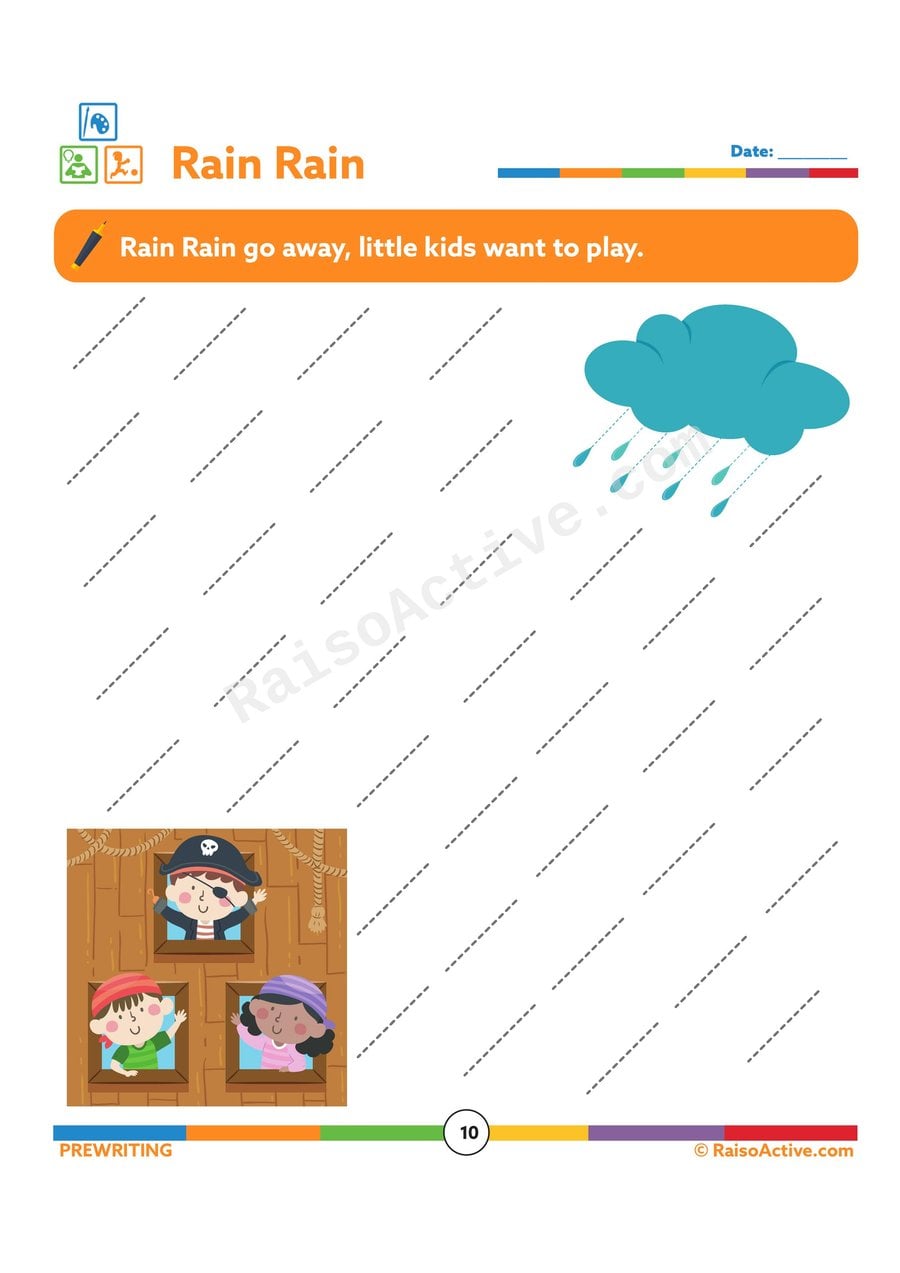
Rain Rain Tracing Worksheet for Preschoolers
Ages 3-5 · Preschool–Pre-KAges 3-5 · Nursery–ReceptionAges 3-5 · Nursery–LKGAges 3-5
Tracing rain-themed curved or drip-shaped lines gives children ages 3-5 practice with the smooth, flowing pencil motion used in curved letters, while the weather theme introduces simple vocabulary about rain and rain clouds. Tying the tracing motion to something children have actually seen, rain falling outside, helps make an abstract curved line feel like a familiar, recognizable shape.
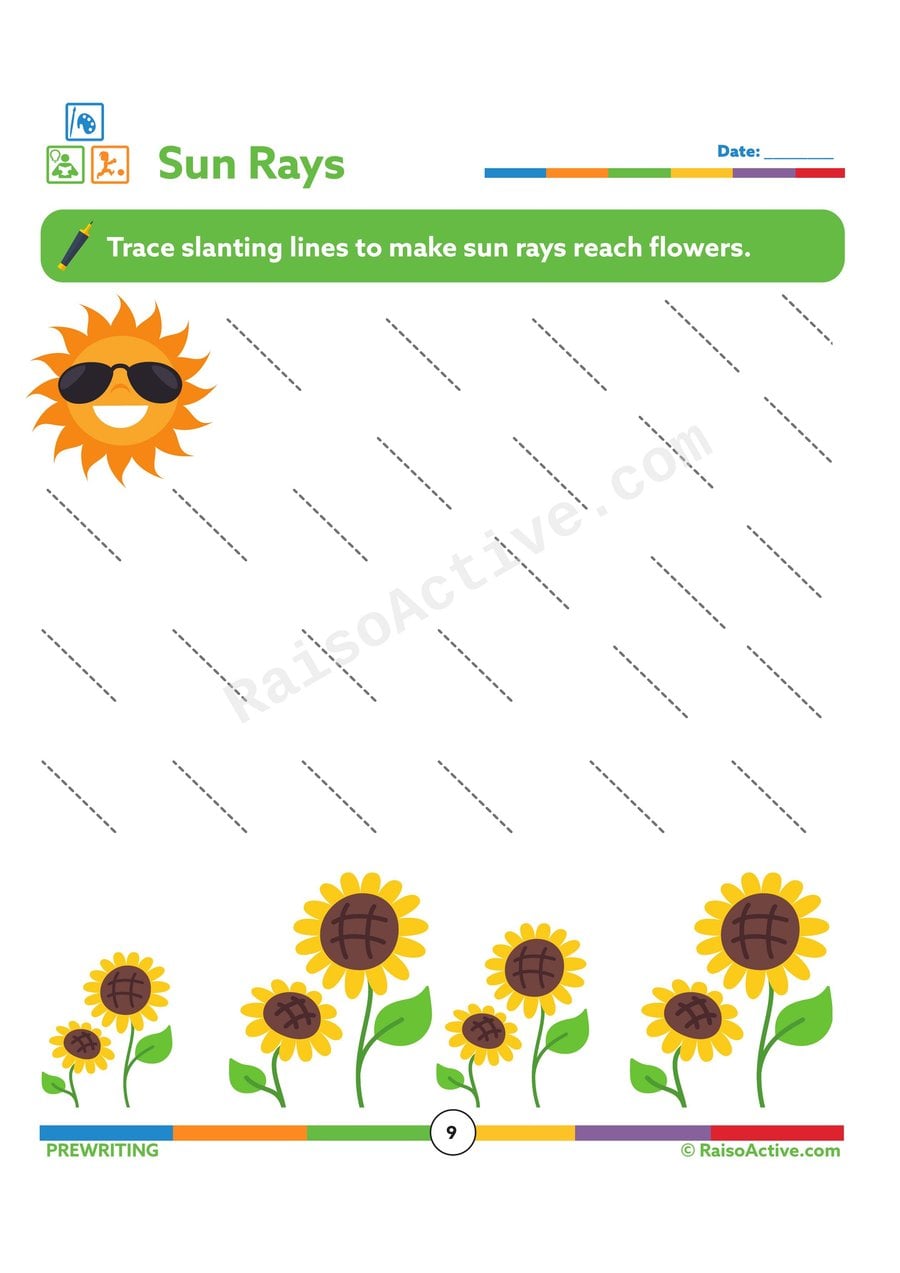
Sun Ray Tracing Worksheet for Preschoolers
Ages 3-5 · Preschool–Pre-KAges 3-5 · Nursery–ReceptionAges 3-5 · Nursery–LKGAges 3-5
Tracing sun rays radiating outward from a circular center gives children ages 3-5 practice changing pencil direction repeatedly within one page, since each ray points a different way from the center, unlike a worksheet where every line runs the same direction. This builds flexible wrist and hand control, along with early spatial awareness of how lines can radiate outward from a single point.
Guides for this topic

Activities That Help with Pencil Grip Development: A Complete Guide for Parents and Teachers
Discover fun, research-backed activities to develop pencil grip in young children. Age-wise exercises, play ideas, and expert tips for parents and teachers.
My Child Can't Trace Dotted Lines — What Activities Can Help? A Complete Guide to Pre-Writing Skills
Struggling to trace dotted lines? Learn why tracing is hard for young children, which skills must come first, and the best activities to build pre-writing readiness.

What's the Right Age for My Child to Start Writing? A Developmental Guide for Parents
Discover the right age for children to start writing, developmental milestones from scribbling to letters, and why rushing can backfire — with activities that help.
Reviews
Every worksheet for ages 3–5, no watermark
Members download the full library of 1,000+ worksheets and every activity pack without watermarks or daily limits. One year costs ₹999 in India or $20 elsewhere.
See membership plansOr download any worksheet free with a watermark (5 a day).