Trace the Curved Lines: Give Balloons to the Girls! Worksheet
This worksheet has children ages 3-5 trace curved balloon strings, practicing the rounded, flowing pencil motion needed later for letters like c, o, and s. Curved lines demand a different wrist and finger movement than straight lines, since the hand has to continuously adjust direction rather than pushing in one line, which makes this an important complement to straight-line tracing practice.
Part of the pack
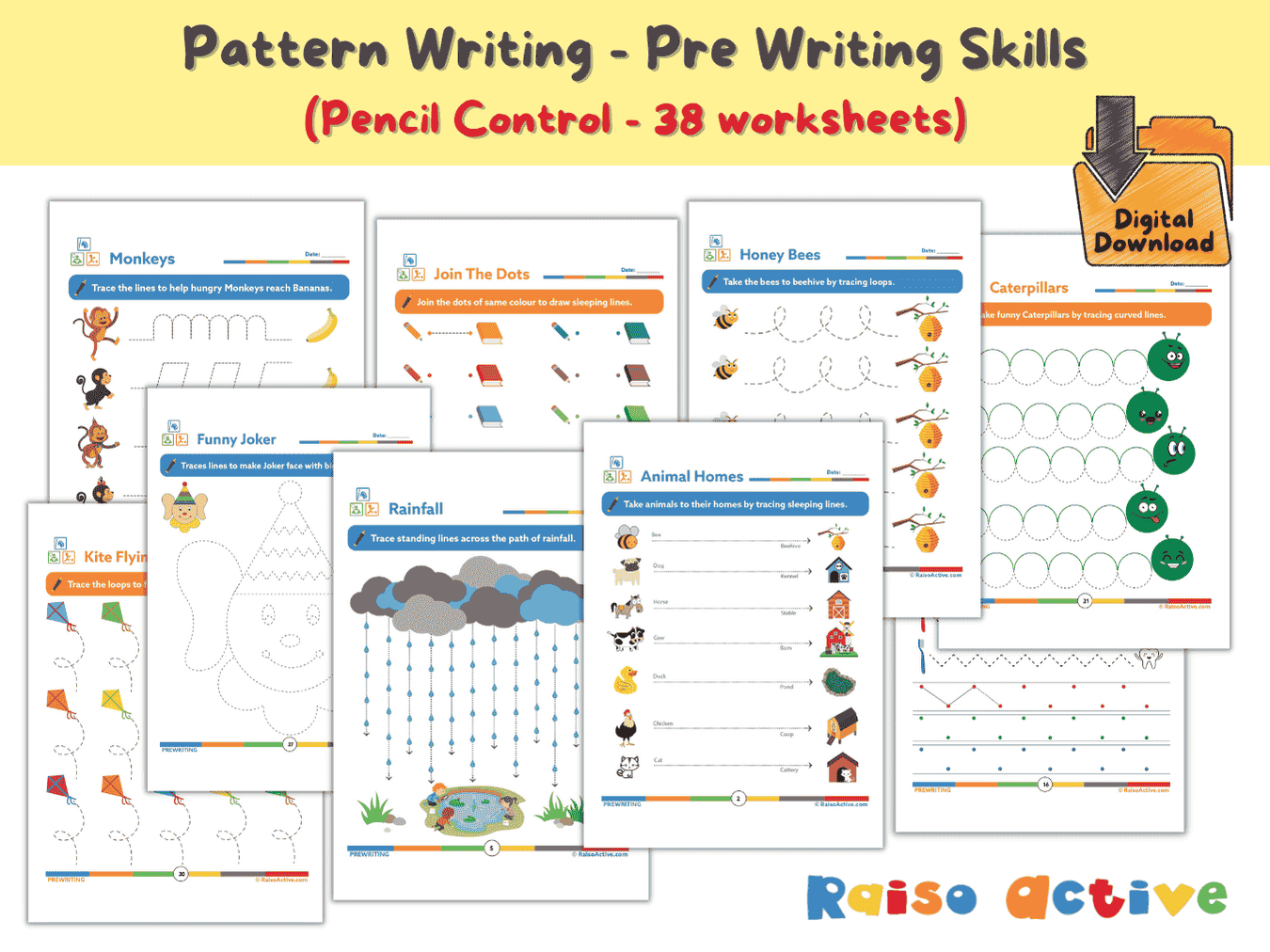
Pattern Writing Pre-writing Skills Activity Book for 3-4 Year Olds
This is page 22 of the pack. Ages 3-4 · PreschoolAges 3-4 · NurseryAges 3-4
Made for your child
A whole activity pack made with their name
60 pages to spot, build, trace and write their own name, plus pages about their favourites, feelings and family. See a free preview with their name.
Make an All About Me packFree preview · free for members
Or start free: a name tracing sheet with their nameCurriculum
- Pre-Writing > Curved Lines
How to use this worksheet
Point out the balloons and the girls waiting to hold them, explaining that each curved line is the string connecting them. Have your child trace the dotted curved line slowly with a pencil or crayon, following the bend of the string from balloon to hand. If a line comes out jagged, let them try tracing it again rather than moving on right away. Finish by coloring the balloons different colors once every string is traced.
Materials needed
- Pencil
- Crayons
Extension activities
- 1Paint curved balloon-string shapes using a paintbrush, encouraging smooth, unbroken strokes.
- 2Draw a giant curved line with sidewalk chalk and have your child hop or walk along its curve.
- 3Trace curved shapes in the air with a finger before picking up a pencil again.
- 4Fill a tray with sand or salt and practice drawing curved lines with a fingertip.
- 5Toss and catch a real balloon together, then count how many tosses you can do in a row.

Written by
Hemsweta Jain · Teacher Cheena
MBA and Early Childhood Educator, teaching since 2014 · Founder of RaisoActive, Mumbai
Every RaisoActive worksheet is designed and checked by the founder before publishing.
Published · Last reviewed
More from Pattern Writing Pre-writing Skills Activity Book for 3-4 Year Olds

Smile with Smiley Face! A Fun Tracing Worksheet for Preschoolers
Ages 3-5 · Preschool–Pre-KAges 3-5 · Nursery–ReceptionAges 3-5 · Nursery–LKGAges 3-5
Tracing a smiling mouth teaches children ages 3-5 the upward curved stroke used in letters like u and later cursive forms, while also tying that curve to something personally meaningful, a smile. Because the shape mirrors an expression children make and recognize every day, this worksheet connects fine motor practice to social-emotional awareness about what a smile looks like and means.

Pre-Writing Skills Practice Worksheet for Preschoolers
Ages 3-5 · Preschool–Pre-KAges 3-5 · Nursery–ReceptionAges 3-5 · Nursery–LKGAges 3-5
This general pre-writing practice worksheet has children ages 3-5 work through a mix of stroke types, likely lines, curves, and simple shapes, in one sitting, giving a broad review of the foundational motions used across nearly all letters and numbers. Practicing several different stroke types together, rather than focusing on just one, helps consolidate pre-writing readiness as a whole rather than skill by skill.

Trace the Train Engine Worksheet for Preschoolers
Ages 3-5 · Preschool–Pre-KAges 3-5 · Nursery–ReceptionAges 3-5 · Nursery–LKGAges 3-5
Tracing the shapes that make up a train engine, like rectangles for the body and circles for the wheels, gives children ages 3-5 practice with mixed straight and curved strokes while reinforcing the idea that complex objects are built from combinations of simple shapes. The train theme also introduces sequencing awareness, since trains are made of connected cars that follow one after another along a track.

Pattern Writing Pre-writing Skills Activity Book for 3-4 Year Olds - Page 17
Ages 3-4 · PreschoolAges 3-4 · NurseryAges 3-4
This page from the pre-writing patterns activity book asks 3-4 year olds to continue a repeating stroke pattern, which trains their brain to predict what comes next in a visual sequence before their hand draws it. That predicting-then-executing process is a form of early motor planning, the same skill that later lets a child anticipate the next stroke needed to form a letter without stopping to think about each individual line.
Trace the Rainbow Worksheet for Preschoolers
Ages 3-5 · Preschool–Pre-KAges 3-5 · Nursery–ReceptionAges 3-5 · Nursery–LKGAges 3-5
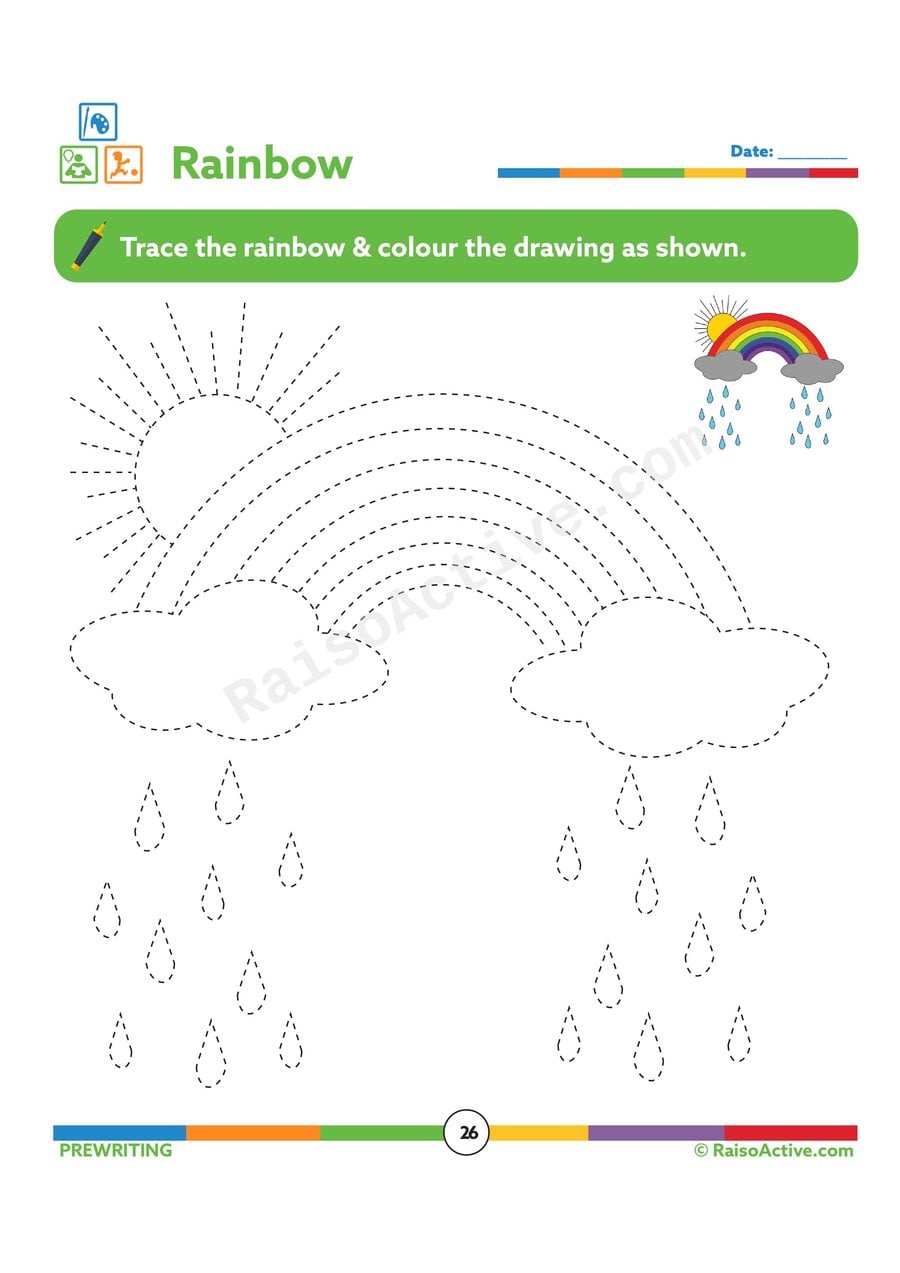
Tracing the concentric arcs of a rainbow gives children ages 3-5 practice with several nested curved lines of increasing size, a step up from tracing a single curve because each new arc has to sit a consistent distance from the one before it. Coloring the bands afterward also introduces simple color naming and sequencing, since rainbow colors typically appear in the same recognizable order.

Pattern Writing Pre-writing Skills Activity Book for 3-4 Year Olds - Page 19
Ages 3-4 · PreschoolAges 3-4 · NurseryAges 3-4
This page from the pre-writing patterns activity book asks 3-4 year olds to keep their pencil pressure steady and consistent while repeating a stroke across a full row, a subtler skill than simply getting the shape right. Learning to apply even, moderate pressure prevents the tearing or overly faint lines common in early writing attempts, and this kind of repeated practice builds that control gradually.

Community Helpers Matching Worksheet for Preschoolers
Ages 3-5 · Preschool–Pre-KAges 3-5 · Nursery–ReceptionAges 3-5 · Nursery–LKGAges 3-5
By tracing a line from each community helper to the tool or vehicle they use, children ages 3-5 practice pencil control while learning the beginnings of social studies: that people in their community have different jobs and different equipment to do them. Pairing a firefighter with a fire truck or a doctor with a stethoscope also builds cause-and-effect thinking about why each helper needs that particular item.

Trace the Bouncy Balls Worksheet for Preschoolers
Ages 3-5 · Preschool–Pre-KAges 3-5 · Nursery–ReceptionAges 3-5 · Nursery–LKGAges 3-5
Tracing the arcing path of a bouncy ball helps children ages 3-5 practice curved pencil strokes while connecting the drawn line to a real physical motion they already understand, a bounce. Linking an abstract line on paper to something they've seen and felt makes the curved stroke easier to grasp than tracing an unfamiliar shape, and it builds the same rounded control needed for letters and numbers later on.
Related worksheets
Curved Lines Tracing Worksheet for Preschoolers
Ages 3-5 · Preschool–Pre-KAges 3-5 · Nursery–ReceptionAges 3-5 · Nursery–LKGAges 3-5
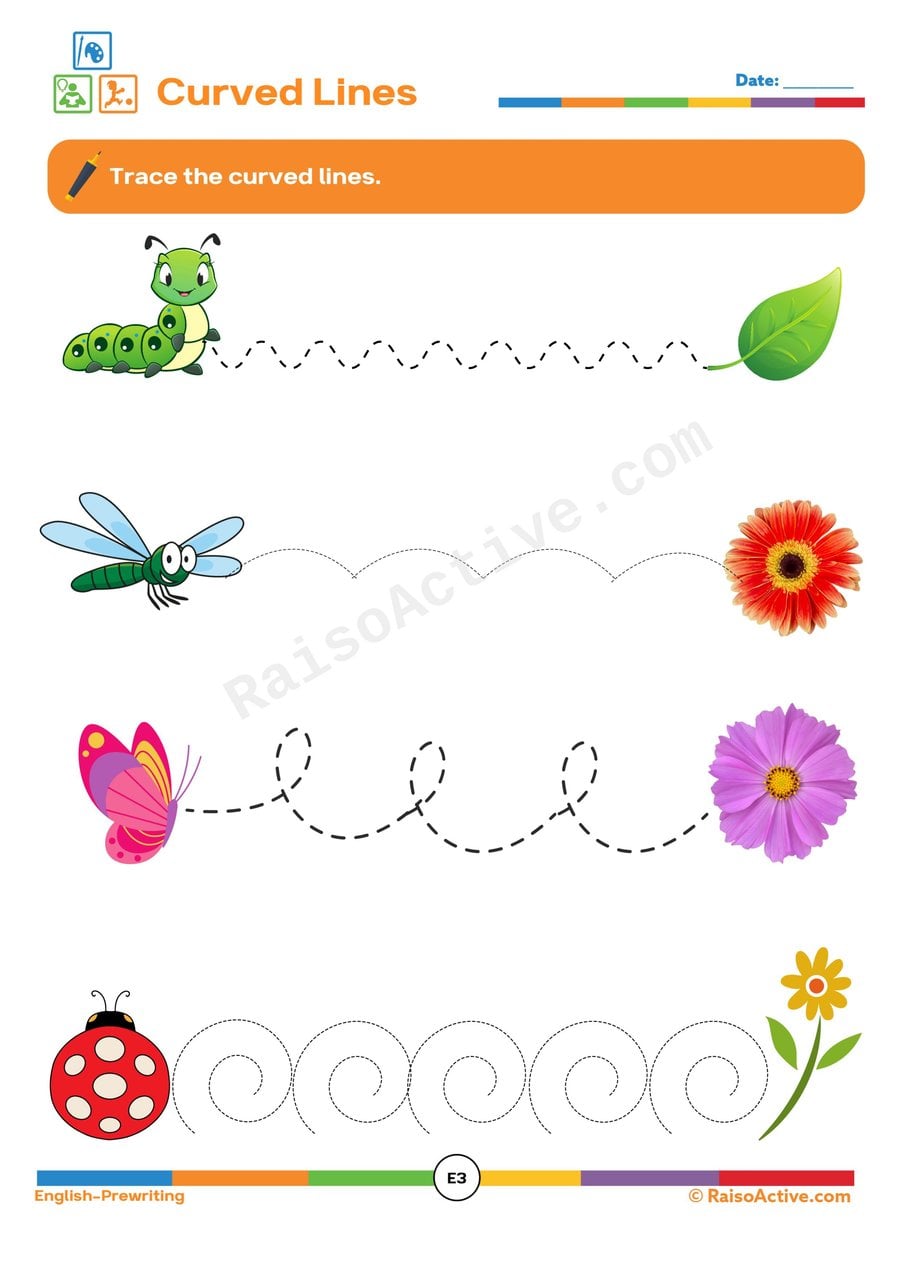
Children ages 3-5 practice tracing curved lines in various directions, building the specific hand-eye coordination and wrist flexibility needed to later form curved letters like c, o, and s. Curved-line control is a distinct pre-writing skill from straight-line tracing, since it requires a smoother, more continuous pencil motion.

Decorate the Christmas Tree! Cut and Paste Worksheet
Ages 3-5 · Preschool–Pre-KAges 3-5 · Nursery–ReceptionAges 3-5 · Nursery–LKGAges 3-5
This cut-and-paste activity builds scissor control and hand strength in children ages 3-5 as they snip out ornaments, stars, and lights to decorate their own Christmas tree. Deciding where each decoration goes also develops spatial planning and following a visual guide, since children compare their tree to the sample image while placing pieces.
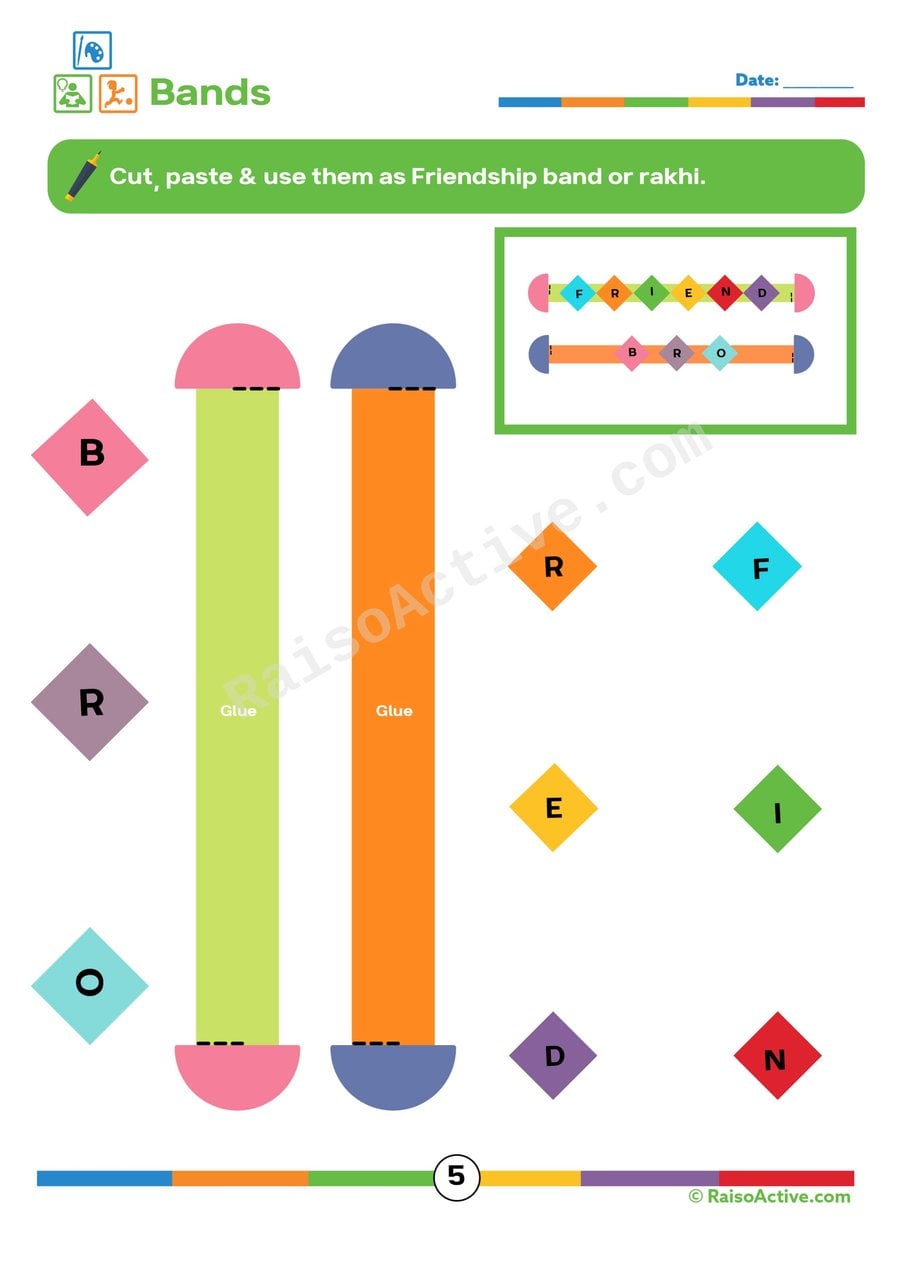
Friendship Band Craft Worksheet for Kids
Ages 3-5 · Preschool–Pre-KAges 3-5 · Nursery–ReceptionAges 3-5 · Nursery–LKGAges 3-5
This worksheet builds fine motor precision as children ages 3-5 cut out individual shapes and glue them onto a paper strip in a sequence of their choosing, creating a personalized friendship band or rakhi. Deciding where each shape goes along the strip also introduces early spatial planning and pattern-making, since children must space the shapes evenly to fill the band.

Reindeer Craft: Follow Instructions and Create a Festive Decoration!
Ages 3-5 · Preschool–Pre-KAges 3-5 · Nursery–ReceptionAges 3-5 · Nursery–LKGAges 3-5
This multi-step reindeer craft has children ages 3-5 follow a sequence of folding and assembly instructions to build a three-dimensional decoration, strengthening both listening comprehension and the fine motor skills needed to position and attach small pieces accurately. Because each step depends on the one before it, children also practice patience and sequencing, skills that carry over into following any multi-step task.

Learn the Sight Word 'Is' - Tracing and Writing Worksheet for Preschoolers
Ages 4-5 · Pre-KAges 4-5 · ReceptionAges 4-5 · LKGAges 4-5
This worksheet helps children ages 4-5 build instant recognition of the sight word 'is' through a layered sequence of tracing, independent writing, sentence fill-in, coloring, and letter-order cut-and-paste practice. Because 'is' can't easily be sounded out using typical phonics rules, repeated multi-format exposure like this is exactly what helps a sight word move into a child's automatic reading vocabulary. Using the word inside real sentence blanks also connects the isolated word to meaningful, functional reading.

Color Santa Claus for Christmas! A Fun Coloring Worksheet
Ages 3-5 · Preschool–Pre-KAges 3-5 · Nursery–ReceptionAges 3-5 · Nursery–LKGAges 3-5
This Santa Claus coloring page lets children ages 3-5 practice crayon control and color selection on a large, familiar holiday figure, building confidence with fine motor coloring skills before moving to smaller or more detailed pictures. Choosing colors for Santa's suit, hat, and beard also opens up conversation about the holiday season and familiar seasonal symbols.
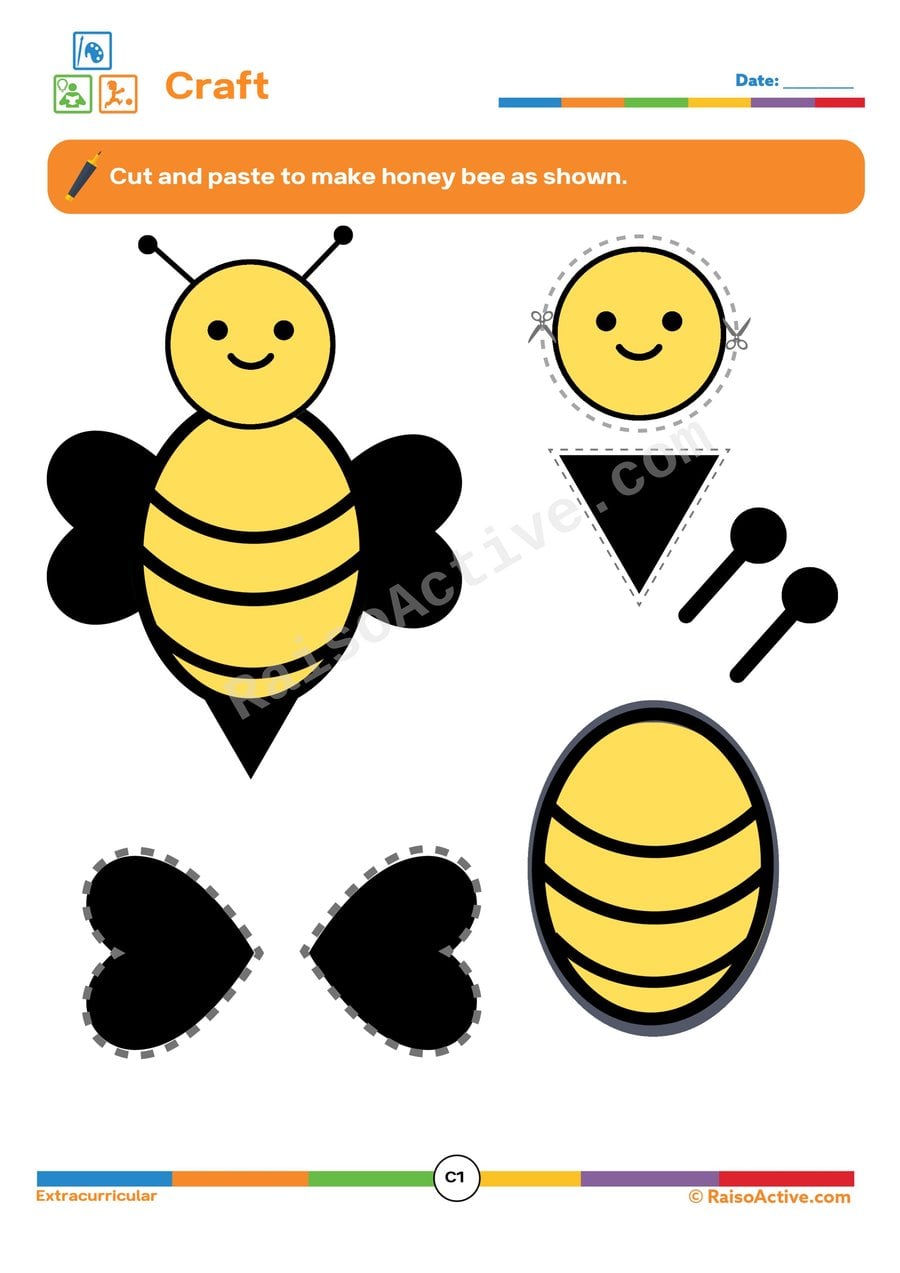
Honey Bee Craft Worksheet: Cut and Paste Fun!
Ages 3-5 · Preschool–Pre-KAges 3-5 · Nursery–ReceptionAges 3-5 · Nursery–LKGAges 3-5
This honey bee craft gives children ages 3-5 targeted practice with scissor control as they cut along dotted lines to separate bee body parts, then reassemble them by pasting into a complete bee shape. Because the pieces must be cut accurately to fit together correctly afterward, this activity demands more precision than simple free-cutting practice. Assembling a multi-piece figure also reinforces spatial reasoning, since children have to recognize how each cut piece relates to the whole.

Letter T Tracing and Coloring Worksheet for Preschoolers
Ages 3-5 · Preschool–Pre-KAges 3-5 · Nursery–ReceptionAges 3-5 · Nursery–LKGAges 3-5
This worksheet helps children ages 3-5 build the fine motor control and directional awareness needed to form the letter T correctly, tracing both its uppercase and lowercase forms along guided dotted lines. Repeated tracing builds the muscle memory in small hand muscles that eventually allows children to write letters independently without a guide. Coloring pictures that begin with T and hunting for the letter in a grid also reinforce letter-sound and letter-shape recognition side by side.
Guides for this topic

Pre-Writing Strokes in Order: From Standing Lines to Loops (With Printable Patterns)
The developmental order of pre-writing strokes, from vertical lines to loops, and why practicing them in sequence makes letter formation much easier to learn.

Portfolio Assessment with Young Children: A Comprehensive Guide to Meaningful Documentation
Learn how portfolio assessment captures your child's growth through meaningful documentation. Practical tips, templates, and age-appropriate strategies for ages 1-8.
What Makes a Good Worksheet vs. a Poor One: A Parent's Guide to Quality Educational Materials
Learn what separates high-quality educational worksheets from poor busy work. Discover design principles, red flags, and how to evaluate free worksheets online for your child aged 1-8.
Reviews
Every worksheet for ages 3–5, no watermark
Members download the full library of 1,000+ worksheets and every activity pack without watermarks or daily limits. One year costs ₹999 in India or $20 elsewhere.
See membership plansOr download any worksheet free with a watermark (5 a day).