Pattern Writing Pre-writing Skills Activity Book for 3-4 Year Olds - Page 17
This page from the pre-writing patterns activity book asks 3-4 year olds to continue a repeating stroke pattern, which trains their brain to predict what comes next in a visual sequence before their hand draws it. That predicting-then-executing process is a form of early motor planning, the same skill that later lets a child anticipate the next stroke needed to form a letter without stopping to think about each individual line.
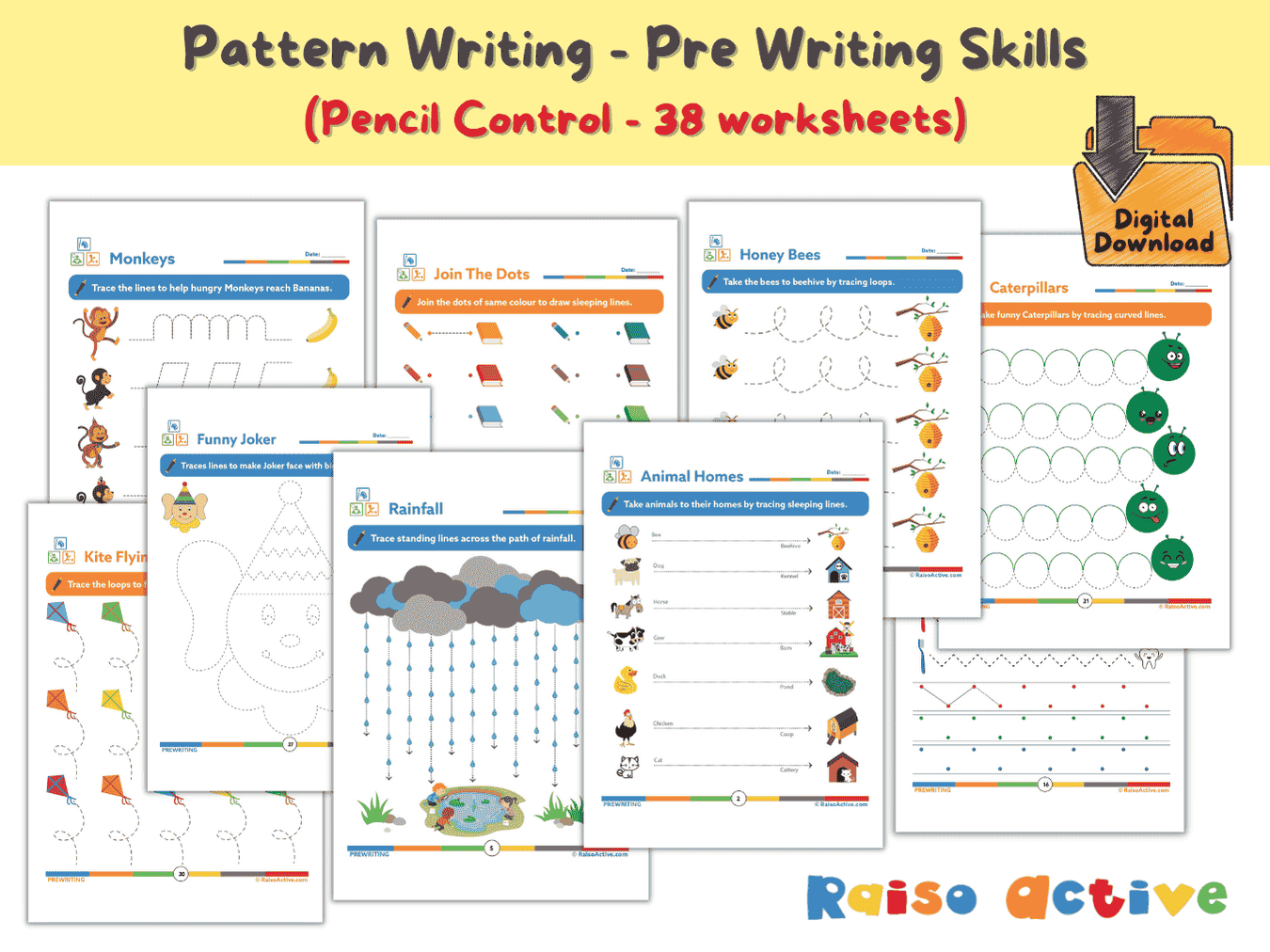
Part of the pack
Pattern Writing Pre-writing Skills Activity Book for 3-4 Year Olds
This is page 17 of the pack. Ages 3-4 · PreschoolAges 3-4 · NurseryAges 3-4
Made for your child
A whole activity pack made with their name
60 pages to spot, build, trace and write their own name, plus pages about their favourites, feelings and family. See a free preview with their name.
Make an All About Me packFree preview · free for members
Or start free: a name tracing sheet with their nameCurriculum
- Pre-Writing > Straight Lines
How to use this worksheet
Look at the beginning of the pattern together and ask your child to describe what they see repeating before picking up a pencil. Have them trace over the existing pattern first so their hand learns the rhythm of the motion. Once they've traced a few repetitions, encourage them to continue the pattern on their own into the blank space at the end of the row. Check in partway through rather than only at the end, since patterns tend to drift the longer a child draws unsupervised.
Extension activities
- 1Clap out a simple repeating rhythm, like clap-stomp-clap-stomp, and have your child continue it.
- 2String beads onto a lace in a repeating color pattern, like red-blue-red-blue.
- 3Draw a large version of the same pattern on paper with a big crayon so your child can practice the arm motion at full scale.
- 4Arrange snacks like crackers and grapes in an alternating pattern and ask your child to keep it going.
- 5Trace the pattern again in a tray of rice or sand to reinforce the motion without a pencil.

Written by
Hemsweta Jain · Teacher Cheena
MBA and Early Childhood Educator, teaching since 2014 · Founder of RaisoActive, Mumbai
Every RaisoActive worksheet is designed and checked by the founder before publishing.
Published · Last reviewed
More from Pattern Writing Pre-writing Skills Activity Book for 3-4 Year Olds
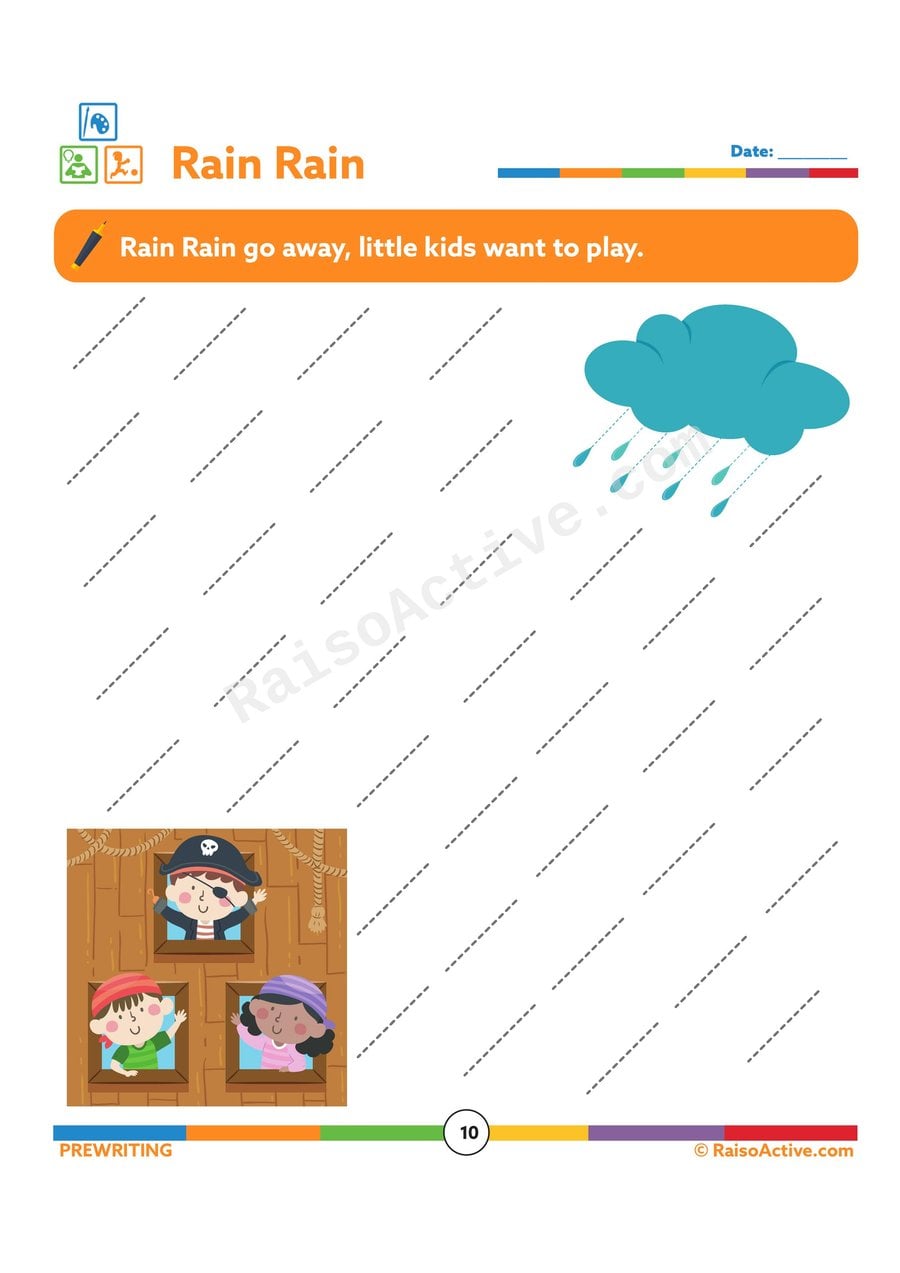
Rain Rain Tracing Worksheet for Preschoolers
Ages 3-5 · Preschool–Pre-KAges 3-5 · Nursery–ReceptionAges 3-5 · Nursery–LKGAges 3-5
Tracing rain-themed curved or drip-shaped lines gives children ages 3-5 practice with the smooth, flowing pencil motion used in curved letters, while the weather theme introduces simple vocabulary about rain and rain clouds. Tying the tracing motion to something children have actually seen, rain falling outside, helps make an abstract curved line feel like a familiar, recognizable shape.

Trace the Waves! A Pre-Writing Worksheet for Kids
Ages 3-5 · Preschool–Pre-KAges 3-5 · Nursery–ReceptionAges 3-5 · Nursery–LKGAges 3-5
Tracing a series of connected wave shapes gives children ages 3-5 practice with a smooth, undulating curve that rises and falls repeatedly, a stroke pattern that underlies letters like m, n, u, and w. Unlike a single curve, a wave line requires the hand to reverse direction multiple times in one continuous motion without lifting the pencil, building more sustained curve control than a shorter, single-curve worksheet.

Pre-Writing Skills Practice Worksheet for Preschoolers
Ages 3-5 · Preschool–Pre-KAges 3-5 · Nursery–ReceptionAges 3-5 · Nursery–LKGAges 3-5
This general pre-writing practice worksheet has children ages 3-5 work through a mix of stroke types, likely lines, curves, and simple shapes, in one sitting, giving a broad review of the foundational motions used across nearly all letters and numbers. Practicing several different stroke types together, rather than focusing on just one, helps consolidate pre-writing readiness as a whole rather than skill by skill.

My Book: A Fun Worksheet for Early Learners
Ages 3-5 · Preschool–Pre-KAges 3-5 · Nursery–ReceptionAges 3-5 · Nursery–LKGAges 3-5
Writing their own name on the cover of something they made gives a 3-5 year old a real, motivating reason to practice name-writing — a very different feeling from tracing letters on a generic worksheet. It's often one of the first pieces of writing a child feels ownership over, which matters for building confidence around writing in general.

Fly Airplanes Tracing Worksheet for Preschoolers
Ages 3-5 · Preschool–Pre-KAges 3-5 · Nursery–ReceptionAges 3-5 · Nursery–LKGAges 3-5
Unlike letter tracing, this worksheet has children follow long, curving flight-path lines from a globe down to the ground, which builds sustained hand-eye coordination and the ability to keep a pencil moving smoothly over a longer distance than a single letter requires. For 3-5 year olds, this kind of extended line tracing is an important bridge between short scribbles and the longer, controlled strokes needed for writing full letters and words.

Trace the Funny Caterpillars Worksheet for Preschoolers
Ages 3-5 · Preschool–Pre-KAges 3-5 · Nursery–ReceptionAges 3-5 · Nursery–LKGAges 3-5
Tracing the rounded segments that make up each caterpillar's body helps children ages 3-5 practice circular and curved pencil strokes while also reinforcing shape recognition, since each segment is essentially a circle or oval joined to the next. This combination of shape tracing and sequencing, moving from one segment to the next in order, builds the same left-to-right, in-order habits that later support reading and writing.
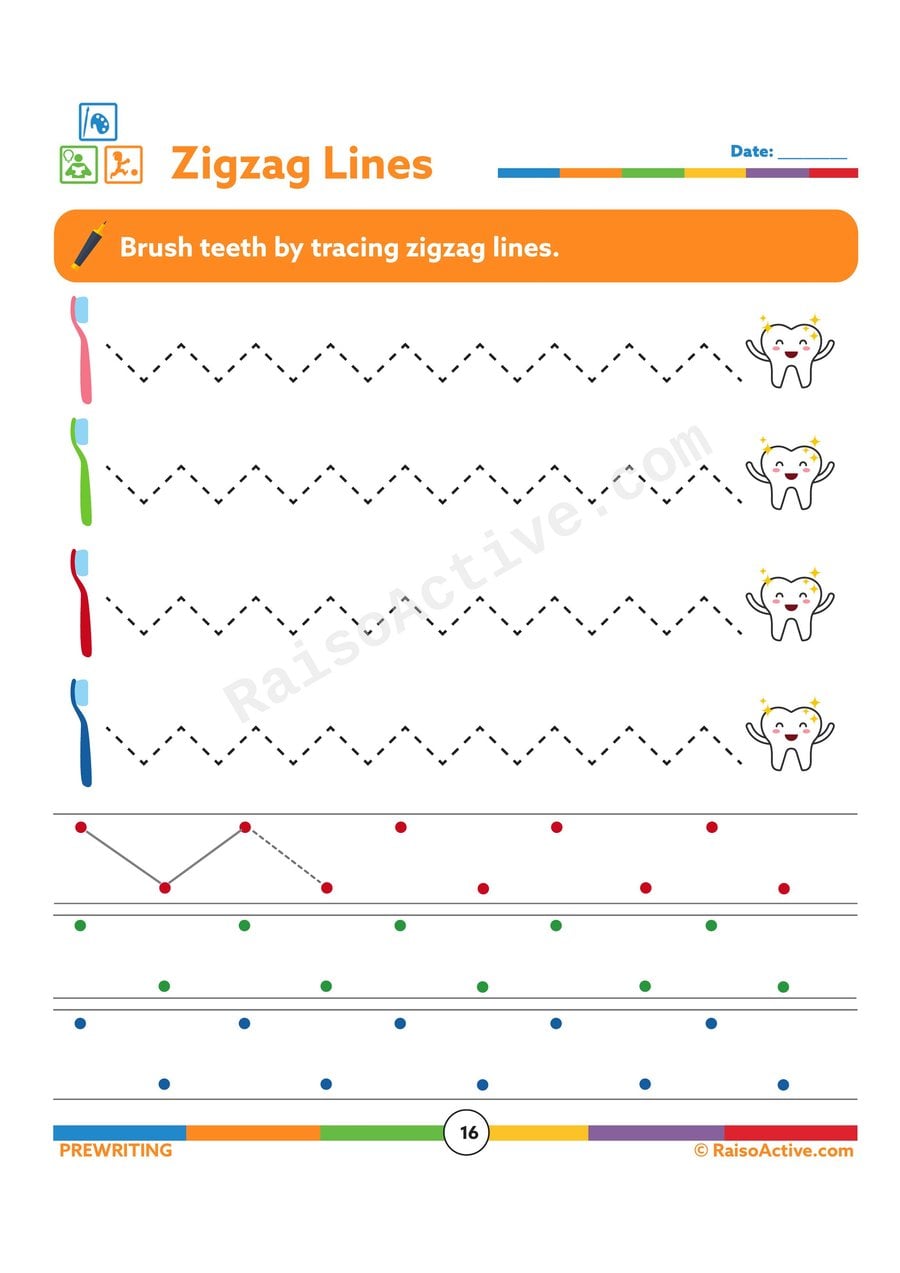
Zigzag Lines Tracing Worksheet: Brush Your Teeth!
Ages 3-5 · Preschool–Pre-KAges 3-5 · Nursery–ReceptionAges 3-5 · Nursery–LKGAges 3-5
Tracing a zigzag line representing a toothbrush's back-and-forth motion gives children ages 3-5 practice with sharp direction changes, a stroke pattern used in letters like Z, W, and M, while tying the abstract line shape to a real daily action, brushing teeth, they already understand. Zigzag lines are more demanding than smooth curves or straight lines because the pencil has to change direction abruptly and repeatedly rather than flowing continuously.

Pattern Writing Pre-writing Skills Activity Book for 3-4 Year Olds - Page 11
Ages 3-4 · PreschoolAges 3-4 · NurseryAges 3-4
This page from the pre-writing patterns activity book strengthens hand and finger muscles for 3-4 year olds through repeated stroke motions, building the physical stamina and grip strength a child needs before sustained handwriting becomes comfortable. Repeating the same basic movement many times across a row also builds muscle memory, so the motion starts to feel automatic rather than something the child has to consciously plan each time.
Related worksheets
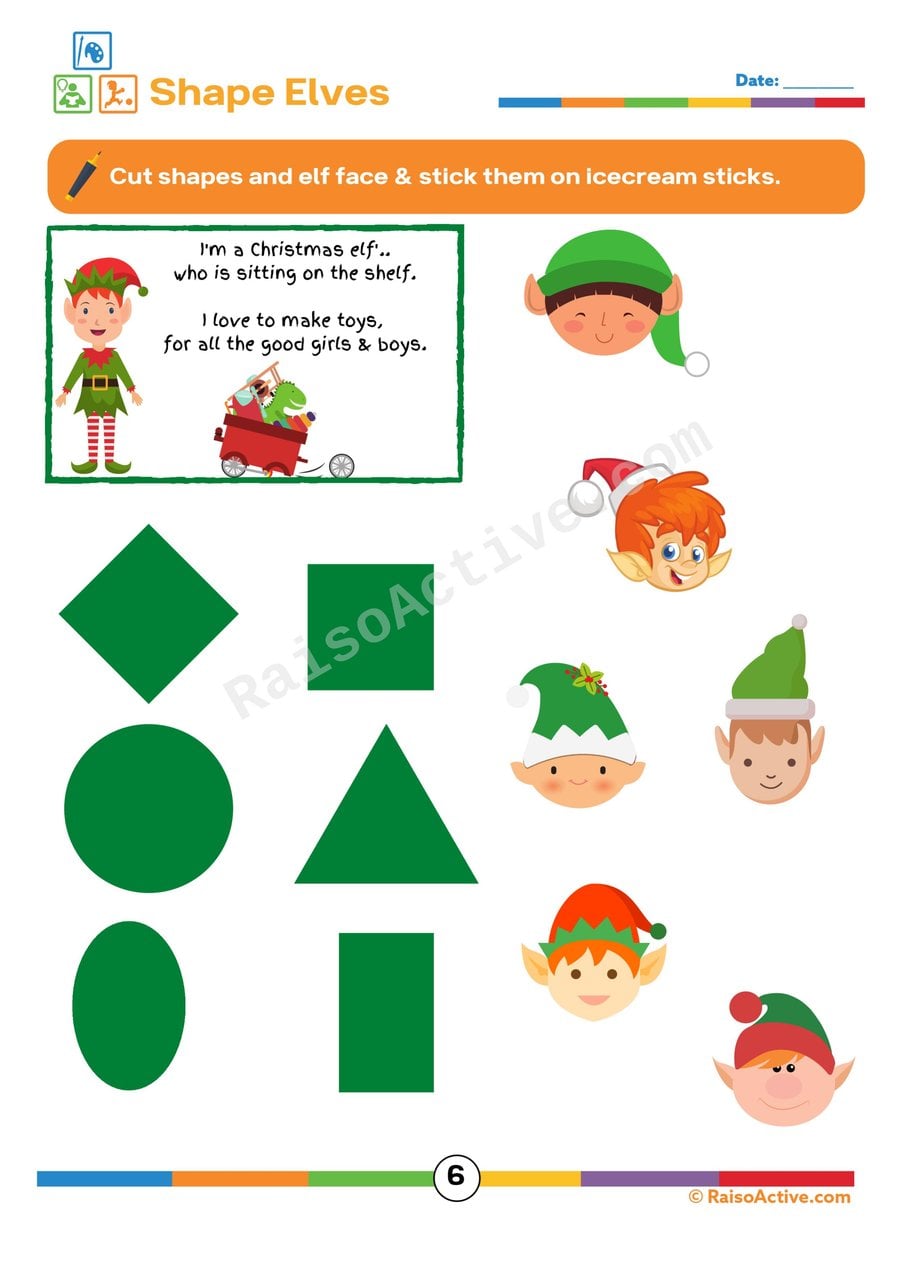
Shape Elves Worksheet: Cut, Paste, and Create!
Ages 3-5 · Preschool–Pre-KAges 3-5 · Nursery–ReceptionAges 3-5 · Nursery–LKGAges 3-5
Cutting out circles, triangles, and rectangles to assemble an elf face teaches children ages 3-5 to recognize and name basic 2D shapes while practicing scissor control along both straight and curved lines. Because each shape has to go in a specific spot to form a recognizable face, children also build spatial reasoning as they figure out which shape works as eyes, a nose, or a hat. Turning geometry into a craft project makes an abstract math concept feel like creative play.
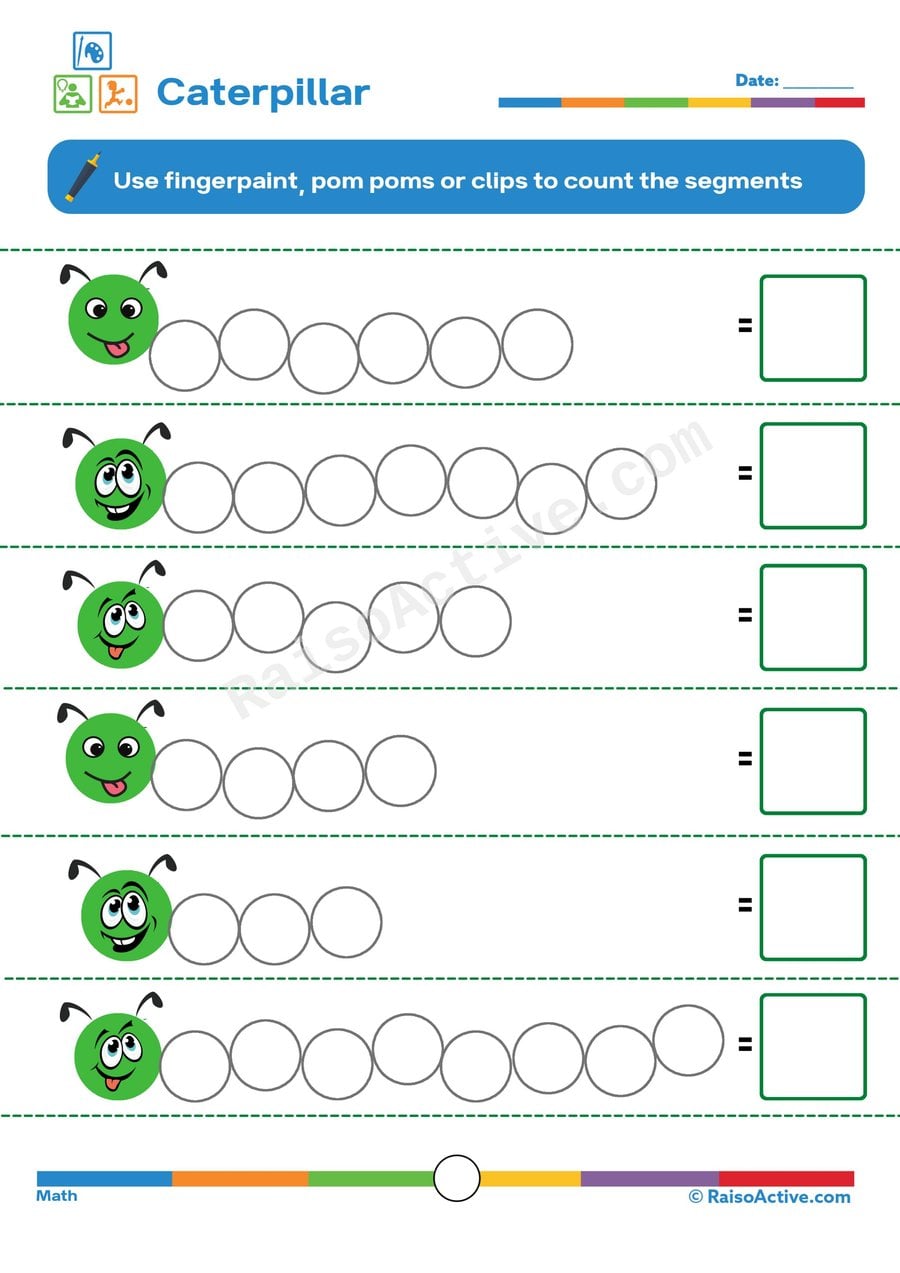
Caterpillar Counting Worksheet for Preschoolers
Ages 3-5 · Preschool–Pre-KAges 3-5 · Nursery–ReceptionAges 3-5 · Nursery–LKGAges 3-5
Counting the segments of each caterpillar teaches children ages 3-5 one-to-one correspondence — touching or marking each segment exactly once while saying a number — which is the core skill underlying accurate counting. Writing the final total in a box also connects the physical act of counting to its written numeral, reinforcing early number-writing practice.
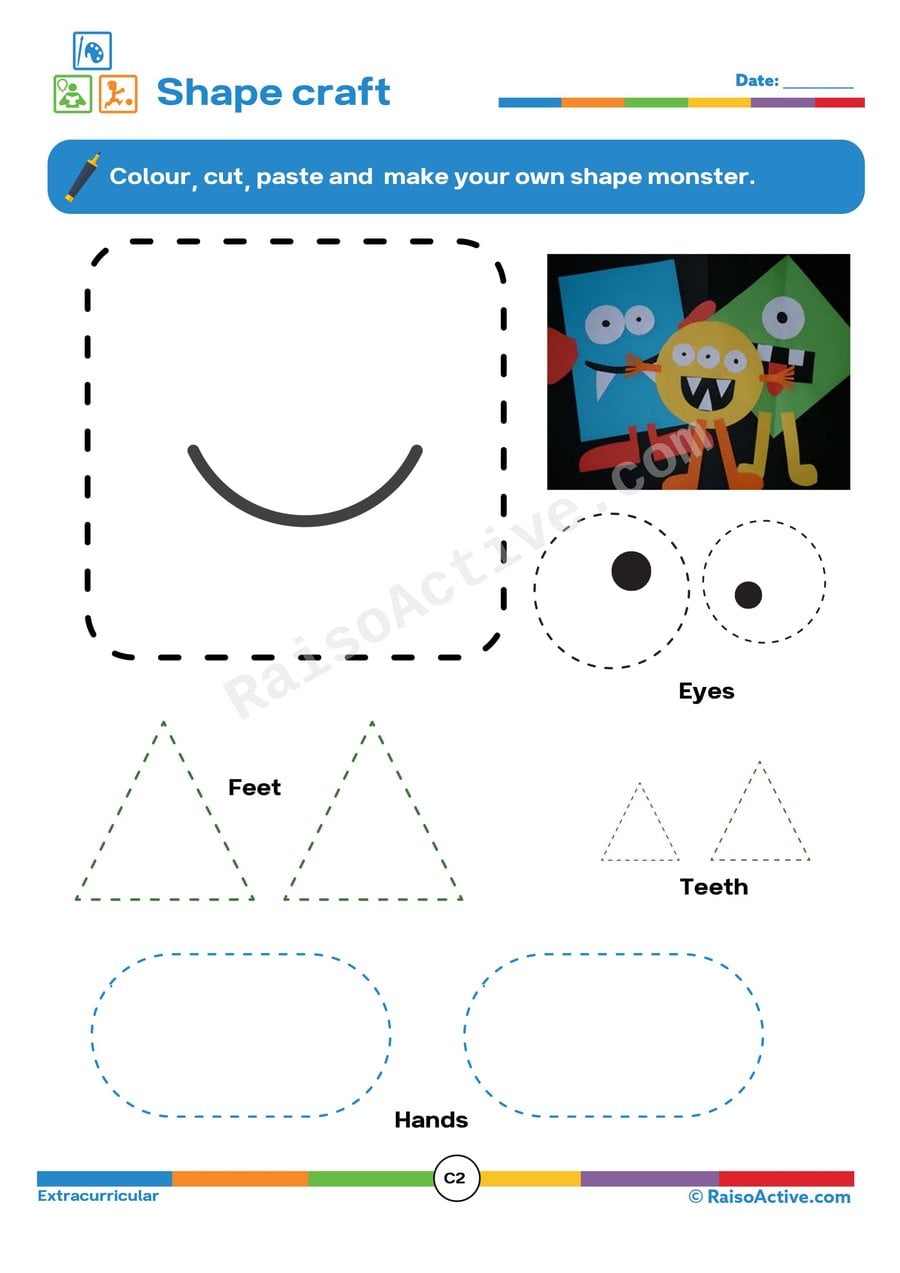
Shape Monster Craft Worksheet for Preschoolers
Ages 3-5 · Preschool–Pre-KAges 3-5 · Nursery–ReceptionAges 3-5 · Nursery–LKGAges 3-5
Coloring, cutting, and gluing shape pieces to build a monster teaches children ages 3-5 to recognize basic 2D shapes, like circles, triangles, and squares, while practicing scissor control along different edge types. Because the shapes need to be arranged in a specific way to form a recognizable monster face and body, this activity also builds spatial reasoning as children decide where each piece belongs. Turning geometry practice into a silly monster craft keeps repetitive shape work feeling like imaginative play rather than a math drill.
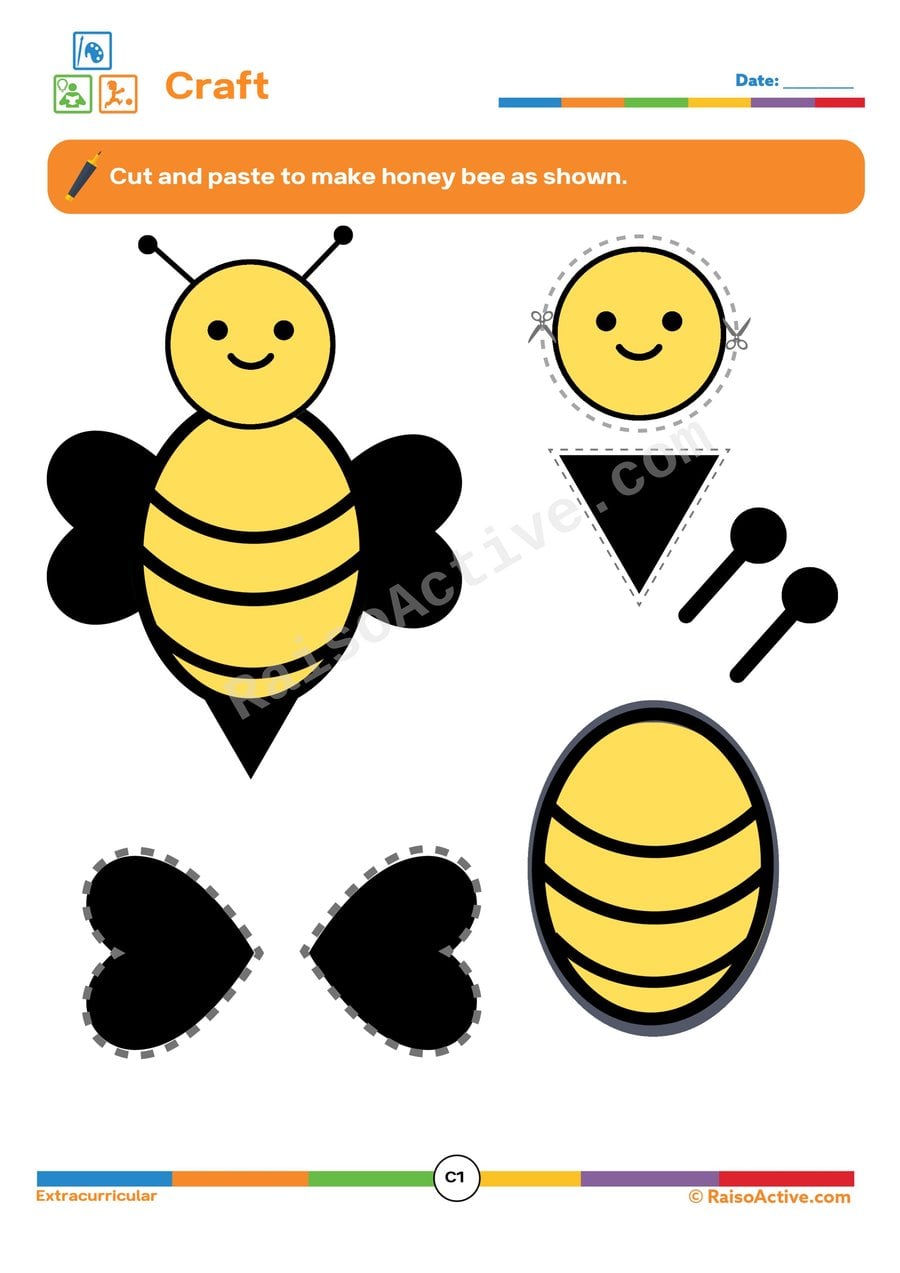
Honey Bee Craft Worksheet: Cut and Paste Fun!
Ages 3-5 · Preschool–Pre-KAges 3-5 · Nursery–ReceptionAges 3-5 · Nursery–LKGAges 3-5
This honey bee craft gives children ages 3-5 targeted practice with scissor control as they cut along dotted lines to separate bee body parts, then reassemble them by pasting into a complete bee shape. Because the pieces must be cut accurately to fit together correctly afterward, this activity demands more precision than simple free-cutting practice. Assembling a multi-piece figure also reinforces spatial reasoning, since children have to recognize how each cut piece relates to the whole.

Happy Face Cut and Paste Worksheet for Preschoolers
Ages 3-5 · Preschool–Pre-KAges 3-5 · Nursery–ReceptionAges 3-5 · Nursery–LKGAges 3-5
This worksheet helps children ages 3-5 learn the names of facial features while practicing scissor control and precise gluing. Assembling a face piece by piece — eyes, nose, mouth, ears — reinforces body part vocabulary in a hands-on way that's more memorable than simply pointing at a picture.

Color the Snowman! A Fun Coloring Worksheet for Kids
Ages 3-5 · Preschool–Pre-KAges 3-5 · Nursery–ReceptionAges 3-5 · Nursery–LKGAges 3-5
This worksheet helps children ages 3-5 practice fine motor control and creative choice while coloring a winter snowman scene. Because the image invites open-ended color decisions rather than following a strict code, it also builds confidence in making independent artistic choices.

Happy Easter Coloring Card Worksheet for Preschoolers
Ages 3-5 · Preschool–Pre-KAges 3-5 · Nursery–ReceptionAges 3-5 · Nursery–LKGAges 3-5
Coloring the Easter egg and bunny images on this fold-into-a-card worksheet gives children ages 3-5 practice with controlled crayon strokes and color choice, while the act of turning their artwork into a card for someone else introduces an early sense of purpose and gift-giving. Because the finished piece becomes a keepsake rather than just a worksheet, children also build pride and motivation to complete their coloring carefully. This blends fine motor practice with a first taste of creating something meaningful for another person.

Christmas Cut and Paste Worksheet for Preschoolers
Ages 3-5 · Preschool–Pre-KAges 3-5 · Nursery–ReceptionAges 3-5 · Nursery–LKGAges 3-5
Cutting out a moon, snowman, gifts, and trees and arranging them inside a circle builds scissor precision and compositional thinking in children ages 3-5. Because there's no single 'correct' layout, children also practice early creative decision-making — choosing where each element belongs within a bordered space, which supports spatial awareness.
Guides for this topic

Pre-Writing Strokes in Order: From Standing Lines to Loops (With Printable Patterns)
The developmental order of pre-writing strokes, from vertical lines to loops, and why practicing them in sequence makes letter formation much easier to learn.

Portfolio Assessment with Young Children: A Comprehensive Guide to Meaningful Documentation
Learn how portfolio assessment captures your child's growth through meaningful documentation. Practical tips, templates, and age-appropriate strategies for ages 1-8.
What Makes a Good Worksheet vs. a Poor One: A Parent's Guide to Quality Educational Materials
Learn what separates high-quality educational worksheets from poor busy work. Discover design principles, red flags, and how to evaluate free worksheets online for your child aged 1-8.
Reviews
Every worksheet for ages 3–4, no watermark
Members download the full library of 1,000+ worksheets and every activity pack without watermarks or daily limits. One year costs ₹999 in India or $20 elsewhere.
See membership plansOr download any worksheet free with a watermark (5 a day).