Pattern Writing Pre-writing Skills Activity Book for 3-4 Year Olds - Page 11
This page from the pre-writing patterns activity book strengthens hand and finger muscles for 3-4 year olds through repeated stroke motions, building the physical stamina and grip strength a child needs before sustained handwriting becomes comfortable. Repeating the same basic movement many times across a row also builds muscle memory, so the motion starts to feel automatic rather than something the child has to consciously plan each time.
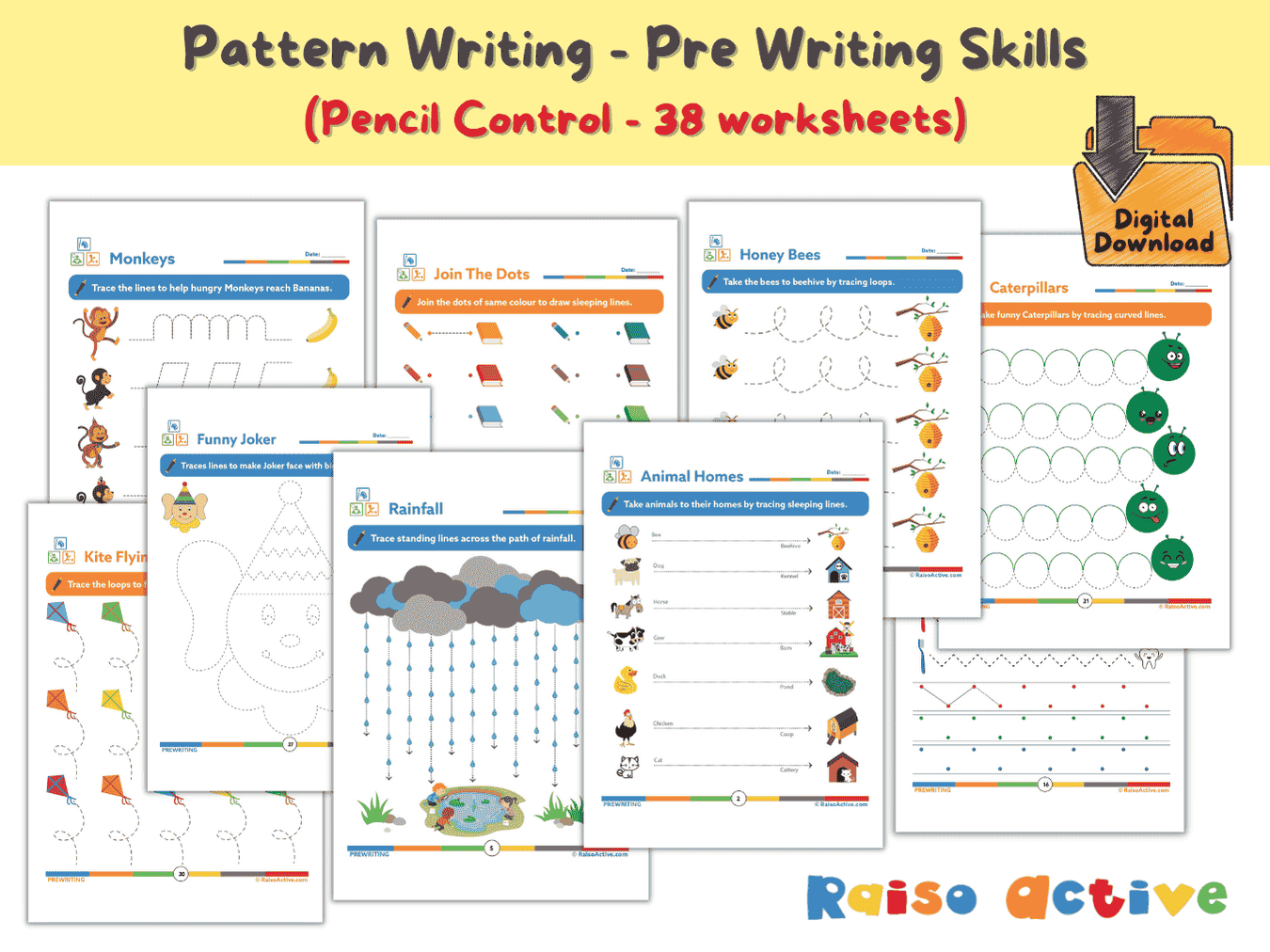
Part of the pack
Pattern Writing Pre-writing Skills Activity Book for 3-4 Year Olds
This is page 11 of the pack. Ages 3-4 · PreschoolAges 3-4 · NurseryAges 3-4
Made for your child
A whole activity pack made with their name
60 pages to spot, build, trace and write their own name, plus pages about their favourites, feelings and family. See a free preview with their name.
Make an All About Me packFree preview · free for members
Or start free: a name tracing sheet with their nameCurriculum
- Pre-Writing > Straight Lines
How to use this worksheet
Have your child hold their pencil in a comfortable grip before starting, adjusting it if their fingers are bunched too close to the tip. Trace over the existing pattern in the row first so their hand feels the correct motion before attempting it independently. Let them continue the pattern into the empty space, checking their grip periodically rather than only correcting it at the end. Take a short break partway through the row if their hand starts to tire.
Extension activities
- 1Squeeze a stress ball or piece of playdough for a minute to build hand strength before pencil work.
- 2Use a clothespin to pick up small pom-poms or cotton balls, strengthening the same pincer grip used for writing.
- 3Trace the pattern again with a crayon held between just two fingers and the thumb to reinforce proper grip.
- 4Roll playdough into a long snake shape, mimicking the pattern's repeated motion with hands instead of a pencil.
- 5Practice picking up small beads or cereal pieces one at a time with finger and thumb.

Written by
Hemsweta Jain · Teacher Cheena
MBA and Early Childhood Educator, teaching since 2014 · Founder of RaisoActive, Mumbai
Every RaisoActive worksheet is designed and checked by the founder before publishing.
Published · Last reviewed
More from Pattern Writing Pre-writing Skills Activity Book for 3-4 Year Olds

Butterfly Tracing Worksheet: Connect the Butterflies to the Flowers!
Ages 3-5 · Preschool–Pre-KAges 3-5 · Nursery–ReceptionAges 3-5 · Nursery–LKGAges 3-5
Tracing a line from each butterfly to its matching flower combines pre-writing line control with an early matching and visual-tracking task, since your child has to follow the correct path among several possible ones without crossing into a neighboring line. This dual challenge builds both the fine motor precision and the visual discrimination skills that later support reading, where the eyes must track along a single line of text without jumping to the wrong row.

Monkey Banana Tracing Worksheet for Preschoolers
Ages 3-5 · Preschool–Pre-KAges 3-5 · Nursery–ReceptionAges 3-5 · Nursery–LKGAges 3-5
Tracing a path connecting a monkey to a banana builds pencil control in children ages 3-5 while reinforcing a simple, well-known animal-and-food pairing that most children already recognize, which keeps the activity approachable and motivating. This worksheet also gives extra practice with whatever line type the path uses, whether a swinging curve or a straighter reach, building on the same skills developed in other animal-food and animal-home tracing worksheets.

Shape Tracing Fun: Trace & Color the Shapes Worksheet for Preschoolers!
Ages 3-5 · Preschool–Pre-KAges 3-5 · Nursery–ReceptionAges 3-5 · Nursery–LKGAges 3-5
Tracing and coloring several different shapes on one page gives children ages 3-5 practice switching between distinct stroke patterns, since a circle requires a continuous curved motion while a square or triangle requires straight lines and sharp corners. Naming each shape while tracing it also reinforces shape vocabulary alongside the physical practice, connecting the word to the motion that draws it.

Trace the Curved Lines: Give Balloons to the Girls! Worksheet
Ages 3-5 · Preschool–Pre-KAges 3-5 · Nursery–ReceptionAges 3-5 · Nursery–LKGAges 3-5
This worksheet has children ages 3-5 trace curved balloon strings, practicing the rounded, flowing pencil motion needed later for letters like c, o, and s. Curved lines demand a different wrist and finger movement than straight lines, since the hand has to continuously adjust direction rather than pushing in one line, which makes this an important complement to straight-line tracing practice.

Trace the Mixed Lines Worksheet: Help the Animals Find Their Babies!
Ages 3-5 · Preschool–Pre-KAges 3-5 · Nursery–ReceptionAges 3-5 · Nursery–LKGAges 3-5
This worksheet combines straight, curved, and zigzag lines on a single page, asking children ages 3-5 to trace whichever type of path connects each animal to its baby. Mixing line types in one activity is more demanding than a single-line-type worksheet because the hand has to switch motion patterns line by line, which builds flexibility in pencil control alongside early vocabulary about animal families, like cow and calf or cat and kitten.

Trace the Moon: A Prewriting Worksheet for Young Learners
Ages 3-6 · Preschool–KindergartenAges 3-6 · Nursery–Year 1Ages 3-6 · Nursery–UKGAges 3-6
Tracing the curved outline of the moon gives children ages 3-6 practice with the smooth, rounded strokes that later support letters like c and o, while the night-sky theme introduces early vocabulary about the moon, stars, and sky. Because the age range spans preschool into early elementary, this worksheet works well for revisiting pencil control at a slightly more advanced level than straight-line tracing alone.

Trace the Penguin: A Fun Pre-Writing Worksheet for Kids!
Ages 3-5 · Preschool–Pre-KAges 3-5 · Nursery–ReceptionAges 3-5 · Nursery–LKGAges 3-5
Tracing the rounded outline of a penguin gives children ages 3-5 practice with curved strokes that form a whole recognizable animal shape rather than an abstract line, which helps the tracing feel purposeful and connected to something familiar from books or videos. The cold-climate theme also introduces simple vocabulary about penguins and their environment, a small science connection layered onto the fine motor practice.

Letter S Tracing Worksheet for Preschoolers
Ages 3-5 · Preschool–Pre-KAges 3-5 · Nursery–ReceptionAges 3-5 · Nursery–LKGAges 3-5
Tracing the letter S gives 3-5 year olds practice with a single flowing curve that changes direction twice, a genuinely different challenge from straight-line letters and one that builds the smooth hand control needed for cursive-style writing later on. This page pairs the tracing practice with a picture to color, reinforcing the letter through a second, playful channel.
Related worksheets

Rocking Santa Card Craft Worksheet for Preschoolers
Ages 3-5 · Preschool–Pre-KAges 3-5 · Nursery–ReceptionAges 3-5 · Nursery–LKGAges 3-5
This rocking Santa card craft has children ages 3-5 cut out individual shape pieces and assemble them onto a folded card base, combining scissor control with an early understanding of how folding creates movement, since the 'rocking' effect comes from the card's fold. Following the assembly steps in order also reinforces sequencing and attention to visual instructions.

Learn the Sight Word 'Is' - Tracing and Writing Worksheet for Preschoolers
Ages 4-5 · Pre-KAges 4-5 · ReceptionAges 4-5 · LKGAges 4-5
This worksheet helps children ages 4-5 build instant recognition of the sight word 'is' through a layered sequence of tracing, independent writing, sentence fill-in, coloring, and letter-order cut-and-paste practice. Because 'is' can't easily be sounded out using typical phonics rules, repeated multi-format exposure like this is exactly what helps a sight word move into a child's automatic reading vocabulary. Using the word inside real sentence blanks also connects the isolated word to meaningful, functional reading.

Parent's Guide: Fun Activities for Gross Motor Development and Emotional Learning
Ages 3-5 · Preschool–Pre-KAges 3-5 · Nursery–ReceptionAges 3-5 · Nursery–LKGAges 3-5
This parent guide equips caregivers of children ages 3-5 with activities spanning gross motor skills, emotional expression, family concepts, shape recognition, and calendar awareness, using role play, finger puppets, and simple games. Combining physical movement with emotional vocabulary practice, such as making different facial expressions, helps children build body awareness and feelings vocabulary side by side. Rotating through several distinct activity types in one guide also keeps a young child's attention across a longer play session.

Color the Reindeer! Christmas Coloring Worksheet for Kids
Ages 3-5 · Preschool–Pre-KAges 3-5 · Nursery–ReceptionAges 3-5 · Nursery–LKGAges 3-5
Coloring the reindeer and gift bag illustrations gives children ages 3-5 focused practice with crayon control and color selection, helping them build the hand strength and precision needed for later handwriting tasks. Choosing colors for a familiar character like a reindeer also encourages imaginative decision-making, since there's no single 'correct' color for a fictional animal's coat or a wrapped gift. The festive subject matter keeps a repetitive fine motor task feeling like a treat rather than a chore.

Reindeer Craft: Follow Instructions and Create a Festive Decoration!
Ages 3-5 · Preschool–Pre-KAges 3-5 · Nursery–ReceptionAges 3-5 · Nursery–LKGAges 3-5
This multi-step reindeer craft has children ages 3-5 follow a sequence of folding and assembly instructions to build a three-dimensional decoration, strengthening both listening comprehension and the fine motor skills needed to position and attach small pieces accurately. Because each step depends on the one before it, children also practice patience and sequencing, skills that carry over into following any multi-step task.

Happy Face Cut and Paste Worksheet for Preschoolers
Ages 3-5 · Preschool–Pre-KAges 3-5 · Nursery–ReceptionAges 3-5 · Nursery–LKGAges 3-5
This worksheet helps children ages 3-5 learn the names of facial features while practicing scissor control and precise gluing. Assembling a face piece by piece — eyes, nose, mouth, ears — reinforces body part vocabulary in a hands-on way that's more memorable than simply pointing at a picture.
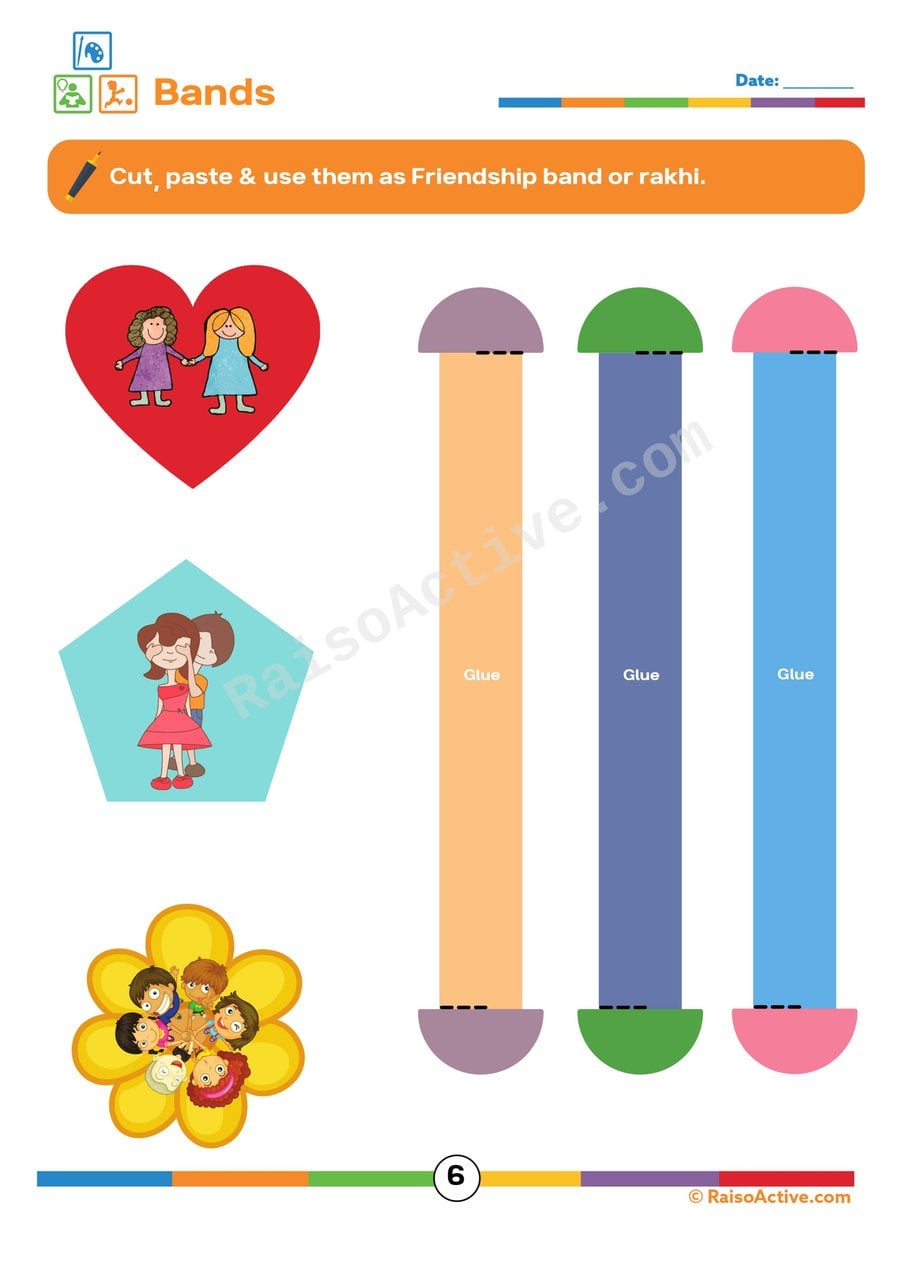
Friendship Band Craft: Cut, Paste, and Create!
Ages 3-5 · Preschool–Pre-KAges 3-5 · Nursery–ReceptionAges 3-5 · Nursery–LKGAges 3-5
This worksheet gives children ages 3-5 additional practice with scissor control and sequential assembly as they cut, join, and decorate their own friendship band or rakhi. Repeating a craft with a new set of shapes reinforces the multi-step process of cutting, arranging, and gluing until it becomes a comfortable, repeatable routine.

Trace the Numbers 1-9 Worksheet for Preschoolers
Ages 3-5 · Preschool–Pre-KAges 3-5 · Nursery–ReceptionAges 3-5 · Nursery–LKGAges 3-5
Tracing the numerals 1 through 9 gives children ages 3-5 repeated, guided practice with the specific pencil strokes each number requires, building the fine motor control and muscle memory needed for independent number writing. Because tracing follows a fixed, correct path, it also reinforces accurate numeral recognition, helping children tell visually similar digits apart.
Guides for this topic

Pre-Writing Strokes in Order: From Standing Lines to Loops (With Printable Patterns)
The developmental order of pre-writing strokes, from vertical lines to loops, and why practicing them in sequence makes letter formation much easier to learn.

Portfolio Assessment with Young Children: A Comprehensive Guide to Meaningful Documentation
Learn how portfolio assessment captures your child's growth through meaningful documentation. Practical tips, templates, and age-appropriate strategies for ages 1-8.
What Makes a Good Worksheet vs. a Poor One: A Parent's Guide to Quality Educational Materials
Learn what separates high-quality educational worksheets from poor busy work. Discover design principles, red flags, and how to evaluate free worksheets online for your child aged 1-8.
Reviews
Every worksheet for ages 3–4, no watermark
Members download the full library of 1,000+ worksheets and every activity pack without watermarks or daily limits. One year costs ₹999 in India or $20 elsewhere.
See membership plansOr download any worksheet free with a watermark (5 a day).