Letter S Tracing Worksheet for Preschoolers
Tracing the letter S gives 3-5 year olds practice with a single flowing curve that changes direction twice, a genuinely different challenge from straight-line letters and one that builds the smooth hand control needed for cursive-style writing later on. This page pairs the tracing practice with a picture to color, reinforcing the letter through a second, playful channel.
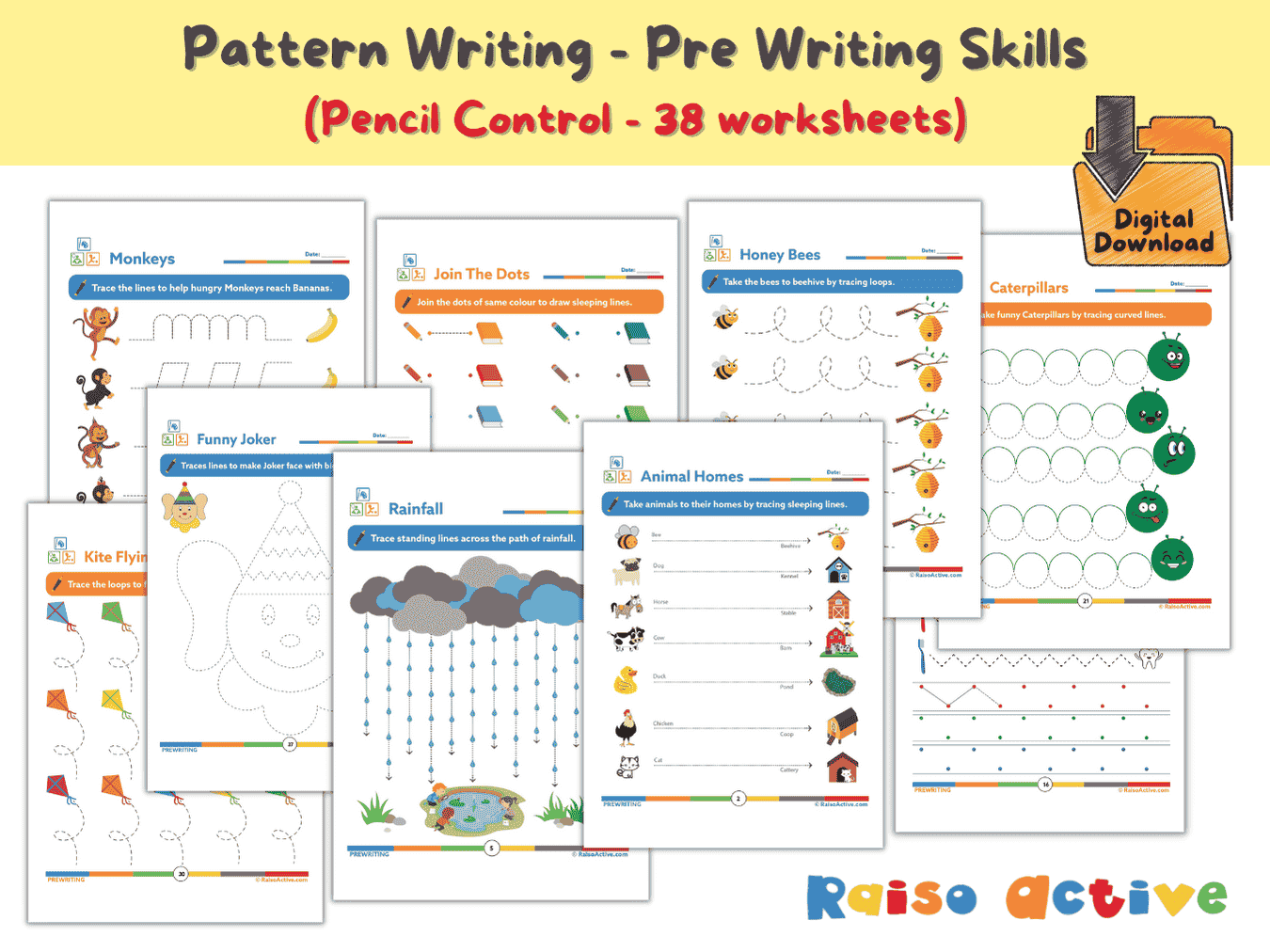
Part of the pack
Pattern Writing Pre-writing Skills Activity Book for 3-4 Year Olds
This is page 43 of the pack. Ages 3-4 · PreschoolAges 3-4 · NurseryAges 3-4

Made for your child
A whole activity pack made with their name
60 pages to spot, build, trace and write their own name, plus pages about their favourites, feelings and family. See a free preview with their name.
Make an All About Me packFree preview · free for members
Or start free: a name tracing sheet with their nameCurriculum
- Pre-Writing > Letter Pre-Writing
How to use this worksheet
Trace the letter S along the dotted lines with your child, using a pencil or crayon and encouraging one smooth, continuous motion. Talk about the hissing /s/ sound as you trace, connecting the shape to its sound. Once the tracing lines are complete, let your child color the accompanying picture. Repeat the tracing a second time on a blank sheet if your child wants more practice.
Materials needed
- Pencil
- Crayons
Extension activities
- 1Hiss like a snake together every time you trace or spot the letter S.
- 2Find S objects around the house, like a spoon, a sock, or a stuffed snake toy.
- 3Draw a sun with S-shaped rays and color it in.
- 4Practice tracing S with a finger in sand or on a foggy window.
- 5Look through a picture book and circle every letter S you find on a page.

Written by
Hemsweta Jain · Teacher Cheena
MBA and Early Childhood Educator, teaching since 2014 · Founder of RaisoActive, Mumbai
Every RaisoActive worksheet is designed and checked by the founder before publishing.
Published · Last reviewed
More from Pattern Writing Pre-writing Skills Activity Book for 3-4 Year Olds

Trace and Color the Letter S Worksheet for Preschoolers
Ages 3-5 · Preschool–Pre-KAges 3-5 · Nursery–ReceptionAges 3-5 · Nursery–LKGAges 3-5
Tracing and writing the letter S gives children ages 3-5 practice with a continuous, flowing curved stroke that changes direction partway through, making it one of the more demanding letters to control smoothly compared to straight-line letters. Because the S shape doesn't lift the pencil mid-stroke, this worksheet specifically builds sustained curve control in a single motion.

My Book: A Fun Worksheet for Early Learners
Ages 3-5 · Preschool–Pre-KAges 3-5 · Nursery–ReceptionAges 3-5 · Nursery–LKGAges 3-5
Writing their own name on the cover of something they made gives a 3-5 year old a real, motivating reason to practice name-writing — a very different feeling from tracing letters on a generic worksheet. It's often one of the first pieces of writing a child feels ownership over, which matters for building confidence around writing in general.

Join the Dots: Standing Lines Worksheet for Preschoolers
Ages 3-5 · Preschool–Pre-KAges 3-5 · Nursery–ReceptionAges 3-5 · Nursery–LKGAges 3-5
This dot-to-dot worksheet asks children ages 3-5 to connect dots forming vertical lines, sometimes called 'standing lines' because they stand upright, building the bottom-to-top or top-to-bottom pencil control needed for letters like l, t, and i. Connecting dots precisely, rather than simply tracing a continuous line, adds an extra layer of accuracy practice on top of the basic straight-line motion.

Pattern Writing Pre-writing Skills Activity Book for 3-4 Year Olds - Page 33
Ages 3-4 · PreschoolAges 3-4 · NurseryAges 3-4
This later page in the pre-writing patterns activity book asks 3-4 year olds to track a repeating pattern visually from left to right across the row before their pencil catches up, building the same visual tracking direction used in reading English text. Because this comes further into the book, it also builds a small dose of persistence, since completing a full row of repeated strokes takes more sustained attention than a single short trace.
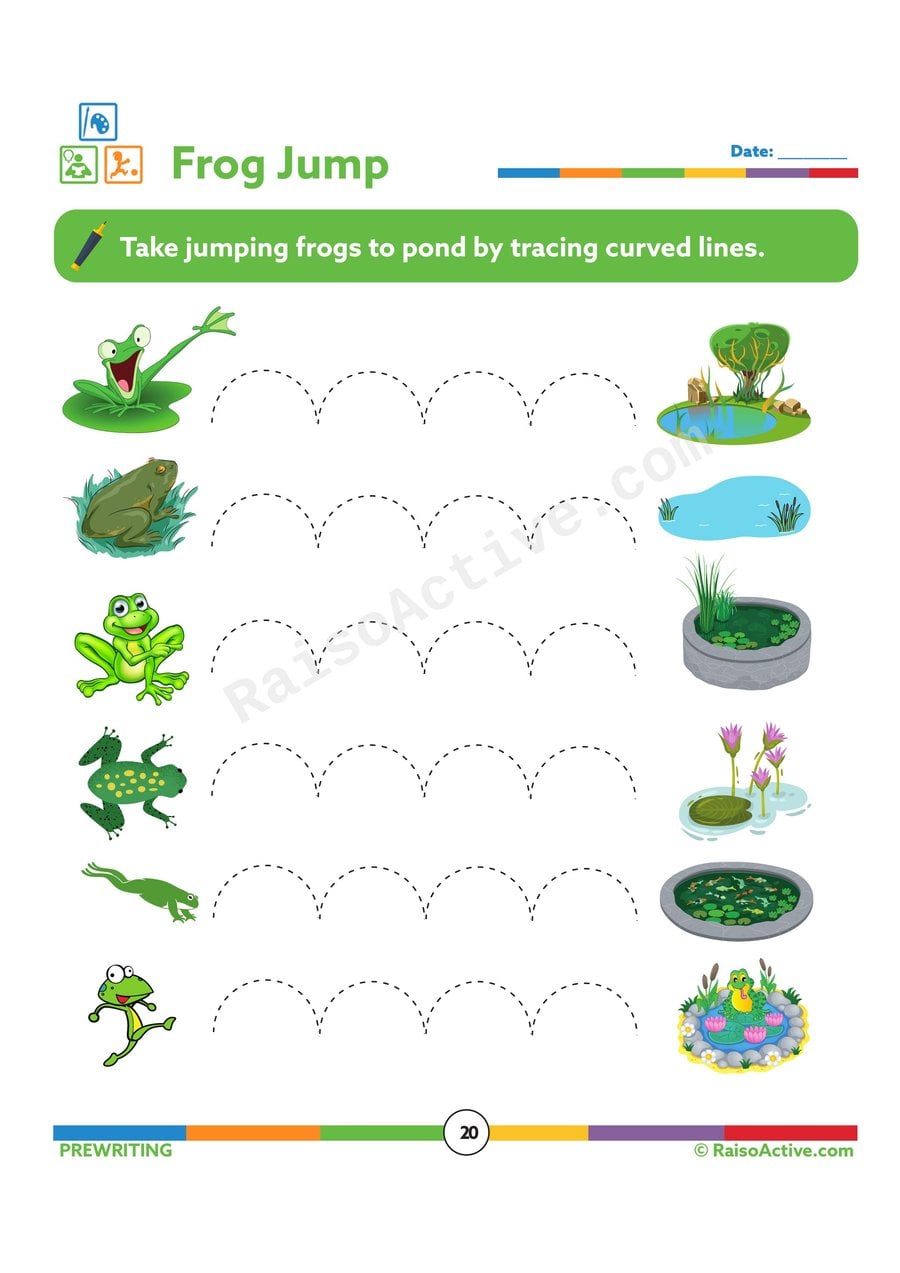
Frog Jump Tracing Worksheet for Preschoolers
Ages 3-5 · Preschool–Pre-KAges 3-5 · Nursery–ReceptionAges 3-5 · Nursery–LKGAges 3-5
Tracing the arc-shaped path of a frog's jump from one lily pad to the next gives children ages 3-5 practice with curved strokes tied to a real physical motion, a hop, which makes the abstract line feel grounded in something they've done themselves. Repeating this jump-shaped arc across several lily pads also builds consistency, helping a child produce similarly sized curves rather than arcs that vary widely from one to the next.

Pattern Writing Pre-writing Skills Activity Book for 3-4 Year Olds - Page 40
Ages 3-4 · PreschoolAges 3-4 · NurseryAges 3-4
As one of the later pages in the pre-writing patterns activity book, this page asks 3-4 year olds to apply everything practiced on earlier pages, steady pressure, consistent spacing, and accurate prediction, to a pattern that combines skills built up gradually through the book. Reaching this stage of the book is itself a marker of growing stamina, since completing a full row of repeated strokes reliably takes more sustained focus than the simpler early pages required.

Community Helpers Matching Worksheet for Preschoolers
Ages 3-5 · Preschool–Pre-KAges 3-5 · Nursery–ReceptionAges 3-5 · Nursery–LKGAges 3-5
By tracing a line from each community helper to the tool or vehicle they use, children ages 3-5 practice pencil control while learning the beginnings of social studies: that people in their community have different jobs and different equipment to do them. Pairing a firefighter with a fire truck or a doctor with a stethoscope also builds cause-and-effect thinking about why each helper needs that particular item.

Sledge Fun: Trace Slanting Lines to the Snowmen Worksheet
Ages 3-5 · Preschool–Pre-KAges 3-5 · Nursery–ReceptionAges 3-5 · Nursery–LKGAges 3-5
Tracing diagonal lines from a sledge down to waiting snowmen gives children ages 3-5 practice with slanting strokes, a motion that's harder to control than straight up-and-down or side-to-side lines because it requires the wrist to angle and rotate. Mastering this diagonal control now lays groundwork for letters like A, K, X, and Y, which all rely on slanted strokes.
Related worksheets

Learn the Letter 'n' Worksheet: Tracing, Matching, and Coloring Fun!
Ages 3-5 · Preschool–Pre-KAges 3-5 · Nursery–ReceptionAges 3-5 · Nursery–LKGAges 3-5
This worksheet builds letter 'n' recognition for 3-5 year olds through tracing, a highlighting search, matching to pictures, and coloring — four connected tasks that ask your child to hold onto the same letter across different formats and follow multi-step instructions in sequence. The letter 'n' is frequently confused with 'm' since both involve humps, so the repeated exposure here helps children start telling the two apart by sound and shape.
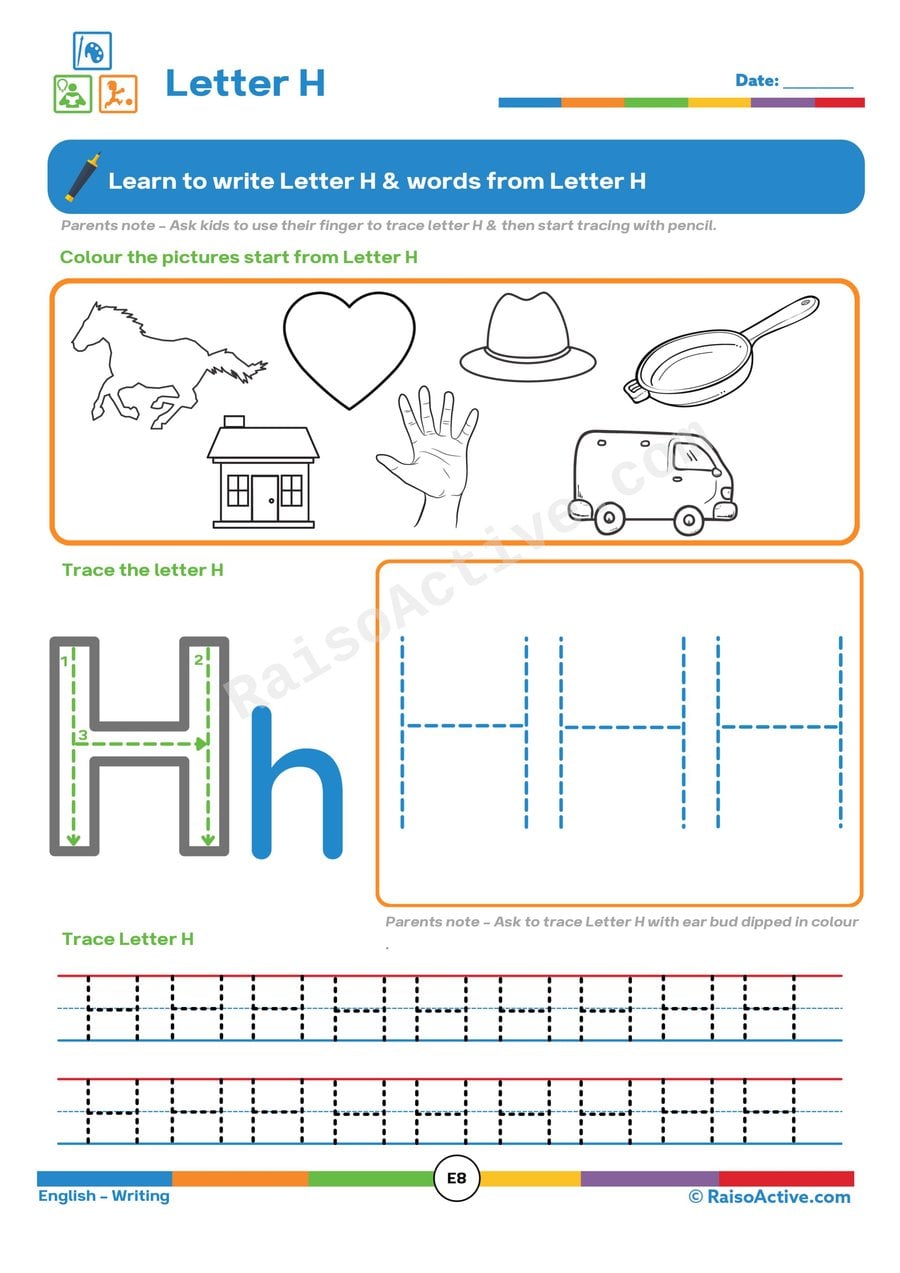
Trace the Letter H Worksheet for Preschoolers
Ages 3-5 · Preschool–Pre-KAges 3-5 · Nursery–ReceptionAges 3-5 · Nursery–LKGAges 3-5
Tracing the capital letter H gives children ages 3-5 focused practice in pencil control, directional tracking (top to bottom, left to right), and the specific line-and-line motion that forms H's two verticals and one horizontal bar. Pairing the tracing with pictures that start with H also strengthens letter-sound association, an essential early step toward decoding words later on.
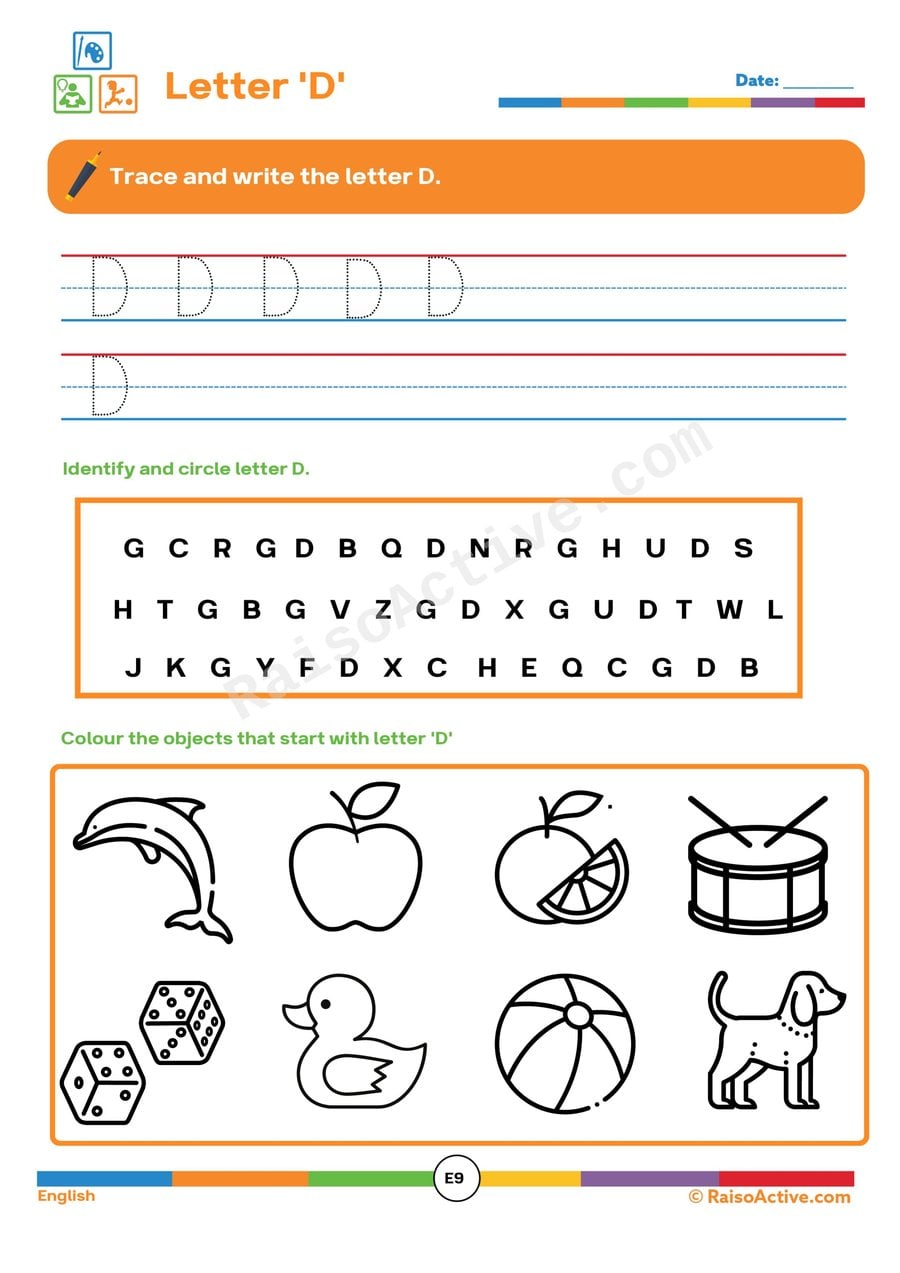
Letter D Worksheet: Trace, Identify, and Color!
Ages 3-5 · Preschool–Pre-KAges 3-5 · Nursery–ReceptionAges 3-5 · Nursery–LKGAges 3-5
This worksheet helps children ages 3-5 practice letter recognition, pencil-controlled tracing, and beginning sound awareness all centered on the letter D. Searching for D within a group of letters builds visual discrimination, an important pre-reading skill for telling similar shapes apart quickly.

Letter X Worksheet: Trace, Write, and Color the Letter X!
Ages 3-5 · Preschool–Pre-KAges 3-5 · Nursery–ReceptionAges 3-5 · Nursery–LKGAges 3-5
This worksheet introduces the letter X, one of the trickier letters for young children since so few common words start with it, by pairing tracing practice with picture identification for words like 'x-ray' or 'xylophone.' For three- to five-year-olds, working through a less familiar letter like X builds persistence and completes their sense of mastering the full alphabet.

Learn the Letter 'L': Tracing, Matching, and Coloring Worksheet for Preschoolers
Ages 3-5 · Preschool–Pre-KAges 3-5 · Nursery–ReceptionAges 3-5 · Nursery–LKGAges 3-5
This worksheet builds letter 'L' recognition through tracing, matching, a themed maze that highlights the letter while guiding a lion to its meat, and coloring — a four-part structure that keeps 3-5 year olds engaged across several formats while reinforcing the same letter each time. The maze section in particular adds a playful goal to what would otherwise be repetitive letter-spotting, motivating your child to scan carefully for every 'L' along the path.

Learn the Letter U! Tracing, Matching, and Coloring Worksheet
Ages 3-5 · Preschool–Pre-KAges 3-5 · Nursery–ReceptionAges 3-5 · Nursery–LKGAges 3-5
Children ages 3-5 practice forming the letter U in both its capital and lowercase shapes, while also learning to spot U words among other pictures, building both handwriting control and letter-sound recognition together. The matching component adds a layer of visual scanning practice, since children must compare each picture's beginning sound against the target letter.

Learn the Letter 'V': Tracing, Matching, and Coloring Worksheet
Ages 3-5 · Preschool–Pre-KAges 3-5 · Nursery–ReceptionAges 3-5 · Nursery–LKGAges 3-5
Tracing, matching, and coloring the letter 'V' gives children ages 3-5 focused repetition on a letter formed entirely from two diagonal strokes, a different motor pattern than the curves and verticals used in many other letters. Matching pictures like a violin or a van to the letter builds the sound-symbol connection for the /v/ sound, which can be tricky to distinguish from /f/ or /b/ for young learners. Highlighting the lowercase 'v' within a letter grid to help a character find an object adds a game-like search element that keeps attention on the task.

Letter B Tracing and Identification Worksheet for Preschoolers
Ages 3-5 · Preschool–Pre-KAges 3-5 · Nursery–ReceptionAges 3-5 · Nursery–LKGAges 3-5
This worksheet helps children ages 3-5 practice tracing and writing the letter B, identifying B among other letters, and recognizing objects that start with the letter B. Circling the correct letter within a small group builds the visual scanning skill children need before they can read words fluently.
Guides for this topic

Pre-Writing Strokes in Order: From Standing Lines to Loops (With Printable Patterns)
The developmental order of pre-writing strokes, from vertical lines to loops, and why practicing them in sequence makes letter formation much easier to learn.

Portfolio Assessment with Young Children: A Comprehensive Guide to Meaningful Documentation
Learn how portfolio assessment captures your child's growth through meaningful documentation. Practical tips, templates, and age-appropriate strategies for ages 1-8.
What Makes a Good Worksheet vs. a Poor One: A Parent's Guide to Quality Educational Materials
Learn what separates high-quality educational worksheets from poor busy work. Discover design principles, red flags, and how to evaluate free worksheets online for your child aged 1-8.
Reviews
Every worksheet for ages 3–5, no watermark
Members download the full library of 1,000+ worksheets and every activity pack without watermarks or daily limits. One year costs ₹999 in India or $20 elsewhere.
See membership plansOr download any worksheet free with a watermark (5 a day).