Trace and Color the Letter S Worksheet for Preschoolers
Tracing and writing the letter S gives children ages 3-5 practice with a continuous, flowing curved stroke that changes direction partway through, making it one of the more demanding letters to control smoothly compared to straight-line letters. Because the S shape doesn't lift the pencil mid-stroke, this worksheet specifically builds sustained curve control in a single motion.
Part of the pack
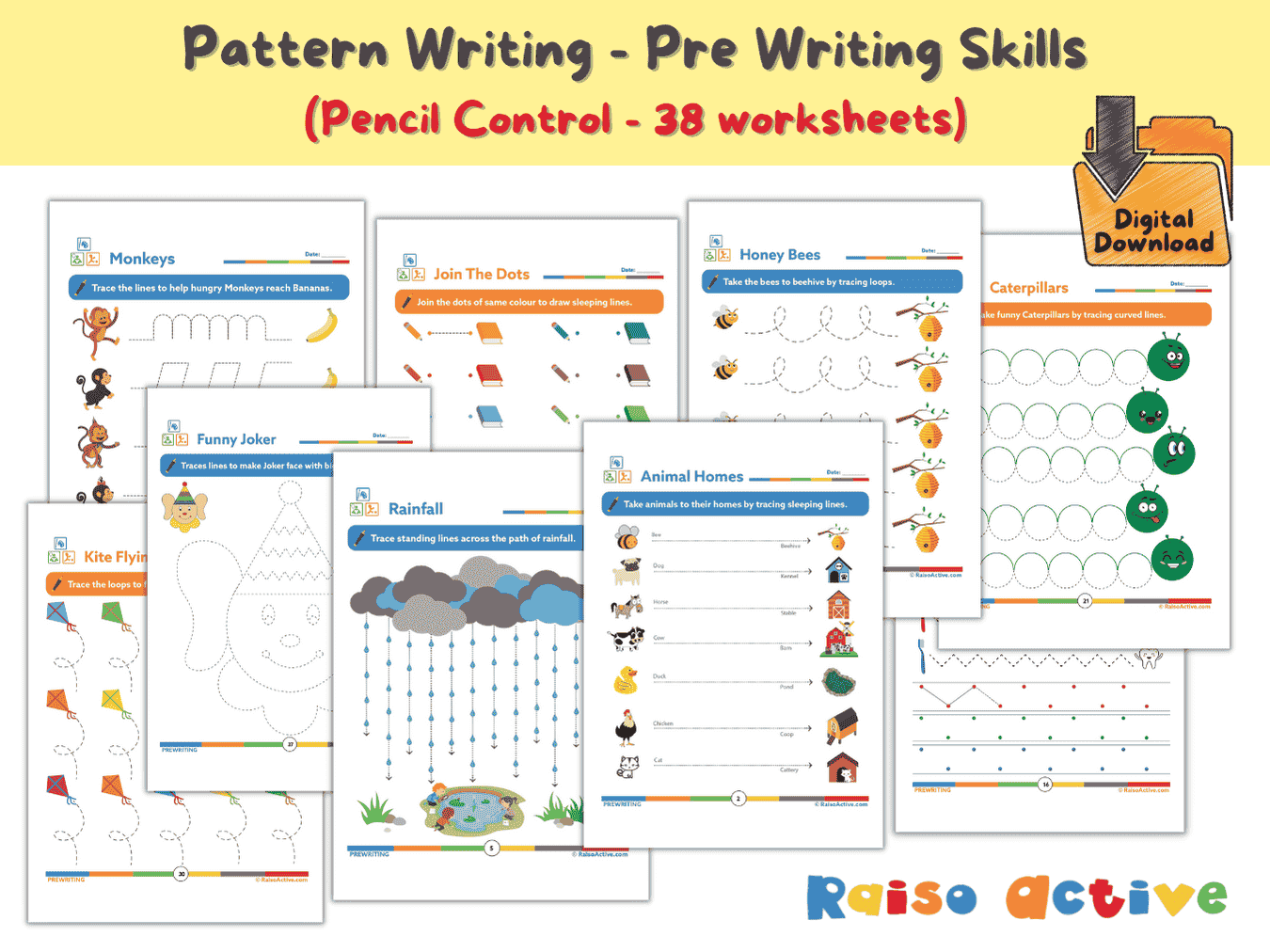
Pattern Writing Pre-writing Skills Activity Book for 3-4 Year Olds
This is page 2 of the pack. Ages 3-4 · PreschoolAges 3-4 · NurseryAges 3-4
Made for your child
A whole activity pack made with their name
60 pages to spot, build, trace and write their own name, plus pages about their favourites, feelings and family. See a free preview with their name.
Make an All About Me packFree preview · free for members
Or start free: a name tracing sheet with their nameCurriculum
- Pre-Writing > Letter Pre-Writing
How to use this worksheet
Trace the large dotted letter S first, saying the /s/ sound as your child's pencil follows the curve from top to bottom in one motion. Move to the practice lines and trace, then attempt writing an S without the guide, encouraging one smooth stroke rather than several short ones. If a recognition activity is included, work through it together, circling every S found. Finish by coloring the capital and lowercase S.
Materials needed
- Pencil
- Crayons
Extension activities
- 1Search the house for objects starting with S, like a spoon, a sock, or the sun.
- 2Trace a large S with a finger in a tray of sand or shaving cream, feeling the curve change direction.
- 3Practice drawing S shapes with sidewalk chalk outside, making them as big as possible.
- 4Cut out pictures of S words from a magazine to make a small collage.
- 5Sing the alphabet song, adding a wiggly snake-like motion with your arm when you reach S.

Written by
Hemsweta Jain · Teacher Cheena
MBA and Early Childhood Educator, teaching since 2014 · Founder of RaisoActive, Mumbai
Every RaisoActive worksheet is designed and checked by the founder before publishing.
Published · Last reviewed
More from Pattern Writing Pre-writing Skills Activity Book for 3-4 Year Olds

Join the Dots: Sleeping Lines Worksheet for Preschoolers
Ages 3-5 · Preschool–Pre-KAges 3-5 · Nursery–ReceptionAges 3-5 · Nursery–LKGAges 3-5
This dot-to-dot worksheet has children ages 3-5 connect dots to form horizontal lines, sometimes called 'sleeping lines' because they lie flat rather than standing upright, building the left-to-right pencil motion that also mirrors the direction of reading and writing English text. Dot-to-dot tracing adds an extra layer of precision beyond simple line tracing, since the child has to land exactly on each dot rather than following a continuous guide.

Fine Motor Skills Activities: Parent's Guide for Pre-Writing
Ages 3-5 · Preschool–Pre-KAges 3-5 · Nursery–ReceptionAges 3-5 · Nursery–LKGAges 3-5
This parent's guide explains that fine motor skills, the small, precise movements of the hands and fingers, need deliberate strengthening before a child can comfortably hold and control a pencil for handwriting. It outlines that skills like a strong pincer grip, wrist stability, and hand strength typically develop through everyday activities like squeezing, pinching, and tearing before they ever translate into neat pencil strokes.
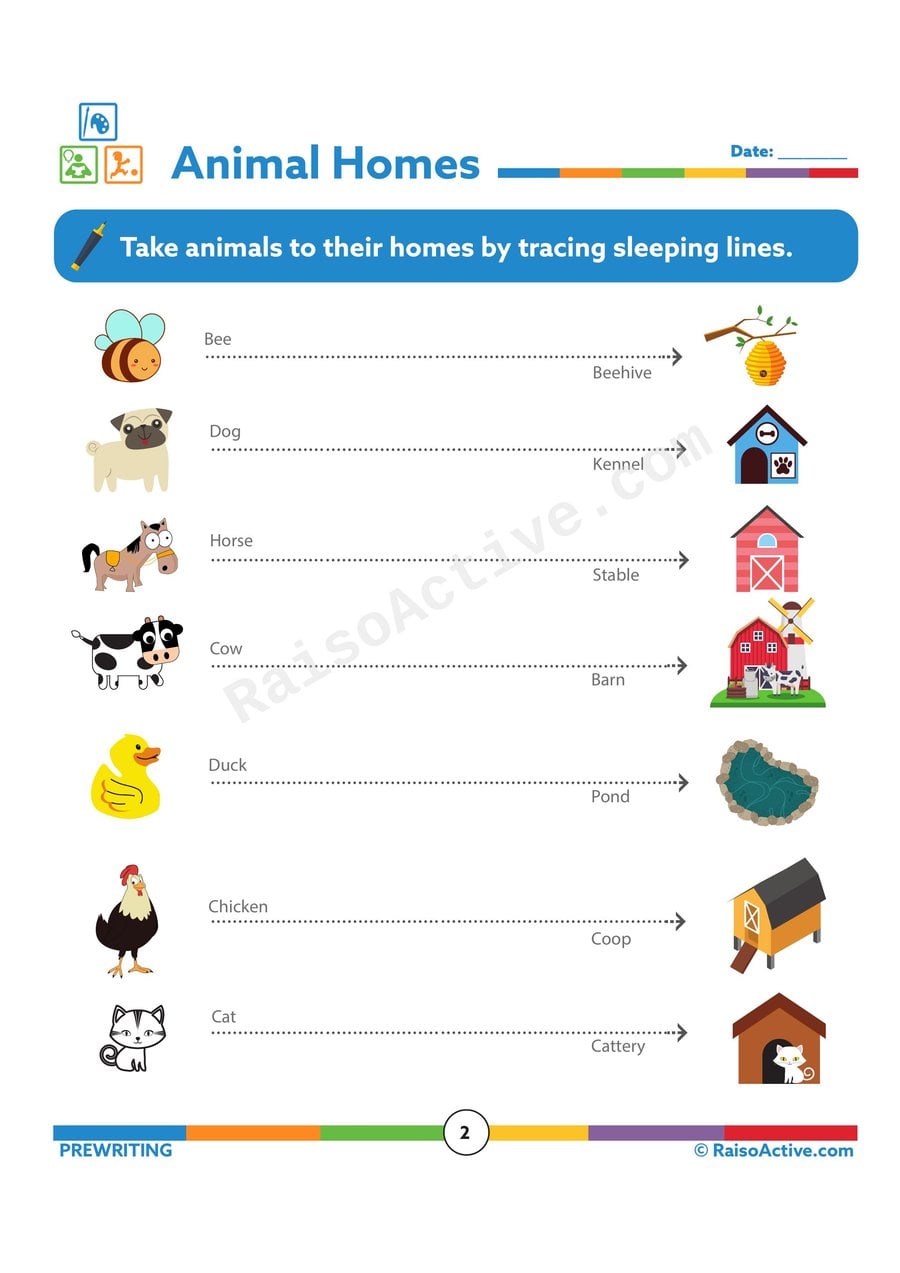
Animal Homes Tracing Worksheet for Preschoolers
Ages 3-5 · Preschool–Pre-KAges 3-5 · Nursery–ReceptionAges 3-5 · Nursery–LKGAges 3-5
Tracing a line from each animal to its home helps children ages 3-5 build pencil control while also introducing an early science concept: that different animals live in different kinds of homes, like a bird's nest or a dog's kennel. Saying the animal and its home aloud while tracing connects the physical tracing motion to new vocabulary, reinforcing both skills at once.

Community Helpers Matching Worksheet for Preschoolers
Ages 3-5 · Preschool–Pre-KAges 3-5 · Nursery–ReceptionAges 3-5 · Nursery–LKGAges 3-5
By tracing a line from each community helper to the tool or vehicle they use, children ages 3-5 practice pencil control while learning the beginnings of social studies: that people in their community have different jobs and different equipment to do them. Pairing a firefighter with a fire truck or a doctor with a stethoscope also builds cause-and-effect thinking about why each helper needs that particular item.
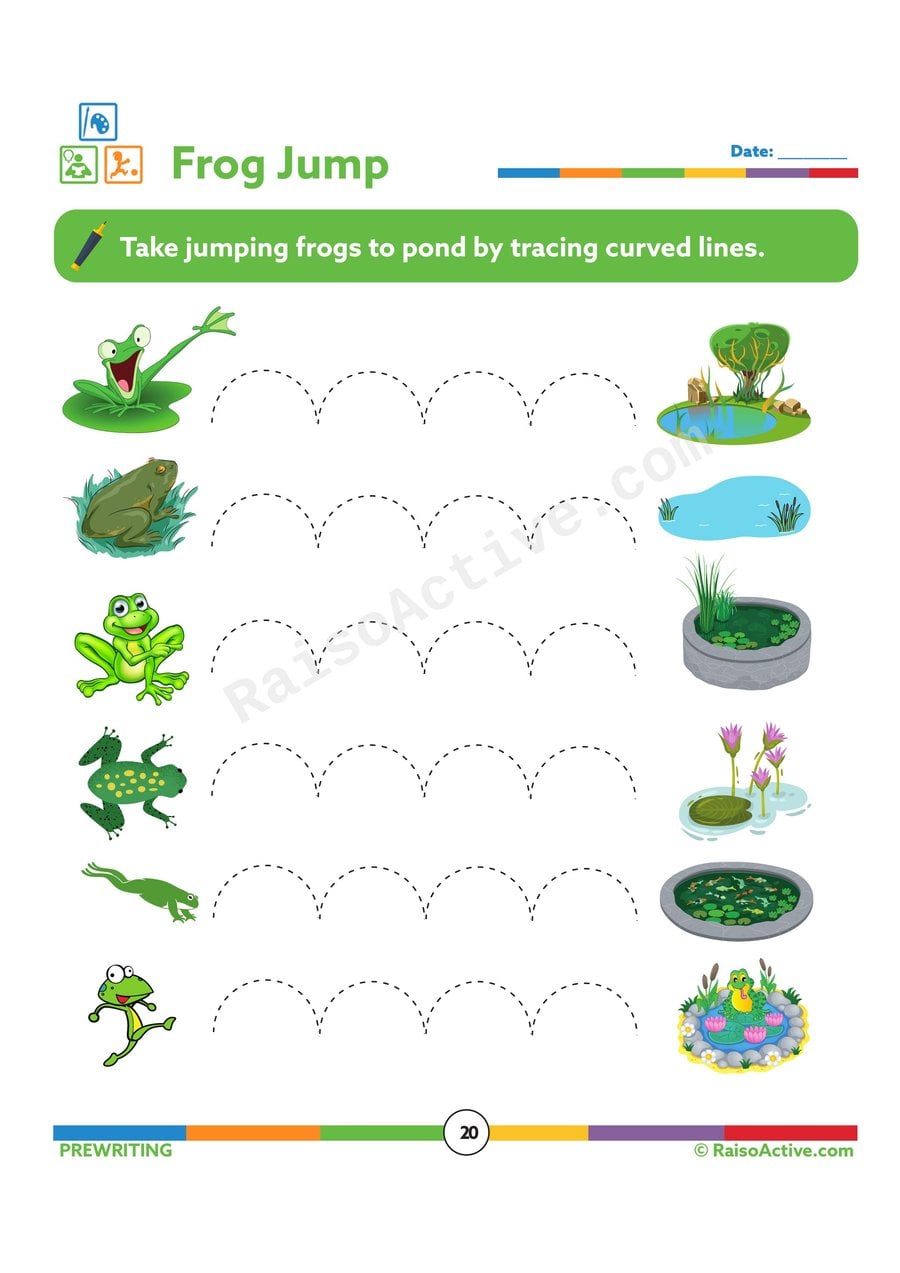
Frog Jump Tracing Worksheet for Preschoolers
Ages 3-5 · Preschool–Pre-KAges 3-5 · Nursery–ReceptionAges 3-5 · Nursery–LKGAges 3-5
Tracing the arc-shaped path of a frog's jump from one lily pad to the next gives children ages 3-5 practice with curved strokes tied to a real physical motion, a hop, which makes the abstract line feel grounded in something they've done themselves. Repeating this jump-shaped arc across several lily pads also builds consistency, helping a child produce similarly sized curves rather than arcs that vary widely from one to the next.
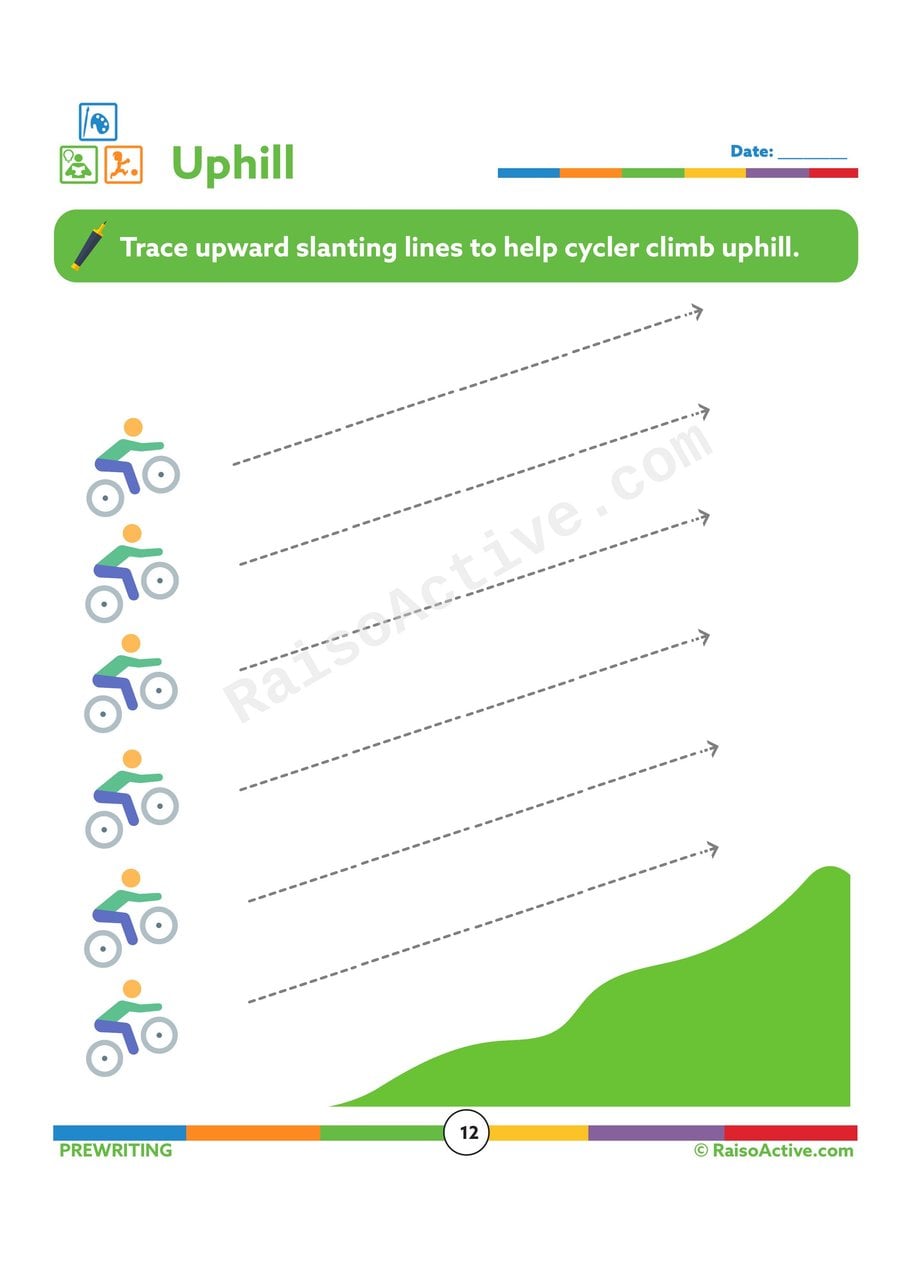
Uphill Tracing Worksheet: Help the Cyclist!
Ages 3-5 · Preschool–Pre-KAges 3-5 · Nursery–ReceptionAges 3-5 · Nursery–LKGAges 3-5
Tracing an uphill diagonal line to help a cyclist reach the top gives children ages 3-5 focused practice with slanting strokes that angle upward, a motion that requires more deliberate wrist control than a downward slant. This worksheet builds on general diagonal-line practice by tying the direction of the line to a concrete idea, going uphill, which helps children understand why the line slants the way it does rather than tracing an abstract shape.

Letter S Tracing Worksheet for Preschoolers
Ages 3-5 · Preschool–Pre-KAges 3-5 · Nursery–ReceptionAges 3-5 · Nursery–LKGAges 3-5
Tracing the letter S gives 3-5 year olds practice with a single flowing curve that changes direction twice, a genuinely different challenge from straight-line letters and one that builds the smooth hand control needed for cursive-style writing later on. This page pairs the tracing practice with a picture to color, reinforcing the letter through a second, playful channel.

Monkey Banana Tracing Worksheet for Preschoolers
Ages 3-5 · Preschool–Pre-KAges 3-5 · Nursery–ReceptionAges 3-5 · Nursery–LKGAges 3-5
Tracing a path connecting a monkey to a banana builds pencil control in children ages 3-5 while reinforcing a simple, well-known animal-and-food pairing that most children already recognize, which keeps the activity approachable and motivating. This worksheet also gives extra practice with whatever line type the path uses, whether a swinging curve or a straighter reach, building on the same skills developed in other animal-food and animal-home tracing worksheets.
Related worksheets

Learn the Letter 'x' Worksheet: Tracing, Matching, and Coloring Fun!
Ages 4-5 · Pre-KAges 4-5 · ReceptionAges 4-5 · LKGAges 4-5
This worksheet builds recognition of the less common letter x through tracing both uppercase and lowercase forms, then reinforces that recognition through matching pictures and highlighting the letter within a grid. For ages 4-5, letter x is genuinely rare at the start of everyday words, so this worksheet leans on strong examples like 'x-ray' to build familiarity despite limited real-world exposure.

Letter S Tracing Worksheet: Learn to Write and Identify the Letter S!
Ages 3-5 · Preschool–Pre-KAges 3-5 · Nursery–ReceptionAges 3-5 · Nursery–LKGAges 3-5
This worksheet helps children ages 3-5 learn to recognize and write the letter S, both uppercase and lowercase, using its distinctive curving stroke, while also practicing identifying words that start with the letter S. Because S makes a long, continuous hissing sound that's easy to isolate, this letter is often one of the more approachable sounds for early phonics practice.
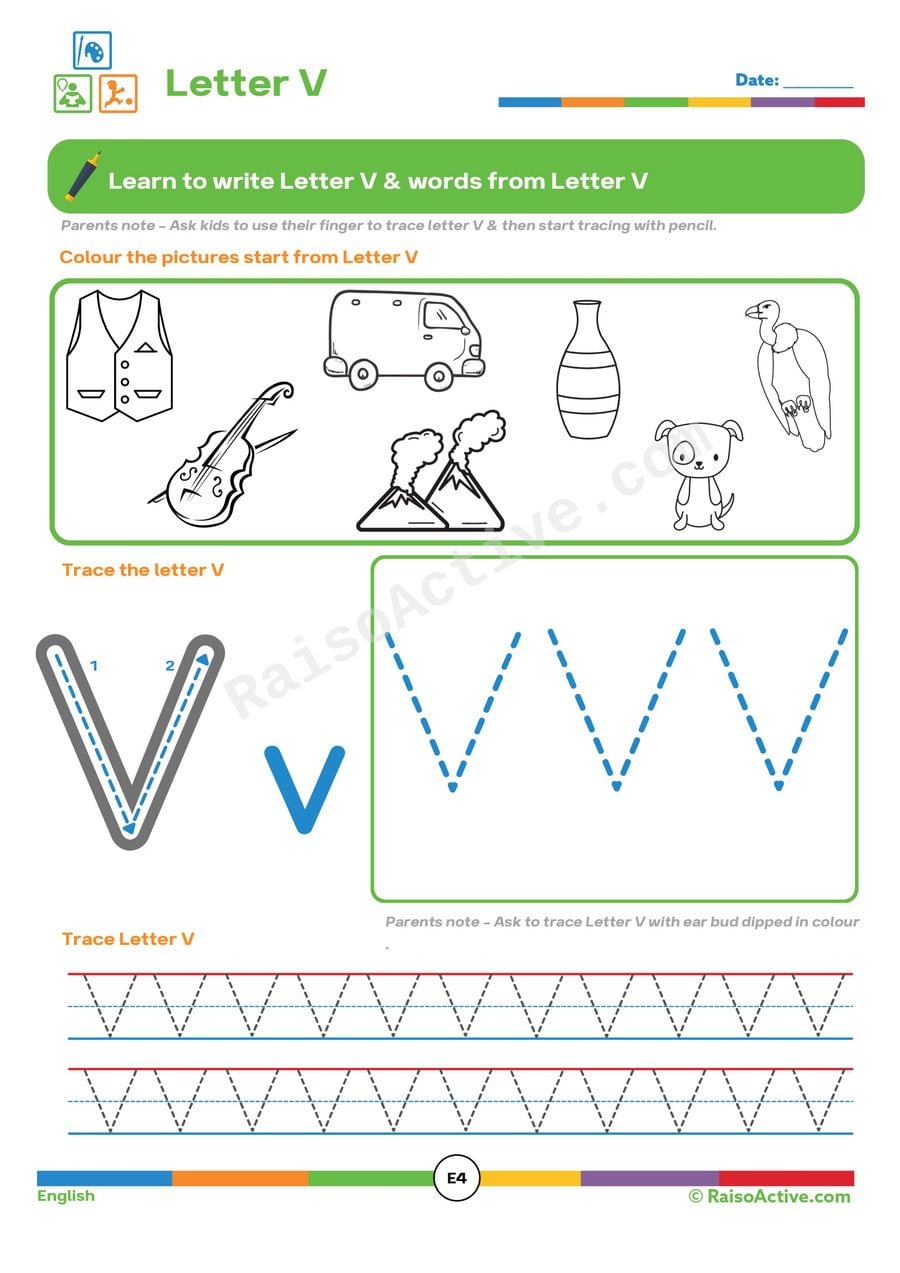
Trace the Letter V Worksheet for Preschoolers
Ages 3-5 · Preschool–Pre-KAges 3-5 · Nursery–ReceptionAges 3-5 · Nursery–LKGAges 3-5
Tracing the uppercase letter V builds the pencil control and stroke memory children ages 3-5 need for handwriting, while coloring pictures that start with V links the written letter to its spoken sound and familiar objects. Repeating the tracing after the picture activity gives extra practice forming the letter correctly.
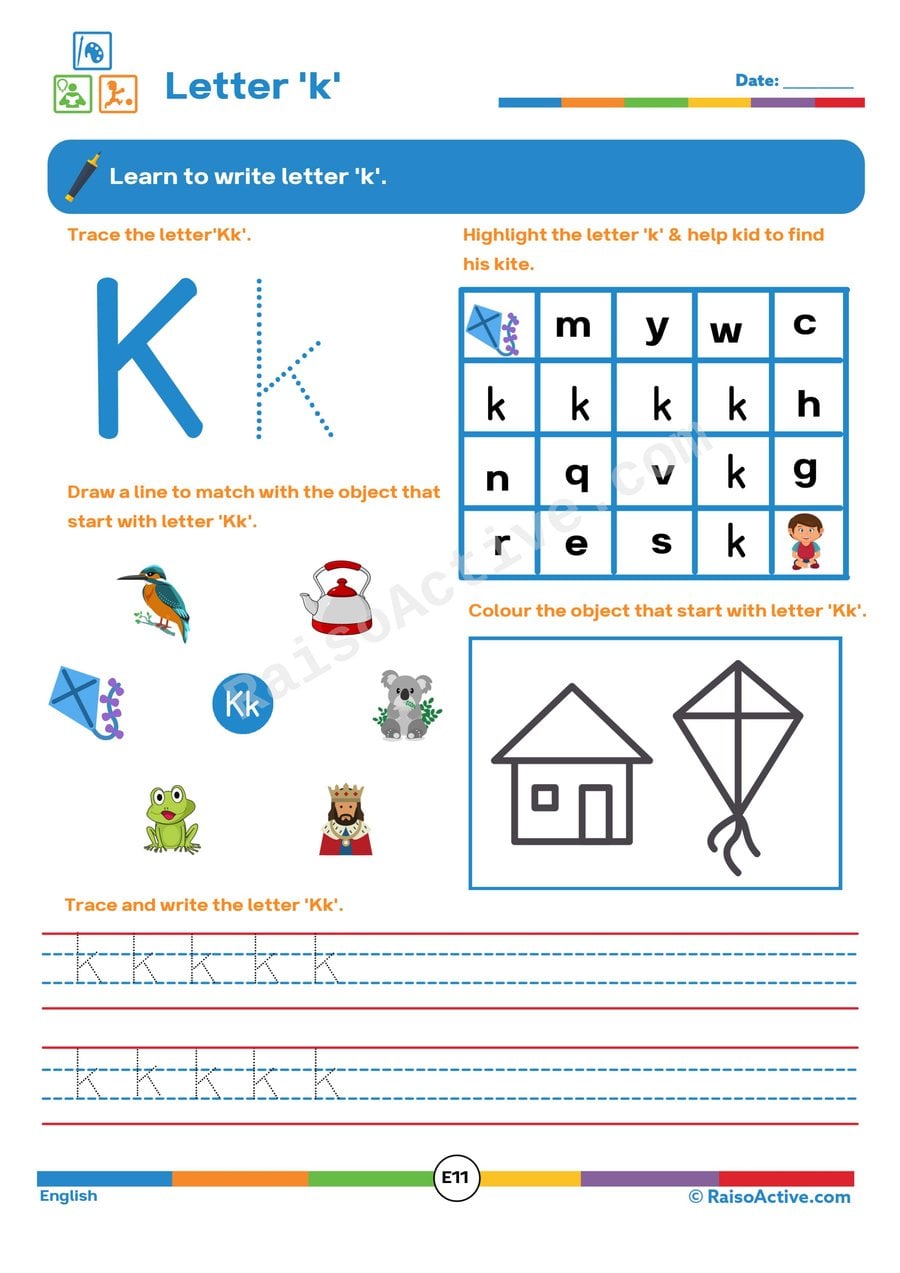
Letter 'k' Worksheet: Trace, Match, and Color!
Ages 3-5 · Preschool–Pre-KAges 3-5 · Nursery–ReceptionAges 3-5 · Nursery–LKGAges 3-5
This worksheet builds letter 'k' recognition for 3-5 year olds across three connected activities — tracing its shape, matching it to pictures that start with the same sound, and coloring those matched objects — which reinforces the letter through repetition in different formats rather than a single pass. The 'k' sound and shape are less commonly practiced than more frequent letters, so this worksheet gives your child valuable extra exposure to a trickier letter.
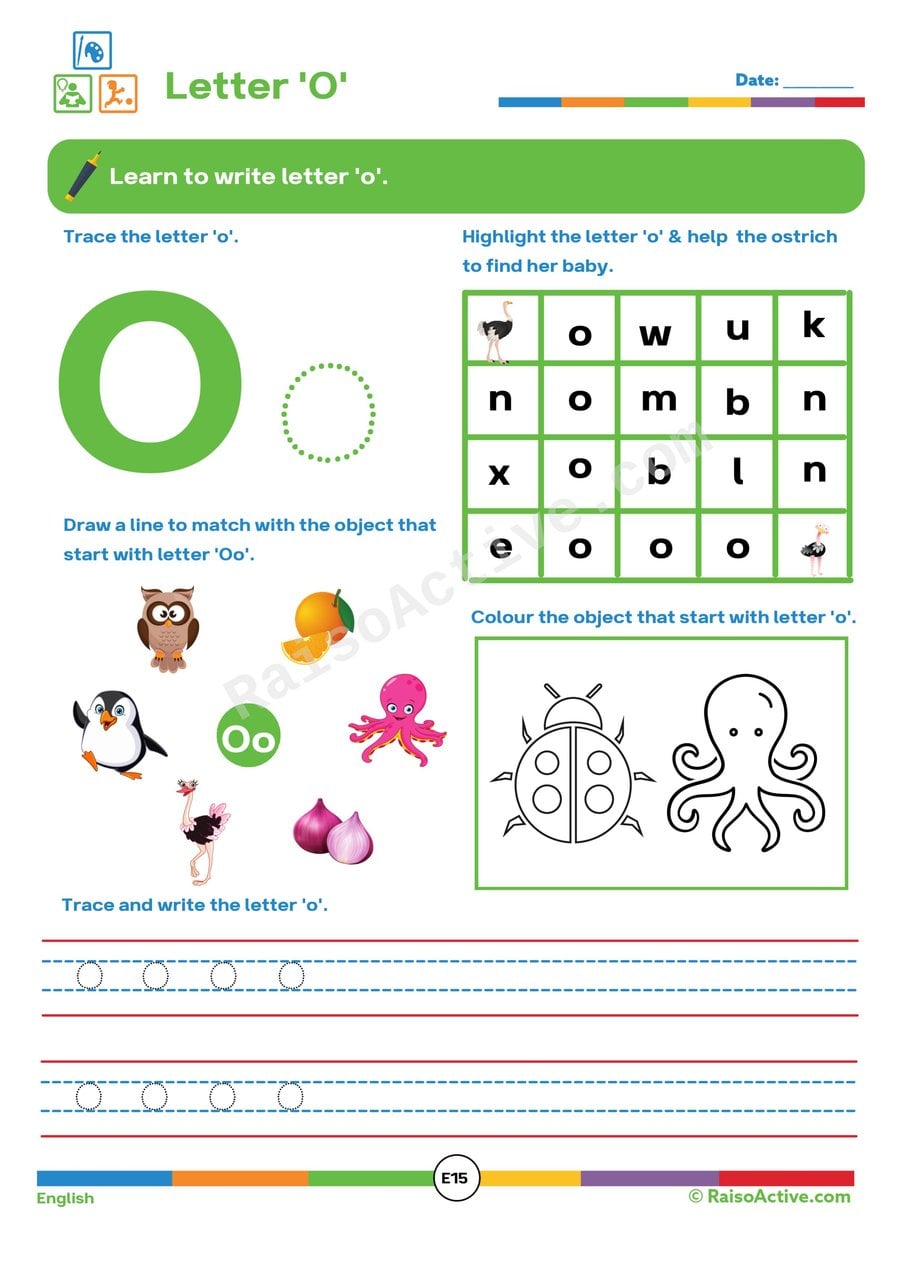
Letter 'O' Worksheet: Trace, Match, and Color!
Ages 3-5 · Preschool–Pre-KAges 3-5 · Nursery–ReceptionAges 3-5 · Nursery–LKGAges 3-5
Tracing, matching, and coloring the letter 'O' gives children ages 3-5 practice with one of the simplest letter shapes to form, making it a great confidence-building letter alongside its sound recognition value for words like 'octopus' and 'ostrich.' Matching pictures that start with 'O' to the letter reinforces the sound-symbol connection through familiar, often fun animal vocabulary. Highlighting the letter within a busy grid adds a visual search challenge that builds focus and letter discrimination beyond simple tracing.
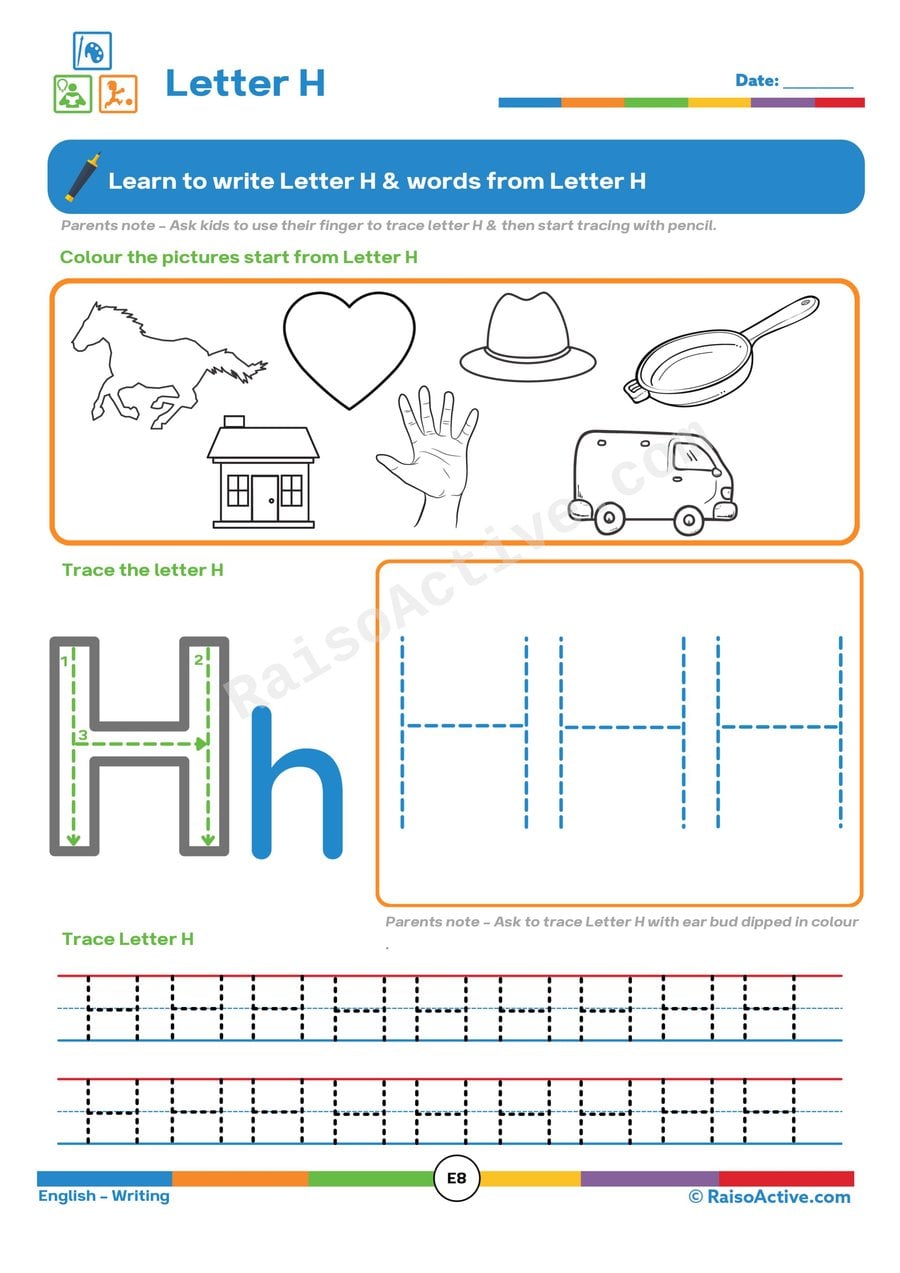
Trace the Letter H Worksheet for Preschoolers
Ages 3-5 · Preschool–Pre-KAges 3-5 · Nursery–ReceptionAges 3-5 · Nursery–LKGAges 3-5
Tracing the capital letter H gives children ages 3-5 focused practice in pencil control, directional tracking (top to bottom, left to right), and the specific line-and-line motion that forms H's two verticals and one horizontal bar. Pairing the tracing with pictures that start with H also strengthens letter-sound association, an essential early step toward decoding words later on.

Gg Letter Tracing and Recognition Worksheet for Preschoolers
Ages 3-5 · Preschool–Pre-KAges 3-5 · Nursery–ReceptionAges 3-5 · Nursery–LKGAges 3-5
This worksheet helps children ages 3-5 practice writing both uppercase and lowercase Gg while training them to recognize the letter in different fonts and contexts, an important skill since printed letters don't always look identical to handwritten ones. Identifying pictures that start with Gg also builds phonemic awareness, linking the letter's shape to its 'guh' sound.
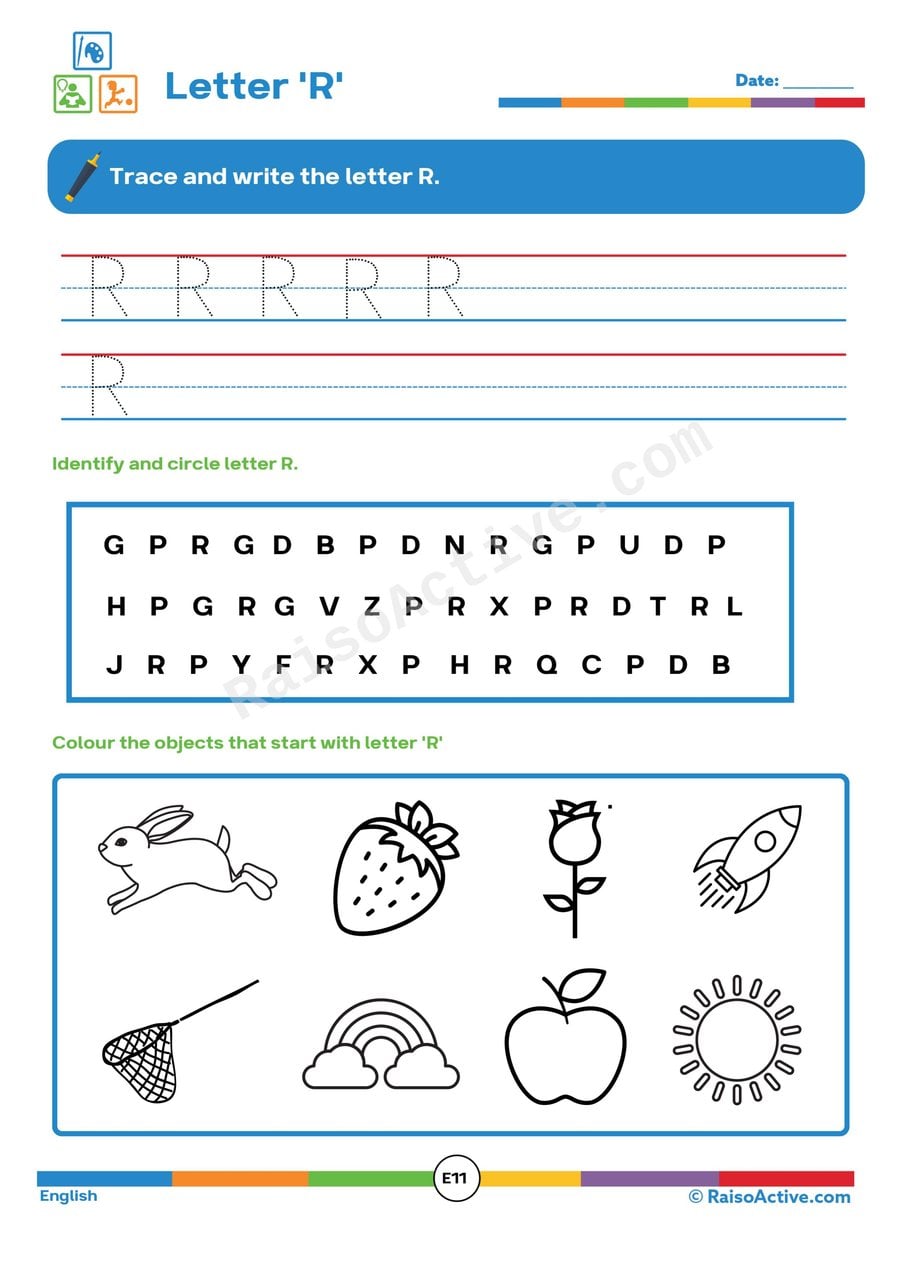
Letter R Worksheet: Trace, Identify, and Color!
Ages 4-5 · Pre-KAges 4-5 · ReceptionAges 4-5 · LKGAges 4-5
This worksheet helps children ages 4-5 practice tracing and writing the letter R, spotting it among a group of other letters, and recognizing objects that begin with the R sound. Working across three related tasks for one letter, tracing, searching, and identifying pictures, gives repeated exposure that helps the letter shape and sound become automatic.
Guides for this topic

Pre-Writing Strokes in Order: From Standing Lines to Loops (With Printable Patterns)
The developmental order of pre-writing strokes, from vertical lines to loops, and why practicing them in sequence makes letter formation much easier to learn.

Best Worksheets for 3-Year-Olds: What Works and What to Avoid
What works on worksheets for 3-year-olds: short sessions, crayons, tracing lines, matching, cutting, a free weekly plan, and signs one is too advanced.
Portfolio Assessment with Young Children: A Comprehensive Guide to Meaningful Documentation
Learn how portfolio assessment captures your child's growth through meaningful documentation. Practical tips, templates, and age-appropriate strategies for ages 1-8.
Reviews
Every worksheet for ages 3–5, no watermark
Members download the full library of 1,000+ worksheets and every activity pack without watermarks or daily limits. One year costs ₹999 in India or $20 elsewhere.
See membership plansOr download any worksheet free with a watermark (5 a day).