Fine Motor Skills Activities: Parent's Guide for Pre-Writing
This parent's guide explains that fine motor skills, the small, precise movements of the hands and fingers, need deliberate strengthening before a child can comfortably hold and control a pencil for handwriting. It outlines that skills like a strong pincer grip, wrist stability, and hand strength typically develop through everyday activities like squeezing, pinching, and tearing before they ever translate into neat pencil strokes.
Part of the pack
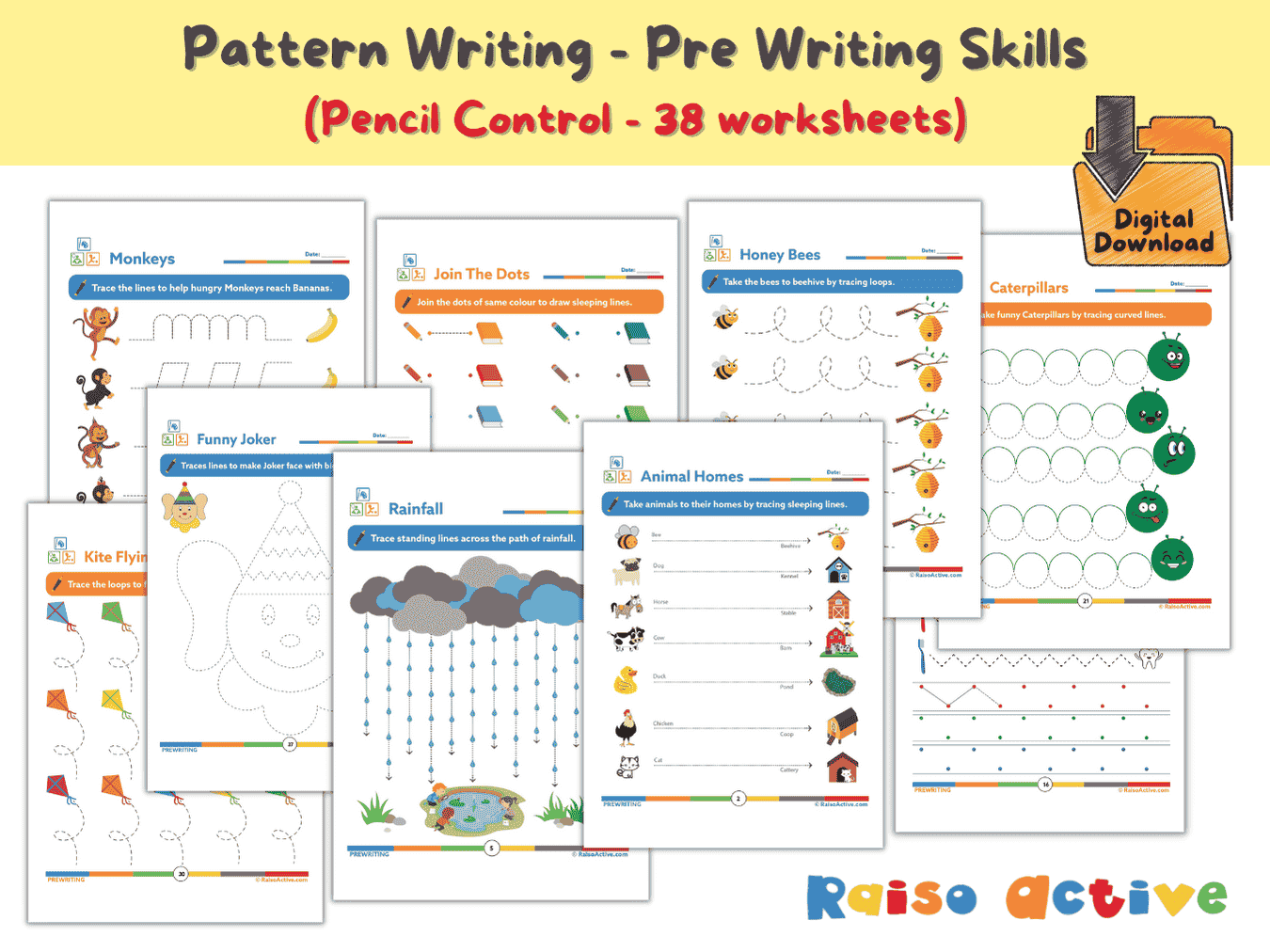
Pattern Writing Pre-writing Skills Activity Book for 3-4 Year Olds
This is page 4 of the pack. Ages 3-4 · PreschoolAges 3-4 · NurseryAges 3-4
Made for your child
A whole activity pack made with their name
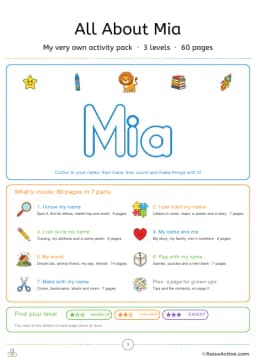
60 pages to spot, build, trace and write their own name, plus pages about their favourites, feelings and family. See a free preview with their name.
Make an All About Me packFree preview · free for members
Or start free: a name tracing sheet with their nameCurriculum
- Pre-Writing > Straight Lines
How to use this worksheet
Read through the guide and note which fine motor activities match your child's current abilities, starting with simpler tasks like squeezing or tearing before moving to more precise ones like using tweezers. Build a short daily routine of five to ten minutes of hands-on fine motor play rather than jumping straight to pencil practice. Watch which activities your child finds easy and which are more challenging, using that as a guide for where to focus. Gradually introduce pencil and crayon activities once grip and hand strength feel steadier.
Extension activities
- 1Squeeze and roll playdough into balls, snakes, and flattened shapes to build hand strength.
- 2Use clothespins or tweezers to pick up and sort small pom-poms or beads.
- 3Practice threading large beads onto a shoelace or pipe cleaner.
- 4Tear strips of paper by hand to make a collage, building the pincer grip used in writing.
- 5Practice buttoning, zipping, or using snaps on clothing or a fastening board.

Written by
Hemsweta Jain · Teacher Cheena
MBA and Early Childhood Educator, teaching since 2014 · Founder of RaisoActive, Mumbai
Every RaisoActive worksheet is designed and checked by the founder before publishing.
Published · Last reviewed
More from Pattern Writing Pre-writing Skills Activity Book for 3-4 Year Olds

Trace the Curved Lines: Give Balloons to the Girls! Worksheet
Ages 3-5 · Preschool–Pre-KAges 3-5 · Nursery–ReceptionAges 3-5 · Nursery–LKGAges 3-5
This worksheet has children ages 3-5 trace curved balloon strings, practicing the rounded, flowing pencil motion needed later for letters like c, o, and s. Curved lines demand a different wrist and finger movement than straight lines, since the hand has to continuously adjust direction rather than pushing in one line, which makes this an important complement to straight-line tracing practice.

Fly Airplanes Tracing Worksheet for Preschoolers
Ages 3-5 · Preschool–Pre-KAges 3-5 · Nursery–ReceptionAges 3-5 · Nursery–LKGAges 3-5
Unlike letter tracing, this worksheet has children follow long, curving flight-path lines from a globe down to the ground, which builds sustained hand-eye coordination and the ability to keep a pencil moving smoothly over a longer distance than a single letter requires. For 3-5 year olds, this kind of extended line tracing is an important bridge between short scribbles and the longer, controlled strokes needed for writing full letters and words.

Letter S Tracing Worksheet for Preschoolers
Ages 3-5 · Preschool–Pre-KAges 3-5 · Nursery–ReceptionAges 3-5 · Nursery–LKGAges 3-5
Tracing the letter S gives 3-5 year olds practice with a single flowing curve that changes direction twice, a genuinely different challenge from straight-line letters and one that builds the smooth hand control needed for cursive-style writing later on. This page pairs the tracing practice with a picture to color, reinforcing the letter through a second, playful channel.

Trace the Penguin: A Fun Pre-Writing Worksheet for Kids!
Ages 3-5 · Preschool–Pre-KAges 3-5 · Nursery–ReceptionAges 3-5 · Nursery–LKGAges 3-5
Tracing the rounded outline of a penguin gives children ages 3-5 practice with curved strokes that form a whole recognizable animal shape rather than an abstract line, which helps the tracing feel purposeful and connected to something familiar from books or videos. The cold-climate theme also introduces simple vocabulary about penguins and their environment, a small science connection layered onto the fine motor practice.

Trace the Train Engine Worksheet for Preschoolers
Ages 3-5 · Preschool–Pre-KAges 3-5 · Nursery–ReceptionAges 3-5 · Nursery–LKGAges 3-5
Tracing the shapes that make up a train engine, like rectangles for the body and circles for the wheels, gives children ages 3-5 practice with mixed straight and curved strokes while reinforcing the idea that complex objects are built from combinations of simple shapes. The train theme also introduces sequencing awareness, since trains are made of connected cars that follow one after another along a track.

Join the Dots: Standing Lines Worksheet for Preschoolers
Ages 3-5 · Preschool–Pre-KAges 3-5 · Nursery–ReceptionAges 3-5 · Nursery–LKGAges 3-5
This dot-to-dot worksheet asks children ages 3-5 to connect dots forming vertical lines, sometimes called 'standing lines' because they stand upright, building the bottom-to-top or top-to-bottom pencil control needed for letters like l, t, and i. Connecting dots precisely, rather than simply tracing a continuous line, adds an extra layer of accuracy practice on top of the basic straight-line motion.

Shape Tracing Fun: Trace & Color the Shapes Worksheet for Preschoolers!
Ages 3-5 · Preschool–Pre-KAges 3-5 · Nursery–ReceptionAges 3-5 · Nursery–LKGAges 3-5
Tracing and coloring several different shapes on one page gives children ages 3-5 practice switching between distinct stroke patterns, since a circle requires a continuous curved motion while a square or triangle requires straight lines and sharp corners. Naming each shape while tracing it also reinforces shape vocabulary alongside the physical practice, connecting the word to the motion that draws it.

Trace and Color the Funny Joker Face Worksheet for Preschoolers
Ages 3-5 · Preschool–Pre-KAges 3-5 · Nursery–ReceptionAges 3-5 · Nursery–LKGAges 3-5
Tracing the curved and circular shapes that make up a funny, exaggerated face gives children ages 3-5 practice with rounded strokes while the silly theme, a joker or clown face, adds humor that tends to boost engagement on what could otherwise feel like a repetitive shape-tracing task. Placing and tracing multiple facial features also reinforces facial feature vocabulary and proportion, similar to other face-based worksheets but with a playful, exaggerated twist.
Related worksheets

Connect the Dots: Hidden Shape Worksheet for Kids
Ages 3-5 · Preschool–Pre-KAges 3-5 · Nursery–ReceptionAges 3-5 · Nursery–LKGAges 3-5
Children ages 3-5 practice counting in sequence and fine motor line control as they connect numbered dots in order to reveal a hidden shape, combining numeracy with hand-eye coordination in one satisfying activity. The surprise of a shape emerging only once every dot is connected correctly also motivates children to stay careful and accurate rather than rushing through the numbers.
Dad's Beard: A Fun Shaving Activity for Kids!
Ages 3-5 · Preschool–Pre-KAges 3-5 · Nursery–ReceptionAges 3-5 · Nursery–LKGAges 3-5
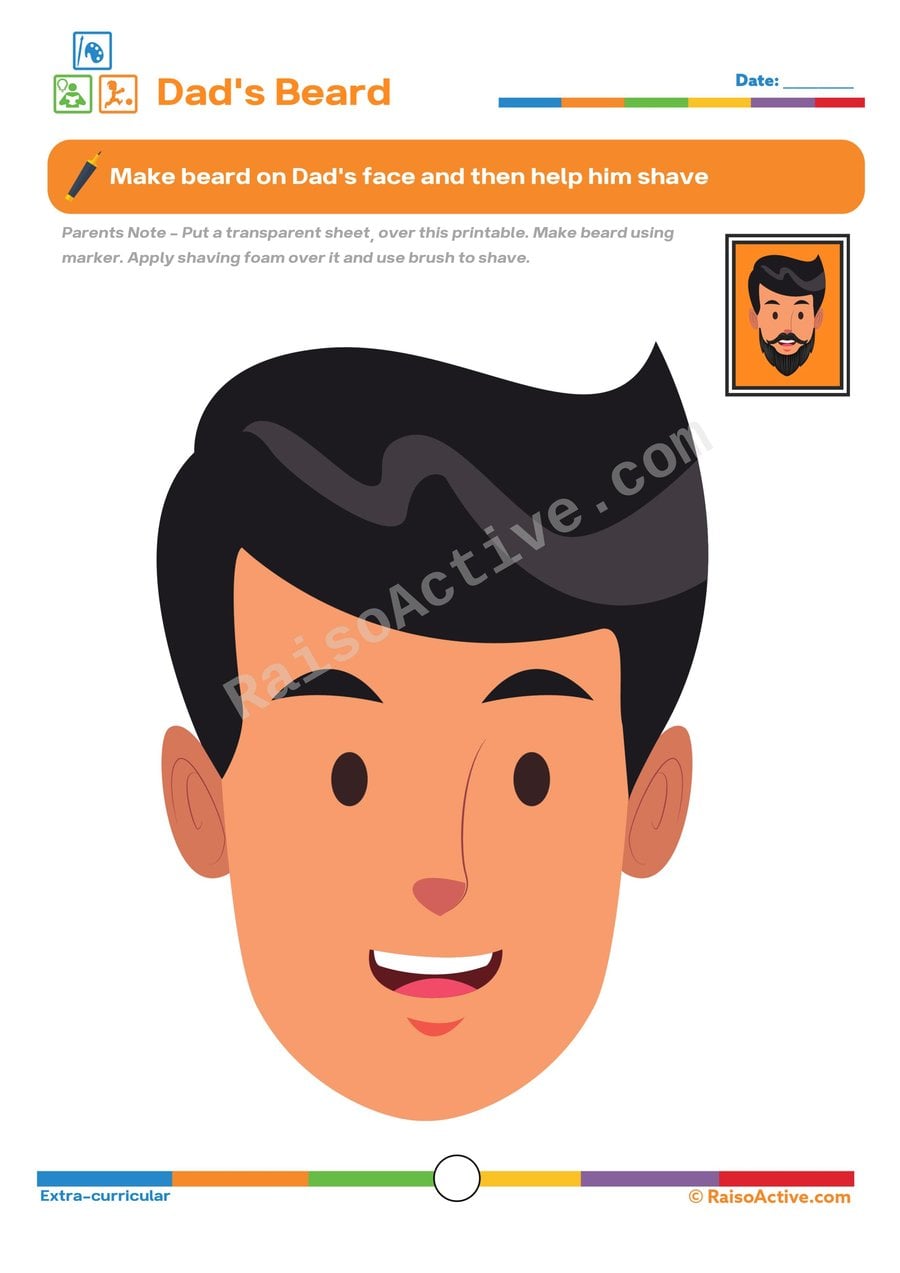
This playful pretend-shaving activity builds fine motor control and bilateral coordination in children ages 3-5, as they draw a beard with a marker and then 'shave' it away using foam and a brush in careful, controlled strokes. It also introduces a simple science idea — that shaving foam can be applied and removed in layers — while giving children a hands-on, sensory way to imitate an everyday grown-up routine.

Father's Day Coloring Card: A Fun Coloring Worksheet for Kids!
Ages 3-5 · Preschool–Pre-KAges 3-5 · Nursery–ReceptionAges 3-5 · Nursery–LKGAges 3-5
Coloring Father's Day themed images and folding the page into a card gives children ages 3-5 practice with crayon control and color choice, while the act of creating a gift adds a meaningful, purposeful goal to the fine motor task. Because the final product becomes something to give to a special person, this worksheet also introduces early ideas about celebration and appreciation. Folding the paper into a card shape adds a simple spatial task on top of the coloring itself.

Parent's Guide: Fun Activities for Gross Motor Development and Emotional Learning
Ages 3-5 · Preschool–Pre-KAges 3-5 · Nursery–ReceptionAges 3-5 · Nursery–LKGAges 3-5
This parent guide equips caregivers of children ages 3-5 with activities spanning gross motor skills, emotional expression, family concepts, shape recognition, and calendar awareness, using role play, finger puppets, and simple games. Combining physical movement with emotional vocabulary practice, such as making different facial expressions, helps children build body awareness and feelings vocabulary side by side. Rotating through several distinct activity types in one guide also keeps a young child's attention across a longer play session.

Big and Small Objects: Coloring Worksheet for Preschoolers
Ages 3-5 · Preschool–Pre-KAges 3-5 · Nursery–ReceptionAges 3-5 · Nursery–LKGAges 3-5
This coloring worksheet helps children ages 3-5 practice comparative size reasoning by identifying and coloring the larger object within each paired set of pictures. Making a size judgment before coloring means the coloring itself becomes a way to record and confirm the child's reasoning, rather than being purely decorative. Repeated practice comparing 'big' and 'small' objects supports later measurement and comparison skills in early math.

Reindeer Craft: Follow Instructions and Create a Festive Decoration!
Ages 3-5 · Preschool–Pre-KAges 3-5 · Nursery–ReceptionAges 3-5 · Nursery–LKGAges 3-5
This multi-step reindeer craft has children ages 3-5 follow a sequence of folding and assembly instructions to build a three-dimensional decoration, strengthening both listening comprehension and the fine motor skills needed to position and attach small pieces accurately. Because each step depends on the one before it, children also practice patience and sequencing, skills that carry over into following any multi-step task.

Spooky Fun Coloring Worksheet for Preschoolers
Ages 3-5 · Preschool–Pre-KAges 3-5 · Nursery–ReceptionAges 3-5 · Nursery–LKGAges 3-5
This Halloween-themed coloring page gives children ages 3-5 practice with crayon grip, color choice, and staying within outlines as they bring a collection of spooky objects to life. Naming each object as they color, like a ghost, a pumpkin, or a bat, also builds seasonal vocabulary tied directly to what they're seeing and creating.

Spider Count Worksheet: Finger Painting Fun for Halloween!
Ages 3-5 · Preschool–Pre-KAges 3-5 · Nursery–ReceptionAges 3-5 · Nursery–LKGAges 3-5
Dabbing fingertips or Q-tips in paint to create the exact number of spiders shown on each web gives children ages 3-5 hands-on practice with one-to-one counting while also strengthening the small hand muscles needed for pencil control later on. Because each web has a target number, children must count as they paint rather than just decorating freely, which reinforces number recognition in a playful, low-pressure way. The messy, sensory nature of finger painting also supports focus and engagement at an age when seated paper-and-pencil tasks can be hard to sustain.
Guides for this topic

Portfolio Assessment with Young Children: A Comprehensive Guide to Meaningful Documentation
Learn how portfolio assessment captures your child's growth through meaningful documentation. Practical tips, templates, and age-appropriate strategies for ages 1-8.
What Makes a Good Worksheet vs. a Poor One: A Parent's Guide to Quality Educational Materials
Learn what separates high-quality educational worksheets from poor busy work. Discover design principles, red flags, and how to evaluate free worksheets online for your child aged 1-8.

How to Help Your Child with Letter Reversals: A Complete Guide for Parents and Teachers
Letter reversals are normal until age 7-8. Learn the best multisensory strategies, anchor letter tricks, and activities to help children write b, d, p, and q correctly.
Reviews
Every worksheet for ages 3–5, no watermark
Members download the full library of 1,000+ worksheets and every activity pack without watermarks or daily limits. One year costs ₹999 in India or $20 elsewhere.
See membership plansOr download any worksheet free with a watermark (5 a day).