Father's Day Coloring Card: A Fun Coloring Worksheet for Kids!
Coloring Father's Day themed images and folding the page into a card gives children ages 3-5 practice with crayon control and color choice, while the act of creating a gift adds a meaningful, purposeful goal to the fine motor task. Because the final product becomes something to give to a special person, this worksheet also introduces early ideas about celebration and appreciation. Folding the paper into a card shape adds a simple spatial task on top of the coloring itself.
Part of the pack
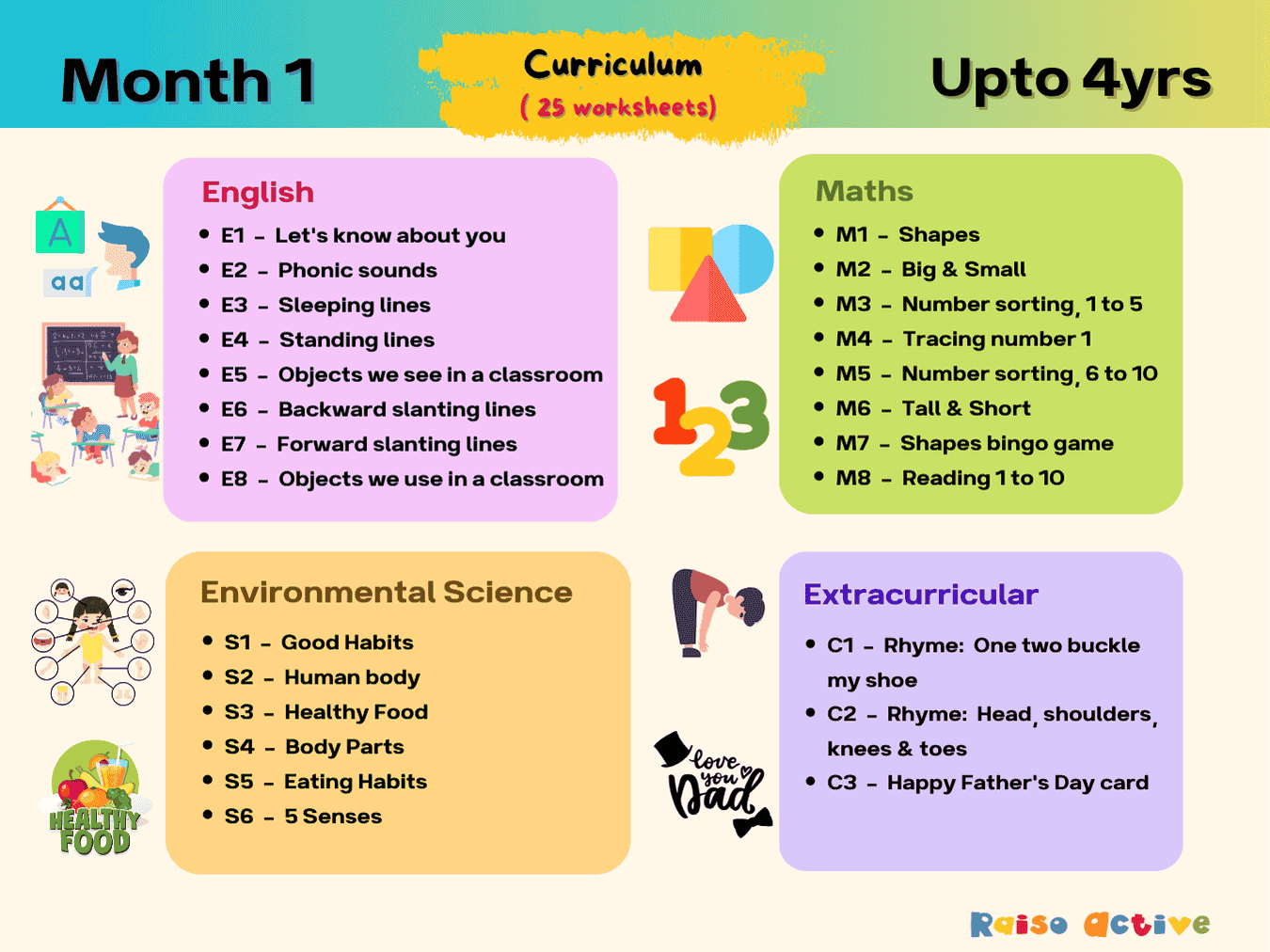
Month 1: Learning & Development | Ages Up to 4
This is page 28 of the pack. Ages 3-4 · PreschoolAges 3-4 · NurseryAges 3-4
Made for your child
A whole activity pack made with their name
60 pages to spot, build, trace and write their own name, plus pages about their favourites, feelings and family. See a free preview with their name.
Make an All About Me packFree preview · free for members
Or start free: a name tracing sheet with their nameCurriculum
- Art & Craft > Arts & Crafts
How to use this worksheet
Give your child crayons or markers and let them choose colors for each object on the page, encouraging them to fill in one section fully before moving to the next. Once the coloring is finished, help your child fold the paper in half to create the card shape. If scissors are needed to trim any edges, offer to help or supervise closely. Open the folded card together and help your child think of a short message to include inside for their dad or another special person in their life.
Materials needed
- Crayons
- Markers
- Scissors (optional)
Extension activities
- 1Write or dictate a short message inside the card about something specific you love doing with dad.
- 2Draw an additional picture of dad on the back of the card to personalize it further.
- 3Make a second matching card for another important adult in your child's life.
- 4Add texture with stickers, torn paper, or fabric scraps to decorate the front of the card.
- 5Practice writing 'Happy Father's Day' or your child's name somewhere on the card.

Written by
Hemsweta Jain · Teacher Cheena
MBA and Early Childhood Educator, teaching since 2014 · Founder of RaisoActive, Mumbai
Every RaisoActive worksheet is designed and checked by the founder before publishing.
Published · Last reviewed
More from Month 1: Learning & Development | Ages Up to 4

Tall and Short Worksheet: Comparing Sizes for Preschoolers
Ages 3-5 · Preschool–Pre-KAges 3-5 · Nursery–ReceptionAges 3-5 · Nursery–LKGAges 3-5
Comparing objects and circling the tallest and shortest one in each row teaches children ages 3-5 comparative size vocabulary, an early math skill that goes beyond simply describing single objects as big or small. This worksheet requires children to look across an entire row and rank items relative to one another, which builds visual comparison skills that later support measurement concepts like longer, shorter, and equal. Using varied pictures for each comparison also keeps children engaged while practicing the same underlying skill repeatedly.

Bean Counting Fun: A Sorting Worksheet for Preschoolers!
Ages 3-5 · Preschool–Pre-KAges 3-5 · Nursery–ReceptionAges 3-5 · Nursery–LKGAges 3-5
Children ages 3-5 practice number recognition and one-to-one correspondence by counting out the exact quantity of beans shown on each numeral and physically placing them onto the matching picture. Handling small, individual beans and placing them one at a time reinforces accurate counting far more effectively than counting printed dots, since a misplaced bean is immediately obvious and easy to correct.

Big and Small Objects: Coloring Worksheet for Preschoolers
Ages 3-5 · Preschool–Pre-KAges 3-5 · Nursery–ReceptionAges 3-5 · Nursery–LKGAges 3-5
This coloring worksheet helps children ages 3-5 practice comparative size reasoning by identifying and coloring the larger object within each paired set of pictures. Making a size judgment before coloring means the coloring itself becomes a way to record and confirm the child's reasoning, rather than being purely decorative. Repeated practice comparing 'big' and 'small' objects supports later measurement and comparison skills in early math.
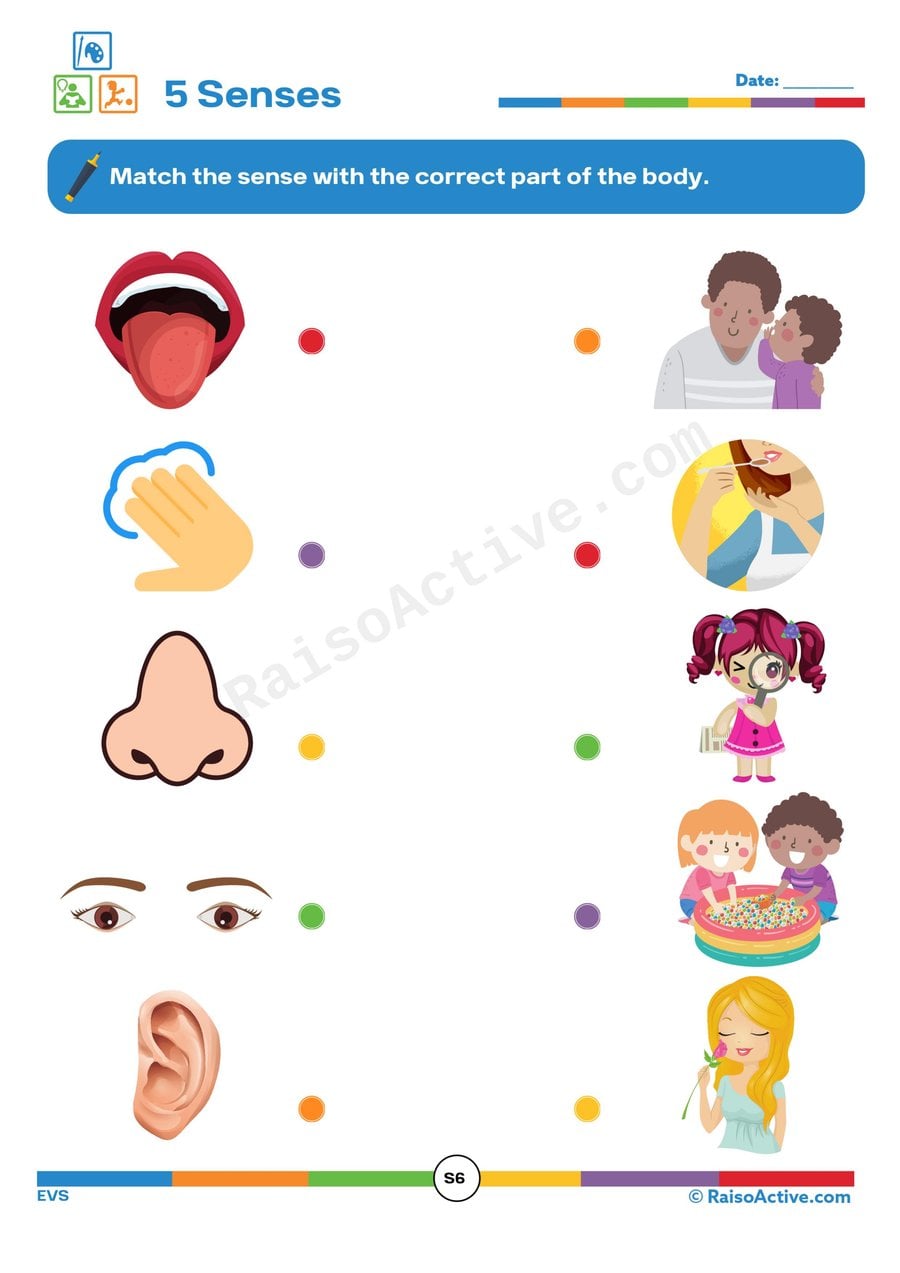
5 Senses Matching Worksheet for Preschoolers
Ages 3-5 · Preschool–Pre-KAges 3-5 · Nursery–ReceptionAges 3-5 · Nursery–LKGAges 3-5
This worksheet introduces children ages 3-5 to the five senses — sight, hearing, smell, taste, and touch — by asking them to match each sense to the body part responsible for it. Understanding that specific body parts are linked to specific senses is an early science concept that builds body awareness and observational vocabulary. Drawing the connecting line for each match also reinforces visual tracking and pencil control.

Classroom Vocabulary Worksheet for Kids: Circle and Name!
Ages 3-5 · Preschool–Pre-KAges 3-5 · Nursery–ReceptionAges 3-5 · Nursery–LKGAges 3-5
Circling pictures of common classroom objects and saying their names aloud builds vocabulary and oral language skills in children ages 3-5, helping them connect familiar school items, like a desk, book, or crayon, to their spoken names. This kind of naming practice supports school readiness, since recognizing and labeling classroom objects helps children feel more comfortable and confident in a school environment. Speaking each word aloud, rather than just circling silently, also reinforces pronunciation and word retrieval.

Phonic Sounds Worksheet: Circle the Picture That Starts with the Alphabet Sound!
Ages 4-5 · Pre-KAges 4-5 · ReceptionAges 4-5 · LKGAges 4-5
This worksheet reinforces beginning-sound recognition for children ages 4-5 by presenting a letter at the start of each row and asking them to find the one picture among several that begins with that same sound. Because each row contains multiple pictures, children must test several beginning sounds against the target letter before settling on the correct one, which builds more precise listening skills than simpler one-picture matching tasks. This process also strengthens the letter-sound mapping that underlies early decoding.

Sleeping Line Worksheet: Help the Cars Drive Straight!
Ages 3-5 · Preschool–Pre-KAges 3-5 · Nursery–ReceptionAges 3-5 · Nursery–LKGAges 3-5
This worksheet helps children ages 3-5 develop pencil control and hand steadiness by tracing horizontal, 'sleeping' lines that guide toy cars straight along a road. Practicing horizontal line tracing is one of the essential prewriting strokes, since many letters and numbers rely on the same steady, left-to-right hand motion this worksheet trains.
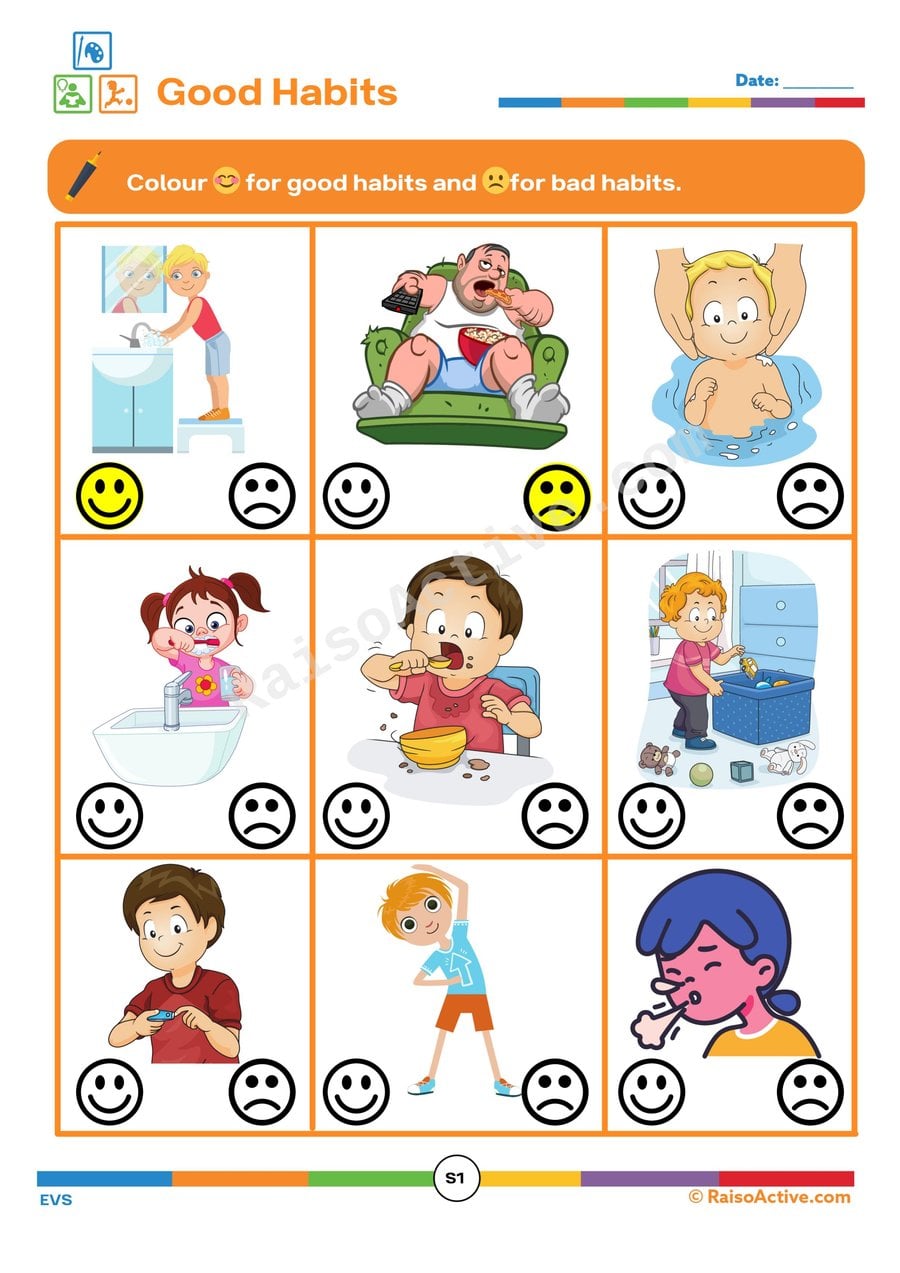
Good Habits Coloring Worksheet for Kids
Ages 3-5 · Preschool–Pre-KAges 3-5 · Nursery–ReceptionAges 3-5 · Nursery–LKGAges 3-5
This coloring activity helps children ages 3-5 practice moral and social reasoning by identifying whether a pictured behavior is a good habit or a bad one, then coloring a smiley face or a sad face to match their judgment. Making this good-or-bad decision for each picture requires children to connect an action to its likely consequence, an early form of the cause-and-effect thinking used in social-emotional learning. The simple color-coded response format also makes the activity accessible even to children who aren't yet writing independently.
Related worksheets
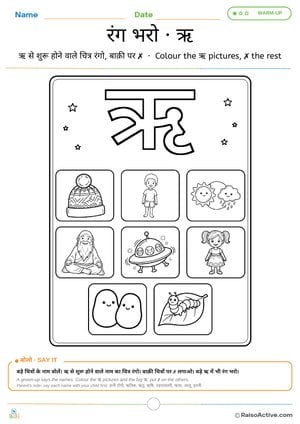
Colour the ऋ Words – Hindi Letter ऋ (ri) Colouring Worksheet | ऋ वाली चीज़ों में रंग भरो
Ages 3-7 · Preschool–Grade 1Ages 3-7 · Nursery–Year 2Ages 3-7 · Nursery–Class 1Ages 3-7
Children say each picture name aloud, decide whether it starts with ऋ, colour the matching pictures (ऋषि, ऋतु, ऋचा and ऋतिक) and the big outline letter, and put a cross on the rest. Sorting by first sound trains the ear and colouring builds hand control.
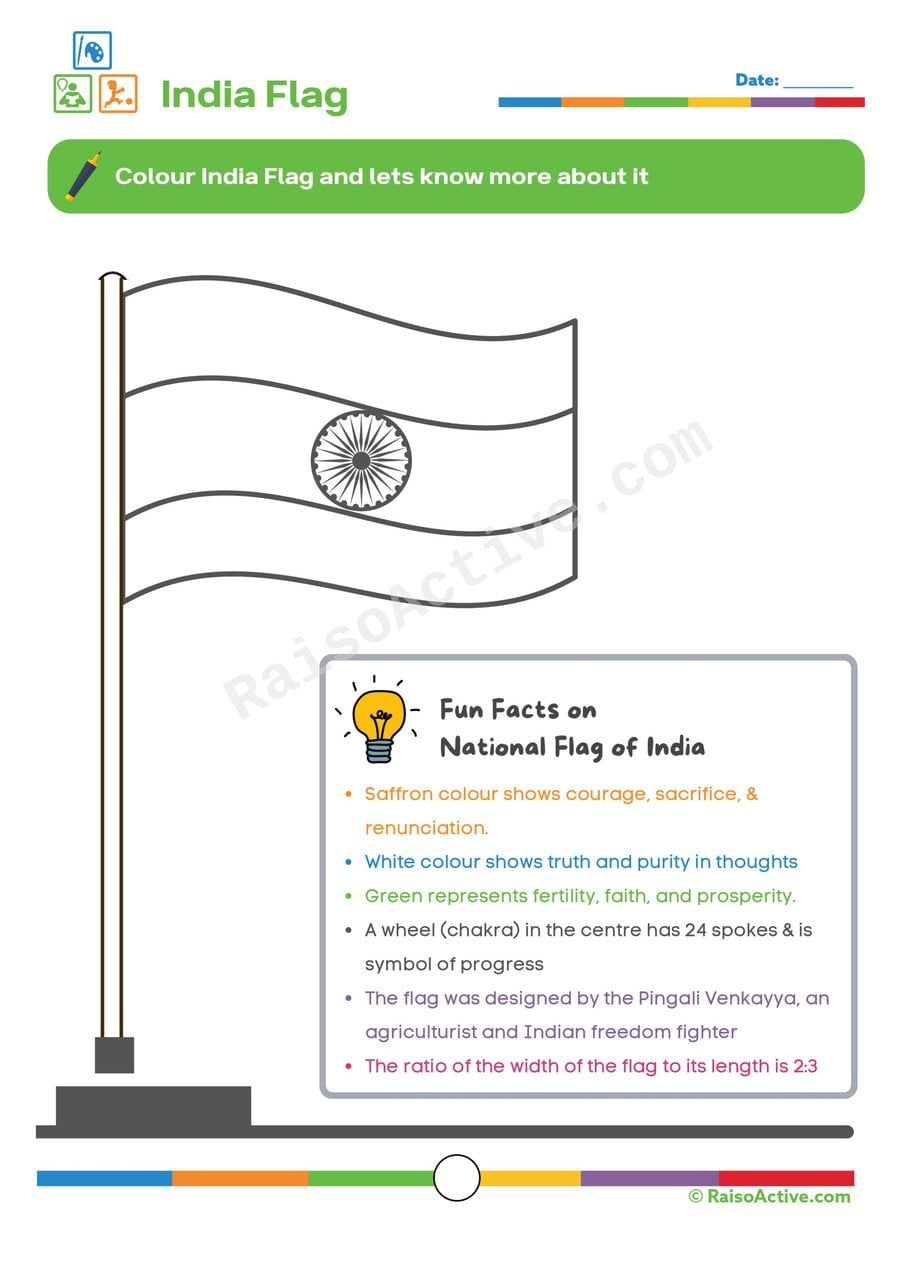
Color the India Flag Worksheet for Preschoolers
Ages 3-5 · Preschool–Pre-KAges 3-5 · Nursery–ReceptionAges 3-5 · Nursery–LKGAges 3-5
This worksheet teaches children ages 3-5 the three colors and layout of the Indian national flag, saffron, white, and green with the navy wheel, while practicing careful, section-by-section coloring. Reading a few simple facts about the flag alongside the coloring also introduces the idea that national symbols carry meaning, an early building block for civic and cultural awareness.
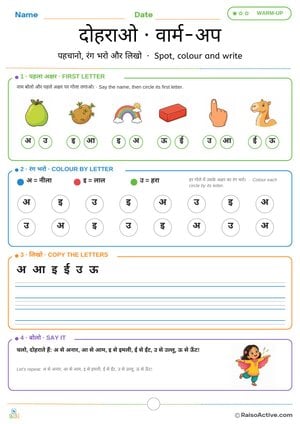
Hindi Vowels Part 1 Revision Warm-Up: First Letter, Colour by Letter and Copy | दोहराओ · वार्म-अप
Ages 3-7 · Preschool–Grade 1Ages 3-7 · Nursery–Year 2Ages 3-7 · Nursery–Class 1Ages 3-7
A mixed revision of the six vowels: circle the first letter of six pictured words, colour circles by letter code (अ blue, इ red, उ green), copy all six vowels on lines and say the revision rhyme.
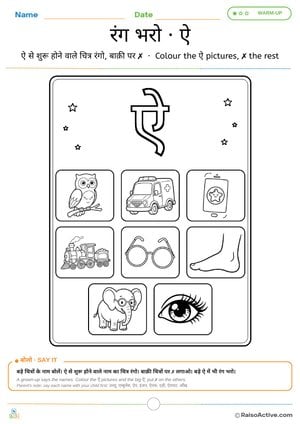
Colour the ऐ Words – Hindi Letter ऐ (ai) Colouring Worksheet | ऐ वाली चीज़ों में रंग भरो
Ages 3-7 · Preschool–Grade 1Ages 3-7 · Nursery–Year 2Ages 3-7 · Nursery–Class 1Ages 3-7
Children say each picture name aloud, decide whether it starts with ऐ, colour the matching pictures (ऐनक, ऐरावत and ऐप) and the big outline letter, and put a cross on the rest. Sorting by first sound trains the ear and colouring builds hand control.

Coloring Worksheet: Identify and Color the Symbols!
Ages 3-5 · Preschool–Pre-KAges 3-5 · Nursery–ReceptionAges 3-5 · Nursery–LKGAges 3-5
This worksheet introduces children ages 3-5 to national symbols by having them color each one and then match or write its name from a list of options. Beyond fine motor coloring practice, naming each symbol builds early cultural knowledge and category-matching skills, since children must connect a picture to the correct word rather than color at random.
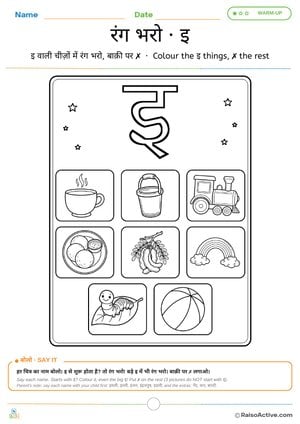
Colour the इ Things: Hindi Letter इ Colouring Page | रंग भरो · इ
Ages 3-7 · Preschool–Grade 1Ages 3-7 · Nursery–Year 2Ages 3-7 · Nursery–Class 1Ages 3-7
Children listen for the first sound of each picture name and decide whether it starts with इ. They colour the इ pictures, cross out the others and colour the big letter.
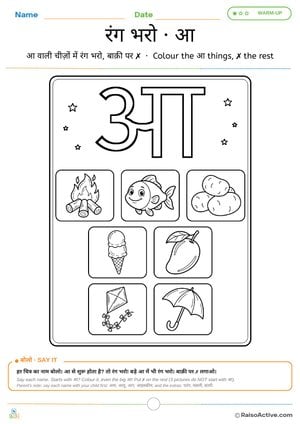
Colour the आ Things: Hindi Letter आ Colouring Page | रंग भरो · आ
Ages 3-7 · Preschool–Grade 1Ages 3-7 · Nursery–Year 2Ages 3-7 · Nursery–Class 1Ages 3-7
Children listen for the first sound of each picture name and decide whether it starts with आ. They colour the आ pictures, cross out the others and colour the big letter.

Spooky Fun: Complete the Halloween Sketches Worksheet
Ages 3-5 · Preschool–Pre-KAges 3-5 · Nursery–ReceptionAges 3-5 · Nursery–LKGAges 3-5
This worksheet has children ages 3-5 complete partially drawn Halloween sketches by tracing or extending existing lines, building visual perception and fine motor control as they figure out what shape a sketch is meant to become. Coloring the completed pictures afterward adds a creative finishing step that rewards the careful tracing work.
Guides for this topic

Best Worksheets for 3-Year-Olds: What Works and What to Avoid
What works on worksheets for 3-year-olds: short sessions, crayons, tracing lines, matching, cutting, a free weekly plan, and signs one is too advanced.
Fostering Creativity in Structured Learning: The Perfect Balance for Young Minds
Learn how to blend creativity with structured learning for children ages 1-8. Practical strategies, activities, and printable worksheets for parents and teachers.
Celebrating Diversity: How to Incorporate Cultural Awareness in Learning Activities for Young Children
Practical cultural awareness activities for young children aged 2-8. Explore Indian festivals, world cultures, food, music, and crafts to teach diversity and inclusion.
Reviews
Every worksheet for ages 3–5, no watermark
Members download the full library of 1,000+ worksheets and every activity pack without watermarks or daily limits. One year costs ₹999 in India or $20 elsewhere.
See membership plansOr download any worksheet free with a watermark (5 a day).