Trace the Waves! A Pre-Writing Worksheet for Kids
Tracing a series of connected wave shapes gives children ages 3-5 practice with a smooth, undulating curve that rises and falls repeatedly, a stroke pattern that underlies letters like m, n, u, and w. Unlike a single curve, a wave line requires the hand to reverse direction multiple times in one continuous motion without lifting the pencil, building more sustained curve control than a shorter, single-curve worksheet.
Part of the pack
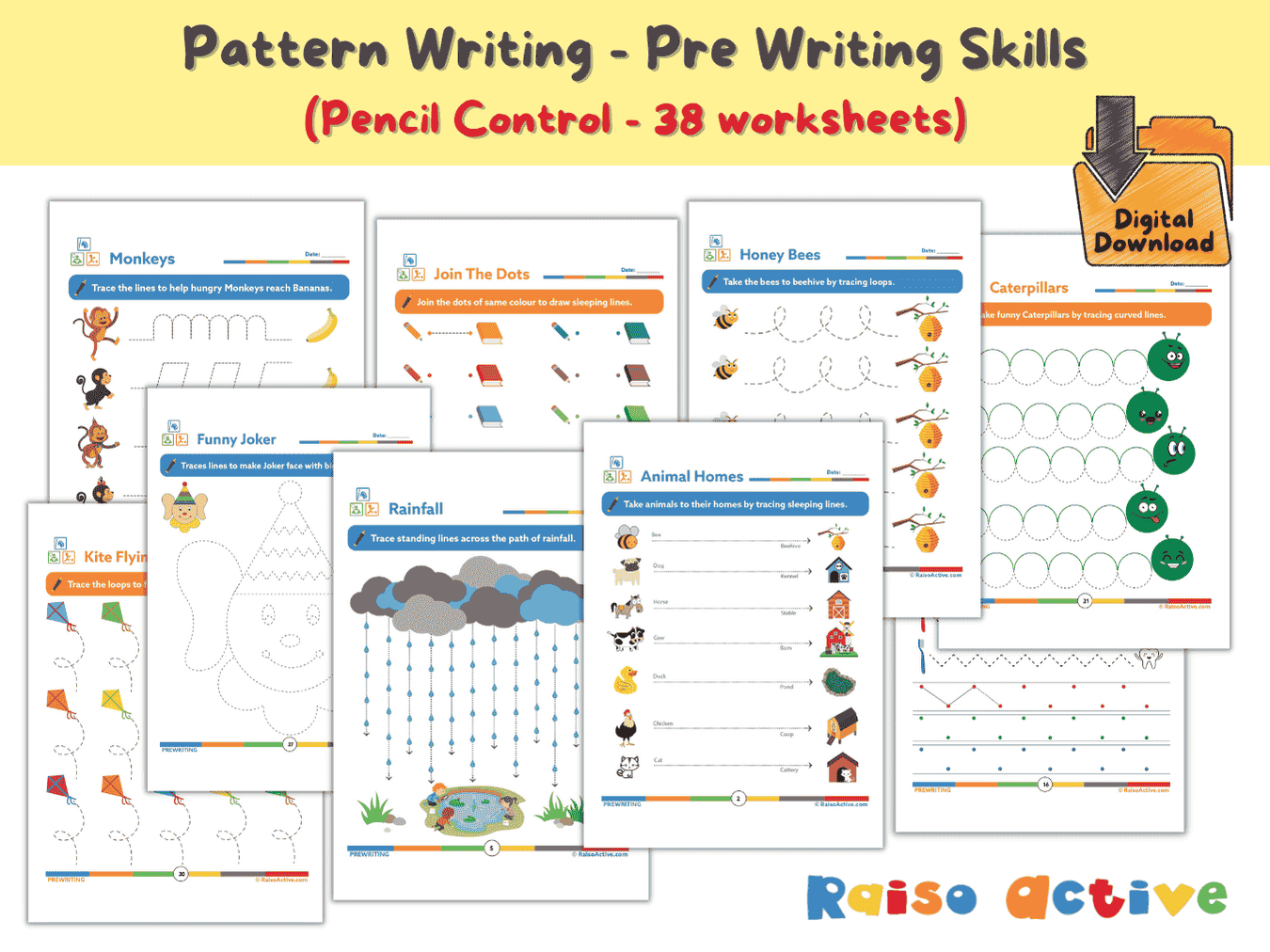
Pattern Writing Pre-writing Skills Activity Book for 3-4 Year Olds
This is page 23 of the pack. Ages 3-4 · PreschoolAges 3-4 · NurseryAges 3-4
Made for your child
A whole activity pack made with their name
60 pages to spot, build, trace and write their own name, plus pages about their favourites, feelings and family. See a free preview with their name.
Make an All About Me packFree preview · free for members
Or start free: a name tracing sheet with their nameCurriculum
- Pre-Writing > Curved Lines
How to use this worksheet
Talk about what ocean waves look like, rising and falling, before your child begins tracing. Guide their pencil along the dotted wave line in one continuous motion, following each rise and dip without lifting the pencil between waves. If the line becomes choppy or breaks apart, encourage them to try that section again. Color the water and wave scene once the full line is traced.
Materials needed
- Pencil
- Crayons
Extension activities
- 1Wave a long ribbon or scarf up and down to physically mimic the wave shape before tracing again.
- 2Make an ocean-in-a-bottle sensory bottle using water, blue food coloring, and a little oil to watch a wave motion.
- 3Visit a beach or watch a video of ocean waves and talk about their rising and falling shape.
- 4Paint wave shapes using a sponge or wide brush dipped in blue paint.
- 5Create a simple ocean sensory bin with blue rice or water beads and small sea creature toys.

Written by
Hemsweta Jain · Teacher Cheena
MBA and Early Childhood Educator, teaching since 2014 · Founder of RaisoActive, Mumbai
Every RaisoActive worksheet is designed and checked by the founder before publishing.
Published · Last reviewed
More from Pattern Writing Pre-writing Skills Activity Book for 3-4 Year Olds
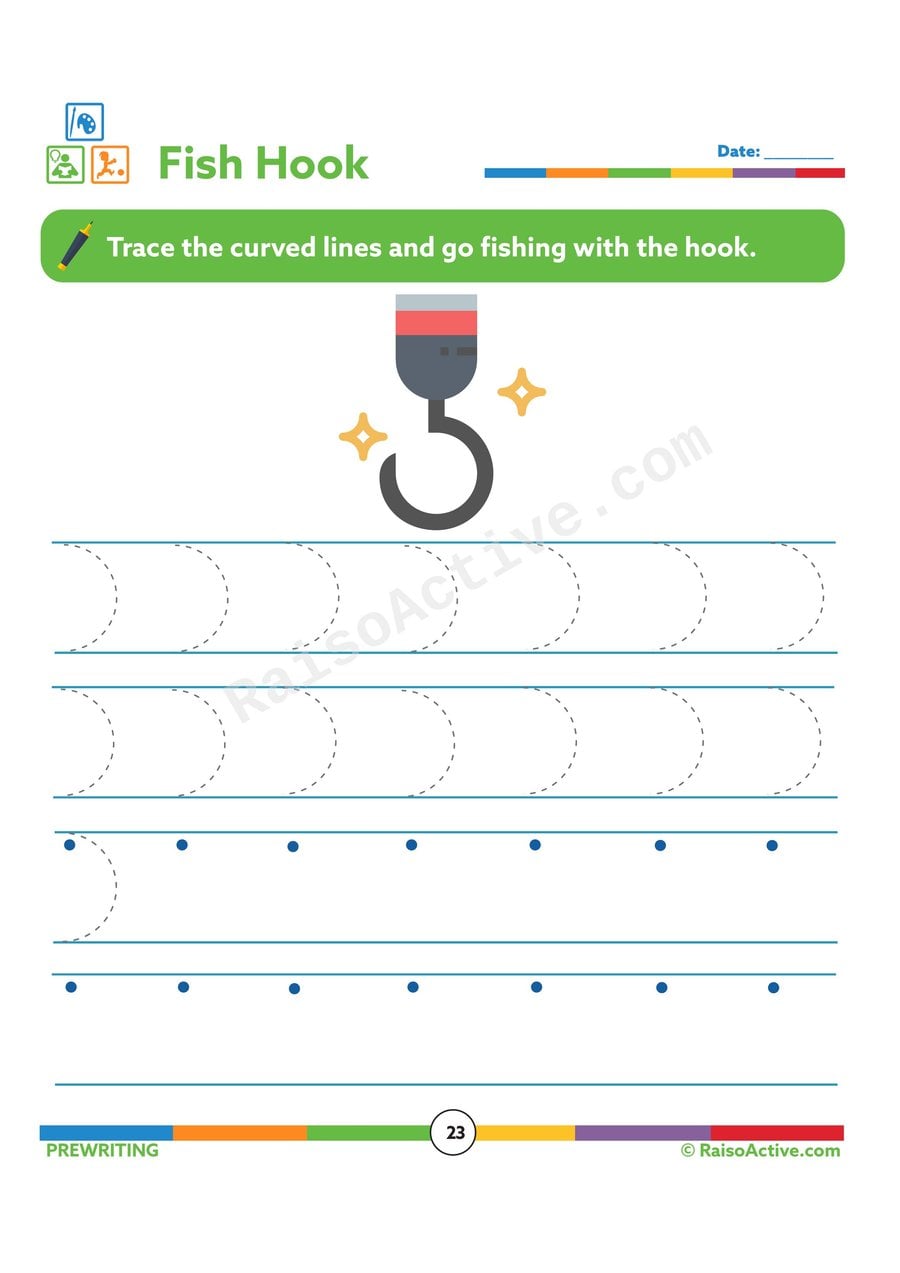
Fish Hook Tracing Worksheet for Preschoolers
Ages 3-5 · Preschool–Pre-KAges 3-5 · Nursery–ReceptionAges 3-5 · Nursery–LKGAges 3-5
Tracing a hook-shaped fishing line curve gives children ages 3-5 practice with a tight, small curved stroke, different from the wide, sweeping curves used in other worksheets, which builds fine control over shorter pencil motions. This particular curve shape is also an early building block for letters like j, which end in a small hook, making this good preparatory practice.

Trace and Build a Castle Worksheet for Preschoolers
Ages 3-5 · Preschool–Pre-KAges 3-5 · Nursery–ReceptionAges 3-5 · Nursery–LKGAges 3-5
Tracing the geometric shapes that form a castle, like triangles for turrets and rectangles for towers, gives children ages 3-5 practice with straight-line shape tracing while also introducing the idea that complex structures are made by combining simple shapes. This spatial reasoning, seeing how basic shapes stack and combine into something bigger, supports both early geometry understanding and imaginative building play.

Pattern Writing Pre-writing Skills Activity Book for 3-4 Year Olds - Page 40
Ages 3-4 · PreschoolAges 3-4 · NurseryAges 3-4
As one of the later pages in the pre-writing patterns activity book, this page asks 3-4 year olds to apply everything practiced on earlier pages, steady pressure, consistent spacing, and accurate prediction, to a pattern that combines skills built up gradually through the book. Reaching this stage of the book is itself a marker of growing stamina, since completing a full row of repeated strokes reliably takes more sustained focus than the simpler early pages required.

Sledge Fun: Trace Slanting Lines to the Snowmen Worksheet
Ages 3-5 · Preschool–Pre-KAges 3-5 · Nursery–ReceptionAges 3-5 · Nursery–LKGAges 3-5
Tracing diagonal lines from a sledge down to waiting snowmen gives children ages 3-5 practice with slanting strokes, a motion that's harder to control than straight up-and-down or side-to-side lines because it requires the wrist to angle and rotate. Mastering this diagonal control now lays groundwork for letters like A, K, X, and Y, which all rely on slanted strokes.

Smile with Smiley Face! A Fun Tracing Worksheet for Preschoolers
Ages 3-5 · Preschool–Pre-KAges 3-5 · Nursery–ReceptionAges 3-5 · Nursery–LKGAges 3-5
Tracing a smiling mouth teaches children ages 3-5 the upward curved stroke used in letters like u and later cursive forms, while also tying that curve to something personally meaningful, a smile. Because the shape mirrors an expression children make and recognize every day, this worksheet connects fine motor practice to social-emotional awareness about what a smile looks like and means.

Climb the Ladder: Pre-Writing Practice Worksheet for Kids
Ages 3-5 · Preschool–Pre-KAges 3-5 · Nursery–ReceptionAges 3-5 · Nursery–LKGAges 3-5
Tracing the rungs of a ladder gives children ages 3-5 focused practice with horizontal and vertical straight lines, the two most basic pencil strokes and the building blocks for letters like L, T, E, F, and H. Because a ladder has repeated, evenly spaced rungs, this worksheet also builds a sense of rhythm and spacing that carries over into writing letters at a consistent size later on.

My Book: A Fun Worksheet for Early Learners
Ages 3-5 · Preschool–Pre-KAges 3-5 · Nursery–ReceptionAges 3-5 · Nursery–LKGAges 3-5
Writing their own name on the cover of something they made gives a 3-5 year old a real, motivating reason to practice name-writing — a very different feeling from tracing letters on a generic worksheet. It's often one of the first pieces of writing a child feels ownership over, which matters for building confidence around writing in general.

Fine Motor Skills Activities: Parent's Guide for Pre-Writing
Ages 3-5 · Preschool–Pre-KAges 3-5 · Nursery–ReceptionAges 3-5 · Nursery–LKGAges 3-5
This parent's guide explains that fine motor skills, the small, precise movements of the hands and fingers, need deliberate strengthening before a child can comfortably hold and control a pencil for handwriting. It outlines that skills like a strong pincer grip, wrist stability, and hand strength typically develop through everyday activities like squeezing, pinching, and tearing before they ever translate into neat pencil strokes.
Related worksheets
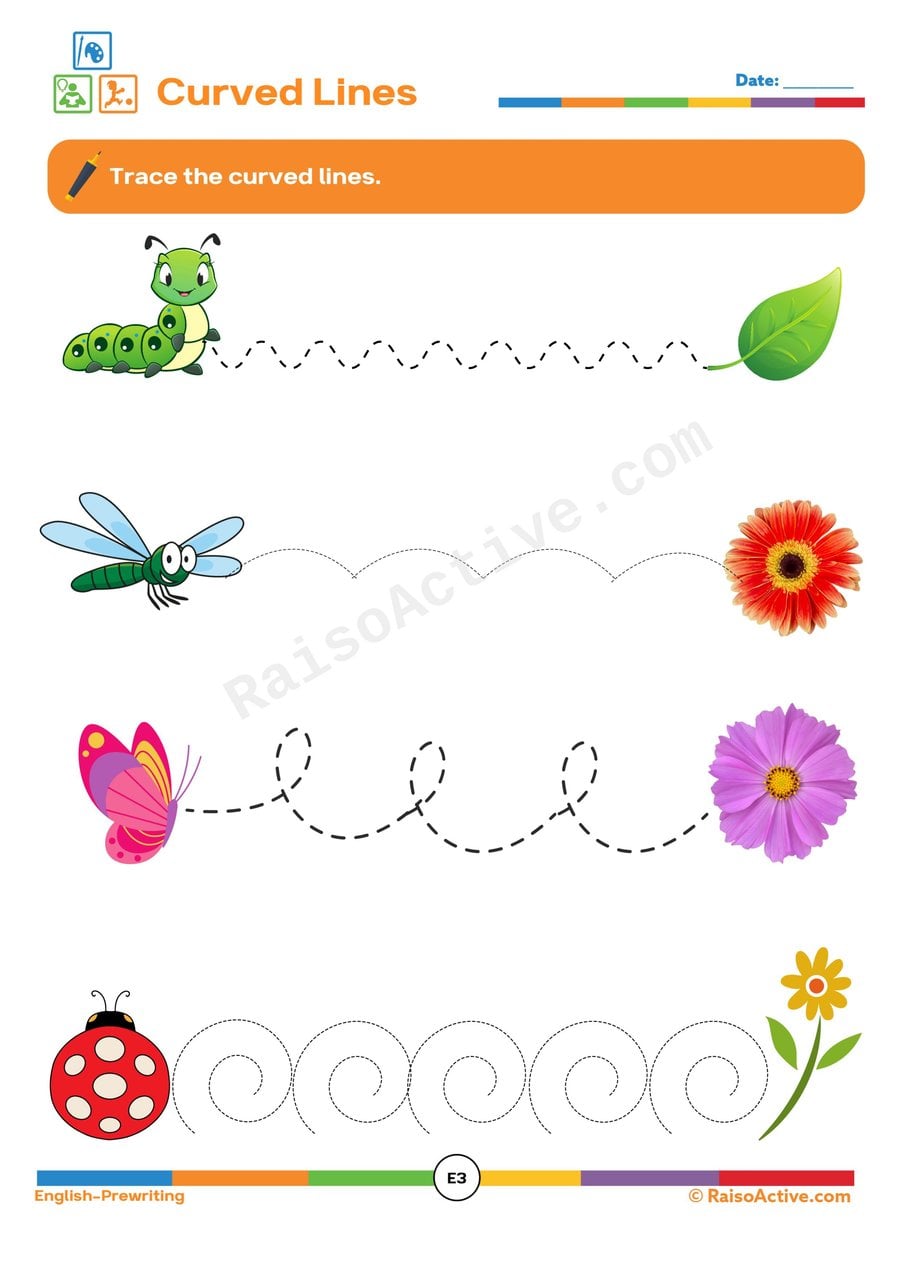
Curved Lines Tracing Worksheet for Preschoolers
Ages 3-5 · Preschool–Pre-KAges 3-5 · Nursery–ReceptionAges 3-5 · Nursery–LKGAges 3-5
Children ages 3-5 practice tracing curved lines in various directions, building the specific hand-eye coordination and wrist flexibility needed to later form curved letters like c, o, and s. Curved-line control is a distinct pre-writing skill from straight-line tracing, since it requires a smoother, more continuous pencil motion.

Parent's Guide: Fun Activities for Gross Motor Development and Emotional Learning
Ages 3-5 · Preschool–Pre-KAges 3-5 · Nursery–ReceptionAges 3-5 · Nursery–LKGAges 3-5
This parent guide equips caregivers of children ages 3-5 with activities spanning gross motor skills, emotional expression, family concepts, shape recognition, and calendar awareness, using role play, finger puppets, and simple games. Combining physical movement with emotional vocabulary practice, such as making different facial expressions, helps children build body awareness and feelings vocabulary side by side. Rotating through several distinct activity types in one guide also keeps a young child's attention across a longer play session.

Ordinal Numbers Coloring Worksheet for Preschoolers
Ages 3-5 · Preschool–Pre-KAges 3-5 · Nursery–ReceptionAges 3-5 · Nursery–LKGAges 3-5
This coloring worksheet introduces children ages 3-5 to ordinal numbers — 1st, 2nd, 3rd, 4th, 5th — by having them identify and color the picture in a row that matches a given ordinal position. Ordinal numbers describe order and rank rather than quantity, which is a meaningfully different concept from the cardinal counting children usually practice first. This distinction is an important step toward understanding sequences, rankings, and everyday language like 'first place' or 'third in line.'
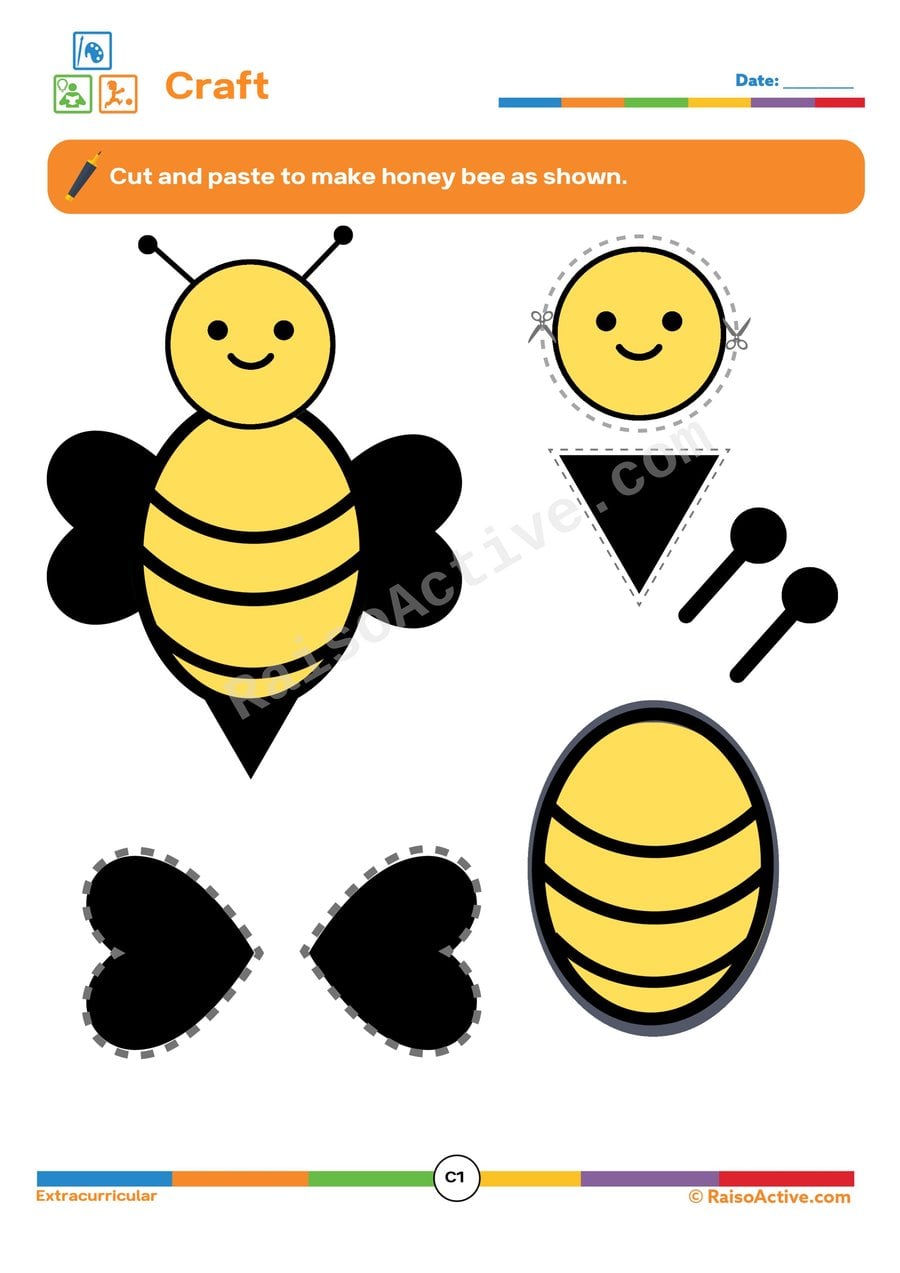
Honey Bee Craft Worksheet: Cut and Paste Fun!
Ages 3-5 · Preschool–Pre-KAges 3-5 · Nursery–ReceptionAges 3-5 · Nursery–LKGAges 3-5
This honey bee craft gives children ages 3-5 targeted practice with scissor control as they cut along dotted lines to separate bee body parts, then reassemble them by pasting into a complete bee shape. Because the pieces must be cut accurately to fit together correctly afterward, this activity demands more precision than simple free-cutting practice. Assembling a multi-piece figure also reinforces spatial reasoning, since children have to recognize how each cut piece relates to the whole.

Decorate the Christmas Tree! Cut and Paste Worksheet
Ages 3-5 · Preschool–Pre-KAges 3-5 · Nursery–ReceptionAges 3-5 · Nursery–LKGAges 3-5
This cut-and-paste activity builds scissor control and hand strength in children ages 3-5 as they snip out ornaments, stars, and lights to decorate their own Christmas tree. Deciding where each decoration goes also develops spatial planning and following a visual guide, since children compare their tree to the sample image while placing pieces.

Rocking Santa Card Craft Worksheet for Preschoolers
Ages 3-5 · Preschool–Pre-KAges 3-5 · Nursery–ReceptionAges 3-5 · Nursery–LKGAges 3-5
This rocking Santa card craft has children ages 3-5 cut out individual shape pieces and assemble them onto a folded card base, combining scissor control with an early understanding of how folding creates movement, since the 'rocking' effect comes from the card's fold. Following the assembly steps in order also reinforces sequencing and attention to visual instructions.

Spooky Fun Coloring Worksheet for Preschoolers
Ages 3-5 · Preschool–Pre-KAges 3-5 · Nursery–ReceptionAges 3-5 · Nursery–LKGAges 3-5
This Halloween-themed coloring page gives children ages 3-5 practice with crayon grip, color choice, and staying within outlines as they bring a collection of spooky objects to life. Naming each object as they color, like a ghost, a pumpkin, or a bat, also builds seasonal vocabulary tied directly to what they're seeing and creating.

Animal Babies Tracing Worksheet: Help the Babies Find Their Mothers!
Ages 3-5 · Preschool–Pre-KAges 3-5 · Nursery–ReceptionAges 3-5 · Nursery–LKGAges 3-5
This tracing worksheet has children ages 3-5 trace dotted lines to connect each baby animal to its correct mother, combining pencil control practice with early science knowledge about animal families. Learning which baby belongs to which adult animal — like a calf to a cow, or a cub to a lion — builds vocabulary and categorization skills that go beyond the tracing itself. Because the correct line only makes sense if the child recognizes the right animal pairing first, this activity blends fine motor practice with genuine content knowledge.
Guides for this topic

Pre-Writing Strokes in Order: From Standing Lines to Loops (With Printable Patterns)
The developmental order of pre-writing strokes, from vertical lines to loops, and why practicing them in sequence makes letter formation much easier to learn.

Portfolio Assessment with Young Children: A Comprehensive Guide to Meaningful Documentation
Learn how portfolio assessment captures your child's growth through meaningful documentation. Practical tips, templates, and age-appropriate strategies for ages 1-8.
What Makes a Good Worksheet vs. a Poor One: A Parent's Guide to Quality Educational Materials
Learn what separates high-quality educational worksheets from poor busy work. Discover design principles, red flags, and how to evaluate free worksheets online for your child aged 1-8.
Reviews
Every worksheet for ages 3–5, no watermark
Members download the full library of 1,000+ worksheets and every activity pack without watermarks or daily limits. One year costs ₹999 in India or $20 elsewhere.
See membership plansOr download any worksheet free with a watermark (5 a day).