Pattern Writing Pre-writing Skills Activity Book for 3-4 Year Olds - Page 19
This page from the pre-writing patterns activity book asks 3-4 year olds to keep their pencil pressure steady and consistent while repeating a stroke across a full row, a subtler skill than simply getting the shape right. Learning to apply even, moderate pressure prevents the tearing or overly faint lines common in early writing attempts, and this kind of repeated practice builds that control gradually.
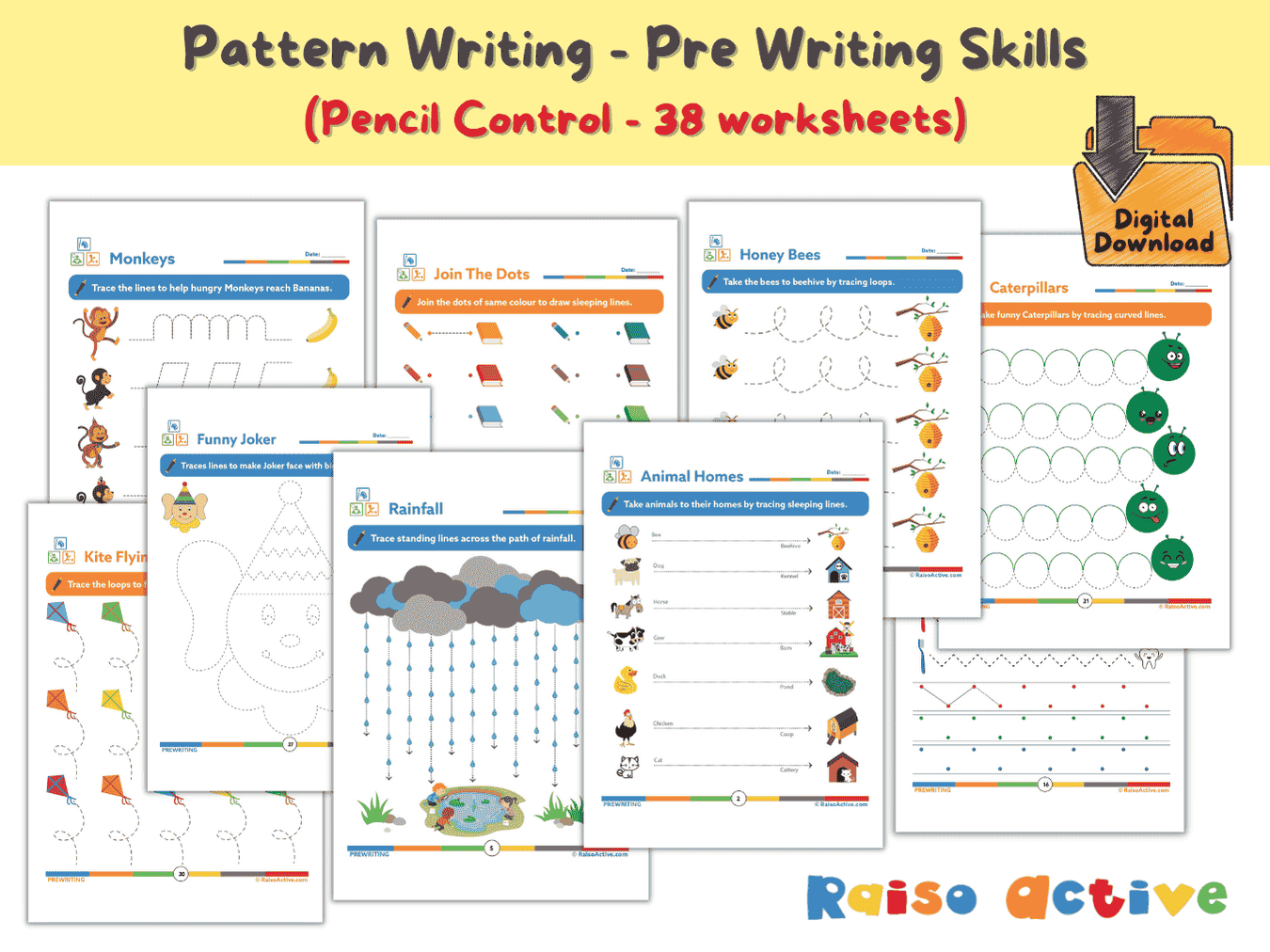
Part of the pack
Pattern Writing Pre-writing Skills Activity Book for 3-4 Year Olds
This is page 19 of the pack. Ages 3-4 · PreschoolAges 3-4 · NurseryAges 3-4
Made for your child
A whole activity pack made with their name
60 pages to spot, build, trace and write their own name, plus pages about their favourites, feelings and family. See a free preview with their name.
Make an All About Me packFree preview · free for members
Or start free: a name tracing sheet with their nameCurriculum
- Pre-Writing > Straight Lines
How to use this worksheet
Before starting, let your child feel the difference between pressing too hard, too soft, and just right on scrap paper. Trace over the existing part of the pattern first, paying attention to how the pencil feels against the page. Continue the pattern into the blank space, checking in partway to see if the lines are staying consistent in darkness and thickness. Praise steady, even pressure as much as an accurate shape.
Extension activities
- 1Practice pressing a crayon lightly, then firmly, on scrap paper and talk about the difference in the marks.
- 2Use a stamp pad and stamp to practice controlled, even pressure with a satisfying visual result.
- 3Try tracing the pattern with a paintbrush and watery paint, which shows pressure changes very clearly.
- 4Play a 'gentle giant' game, practicing soft touches with hands before returning to a gentle pencil grip.
- 5Trace the pattern in a tray of shaving cream, where too much pressure will smear the design.

Written by
Hemsweta Jain · Teacher Cheena
MBA and Early Childhood Educator, teaching since 2014 · Founder of RaisoActive, Mumbai
Every RaisoActive worksheet is designed and checked by the founder before publishing.
Published · Last reviewed
More from Pattern Writing Pre-writing Skills Activity Book for 3-4 Year Olds

Pattern Writing Pre-writing Skills Activity Book for 3-4 Year Olds - Page 33
Ages 3-4 · PreschoolAges 3-4 · NurseryAges 3-4
This later page in the pre-writing patterns activity book asks 3-4 year olds to track a repeating pattern visually from left to right across the row before their pencil catches up, building the same visual tracking direction used in reading English text. Because this comes further into the book, it also builds a small dose of persistence, since completing a full row of repeated strokes takes more sustained attention than a single short trace.

Trace the Train Engine Worksheet for Preschoolers
Ages 3-5 · Preschool–Pre-KAges 3-5 · Nursery–ReceptionAges 3-5 · Nursery–LKGAges 3-5
Tracing the shapes that make up a train engine, like rectangles for the body and circles for the wheels, gives children ages 3-5 practice with mixed straight and curved strokes while reinforcing the idea that complex objects are built from combinations of simple shapes. The train theme also introduces sequencing awareness, since trains are made of connected cars that follow one after another along a track.
Uphill Tracing Worksheet: Help the Cyclist!
Ages 3-5 · Preschool–Pre-KAges 3-5 · Nursery–ReceptionAges 3-5 · Nursery–LKGAges 3-5
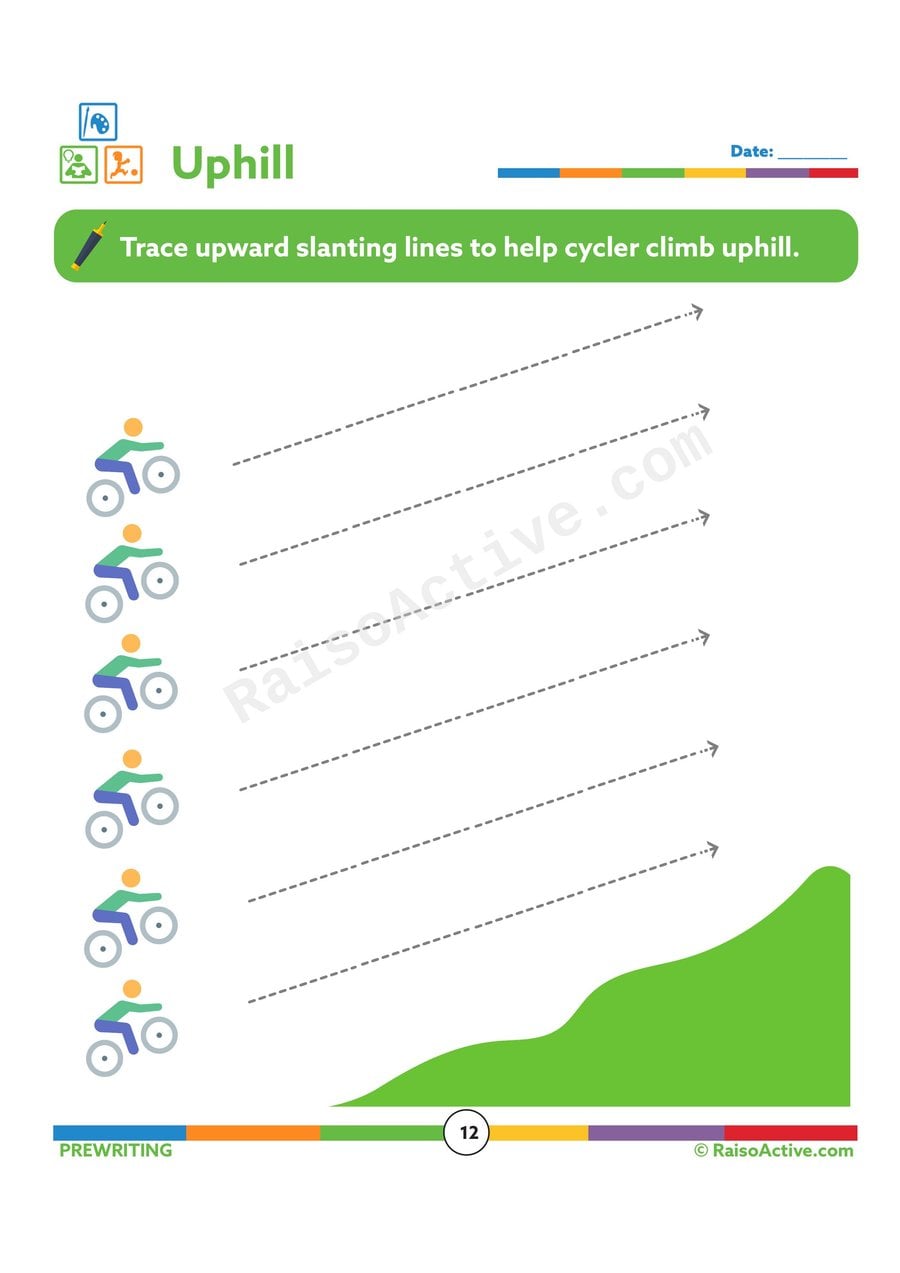
Tracing an uphill diagonal line to help a cyclist reach the top gives children ages 3-5 focused practice with slanting strokes that angle upward, a motion that requires more deliberate wrist control than a downward slant. This worksheet builds on general diagonal-line practice by tying the direction of the line to a concrete idea, going uphill, which helps children understand why the line slants the way it does rather than tracing an abstract shape.
Animal Food Matching Worksheet for Preschoolers
Ages 3-5 · Preschool–Pre-KAges 3-5 · Nursery–ReceptionAges 3-5 · Nursery–LKGAges 3-5
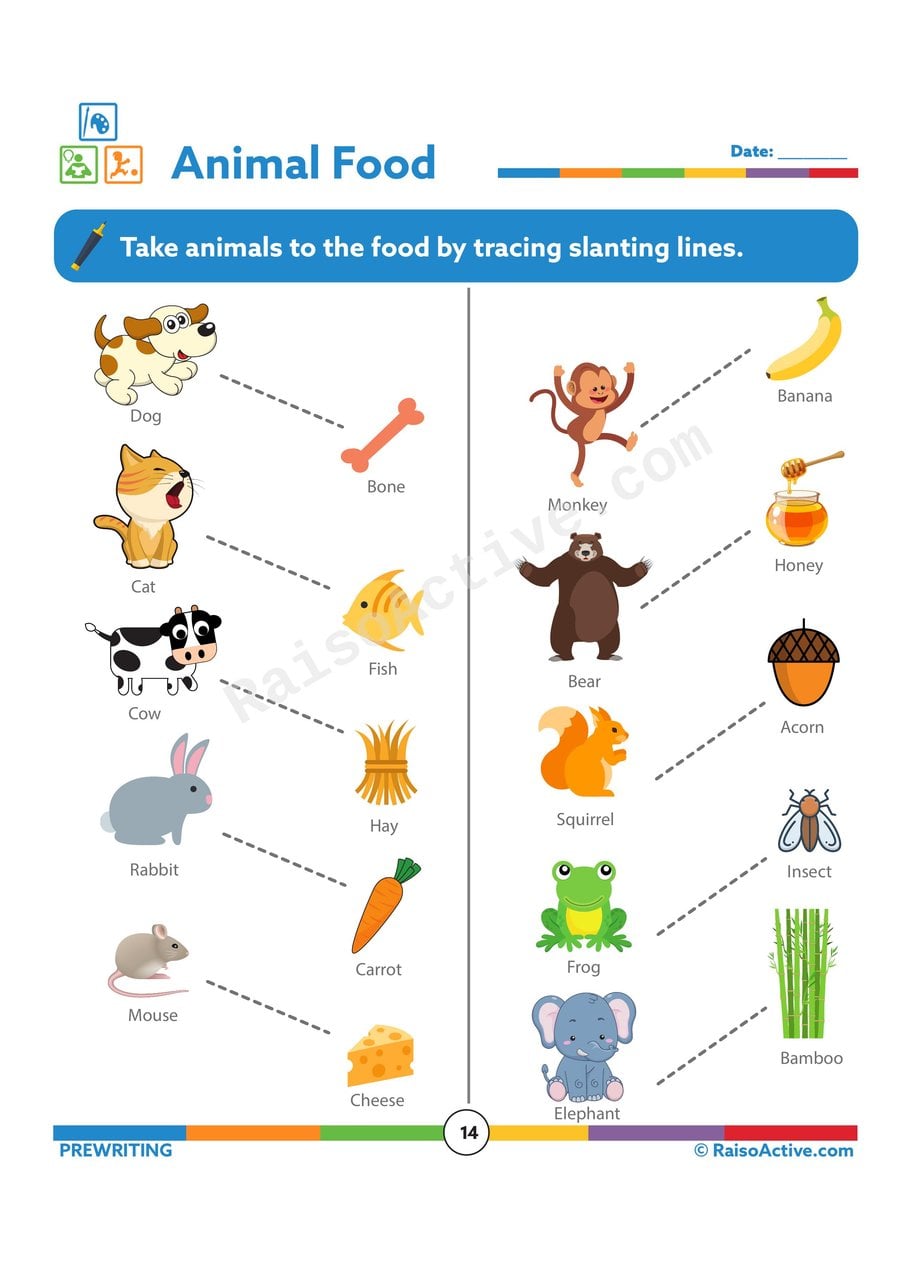
Tracing a line from each animal to the food it eats helps children ages 3-5 build pencil control while learning an early biology concept: that different animals eat different things based on what they are. Connecting a rabbit to a carrot or a bird to a worm also builds simple reasoning skills, since children start to notice why a particular pairing makes sense rather than memorizing it by rote.

Trace the Moon: A Prewriting Worksheet for Young Learners
Ages 3-6 · Preschool–KindergartenAges 3-6 · Nursery–Year 1Ages 3-6 · Nursery–UKGAges 3-6
Tracing the curved outline of the moon gives children ages 3-6 practice with the smooth, rounded strokes that later support letters like c and o, while the night-sky theme introduces early vocabulary about the moon, stars, and sky. Because the age range spans preschool into early elementary, this worksheet works well for revisiting pencil control at a slightly more advanced level than straight-line tracing alone.
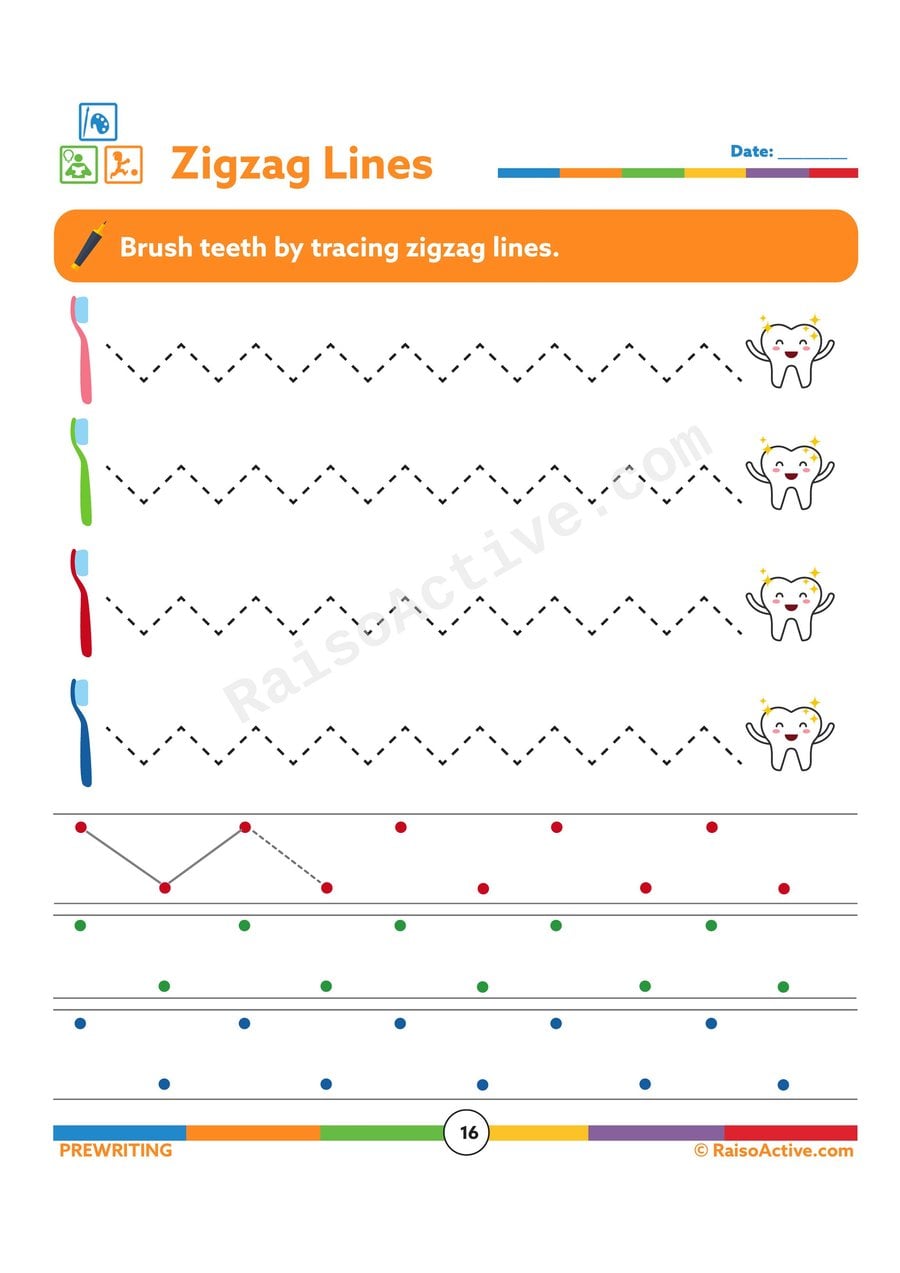
Zigzag Lines Tracing Worksheet: Brush Your Teeth!
Ages 3-5 · Preschool–Pre-KAges 3-5 · Nursery–ReceptionAges 3-5 · Nursery–LKGAges 3-5
Tracing a zigzag line representing a toothbrush's back-and-forth motion gives children ages 3-5 practice with sharp direction changes, a stroke pattern used in letters like Z, W, and M, while tying the abstract line shape to a real daily action, brushing teeth, they already understand. Zigzag lines are more demanding than smooth curves or straight lines because the pencil has to change direction abruptly and repeatedly rather than flowing continuously.
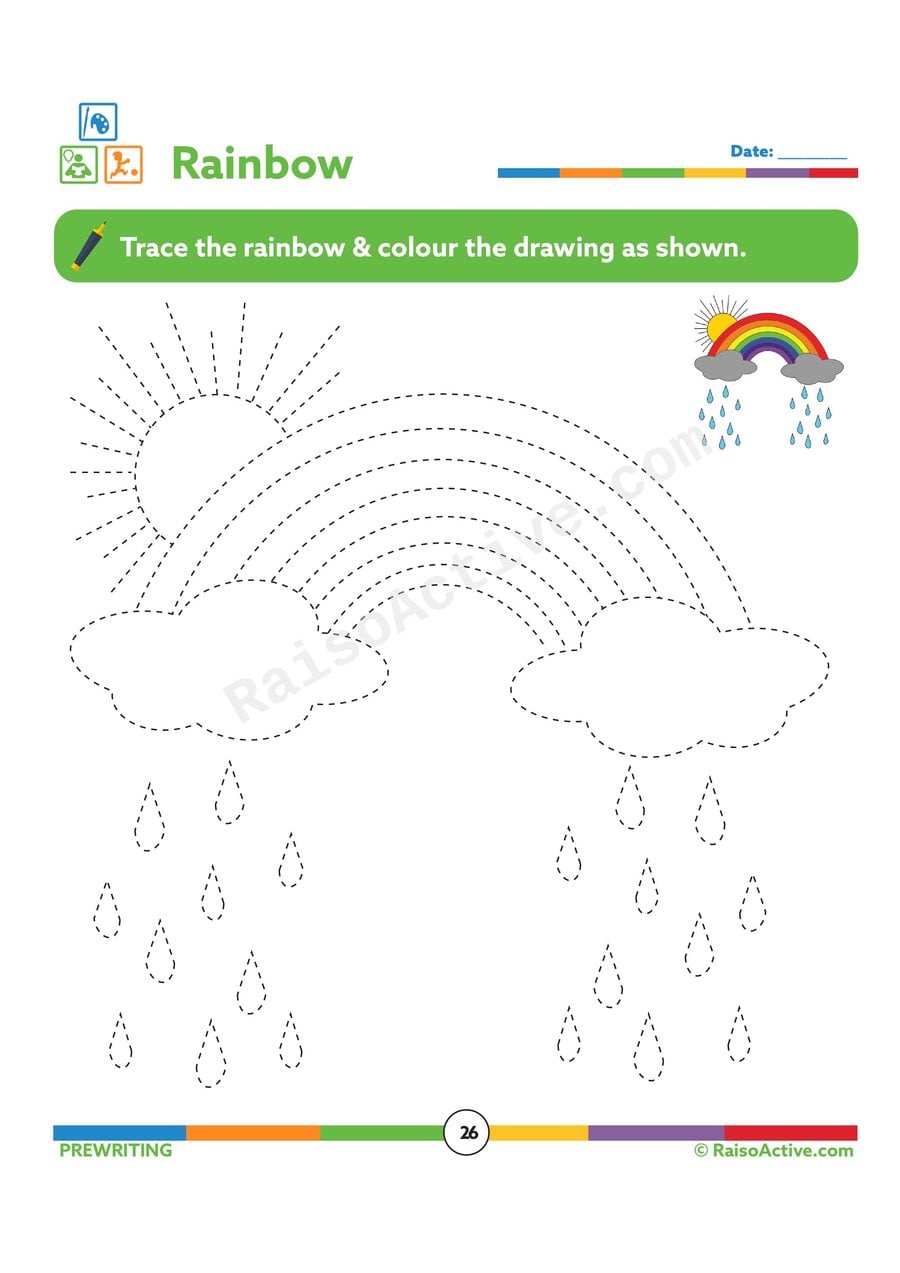
Trace the Rainbow Worksheet for Preschoolers
Ages 3-5 · Preschool–Pre-KAges 3-5 · Nursery–ReceptionAges 3-5 · Nursery–LKGAges 3-5
Tracing the concentric arcs of a rainbow gives children ages 3-5 practice with several nested curved lines of increasing size, a step up from tracing a single curve because each new arc has to sit a consistent distance from the one before it. Coloring the bands afterward also introduces simple color naming and sequencing, since rainbow colors typically appear in the same recognizable order.

Trace and Build a Castle Worksheet for Preschoolers
Ages 3-5 · Preschool–Pre-KAges 3-5 · Nursery–ReceptionAges 3-5 · Nursery–LKGAges 3-5
Tracing the geometric shapes that form a castle, like triangles for turrets and rectangles for towers, gives children ages 3-5 practice with straight-line shape tracing while also introducing the idea that complex structures are made by combining simple shapes. This spatial reasoning, seeing how basic shapes stack and combine into something bigger, supports both early geometry understanding and imaginative building play.
Related worksheets

Paper Bag Bunny Craft Worksheet for Preschoolers
Ages 3-5 · Preschool–Pre-KAges 3-5 · Nursery–ReceptionAges 3-5 · Nursery–LKGAges 3-5
This paper bag craft has children ages 3-5 follow a multi-step sequence of instructions — attaching a pom pom nose, spoon ears, googly eyes, and whisker details — while practicing the fine motor control needed to place and glue small materials precisely. Because the craft uses several different textures and materials in one project, children also get sensory-rich practice beyond typical paper-and-crayon activities. Successfully completing each step in order builds confidence in following sequential, multi-part directions.

Learn the Sight Word 'Is' - Tracing and Writing Worksheet for Preschoolers
Ages 4-5 · Pre-KAges 4-5 · ReceptionAges 4-5 · LKGAges 4-5
This worksheet helps children ages 4-5 build instant recognition of the sight word 'is' through a layered sequence of tracing, independent writing, sentence fill-in, coloring, and letter-order cut-and-paste practice. Because 'is' can't easily be sounded out using typical phonics rules, repeated multi-format exposure like this is exactly what helps a sight word move into a child's automatic reading vocabulary. Using the word inside real sentence blanks also connects the isolated word to meaningful, functional reading.
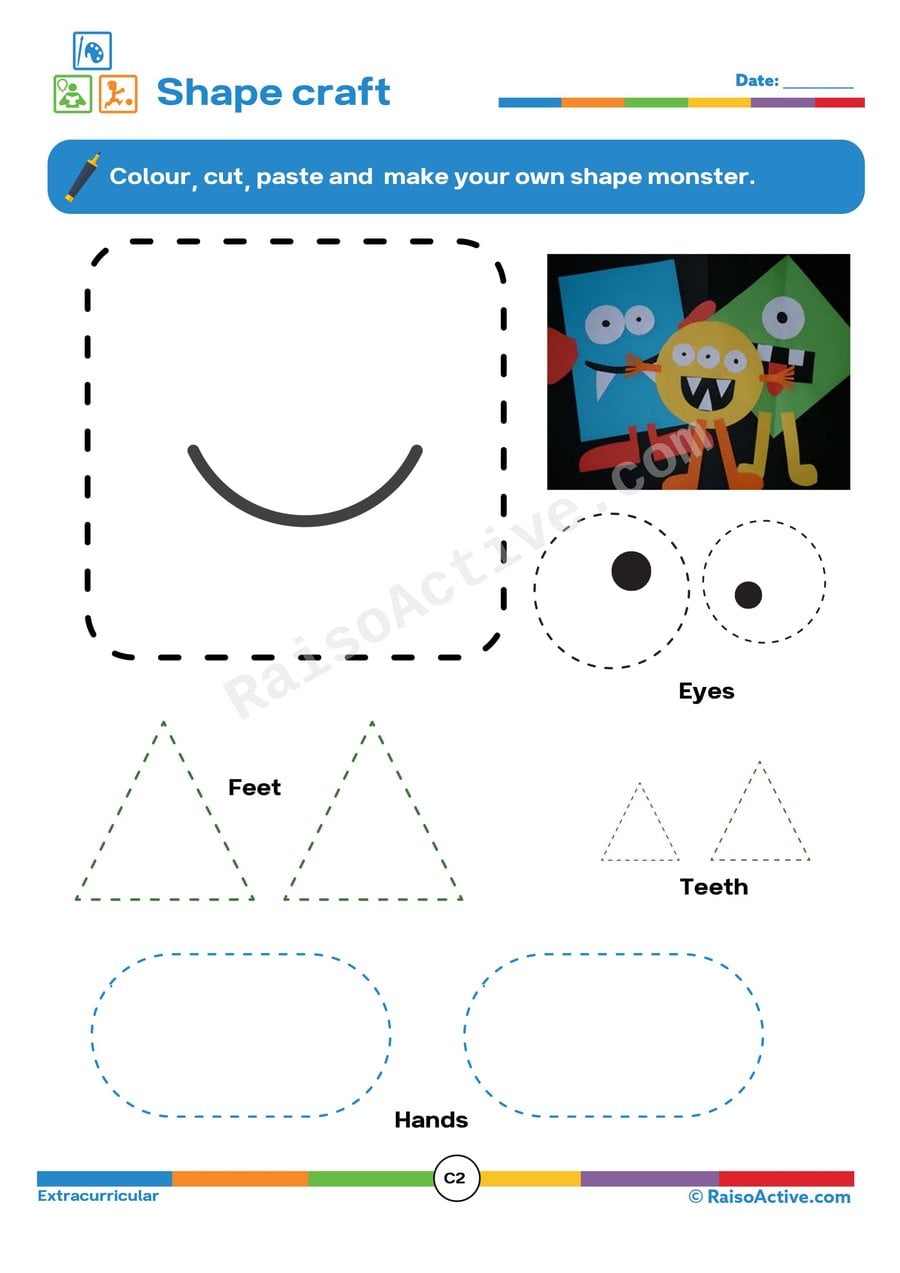
Shape Monster Craft Worksheet for Preschoolers
Ages 3-5 · Preschool–Pre-KAges 3-5 · Nursery–ReceptionAges 3-5 · Nursery–LKGAges 3-5
Coloring, cutting, and gluing shape pieces to build a monster teaches children ages 3-5 to recognize basic 2D shapes, like circles, triangles, and squares, while practicing scissor control along different edge types. Because the shapes need to be arranged in a specific way to form a recognizable monster face and body, this activity also builds spatial reasoning as children decide where each piece belongs. Turning geometry practice into a silly monster craft keeps repetitive shape work feeling like imaginative play rather than a math drill.

Parent's Guide: Fun Activities for Gross Motor Development and Emotional Learning
Ages 3-5 · Preschool–Pre-KAges 3-5 · Nursery–ReceptionAges 3-5 · Nursery–LKGAges 3-5
This parent guide equips caregivers of children ages 3-5 with activities spanning gross motor skills, emotional expression, family concepts, shape recognition, and calendar awareness, using role play, finger puppets, and simple games. Combining physical movement with emotional vocabulary practice, such as making different facial expressions, helps children build body awareness and feelings vocabulary side by side. Rotating through several distinct activity types in one guide also keeps a young child's attention across a longer play session.
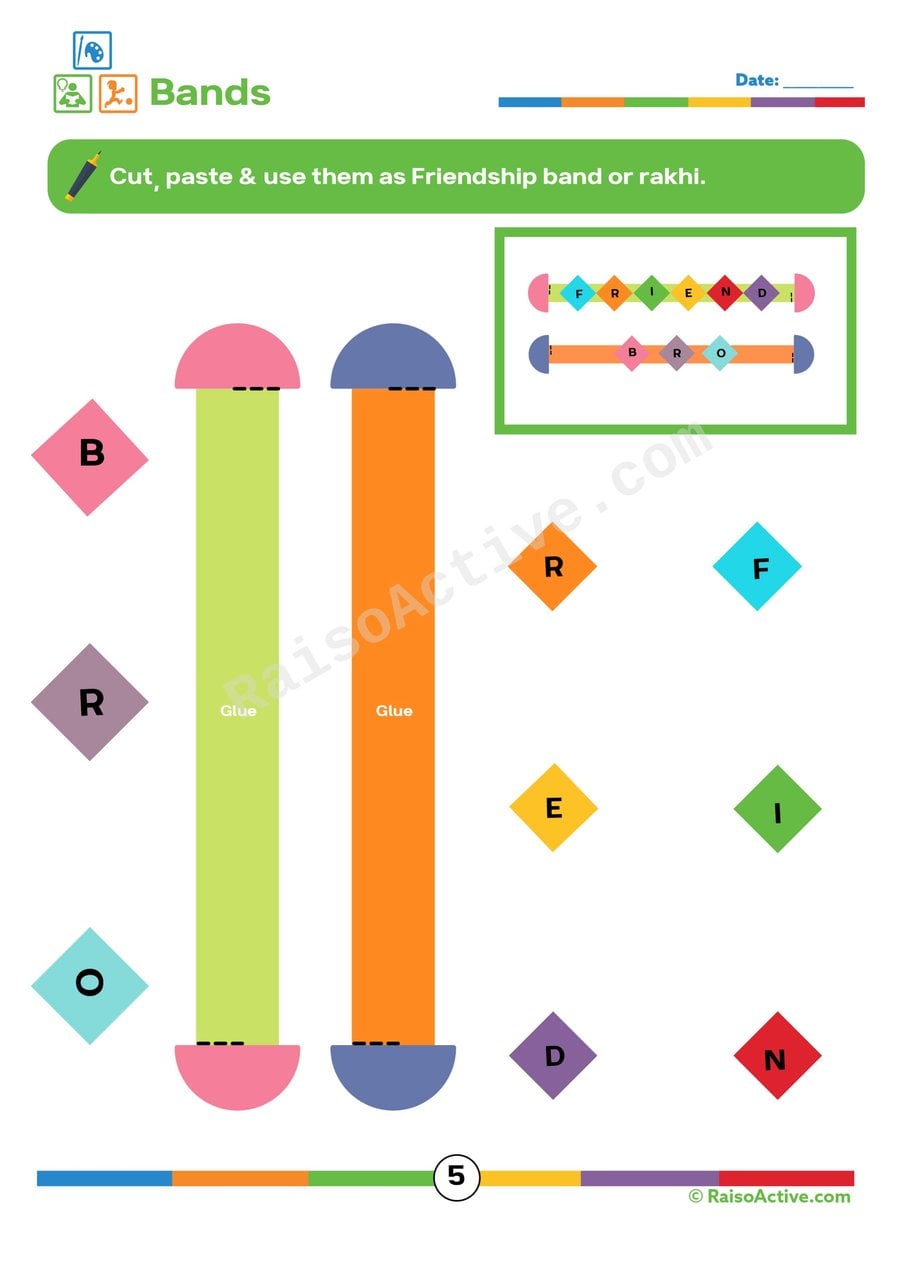
Friendship Band Craft Worksheet for Kids
Ages 3-5 · Preschool–Pre-KAges 3-5 · Nursery–ReceptionAges 3-5 · Nursery–LKGAges 3-5
This worksheet builds fine motor precision as children ages 3-5 cut out individual shapes and glue them onto a paper strip in a sequence of their choosing, creating a personalized friendship band or rakhi. Deciding where each shape goes along the strip also introduces early spatial planning and pattern-making, since children must space the shapes evenly to fill the band.
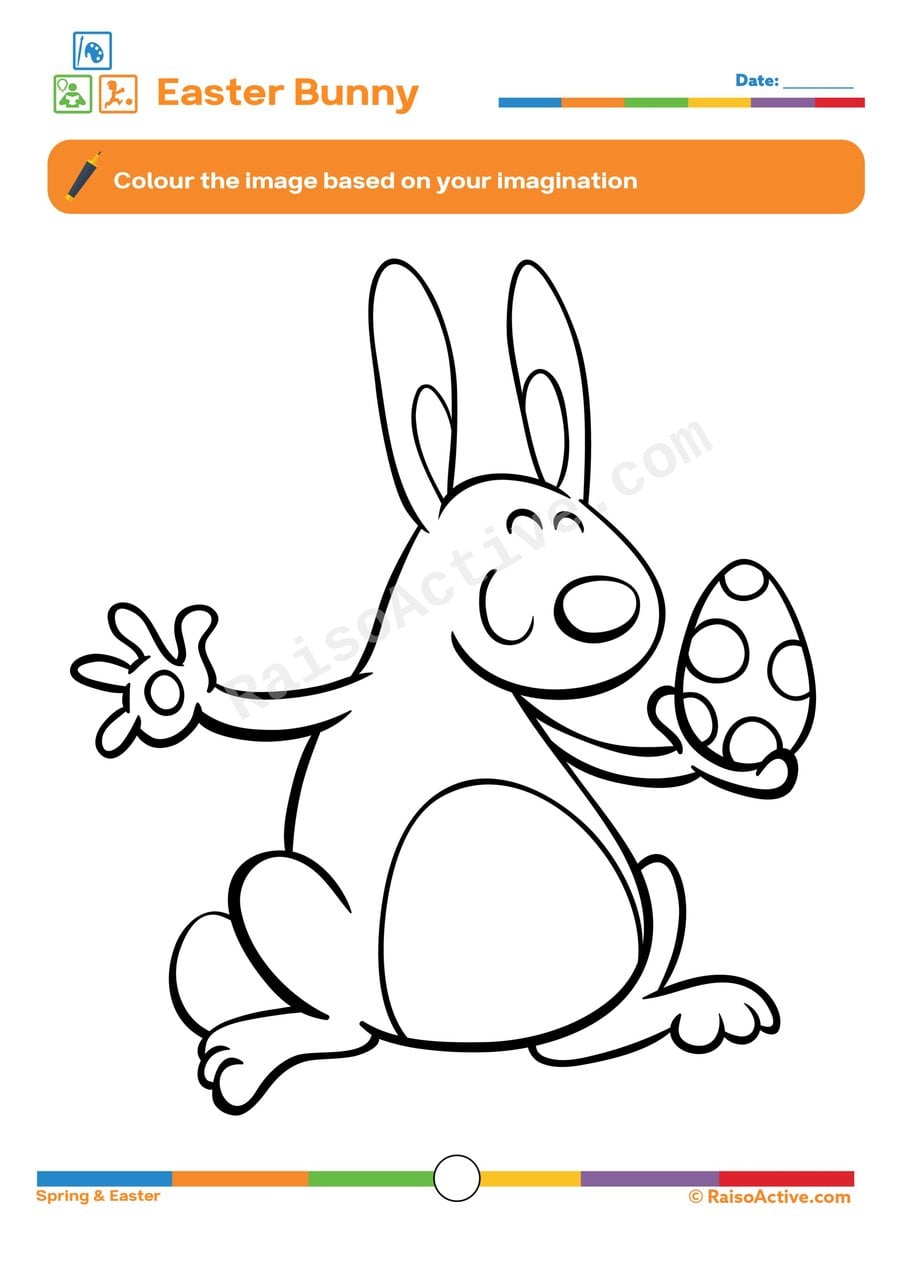
Easter Bunny Coloring Worksheet for Kids
Ages 3-5 · Preschool–Pre-KAges 3-5 · Nursery–ReceptionAges 3-5 · Nursery–LKGAges 3-5
Children ages 3-5 build fine motor control and creative expression while coloring an Easter bunny and egg using crayons or colored pencils. Open-ended coloring tasks like this one, without a strict color code, give children room to make independent choices while still practicing the pencil grip and control needed for later writing.
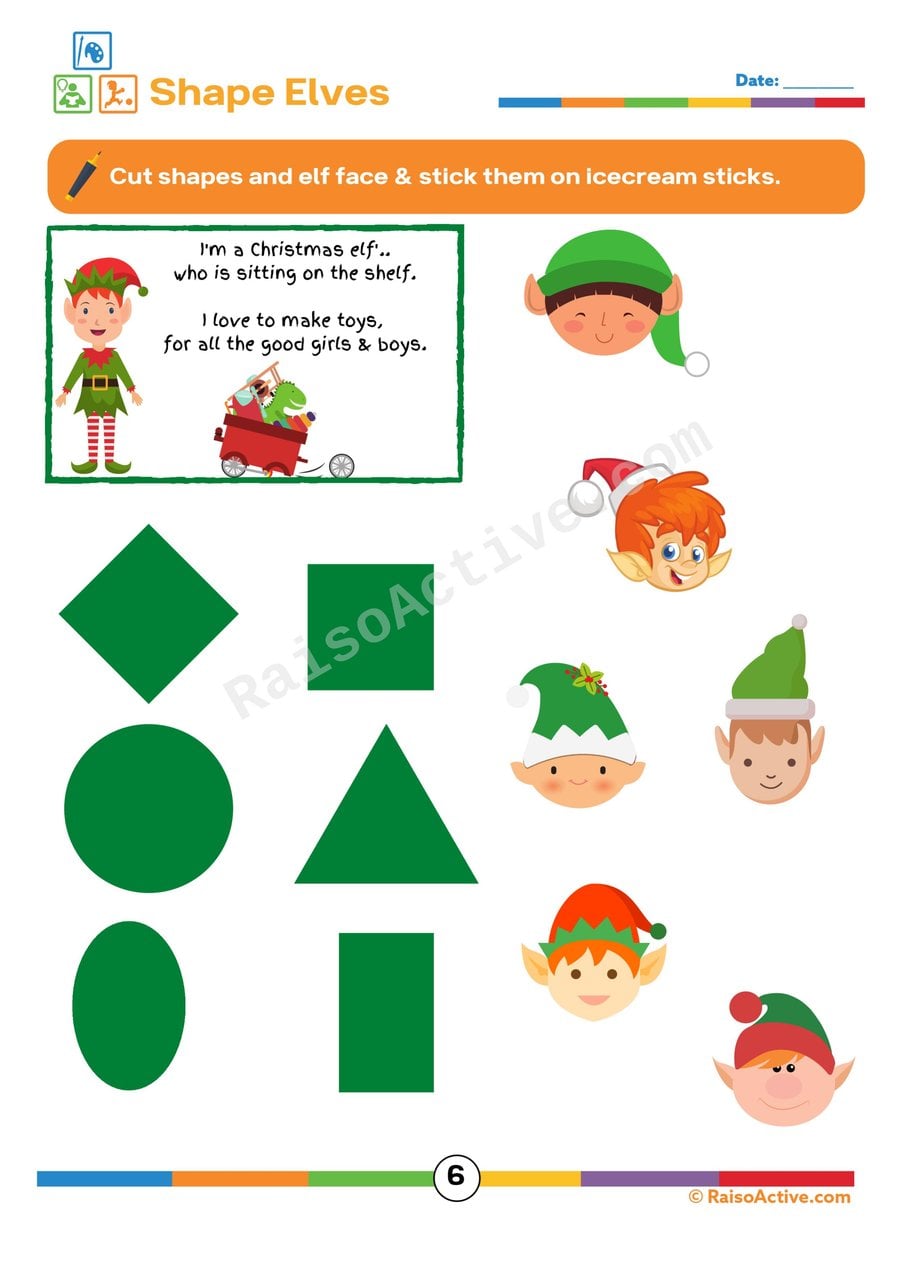
Shape Elves Worksheet: Cut, Paste, and Create!
Ages 3-5 · Preschool–Pre-KAges 3-5 · Nursery–ReceptionAges 3-5 · Nursery–LKGAges 3-5
Cutting out circles, triangles, and rectangles to assemble an elf face teaches children ages 3-5 to recognize and name basic 2D shapes while practicing scissor control along both straight and curved lines. Because each shape has to go in a specific spot to form a recognizable face, children also build spatial reasoning as they figure out which shape works as eyes, a nose, or a hat. Turning geometry into a craft project makes an abstract math concept feel like creative play.

Happy Easter Coloring Card Worksheet for Preschoolers
Ages 3-5 · Preschool–Pre-KAges 3-5 · Nursery–ReceptionAges 3-5 · Nursery–LKGAges 3-5
Coloring the Easter egg and bunny images on this fold-into-a-card worksheet gives children ages 3-5 practice with controlled crayon strokes and color choice, while the act of turning their artwork into a card for someone else introduces an early sense of purpose and gift-giving. Because the finished piece becomes a keepsake rather than just a worksheet, children also build pride and motivation to complete their coloring carefully. This blends fine motor practice with a first taste of creating something meaningful for another person.
Guides for this topic

Pre-Writing Strokes in Order: From Standing Lines to Loops (With Printable Patterns)
The developmental order of pre-writing strokes, from vertical lines to loops, and why practicing them in sequence makes letter formation much easier to learn.

Portfolio Assessment with Young Children: A Comprehensive Guide to Meaningful Documentation
Learn how portfolio assessment captures your child's growth through meaningful documentation. Practical tips, templates, and age-appropriate strategies for ages 1-8.
What Makes a Good Worksheet vs. a Poor One: A Parent's Guide to Quality Educational Materials
Learn what separates high-quality educational worksheets from poor busy work. Discover design principles, red flags, and how to evaluate free worksheets online for your child aged 1-8.
Reviews
Every worksheet for ages 3–4, no watermark
Members download the full library of 1,000+ worksheets and every activity pack without watermarks or daily limits. One year costs ₹999 in India or $20 elsewhere.
See membership plansOr download any worksheet free with a watermark (5 a day).