Trace the Bouncy Balls Worksheet for Preschoolers
Tracing the arcing path of a bouncy ball helps children ages 3-5 practice curved pencil strokes while connecting the drawn line to a real physical motion they already understand, a bounce. Linking an abstract line on paper to something they've seen and felt makes the curved stroke easier to grasp than tracing an unfamiliar shape, and it builds the same rounded control needed for letters and numbers later on.
Part of the pack
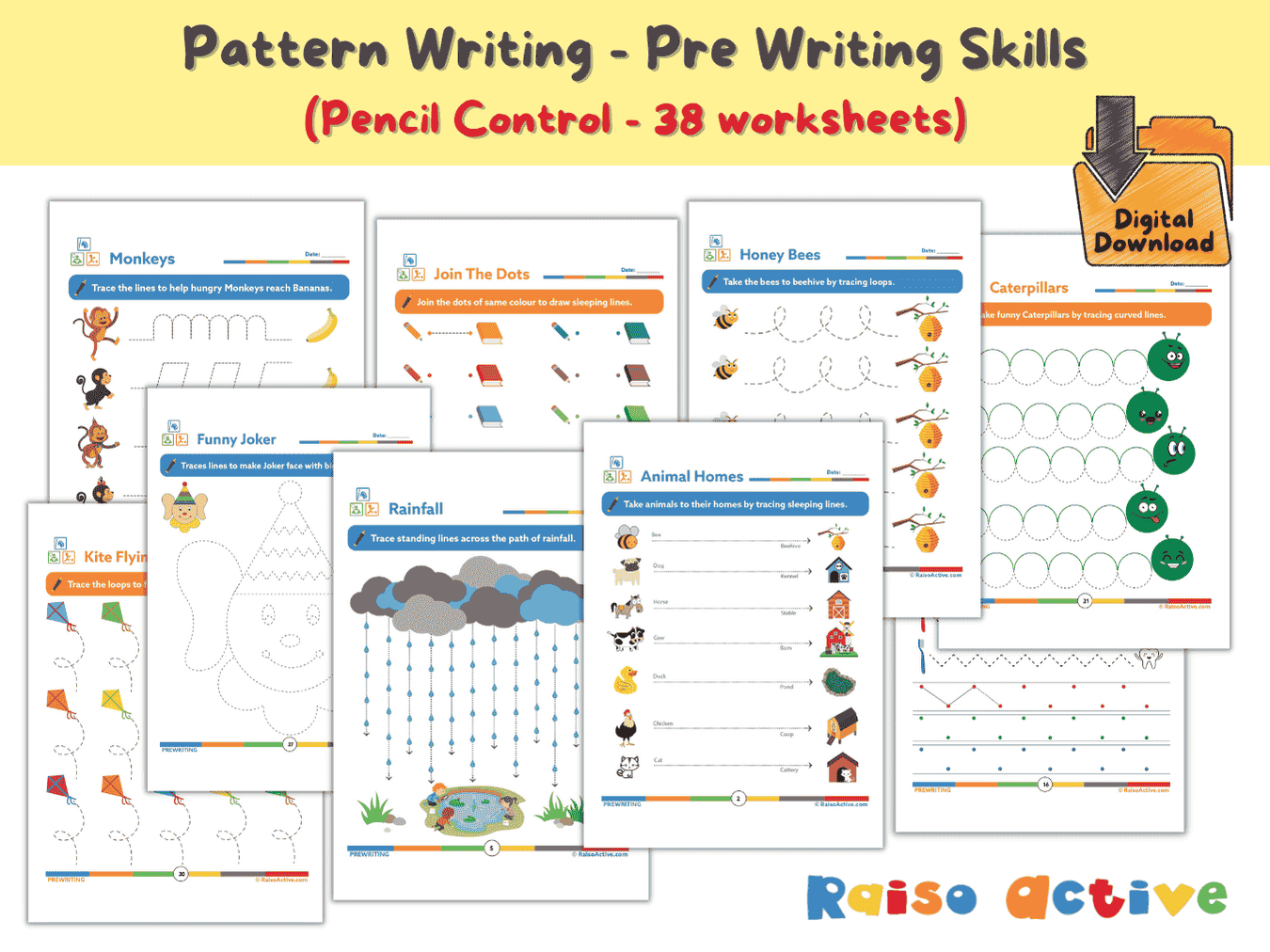
Pattern Writing Pre-writing Skills Activity Book for 3-4 Year Olds
This is page 29 of the pack. Ages 3-4 · PreschoolAges 3-4 · NurseryAges 3-4
Made for your child
A whole activity pack made with their name
60 pages to spot, build, trace and write their own name, plus pages about their favourites, feelings and family. See a free preview with their name.
Make an All About Me packFree preview · free for members
Or start free: a name tracing sheet with their nameCurriculum
- Pre-Writing > Shape Tracing
How to use this worksheet
Ask your child to describe what happens when a ball bounces before they start tracing, so they connect the shape to the motion. Guide their pencil along each arc from one bounce point to the next, encouraging a smooth up-and-down rhythm rather than a jagged line. Let them pause briefly at each 'bounce' point on the page, just as a real ball pauses briefly when it hits the ground. Color the balls once all the arcs are traced.
Materials needed
- Pencil
- Crayons
Extension activities
- 1Bounce a real ball together and count how many times it bounces before stopping.
- 2Dip a small ball in washable paint and bounce it gently on paper to make an arc-shaped print.
- 3Trace bounce-shaped arcs in the air with a finger, following an imaginary ball's path.
- 4Play a hopping game where your child jumps in an arc shape from one spot to another, mimicking the ball's bounce.
- 5Roll playdough into balls and press them along a drawn arc line to reinforce the shape.

Written by
Hemsweta Jain · Teacher Cheena
MBA and Early Childhood Educator, teaching since 2014 · Founder of RaisoActive, Mumbai
Every RaisoActive worksheet is designed and checked by the founder before publishing.
Published · Last reviewed
Related worksheets
Pandal Engineers: Navratri Paper Tower and Strong Shapes STEM Challenge
Ages 7-11 · Grade 2–Grade 3Ages 7-11 · Year 3–Year 4Ages 7-11 · Class 2–Class 3Ages 7-11
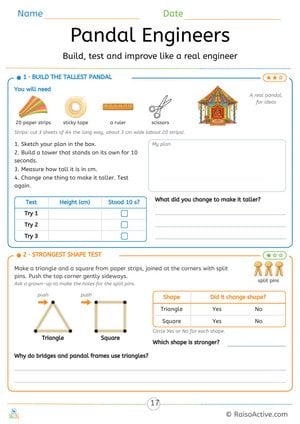
Children plan, build, measure and improve a paper-strip tower, record three tries in a table, and test a triangle and a square made with split pins to find out why bridges and pandal frames use triangles.

Trace the Numbers 1-9 Worksheet for Preschoolers
Ages 3-5 · Preschool–Pre-KAges 3-5 · Nursery–ReceptionAges 3-5 · Nursery–LKGAges 3-5
Tracing the numerals 1 through 9 gives children ages 3-5 repeated, guided practice with the specific pencil strokes each number requires, building the fine motor control and muscle memory needed for independent number writing. Because tracing follows a fixed, correct path, it also reinforces accurate numeral recognition, helping children tell visually similar digits apart.
Caterpillar Counting Worksheet for Preschoolers
Ages 3-5 · Preschool–Pre-KAges 3-5 · Nursery–ReceptionAges 3-5 · Nursery–LKGAges 3-5
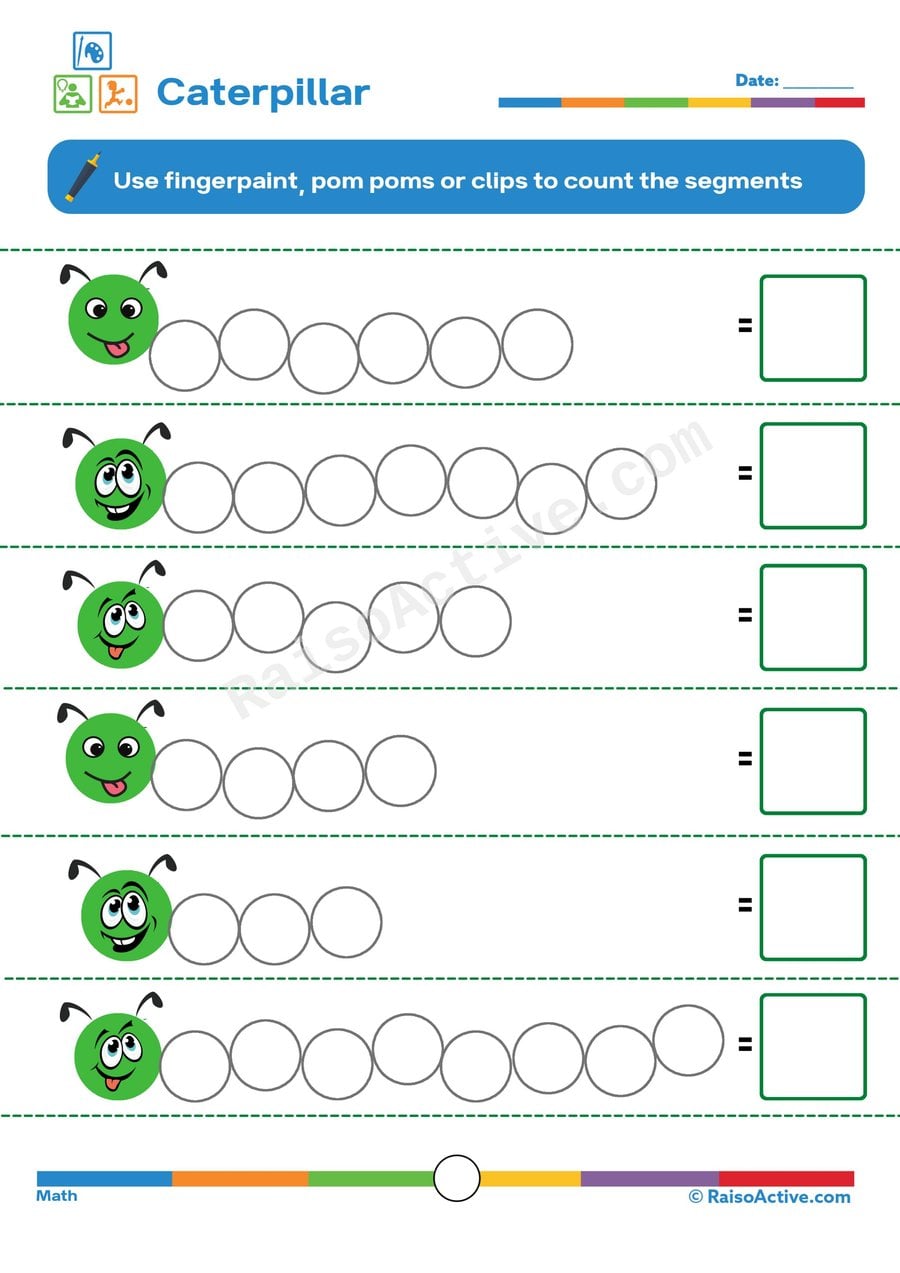
Counting the segments of each caterpillar teaches children ages 3-5 one-to-one correspondence — touching or marking each segment exactly once while saying a number — which is the core skill underlying accurate counting. Writing the final total in a box also connects the physical act of counting to its written numeral, reinforcing early number-writing practice.

Elephant Shapes: Fun Sorting Worksheet for Preschoolers!
Ages 3-5 · Preschool–Pre-KAges 3-5 · Nursery–ReceptionAges 3-5 · Nursery–LKGAges 3-5
This playful sorting worksheet has children ages 3-5 use an elephant's 'trunk' (their own hand reaching through a cut circle) to pick and sort shapes, building both shape recognition and simple classification skills. Physically selecting and grouping shapes by type, rather than just naming them on sight, helps solidify the concept that shapes can share a category even when their size or color differs.
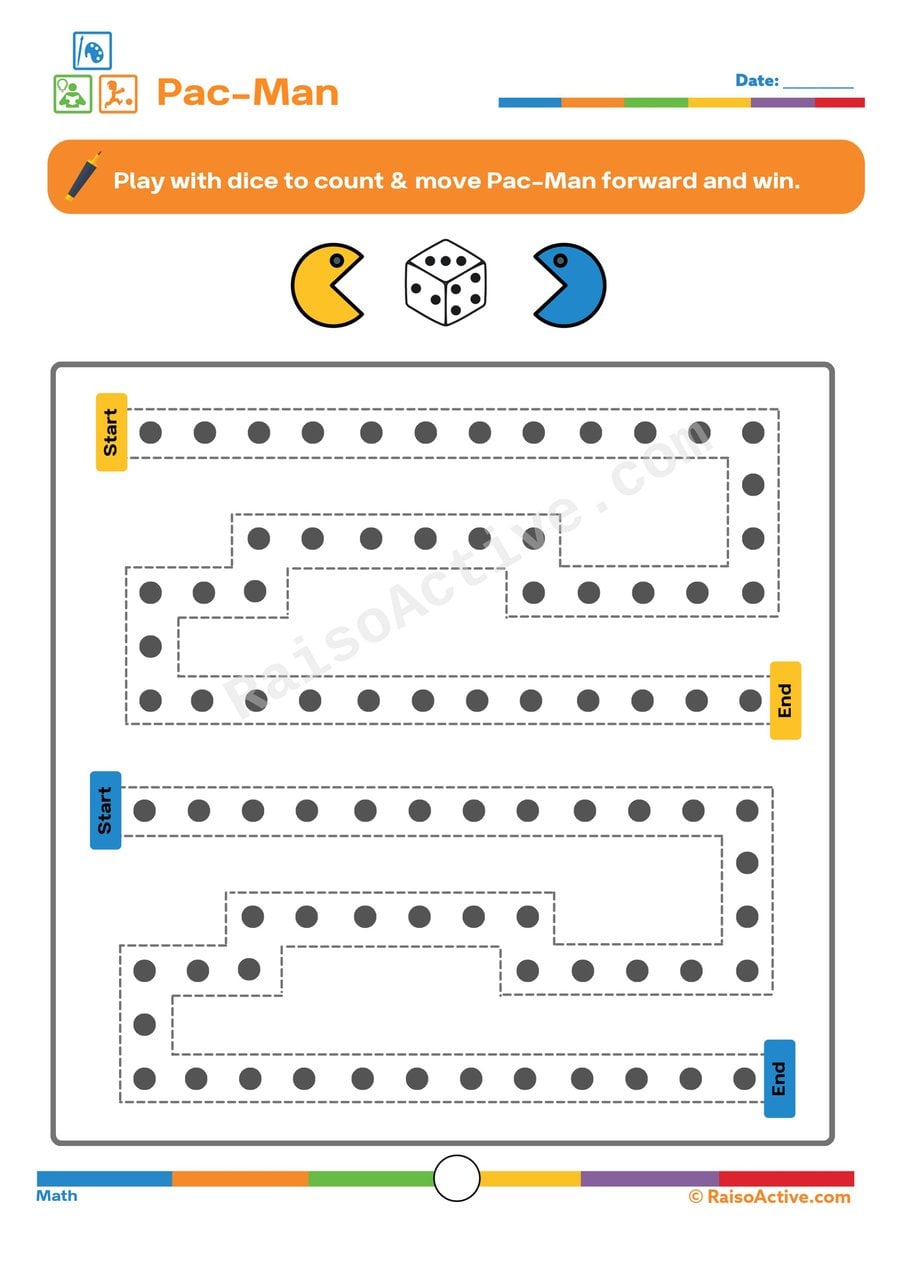
Pac-Man Maze Worksheet: Count and Move!
Ages 3-5 · Preschool–Pre-KAges 3-5 · Nursery–ReceptionAges 3-5 · Nursery–LKGAges 3-5
This dice-counting maze gives children ages 3-5 repeated practice matching a rolled number to the correct number of moves, reinforcing accurate counting under a bit of playful pressure. Tracking Pac-Man's current position after each roll also builds short-term spatial memory, since children must remember where they left off before moving again.

Stick Man Emotions Worksheet: Happy, Sad, Angry, and Surprised!
Ages 4-6 · Pre-K–KindergartenAges 4-6 · Reception–Year 1Ages 4-6 · LKG–UKGAges 4-6
Children ages 4-6 practice reading facial expressions on this worksheet, matching stick-figure faces to their correct emotion labels by noticing details like mouth shape and eyebrow position. This strengthens emotional literacy — the ability to name and recognize feelings in others — which supports empathy and smoother social interactions as children move into more group play and classroom settings.
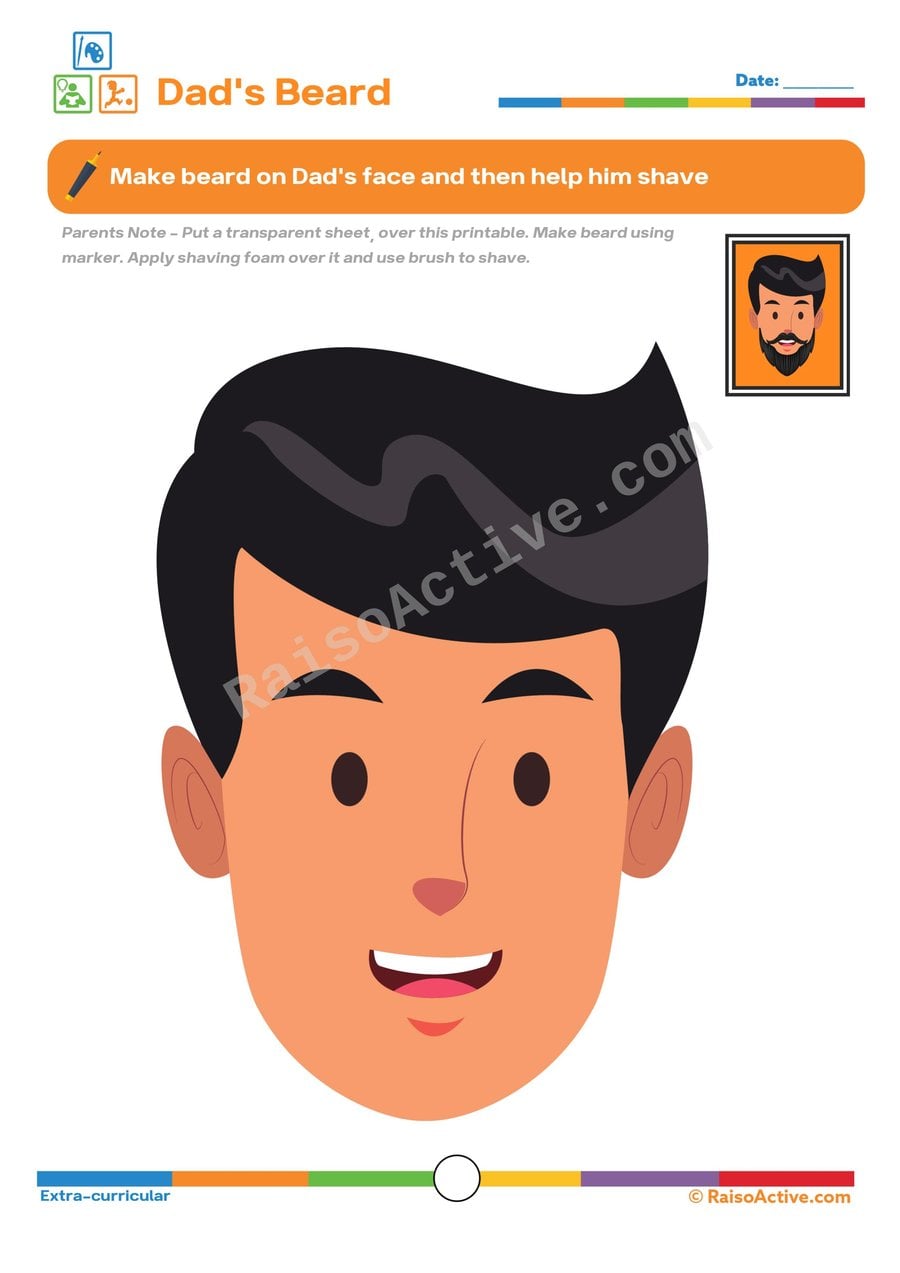
Dad's Beard: A Fun Shaving Activity for Kids!
Ages 3-5 · Preschool–Pre-KAges 3-5 · Nursery–ReceptionAges 3-5 · Nursery–LKGAges 3-5
This playful pretend-shaving activity builds fine motor control and bilateral coordination in children ages 3-5, as they draw a beard with a marker and then 'shave' it away using foam and a brush in careful, controlled strokes. It also introduces a simple science idea — that shaving foam can be applied and removed in layers — while giving children a hands-on, sensory way to imitate an everyday grown-up routine.
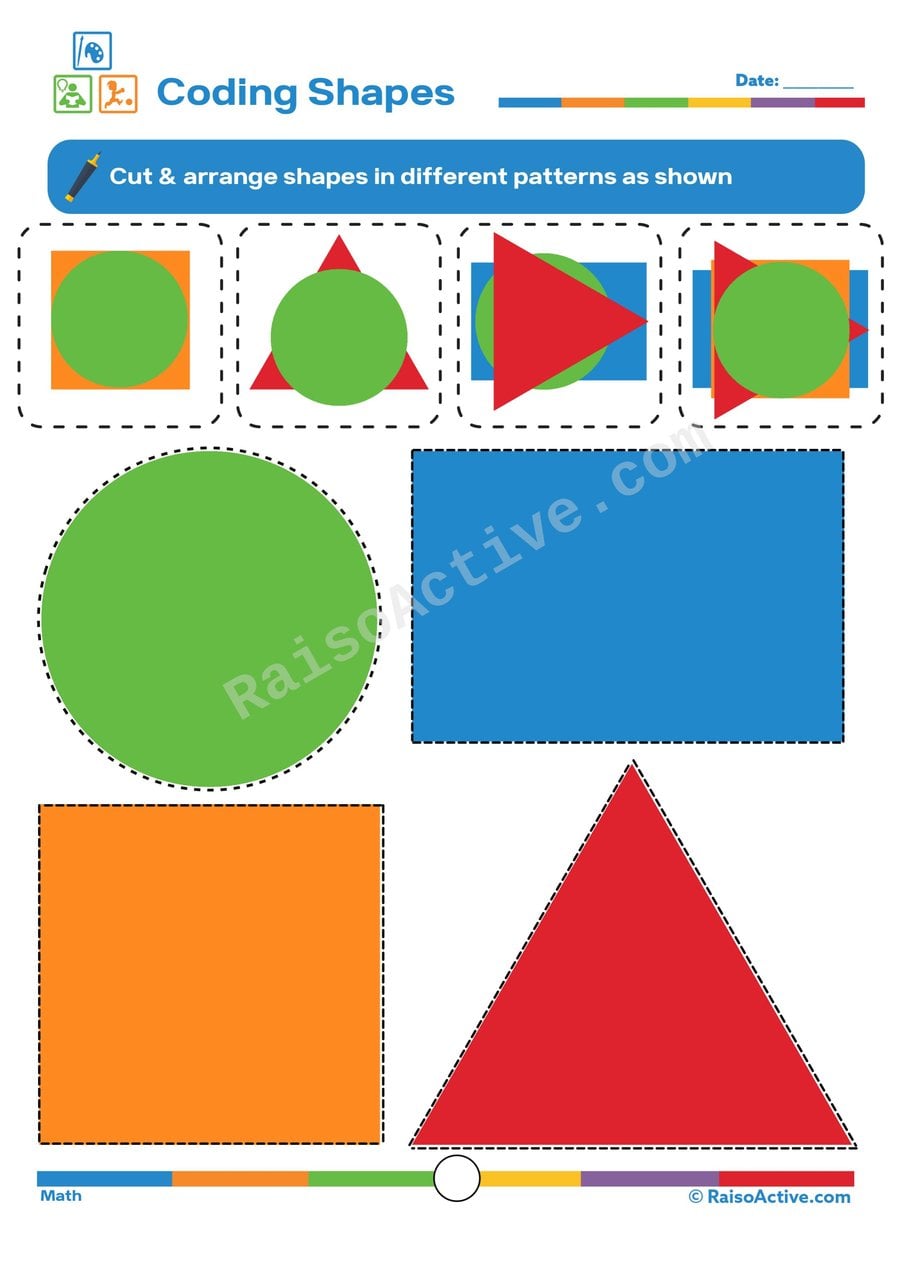
Coding Shapes Worksheet: Cut and Arrange Shapes!
Ages 3-5 · Preschool–Pre-KAges 3-5 · Nursery–ReceptionAges 3-5 · Nursery–LKGAges 3-5
This cut-and-paste worksheet has children ages 3-5 recreate example shape sequences by cutting out individual pieces and arranging them to match, combining shape recognition with the ordered, step-by-step thinking used in early coding and pattern logic. The physical act of cutting and precisely placing each piece also strengthens fine motor control and spatial planning.
Guides for this topic

Pre-Writing Strokes in Order: From Standing Lines to Loops (With Printable Patterns)
The developmental order of pre-writing strokes, from vertical lines to loops, and why practicing them in sequence makes letter formation much easier to learn.

Portfolio Assessment with Young Children: A Comprehensive Guide to Meaningful Documentation
Learn how portfolio assessment captures your child's growth through meaningful documentation. Practical tips, templates, and age-appropriate strategies for ages 1-8.
What Makes a Good Worksheet vs. a Poor One: A Parent's Guide to Quality Educational Materials
Learn what separates high-quality educational worksheets from poor busy work. Discover design principles, red flags, and how to evaluate free worksheets online for your child aged 1-8.
Reviews
Every worksheet for ages 3–5, no watermark
Members download the full library of 1,000+ worksheets and every activity pack without watermarks or daily limits. One year costs ₹999 in India or $20 elsewhere.
See membership plansOr download any worksheet free with a watermark (5 a day).