Letter E Tracing Worksheet for Preschoolers: Learn to Write!
Children ages 3-5 use this worksheet to build the specific motor pattern for capital E — three horizontal strokes branching off one vertical line — while reinforcing the /e/ sound through picture recognition. Repeated tracing in a dashed-box format also trains children to keep letters a consistent size, an important pre-writing skill before they move to unlined paper.
Part of the pack
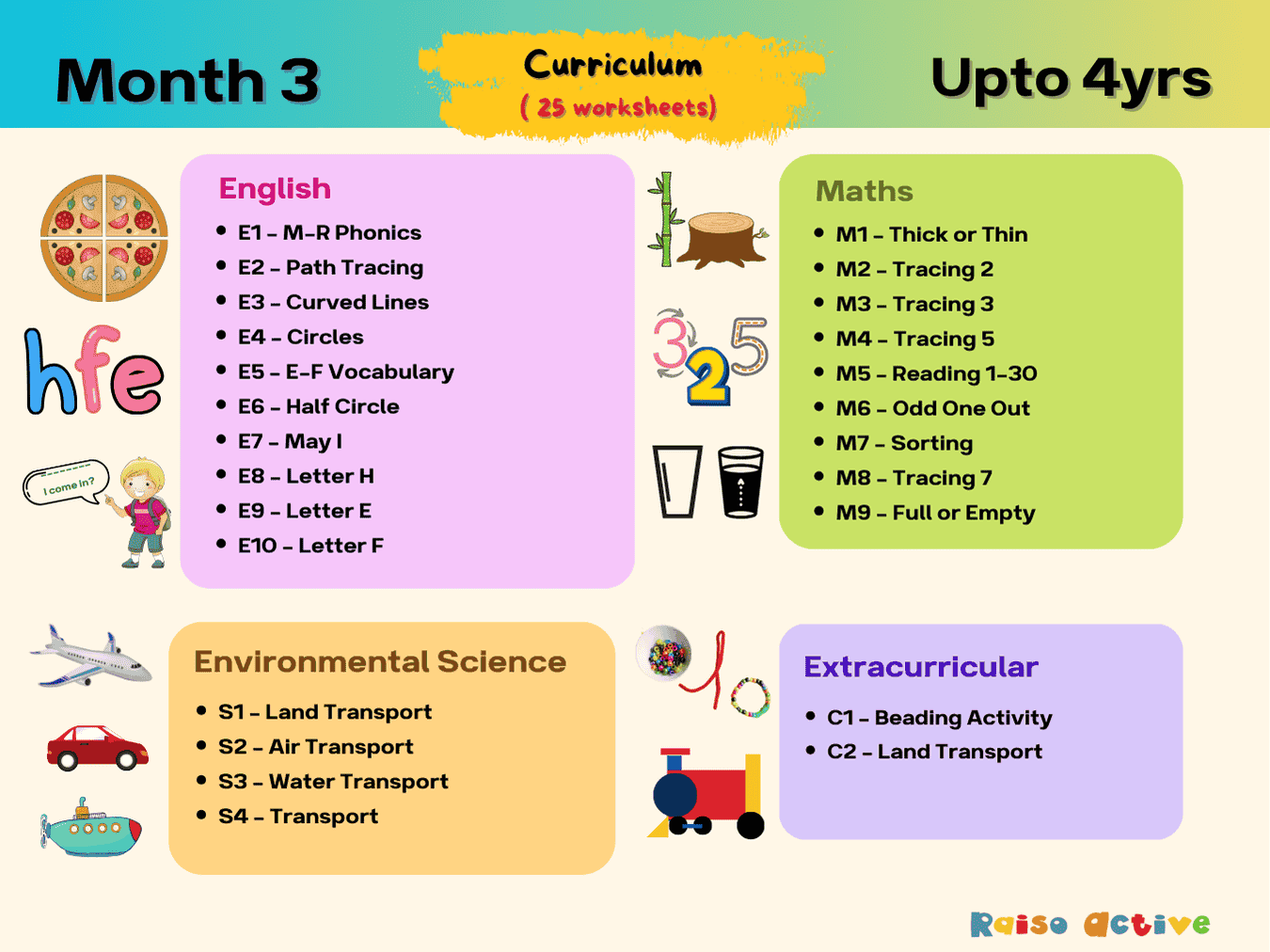
Month 3: Learning & Development | Ages Up to 4
This is page 12 of the pack. Ages 3-4 · PreschoolAges 3-4 · NurseryAges 3-4
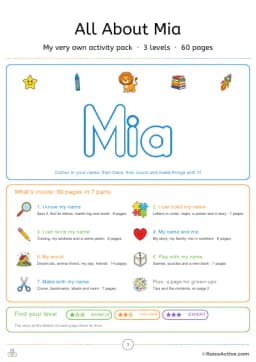
Made for your child
A whole activity pack made with their name
60 pages to spot, build, trace and write their own name, plus pages about their favourites, feelings and family. See a free preview with their name.
Make an All About Me packFree preview · free for members
Or start free: a name tracing sheet with their nameCurriculum
- Writing > Letter Tracing A-Z
How to use this worksheet
Have your child trace the large sample letter E first, then work through the dashed practice boxes one at a time, pausing to check that all three horizontal lines point the same direction. Say the /e/ sound together before and after each trace. Once the tracing rows are complete, move to the picture section and have your child color only the pictures that begin with E, naming each one out loud.
Materials needed
- Pencil
- Crayons
Extension activities
- 1Search the house or kitchen for objects that start with E, such as an egg, an envelope, or an eraser.
- 2Practice drawing E on a whiteboard or in a tray of sand using a finger or unsharpened pencil.
- 3Cut out pictures of E words from magazines or printouts and glue them onto a paper plate to make an 'E collage.'
- 4Use pretzel sticks or straws to build the three horizontal bars and one vertical bar of a capital E.
- 5Play 'I spy something that starts with E' during a walk or car ride.

Written by
Hemsweta Jain · Teacher Cheena
MBA and Early Childhood Educator, teaching since 2014 · Founder of RaisoActive, Mumbai
Every RaisoActive worksheet is designed and checked by the founder before publishing.
Published · Last reviewed
More from Month 3: Learning & Development | Ages Up to 4

Dot-to-Dot Snail Worksheet: Counting Numbers 1-30!
Ages 3-5 · Preschool–Pre-KAges 3-5 · Nursery–ReceptionAges 3-5 · Nursery–LKGAges 3-5
This dot-to-dot worksheet challenges children ages 3-5 to count and connect numbers from 1 to 30 in sequence, extending their number-order knowledge well past the more common 1-10 range while also building fine motor control as they draw connecting lines. Successfully completing a longer sequence like this gives children a real sense of accomplishment tied directly to numeracy.

Color the Air Transport Vehicles Worksheet for Preschoolers
Ages 3-5 · Preschool–Pre-KAges 3-5 · Nursery–ReceptionAges 3-5 · Nursery–LKGAges 3-5
This coloring worksheet builds vocabulary and visual recognition around air transport — planes, helicopters, and other flying vehicles — while giving children ages 3-5 sustained practice with crayon control and staying within outlines. Naming each vehicle as they color it also strengthens category thinking, helping children understand 'air transport' as a group distinct from things that travel by road or water.
Circle Shapes Worksheet: Trace, Color, and Draw!
Ages 3-5 · Preschool–Pre-KAges 3-5 · Nursery–ReceptionAges 3-5 · Nursery–LKGAges 3-5
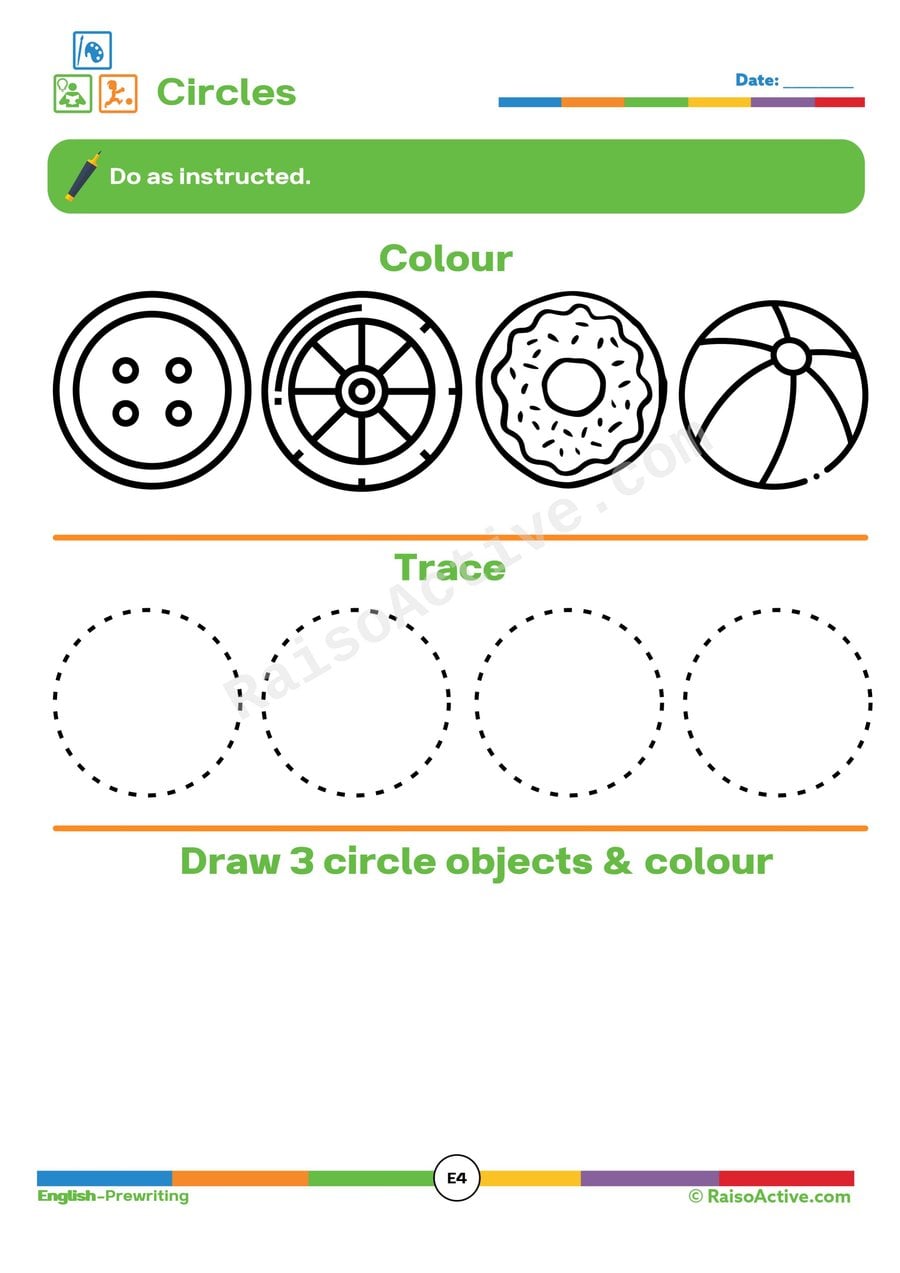
This worksheet builds shape recognition and drawing skills as children ages 3-5 trace dotted circles, color pictures of circular objects, and then draw three circle-shaped objects entirely on their own. Moving from tracing to independent drawing tracks a real developmental progression — first following a guide, then applying the shape from memory — which builds true shape mastery rather than just copying.

Thick and Thin Sorting Worksheet for Preschoolers
Ages 3-5 · Preschool–Pre-KAges 3-5 · Nursery–ReceptionAges 3-5 · Nursery–LKGAges 3-5
This sorting worksheet asks children ages 3-5 to classify pictured objects as either thick or thin, building an early comparative vocabulary skill that goes beyond simple size words like big and small into more specific, descriptive language. Learning to compare and sort by a specific physical property is an important step toward the broader skill of classification used throughout early math and science.

May I? Permission and Future Possibilities Worksheet
Ages 3-5 · Preschool–Pre-KAges 3-5 · Nursery–ReceptionAges 3-5 · Nursery–LKGAges 3-5
This worksheet helps children ages 3-5 practice using the polite phrase 'May I' to ask for permission and to talk about things they might do in the future, building both grammar skills and an important social convention for respectful communication. Learning to phrase a request politely is a social-emotional skill that supports smoother interactions with teachers, family, and peers well beyond this single worksheet.

Tracing and Writing the Number 5 Worksheet for Preschoolers
Ages 3-5 · Preschool–Pre-KAges 3-5 · Nursery–ReceptionAges 3-5 · Nursery–LKGAges 3-5
This worksheet targets the specific pencil-control needed to form the numeral 5 correctly, while linking that written symbol to the quantity it represents through counting the apples on the page. Practicing number formation alongside counting at this age helps children connect the abstract symbol '5' to a concrete amount they can see and touch.
Beading Fun: Make Your Own Bracelet Worksheet
Ages 3-5 · Preschool–Pre-KAges 3-5 · Nursery–ReceptionAges 3-5 · Nursery–LKGAges 3-5
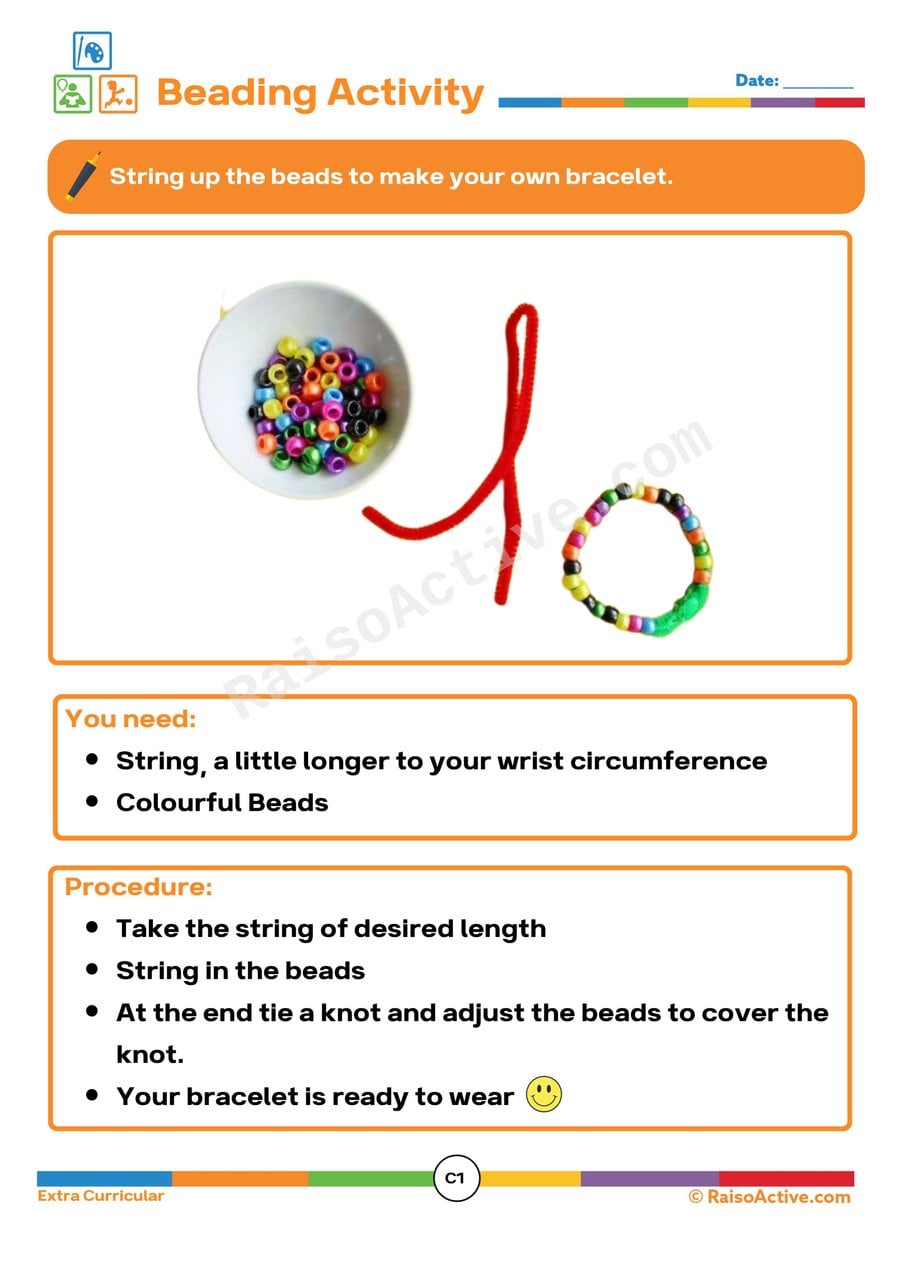
This beading craft has children ages 3-5 string beads onto a cord and tie it off to make a wearable bracelet, building bilateral coordination as one hand holds the string steady while the other threads beads — a genuinely demanding fine motor task at this age. Completing a sequence of small, repeated actions toward a finished, wearable product also builds patience and a sense of accomplishment.
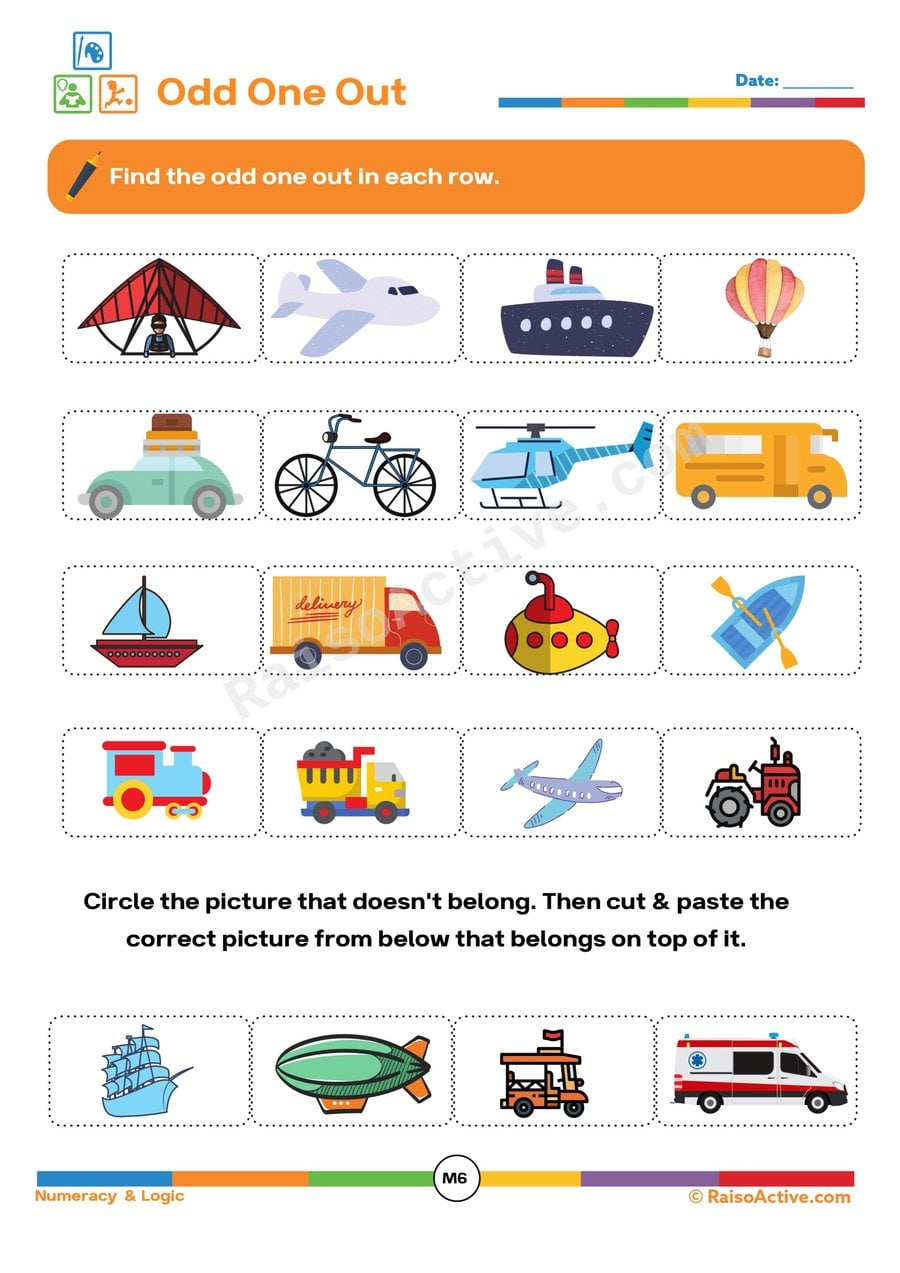
Odd One Out: Transportation Worksheet for Kids
Ages 3-5 · Preschool–Pre-KAges 3-5 · Nursery–ReceptionAges 3-5 · Nursery–LKGAges 3-5
This worksheet sharpens visual discrimination and categorization skills as children ages 3-5 study a row of transportation pictures and identify the one that doesn't belong with the others, then replace it with a correct match cut from the bottom of the page. Explaining why an item is the 'odd one out' builds early critical-thinking and reasoning skills that go beyond simple picture recognition.
Related worksheets

Learn the Letter 'L': Tracing, Matching, and Coloring Worksheet for Preschoolers
Ages 3-5 · Preschool–Pre-KAges 3-5 · Nursery–ReceptionAges 3-5 · Nursery–LKGAges 3-5
This worksheet builds letter 'L' recognition through tracing, matching, a themed maze that highlights the letter while guiding a lion to its meat, and coloring — a four-part structure that keeps 3-5 year olds engaged across several formats while reinforcing the same letter each time. The maze section in particular adds a playful goal to what would otherwise be repetitive letter-spotting, motivating your child to scan carefully for every 'L' along the path.
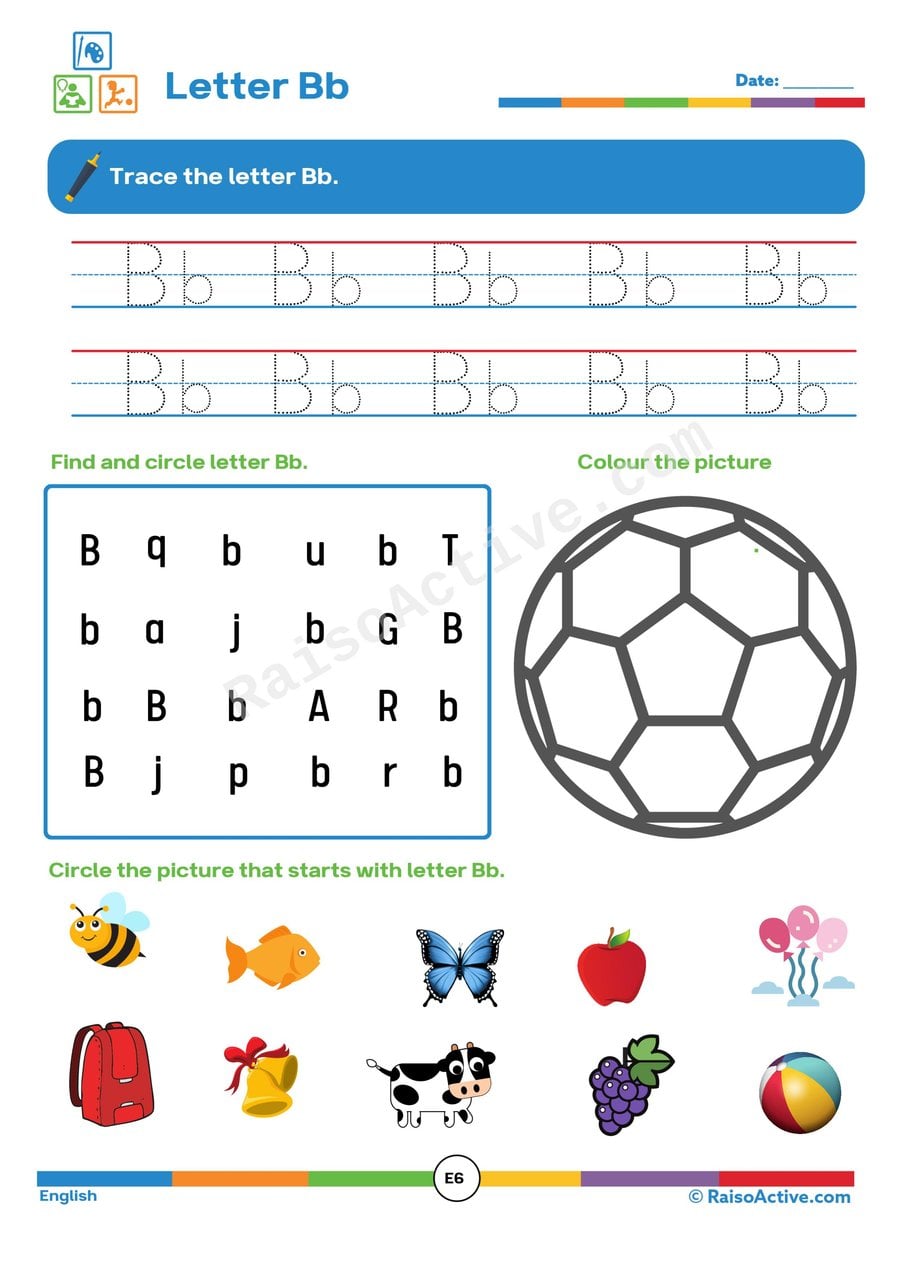
Letter Bb Worksheet: Trace, Find, and Color!
Ages 3-5 · Preschool–Pre-KAges 3-5 · Nursery–ReceptionAges 3-5 · Nursery–LKGAges 3-5
This worksheet builds letter recognition and handwriting readiness as children ages 3-5 trace both uppercase and lowercase Bb, hunt for the letter among a group of other letters, and identify pictures of objects that start with the Bb sound. Practicing a letter across several formats — tracing, spotting, and sound matching — helps cement both its shape and its sound more effectively than tracing alone.
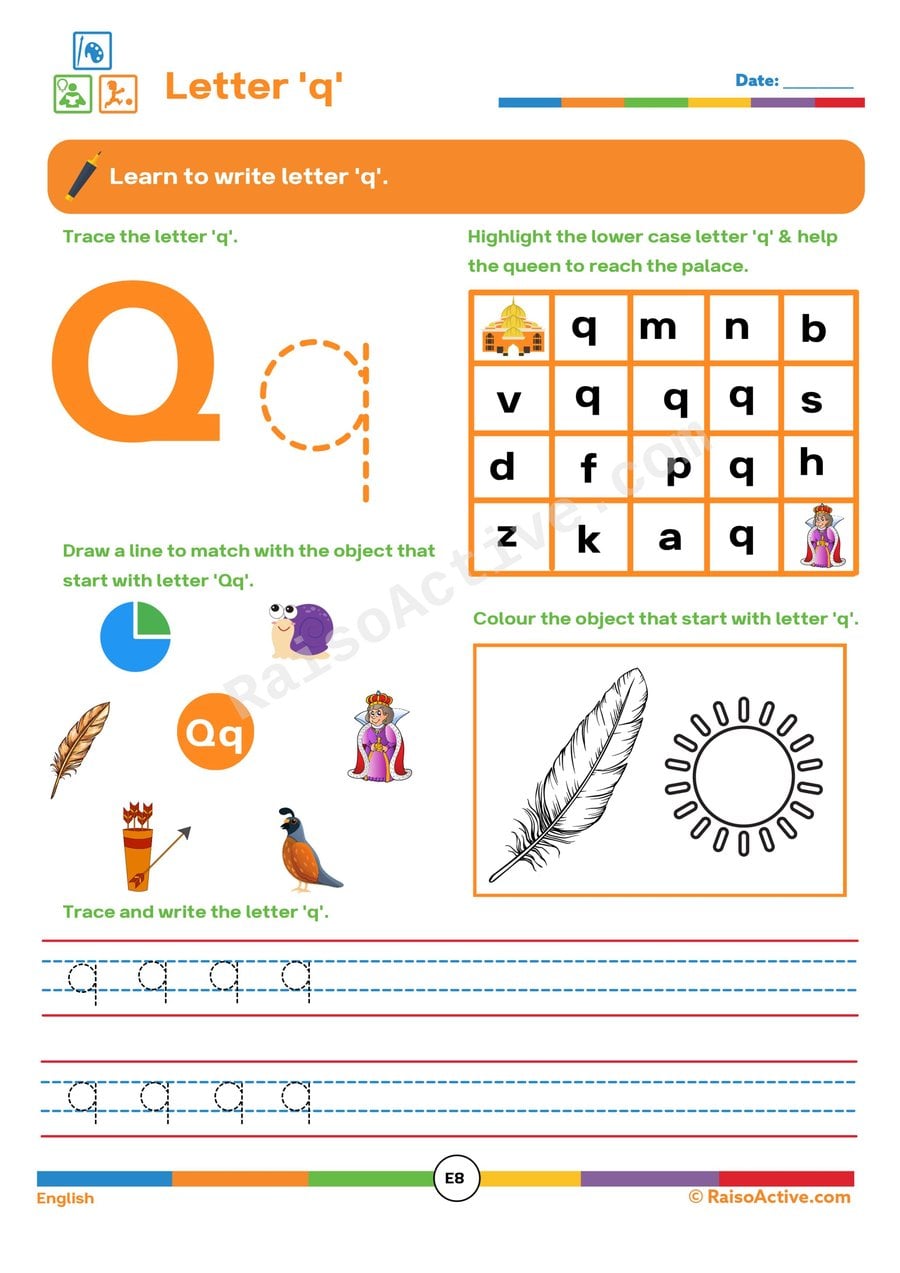
Letter 'q' Worksheet: Trace, Match, and Color!
Ages 3-5 · Preschool–Pre-KAges 3-5 · Nursery–ReceptionAges 3-5 · Nursery–LKGAges 3-5
This worksheet builds letter recognition for 'q' in both its uppercase and lowercase forms for children ages 3-5, a letter that's often trickier than most since it almost always pairs with 'u' and rarely appears alone in early vocabulary. Tracing the letter strengthens the fine motor control for its distinctive tail stroke, while matching and highlighting activities reinforce visual recognition across a busy grid. Helping the queen reach the palace through a simple letter-hunt maze adds a playful, motivating goal to an otherwise repetitive tracing task.
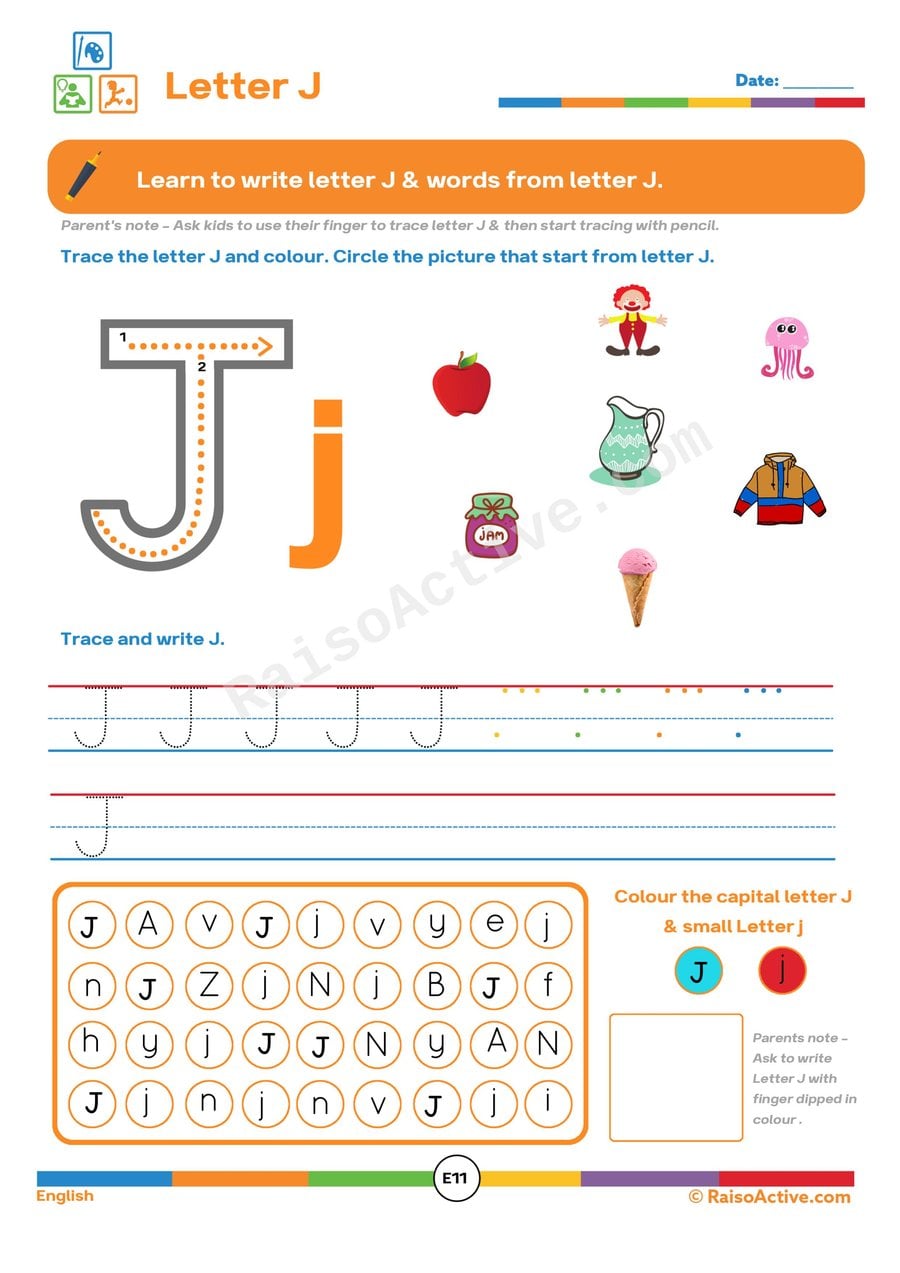
Letter J Worksheet: Trace, Write, and Color!
Ages 3-5 · Preschool–Pre-KAges 3-5 · Nursery–ReceptionAges 3-5 · Nursery–LKGAges 3-5
Children ages 3-5 practice forming the letter J, both uppercase and lowercase, through guided tracing, while also linking the letter to its sound by identifying pictures that begin with J. This combination of motor practice and phonics builds the foundation for both handwriting and early reading.

Letter I Tracing Worksheet: Learn to Trace and Identify Words
Ages 3-5 · Preschool–Pre-KAges 3-5 · Nursery–ReceptionAges 3-5 · Nursery–LKGAges 3-5
This worksheet builds recognition and formation of the letter I, both uppercase and lowercase, through tracing practice and identifying pictures of words that start with I, like 'igloo' or 'insect.' For three- to five-year-olds, uppercase I is one of the simplest letter shapes to form, making it a good confidence-building letter even as lowercase i, with its added dot, introduces a slightly trickier two-part stroke.
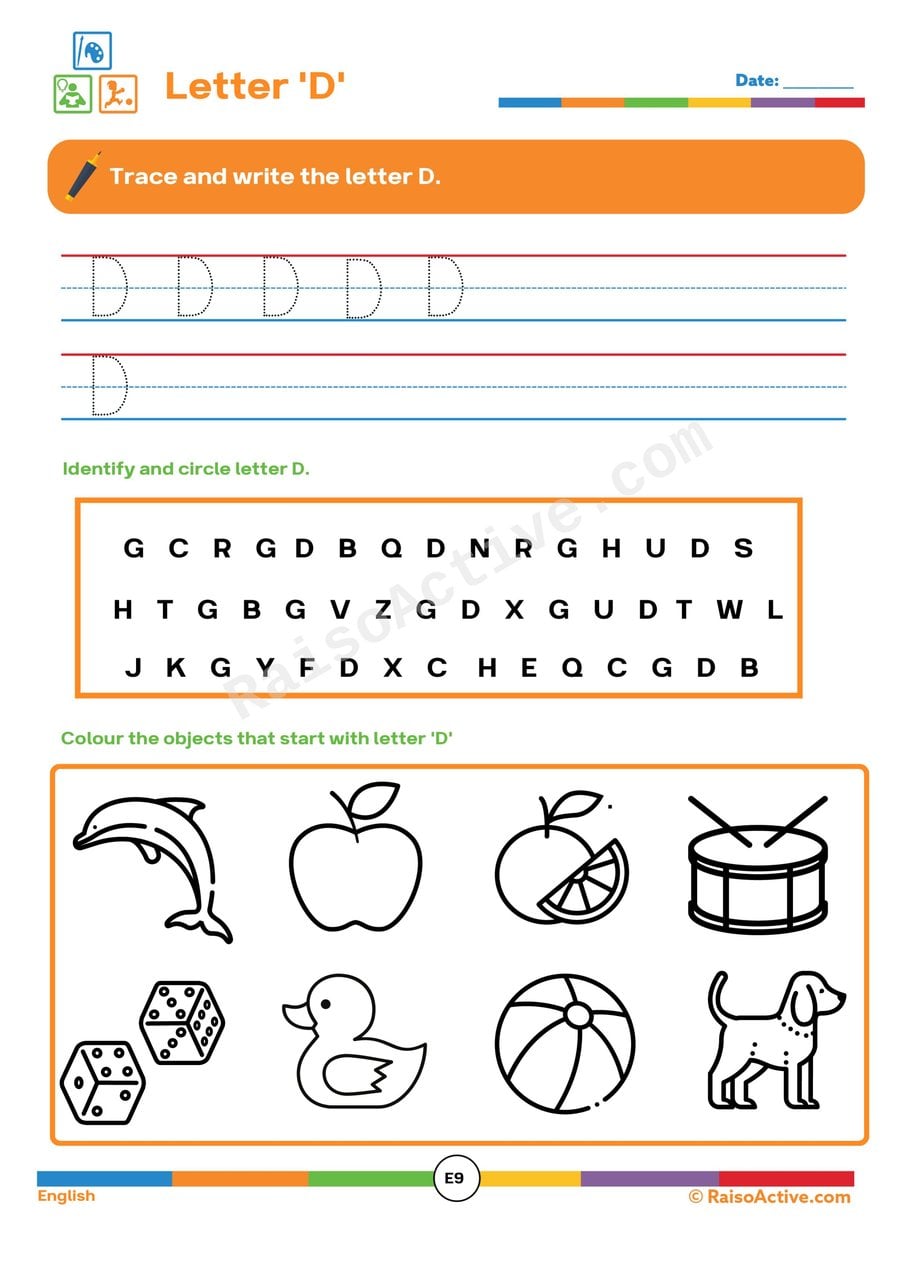
Letter D Worksheet: Trace, Identify, and Color!
Ages 3-5 · Preschool–Pre-KAges 3-5 · Nursery–ReceptionAges 3-5 · Nursery–LKGAges 3-5
This worksheet helps children ages 3-5 practice letter recognition, pencil-controlled tracing, and beginning sound awareness all centered on the letter D. Searching for D within a group of letters builds visual discrimination, an important pre-reading skill for telling similar shapes apart quickly.

Trace and Identify the Letter 'G' Worksheet for Preschoolers
Ages 4-5 · Pre-KAges 4-5 · ReceptionAges 4-5 · LKGAges 4-5
This worksheet helps children ages 4-5 build the pencil control needed to form the letter G while also practicing visual search skills as they locate every G hidden among other letters. Coloring pictures that start with G ties the abstract letter shape to concrete, familiar words, strengthening the letter-sound connection.

Letter Hh Tracing and Matching Worksheet for Preschoolers
Ages 3-5 · Preschool–Pre-KAges 3-5 · Nursery–ReceptionAges 3-5 · Nursery–LKGAges 3-5
Children ages 3-5 build letter recognition and handwriting readiness as they trace uppercase and lowercase Hh, identify the letter among different fonts, and match it to pictures of objects that start with the Hh sound. Practicing the letter across tracing, spotting, and sound-matching formats helps cement both its shape and its 'huh' sound more thoroughly than repetition of just one activity.
Guides for this topic

Documenting Learning Without Drowning in Data: A Practical Guide for Parents and Teachers
Learn practical ways to document your child's learning without overwhelm. Simple portfolios, observation tips, and printable trackers for ages 1-8.

How to Help Your Child with Letter Reversals: A Complete Guide for Parents and Teachers
Letter reversals are normal until age 7-8. Learn the best multisensory strategies, anchor letter tricks, and activities to help children write b, d, p, and q correctly.

Activities That Help with Pencil Grip Development: A Complete Guide for Parents and Teachers
Discover fun, research-backed activities to develop pencil grip in young children. Age-wise exercises, play ideas, and expert tips for parents and teachers.
Reviews
Every worksheet for ages 3–5, no watermark
Members download the full library of 1,000+ worksheets and every activity pack without watermarks or daily limits. One year costs ₹999 in India or $20 elsewhere.
See membership plansOr download any worksheet free with a watermark (5 a day).