Letter I Tracing Worksheet: Learn to Trace and Identify Words
This worksheet builds recognition and formation of the letter I, both uppercase and lowercase, through tracing practice and identifying pictures of words that start with I, like 'igloo' or 'insect.' For three- to five-year-olds, uppercase I is one of the simplest letter shapes to form, making it a good confidence-building letter even as lowercase i, with its added dot, introduces a slightly trickier two-part stroke.
Part of the pack
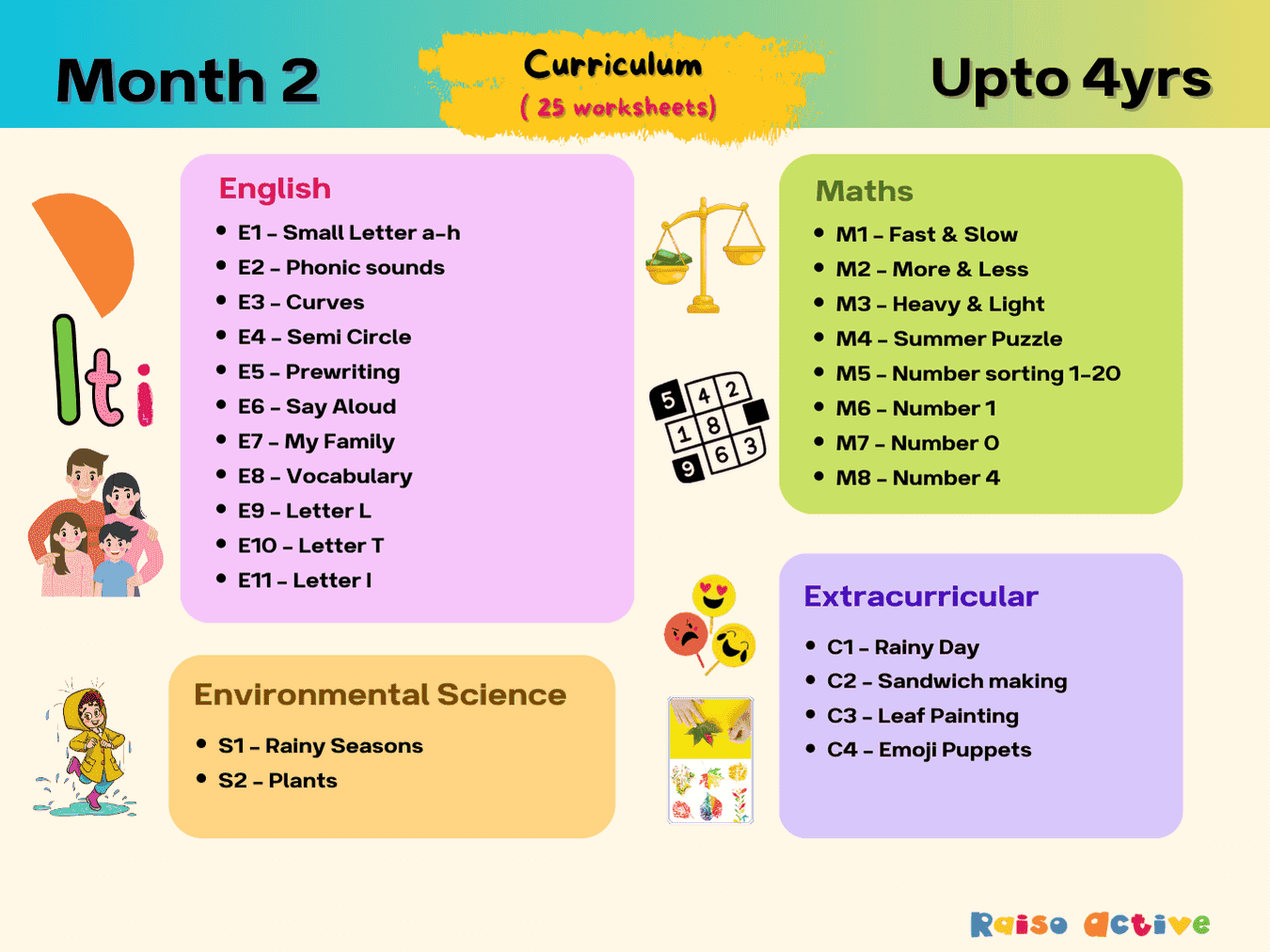
Month 2: Learning & Development | Ages Up to 4
This is page 14 of the pack. Ages 3-4 · PreschoolAges 3-4 · NurseryAges 3-4
Made for your child
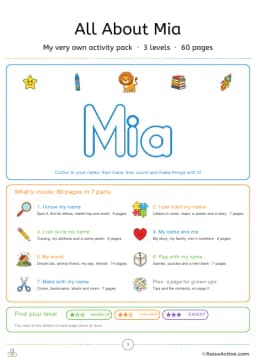
A whole activity pack made with their name
60 pages to spot, build, trace and write their own name, plus pages about their favourites, feelings and family. See a free preview with their name.
Make an All About Me packFree preview · free for members
Or start free: a name tracing sheet with their nameCurriculum
- Writing > Letter Tracing A-Z
How to use this worksheet
Have your child trace the letter I along the dotted lines, first the uppercase form and then the lowercase form with its dot. Look at the pictures together, name each one, and have your child color the pictures that start with the letter I. Finally, have them trace the letter I independently on the practice lines provided, saying the /i/ sound each time.
Materials needed
- Pencil
- Crayons
Extension activities
- 1Find other objects in the classroom or home that start with the letter I, like ice or an invitation.
- 2Practice writing the letter I on a whiteboard or in a notebook for extra repetition.
- 3Talk about insects or igloos to connect the letter to real-world vocabulary and pictures.
- 4Draw a picture of something starting with I and label it together.
- 5Compare uppercase I and lowercase i side by side, noticing the added dot on the lowercase form.

Written by
Hemsweta Jain · Teacher Cheena
MBA and Early Childhood Educator, teaching since 2014 · Founder of RaisoActive, Mumbai
Every RaisoActive worksheet is designed and checked by the founder before publishing.
Published · Last reviewed
More from Month 2: Learning & Development | Ages Up to 4

Plant Life Cycle Worksheet: Cut and Paste the Stages!
Ages 3-5 · Preschool–Pre-KAges 3-5 · Nursery–ReceptionAges 3-5 · Nursery–LKGAges 3-5
This worksheet helps children ages 3-5 learn the different stages of a plant's life cycle, from seed to sprout to full-grown plant, by coloring each stage and then cutting and pasting the pictures in the correct sequential order. Sequencing the stages builds early scientific reasoning about growth and change over time, a concept children can also observe in themselves.

Trace the Letter T Worksheet: Practice Writing & Coloring Fun!
Ages 3-5 · Preschool–Pre-KAges 3-5 · Nursery–ReceptionAges 3-5 · Nursery–LKGAges 3-5
This worksheet builds recognition and formation of the letter T through guided tracing and by identifying pictures of words that start with T, like 'tiger' or 'turtle.' For three- to five-year-olds, the letter T's simple cross-shaped stroke — one straight line down, one straight line across — makes it a good letter for practicing controlled, confident pencil strokes.

Heavy or Light? Sorting Worksheet for Preschoolers
Ages 3-5 · Preschool–Pre-KAges 3-5 · Nursery–ReceptionAges 3-5 · Nursery–LKGAges 3-5
This worksheet helps children ages 3-5 understand the concept of weight by looking at balance scale pictures and identifying which object is heavier or lighter, then sorting objects into heavy and light categories through a cut-and-paste activity. Comparing weight this way introduces an early physics concept and builds the comparative reasoning skills used across many areas of math.

Say Aloud and Match: Fun Worksheet for Young Learners
Ages 3-5 · Preschool–Pre-KAges 3-5 · Nursery–ReceptionAges 3-5 · Nursery–LKGAges 3-5
This worksheet builds sentence comprehension by having children listen to a full sentence and then find the picture that matches its meaning, rather than just recognizing individual words. For three- to five-year-olds, this task requires holding an entire sentence in mind and connecting it to a visual scene, an important early step toward reading comprehension beyond single-word recognition.

Parent's Guide: Fun Activities for Letter Recognition, Conversation & More!
Ages 3-5 · Preschool–Pre-KAges 3-5 · Nursery–ReceptionAges 3-5 · Nursery–LKGAges 3-5
This guide is a collection of hands-on activities parents can use to build letter recognition, phonics awareness, basic conversation skills, and spatial vocabulary in three- to five-year-olds through everyday play rather than worksheet drills. Because it's built around games like hiding letters or setting up a pretend shop, it teaches these early literacy and language skills through movement and imagination, which holds young children's attention far longer than seated tasks.

Semi-Circle Fun: Tracing, Counting, and Patterns Worksheet for Preschoolers
Ages 3-5 · Preschool–Pre-KAges 3-5 · Nursery–ReceptionAges 3-5 · Nursery–LKGAges 3-5
This worksheet helps children ages 3-5 learn about semi-circles through tracing their curved edge, counting how many appear in a group, and identifying which shape comes next in a repeating pattern. Covering one shape across three different skills, tracing, counting, and patterning, gives children a well-rounded, layered understanding of what makes a semi-circle unique.
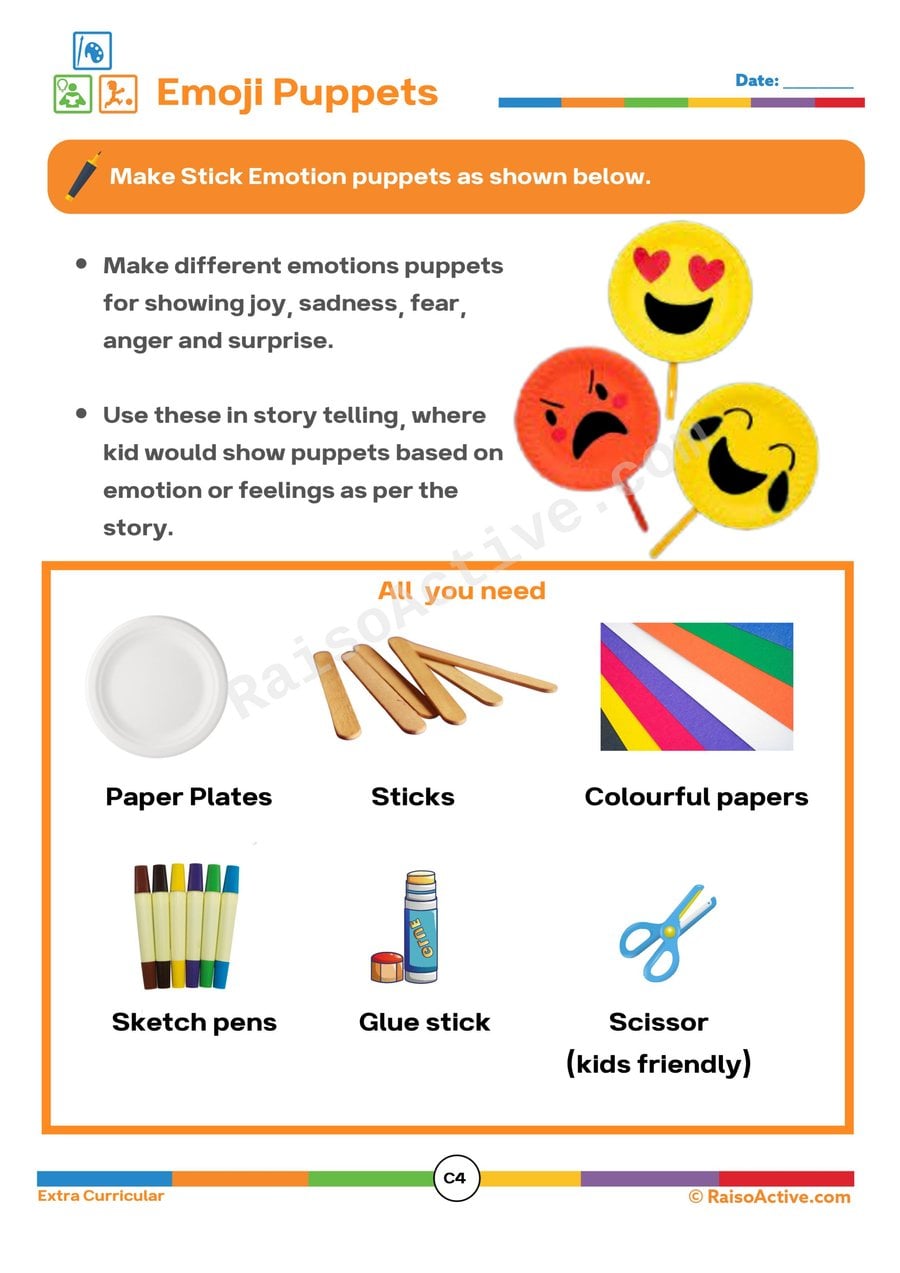
Emoji Puppets Craft Worksheet for Kids
Ages 3-5 · Preschool–Pre-KAges 3-5 · Nursery–ReceptionAges 3-5 · Nursery–LKGAges 3-5
This craft worksheet helps children ages 3-5 create emoji puppets representing different emotions, building emotional vocabulary and fine motor scissor skills at the same time as creative storytelling. Making a physical puppet for each feeling gives children a tangible way to talk about emotions that can feel abstract when discussed with words alone.

Leaf Painting Worksheet for Kids: Stamp and Create!
Ages 3-5 · Preschool–Pre-KAges 3-5 · Nursery–ReceptionAges 3-5 · Nursery–LKGAges 3-5
This activity builds fine motor skills and early science observation as children examine real leaf shapes and sizes while painting and stamping them onto paper to create original artwork. For three- to five-year-olds, handling actual leaves before turning them into art connects a hands-on nature experience to a creative outcome, reinforcing that natural objects have distinct shapes worth noticing.
Related worksheets

Letter B Tracing and Identification Worksheet for Preschoolers
Ages 3-5 · Preschool–Pre-KAges 3-5 · Nursery–ReceptionAges 3-5 · Nursery–LKGAges 3-5
This worksheet helps children ages 3-5 practice tracing and writing the letter B, identifying B among other letters, and recognizing objects that start with the letter B. Circling the correct letter within a small group builds the visual scanning skill children need before they can read words fluently.

Letter X Worksheet: Trace, Write, and Color the Letter X!
Ages 3-5 · Preschool–Pre-KAges 3-5 · Nursery–ReceptionAges 3-5 · Nursery–LKGAges 3-5
This worksheet introduces the letter X, one of the trickier letters for young children since so few common words start with it, by pairing tracing practice with picture identification for words like 'x-ray' or 'xylophone.' For three- to five-year-olds, working through a less familiar letter like X builds persistence and completes their sense of mastering the full alphabet.

Learn the Letter 'm' Worksheet: Tracing, Matching, and Coloring Fun!
Ages 3-5 · Preschool–Pre-KAges 3-5 · Nursery–ReceptionAges 3-5 · Nursery–LKGAges 3-5
This worksheet builds letter 'm' recognition through four connected tasks — tracing its shape, matching pictures that start with the Mm sound, navigating a highlight maze to help an Eskimo find an igloo, and coloring 'm' objects — which together reinforce the letter through touch, sight, and sound rather than a single repetitive drill. Multi-step worksheets like this also build a young child's ability to follow a sequence of instructions across an activity, which is its own developmental skill at ages 3-5.
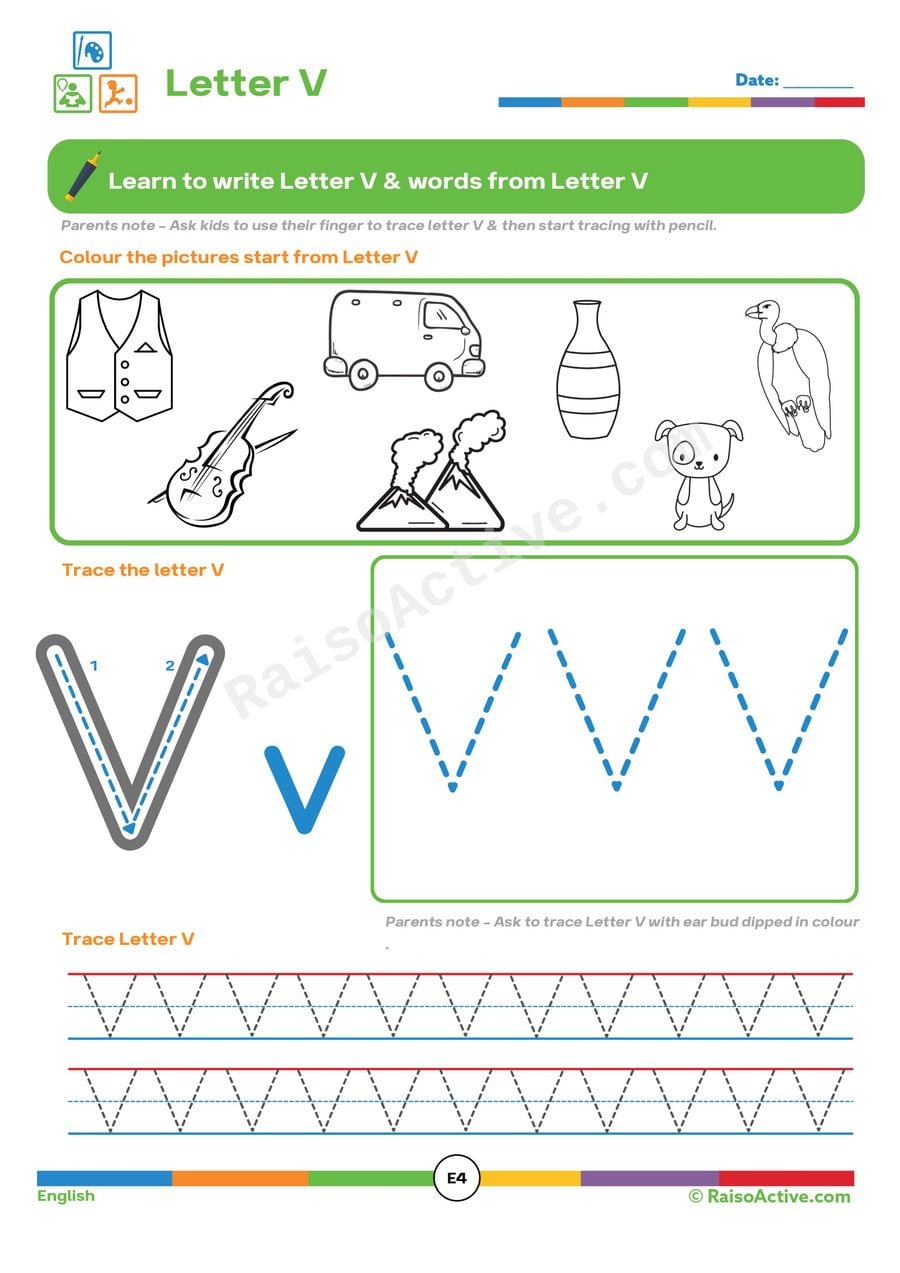
Trace the Letter V Worksheet for Preschoolers
Ages 3-5 · Preschool–Pre-KAges 3-5 · Nursery–ReceptionAges 3-5 · Nursery–LKGAges 3-5
Tracing the uppercase letter V builds the pencil control and stroke memory children ages 3-5 need for handwriting, while coloring pictures that start with V links the written letter to its spoken sound and familiar objects. Repeating the tracing after the picture activity gives extra practice forming the letter correctly.

Letter A Tracing and Coloring Worksheet for Preschoolers
Ages 3-5 · Preschool–Pre-KAges 3-5 · Nursery–ReceptionAges 3-5 · Nursery–LKGAges 3-5
Preschoolers ages 3-5 practice the specific pencil strokes needed to form the letter A, both uppercase and lowercase, while also connecting the letter to its sound through picture recognition. Tracing before free writing builds the fine motor muscle memory that makes independent letter formation possible.

Trace and Identify the Letter 'G' Worksheet for Preschoolers
Ages 4-5 · Pre-KAges 4-5 · ReceptionAges 4-5 · LKGAges 4-5
This worksheet helps children ages 4-5 build the pencil control needed to form the letter G while also practicing visual search skills as they locate every G hidden among other letters. Coloring pictures that start with G ties the abstract letter shape to concrete, familiar words, strengthening the letter-sound connection.
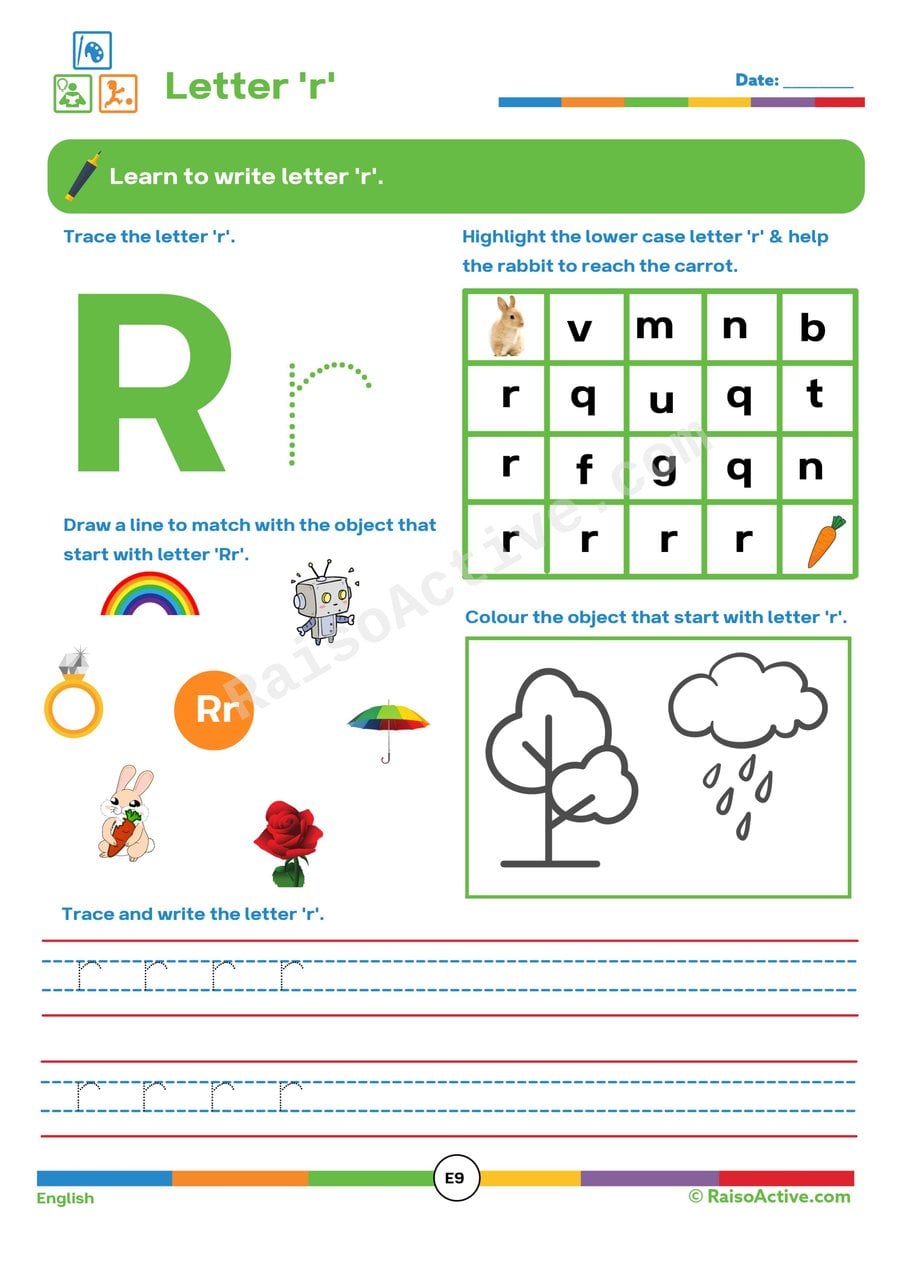
Letter 'r' Worksheet: Trace, Match, and Color!
Ages 3-5 · Preschool–Pre-KAges 3-5 · Nursery–ReceptionAges 3-5 · Nursery–LKGAges 3-5
This multi-part worksheet builds letter recognition for both uppercase and lowercase 'r' through tracing, while the matching and maze-style activities reinforce the beginning 'r' sound through picture identification. For ages 3-5, combining tracing with sound-based matching in one sitting strengthens the connection between a letter's shape and its sound from multiple angles.

Learn the Letter 'n' Worksheet: Tracing, Matching, and Coloring Fun!
Ages 3-5 · Preschool–Pre-KAges 3-5 · Nursery–ReceptionAges 3-5 · Nursery–LKGAges 3-5
This worksheet builds letter 'n' recognition for 3-5 year olds through tracing, a highlighting search, matching to pictures, and coloring — four connected tasks that ask your child to hold onto the same letter across different formats and follow multi-step instructions in sequence. The letter 'n' is frequently confused with 'm' since both involve humps, so the repeated exposure here helps children start telling the two apart by sound and shape.
Guides for this topic

How to Help Your Child with Letter Reversals: A Complete Guide for Parents and Teachers
Letter reversals are normal until age 7-8. Learn the best multisensory strategies, anchor letter tricks, and activities to help children write b, d, p, and q correctly.

Should I Worry If My 4-Year-Old Can't Write Their Name? A Developmental Guide for Parents
Relax: most kids don't write their name clearly until age 5, not 4. See the real developmental timeline and what actually helps at this age.

My Child Can't Trace Dotted Lines — What Activities Can Help? A Complete Guide to Pre-Writing Skills
Struggling to trace dotted lines? Learn why tracing is hard for young children, which skills must come first, and the best activities to build pre-writing readiness.
Reviews
Every worksheet for ages 3–5, no watermark
Members download the full library of 1,000+ worksheets and every activity pack without watermarks or daily limits. One year costs ₹999 in India or $20 elsewhere.
See membership plansOr download any worksheet free with a watermark (5 a day).