Learn India's National Symbols: A Dot-to-Dot Worksheet
Connecting numbered dots to reveal each national symbol builds fine motor control and number-sequence recognition in children ages 3-5, since they must find and connect dots in the correct numerical order to form a recognizable picture. As each symbol emerges from the dots, children also gain early familiarity with important national imagery and its name.
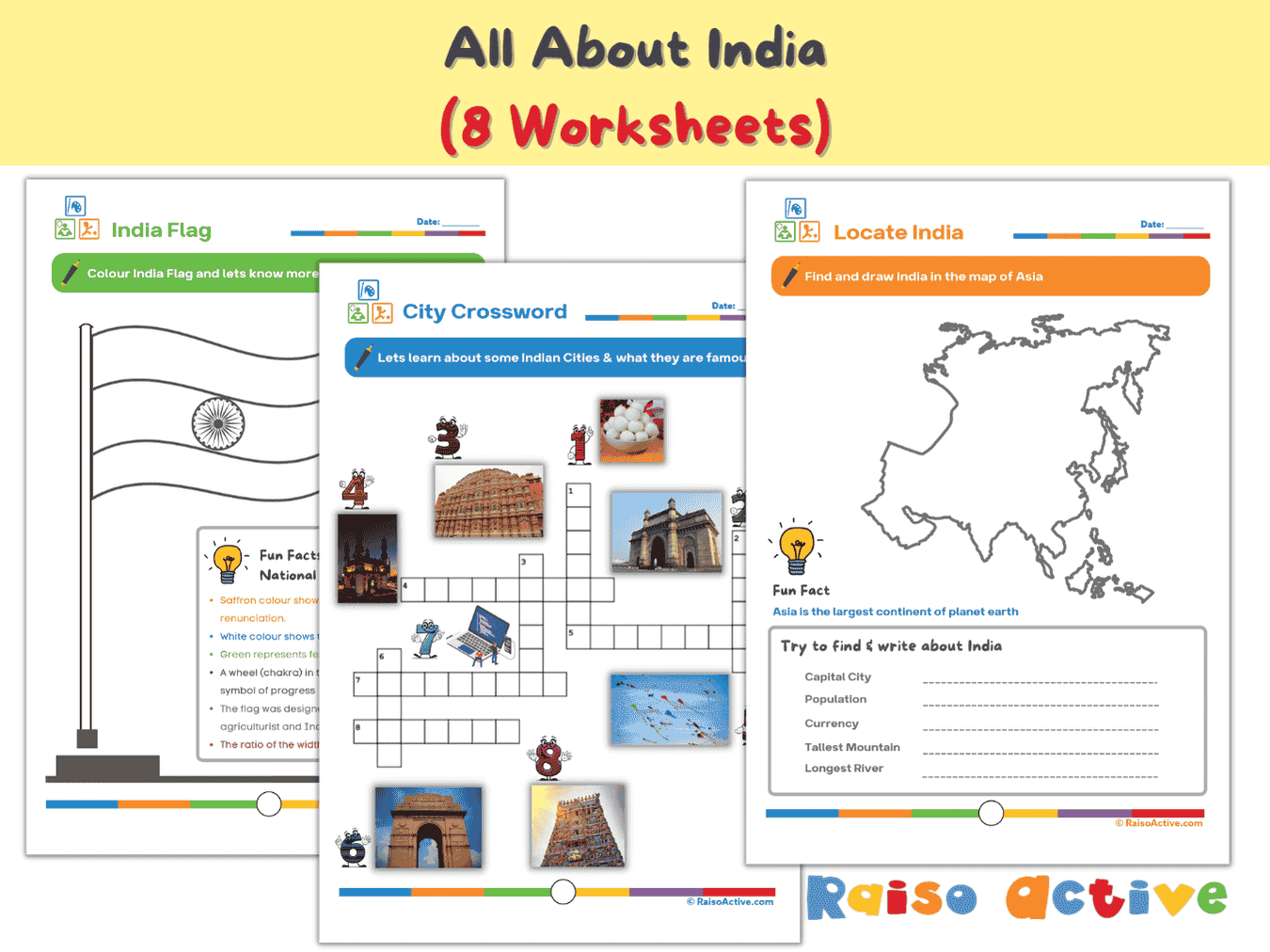
Part of the pack
India Activity Book for Kids: Explore Geography, Culture & Symbols (Ages 5-8)
This is page 6 of the pack. Ages 5-8 · Kindergarten–Grade 2Ages 5-8 · Year 1–Year 3Ages 5-8 · UKG–Class 2Ages 5-8
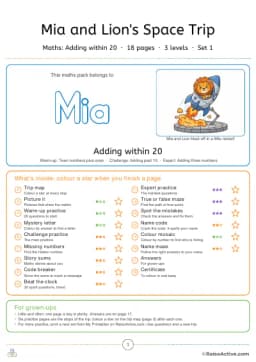
Made for your child
Counting to 10, made for your child
A maths pack with your child's name in it: pictures that explain, practice at three levels, puzzles and story sums about them. Print a new set whenever they finish.
Make a maths packFree preview · free for members
Curriculum
- Earth & Environment > Country Symbols
How to use this worksheet
Point to dot number 1 on the first symbol and help your child find dot number 2 nearby, drawing a straight line to connect them. Continue counting and connecting dots in order, saying each number aloud, until the full outline of the symbol appears. Once revealed, talk briefly about what the symbol is and say its name together. Let your child color the completed picture, then repeat the process for the remaining symbols on the page.
Materials needed
- Pencil
- Crayons
Extension activities
- 1Look up a real photo of each revealed symbol and compare it to the connected-dot drawing.
- 2Create a simple dot-to-dot of your own using numbers 1 to 10 for your child to solve.
- 3Talk about why each symbol was chosen to represent the country and what it means.
- 4Draw a free-hand version of one symbol from memory after completing the dot-to-dot.

Written by
Hemsweta Jain · Teacher Cheena
MBA and Early Childhood Educator, teaching since 2014 · Founder of RaisoActive, Mumbai
Every RaisoActive worksheet is designed and checked by the founder before publishing.
Published · Last reviewed
Related worksheets

Flags Flashcards: Learn About Countries and Their Symbols!
Ages 3-5 · Preschool–Pre-KAges 3-5 · Nursery–ReceptionAges 3-5 · Nursery–LKGAges 3-5
Children ages 3-5 build early geography awareness and visual memory by learning to recognize the flags, capitals, and a few fun facts of different countries through flashcards. Repeated exposure to flag colors and patterns strengthens visual discrimination, a skill that also supports letter and shape recognition.

Dussehra and First Letters: Vidyarambham Tracing and Letter Hunt
Ages 4-6 · Pre-K–KindergartenAges 4-6 · Reception–Year 1Ages 4-6 · LKG–UKGAges 4-6
Children learn about Vidyarambham, when little children write their first letters in rice on Vijayadashami, and about Dussehra, when Rama won against Ravana. They trace letters, sort things we use to learn, count to 10 and match letters to beginning sounds.

Golu Doll Fun: Navratri Golu Counting and Sharing Worksheet
Ages 4-6 · Pre-K–KindergartenAges 4-6 · Reception–Year 1Ages 4-6 · LKG–UKGAges 4-6
Children learn that a golu is a display of dolls on steps set up for Navratri. They count the dolls on each step and find the total, then share cups of sundal among friends and count what is left over.
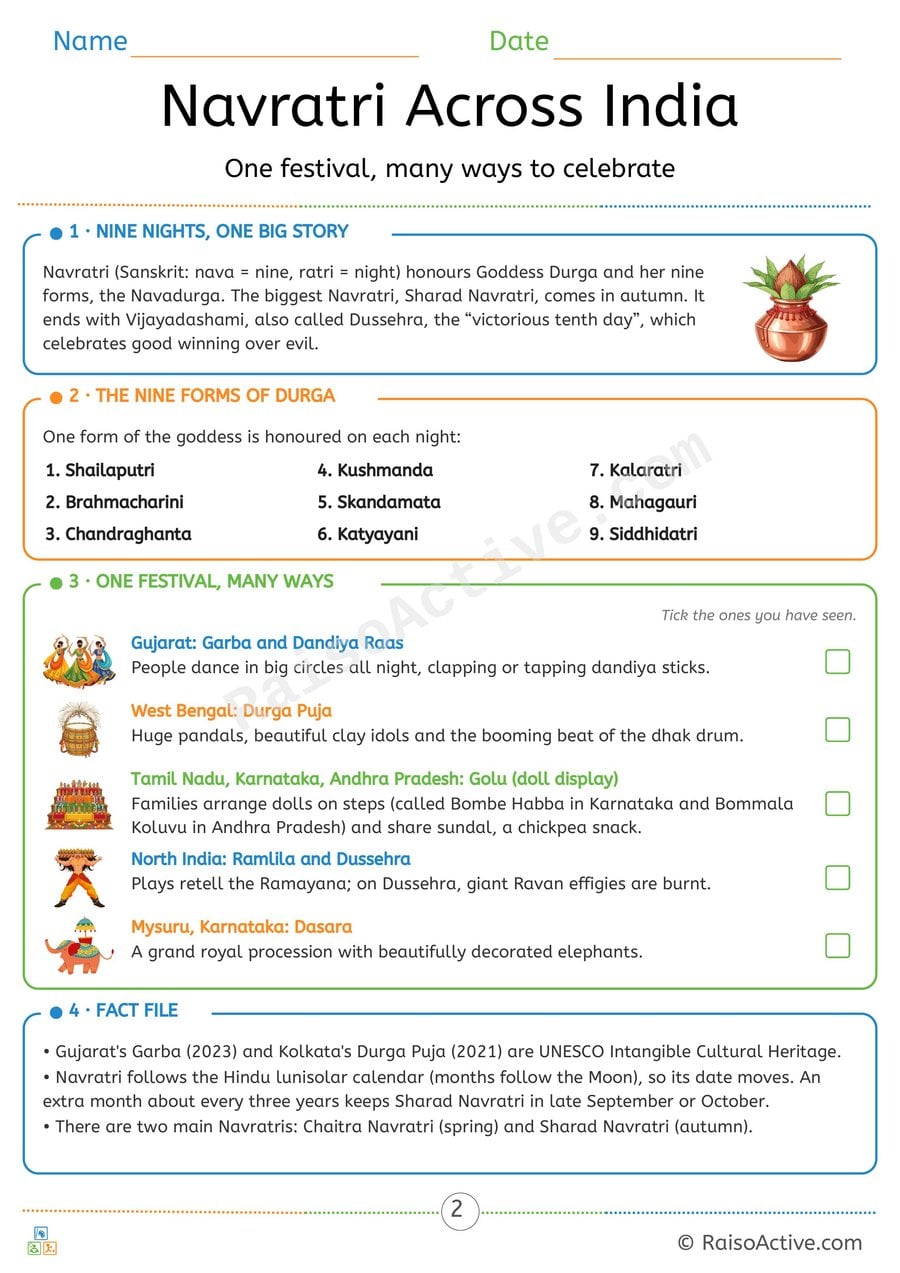
Navratri Across India: How Different States Celebrate
Ages 7-11 · Grade 2–Grade 3Ages 7-11 · Year 3–Year 4Ages 7-11 · Class 2–Class 3Ages 7-11
Children learn what Navratri means (nava = nine, ratri = night), that Sharad Navratri ends with Vijayadashami (Dussehra), and the names of the nine forms of Durga. They read how the festival is celebrated in Gujarat, West Bengal, South India, North India and Mysuru, and a short fact file about UNESCO heritage and the lunisolar calendar.

What is Navratri? Nine Nights Worksheet for Kids
Ages 4-6 · Pre-K–KindergartenAges 4-6 · Reception–Year 1Ages 4-6 · LKG–UKGAges 4-6
Children learn that Navratri means "nine nights", that families pray to Maa Durga, light diyas, dance and share sweets, and that Dussehra comes on the tenth day. They name six things seen at the festival: diya, dandiya, dhol, marigold, kalash and rangoli.

Trace the Numbers 1-9 Worksheet for Preschoolers
Ages 3-5 · Preschool–Pre-KAges 3-5 · Nursery–ReceptionAges 3-5 · Nursery–LKGAges 3-5
Tracing the numerals 1 through 9 gives children ages 3-5 repeated, guided practice with the specific pencil strokes each number requires, building the fine motor control and muscle memory needed for independent number writing. Because tracing follows a fixed, correct path, it also reinforces accurate numeral recognition, helping children tell visually similar digits apart.
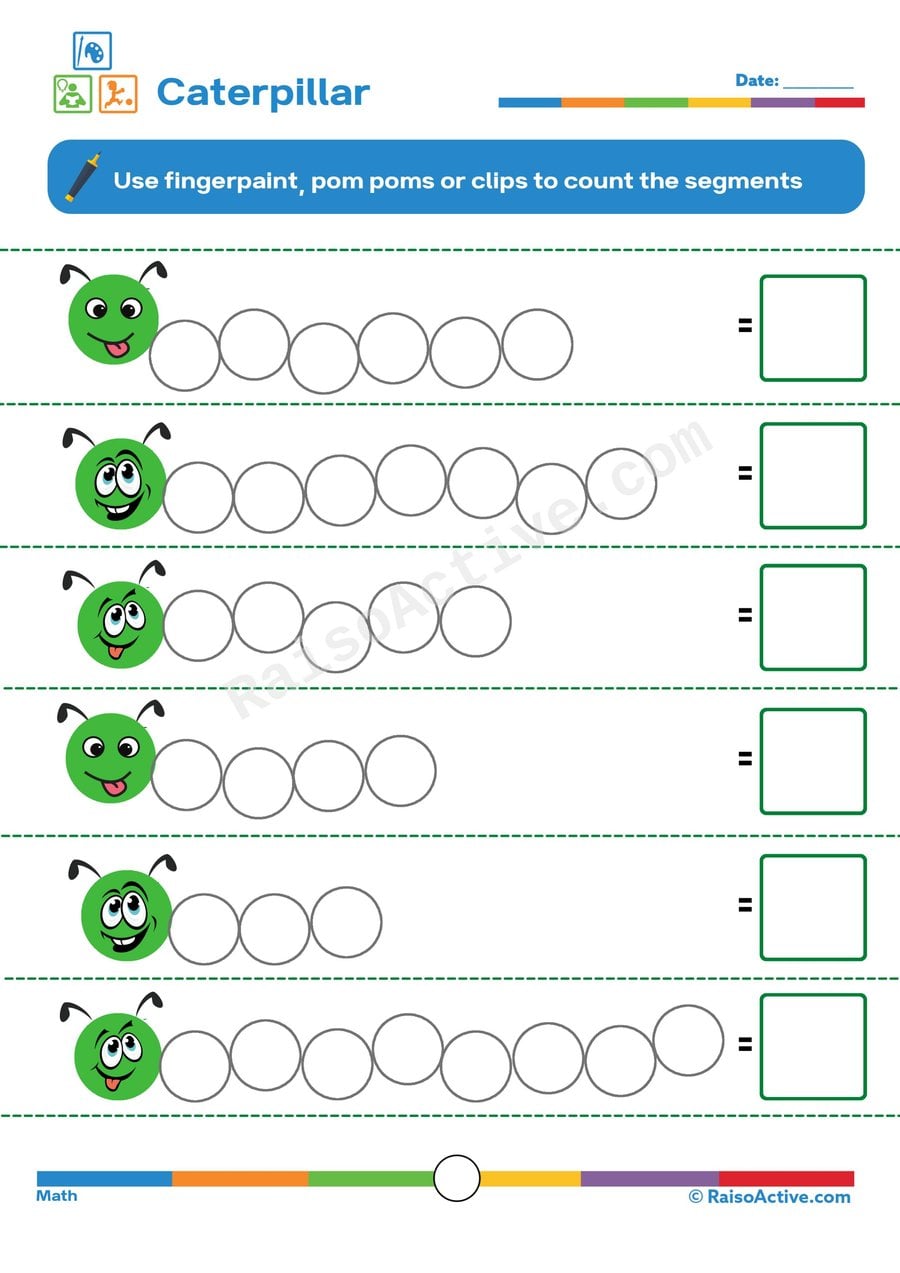
Caterpillar Counting Worksheet for Preschoolers
Ages 3-5 · Preschool–Pre-KAges 3-5 · Nursery–ReceptionAges 3-5 · Nursery–LKGAges 3-5
Counting the segments of each caterpillar teaches children ages 3-5 one-to-one correspondence — touching or marking each segment exactly once while saying a number — which is the core skill underlying accurate counting. Writing the final total in a box also connects the physical act of counting to its written numeral, reinforcing early number-writing practice.
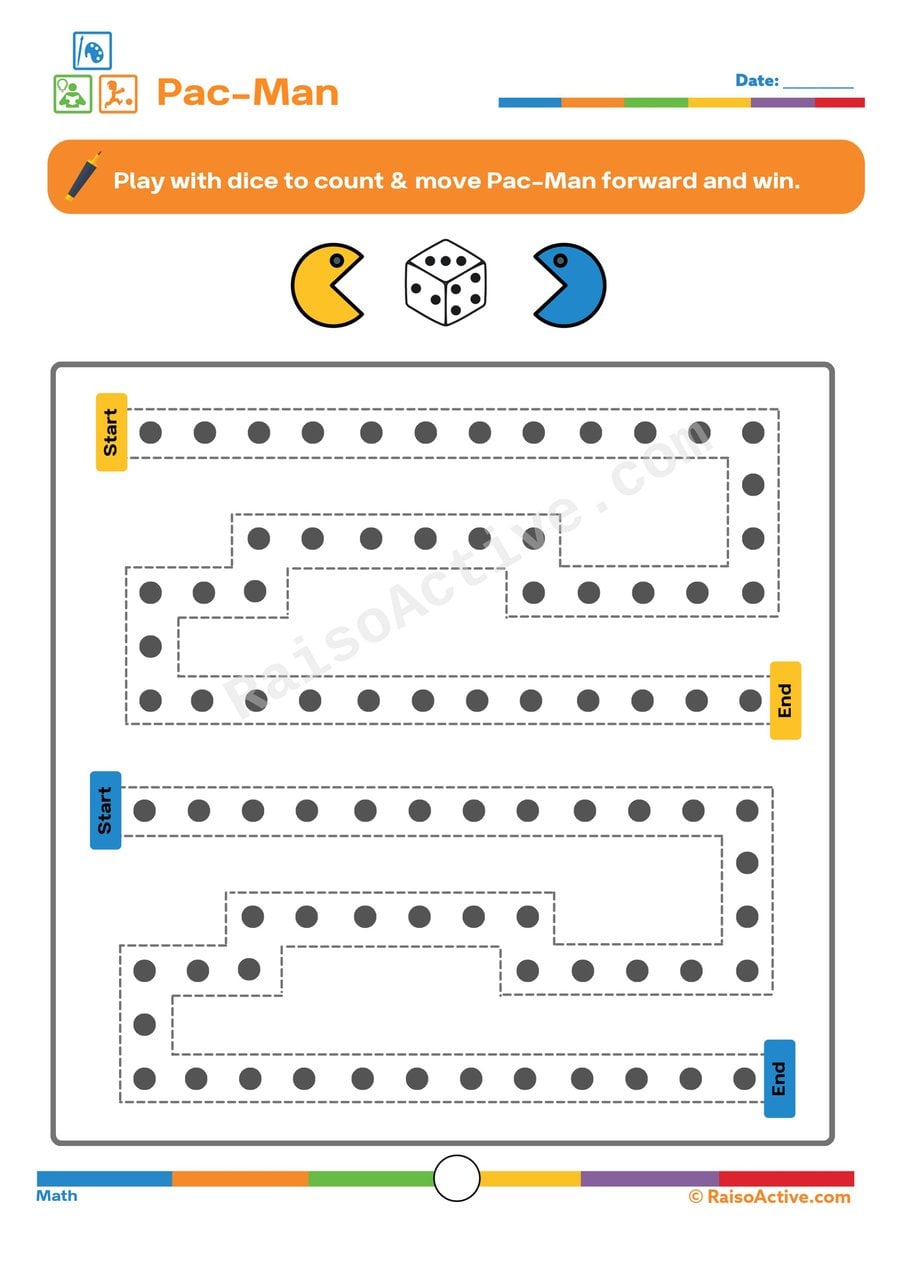
Pac-Man Maze Worksheet: Count and Move!
Ages 3-5 · Preschool–Pre-KAges 3-5 · Nursery–ReceptionAges 3-5 · Nursery–LKGAges 3-5
This dice-counting maze gives children ages 3-5 repeated practice matching a rolled number to the correct number of moves, reinforcing accurate counting under a bit of playful pressure. Tracking Pac-Man's current position after each roll also builds short-term spatial memory, since children must remember where they left off before moving again.
Guides for this topic

Bridging Two Worlds: A Complete Guide to Teaching Heritage Languages Alongside English
A practical guide to raising bilingual children who speak both their heritage language and English with confidence. Research-backed strategies, activities, and tips for Indian families.

Empowering Multilingual Learners: Essential Resources and Strategies for Bilingual and Multilingual Children
Discover research-backed strategies, activities, and free printable resources to support bilingual and multilingual children ages 1-8. Practical tips for Indian families raising confident multilingual learners.
Celebrating Diversity: How to Incorporate Cultural Awareness in Learning Activities for Young Children
Practical cultural awareness activities for young children aged 2-8. Explore Indian festivals, world cultures, food, music, and crafts to teach diversity and inclusion.
Reviews
Every worksheet for ages 3–5, no watermark
Members download the full library of 1,000+ worksheets and every activity pack without watermarks or daily limits. One year costs ₹999 in India or $20 elsewhere.
See membership plansOr download any worksheet free with a watermark (5 a day).