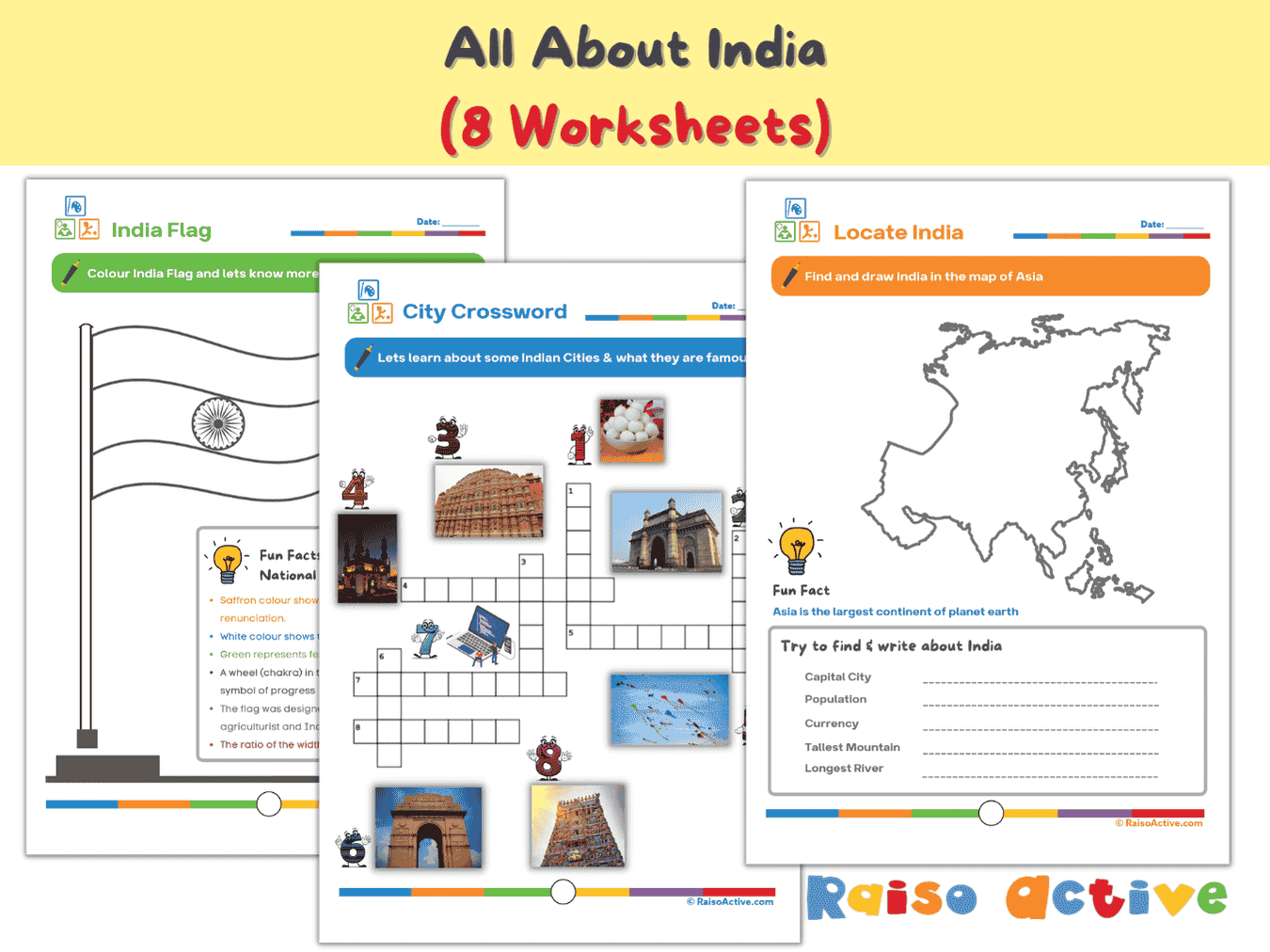
Indian Cities Crossword Puzzle Worksheet for Kids
This crossword challenges children ages 4-6 to identify famous Indian cities from picture clues of their landmarks and then spell out each city's name in the puzzle grid, combining observation skills with early geography knowledge. Counting the crossword boxes to match each city's letter count also reinforces attention to word length before writing.
Part of the pack
India Activity Book for Kids: Explore Geography, Culture & Symbols (Ages 5-8)
This is page 5 of the pack. Ages 5-8 · Kindergarten–Grade 2Ages 5-8 · Year 1–Year 3Ages 5-8 · UKG–Class 2Ages 5-8
Made for your child
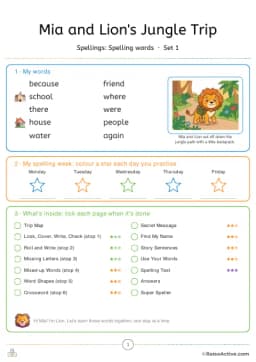
Spelling practice, made for your child
Their own spelling words turned into a pack: trace or look-cover-write-check, roll and write, a secret picture code, a word search, a crossword and a test, with their name in it.
Make a spelling packFree preview · free for members
Or start free: a word search with sight wordsCurriculum
- Cognitive - Attention > Observation Skills
How to use this worksheet
Look at the first picture clue together and talk about what landmark it shows and which city it belongs to. Count the boxes in the matching crossword row to confirm how many letters the city name needs. Help your child write the name letter by letter into the grid, sounding it out as they go. Continue through each picture clue until the whole crossword is filled with correctly spelled city names.
Materials needed
- Pencil
- Eraser
Extension activities
- 1Research more about the cities featured in the crossword and their famous landmarks.
- 2Draw a picture of your favorite Indian city or one you'd like to visit.
- 3Find each city on a map of India and mark it with a sticker.
- 4Make a matching game pairing city names to their landmark pictures.
- 5Ask a family member to share a memory of visiting one of the cities.

Written by
Hemsweta Jain · Teacher Cheena
MBA and Early Childhood Educator, teaching since 2014 · Founder of RaisoActive, Mumbai
Every RaisoActive worksheet is designed and checked by the founder before publishing.
Published · Last reviewed
More from India Activity Book for Kids: Explore Geography, Culture & Symbols (Ages 5-8)

Find and Draw India's Major Rivers Worksheet for Kids
Ages 5-8 · Kindergarten–Grade 2Ages 5-8 · Year 1–Year 3Ages 5-8 · UKG–Class 2Ages 5-8
This activity teaches children ages 5-8 to locate and draw ten of India's major rivers on a blank map, building map-reading skills and geographic memory of the country's physical features. Translating a written list into hand-drawn lines on a map also strengthens the connection between abstract information (a river's name and rough course) and concrete spatial representation.

Learn India's National Symbols: A Dot-to-Dot Worksheet
Ages 3-5 · Preschool–Pre-KAges 3-5 · Nursery–ReceptionAges 3-5 · Nursery–LKGAges 3-5
Connecting numbered dots to reveal each national symbol builds fine motor control and number-sequence recognition in children ages 3-5, since they must find and connect dots in the correct numerical order to form a recognizable picture. As each symbol emerges from the dots, children also gain early familiarity with important national imagery and its name.

My Address Worksheet: Color the State and Fill in Your Details!
Ages 3-5 · Preschool–Pre-KAges 3-5 · Nursery–ReceptionAges 3-5 · Nursery–LKGAges 3-5
This worksheet introduces children ages 3-5 to their personal address as a piece of core safety knowledge, while the map-coloring task builds early geography skills by having them physically locate and color their home state within India. Practicing house number, street, city, and PIN code also gives meaningful, motivated handwriting practice since the words are personally relevant.
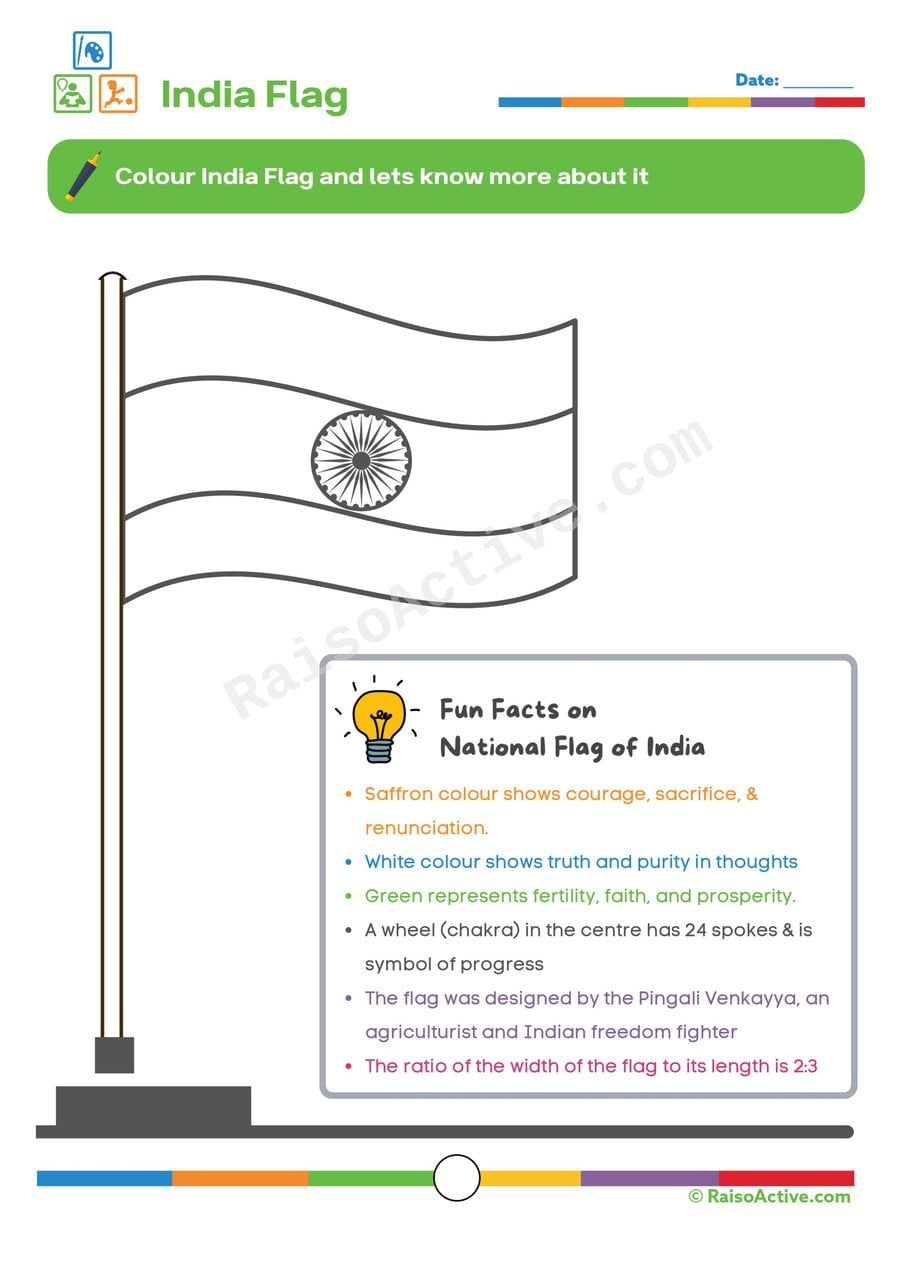
Color the India Flag Worksheet for Preschoolers
Ages 3-5 · Preschool–Pre-KAges 3-5 · Nursery–ReceptionAges 3-5 · Nursery–LKGAges 3-5
This worksheet teaches children ages 3-5 the three colors and layout of the Indian national flag, saffron, white, and green with the navy wheel, while practicing careful, section-by-section coloring. Reading a few simple facts about the flag alongside the coloring also introduces the idea that national symbols carry meaning, an early building block for civic and cultural awareness.
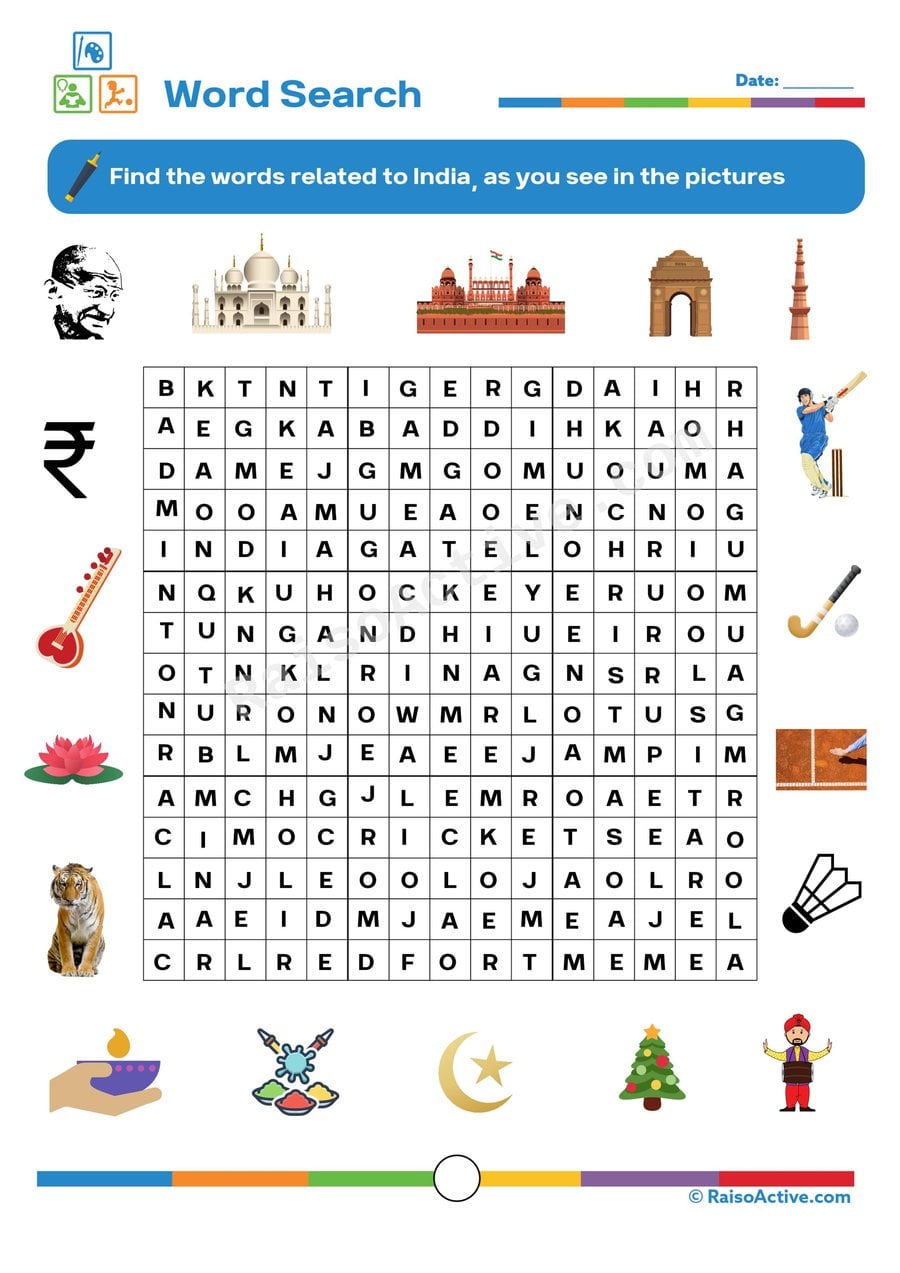
India Word Search Worksheet for Kids
Ages 4-7 · Pre-K–Grade 1Ages 4-7 · Reception–Year 2Ages 4-7 · LKG–Class 1Ages 4-7
Searching a letter grid for words connected to India, such as festival names, foods, or landmarks, builds visual scanning and word-recognition skills in children ages 4-7 while introducing vocabulary tied to Indian culture and geography. Because the target words vary in length and may run in different directions through the grid, children also practice sustained visual attention and letter-sequence tracking, both important pre-reading skills. This worksheet pairs literacy practice with cultural and social studies exposure in a single activity.

Coloring Worksheet: Identify and Color the Symbols!
Ages 3-5 · Preschool–Pre-KAges 3-5 · Nursery–ReceptionAges 3-5 · Nursery–LKGAges 3-5
This worksheet introduces children ages 3-5 to national symbols by having them color each one and then match or write its name from a list of options. Beyond fine motor coloring practice, naming each symbol builds early cultural knowledge and category-matching skills, since children must connect a picture to the correct word rather than color at random.
Related worksheets

Transportation Coloring Worksheet for Preschoolers
Ages 3-5 · Preschool–Pre-KAges 3-5 · Nursery–ReceptionAges 3-5 · Nursery–LKGAges 3-5
This worksheet helps children ages 3-5 practice categorizing vehicles by where they travel — air, water, or land — while strengthening fine motor control through a color-coded coloring task. Following a color key adds a layer of symbolic thinking, since children must hold three rules in mind and apply the correct one to each vehicle. It's a natural bridge between science classification and hands-on art.

Lock and Key Matching Worksheet for Preschoolers
Ages 3-5 · Preschool–Pre-KAges 3-5 · Nursery–ReceptionAges 3-5 · Nursery–LKGAges 3-5
Matching each key to the lock sharing the same letter helps children ages 3-5 practice letter recognition in a playful, puzzle-like context rather than rote drilling. Because each key must be checked against several similar-looking locks before finding the right match, this worksheet also builds visual scanning and careful comparison skills that support problem-solving.

Summer Shadows Matching Worksheet for Preschoolers
Ages 3-5 · Preschool–Pre-KAges 3-5 · Nursery–ReceptionAges 3-5 · Nursery–LKGAges 3-5
This worksheet has children ages 3-5 match pictures of summer activities, like swimming or building a sandcastle, to their correct shadow silhouettes, building visual discrimination through shape recognition rather than color or detail. Because these shadows represent action scenes rather than single objects, children must recognize more complex outlines, including body positions and poses, which is a step up from matching simpler object shadows. This adds a layer of visual reasoning about how shapes and motion relate.
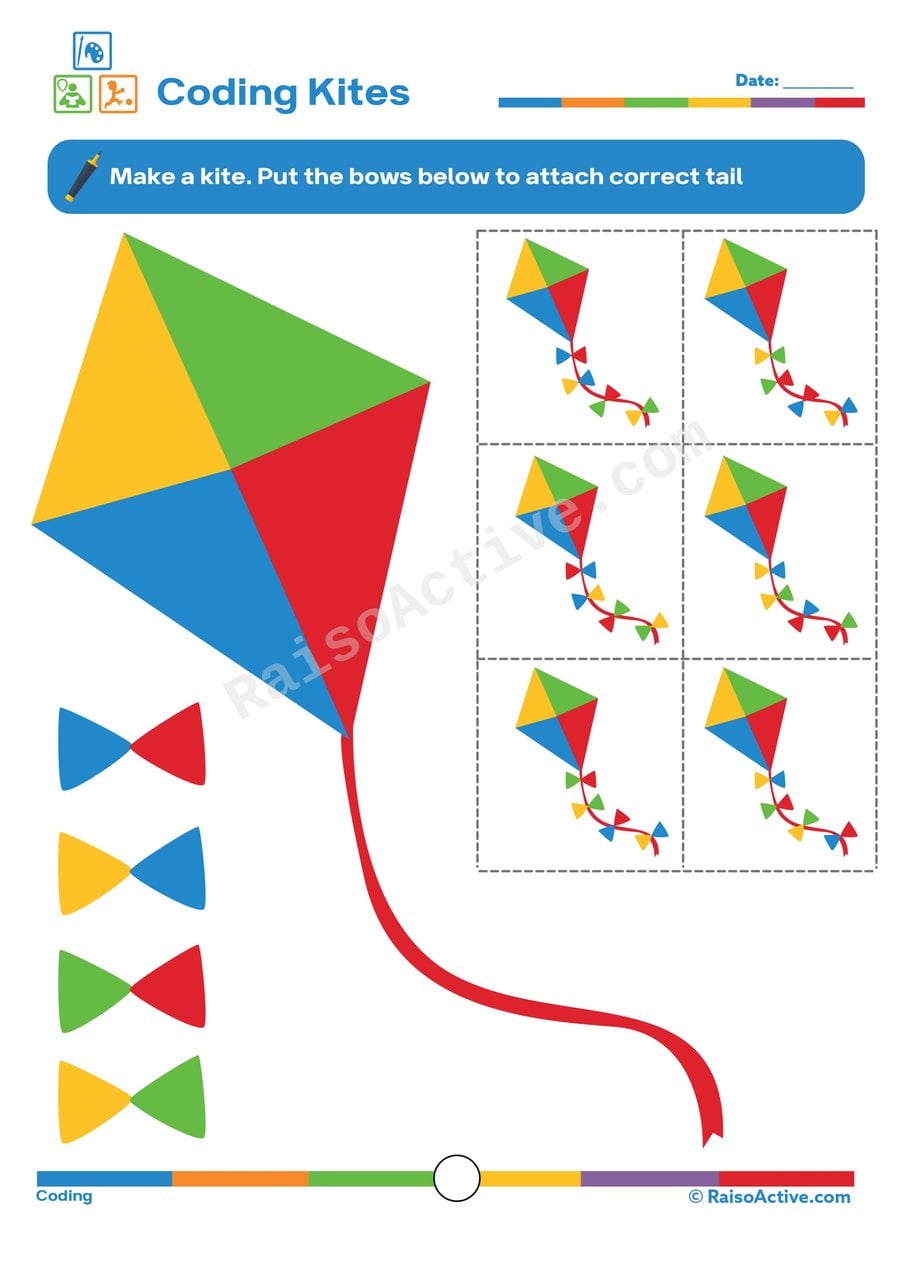
Coding Kites Worksheet: Match the Bows!
Ages 3-5 · Preschool–Pre-KAges 3-5 · Nursery–ReceptionAges 3-5 · Nursery–LKGAges 3-5
This activity sharpens visual observation in children ages 3-5 as they compare color sequences on each kite to a set of loose bows and find the exact match. Careful, systematic comparison — checking each color in order rather than glancing quickly — builds an attention-to-detail habit that transfers directly to early reading and number work.

Near and Far Worksheet: Identifying Distance for Preschoolers
Ages 3-5 · Preschool–Pre-KAges 3-5 · Nursery–ReceptionAges 3-5 · Nursery–LKGAges 3-5
Judging whether an object is near or far and connecting objects based on that positional relationship builds spatial vocabulary for children ages 3-5, an early skill that supports understanding distance, maps, and following directional instructions.

Light Energy Worksheet: Connect the Sun to Light Sources!
Ages 3-5 · Preschool–Pre-KAges 3-5 · Nursery–ReceptionAges 3-5 · Nursery–LKGAges 3-5
Connecting the sun to other objects that produce light builds early science reasoning for children ages 3-5, introducing the concept that light comes from specific sources rather than simply existing everywhere.

Fruit and Vegetable Sorting Worksheet for Preschoolers
Ages 3-5 · Preschool–Pre-KAges 3-5 · Nursery–ReceptionAges 3-5 · Nursery–LKGAges 3-5
This worksheet helps children ages 3-5 practice identifying and categorizing fruits and vegetables by coloring circles next to each pictured food item. Learning to tell fruits and vegetables apart, and eventually name specific ones, builds early categorization skills alongside healthy eating awareness, since recognizing food groups is a foundation for later nutrition education.
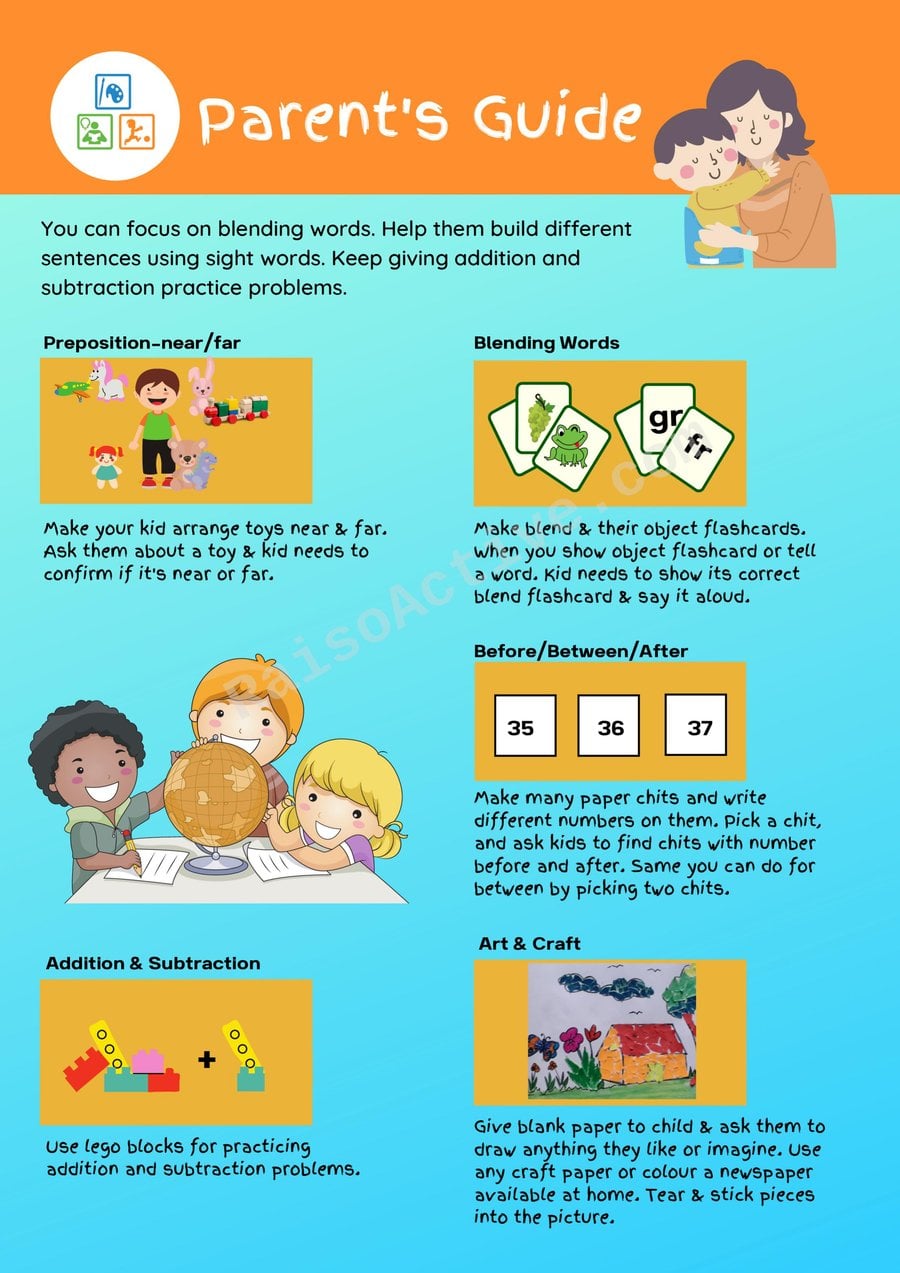
Parent's Guide: Fun Activities for Early Learning
Ages 3-5 · Preschool–Pre-KAges 3-5 · Nursery–ReceptionAges 3-5 · Nursery–LKGAges 3-5
This parent guide bundles three separate early-learning activities, blending sounds into words, understanding prepositions like 'near' and 'far,' and practicing basic math, into one set of hands-on games rather than a single printed page. Combining these skills in short, varied activities matches how preschoolers actually learn best: through play, repetition, and movement rather than sitting through one long task.
Guides for this topic

Sight Words by Age: The First 50 Words and How to Teach Them Without Flashcard Fatigue
Which sight words to teach first and why, the heart-word method, a read-trace-write-find routine, games, and a by-age table of typical sight-word progress.
How to Teach CVC Blending: A Step-by-Step Method That Works in Two Weeks
A step-by-step method for teaching CVC blending, covering continuous sounds, word families, common errors, and a 14-day plan that most children finish reading CVC words.

Age-Appropriate Problem-Solving Activities: Building Critical Thinkers from the Ground Up
Discover fun, age-appropriate problem-solving activities for children ages 1-8. Build critical thinking, logic, and reasoning skills through play-based learning.
Reviews
Every worksheet for ages 4–6, no watermark
Members download the full library of 1,000+ worksheets and every activity pack without watermarks or daily limits. One year costs ₹999 in India or $20 elsewhere.
See membership plansOr download any worksheet free with a watermark (5 a day).