My Family Tree Worksheet: Learn About Family Members!
Filling in a family tree helps children ages 3-5 practice family vocabulary, like mother, father, sibling, and grandparent, while also building an early sense of belonging and identity by seeing themselves as part of a larger family structure. Talking through each relationship as it's added also supports oral language development, since children have to describe who each person is and how that person relates to them.
Part of the pack
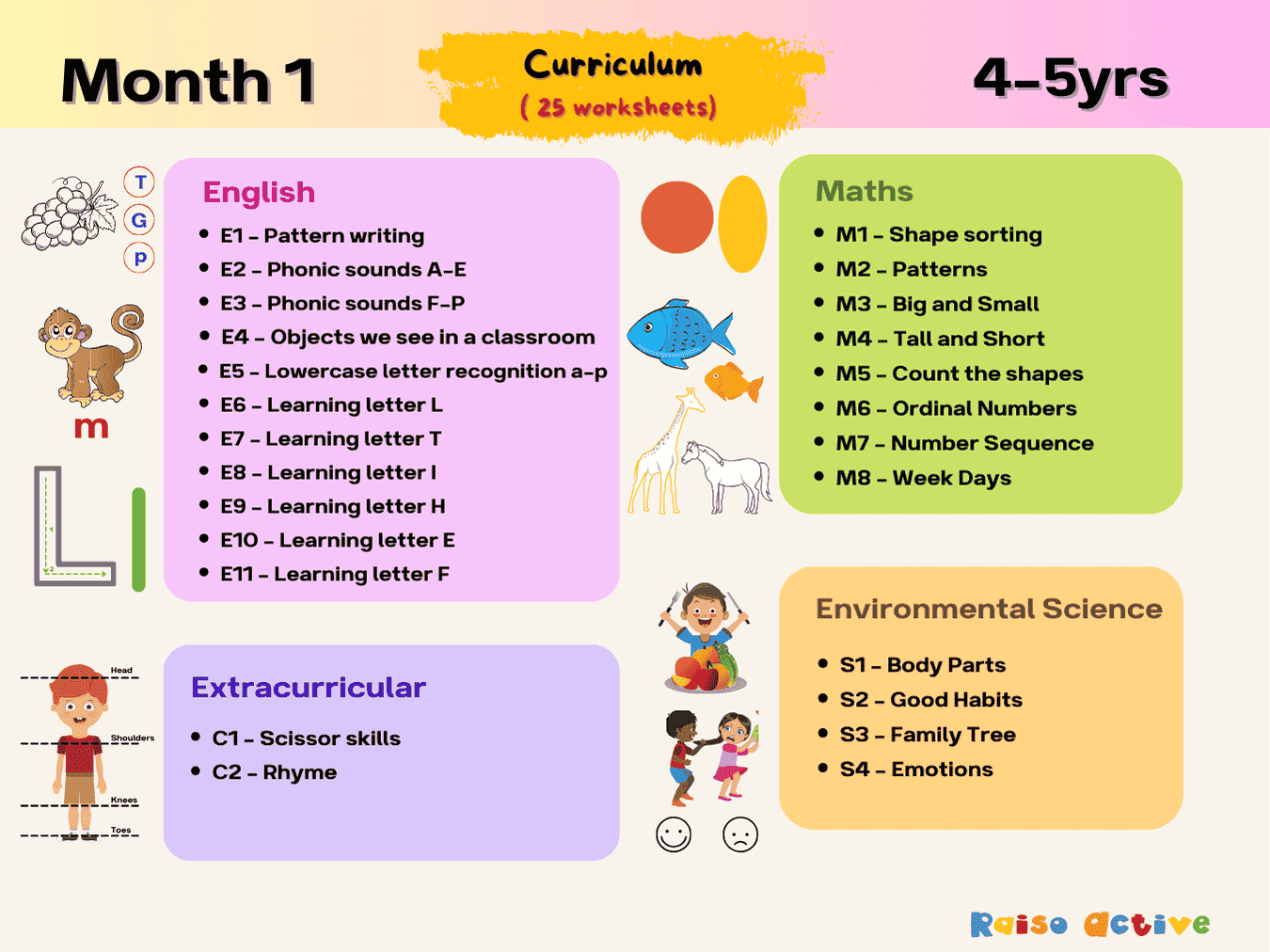
Month 1: Learning & Development | Ages 4-5
This is page 25 of the pack. Ages 4-5 · Pre-KAges 4-5 · ReceptionAges 4-5 · LKGAges 4-5
Curriculum
- My Family & Community > My Family
How to use this worksheet
Start with your child at the base or trunk of the tree and work outward, naming and drawing or writing each family member together. Ask your child to describe each person, like what they look like or a favorite memory with them, before moving to the next branch. Let your child color or decorate each person's space in a way that feels personal to them. Once finished, walk through the whole tree together and have your child explain who everyone is.
Materials needed
- Pictures of family members (or drawing supplies)
- Glue or tape
- Pencil
Extension activities
- 1Gather real family photos and make a photo collage version of the family tree to display at home.
- 2Interview a grandparent or older relative and write down one story they share for the family tree.
- 3Draw a self-portrait to glue onto the trunk of the tree as the starting point of the family.
- 4Look through old photos together to find pictures of relatives to add to the tree.
- 5Have a family game night where your child asks each person a question about their own childhood.

Written by
Hemsweta Jain · Teacher Cheena
MBA and Early Childhood Educator, teaching since 2014 · Founder of RaisoActive, Mumbai
Every RaisoActive worksheet is designed and checked by the founder before publishing.
Published · Last reviewed
More from Month 1: Learning & Development | Ages 4-5

Big and Small Fish Counting Worksheet for Preschoolers
Ages 3-5 · Preschool–Pre-KAges 3-5 · Nursery–ReceptionAges 3-5 · Nursery–LKGAges 3-5
This worksheet helps children aged 3-5 develop crucial early numeracy by practicing one-to-one correspondence as they count specific groups of fish. Children will also strengthen their observation skills by distinguishing between 'big' and 'small' fish, a foundational step in understanding comparative sizes and classification. This combination builds both number sense and pre-mathematical reasoning.

Say My Sound: Beginning Letter Worksheet for Preschoolers
Ages 3-5 · Preschool–Pre-KAges 3-5 · Nursery–ReceptionAges 3-5 · Nursery–LKGAges 3-5
This is a companion beginning-sounds sheet with a new set of pictures, giving your child more practice isolating the first sound of a word — a skill that only really sticks with repeated exposure across different words, not a single worksheet. Circling instead of coloring the answer keeps the response quick and low-effort, so more of the session goes toward the listening task itself.

Letter Sounds: Color the Letter Worksheet for Preschoolers
Ages 3-5 · Preschool–Pre-KAges 3-5 · Nursery–ReceptionAges 3-5 · Nursery–LKGAges 3-5
Matching a picture — a ball, a cat, a dog — to the letter it starts with asks a 3-5 year old to isolate the very first sound of a word, which is one of the core building blocks of phonemic awareness before formal reading begins. Coloring the matching letter circle adds a low-pressure, motor-skill layer to what's really a listening and sound-matching task.

Diamond Shape Counting and Matching Worksheet for Preschoolers
Ages 3-5 · Preschool–Pre-KAges 3-5 · Nursery–ReceptionAges 3-5 · Nursery–LKGAges 3-5
This diamond-themed worksheet helps 3-5 year olds tell a diamond apart from squares, circles, and triangles by its four slanted sides and pointed top and bottom, a shape many preschoolers find trickier than rounder or more symmetrical ones. Counting the diamonds one at a time builds one-to-one correspondence, and matching same-sized diamonds strengthens visual discrimination, the skill of spotting small differences between similar-looking shapes.
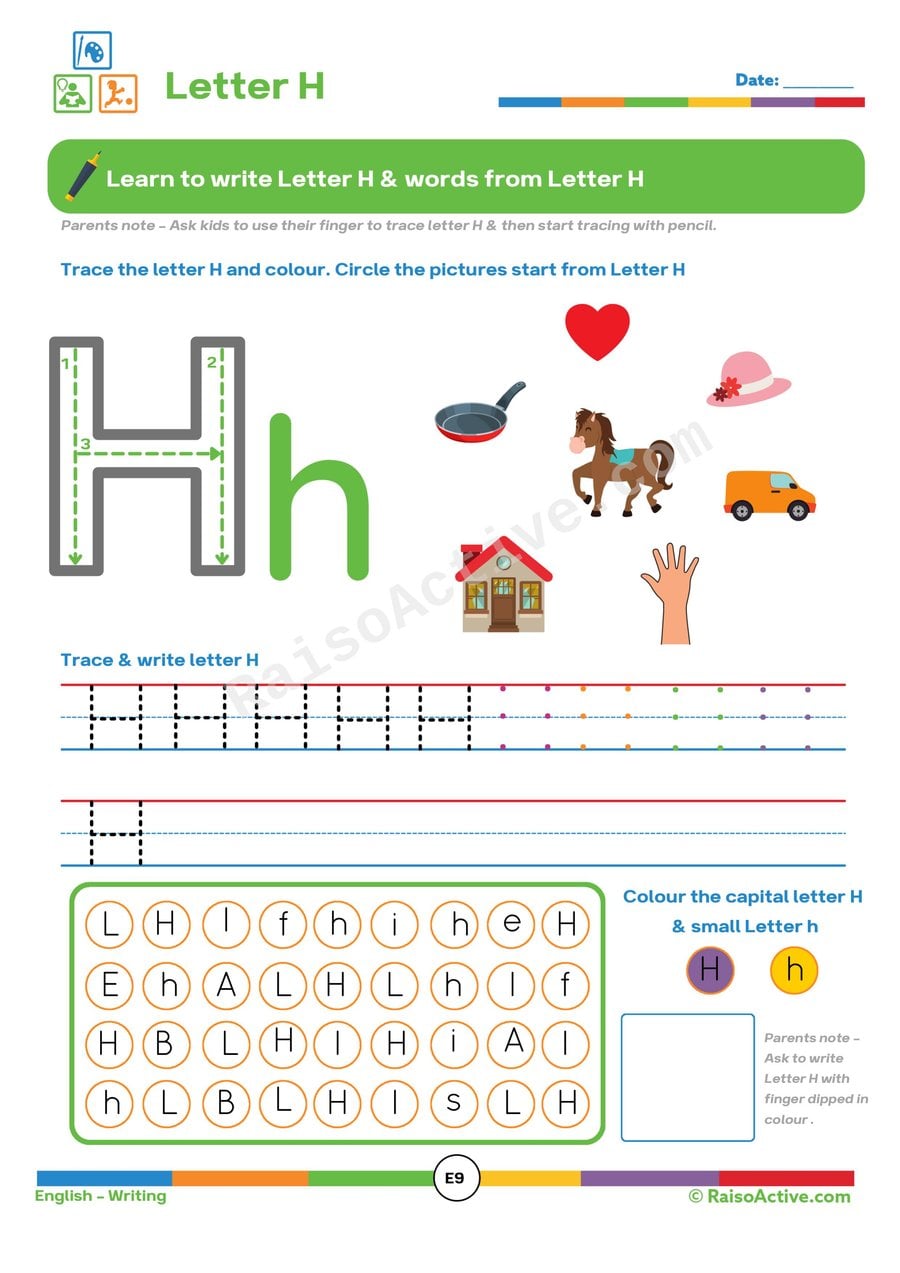
Letter H Worksheet: Trace, Write, and Color!
Ages 3-5 · Preschool–Pre-KAges 3-5 · Nursery–ReceptionAges 3-5 · Nursery–LKGAges 3-5
Tracing and writing the letter H, in both its tall uppercase and shorter lowercase form, gives children ages 3-5 repeated practice with the two straight vertical strokes and one connecting horizontal bar that make up the letter. This builds the pencil control needed before a child can write independently, while circling H's in a simple word search sharpens visual letter recognition separate from the physical act of writing.
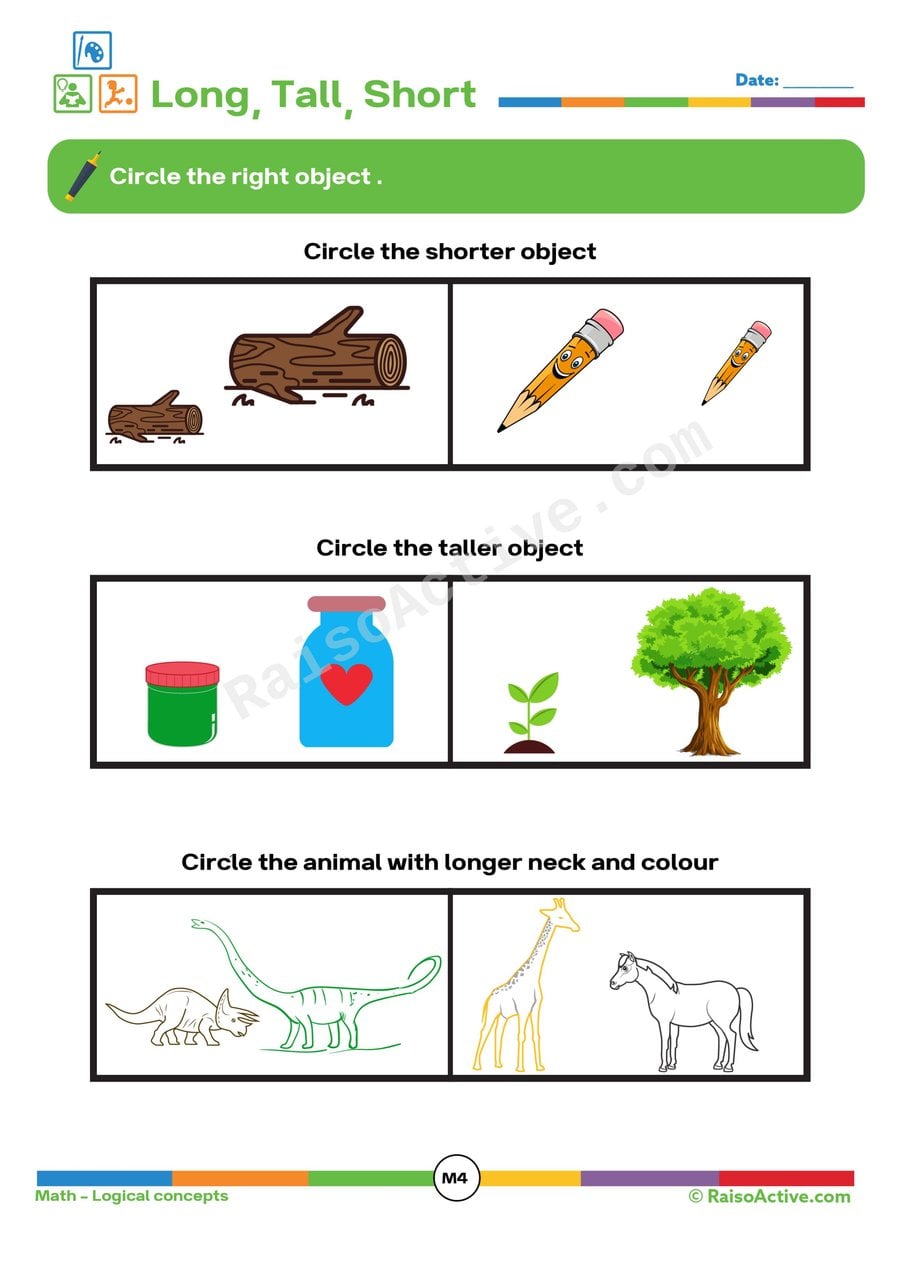
Long, Tall, Short Worksheet: Comparing Objects!
Ages 3-5 · Preschool–Pre-KAges 3-5 · Nursery–ReceptionAges 3-5 · Nursery–LKGAges 3-5
This worksheet guides your child in visually comparing objects based on their length and height, using terms like "long," "tall," and "short." By matching items with specific size descriptions, children aged 3-5 build essential observation skills and foundational pre-math understanding of attributes. This practice helps develop their vocabulary for describing the world around them and strengthens critical thinking as they distinguish subtle differences.

Animal Babies Tracing Worksheet: Help the Babies Find Their Mothers!
Ages 3-5 · Preschool–Pre-KAges 3-5 · Nursery–ReceptionAges 3-5 · Nursery–LKGAges 3-5
This tracing worksheet sharpens fine motor skills and hand-eye coordination as children carefully follow the dotted lines. It helps them develop the controlled pencil movements essential for pre-writing while reinforcing visual discrimination to match baby animals with their mothers. Children also expand their vocabulary by identifying different animal families and their offspring.
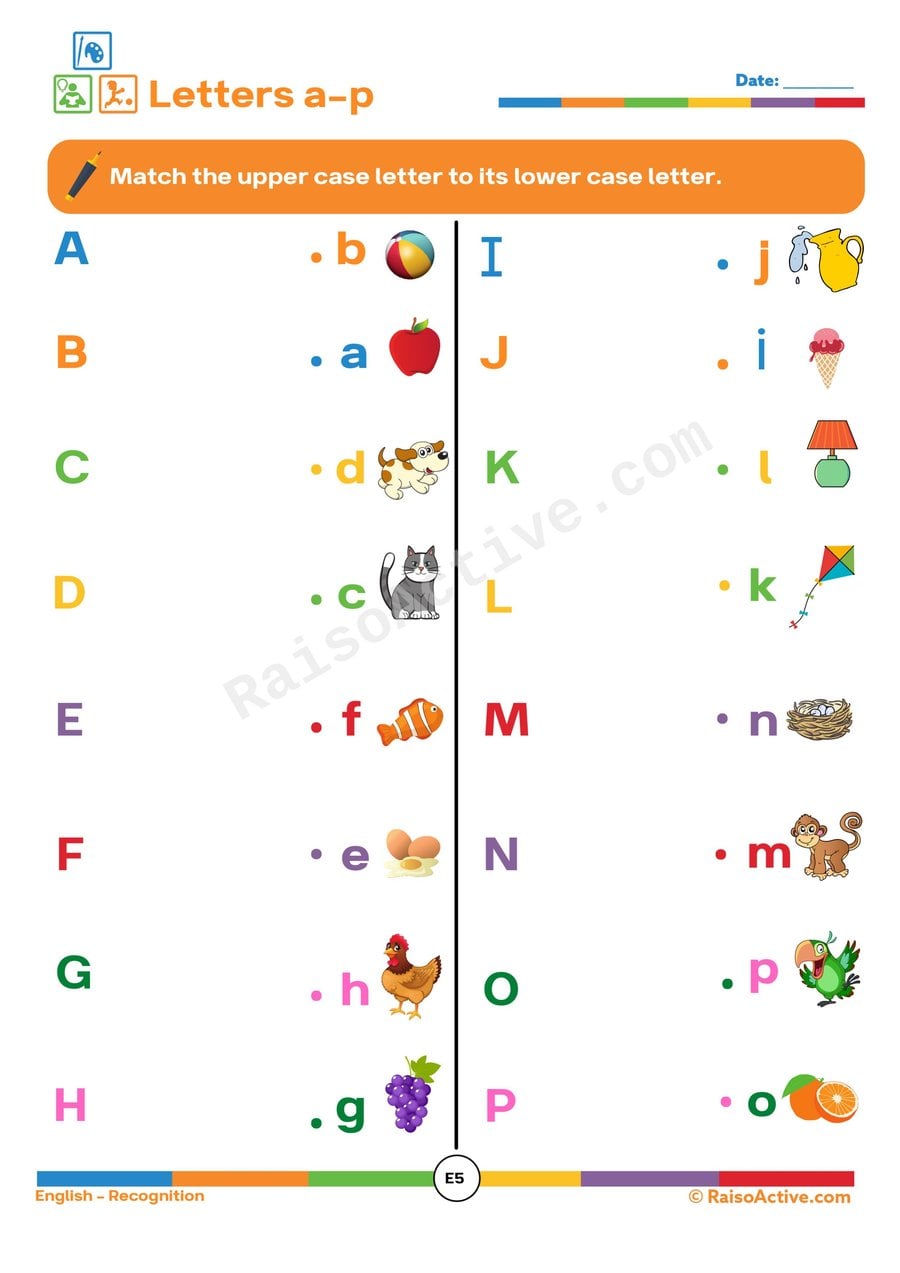
Match the Uppercase Letters: A-P Worksheet
Ages 4-5 · Pre-KAges 4-5 · ReceptionAges 4-5 · LKGAges 4-5
This worksheet strengthens your child's visual discrimination skills by focusing on uppercase letters from A to P. Children aged 4-5 years develop crucial pre-reading abilities as they learn to identify and pair identical letter forms. Mastering this matching task builds a strong foundation for future letter recognition and early literacy success.
Related worksheets
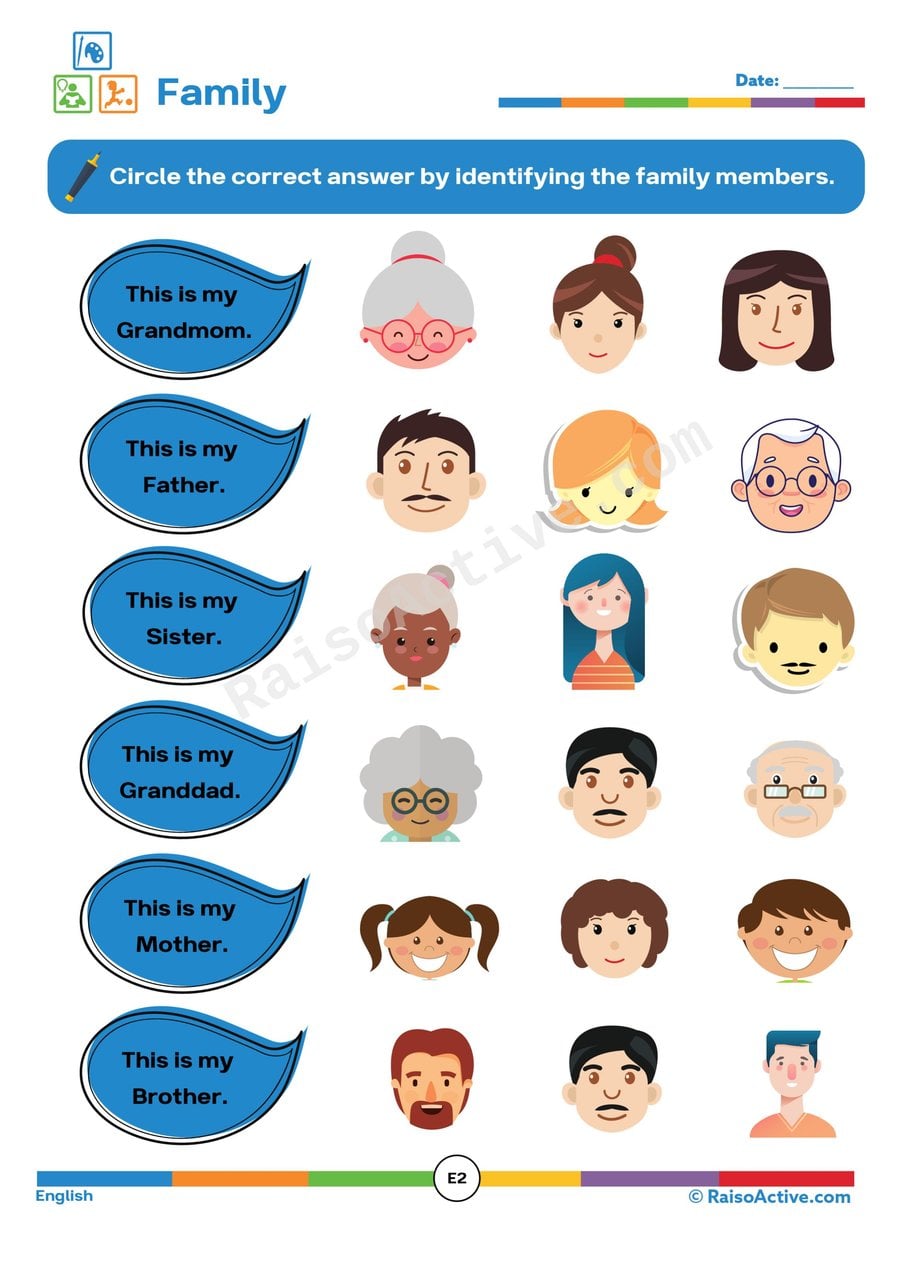
Family Members Worksheet: Identify and Circle!
Ages 3-5 · Preschool–Pre-KAges 3-5 · Nursery–ReceptionAges 3-5 · Nursery–LKGAges 3-5
Reading a sentence describing a family member and circling the matching picture teaches children ages 3-5 to connect written description to a specific person, combining early reading comprehension with family vocabulary. This task also builds the habit of checking text carefully rather than guessing from the picture alone.
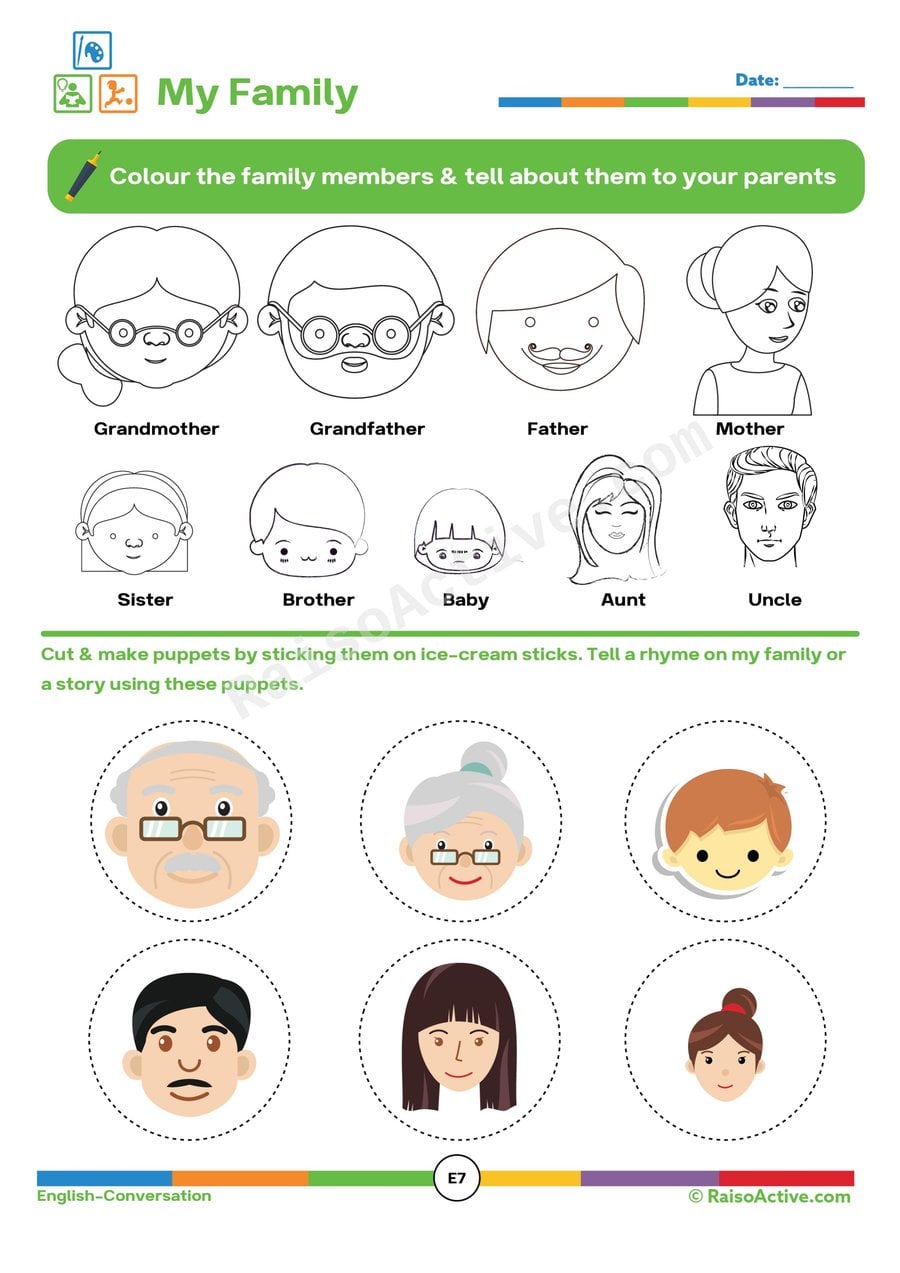
My Family: Color and Create Puppets Worksheet
Ages 3-5 · Preschool–Pre-KAges 3-5 · Nursery–ReceptionAges 3-5 · Nursery–LKGAges 3-5
This worksheet builds early social-emotional vocabulary around family roles while developing fine motor skills through coloring, cutting, and assembling finger puppets. For three- to five-year-olds, turning family members into puppets they can move and talk through gives them a hands-on way to describe relationships and practice storytelling about people who matter most to them.
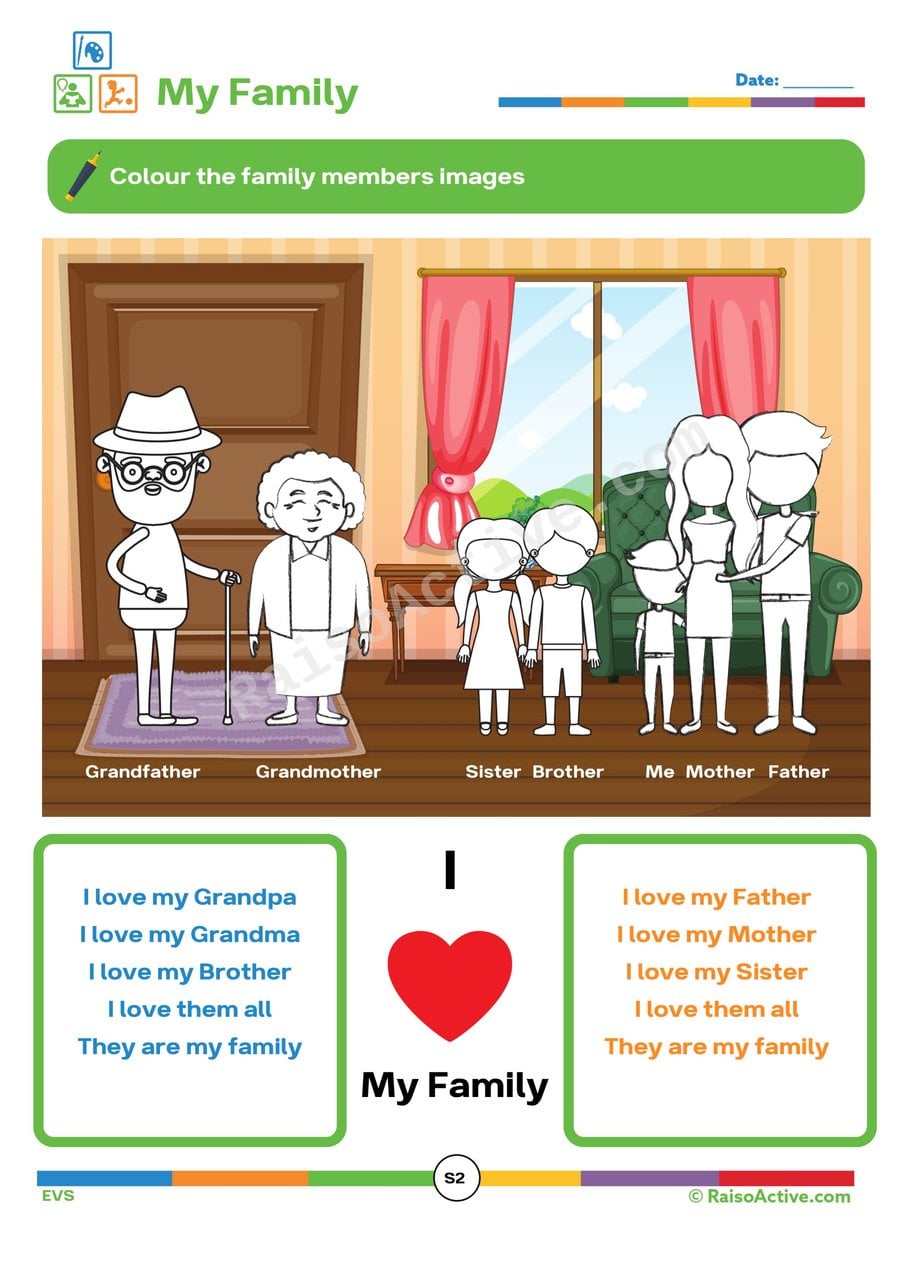
My Family Coloring Worksheet for Preschoolers
Ages 3-5 · Preschool–Pre-KAges 3-5 · Nursery–ReceptionAges 3-5 · Nursery–LKGAges 3-5
This worksheet helps children ages 3-5 practice fine motor control and color-staying-in-the-lines skills while coloring pictures of family members, giving them a personal, meaningful subject that keeps engagement high. Reading and coloring a heart after the family sentences also introduces the idea that words can express feelings, linking literacy with emotional expression.

Gingerbread Man Coloring Worksheet for Preschoolers
Ages 3-5 · Preschool–Pre-KAges 3-5 · Nursery–ReceptionAges 3-5 · Nursery–LKGAges 3-5
This gingerbread man worksheet gives children ages 3-5 practice coloring within a simple, familiar outline while also adding their own decorative details like buttons and a bow, encouraging creative choices within a structured shape. Deciding where to place each decoration also builds early spatial awareness, since buttons and a bow need to be positioned in specific spots on the body.

Color the Snowman! A Fun Coloring Worksheet for Kids
Ages 3-5 · Preschool–Pre-KAges 3-5 · Nursery–ReceptionAges 3-5 · Nursery–LKGAges 3-5
This worksheet helps children ages 3-5 practice fine motor control and creative choice while coloring a winter snowman scene. Because the image invites open-ended color decisions rather than following a strict code, it also builds confidence in making independent artistic choices.
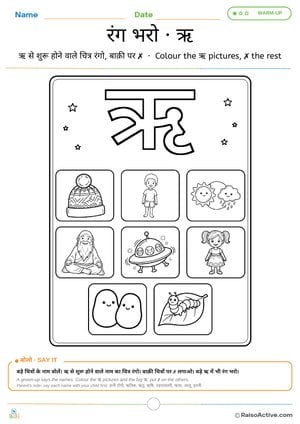
Colour the ऋ Words – Hindi Letter ऋ (ri) Colouring Worksheet | ऋ वाली चीज़ों में रंग भरो
Ages 3-7 · Preschool–Grade 1Ages 3-7 · Nursery–Year 2Ages 3-7 · Nursery–Class 1Ages 3-7
Children say each picture name aloud, decide whether it starts with ऋ, colour the matching pictures (ऋषि, ऋतु, ऋचा and ऋतिक) and the big outline letter, and put a cross on the rest. Sorting by first sound trains the ear and colouring builds hand control.

Spring Table Color by Number Worksheet for Preschoolers
Ages 3-5 · Preschool–Pre-KAges 3-5 · Nursery–ReceptionAges 3-5 · Nursery–LKGAges 3-5
This color-by-number worksheet has children ages 3-5 practice matching numerals to a specific color key and then applying that color accurately across a picture, reinforcing both number recognition and one-to-one correspondence between a symbol and an action. Rolling a dice to determine which color to use next also adds an element of chance that keeps the repetitive coloring task engaging.

Merry Christmas Coloring Worksheet for Preschoolers
Ages 3-5 · Preschool–Pre-KAges 3-5 · Nursery–ReceptionAges 3-5 · Nursery–LKGAges 3-5
Filling in Christmas-themed pictures with crayons or colored pencils helps children ages 3-5 refine their pencil grip and hand control while practicing the concept of staying within a defined boundary. Because the pictures include multiple familiar holiday objects, this worksheet also gives children a chance to build vocabulary by naming each item as they color it. Repeated coloring practice at this age steadily improves the wrist and finger strength needed for later writing tasks.
Guides for this topic

Best Worksheets for 3-Year-Olds: What Works and What to Avoid
What works on worksheets for 3-year-olds: short sessions, crayons, tracing lines, matching, cutting, a free weekly plan, and signs one is too advanced.
Fostering Creativity in Structured Learning: The Perfect Balance for Young Minds
Learn how to blend creativity with structured learning for children ages 1-8. Practical strategies, activities, and printable worksheets for parents and teachers.
Preparing Your Child for a Rapidly Changing World: Essential Skills for Future Success
Discover the essential 21st century skills your child needs for future success. Practical tips on creativity, critical thinking, digital literacy & emotional intelligence for ages 1-8.
Reviews
Every worksheet for ages 3–5, no watermark
Members download the full library of 1,000+ worksheets and every activity pack without watermarks or daily limits. One year costs ₹999 in India or $20 elsewhere.
See membership plansOr download any worksheet free with a watermark (5 a day).