Letter H Worksheet: Trace, Write, and Color!
Tracing and writing the letter H, in both its tall uppercase and shorter lowercase form, gives children ages 3-5 repeated practice with the two straight vertical strokes and one connecting horizontal bar that make up the letter. This builds the pencil control needed before a child can write independently, while circling H's in a simple word search sharpens visual letter recognition separate from the physical act of writing.
Part of the pack
Month 1: Learning & Development | Ages 4-5
This is page 12 of the pack. Ages 4-5 · Pre-KAges 4-5 · ReceptionAges 4-5 · LKGAges 4-5
Made for your child
A whole activity pack made with their name
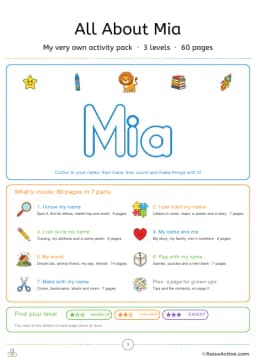
60 pages to spot, build, trace and write their own name, plus pages about their favourites, feelings and family. See a free preview with their name.
Make an All About Me packFree preview · free for members
Or start free: a name tracing sheet with their nameCurriculum
- Writing > Letter Tracing A-Z
How to use this worksheet
Start by tracing the large dotted letter H at the top of the page with a pencil, saying the /h/ sound out loud each time. Move down to the practice lines and trace, then try writing H without the dotted guide. Next, scan the word search together and circle every H your child finds. Finish by coloring the big capital and small lowercase H, naming which is which as you go.
Materials needed
- Pencil
- Crayons
Extension activities
- 1Go on an 'H hunt' around the house for objects that start with H, like a hat, hairbrush, or hammer.
- 2Practice writing a giant letter H with a finger in a tray of sand, rice, or shaving cream.
- 3Cut pictures of H words from magazines and glue them onto paper to make an H collage.
- 4Use two straws or popsicle sticks to build a 3D letter H on the table.
- 5Sing the alphabet song and pause to clap loudly every time you reach H.

Written by
Hemsweta Jain · Teacher Cheena
MBA and Early Childhood Educator, teaching since 2014 · Founder of RaisoActive, Mumbai
Every RaisoActive worksheet is designed and checked by the founder before publishing.
Published · Last reviewed
More from Month 1: Learning & Development | Ages 4-5

Trace and Color the Letter T Worksheet for Preschoolers
Ages 3-5 · Preschool–Pre-KAges 3-5 · Nursery–ReceptionAges 3-5 · Nursery–LKGAges 3-5
Tracing and writing the letter T gives children ages 3-5 practice with one simple vertical stroke crossed by one horizontal stroke, making it one of the more approachable uppercase letters to master, which builds confidence before moving on to more complex shapes. Coloring the finished letters afterward reinforces recognition of the letter's form independent of the writing motion itself.

My Body Parts Matching Worksheet for Preschoolers
Ages 3-5 · Preschool–Pre-KAges 3-5 · Nursery–ReceptionAges 3-5 · Nursery–LKGAges 3-5
Matching body part pictures to their names or functions helps children ages 3-5 build body awareness vocabulary, connecting a word like 'elbow' or 'knee' to the correct part of their own body. This kind of labeling activity also supports early self-care and safety skills, since children who can name body parts accurately can better communicate if something hurts or needs attention.
Find and Color Ordinal Numbers Worksheet
Ages 4-6 · Pre-K–KindergartenAges 4-6 · Reception–Year 1Ages 4-6 · LKG–UKGAges 4-6
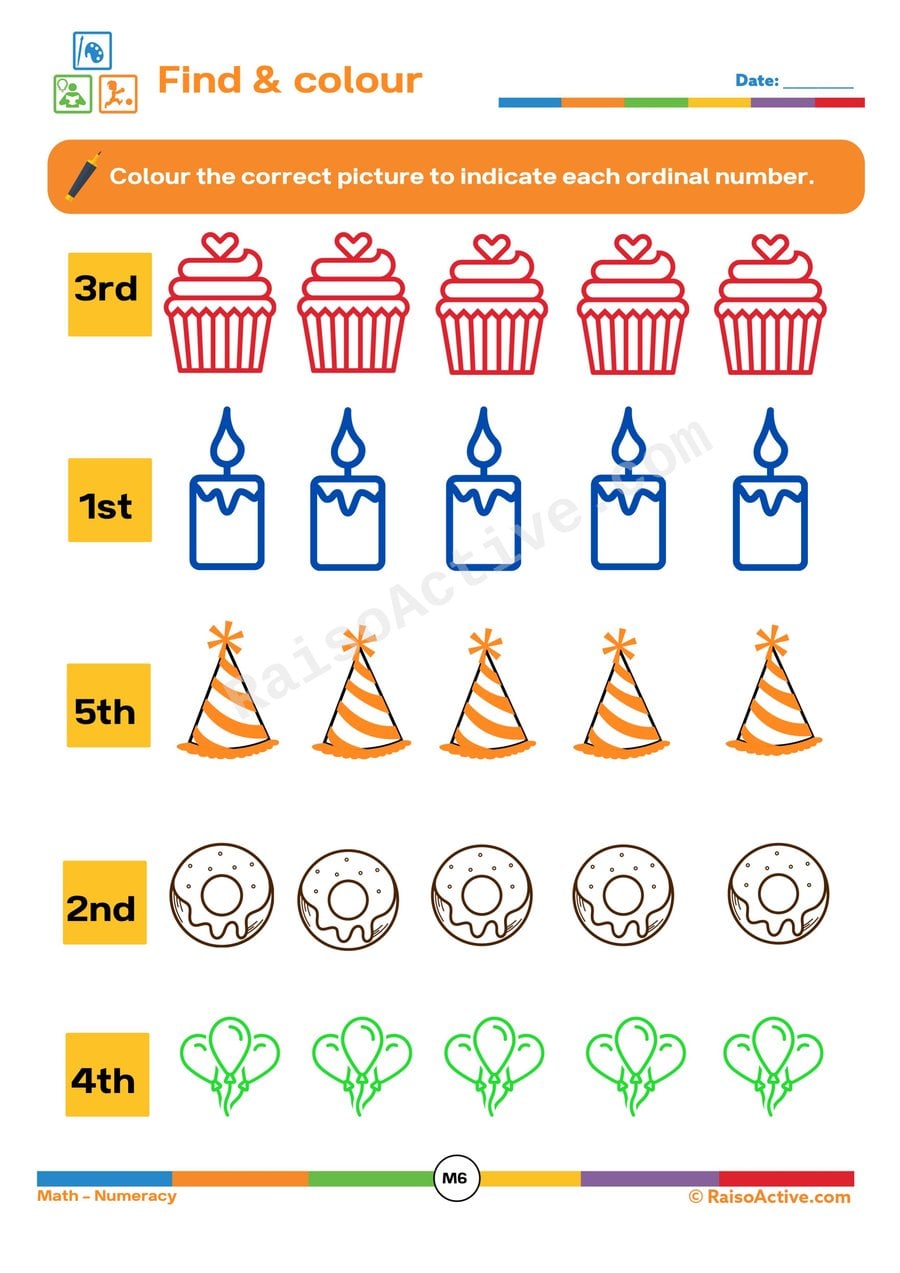
Finding and coloring items based on their ordinal position, like the third balloon or the first star, teaches children ages 4-6 a different kind of counting than they may be used to. Ordinal numbers describe position in a sequence, first, second, third, rather than quantity, and this distinction is a genuinely tricky concept that takes deliberate practice to master, forming an important foundation for later math concepts like sequencing steps.

My Family Tree Worksheet: Learn About Family Members!
Ages 3-5 · Preschool–Pre-KAges 3-5 · Nursery–ReceptionAges 3-5 · Nursery–LKGAges 3-5
Filling in a family tree helps children ages 3-5 practice family vocabulary, like mother, father, sibling, and grandparent, while also building an early sense of belonging and identity by seeing themselves as part of a larger family structure. Talking through each relationship as it's added also supports oral language development, since children have to describe who each person is and how that person relates to them.

Butterfly Cutting Practice Worksheet for Preschoolers
Ages 3-5 · Preschool–Pre-KAges 3-5 · Nursery–ReceptionAges 3-5 · Nursery–LKGAges 3-5
Cutting along a butterfly's wing outline gives children ages 3-5 focused scissor practice with a mix of straight and gently curved edges, building the specific hand strength and control needed for more advanced cutting tasks. Scissor skills like this directly support later pencil control too, since both rely on similar hand muscles and a steady, coordinated grip between two hands.
Shape Sorting Worksheet: Cut and Paste Fun!
Ages 3-5 · Preschool–Pre-KAges 3-5 · Nursery–ReceptionAges 3-5 · Nursery–LKGAges 3-5
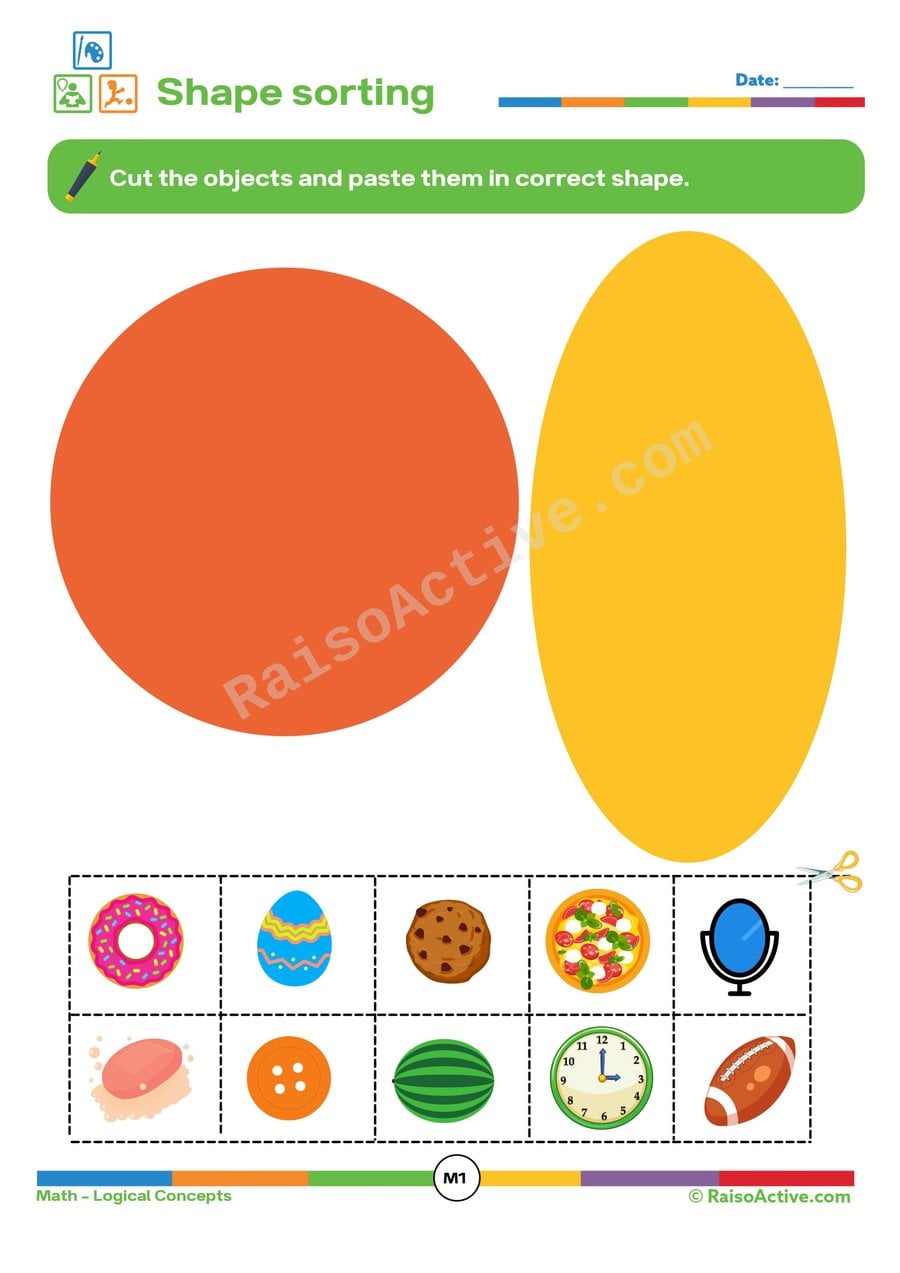
Sorting everyday objects — a plate, an egg, a clock — into 'circle' or 'oval' bins asks a 3-5 year old to look past what an object is and notice its geometric shape instead, an early step toward abstract categorization. Cutting along the outline of each picture and gluing it into the right column also builds the scissor control and hand-eye coordination that later supports handwriting.

The Hungry Ant: Fruit Matching Worksheet for Kids
Ages 3-5 · Preschool–Pre-KAges 3-5 · Nursery–ReceptionAges 3-5 · Nursery–LKGAges 3-5
Cutting out fruit pictures and matching them to an ant's trail builds scissor control in children ages 3-5 while also reinforcing counting and fruit vocabulary as they sort or count pieces before gluing. The hungry ant theme gives the matching task a simple narrative reason, finding food for the ant, which tends to hold young children's attention better than an unconnected matching exercise.
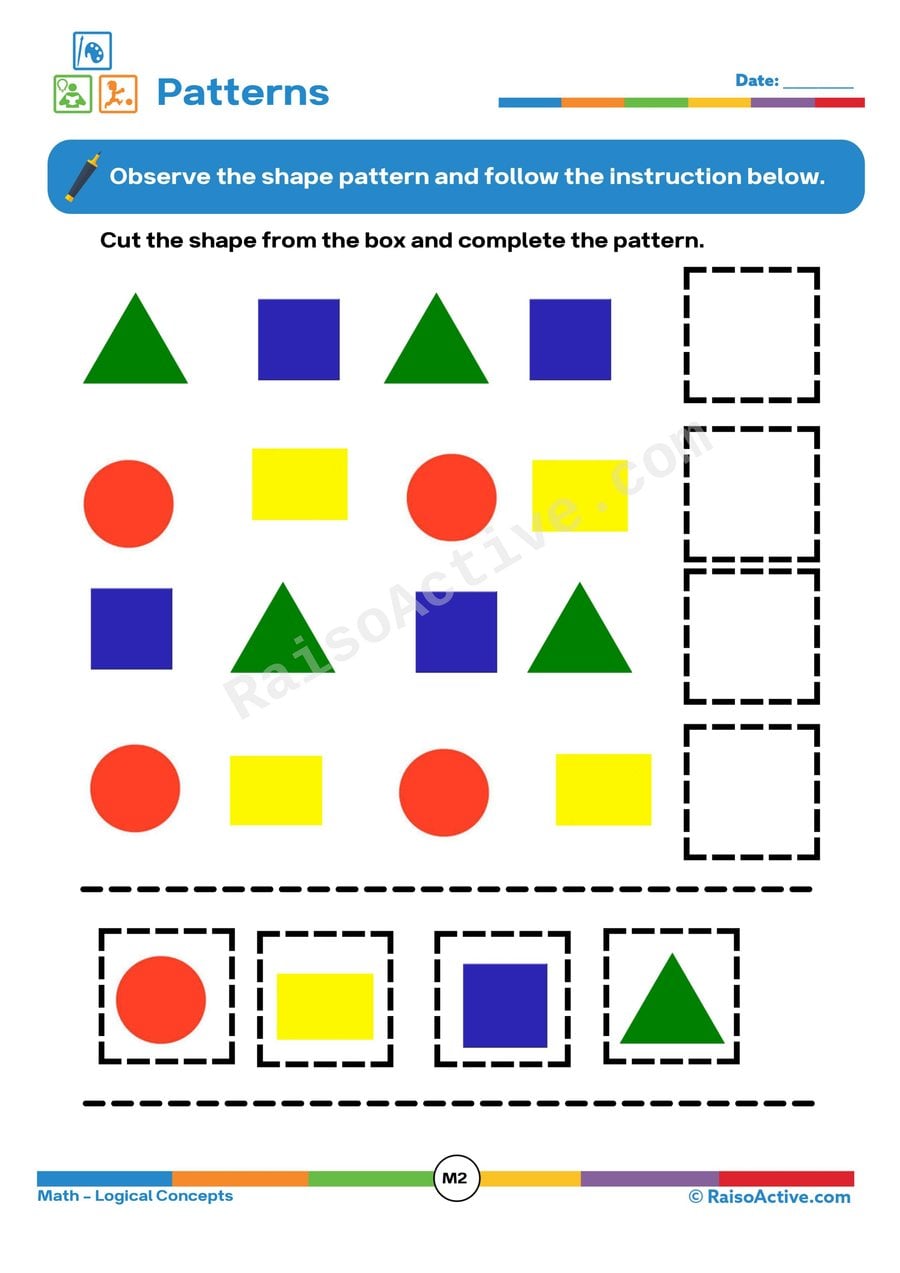
Shape Pattern Worksheet: Complete the Pattern!
Ages 3-5 · Preschool–Pre-KAges 3-5 · Nursery–ReceptionAges 3-5 · Nursery–LKGAges 3-5
Completing a repeating shape pattern asks children ages 3-5 to notice what comes next in a sequence and predict it correctly, an early form of the logical reasoning used in algebra much later on. Recognizing and continuing patterns also strengthens visual memory, since a child has to hold the beginning of the pattern in mind while figuring out what should come next.
Related worksheets
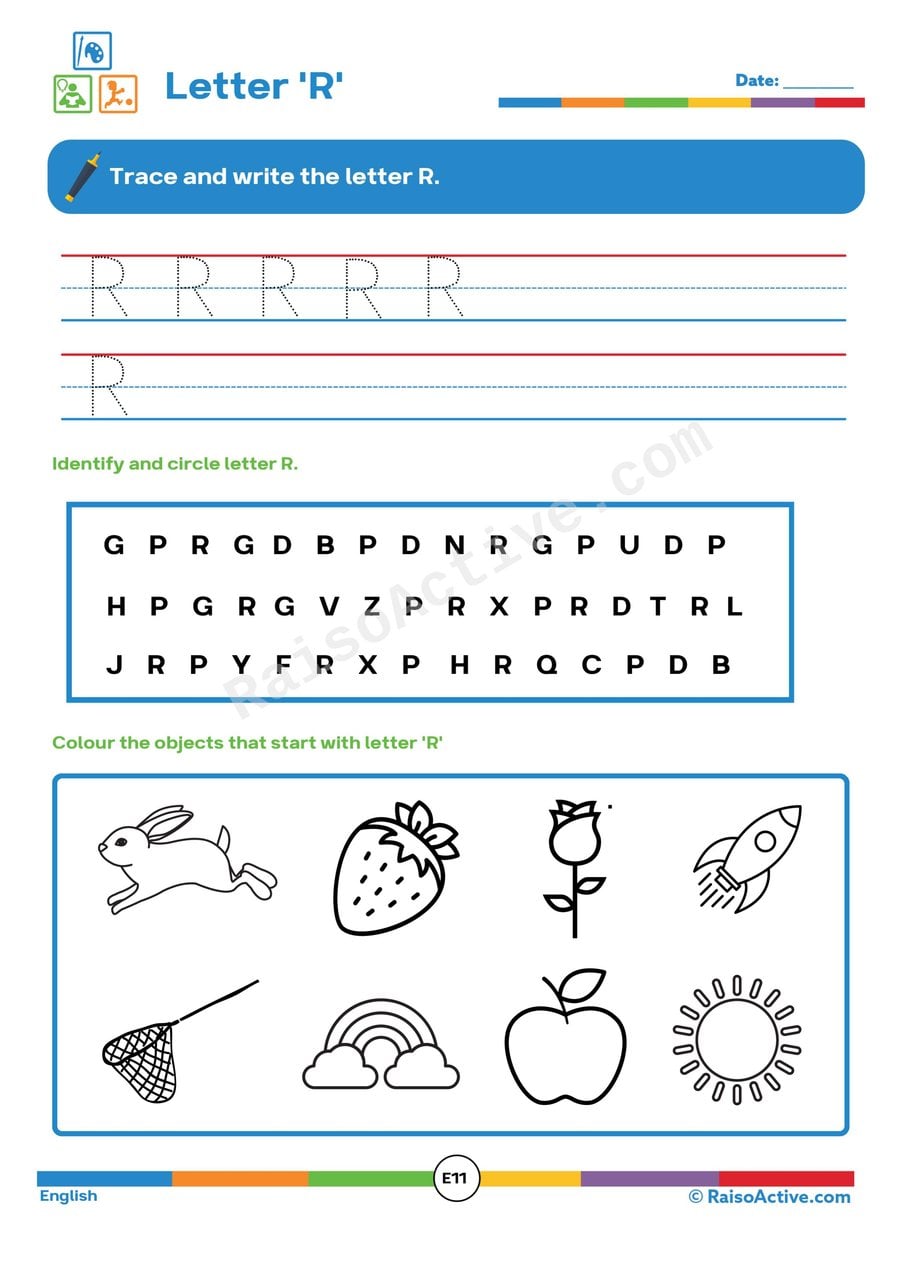
Letter R Worksheet: Trace, Identify, and Color!
Ages 4-5 · Pre-KAges 4-5 · ReceptionAges 4-5 · LKGAges 4-5
This worksheet helps children ages 4-5 practice tracing and writing the letter R, spotting it among a group of other letters, and recognizing objects that begin with the R sound. Working across three related tasks for one letter, tracing, searching, and identifying pictures, gives repeated exposure that helps the letter shape and sound become automatic.
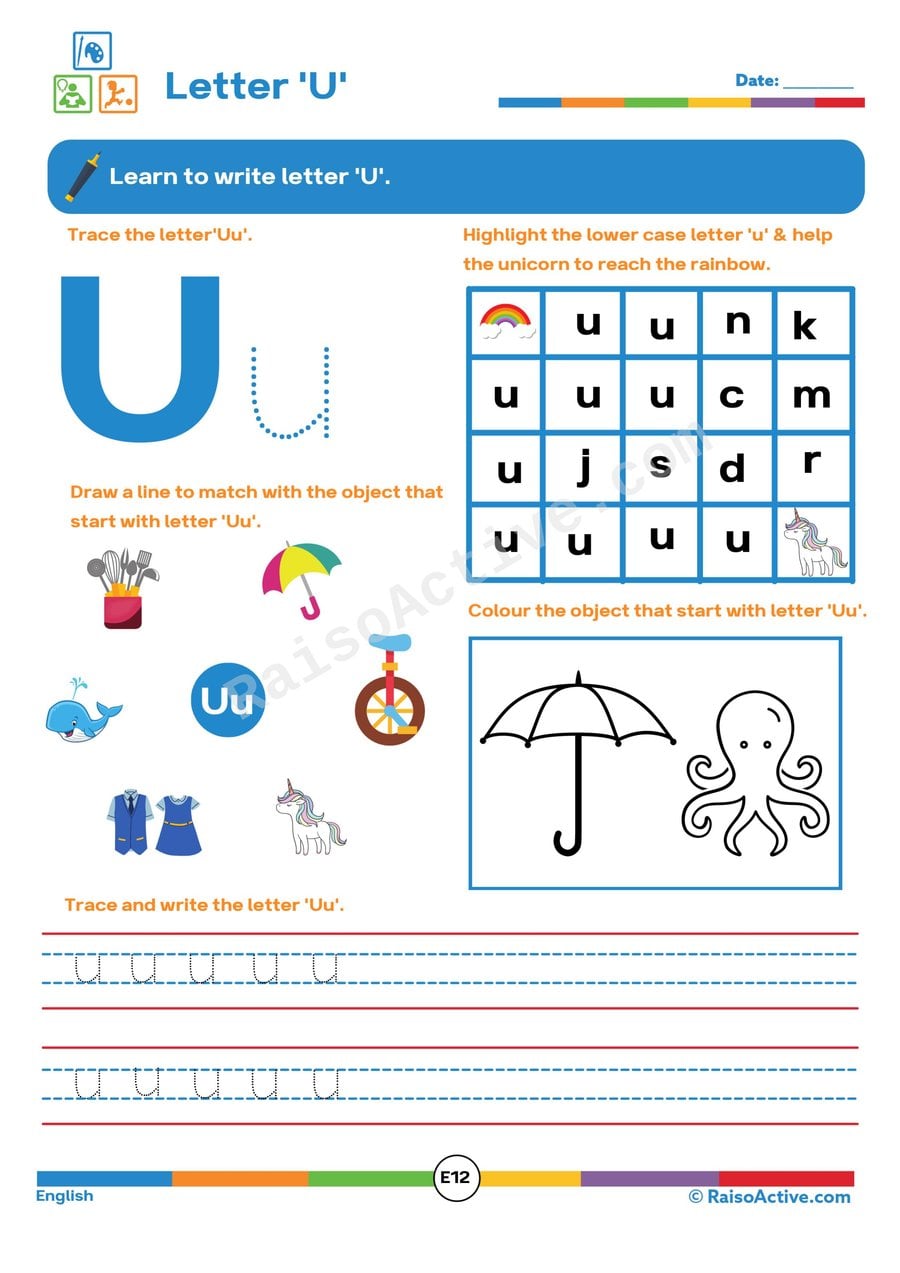
Letter 'U' Worksheet: Trace, Match, and Color!
Ages 3-5 · Preschool–Pre-KAges 3-5 · Nursery–ReceptionAges 3-5 · Nursery–LKGAges 3-5
Tracing, matching, and coloring the letter 'U' gives children ages 3-5 focused repetition on a rounded letter shape while building the sound-symbol connection for its short /u/ sound, as in 'umbrella' or 'up.' Matching pictures that start with 'U' to the letter reinforces recognition beyond the written form, tying it to real, familiar objects. Combining tracing, matching, and coloring in a single page suits a preschooler's need for varied, short activities rather than one long repetitive drill.
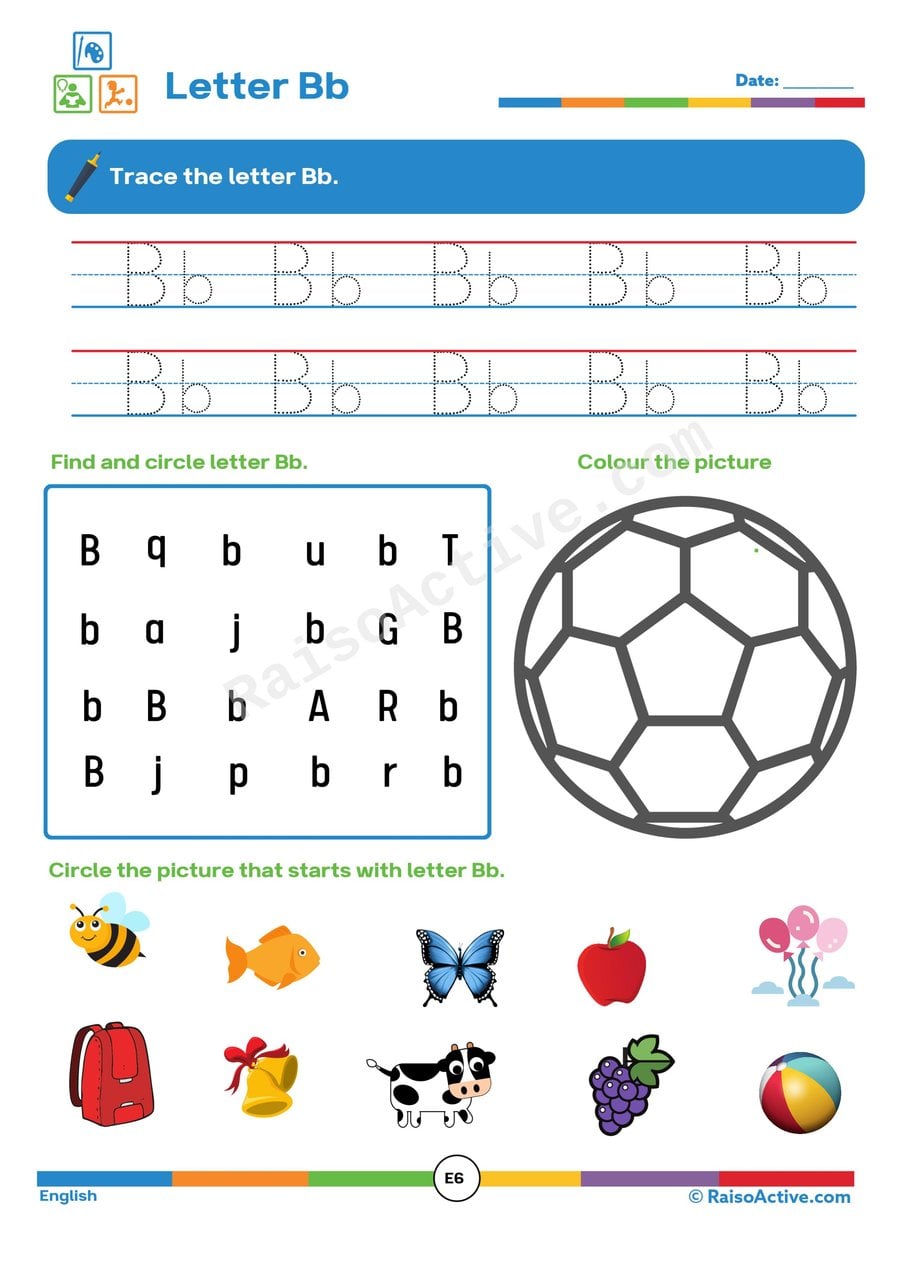
Letter Bb Worksheet: Trace, Find, and Color!
Ages 3-5 · Preschool–Pre-KAges 3-5 · Nursery–ReceptionAges 3-5 · Nursery–LKGAges 3-5
This worksheet builds letter recognition and handwriting readiness as children ages 3-5 trace both uppercase and lowercase Bb, hunt for the letter among a group of other letters, and identify pictures of objects that start with the Bb sound. Practicing a letter across several formats — tracing, spotting, and sound matching — helps cement both its shape and its sound more effectively than tracing alone.
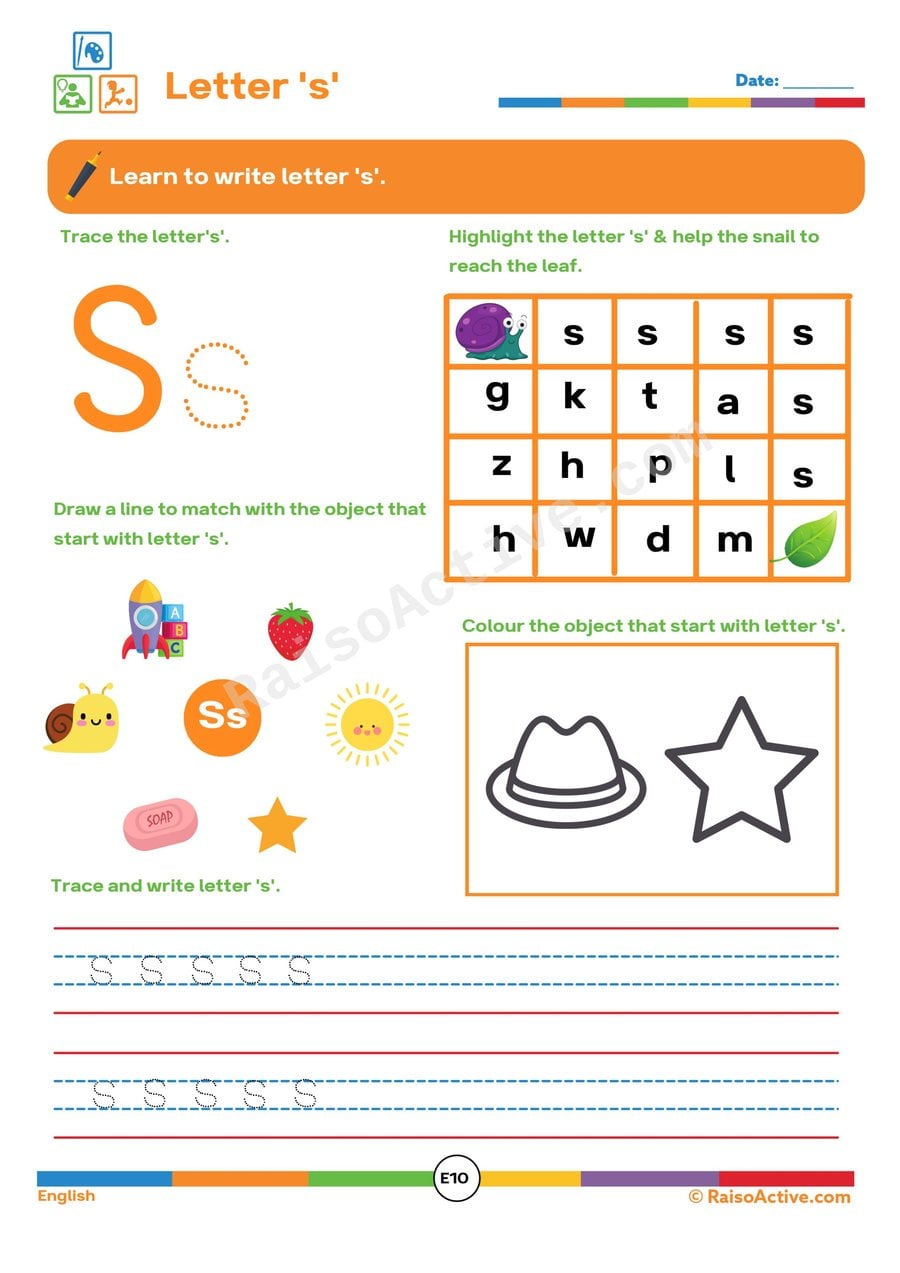
Letter 's' Worksheet: Trace, Match, and Color!
Ages 3-5 · Preschool–Pre-KAges 3-5 · Nursery–ReceptionAges 3-5 · Nursery–LKGAges 3-5
This worksheet gives children ages 3-5 focused practice forming the letter 's,' one of the trickier curved strokes for beginning writers to control with a pencil. Beyond handwriting, matching pictures to the letter and coloring only the 's' objects builds phonemic awareness by linking the letter shape to its /s/ sound at the start of words. Combining tracing, matching, and coloring in one page also keeps a young child's attention across multiple related tasks.

Letter Dd Tracing and Matching Worksheet for Preschoolers
Ages 3-5 · Preschool–Pre-KAges 3-5 · Nursery–ReceptionAges 3-5 · Nursery–LKGAges 3-5
Children ages 3-5 practice writing the letter Dd through guided tracing, then apply that recognition by finding Dd hidden in a letter grid and identifying pictures that start with the sound. Moving from writing the letter to spotting it among other letters, and then to hearing it at the start of real words, builds a well-rounded, multi-sense understanding of the letter D.

Letter 'i' Tracing and Matching Worksheet for Preschoolers
Ages 3-5 · Preschool–Pre-KAges 3-5 · Nursery–ReceptionAges 3-5 · Nursery–LKGAges 3-5
This worksheet builds recognition of the letter 'i' for 3-5 year olds through tracing, picture matching, and a highlighting activity, giving repeated exposure to both the letter's shape and its sound in a single sitting. Matching objects that start with 'i' alongside the tracing practice connects the visual letter shape to real vocabulary, reinforcing that letters aren't abstract marks but stand for actual sounds your child hears in words they already know.
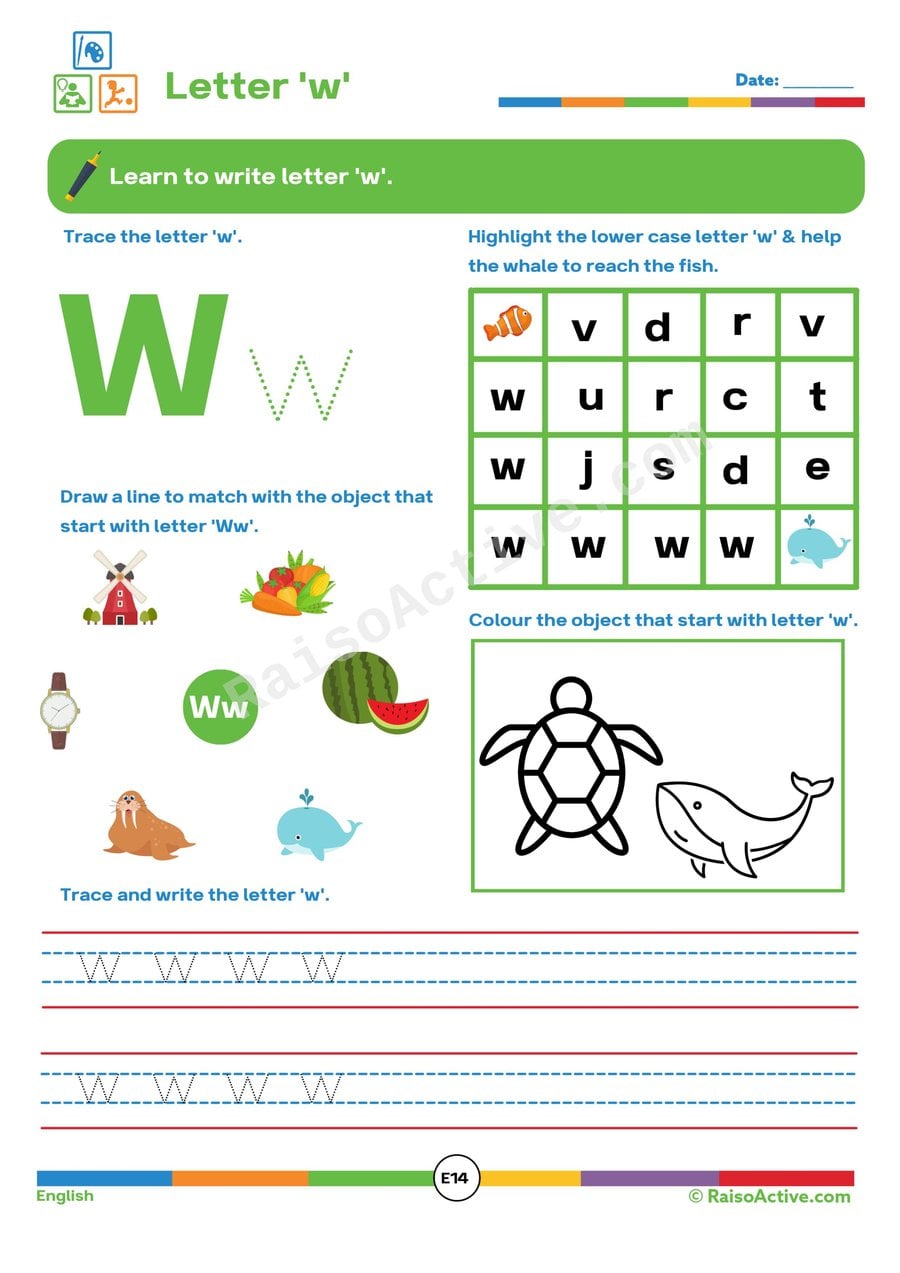
Letter 'w' Worksheet: Trace, Match, and Color!
Ages 3-5 · Preschool–Pre-KAges 3-5 · Nursery–ReceptionAges 3-5 · Nursery–LKGAges 3-5
Tracing, matching, and highlighting the letter 'w' gives children ages 3-5 practice with one of the more visually complex lowercase letters, made up of four connected diagonal strokes rather than a single simple shape. Matching pictures that start with 'w' to the letter reinforces the /w/ sound-to-symbol link, while scanning a letter grid to highlight every 'w' builds visual search skills alongside letter recognition. This combination of tracing, matching, searching, and coloring keeps the practice varied enough to hold a young child's attention across the full page.

Letter Y Tracing and Recognition Worksheet for Preschoolers
Ages 3-5 · Preschool–Pre-KAges 3-5 · Nursery–ReceptionAges 3-5 · Nursery–LKGAges 3-5
This worksheet builds recognition and formation of the letter Y through guided tracing practice and by identifying pictures of words that start with Y, like 'yarn' or 'yo-yo.' For three- to five-year-olds, tracing first with a finger and then with a pencil builds the motor memory needed before a child can form the letter confidently on their own.
Guides for this topic

Best Worksheets for 3-Year-Olds: What Works and What to Avoid
What works on worksheets for 3-year-olds: short sessions, crayons, tracing lines, matching, cutting, a free weekly plan, and signs one is too advanced.
Documenting Learning Without Drowning in Data: A Practical Guide for Parents and Teachers
Learn practical ways to document your child's learning without overwhelm. Simple portfolios, observation tips, and printable trackers for ages 1-8.
Fostering Creativity in Structured Learning: The Perfect Balance for Young Minds
Learn how to blend creativity with structured learning for children ages 1-8. Practical strategies, activities, and printable worksheets for parents and teachers.
Reviews
Every worksheet for ages 3–5, no watermark
Members download the full library of 1,000+ worksheets and every activity pack without watermarks or daily limits. One year costs ₹999 in India or $20 elsewhere.
See membership plansOr download any worksheet free with a watermark (5 a day).