Big Feeling, Calm Choice: Stop, Breathe, Talk Worksheet
Children hear three tricky moments (a swing, a lost game, leaving the park) and pick the calm choice. They learn a three-step routine, Stop, Breathe, Talk, and draw a place where they feel calm.
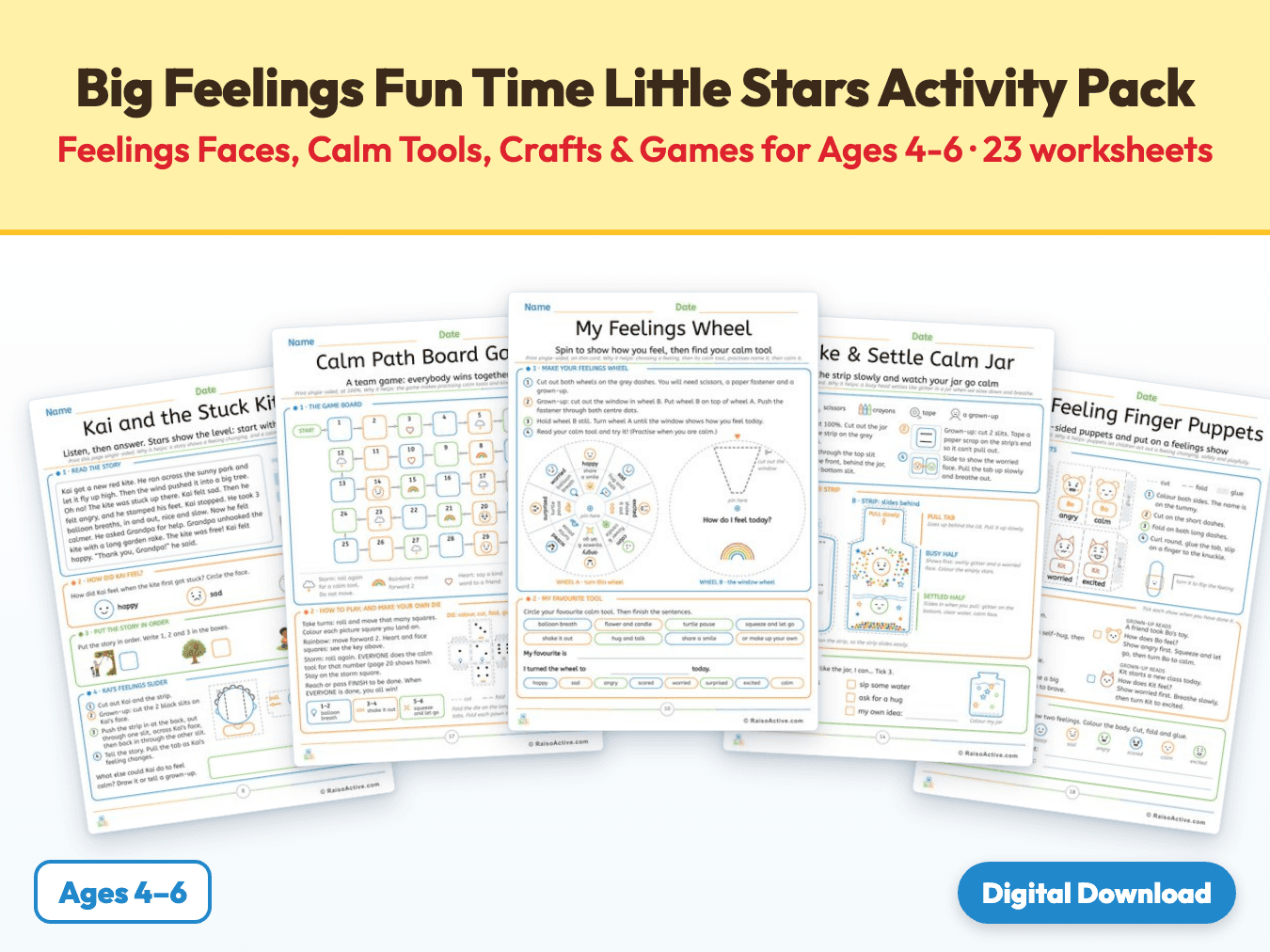
Part of the pack
Big Feelings Fun Time Little Stars Activity Pack: Feelings Faces, Calm Tools, Crafts & Games for Ages 4-6
This is page 15 of the pack. Ages 4-6 · Pre-K–KindergartenAges 4-6 · Reception–Year 1Ages 4-6 · LKG–UKGAges 4-6
How to use this worksheet
A grown-up reads each moment. Circle the calm choice and draw a rainbow beside it. Number the cards 1, 2, 3 for Stop, Breathe, Talk, then draw your calm place.
Materials needed
- Pencil
- Crayons
Extension activities
- 1Act out the three moments with toys.
- 2Add a calm choice of your own.

Written by
Hemsweta Jain · Teacher Cheena
MBA and Early Childhood Educator, teaching since 2014 · Founder of RaisoActive, Mumbai
Every RaisoActive worksheet is designed and checked by the founder before publishing.
Published · Last reviewed
More from Big Feelings Fun Time Little Stars Activity Pack: Feelings Faces, Calm Tools, Crafts & Games for Ages 4-6

Meet My Feelings: Eight Feelings Faces and Feelings Weather for Little Stars
Ages 4-6 · Pre-K–KindergartenAges 4-6 · Reception–Year 1Ages 4-6 · LKG–UKGAges 4-6
Children meet eight feelings (happy, sad, angry, scared, worried, surprised, excited and calm), each paired with a weather picture. They learn that all feelings are OK and say how they feel today.

Big Feelings Fun Time Certificate: Calm Star Award
Ages 4-6 · Pre-K–KindergartenAges 4-6 · Reception–Year 1Ages 4-6 · LKG–UKGAges 4-6
A certificate of achievement for children who named big feelings and tried calm tools in the Big Feelings Fun Time pack. Tick the three levels completed.

My Feelings Wheel: Cut-Out Spinner to Show How You Feel and Pick a Calm Tool
Ages 4-6 · Pre-K–KindergartenAges 4-6 · Reception–Year 1Ages 4-6 · LKG–UKGAges 4-6
Children make a turnable wheel with eight feelings. Each feeling points to a calm tool, such as balloon breath, shake it out or hug and talk. They also circle a favourite tool.

Feelings Faces Worksheet: Match, Trace and Circle the Happy Faces
Ages 4-6 · Pre-K–KindergartenAges 4-6 · Reception–Year 1Ages 4-6 · LKG–UKGAges 4-6
Children link everyday moments (bubbles, ice cream, blocks, a storm, a gift) to the face that shows the feeling, trace four feelings words and count happy faces.

Breathe With Me: Wave, Flower and Candle Breathing Tracing
Ages 4-6 · Pre-K–KindergartenAges 4-6 · Reception–Year 1Ages 4-6 · LKG–UKGAges 4-6
Children trace a wave and a mountain path while breathing slowly, practise 'smell the flower, blow the candle', and colour a bubble after each breath. They check in with how they feel afterwards.

Calm Path Board Game with a Make-Your-Own Calm Die
Ages 4-6 · Pre-K–KindergartenAges 4-6 · Reception–Year 1Ages 4-6 · LKG–UKGAges 4-6
Children play a cooperative game with feeling squares, storm squares, rainbow squares and kind hearts. They practise naming feelings, using calm tools such as balloon breaths and squeezing and letting go, and saying kind words.

Shake and Settle Calm Jar: Make a Pull-Strip Calm-Down Jar
Ages 4-6 · Pre-K–KindergartenAges 4-6 · Reception–Year 1Ages 4-6 · LKG–UKGAges 4-6
Children build a paper calm jar. When they pull the strip up slowly, a swirly, busy jar changes to a settled one, showing how a busy head can calm down. They then tick three calm tools.

Feelings Puzzles: Spot 5 Differences, Odd One Out and Face Patterns
Ages 4-6 · Pre-K–KindergartenAges 4-6 · Reception–Year 1Ages 4-6 · LKG–UKGAges 4-6
Children practise looking closely with a spot-the-difference picture, find the face that shows a different feeling in each row, and finish simple face patterns (AB, AAB and ABC).
Related worksheets
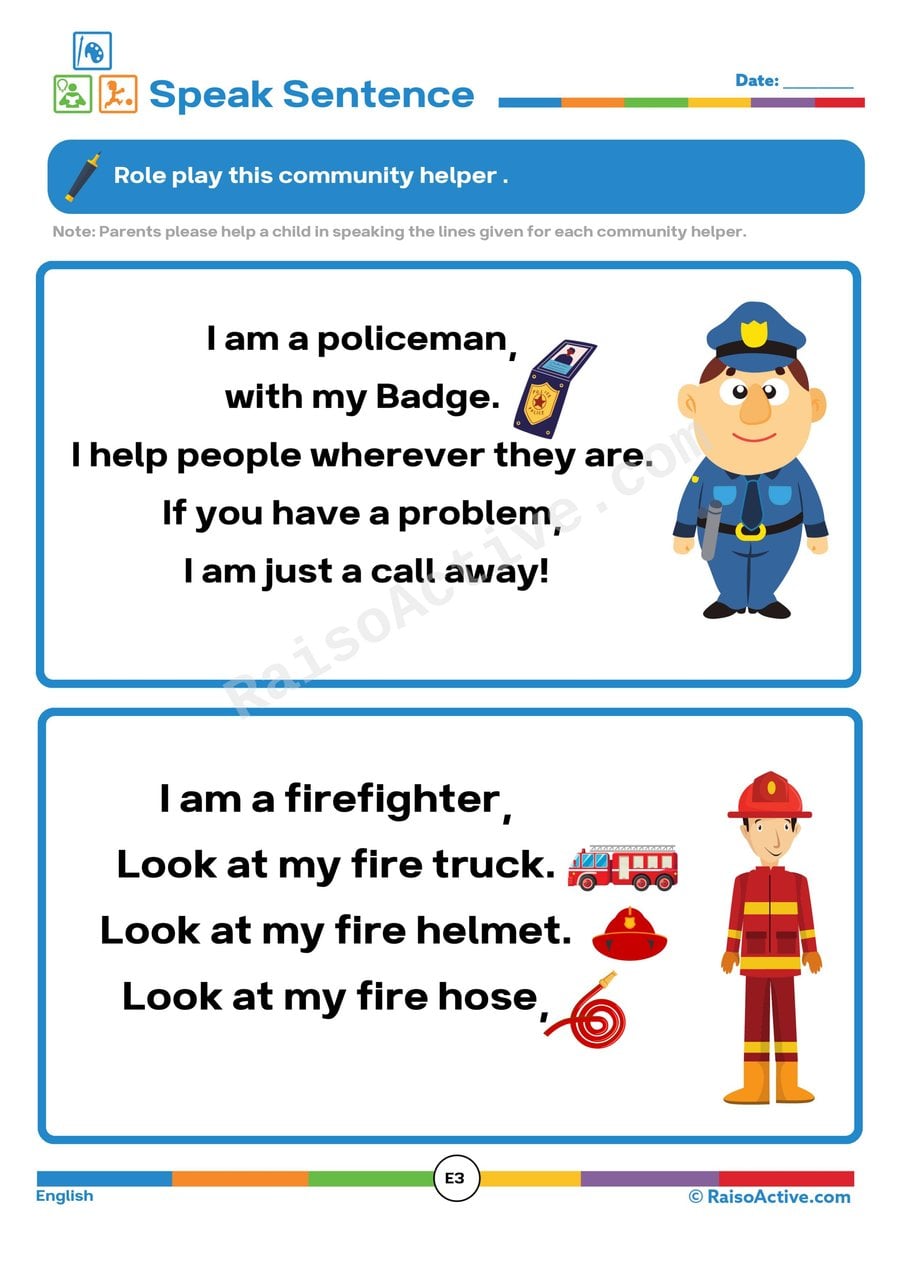
Community Helpers Role Play Worksheet for Kids
Ages 3-5 · Preschool–Pre-KAges 3-5 · Nursery–ReceptionAges 3-5 · Nursery–LKGAges 3-5
This worksheet helps children ages 3-5 learn about community helpers while practicing spoken sentence structure through guided role play. Reading a short scripted sentence aloud and then acting out the role of that helper builds oral language and expressive confidence alongside social studies knowledge, giving children a chance to practice full sentences in a low-pressure, playful context.
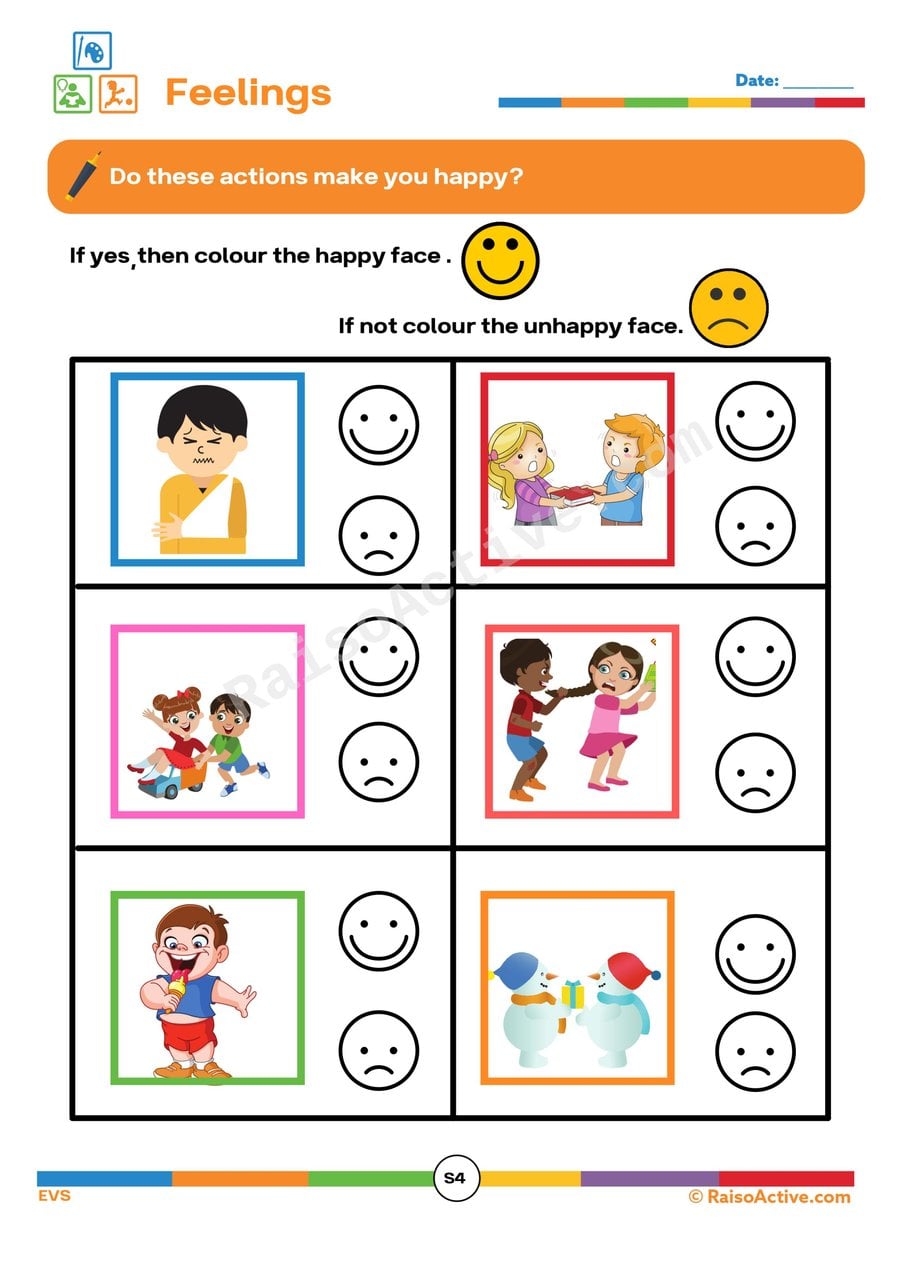
Feelings Worksheet: Happy or Sad?
Ages 3-5 · Preschool–Pre-KAges 3-5 · Nursery–ReceptionAges 3-5 · Nursery–LKGAges 3-5
Children ages 3-5 build emotional vocabulary and self-awareness as they decide whether different everyday situations would make them feel happy or sad. Naming and sorting emotions based on a scenario is an early social-emotional skill that helps children recognize and eventually talk about their own feelings more clearly.

May I? Permission and Future Possibilities Worksheet
Ages 3-5 · Preschool–Pre-KAges 3-5 · Nursery–ReceptionAges 3-5 · Nursery–LKGAges 3-5
This worksheet helps children ages 3-5 practice using the polite phrase 'May I' to ask for permission and to talk about things they might do in the future, building both grammar skills and an important social convention for respectful communication. Learning to phrase a request politely is a social-emotional skill that supports smoother interactions with teachers, family, and peers well beyond this single worksheet.

Healthy Habits Game: Roll the Dice and Practice Good Manners!
Ages 3-5 · Preschool–Pre-KAges 3-5 · Nursery–ReceptionAges 3-5 · Nursery–LKGAges 3-5
This dice-based board game teaches children ages 3-5 healthy habits and polite social language by combining movement, counting, and speaking practice in one activity. Rolling the dice and counting spaces builds number recognition and one-to-one counting, while landing on speaker icons gives structured practice saying polite phrases like 'please' and 'thank you' out loud. Coloring a smiley or sad face based on the habit shown also reinforces the idea that choices have positive or negative consequences.

Body Clues and Triggers: Spot the Early Warning Signs Before a Feeling Gets Big
Ages 7-10 · Grade 2–Grade 3Ages 7-10 · Year 3–Year 4Ages 7-10 · Class 2–Class 3Ages 7-10
Children label body clues (racing heart, hot face, tight fists, butterflies, tears, shaky legs), tick the feeling six situations might give them, and list their own early warning signs for anger.
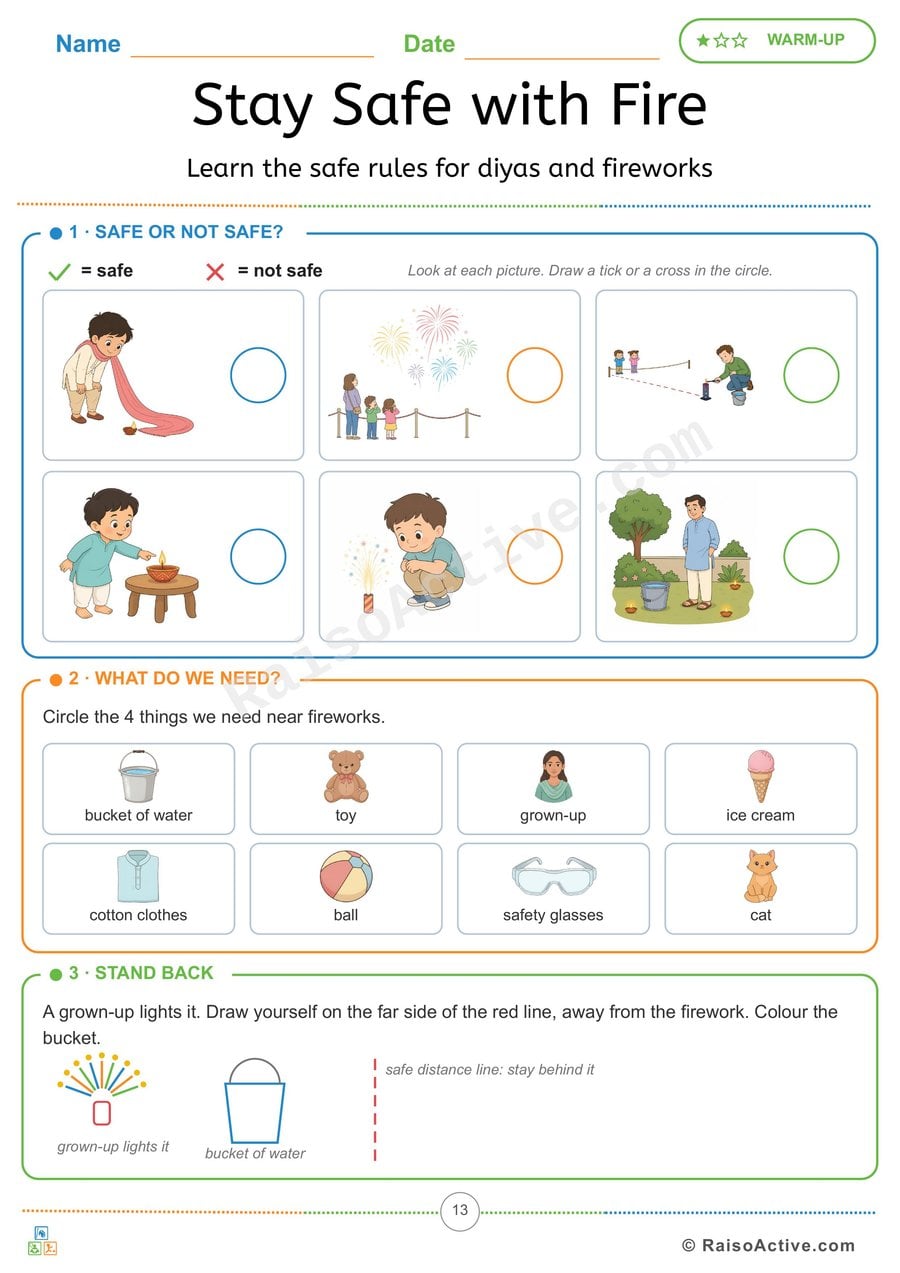
Diwali Fire Safety for Kids: Safe or Not Safe Worksheet
Ages 4-6 · Pre-K–KindergartenAges 4-6 · Reception–Year 1Ages 4-6 · LKG–UKGAges 4-6
Children look at six pictures and mark each as safe or not safe, circle the four things needed near fireworks, and show where to stand by drawing themselves behind the safe-distance line.

Level Up! Calm Hero Sheet: Hero Stats, Power-Ups and an XP Tracker
Ages 7-10 · Grade 2–Grade 3Ages 7-10 · Year 3–Year 4Ages 7-10 · Class 2–Class 3Ages 7-10
Children design a calm hero, colour stats for breathing, brave talk, kindness and patience, tick power-ups as they try them, pair three big-feeling friends with calm tools and fill a 20-box XP tracker.

Police Officer Worksheet: Learn About Community Helpers!
Ages 3-5 · Preschool–Pre-KAges 3-5 · Nursery–ReceptionAges 3-5 · Nursery–LKGAges 3-5
Beyond coloring practice, this worksheet builds early community-helper knowledge by asking children to identify which specific items — a badge, a hat, handcuffs, a whistle — actually belong to a police officer's job. Circling the correct items requires visual discrimination and recall of a real-world role, which is the beginning of understanding that different jobs come with different tools and responsibilities. Drawing the officer's face afterward adds a layer of personal expression to a lesson that's otherwise about categorization.
Guides for this topic

Resources for Children with Multiple Disabilities: A Comprehensive Guide for Families
Discover essential resources for children with multiple disabilities. Therapies, inclusive learning, assistive technology, and printable activities for ages 1-8.
Understanding Standardized Testing in Early Childhood: A Parent's Guide to Assessment Balance
Learn how standardised tests work in early childhood, when they help, when they harm, and how to balance formal assessment with observation-based learning.
Preparing Your Child for a Rapidly Changing World: Essential Skills for Future Success
Discover the essential 21st century skills your child needs for future success. Practical tips on creativity, critical thinking, digital literacy & emotional intelligence for ages 1-8.
Reviews
Every worksheet for ages 4–6, no watermark
Members download the full library of 1,000+ worksheets and every activity pack without watermarks or daily limits. One year costs ₹999 in India or $20 elsewhere.
See membership plansOr download any worksheet free with a watermark (5 a day).