Free printable worksheets · United States
Pre-K Math Worksheets
Pre-K math worksheets are printable number-readiness practice for children aged 4 to 5 in the year before kindergarten. They cover counting to 20 with one-to-one correspondence, recognizing and writing numerals 0 to 10, comparing two sets to find more, fewer or the same, copying and extending AB and ABC patterns, positional words, and measurement vocabulary.
Pre-K math is the year counting becomes reliable and numerals become meaningful. A four-year-old who could count a row of five objects at three now counts to 20 by rote, counts out 10 objects from a larger pile, and starts to connect the numeral 7 with seven things rather than with the number song. State pre-K standards and the Head Start framework add comparing sets (which has more?), copying and extending patterns beyond AB to ABC and AAB, positional words (on, under, next to, between), and measurement vocabulary (taller, heavier, holds more). None of this is written arithmetic; addition and subtraction with symbols belong to kindergarten. The worksheets on this page stay concrete, using pictures to count, circle and compare, ten-frames for numbers to 10, and pattern strips to continue, with numeral tracing as the only writing task.
920+ worksheets · free PDF download · print on A4 or Letter
Pre-K Math Worksheets to print
Browse all worksheets for ages 4–5
Clothing Pattern Match Worksheet for Preschoolers
This worksheet has children ages 3-5 study repeating patterns on clothing items — stripes, polka dots, or checks — and match each item to its identical twin, building visual discrimination and early pattern-sequencing skills. Distinguishing between similar-looking patterns also sharpens attention to detail, a skill that later supports letter and word recognition.

Match the Fruits to Their Plants Worksheet for Preschoolers
This worksheet helps children ages 3-5 build early plant science knowledge by matching common fruits to the plant or tree they actually grow on, such as an apple to a tree or a strawberry to a low bush. This task moves beyond simply naming fruits into understanding where food comes from, an important first step in connecting nature to the food children eat every day.

Living or Non-Living? A Fun Sorting Worksheet for Preschoolers
This sorting worksheet introduces children ages 3-5 to one of science's foundational classification concepts: distinguishing living things from non-living things. Deciding whether to tick or cross each picture pushes children to apply criteria — does it grow, move, breathe, or need food — rather than sort by appearance alone, an early form of scientific reasoning. This distinction also builds vocabulary they'll use throughout later nature and biology topics.

Weather Worksheet: Match the Weather to the Number!
This matching activity asks children ages 3-5 to connect weather pictures — sun, rain, clouds, snow — to numbered labels, combining early reading of weather vocabulary with number-symbol association. Recognizing that a picture, a word, and a number can all represent the same idea builds the kind of flexible symbolic thinking children will later use in reading and math alike. Weather is also a topic children experience daily, which makes the vocabulary immediately meaningful rather than abstract.

Animal Needs Worksheet for Kids: Matching and Identifying
This worksheet helps children ages 3-5 understand and articulate the basic survival needs of animals — food, water, air, shelter — by completing sentences with the correct need word and then circling matching pictures. Requiring both a writing and a circling response means children practice the vocabulary in two different formats, reinforcing recall from multiple angles. This groundwork in animal needs also supports later, more complex science concepts about habitats and ecosystems.

Match the Flags! A Fun Coloring Worksheet for Kids
This worksheet combines coloring with flag recognition, helping children ages 3-5 practice fine motor control while learning to match a colored flag to its correct blank outline. Coloring the flags first, then matching them, adds an extra layer of visual processing as children must recall the colors they just used to complete the matching step.
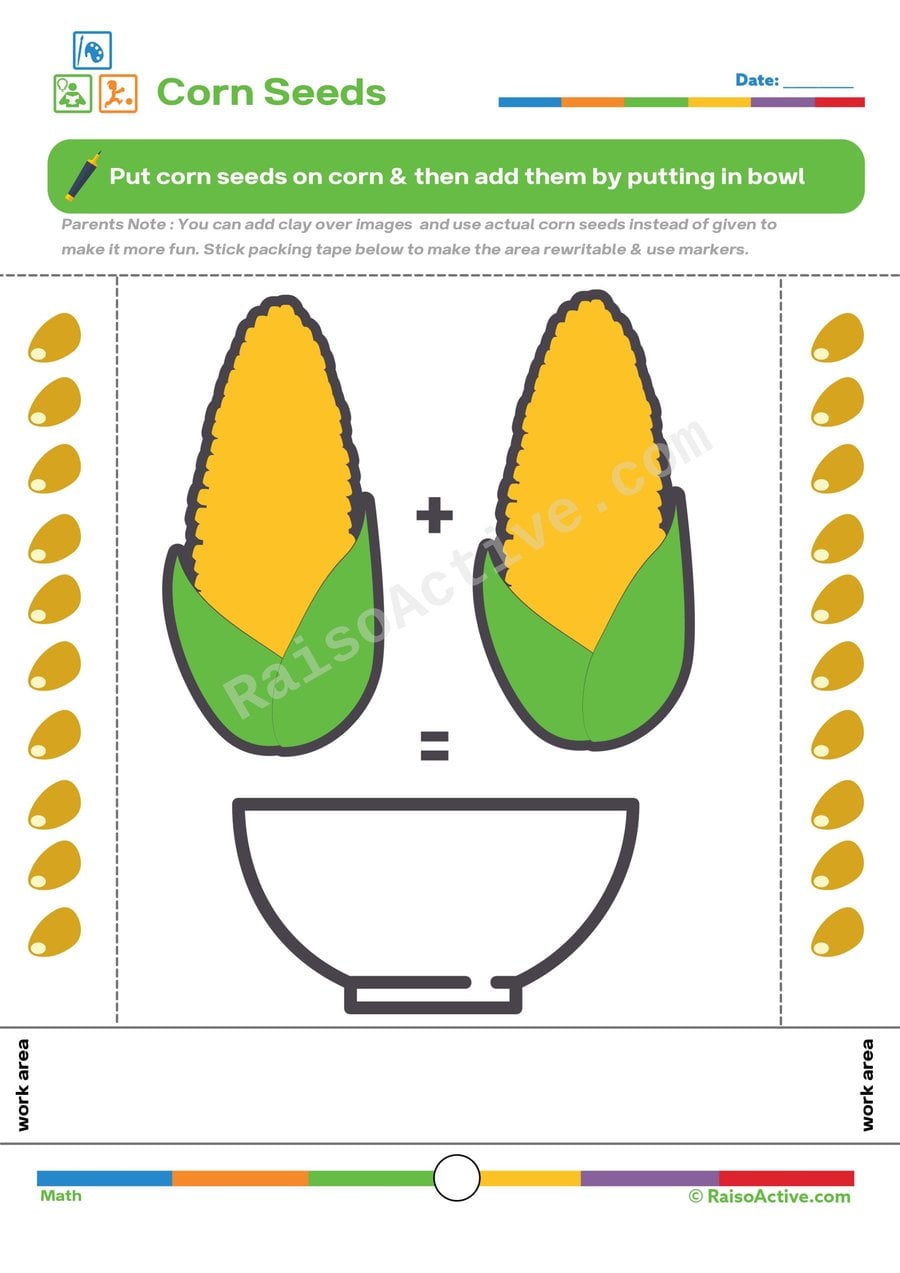
Corn Seed Addition Worksheet for Preschoolers
Counting corn seeds on two ears of corn and combining them into one total teaches children ages 3-5 the core concept of addition as joining groups together, using a concrete, countable image rather than abstract numerals alone. This worksheet also builds one-to-one correspondence, since accurate addition depends on touching or pointing to each seed exactly once while counting.

Taller or Shorter? Comparing Heights Worksheet for Preschoolers
This worksheet builds early measurement vocabulary for children ages 3-5 as they compare the heights of pictured objects and people, circling the taller or shorter one as instructed. Beyond simple height comparison, the final section asks your child to identify both the tallest and smallest in a group, requiring them to compare more than two items at once, a step up in reasoning from simple pairwise comparison.

Fall Leaf Patterns Matching Worksheet for Preschoolers
Children ages 3-5 build pattern recognition and logical reasoning skills by matching colored fall leaves to complete repeating patterns in a grid. Recognizing and continuing a pattern is an early algebraic thinking skill, teaching children to notice what comes next based on a repeating sequence — a foundation for later math concepts.

Read and Match: Sentence Reading Worksheet for Preschoolers
Reading a sentence aloud and then circling its matching picture strengthens reading comprehension for children ages 3-5, requiring them to hold the meaning of several words in mind at once rather than recognizing them individually. This early comprehension practice builds toward the ability to read a full passage and understand what actually happened, not just decode isolated words.

Emotions Worksheet: Count, Color, and Identify Feelings!
Identifying emotions from facial expressions and then counting and coloring them builds emotional literacy, the ability to name feelings like happy, sad, or surprised, alongside basic counting practice, giving children a vocabulary for something they experience daily but may not yet know how to describe. For ages three to five, naming emotions explicitly is an important early step in self-regulation and empathy.

Egg Sorting Worksheet: Count and Order the Chicks!
Cutting out and arranging numbered eggs in order builds number sequencing skills for children ages 3-5, requiring them to compare several numbers at once and place them correctly rather than just recognizing a single number in isolation. This hands-on ordering task also reinforces counting fluency, since children benefit from counting aloud as they check their arrangement.
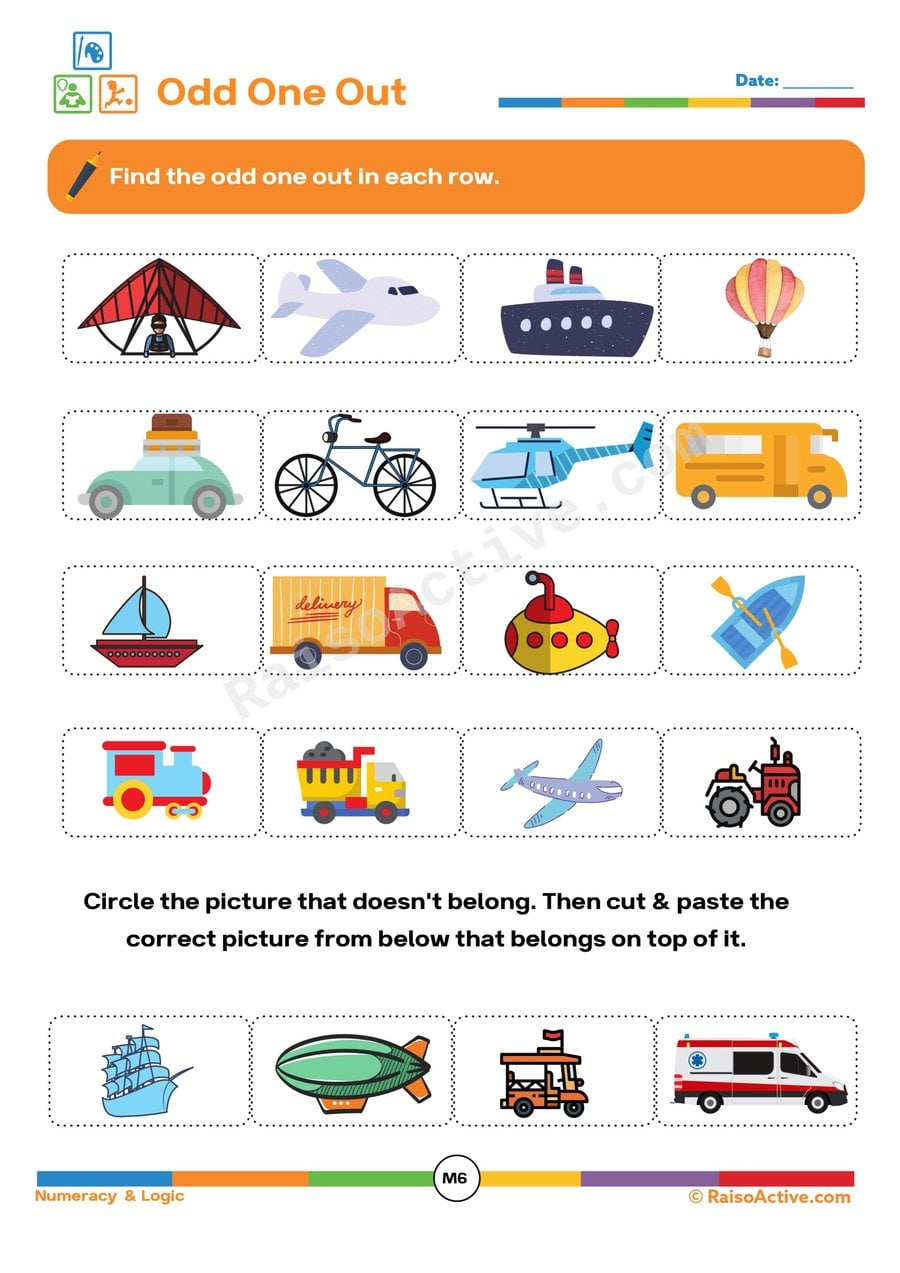
Odd One Out: Transportation Worksheet for Kids
This worksheet sharpens visual discrimination and categorization skills as children ages 3-5 study a row of transportation pictures and identify the one that doesn't belong with the others, then replace it with a correct match cut from the bottom of the page. Explaining why an item is the 'odd one out' builds early critical-thinking and reasoning skills that go beyond simple picture recognition.
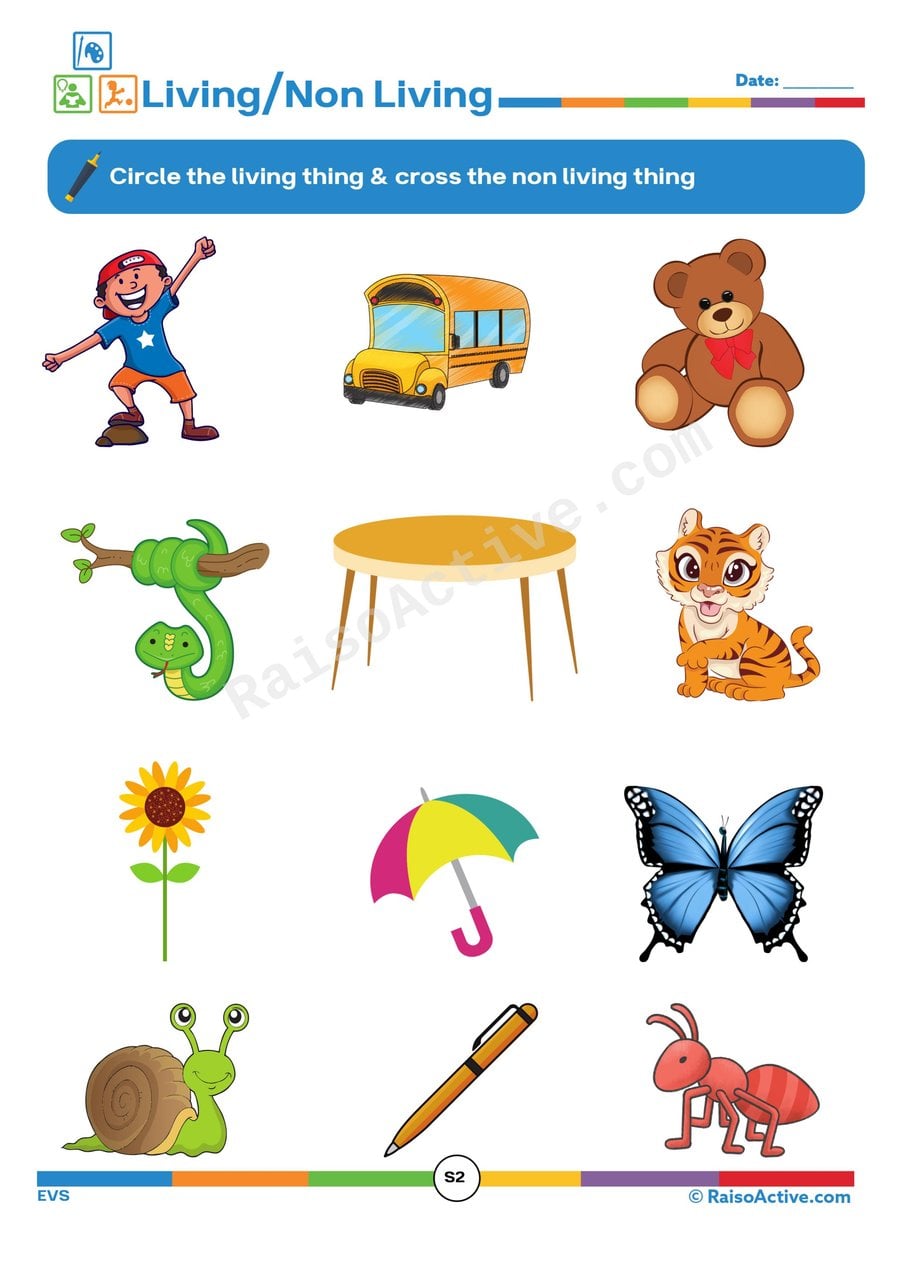
Living and Non-Living Things Worksheet for Kids
Children ages 3-5 practice an early scientific classification skill by deciding whether each pictured object grows, breathes, and moves on its own, versus things like rocks or toys that don't. Sorting living from non-living things builds the observational reasoning that underpins all later science learning.
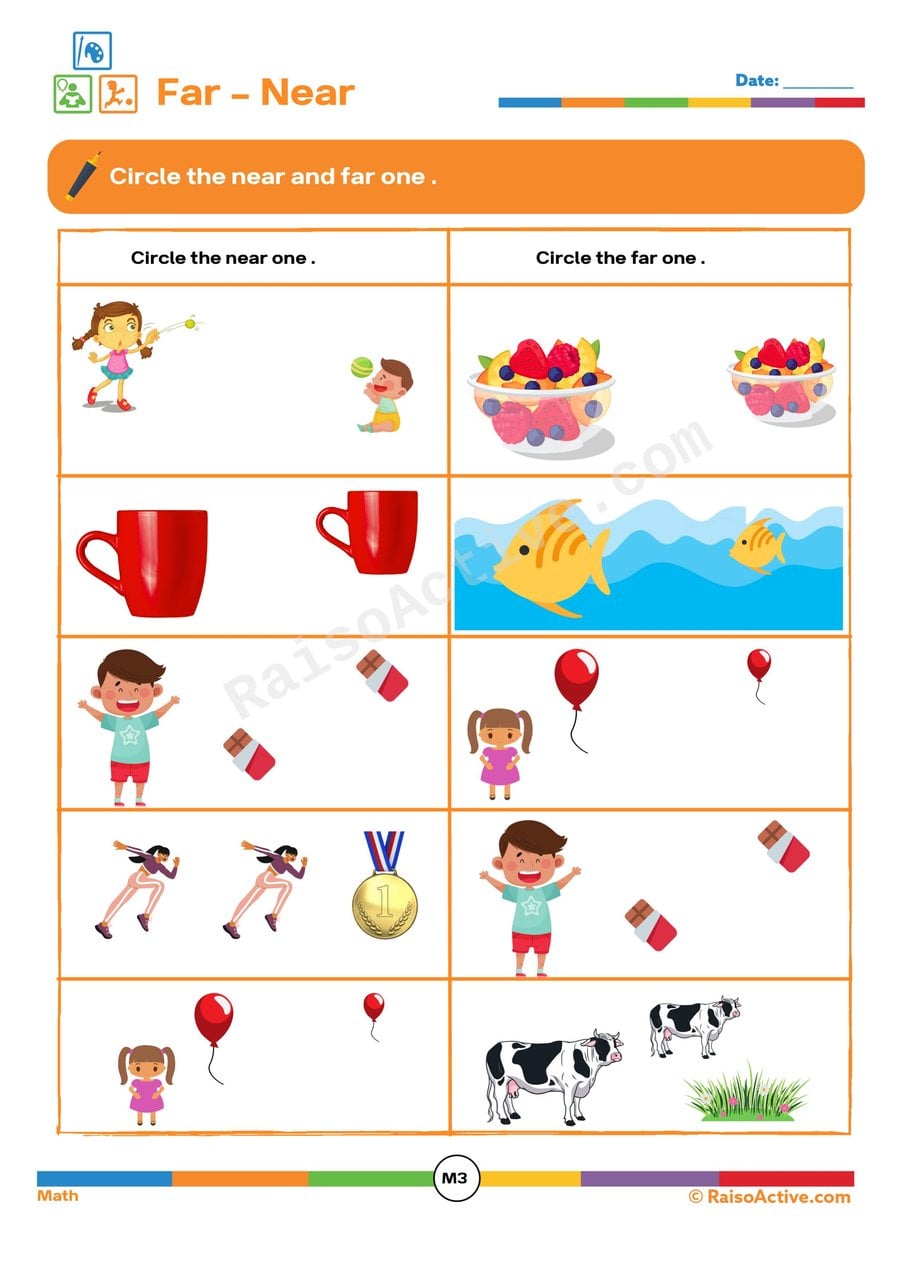
Far and Near Worksheet: Circle the Objects!
Children ages 3-5 build early spatial reasoning by comparing the relative distance of paired objects and deciding which is 'near' and which is 'far,' a foundational concept for understanding position and distance in the world around them. This kind of comparative thinking also supports later math concepts like measurement and estimation.
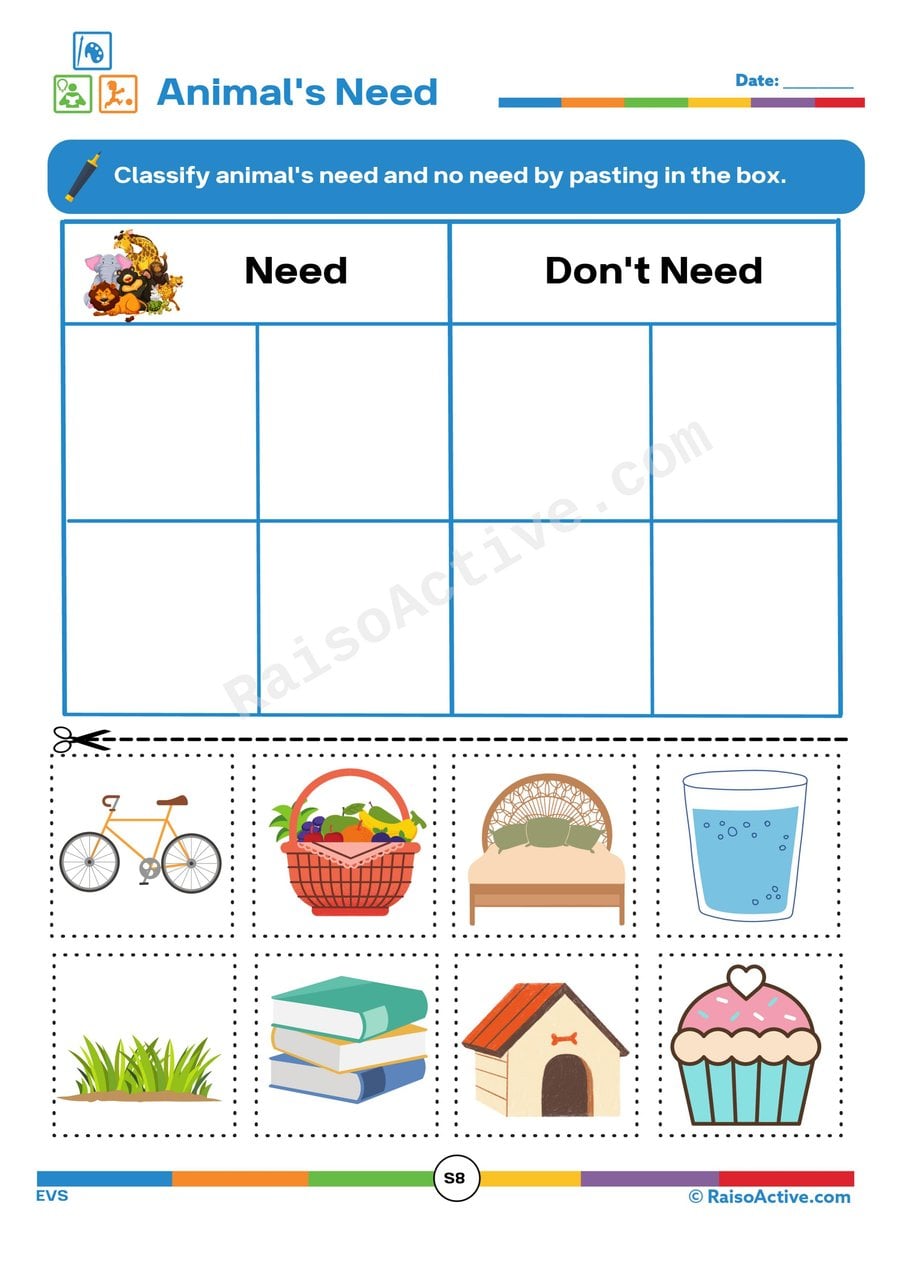
Animal Needs Sorting Worksheet for Preschoolers
This sorting activity helps children ages 3-5 understand that animals have specific survival needs — food, water, shelter, air — by cutting out picture cards and classifying each one as something an animal 'needs' or 'doesn't need.' Making this distinction requires children to reason about cause and effect in a simple form: what happens to an animal without food or water. This early exposure to classification and survival needs lays groundwork for more formal life science concepts children will encounter in later grades.

Noun Sorting Worksheet for Kids: Person, Animal, Place, and Thing!
This worksheet introduces the grammar concept of nouns by having children sort words into four concrete categories: person, animal, place, and thing. For three- to five-year-olds, sorting words by what they name is an early step toward understanding how language is built from different types of words, well before formal grammar instruction begins.

Safety Stairs Worksheet: Matching Traffic Signs and Following Directions
This worksheet builds road safety awareness in children ages 3-5 while also practicing sign recognition, visual matching, and following a multi-step path from start to finish. Matching sign names to sign shapes teaches children to recognize traffic signs by both their look and their meaning, a real-world reading skill that supports their safety once they're out walking or biking.

Animal Habitat Matching Worksheet for Preschoolers
This worksheet builds science vocabulary by having children match each animal to its natural habitat, such as a fish to the ocean or a lion to the savanna. For three- to five-year-olds, connecting an animal to where it lives introduces the idea that living things are suited to specific environments, an early step toward understanding ecosystems.
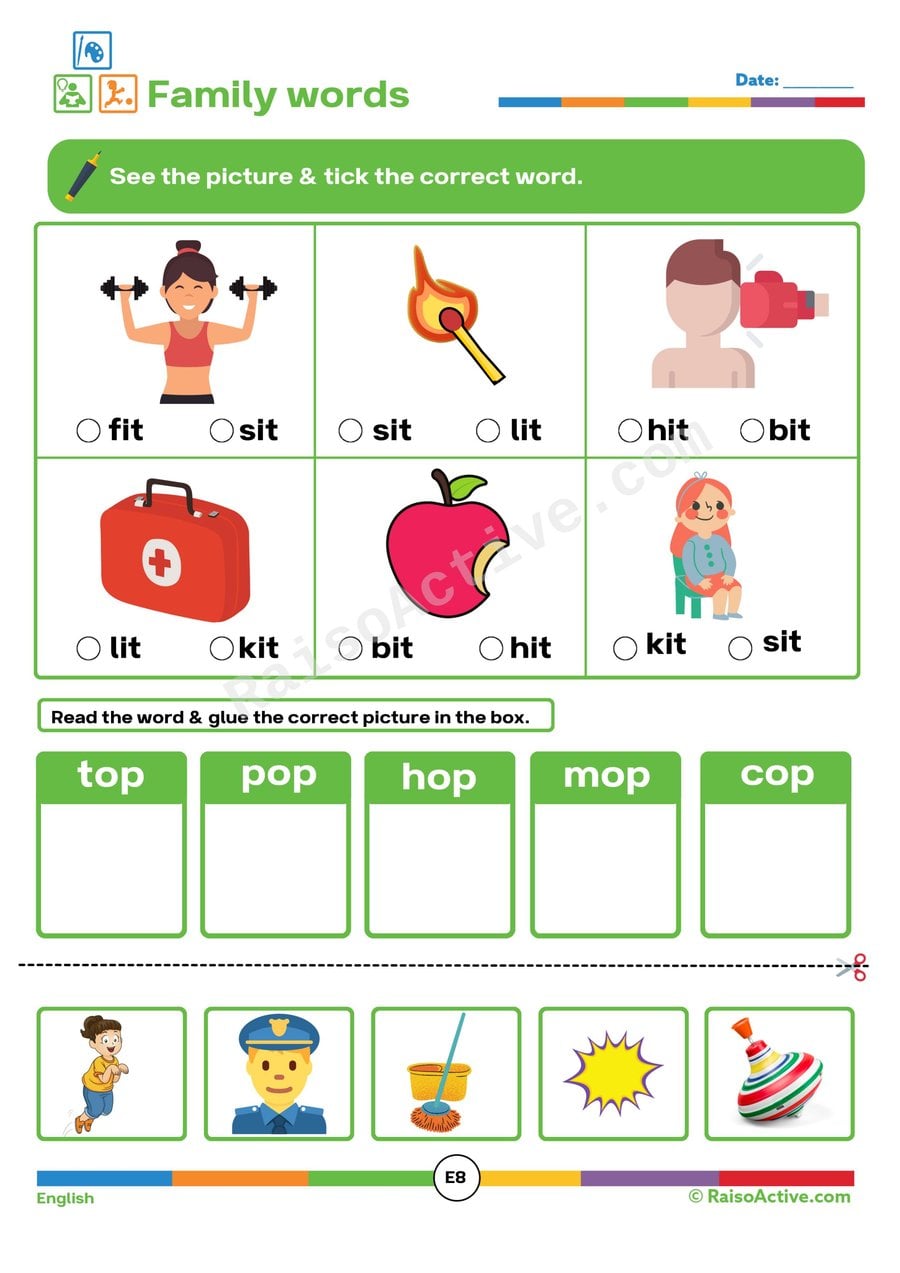
Family Words Worksheet: See, Tick, and Glue!
Children ages 3-5 practice recognizing family-member words and connecting them to pictures through a tick-and-glue format that combines quick visual checking with a hands-on cutting task. Doing the same type of match twice in different formats — once by ticking, once by pasting — gives extra repetition of the same small set of words, which is exactly what builds recognition at this age.
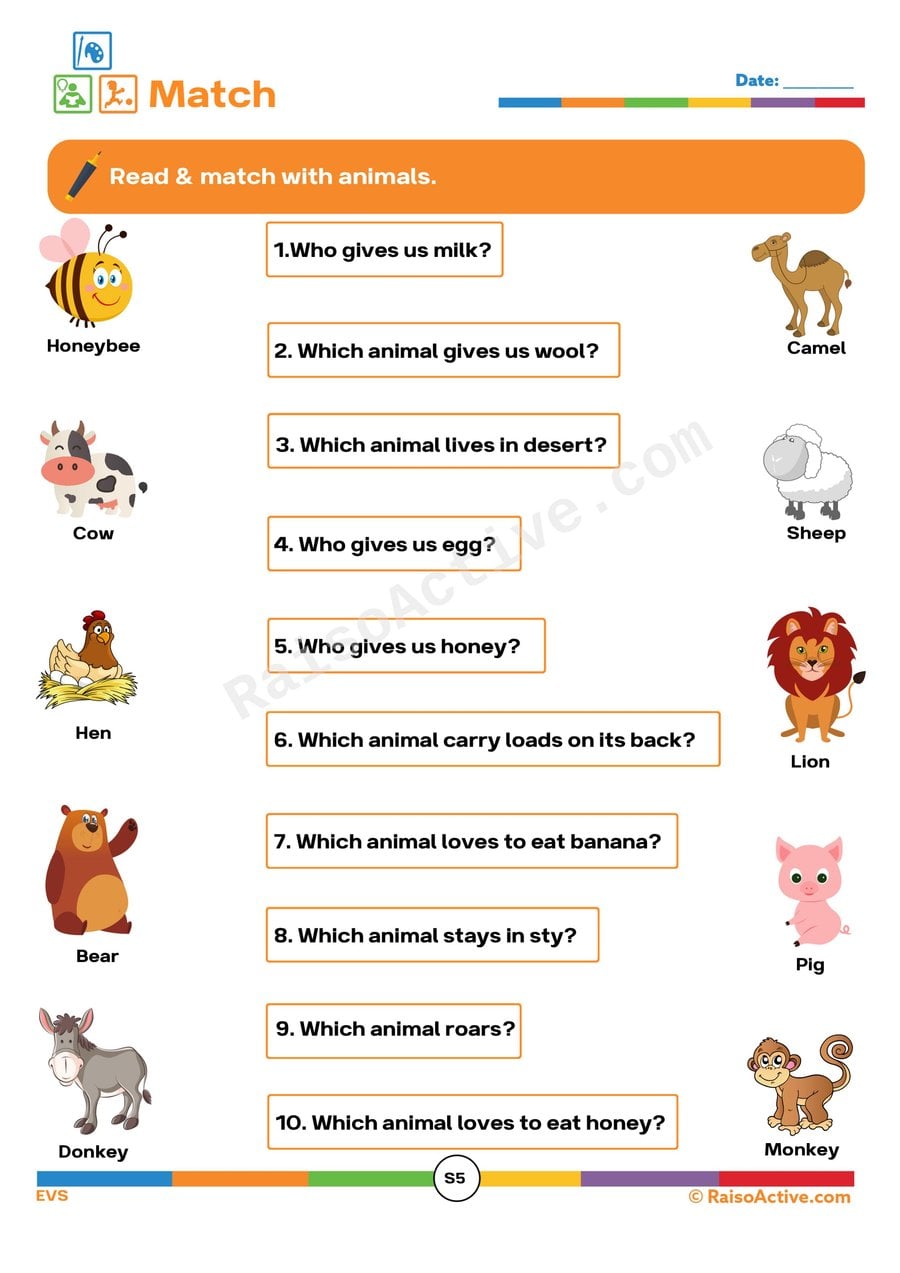
Match the Animals! A Fun Worksheet for Kids
This worksheet helps children ages 3-5 build observation and reasoning skills as they read a simple question or clue about an animal and match it to the correct picture. Rather than matching by appearance alone, children must connect descriptive language to an animal's known characteristics, which strengthens both listening comprehension and early vocabulary about animals.
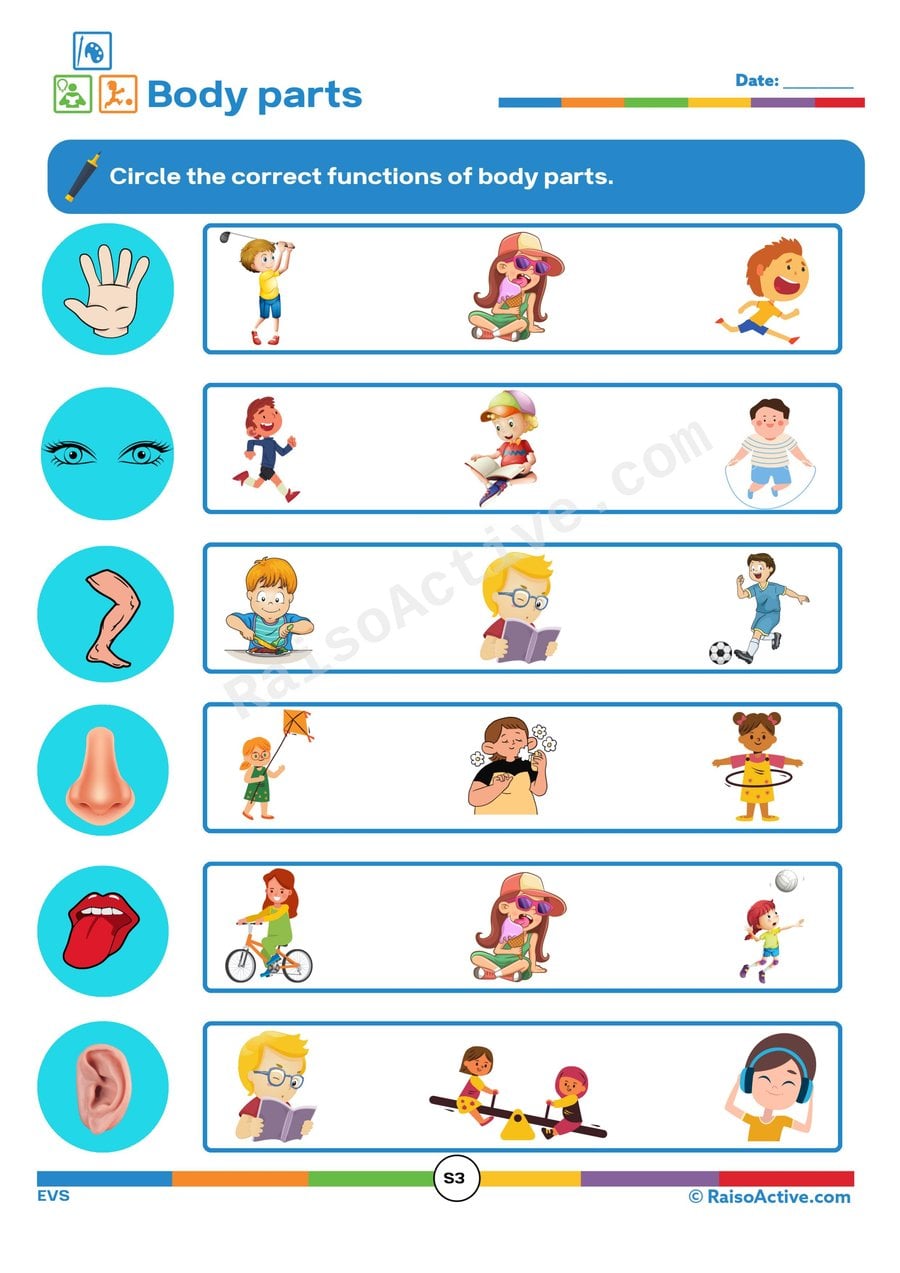
Body Parts Functions Worksheet for Kids
Children ages 3-5 practice connecting specific body parts to their real-world function, like eyes for seeing or ears for hearing, by circling the picture that shows what each body part is used for. This reinforces body awareness and vocabulary while building the reasoning skill of linking a body part to its purpose.

Match the Flags Worksheet: Fun Flag Matching Activity for Kids!
This flag-matching worksheet strengthens visual scanning and word recognition as children ages 3-5 compare printed country names on one side of the page to flag images on the other and connect the correct pairs. Because they must scan back and forth between two columns, it also builds the left-to-right tracking skills that support early reading.

Match the Life Cycle Stages Worksheet for Preschoolers
Children ages 3-5 practice matching animals and plants to their correct life cycle stage, reinforcing the broader science concept that all living things grow and change over time. Working across multiple types of living things — not just one animal — helps children recognize life cycles as a general pattern in nature rather than a fact specific to a single creature.
What Pre-K math covers
Most state pre-K standards and the Head Start Early Learning Outcomes Framework organize four-year-old math into counting and cardinality, operations and algebraic thinking (patterns and combining small groups), measurement, and geometry and spatial sense. Kindergarten's K.CC and K.G standards pick up exactly where these leave off, so a child who is secure here starts kindergarten ready for its counting-to-100 and shape work.
- Counting: rote counting to 20 and beyond, counting out up to 10 objects, knowing the last number tells how many
- Numerals: recognizing 0–10 (many children to 20), matching numerals to sets, tracing and writing 0–10
- Comparing: more, fewer and the same for two sets up to 10; which number is bigger
- Patterns and sorting: AB, ABC and AAB patterns; sorting by two attributes
- Geometry and space: circle, square, triangle, rectangle, hexagon; above, below, beside, between
- Measurement: longer and shorter, taller and shorter, heavier and lighter, holds more and less
Counting to 20 and the teen numbers
Rote counting past 10 is harder than it looks because the English teen words are irregular: eleven and twelve give no clue, thirteen and fifteen break the pattern, and children commonly skip from 14 to 16. Daily counting out loud, up the stairs and on fingers, fixes the sequence. Counting objects to 20 comes later than saying the words, and Pre-K sheets usually keep object counting to 10 while the rote sequence extends to 20 and beyond.
How to use Pre-K math worksheets at home
Keep a bag of ten counters (buttons, pasta, blocks) with the printouts and build each problem before marking the sheet. Ten minutes a day is the right amount. Ask comparison questions during ordinary routines, which plate has more, who is taller, then let the sheet confirm what your child already understands. Trace numerals only after the child can form the pre-writing strokes; a child who reverses 3 or 5 needs more finger tracing, not more pages.
Frequently asked questions
What math should a child know before kindergarten?
Most kindergarten readiness guidelines expect a child to count to 20 by rote, count out 10 objects accurately, recognize numerals to 10, compare two small sets to say which has more, copy a simple pattern, name a circle, square, triangle and rectangle, sort objects by one attribute, and use words like more, less, bigger and taller. Writing numerals to 10 is a bonus, not a requirement; adding and subtracting are kindergarten skills.
How high should a 4-year-old count?
By the end of Pre-K most children count to 20 by rote and many go higher, though the teens are often shaky. Counting objects accurately lags behind reciting: counting out 10 objects is a typical end-of-Pre-K skill, and kindergarten extends both rote counting (to 100) and object counting (to 20). If a child skips numbers in the teens, daily oral counting matters more than any worksheet.
What is the difference between Pre-K math and kindergarten math?
Pre-K math works within 10 for objects and 20 for rote counting, and everything is done with pictures and objects. Kindergarten math counts to 100, writes numerals to 20, introduces addition and subtraction within 10 with equations, sees teen numbers as ten and ones, and describes 3D shapes. Pre-K sheets have no symbols; kindergarten sheets introduce plus, minus and equals signs by mid-year.
What are AB and ABC patterns?
An AB pattern alternates two elements: red, blue, red, blue. An ABC pattern cycles three: circle, square, triangle. AAB and ABB patterns repeat one element: big, big, small. Pre-K children learn to copy a pattern, continue it, and eventually create their own, which builds the recognition of regularity that underlies skip counting and later algebra. Pattern strips with pictures or colors are the usual worksheet format.
Are Pre-K math worksheets free to download?
Yes. Create a free account and download any sheet as a watermarked PDF, five a day. An annual subscription removes the watermark and the daily limit for the whole library of more than 1,000 worksheets and all printable activity packs. Pages are sized for US Letter and A4.

Written by
Hemsweta Jain · Teacher Cheena
MBA and Early Childhood Educator, teaching since 2014 · Founder of RaisoActive, Mumbai
Written and reviewed by Hemsweta Jain (Teacher Cheena), who designs every RaisoActive worksheet.
Last reviewed
Printable packs for ages 4–5
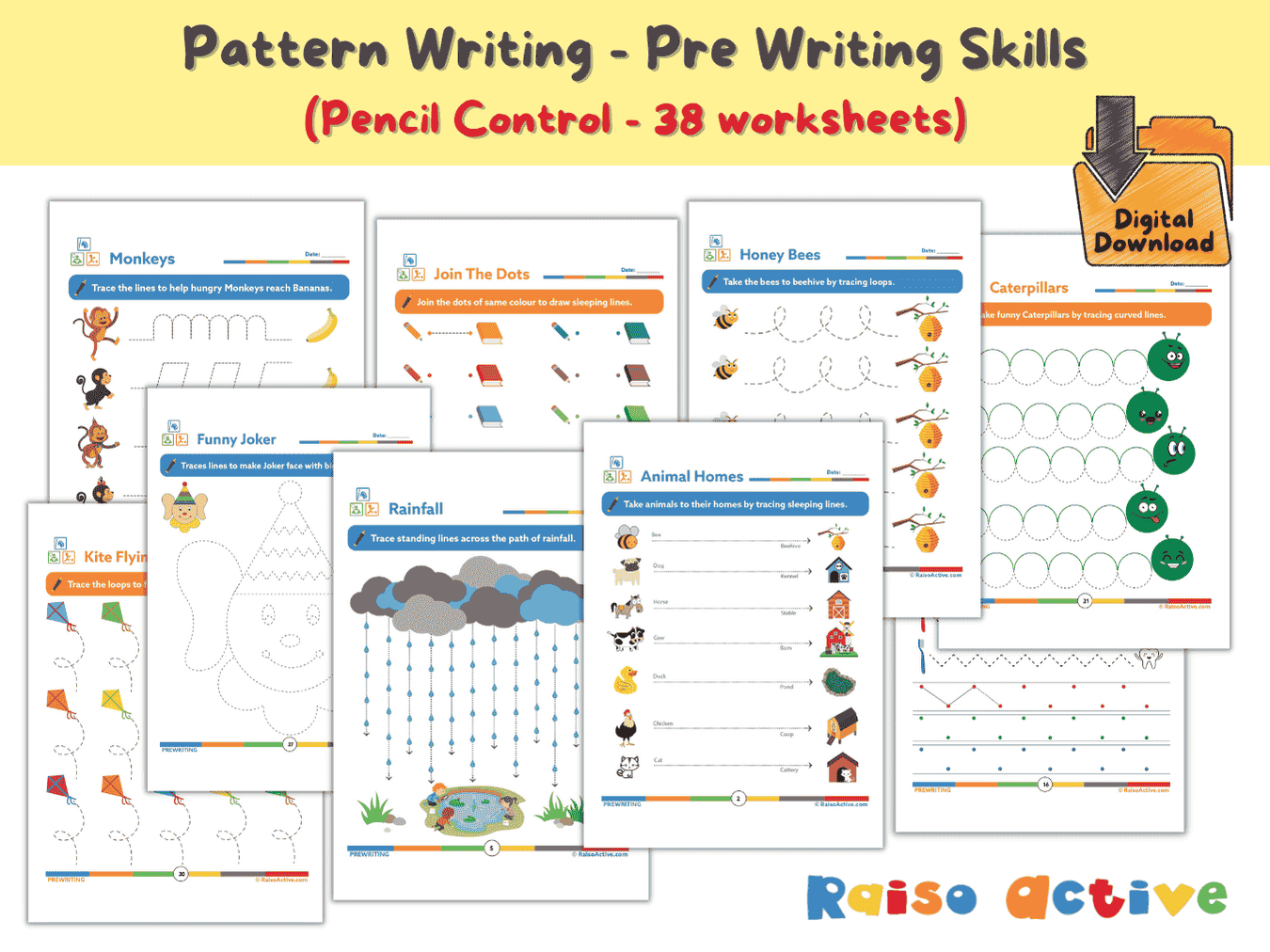
Pattern Writing Pre-writing Skills Activity Book for 3-4 Year Olds
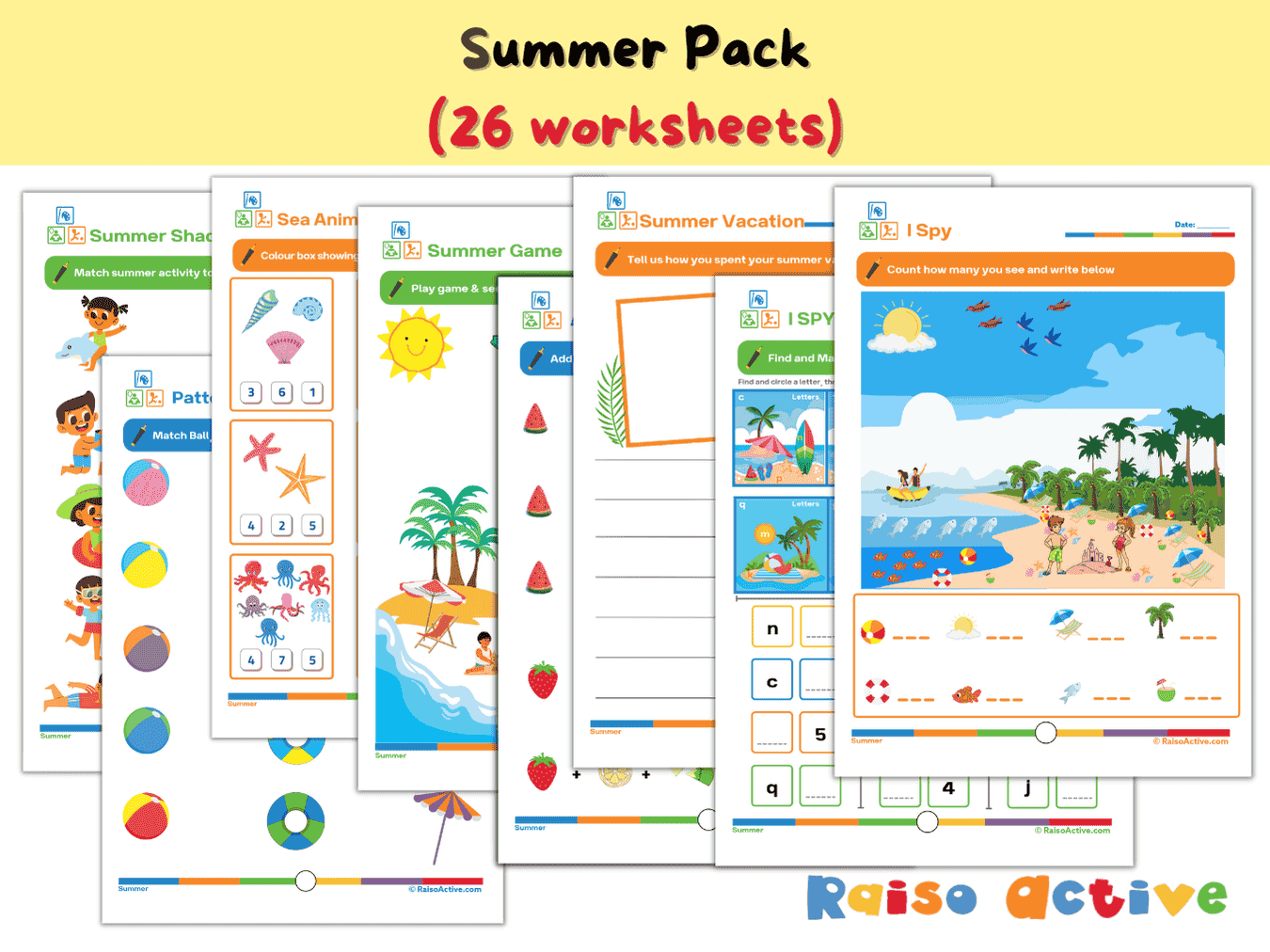
Summer Activity Pack: Math, Literacy, Puzzles & More for Preschool & Kindergarten
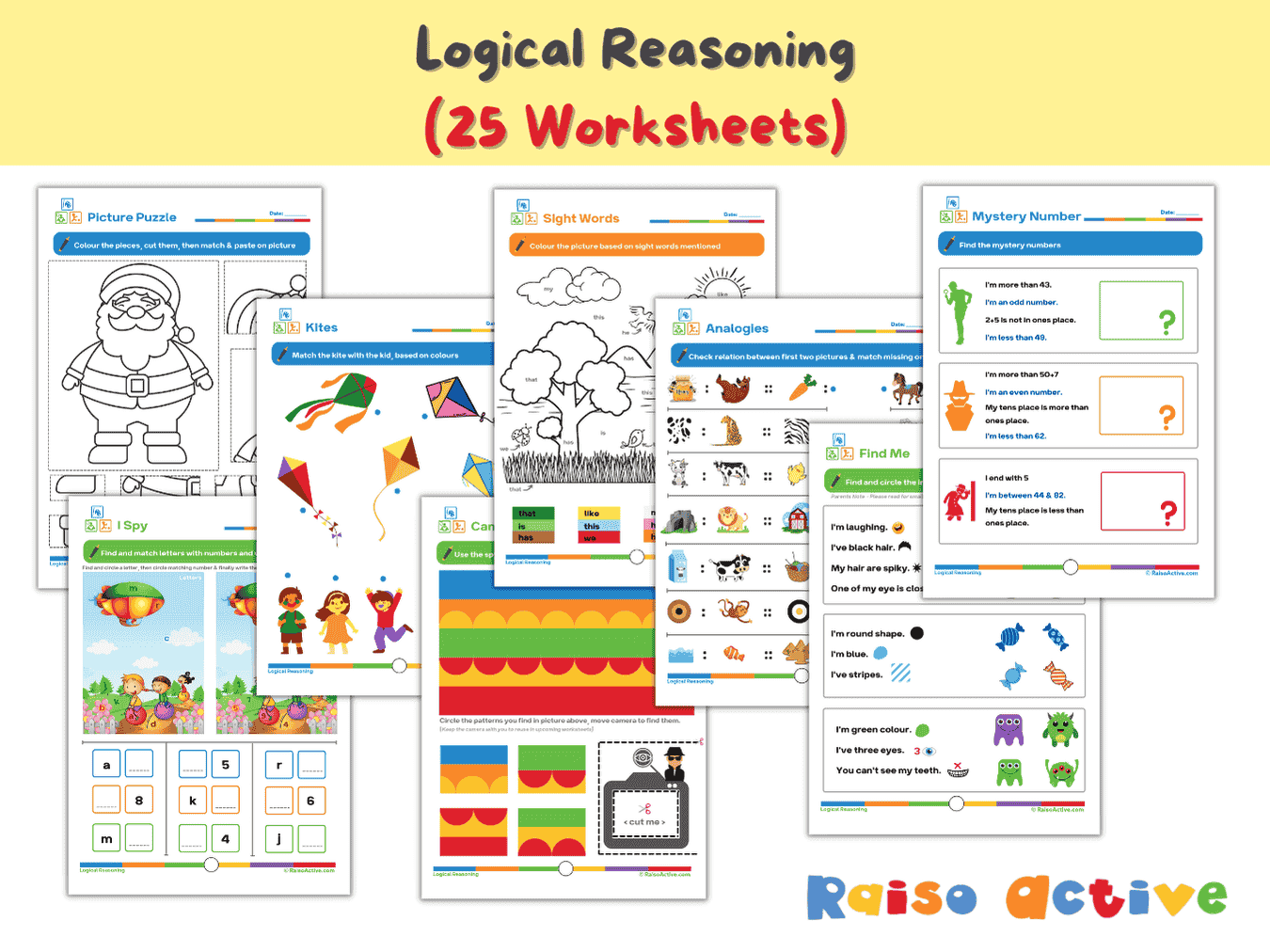
Logical Reasoning Activity Book for Preschool & Kindergarten | Patterns, Puzzles & Analogies
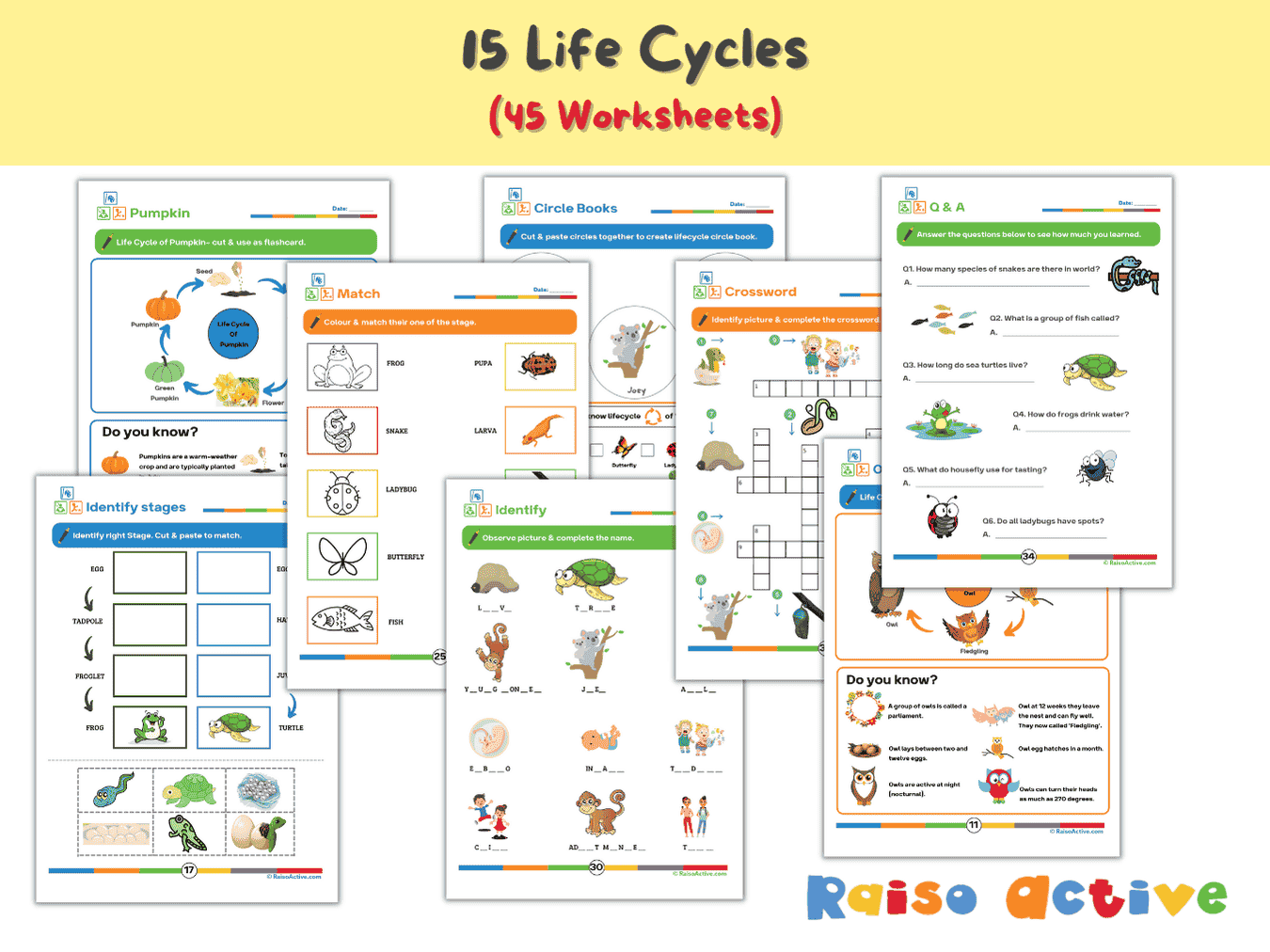
Lifecycles Activity Book & Flashcards for Preschool & Early Elementary
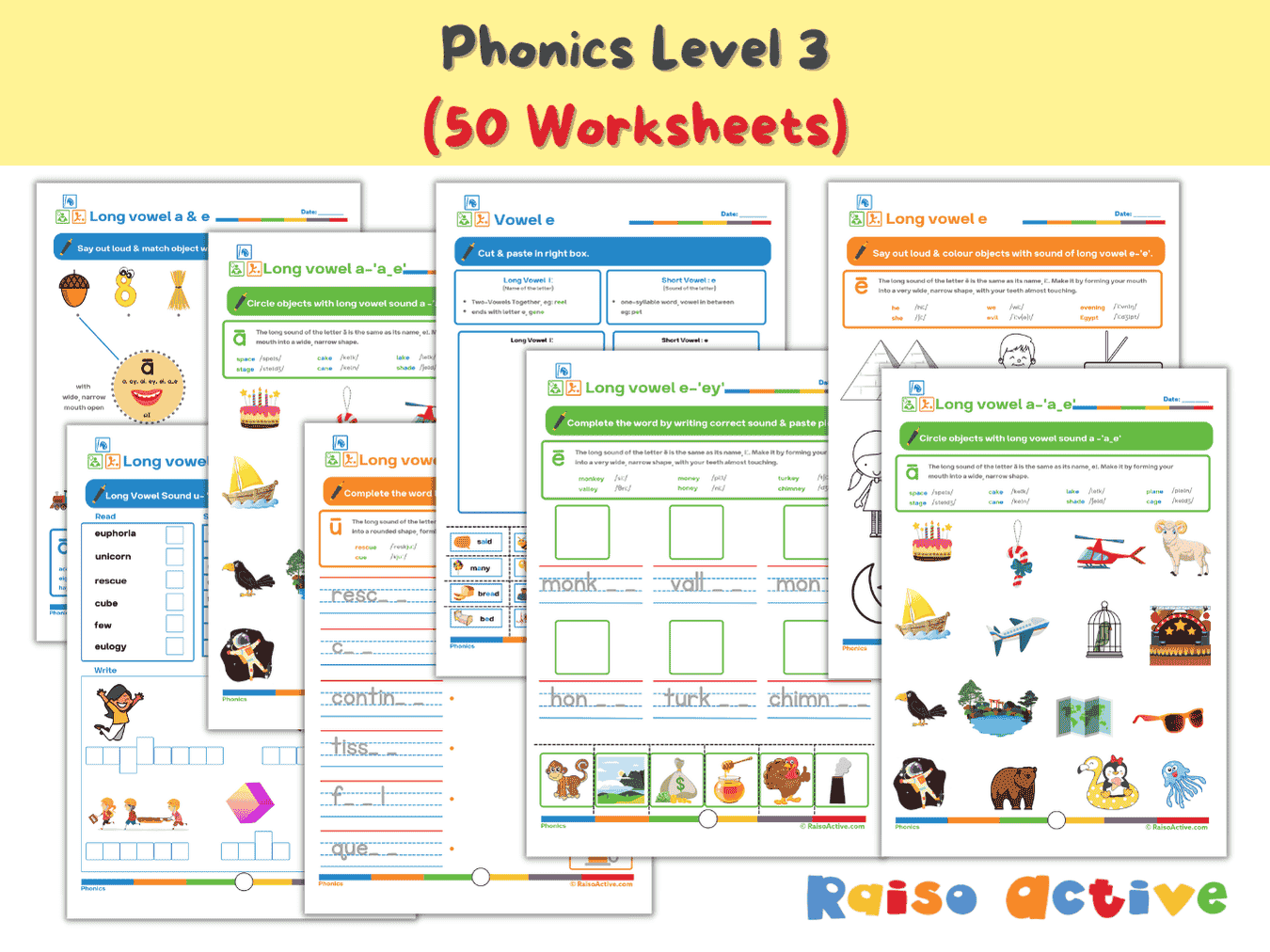
Phonics Level 3 Long Vowels Activity Book for Kindergarten & 1st Grade
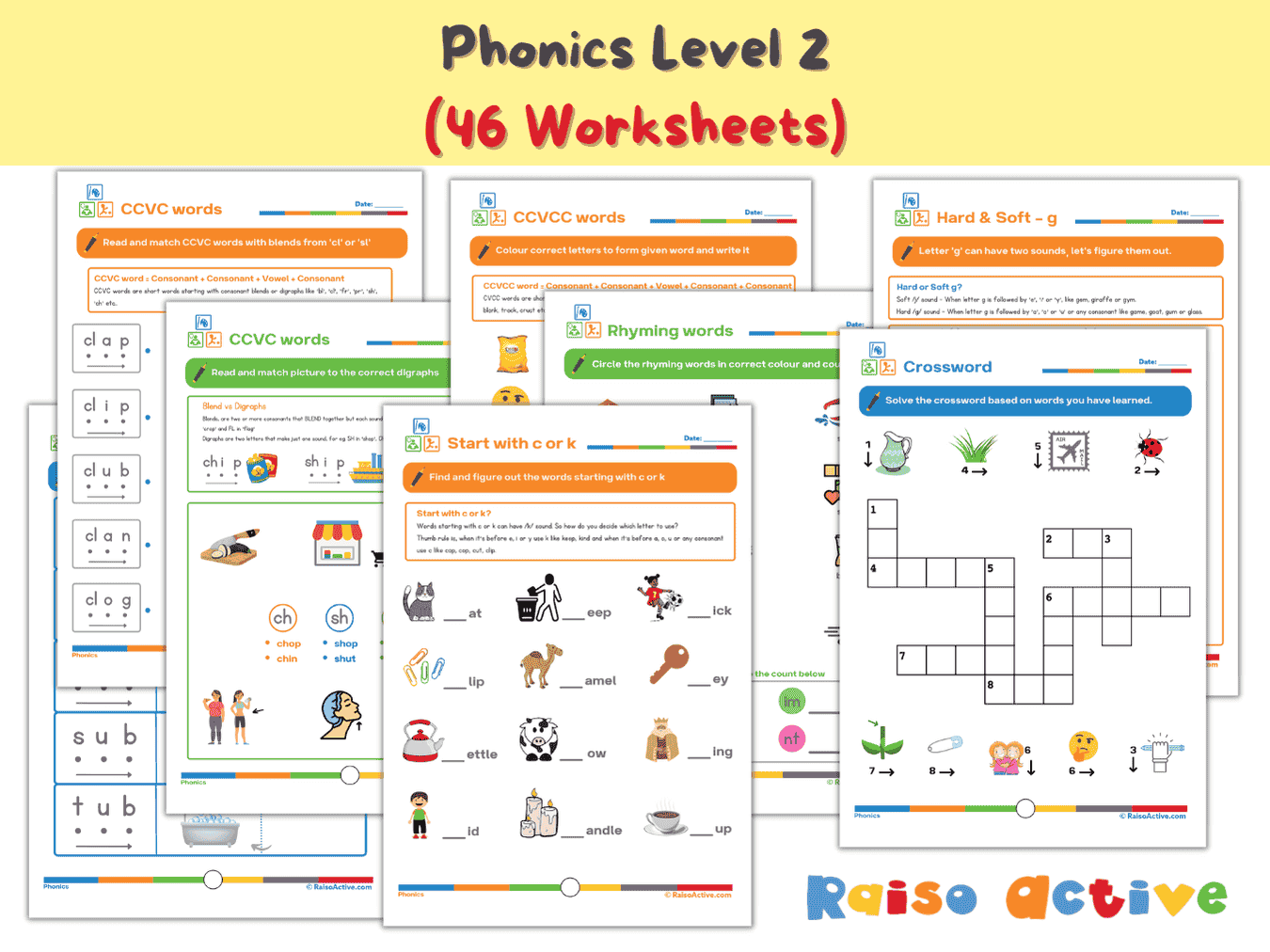
Phonics Level 2 Worksheets: CVC, CCVC, CVCC Word Families & Blends for Early Readers (Ages 4-7)
Guides for parents and teachers
See all guides →Sight Words by Age: The First 50 Words and How to Teach Them Without Flashcard Fatigue
Which sight words to teach first and why, the heart-word method, a read-trace-write-find routine, games, and a by-age table of typical sight-word progress.
Number Formation Rhymes 0–9 and How to Fix Reversals
Original number formation rhymes for 0–9, the correct stroke order for each digit, why 3, 5 and 7 get reversed most often, and multisensory fixes that work.
Pre-Writing Strokes in Order: From Standing Lines to Loops (With Printable Patterns)
The developmental order of pre-writing strokes, from vertical lines to loops, and why practicing them in sequence makes letter formation much easier to learn.
Kindergarten Readiness Checklist: 25 Skills to Practice Before the First Day
A kindergarten readiness checklist of 25 literacy, math, motor, self-regulation and self-help skills, with an 8-week summer plan and notes on when not to worry.
Reception Year Explained: EYFS Learning and How to Help at Home
A teacher's plain-English guide to the Reception Year: the seven areas of learning, Early Learning Goals, Phase 2/3 phonics, the RBA and home routines.
UKG Syllabus Explained: English, Maths and EVS Month by Month
What UKG classes typically cover in English, maths and EVS, month by month, aligned to NEP 2020, with ways to support at home and signs your child is behind.