Free printable worksheets · United States
Kindergarten Math Worksheets
Kindergarten math worksheets are printable practice for children aged 5 to 6 covering the five Common Core kindergarten math domains: counting to 100 and writing numbers to 20 (K.CC), addition and subtraction within 10 (K.OA), teen numbers as ten plus ones (K.NBT), comparing length and weight and sorting (K.MD), and naming and building 2D and 3D shapes (K.G).
Counting is the heart of kindergarten math, and the standards are precise about what counting means. K.CC.4 asks that a child say one number per object, know that the last number said is the total, and know that each number is one more than the one before; that understanding, called cardinality, is what separates a child who has memorized the number song from one who can actually count. Once it is secure, K.OA builds addition and subtraction within 10 as putting together and taking apart, with ten-frames and drawings rather than symbols at first, and K.NBT introduces 11 to 19 as a ten and some ones, the first step toward place value. The worksheets on this page are grouped by domain so a ten-frame sheet, a teen-number sheet or a shape sheet can be matched to the week's lesson.
933+ worksheets · free PDF download · print on A4 or Letter
Kindergarten Math Worksheets to print
Browse all worksheets for ages 5–6
Word Problems Worksheet: Solving for Addition and Subtraction
This worksheet builds the ability to translate real-world scenarios into number sentences, teaching children ages 4-6 to spot clue words like 'gave away' or 'found more' that signal whether to add or subtract. It also practices reading comprehension applied to math, a key step as children move from rote counting toward applied reasoning.
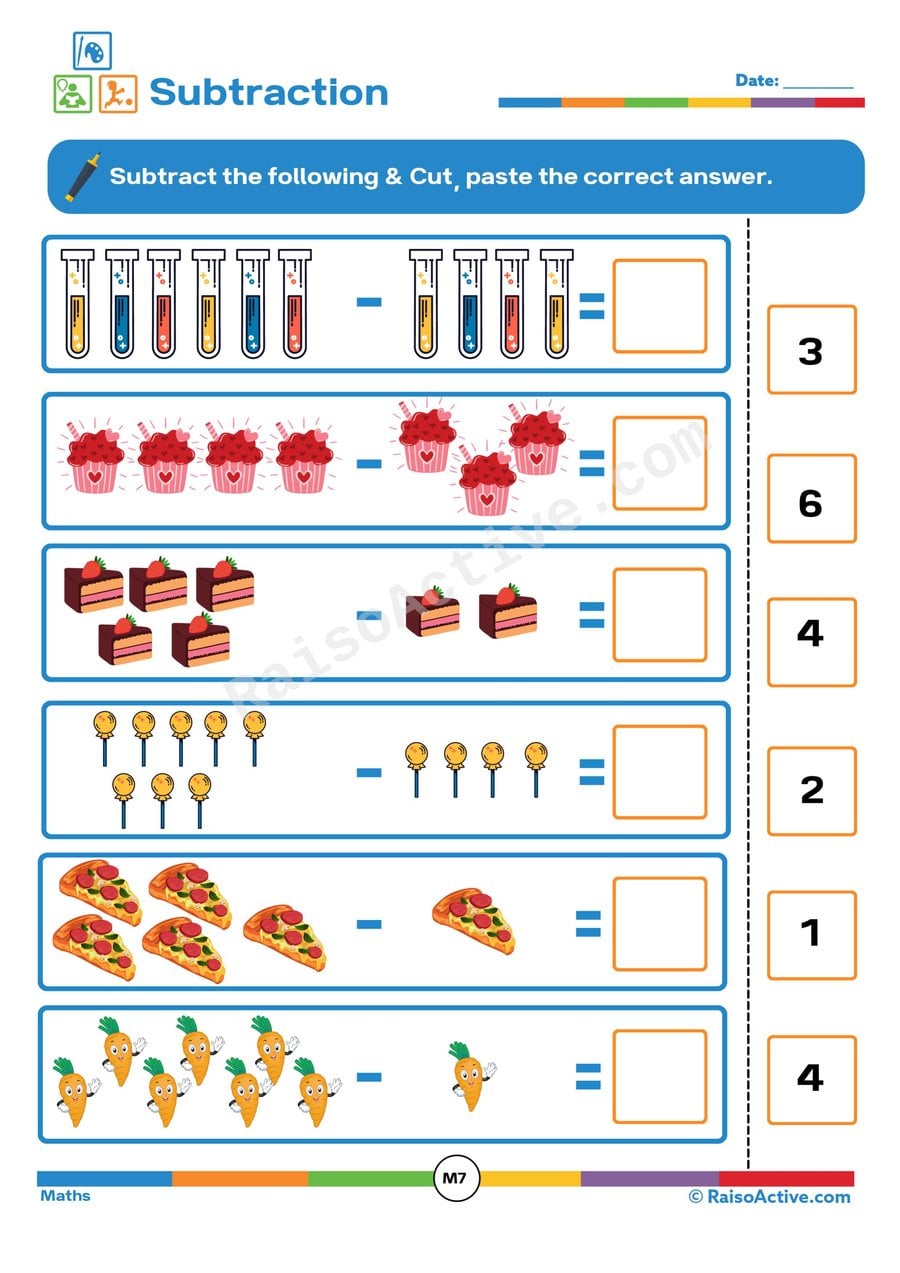
Subtraction Fun: Cut and Paste the Answers!
This worksheet grounds subtraction in something concrete for children ages 4-6 by having them count visual object groups, subtract, and then physically select and paste the correct numeral answer from a set of choices. Counting objects before subtracting keeps the math anchored in real quantities rather than abstract numerals alone, which is exactly the kind of support young learners need before they're ready for purely symbolic subtraction. The cut-and-paste answer selection also adds a layer of verification, since your child has to search through several numeral options to find the one that truly matches their calculated answer.

Life Cycle Stages Worksheet: Identify and Sequence!
This worksheet asks children ages 4-6 to identify what life-cycle stage is shown in each individual picture and then number a whole set of pictures into the correct growth sequence, moving beyond simple matching into independent ordering and logical reasoning. Because the worksheet likely mixes several different animals' or plants' stages, it also asks children to recognize what type of life cycle a picture belongs to before sequencing it.

Adjective Adventure: Matching Sentences Worksheet for Kids
This worksheet teaches 4-6 year olds that adjectives are the words that describe nouns, asking them to fill in a missing adjective in a sentence and then physically mark the noun and adjective separately by underlining and circling. That separation step — telling apart which word names a thing and which word describes it — is a genuinely useful grammar distinction that most children haven't consciously noticed before, even though they use adjectives constantly in speech.

Apples to Basket: Sorting Math Worksheet for Preschoolers
This worksheet combines basic addition and subtraction practice with sorting skills as children ages 4-6 solve a math problem written on each apple, then decide which basket it belongs in based on whether the answer is more or less than a target number. Categorizing numbers by size after calculating them adds a layer of number-sense reasoning beyond simply finding the right answer.

Subtraction Worksheet: Count and Subtract for Preschoolers
This worksheet introduces children ages 4-6 to subtraction by having them count a group of objects, take away the indicated amount, and write the resulting difference. Grounding subtraction in physical counting rather than abstract number facts helps children build real number sense, understanding subtraction as 'taking away' rather than just memorizing symbols and answers.
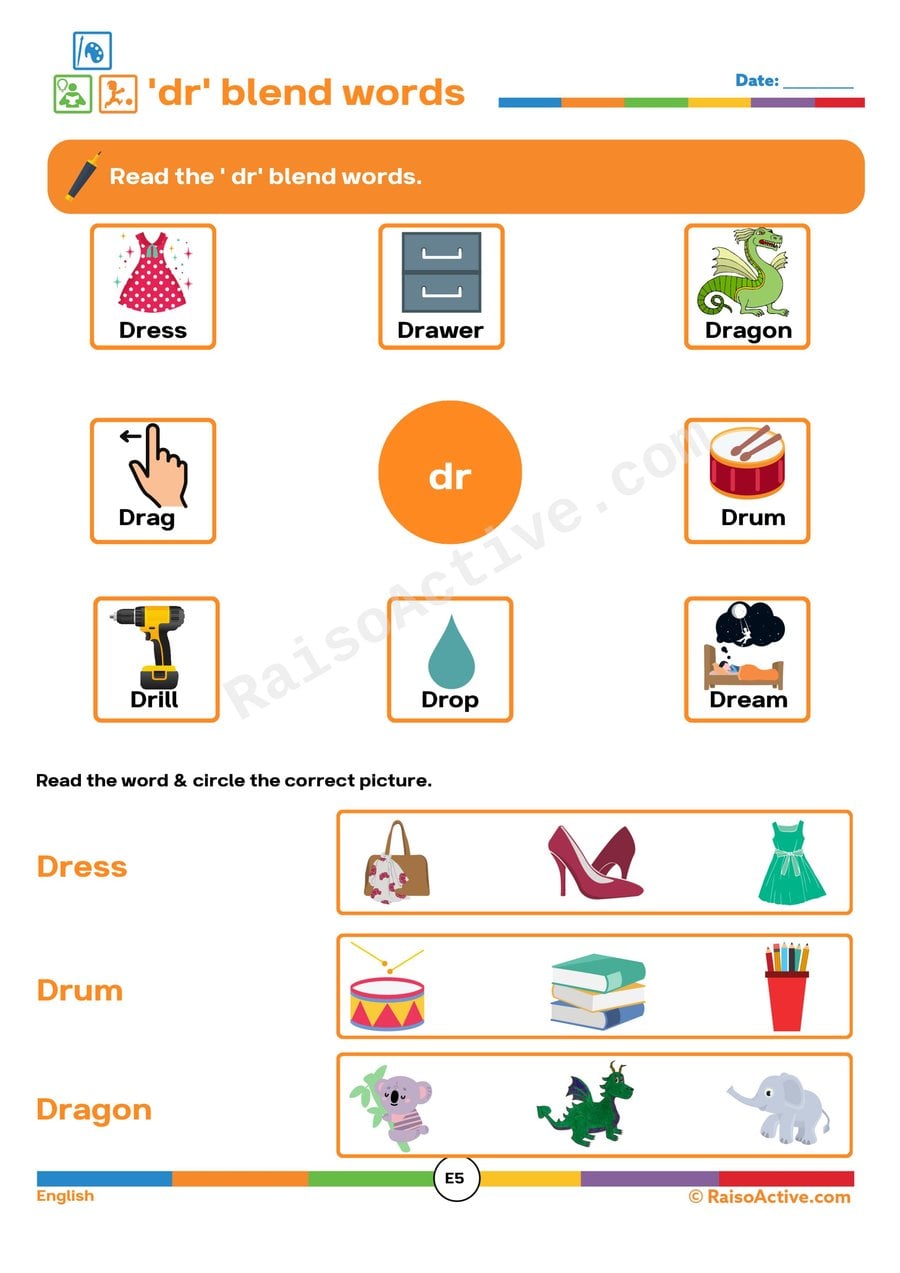
Dr Blend Words Worksheet: Read and Match!
This worksheet focuses on the 'dr' blend, as in 'drum' or 'dress,' asking children to read the word first and then find its matching picture, which reverses the more common picture-first phonics approach and pushes children to truly decode the word rather than guess from an image. For ages four to six, reading the word independently before checking against a picture builds real decoding confidence.

Ascending Order Fun: A Printable Worksheet for Numbers!
Arranging numbers from smallest to largest teaches children ages 4-6 to compare quantities and understand relative magnitude, a skill that underlies later work with number lines, place value, and basic operations. It also reinforces number recognition, since children must correctly identify each numeral before they can decide where it belongs in the sequence.
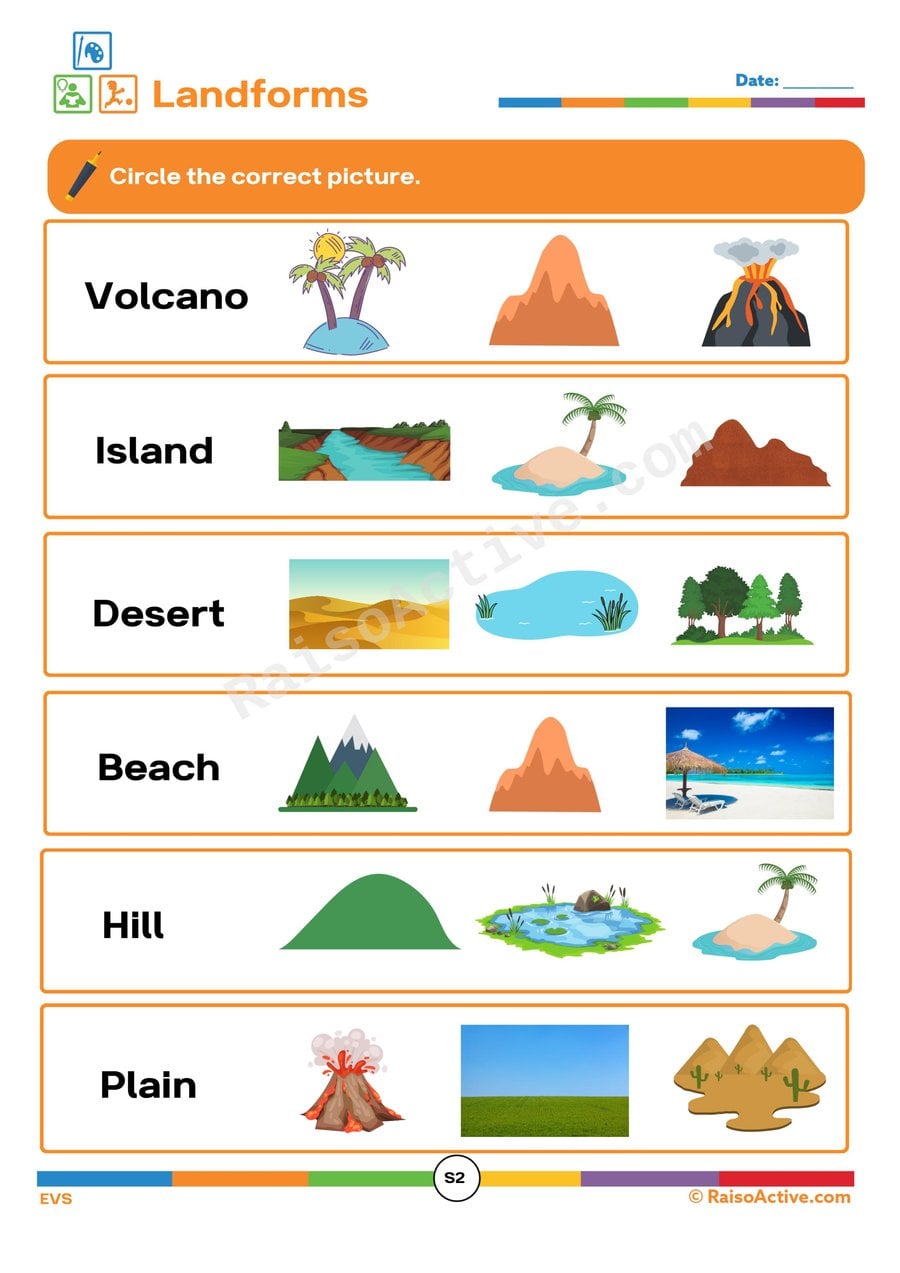
Landforms Worksheet: Circle the Correct Picture!
This worksheet introduces children ages 4-6 to basic landform vocabulary — words like mountain, valley, island, or river — by asking them to read or hear a landform's name and circle the picture that matches it. Connecting a geography term to its correct visual representation builds early science and social studies vocabulary well before children can read complex nonfiction text on their own. This kind of word-to-picture matching also reinforces observational skills, since children must notice the distinguishing visual features that make one landform different from another.

Rolling Addition Worksheet for Preschoolers: Dice Game Fun!
Rolling two dice and adding the results teaches children ages 4-6 the core idea of addition as combining two quantities into one total, rather than just memorizing number facts. The physical act of rolling builds excitement around math while requiring them to recognize dice pips or numerals, transfer them to paper, and calculate a sum, connecting concrete play to abstract arithmetic.

Addition Fun: Add and Match the Numbers! (Worksheet)
Children ages 4-6 practice basic addition by counting two groups of pictured objects, finding their total, and then matching that sum to the correct number, combining counting, addition, and visual matching in a single activity. Drawing a line to connect an answer to its number reinforces that a math sentence and a numeral represent exactly the same quantity.

Let's Solve Word Problems! - Addition Worksheet for Kids
This word problem worksheet moves children ages 4-6 beyond bare number addition into applied math, asking them to read a short story-style problem, count the objects described, and add the quantities together. Translating words into numbers and then into an equation is a key early step toward algebraic thinking, since it requires children to identify what's being asked before they can solve it. Counting the pictured objects first also keeps the addition grounded in something concrete rather than abstract digits alone.
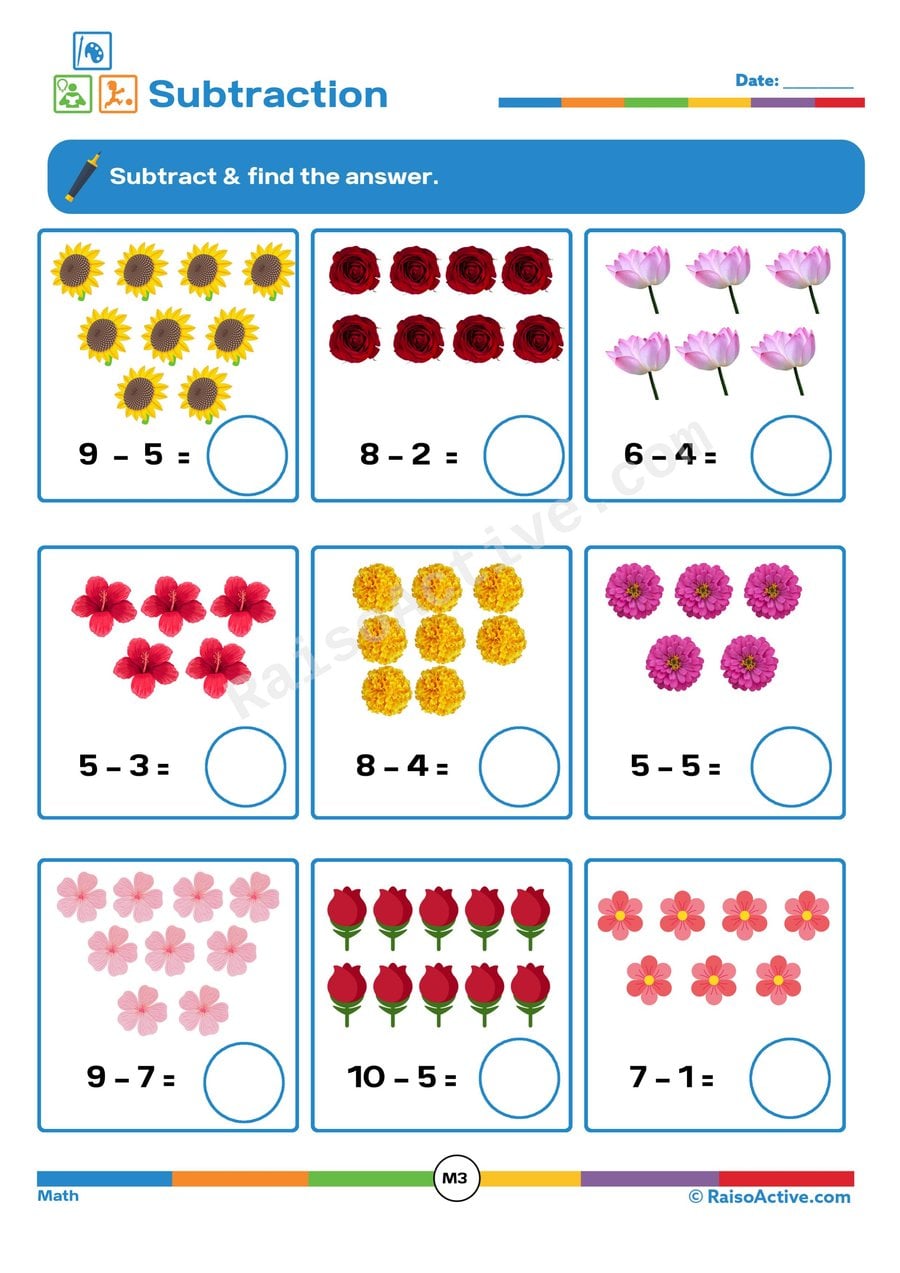
Flower Power Subtraction Worksheet for Kids
This worksheet gives children ages 4-6 hands-on subtraction practice using a flower-themed counting context, asking them to count pictured objects, subtract a given amount, and write the difference in a circle. The visual, countable format helps make subtraction concrete rather than abstract, reinforcing that 'taking away' reduces a group's total in a way children can see and verify by recounting.
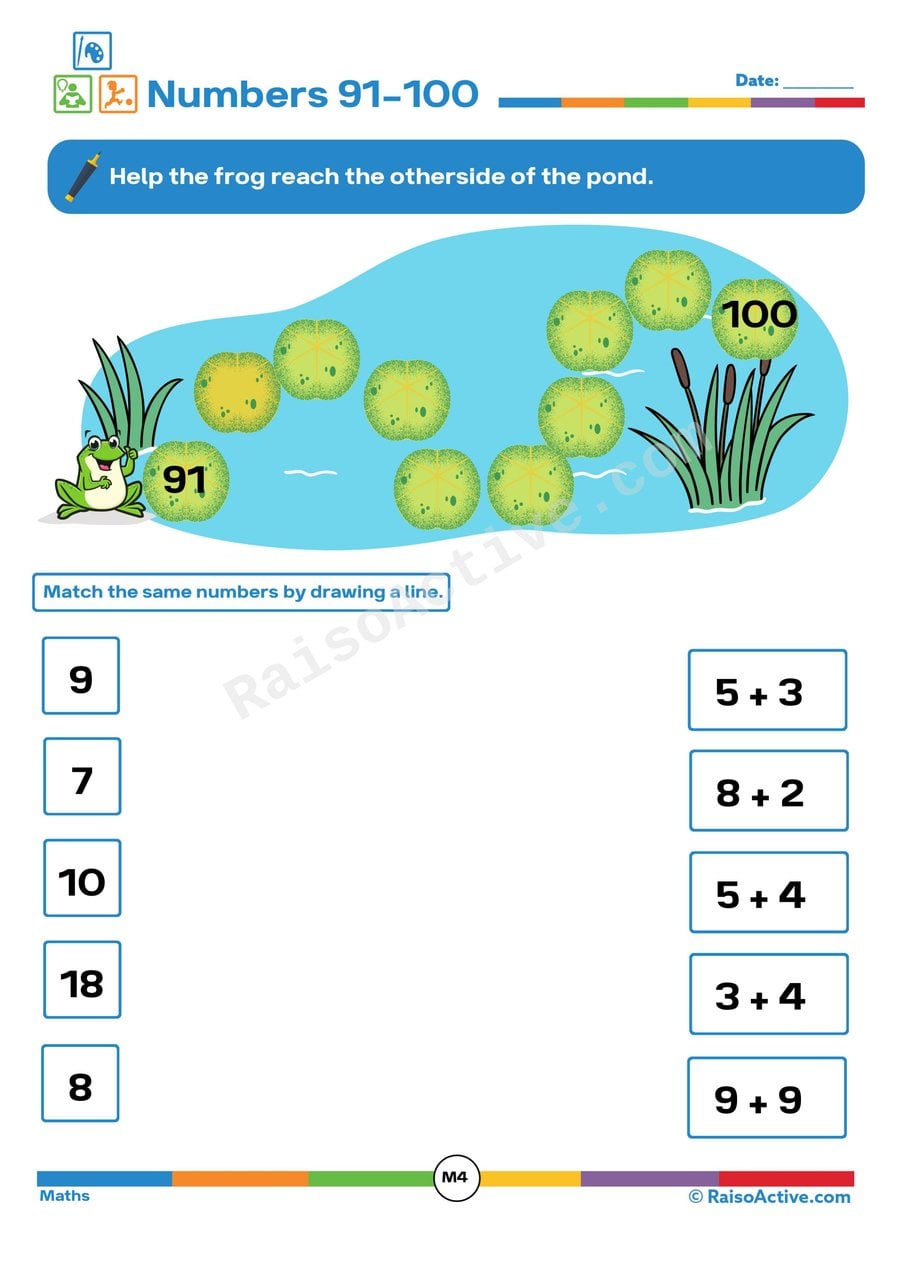
Numbers 91-100 Worksheet: Help the Frog!
Numbers in the 90s are a milestone range for children ages 4-6, since they require holding two-digit number recognition steady while approaching the conceptually significant number 100. This worksheet has children match numbers on lily pads to their corresponding value or sum, reinforcing number recognition within this higher range through a playful matching format. Building fluency with numbers up to 100 lays essential groundwork for place value concepts like tens and ones that children will tackle soon after.
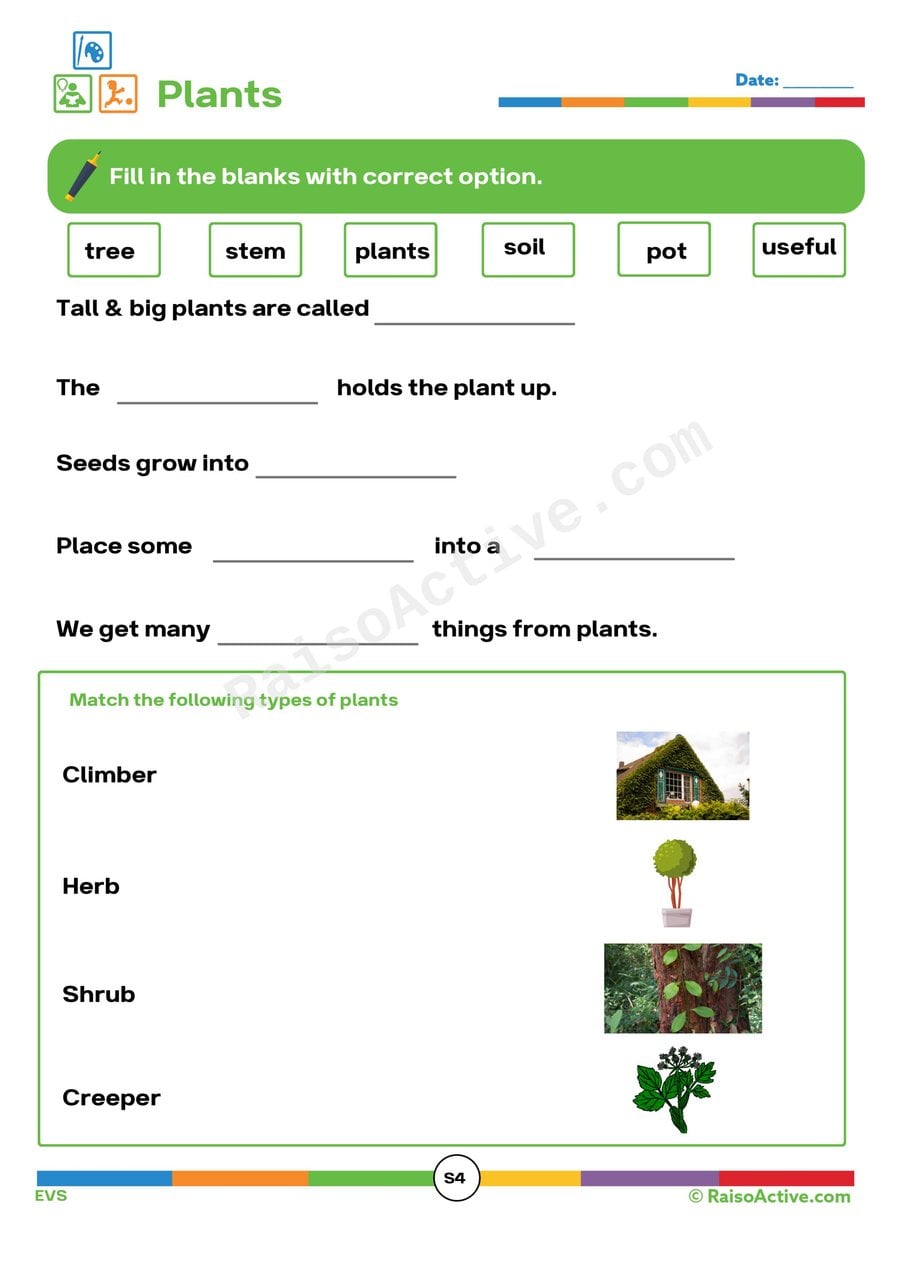
Plant Parts Worksheet for Preschoolers
This worksheet introduces 4-6 year olds to plant anatomy — roots, stem, leaves, and flower — and asks them to connect each part's name to its function, while a separate matching section links different plant types to their pictures. Learning that plants have parts with specific jobs (roots drink water, leaves make food from sunlight) is an early building block of life science, and naming these parts gives your child vocabulary they'll keep reusing throughout school science lessons.
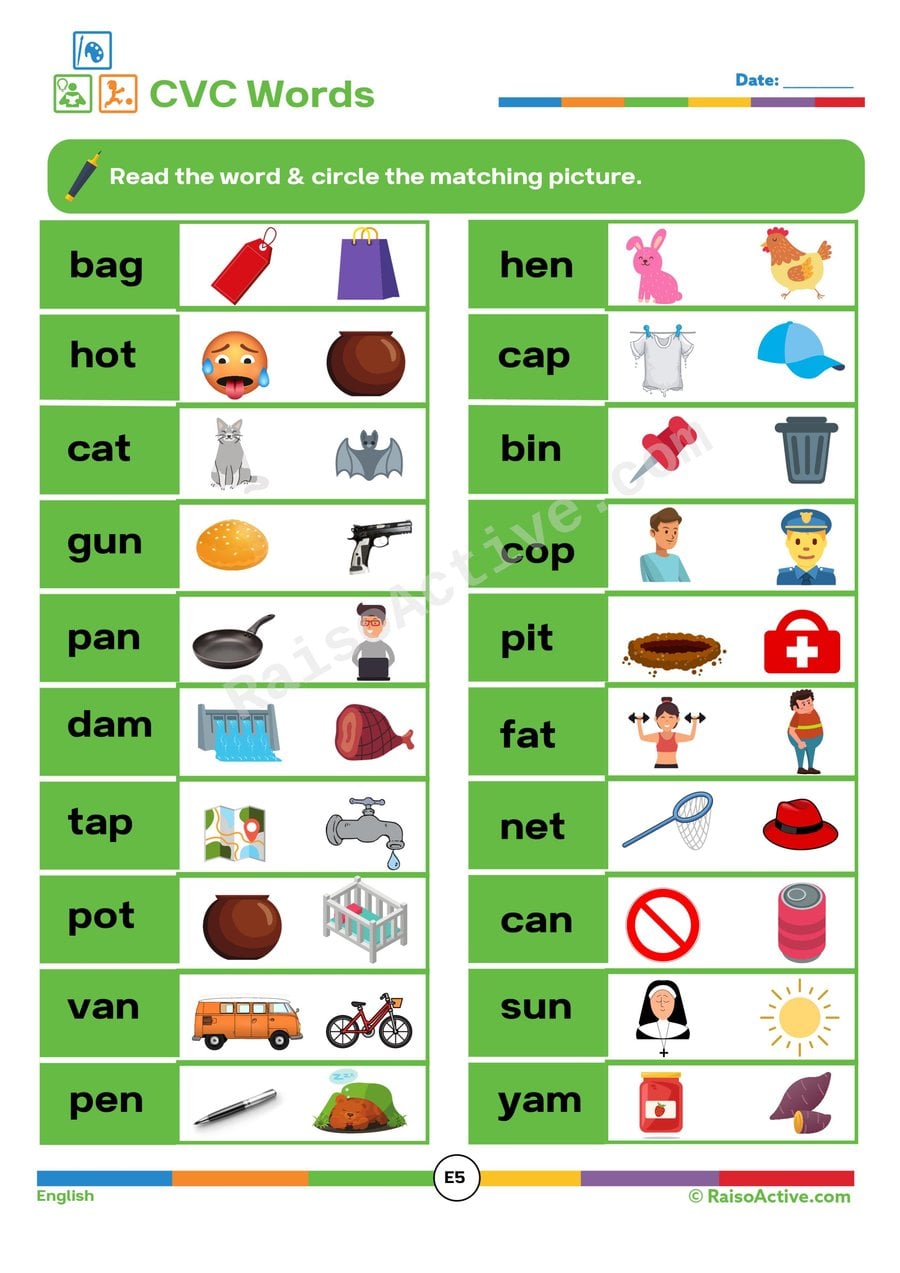
CVC Word Matching Worksheet: Read and Circle!
Sounding out each consonant-vowel-consonant word letter by letter strengthens decoding, and matching that word to its picture connects decoding to meaning — an essential step for children ages 4-6 becoming independent readers.

Y and Z Consonant Sounds Worksheet: Match the Objects!
This worksheet builds beginning-sound recognition for children ages 4-6 with the letters 'y' and 'z', two consonants that appear less frequently at the start of common words, giving children practice with sounds they may hear less often than 's', 't', or 'm'. Matching each picture to its correct starting letter reinforces the sound-symbol connection while also expanding vocabulary, since words like 'yarn' or 'zebra' may be less familiar to young learners. This rounds out a child's coverage of consonant sounds toward full alphabet mastery.

Word Problems Worksheet: Addition Practice for Young Learners
Solving simple addition word problems teaches children ages 4-6 to translate a short story into a number sentence, practicing both reading comprehension and the mechanics of combining two groups into a total.

Numeracy Match: Counting and Number Recognition Worksheet
Children ages 4-6 strengthen number recognition by matching written numerals to their corresponding word names or quantities, reinforcing that numbers can be represented in more than one way. This kind of numeral-to-word matching deepens number sense beyond simple counting, helping children see the relationship between symbol, word, and quantity. Coloring in their birth date personalizes the practice and connects it to something meaningful in their own life.

Word Problems Worksheet: Solving Addition and Subtraction
Solving a mix of addition and subtraction word problems trains children ages 4-6 to decide which operation a story calls for, based on whether it describes combining groups or taking something away, a key reasoning skill before formal equation writing.
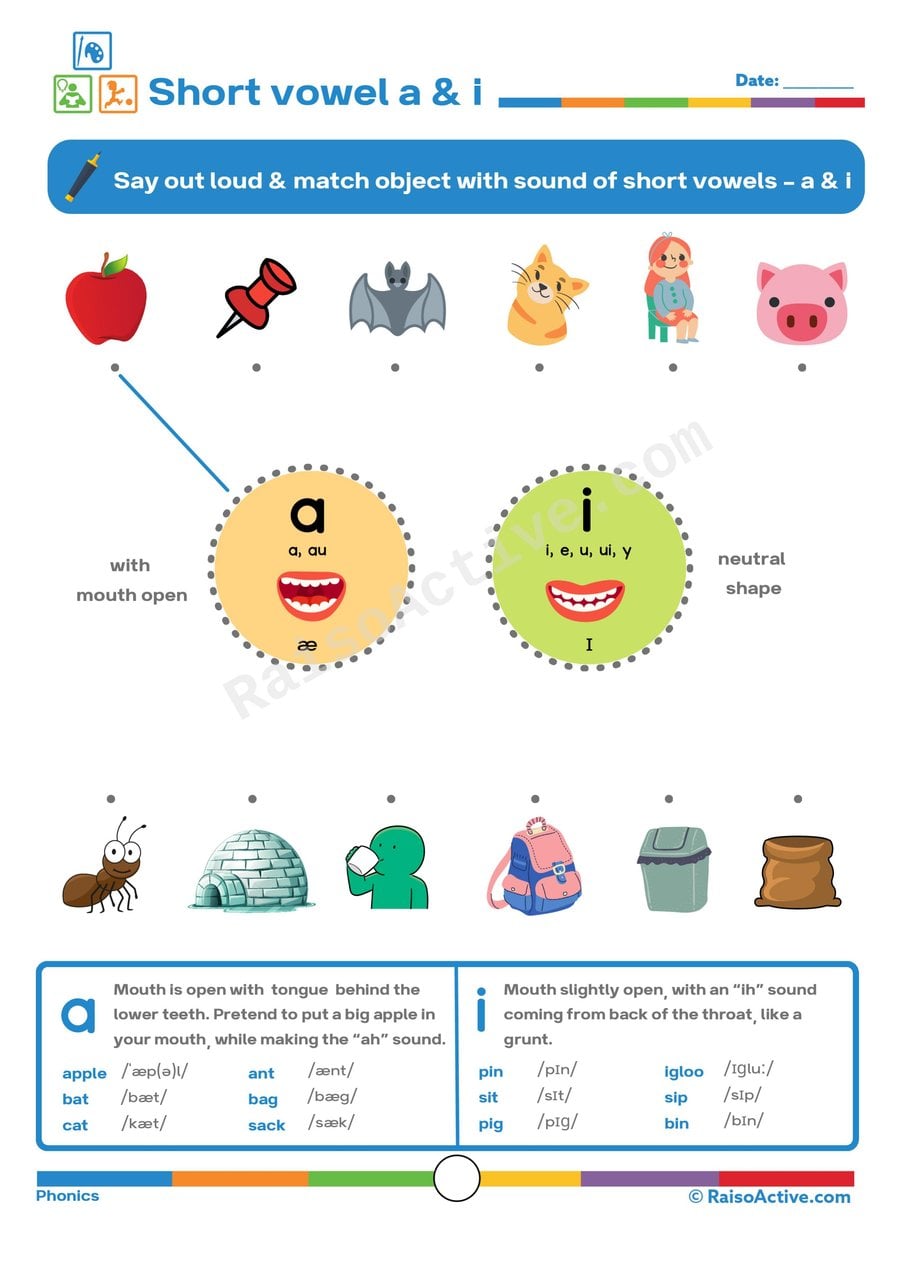
Short Vowel Sounds: Match the Pictures Worksheet
Distinguishing between the short 'a' and short 'i' sounds is a foundational listening skill for children ages 4-6, since these two vowel sounds are easy to confuse and appear constantly in early reading words. This worksheet has children say a word aloud, listen for its vowel sound, and match the picture to the correct sound category, training their ear before they're expected to read or spell independently. Strong auditory discrimination between short vowels directly predicts success decoding CVC words like 'cat' and 'sit' later on.

Internal Organs Worksheet: Find and Match the Body Parts!
Finding organ names hidden in a word search and then cutting and pasting the organs onto the correct spot on a body diagram teaches children ages 4-6 the names and general locations of internal organs, like the heart, lungs, and stomach, introducing basic human biology. Searching the word grid builds visual scanning and word recognition, while the cut-and-paste placement step reinforces spatial understanding of where each organ sits inside the body. Combining a word search with a hands-on placement task gives this worksheet both a literacy and a science learning goal.
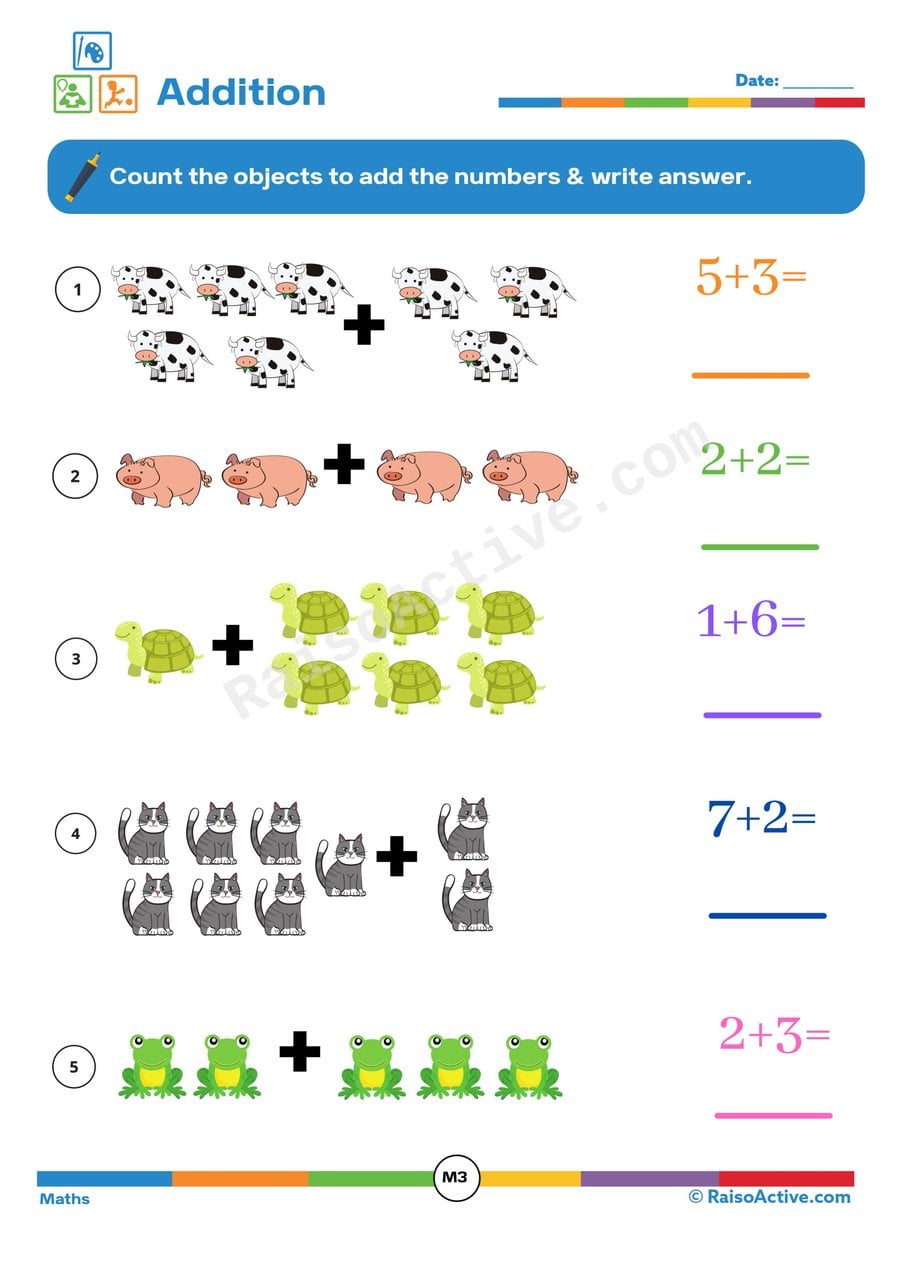
Addition Worksheet: Count and Add Objects!
Counting two groups of pictured objects and writing their combined total introduces children ages 4-6 to addition as a concrete, visual process before they work with numbers alone. Because the objects are drawn out rather than represented only by digits, children can physically point and count to verify their answer, building confidence in early math reasoning. Repeated practice with this picture-based format helps children internalize what a plus sign means before they're expected to solve equations without visual support.
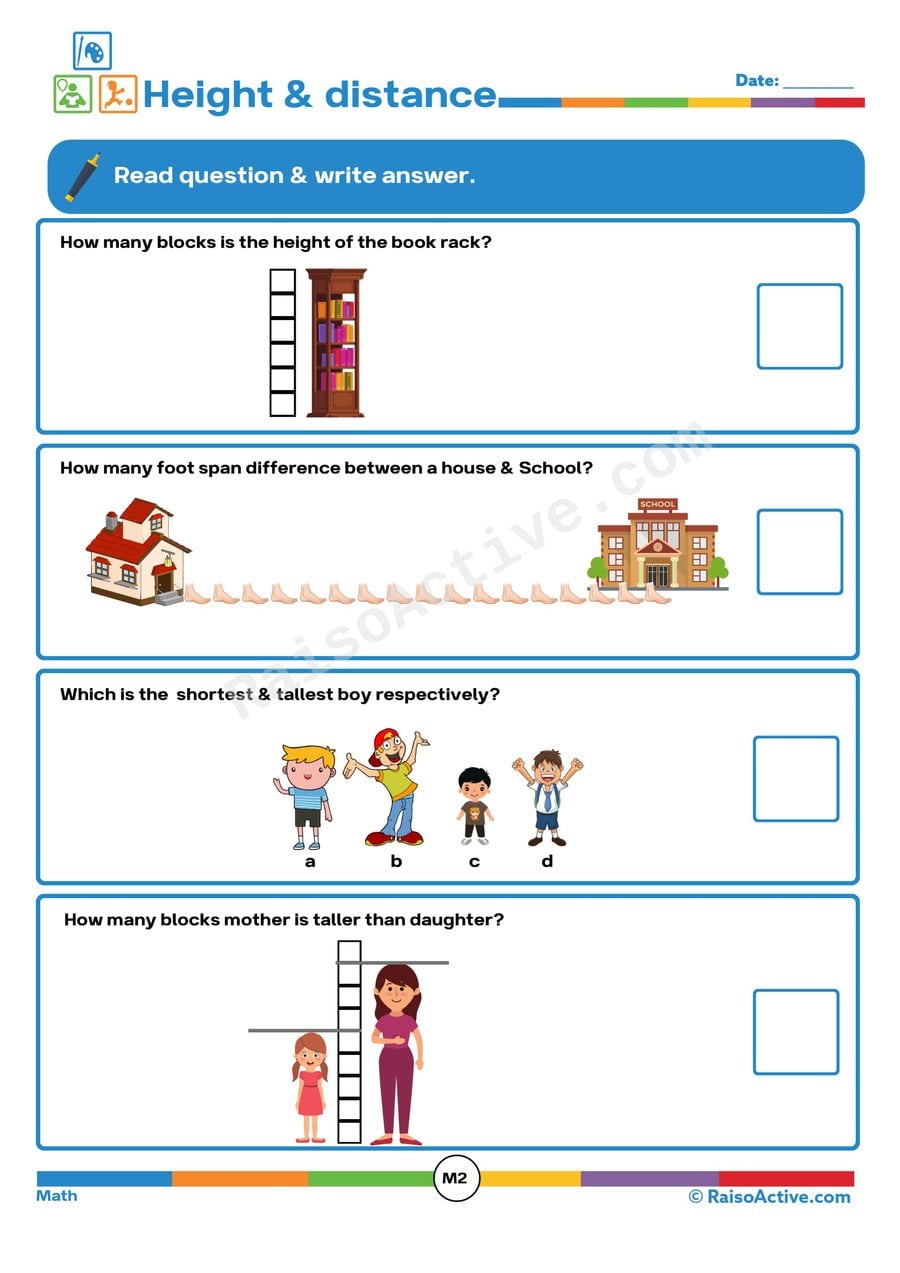
Height and Distance Worksheet for Kids
Children ages 4-6 practice comparing height and distance using visual examples, building early measurement and comparison skills that form the basis for later lessons in math involving length and size. Learning to compare 'taller,' 'shorter,' 'closer,' and 'farther' helps children describe the physical world with more precise language.
The five kindergarten math domains
Common Core organizes kindergarten math into five domains, and the two counting domains carry most of the weight. The critical areas the standards name are representing and comparing whole numbers, initially with sets of objects, and describing shapes and space. Everything else, including measurement, is in service of those two.
- K.CC Counting and Cardinality: count to 100 by ones and tens, count forward from any number, write 0–20, count objects to 20, compare groups and numerals
- K.OA Operations and Algebraic Thinking: add and subtract within 10 with objects, fingers, drawings and equations; decompose numbers to 10; make ten; fluency within 5
- K.NBT Number and Operations in Base Ten: compose and decompose 11–19 as ten ones and some more ones
- K.MD Measurement and Data: describe length and weight, compare two objects, sort into categories and count each
- K.G Geometry: name shapes regardless of size or orientation, 2D versus 3D, describe by sides and corners, build and combine shapes
Ten-frames, number bonds and teen numbers
A ten-frame is a two-by-five grid that shows any number to 10 as filled and empty spaces, so 7 is visibly 5 and 2, or 10 take away 3. Kindergarten uses it for subitizing, for addition and subtraction within 10, and then for teen numbers: a full frame plus 4 more is 14. Number bond diagrams (a whole with two parts) do the same job in a different form. Sheets that use both, before any bare equations, match how classrooms teach.
How to use these worksheets at home
Count real things every day before touching a worksheet: stairs, crackers, cars in the parking lot. When you sit down with a sheet, give your child ten counters or coins so every problem can be built first. Ask 'how do you know?' rather than 'is that right?', because explaining the strategy is the skill. Ten to fifteen minutes, three or four days a week, is plenty. If counting past 12 is shaky, stay there; the teens take time.
Frequently asked questions
What math should a child know by the end of kindergarten?
By the end of kindergarten a child should count to 100 by ones and tens, count on from any number below 100, write numerals 0 to 20, count up to 20 objects accurately, compare two groups and two numerals, add and subtract within 10 and do so fluently within 5, understand teen numbers as ten and some ones, compare lengths and weights, sort objects, and name and describe common 2D and 3D shapes.
What is K.CC in Common Core?
K.CC is the Counting and Cardinality domain of the kindergarten math standards. It has seven standards in three clusters: know number names and the count sequence (count to 100, write to 20), count to tell the number of objects (one-to-one correspondence, cardinality, counting out a given number), and compare numbers (more, fewer, equal, and comparing written numerals to 10). It is the foundation for everything in first grade math.
Should kindergartners memorize addition facts?
Common Core asks for fluency within 5 only (K.OA.5), meaning quick and accurate recall of facts like 2 + 3 and 4 − 1. Facts within 10 are solved with objects, drawings, fingers and ten-frames, and fluency within 10 is a first grade goal. Timed drills of facts to 10 are not expected in kindergarten; understanding that 7 can be made from 5 and 2, 6 and 1, or 3 and 4 is.
How do you teach teen numbers in kindergarten?
K.NBT.1 asks children to see 11 through 19 as a group of ten and some ones, using objects and drawings and an equation such as 14 = 10 + 4. Ten-frames make this concrete: one full frame plus some counters in a second. The teen number names in English are irregular (eleven, twelve, thirteen), so plenty of oral counting and writing the numerals alongside the ten-frame pictures both matter.
What is the difference between kindergarten math and 1st grade math?
Kindergarten math stays within 10 for operations, counts to 100, and introduces teen numbers as ten and ones. First grade extends addition and subtraction to 20 with fluency to 10, adds place value with tens and ones to 120, two-digit addition, comparison symbols, time to the half hour and simple graphs. Kindergarten sheets have pictures on every item; first grade sheets rely more on numerals and equations.

Written by
Hemsweta Jain · Teacher Cheena
MBA and Early Childhood Educator, teaching since 2014 · Founder of RaisoActive, Mumbai
Written and reviewed by Hemsweta Jain (Teacher Cheena), who designs every RaisoActive worksheet.
Last reviewed
Printable packs for ages 5–6
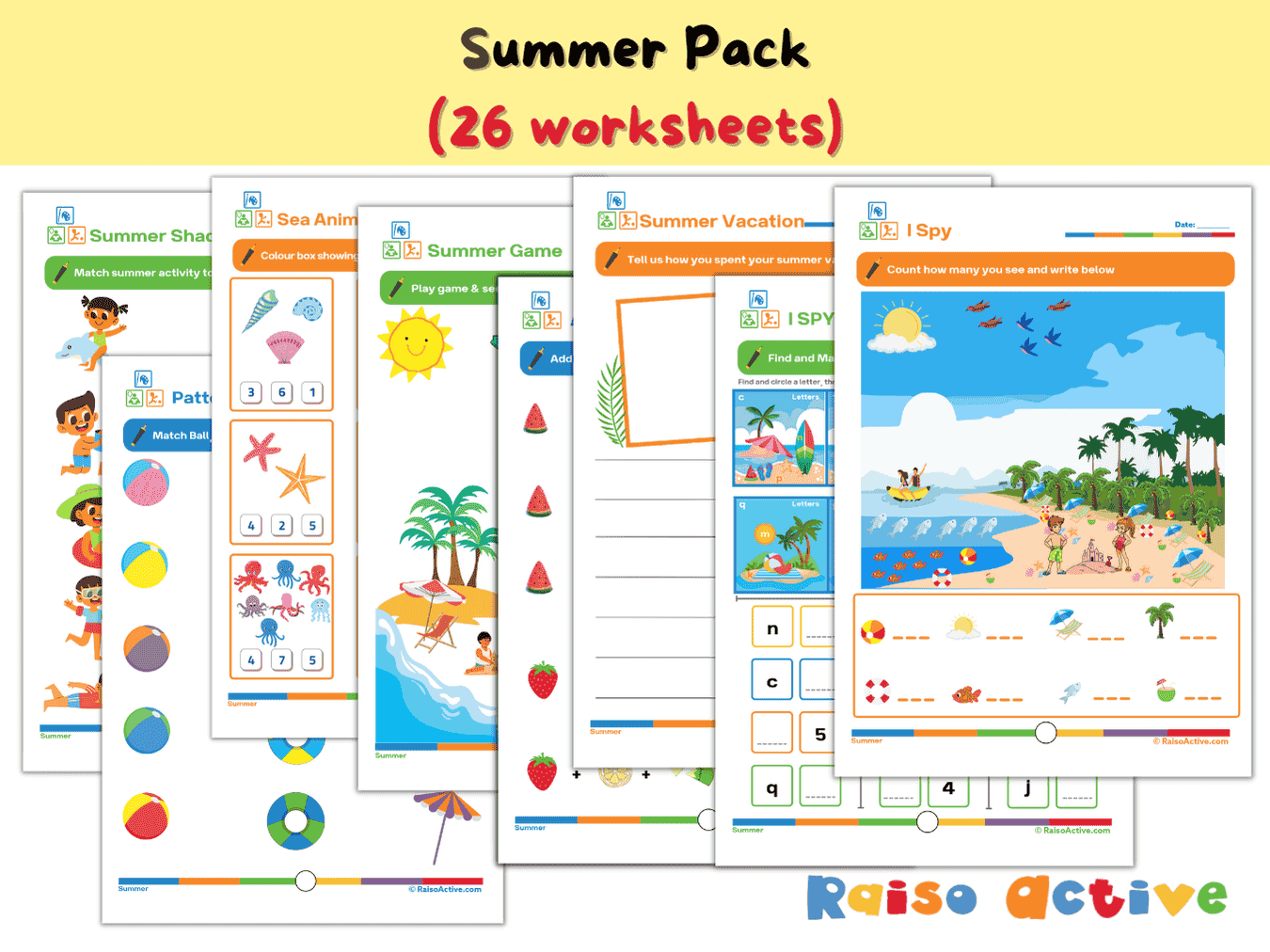
Summer Activity Pack: Math, Literacy, Puzzles & More for Preschool & Kindergarten
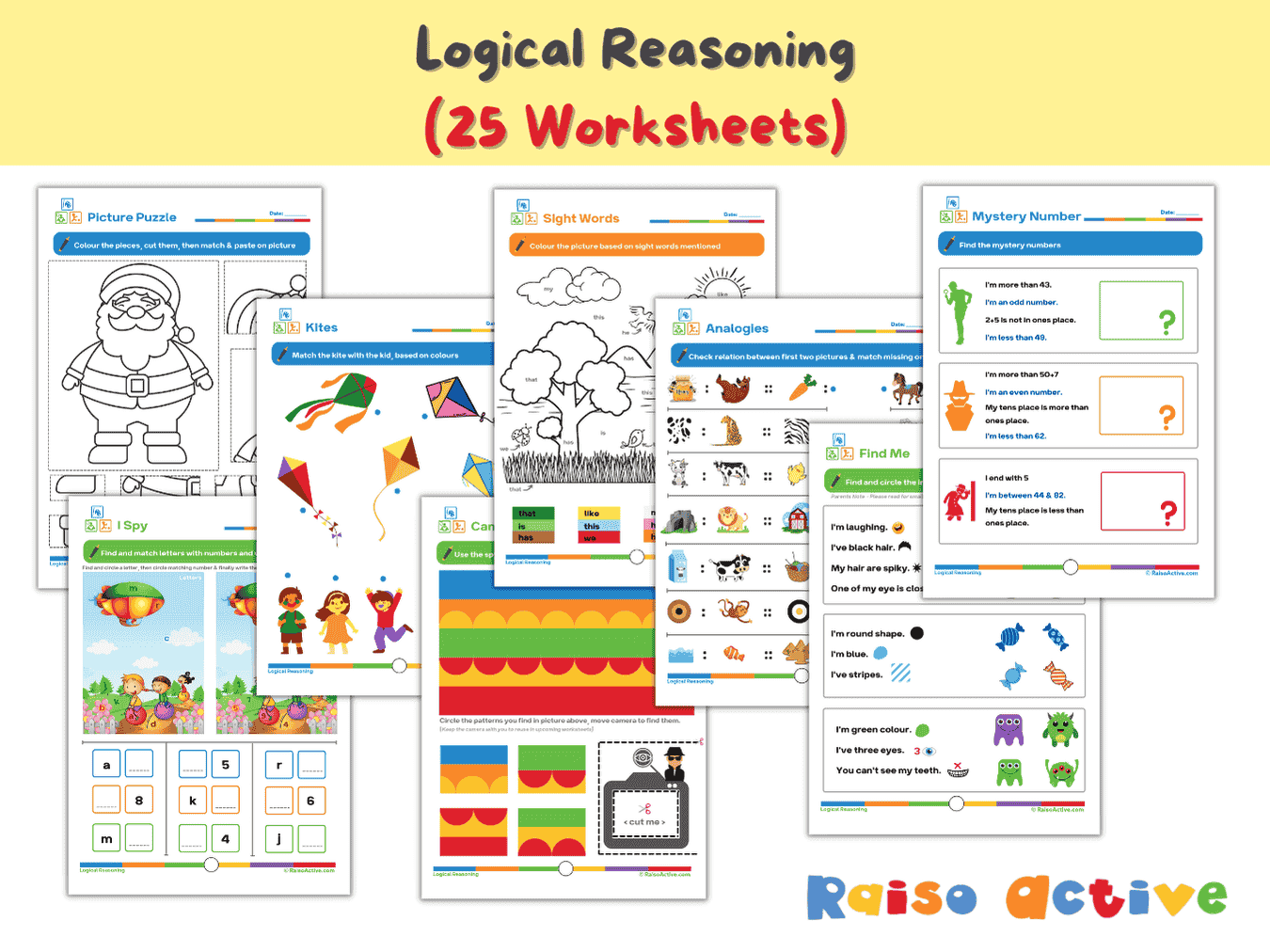
Logical Reasoning Activity Book for Preschool & Kindergarten | Patterns, Puzzles & Analogies
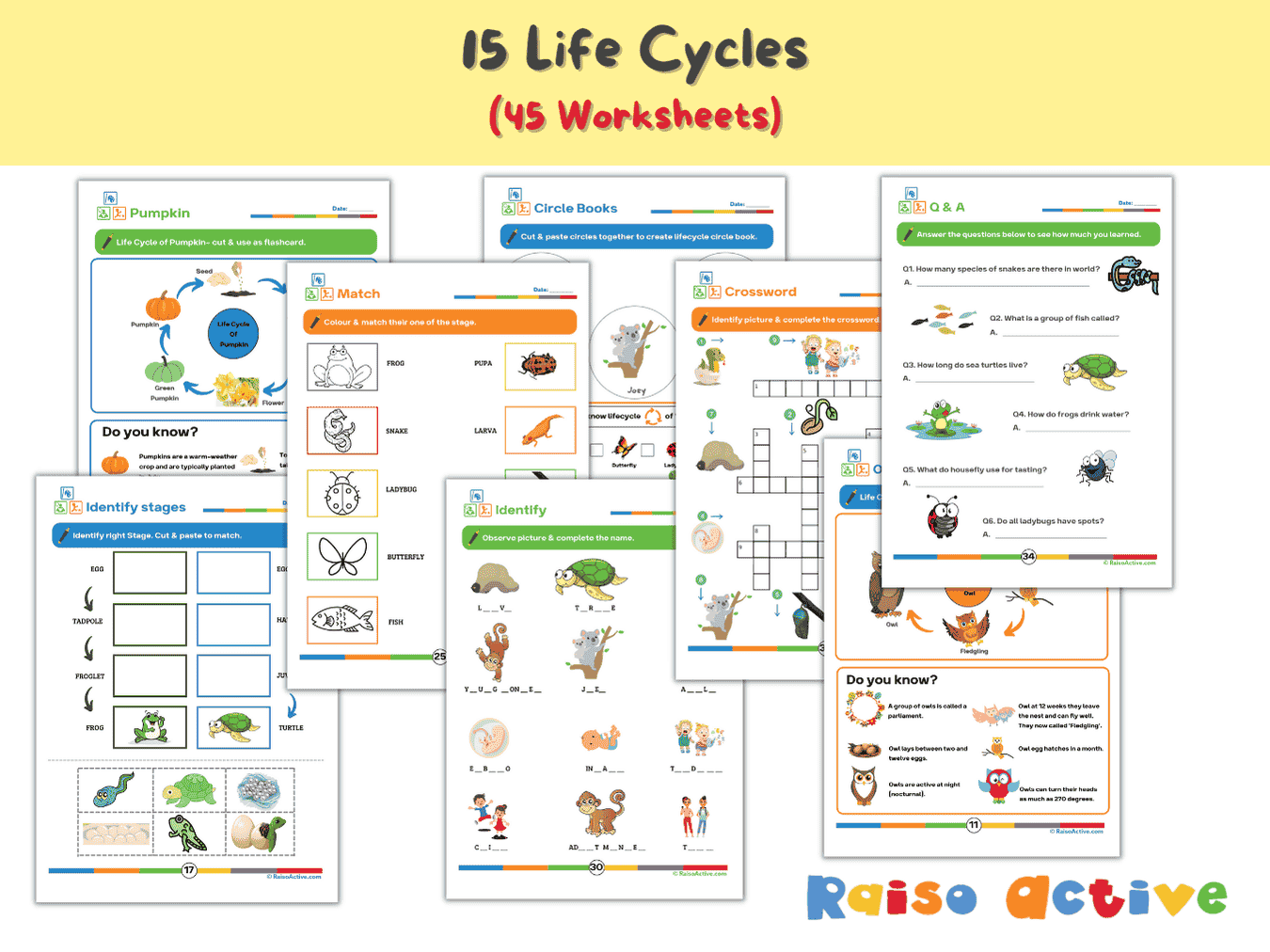
Lifecycles Activity Book & Flashcards for Preschool & Early Elementary
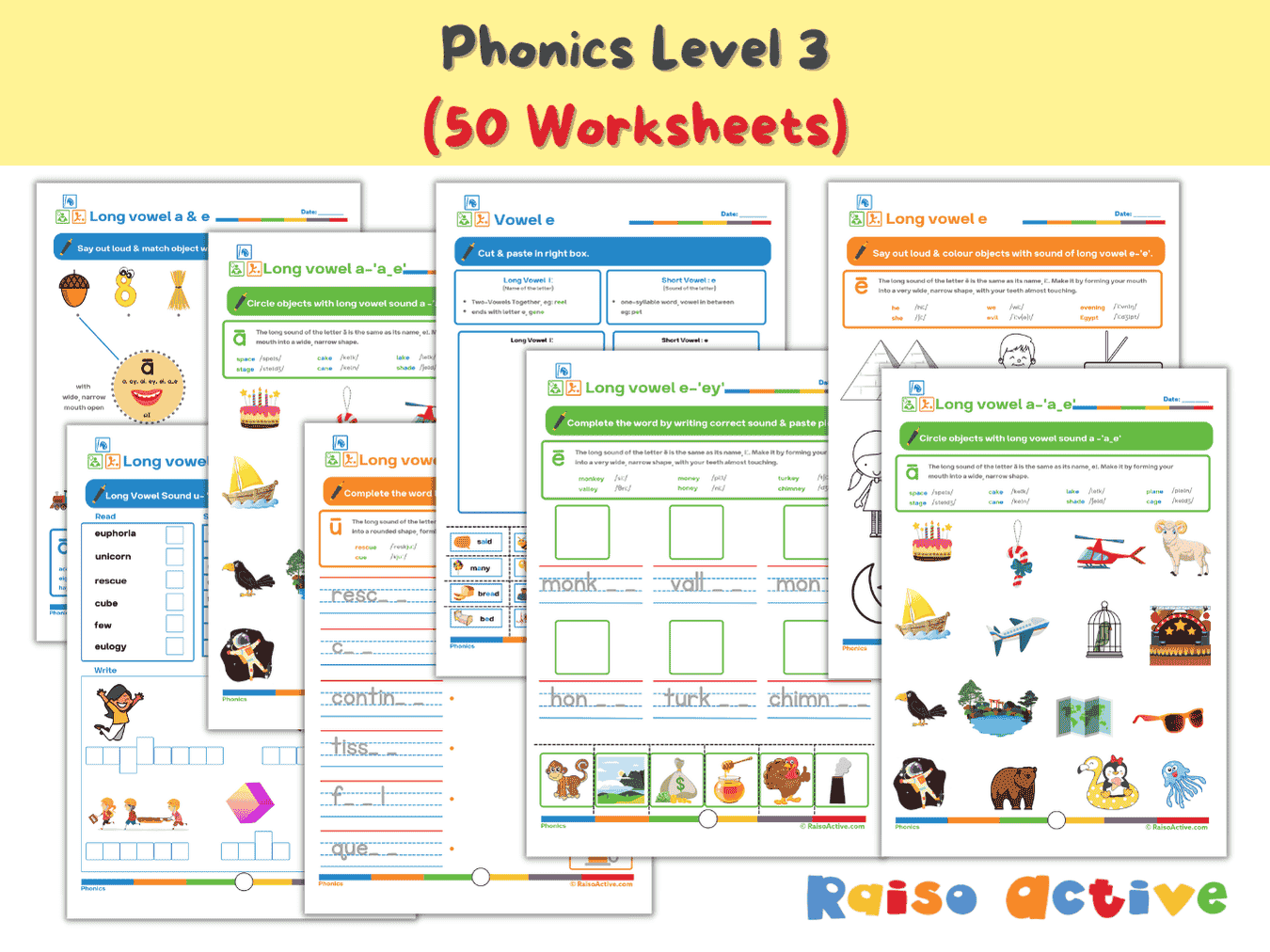
Phonics Level 3 Long Vowels Activity Book for Kindergarten & 1st Grade
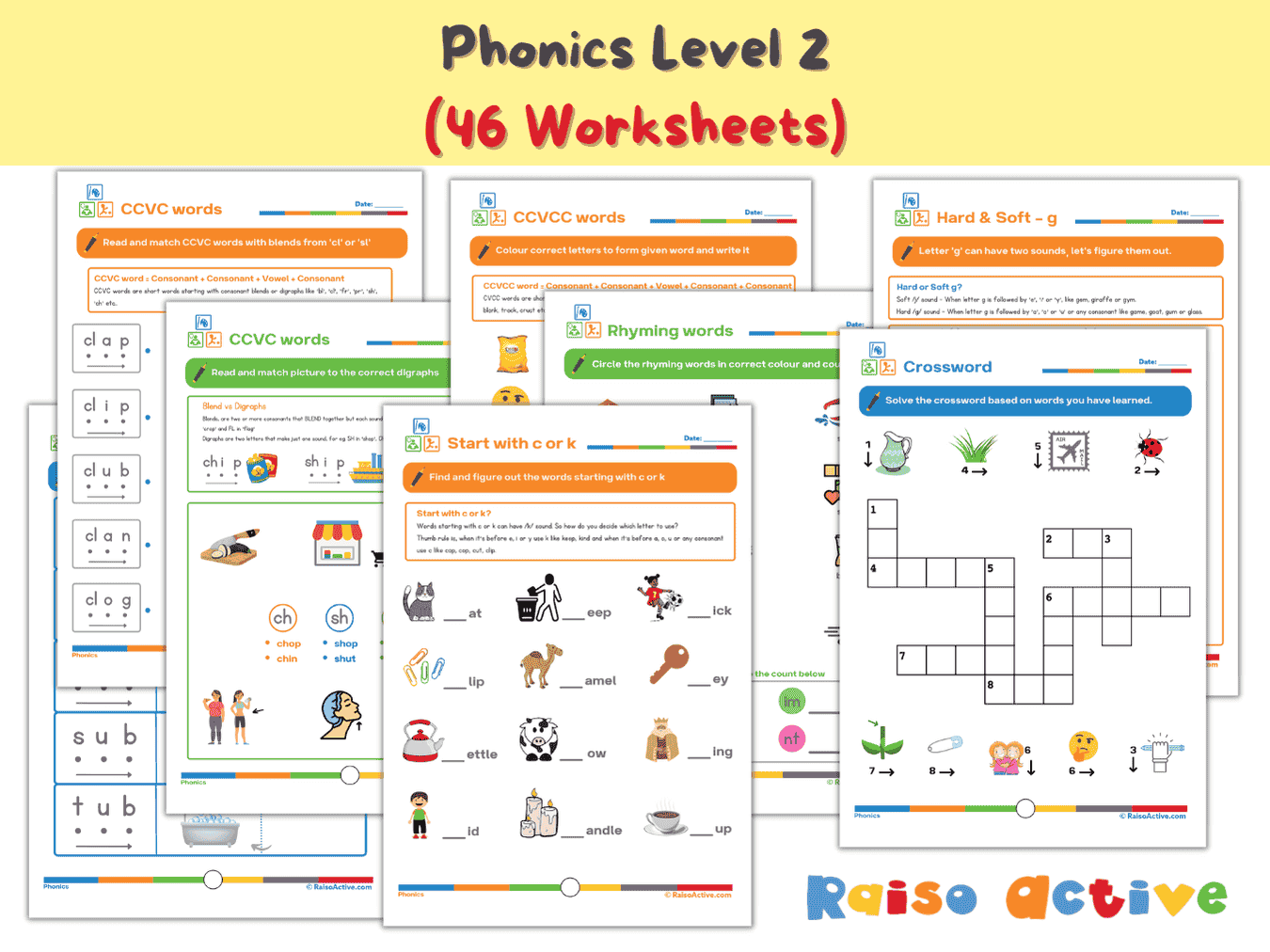
Phonics Level 2 Worksheets: CVC, CCVC, CVCC Word Families & Blends for Early Readers (Ages 4-7)
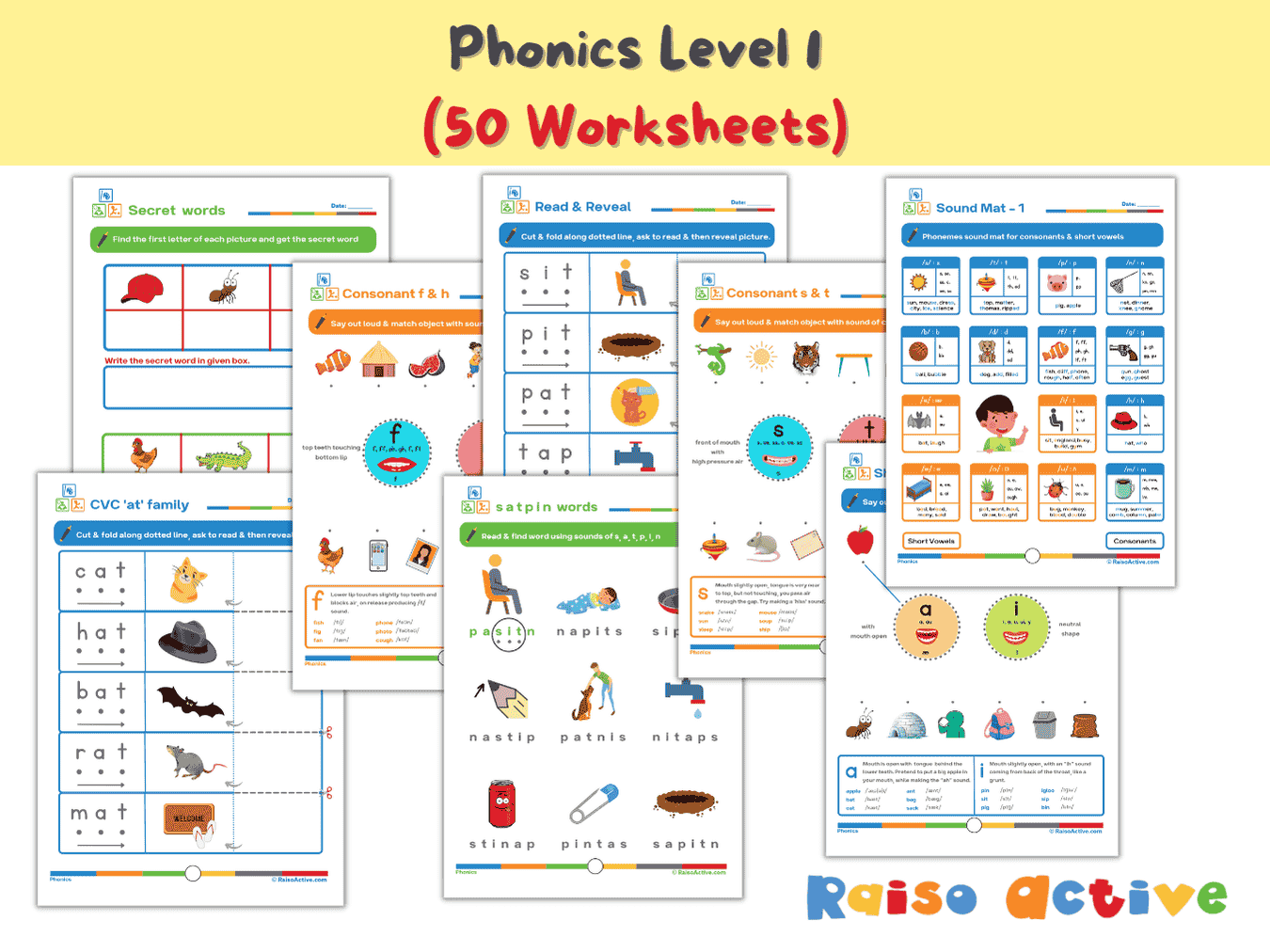
Phonics Level 1 Activity Book: Letter Sounds, Blending & CVC Words for Preschool & Kindergarten
Guides for parents and teachers
See all guides →Number Formation Rhymes 0–9 and How to Fix Reversals
Original number formation rhymes for 0–9, the correct stroke order for each digit, why 3, 5 and 7 get reversed most often, and multisensory fixes that work.
UKG Syllabus Explained: English, Maths and EVS Month by Month
What UKG classes typically cover in English, maths and EVS, month by month, aligned to NEP 2020, with ways to support at home and signs your child is behind.
Christmas and Winter Activities That Combine Fun and Learning: Creating Magical Educational Experiences
Discover Christmas and winter activities that combine festive fun with real learning. Crafts, counting, literacy, and printable worksheets for ages 2 to 8 — perfect for home and school.
Age-Appropriate Halloween Learning Activities: Balancing Spooks and Skills for Young Learners
Discover fun, age-appropriate Halloween learning activities for young children. Spooky crafts, counting games, literacy ideas, and printable worksheets for ages 2 to 8.
The Power of Music: How Musical Activities Accelerate Learning Development in Young Children
Discover how musical activities accelerate brain development, phonics, maths, and emotional regulation in children ages 1–8. Practical tips for Indian homes and classrooms.
What's the Best Alternative to ABCmouse? A Complete Parent's Guide to Free and Affordable Educational Apps
ABCmouse runs ~Rs 4,000-5,000/year with US spellings and curriculum. Compare free & affordable Indian-friendly apps like Khan Academy Kids and DIKSHA.
Canonical: https://raisoactive.com/worksheets/kindergarten-math