Number Names Worksheet: Unscramble, Match, and Write Numbers!
This worksheet layers three literacy and numeracy skills together: unscrambling jumbled letters to spell out number names, writing the corresponding numeral, and matching numbers to their written names. For ages 4-6, connecting a numeral like '5' to its written word 'five' bridges math and reading skills, reinforcing that numbers can be represented in more than one way.
Part of the pack
Month 6: Holistic early learning activities | Ages 5-6
This is page 20 of the pack. Ages 5-6 · KindergartenAges 5-6 · Year 1Ages 5-6 · UKGAges 5-6

Made for your child
Counting to 10, made for your child
A maths pack with your child's name in it: pictures that explain, practice at three levels, puzzles and story sums about them. Print a new set whenever they finish.
Make a maths packFree preview · free for members
Curriculum
- Number Recognition > Number Names
How to use this worksheet
Look at the first scrambled word together, reading the jumbled letters aloud and figuring out which number name they spell when rearranged correctly. Have your child write the unscrambled number name in the space provided, then write the matching numeral in the box beside it. Move through each remaining scrambled word the same way, unscrambling, writing the word, and writing the numeral. Finish with the matching section, where your child draws lines connecting numerals to their correct written number names.
Materials needed
- Pencil
- Eraser
Extension activities
- 1Have your child draw the correct number of objects to match one of the number names they unscrambled.
- 2Create new scrambled number name puzzles together for your child to solve.
- 3Practice writing each number name in a full sentence, like 'I have five apples.'
- 4Make flashcards pairing numerals with their written names for a quick matching review.
- 5Play a game saying a number name aloud and having your child write both the word and the numeral.

Written by
Hemsweta Jain · Teacher Cheena
MBA and Early Childhood Educator, teaching since 2014 · Founder of RaisoActive, Mumbai
Every RaisoActive worksheet is designed and checked by the founder before publishing.
Published · Last reviewed
More from Month 6: Holistic early learning activities | Ages 5-6

Subtraction Worksheet: Count and Subtract for Preschoolers
Ages 4-5 · Pre-KAges 4-5 · ReceptionAges 4-5 · LKGAges 4-5
This worksheet introduces basic subtraction by having children count a starting group of objects, remove or cross out a specified number, and count what remains to find the answer. For ages 4-5, grounding subtraction in physical counting rather than abstract numbers alone helps children understand that subtraction means 'taking away' a quantity, not just manipulating symbols.

Jump into Learning: Sight Word 'Jump' Worksheet for Preschoolers
Ages 4-5 · Pre-KAges 4-5 · ReceptionAges 4-5 · LKGAges 4-5
This worksheet builds sight word recognition for the word 'jump' through several different activities, tracing, coloring, finding it in a list, connecting letters, and cutting and pasting, giving children multiple ways to encounter and memorize the same word. For ages 4-5, repeated exposure to a high-frequency word across varied formats is one of the most effective ways to build automatic word recognition, a key building block of fluent reading.

Parent's Guide: Fun Activities for Early Learners
Ages 3-5 · Preschool–Pre-KAges 3-5 · Nursery–ReceptionAges 3-5 · Nursery–LKGAges 3-5
This parent's guide offers a set of activities spanning literacy, sequencing, and early addition, giving caregivers several ready-to-use options for building foundational skills through everyday play. For ages 3-5, rotating between different skill areas, like rhyming games and simple math card games, keeps early learning varied and prevents any one skill from feeling repetitive or tedious.

Draw a Penguin! Step-by-Step Drawing Worksheet for Kids
Ages 3-5 · Preschool–Pre-KAges 3-5 · Nursery–ReceptionAges 3-5 · Nursery–LKGAges 3-5
This worksheet builds drawing confidence and fine motor control by breaking down how to draw a penguin into simple, sequential steps that a young child can follow one at a time. For ages 3-5, step-by-step drawing teaches children that a complex image can be built from a series of simple shapes, an approach that transfers to drawing other subjects later on.

Nature Color by Number Worksheet: Addition and Subtraction Fun!
Ages 4-6 · Pre-K–KindergartenAges 4-6 · Reception–Year 1Ages 4-6 · LKG–UKGAges 4-6
This worksheet combines addition and subtraction practice with a color-by-number format, requiring children to solve simple math problems and then use a color key to reveal a nature-themed picture. For ages 4-6, embedding math practice within a creative, rewarding coloring activity keeps motivation high through problems that might otherwise feel repetitive on their own.

Parts of a Plant Crossword Puzzle Worksheet for Kids
Ages 3-5 · Preschool–Pre-KAges 3-5 · Nursery–ReceptionAges 3-5 · Nursery–LKGAges 3-5
This worksheet introduces basic plant biology vocabulary, flower, leaf, stem, root, and fruit, by having children use picture clues to complete a crossword puzzle. For ages 3-5, connecting a picture of a specific plant part to its written name builds early science vocabulary alongside letter and spelling recognition through the crossword format.
Match the Country Symbols Worksheet for Kids
Ages 4-6 · Pre-K–KindergartenAges 4-6 · Reception–Year 1Ages 4-6 · LKG–UKGAges 4-6
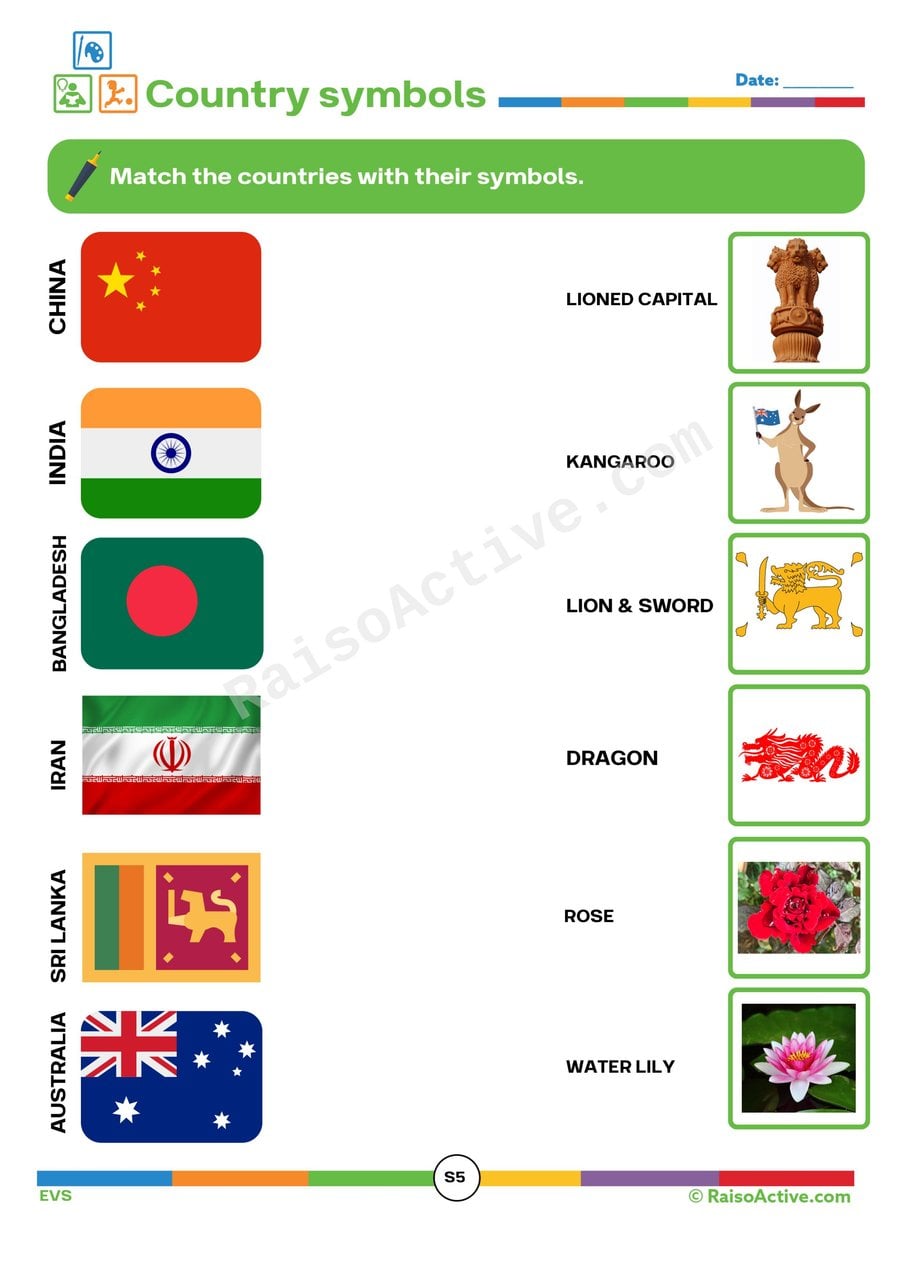
Matching country flags to their national symbols introduces children ages 4-6 to the idea that countries have their own distinct visual identities, an early and engaging entry point into geography and cultural awareness. This matching task builds visual discrimination, since flags and symbols can share similar colors or shapes that require careful comparison. Learning to associate a flag with a symbol also plants early vocabulary for talking about different countries and cultures around the world.
Pizza Path: Numbers 51-60 Worksheet for Kids
Ages 4-5 · Pre-KAges 4-5 · ReceptionAges 4-5 · LKGAges 4-5
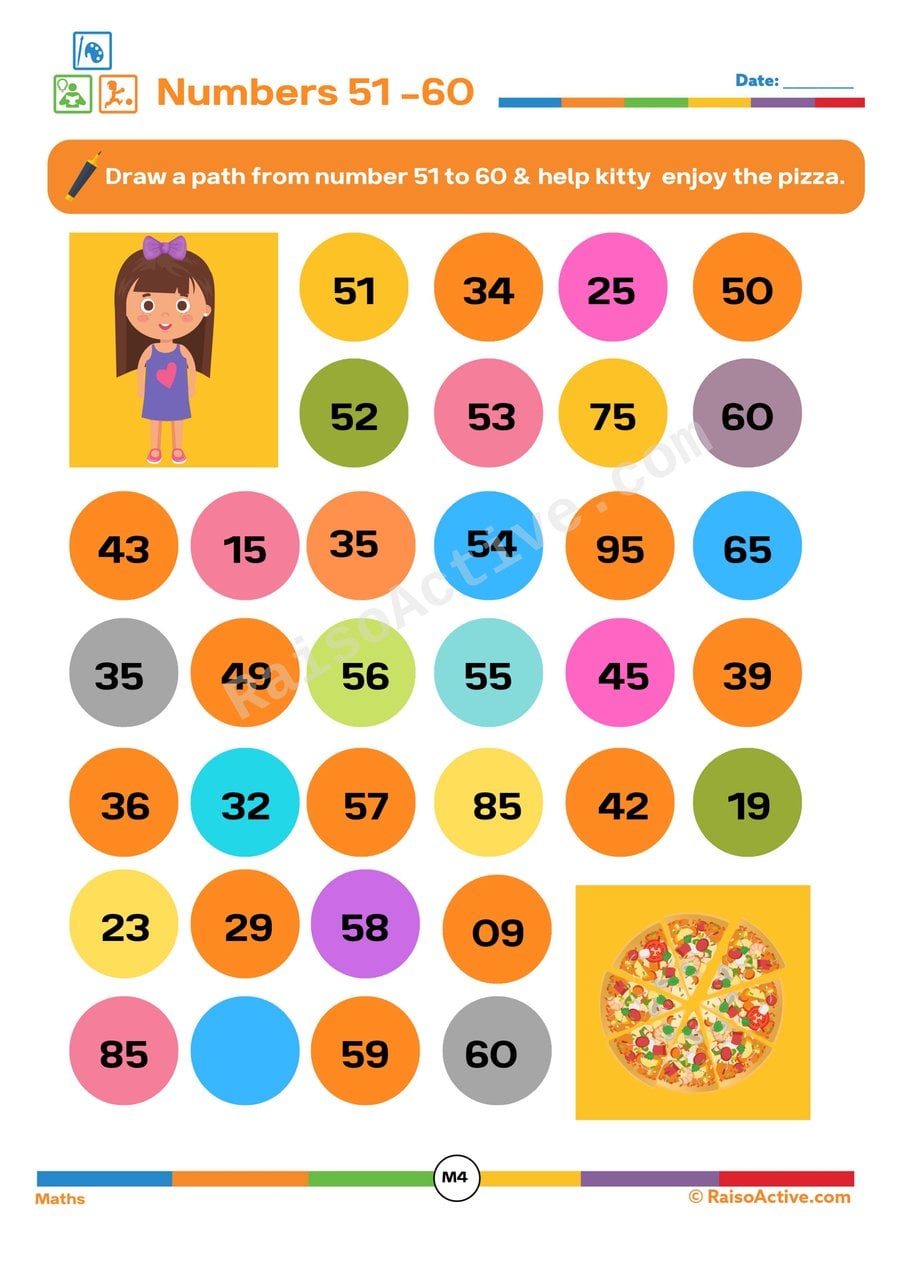
Connecting the dots from 51 to 60 in order pushes children ages 4-5 beyond the more familiar 1-20 range, helping them recognize two-digit numbers and understand that counting sequences continue predictably into higher decades. This dot-to-dot format turns number recognition into a rewarding visual payoff, since a hidden pizza picture only appears once every number is found and connected correctly. It's a motivating way to practice number order without it feeling like repetitive drilling.
Related worksheets

Number Names Worksheet: Trace, Count, and Match Numbers 1-5!
Ages 3-5 · Preschool–Pre-KAges 3-5 · Nursery–ReceptionAges 3-5 · Nursery–LKGAges 3-5
Tracing, counting, and matching number names for 1 through 5 helps children ages 3-5 connect three different representations of the same quantity — the written word, the numeral, and a countable group of objects. Building this three-way connection early strengthens overall number sense and makes it easier to recognize numbers in whatever form they appear later, whether written as words or digits.
Count and Paste! Tens and Ones Worksheet
Ages 4-6 · Pre-K–KindergartenAges 4-6 · Reception–Year 1Ages 4-6 · LKG–UKGAges 4-6
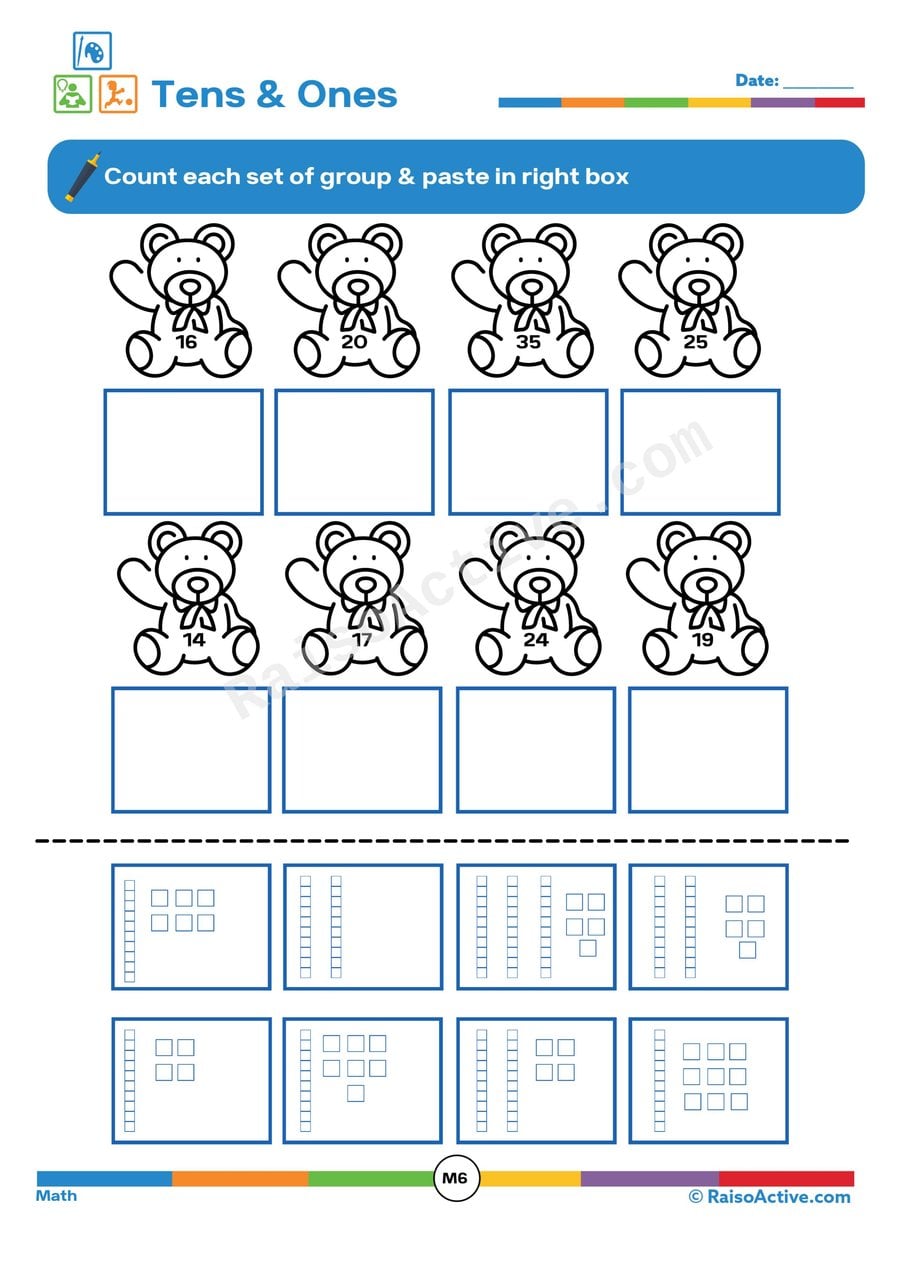
Counting groups of teddy bears and then matching each total to its tens-and-ones representation teaches children ages 4-6 to connect a counted quantity with its place value breakdown, reinforcing that numbers can be represented in more than one way. Cutting and pasting the matching representation adds fine motor practice to the counting and place value work.

Number Names Worksheet: Write the Missing Letters!
Ages 4-6 · Pre-K–KindergartenAges 4-6 · Reception–Year 1Ages 4-6 · LKG–UKGAges 4-6
This worksheet builds early spelling and number-word recognition as children ages 4-6 look at a numeral and fill in the missing letters to complete its written name, such as turning 'f_ve' into 'five.' Connecting the numeral, the spoken word, and its written spelling all in one task strengthens both literacy and numeracy at the same time.

Number Names Worksheet: Matching and Writing Numbers
Ages 4-6 · Pre-K–KindergartenAges 4-6 · Reception–Year 1Ages 4-6 · LKG–UKGAges 4-6
This worksheet strengthens the connection between a written number name and its numeral for 4-6 year olds — first by circling the numeral that matches a given name, then by writing the number name out themselves, which adds a spelling and handwriting layer on top of simple recognition. Because number-name spelling doesn't always follow easy sound-out rules, this repeated practice with both reading and writing the words builds genuine sight-word familiarity with number vocabulary.

Number Names Matching Worksheet for Preschoolers
Ages 3-5 · Preschool–Pre-KAges 3-5 · Nursery–ReceptionAges 3-5 · Nursery–LKGAges 3-5
This worksheet helps children ages 3-5 connect written number words — like 'three' or 'seven' — to their matching numerals, an important step beyond simple numeral recognition toward full number literacy. Drawing a line from a number name to the numeral it stands for requires children to read or recall the word and hold it in mind while scanning for its match, which builds working memory alongside early reading and number skills.

Number Names Matching Worksheet for Preschoolers
Ages 3-5 · Preschool–Pre-KAges 3-5 · Nursery–ReceptionAges 3-5 · Nursery–LKGAges 3-5
This worksheet helps children ages 3-5 connect written number names, like 'three' or 'seven,' to the numeral they represent, an important step beyond simply recognizing digits since it introduces reading actual number words. Decoding a color clue to figure out and write each number name first adds an extra layer of visual attention before the matching step even begins.

Tens and Ones Worksheet: Counting and Place Value Practice!
Ages 4-6 · Pre-K–KindergartenAges 4-6 · Reception–Year 1Ages 4-6 · LKG–UKGAges 4-6
This worksheet introduces children ages 4-6 to place value by having them look at a two-digit number, break it into groups of ten and single ones, and represent each group by drawing the matching number of crayons. Understanding that '23' means two full groups of ten plus three more is a foundational concept for all later multi-digit addition, subtraction, and number sense.

Number Names Worksheet: Addition Practice for Kids
Ages 4-6 · Pre-K–KindergartenAges 4-6 · Reception–Year 1Ages 4-6 · LKG–UKGAges 4-6
This worksheet combines addition practice with number-word writing for children ages 4-6, asking them to solve simple addition problems and then spell out the answer using its written name rather than a numeral. Requiring the answer in word form pushes children beyond calculation into applying number vocabulary correctly, reinforcing that 'seven' and '7' represent the same value. This dual task builds both math fluency and early spelling skills together.
Guides for this topic

Number Formation Rhymes 0–9 and How to Fix Reversals
Original number formation rhymes for 0–9, the correct stroke order for each digit, why 3, 5 and 7 get reversed most often, and multisensory fixes that work.

Best Worksheets for 3-Year-Olds: What Works and What to Avoid
What works on worksheets for 3-year-olds: short sessions, crayons, tracing lines, matching, cutting, a free weekly plan, and signs one is too advanced.
Documenting Learning Without Drowning in Data: A Practical Guide for Parents and Teachers
Learn practical ways to document your child's learning without overwhelm. Simple portfolios, observation tips, and printable trackers for ages 1-8.
Reviews
Every worksheet for ages 4–6, no watermark
Members download the full library of 1,000+ worksheets and every activity pack without watermarks or daily limits. One year costs ₹999 in India or $20 elsewhere.
See membership plansOr download any worksheet free with a watermark (5 a day).