Free printable worksheets · US · UK · India
Pattern Writing Worksheets (Pre-Writing Strokes)
Pattern writing worksheets, also called pre-writing stroke worksheets, are tracing sheets for children aged 3 to 5 that practice the lines and curves letters are built from: standing (vertical) lines, sleeping (horizontal) lines, slanting lines, curves, loops, zigzags and waves. They develop pencil grip, hand control, left-to-right direction and the stroke memory needed for letter formation.
Every letter in print or cursive is a combination of a few strokes: a standing line, a sleeping line, a slant, a curve, a loop. Pattern writing worksheets isolate those strokes so a child can master them one at a time before letters ask for all of them at once. Indian Nursery and LKG teachers call this "pattern writing"; UK Reception and US Preschool teachers call it "pre-writing strokes" or "mark making", but the sheets are the same. The progression runs from thick, widely spaced lines for two- and three-year-olds to fine, closely spaced rows by age five, then continuous cursive loops and waves for six- and seven-year-olds. A child who can copy a circle, a cross and a square is typically ready to start.
- 150 worksheets
- Free PDF download
- Print on A4 or Letter
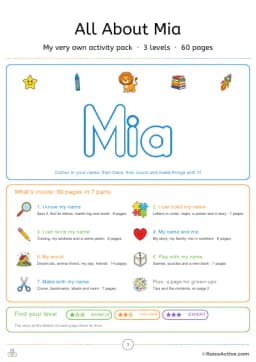
Made for your child
A whole activity pack made with their name
60 pages to spot, build, trace and write their own name, plus pages about their favourites, feelings and family. See a free preview with their name.
Make an All About Me packFree preview · free for members
Or start free: a name tracing sheet with their namePattern Writing Worksheets to print
Browse all worksheets for ages 3–5
Pattern Power! What Comes Next? Worksheet for Preschoolers
Ages 3-5 · Preschool–Pre-KAges 3-5 · Nursery–ReceptionAges 3-5 · Nursery–LKGAges 3-5
This worksheet builds pattern recognition, an early algebraic thinking skill, as children ages 3-5 study a repeating sequence of shapes, letters, or numbers and figure out what belongs next. Spotting what repeats and predicting what comes after it trains logical reasoning and attention to detail that later transfers directly to math sequences and number patterns.

Simple Pattern Worksheet for Preschoolers: Fill in the Sequence!
Ages 3-5 · Preschool–Pre-KAges 3-5 · Nursery–ReceptionAges 3-5 · Nursery–LKGAges 3-5
Recognizing and continuing a pattern is one of the earliest building blocks of mathematical and logical thinking for children ages 3-5, since it requires noticing a repeating rule and predicting what comes next based on that rule. This worksheet uses both shapes and numbers to build pattern awareness, asking children to fill in missing elements in a sequence and then match related number sequences together. Pattern recognition like this underpins later skills in math, reading, and even everyday problem-solving, since spotting repeating structures is a skill that transfers well beyond this one worksheet.
Sun Ray Tracing Worksheet for Preschoolers
Ages 3-5 · Preschool–Pre-KAges 3-5 · Nursery–ReceptionAges 3-5 · Nursery–LKGAges 3-5
Tracing sun rays radiating outward from a circular center gives children ages 3-5 practice changing pencil direction repeatedly within one page, since each ray points a different way from the center, unlike a worksheet where every line runs the same direction. This builds flexible wrist and hand control, along with early spatial awareness of how lines can radiate outward from a single point.

Sleeping Line Worksheet: Help the Cars Drive Straight!
Ages 3-5 · Preschool–Pre-KAges 3-5 · Nursery–ReceptionAges 3-5 · Nursery–LKGAges 3-5
This worksheet helps children ages 3-5 develop pencil control and hand steadiness by tracing horizontal, 'sleeping' lines that guide toy cars straight along a road. Practicing horizontal line tracing is one of the essential prewriting strokes, since many letters and numbers rely on the same steady, left-to-right hand motion this worksheet trains.
Easter Egg Patterns Worksheet for Preschoolers
Ages 3-5 · Preschool–Pre-KAges 3-5 · Nursery–ReceptionAges 3-5 · Nursery–LKGAges 3-5
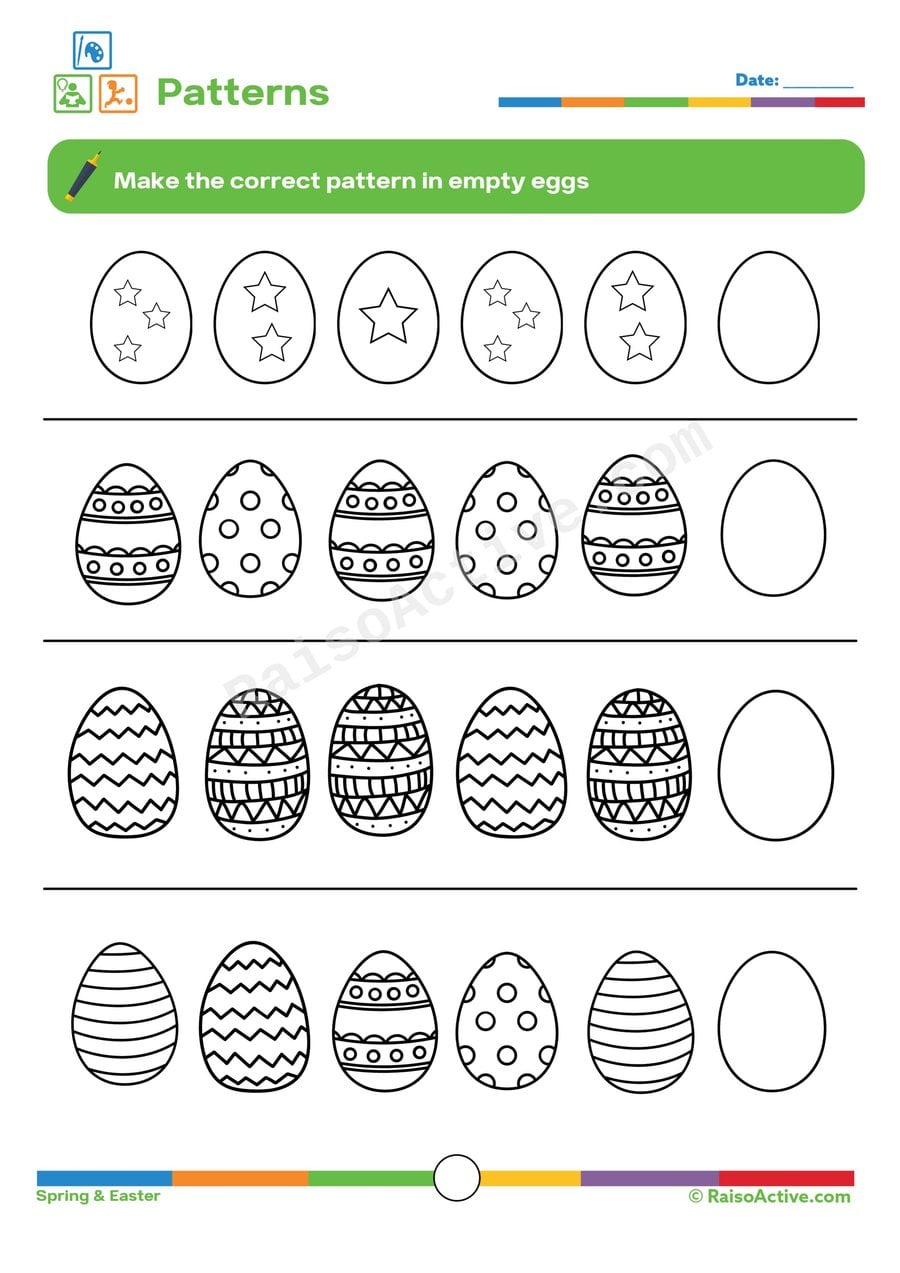
This worksheet asks children ages 3-5 to study a sequence of patterned Easter eggs and figure out what design should come next, then draw it into the empty egg themselves. Predicting and completing a pattern, rather than just matching an existing one, pushes children a step further into the kind of what-comes-next reasoning that underlies early math and logic.

Pumpkin Pattern Worksheet: Make the Correct Faces!
Ages 3-5 · Preschool–Pre-KAges 3-5 · Nursery–ReceptionAges 3-5 · Nursery–LKGAges 3-5
This worksheet builds pattern recognition and fine motor drawing skills in children ages 3-5 as they study a sequence of pumpkin faces and draw the missing face to complete each pattern. Unlike matching or pasting, drawing the answer requires children to actively recall and reproduce the pattern rather than simply selecting from options, which deepens their understanding.
Fish Hook Tracing Worksheet for Preschoolers
Ages 3-5 · Preschool–Pre-KAges 3-5 · Nursery–ReceptionAges 3-5 · Nursery–LKGAges 3-5
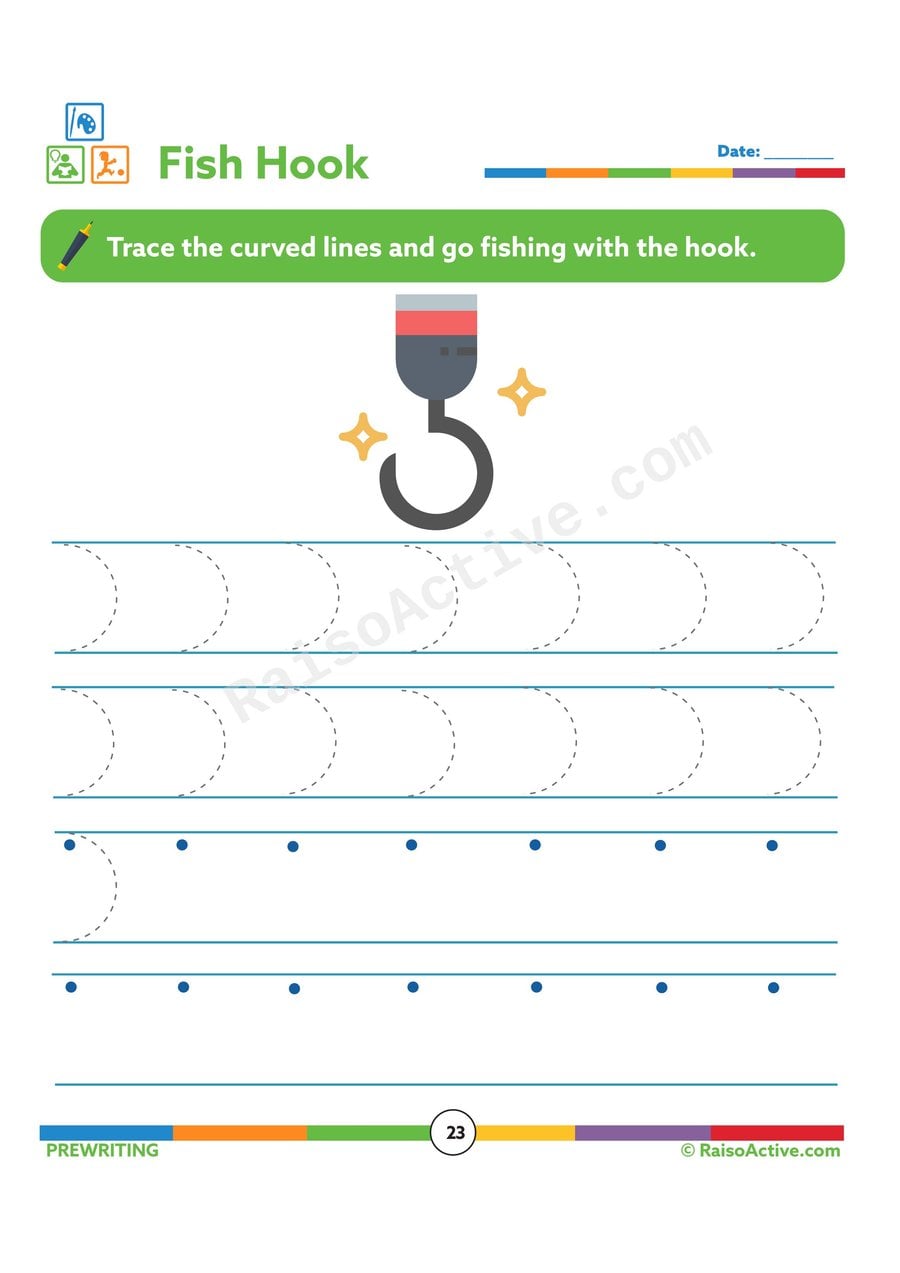
Tracing a hook-shaped fishing line curve gives children ages 3-5 practice with a tight, small curved stroke, different from the wide, sweeping curves used in other worksheets, which builds fine control over shorter pencil motions. This particular curve shape is also an early building block for letters like j, which end in a small hook, making this good preparatory practice.

My Book: A Fun Worksheet for Early Learners
Ages 3-5 · Preschool–Pre-KAges 3-5 · Nursery–ReceptionAges 3-5 · Nursery–LKGAges 3-5
Writing their own name on the cover of something they made gives a 3-5 year old a real, motivating reason to practice name-writing — a very different feeling from tracing letters on a generic worksheet. It's often one of the first pieces of writing a child feels ownership over, which matters for building confidence around writing in general.
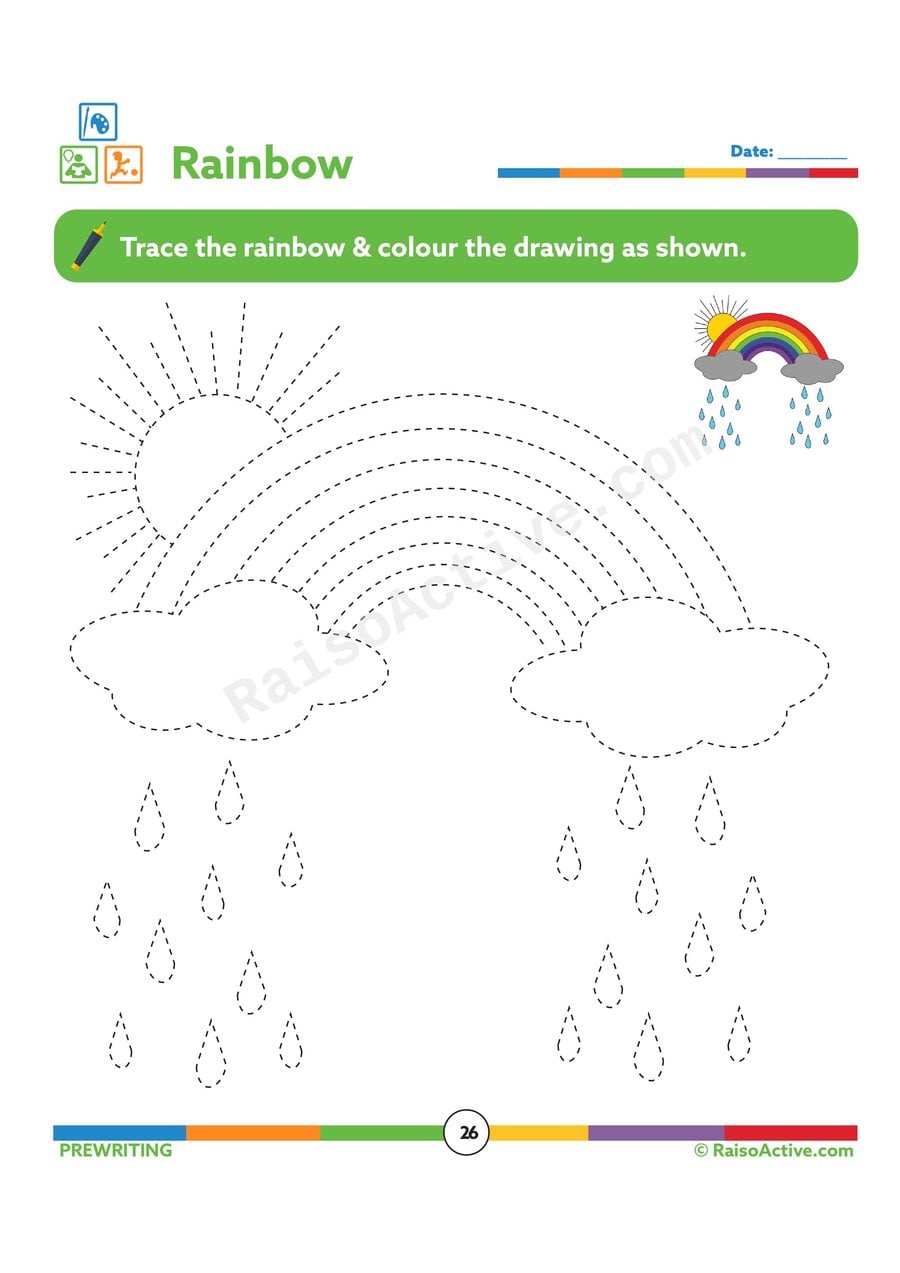
Trace the Rainbow Worksheet for Preschoolers
Ages 3-5 · Preschool–Pre-KAges 3-5 · Nursery–ReceptionAges 3-5 · Nursery–LKGAges 3-5
Tracing the concentric arcs of a rainbow gives children ages 3-5 practice with several nested curved lines of increasing size, a step up from tracing a single curve because each new arc has to sit a consistent distance from the one before it. Coloring the bands afterward also introduces simple color naming and sequencing, since rainbow colors typically appear in the same recognizable order.
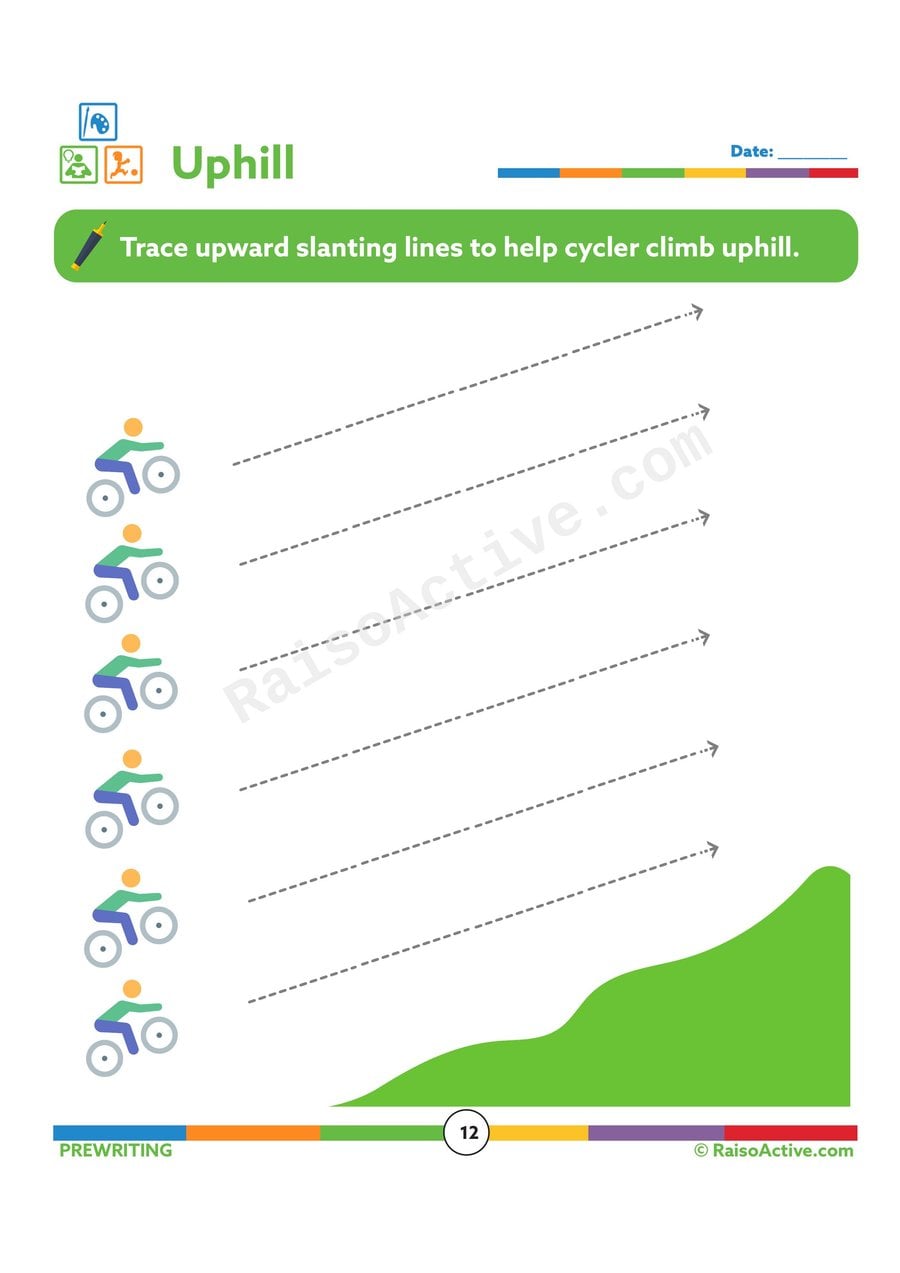
Uphill Tracing Worksheet: Help the Cyclist!
Ages 3-5 · Preschool–Pre-KAges 3-5 · Nursery–ReceptionAges 3-5 · Nursery–LKGAges 3-5
Tracing an uphill diagonal line to help a cyclist reach the top gives children ages 3-5 focused practice with slanting strokes that angle upward, a motion that requires more deliberate wrist control than a downward slant. This worksheet builds on general diagonal-line practice by tying the direction of the line to a concrete idea, going uphill, which helps children understand why the line slants the way it does rather than tracing an abstract shape.

Trace the Waves! A Pre-Writing Worksheet for Kids
Ages 3-5 · Preschool–Pre-KAges 3-5 · Nursery–ReceptionAges 3-5 · Nursery–LKGAges 3-5
Tracing a series of connected wave shapes gives children ages 3-5 practice with a smooth, undulating curve that rises and falls repeatedly, a stroke pattern that underlies letters like m, n, u, and w. Unlike a single curve, a wave line requires the hand to reverse direction multiple times in one continuous motion without lifting the pencil, building more sustained curve control than a shorter, single-curve worksheet.

Trace the Curved Lines: Give Balloons to the Girls! Worksheet
Ages 3-5 · Preschool–Pre-KAges 3-5 · Nursery–ReceptionAges 3-5 · Nursery–LKGAges 3-5
This worksheet has children ages 3-5 trace curved balloon strings, practicing the rounded, flowing pencil motion needed later for letters like c, o, and s. Curved lines demand a different wrist and finger movement than straight lines, since the hand has to continuously adjust direction rather than pushing in one line, which makes this an important complement to straight-line tracing practice.
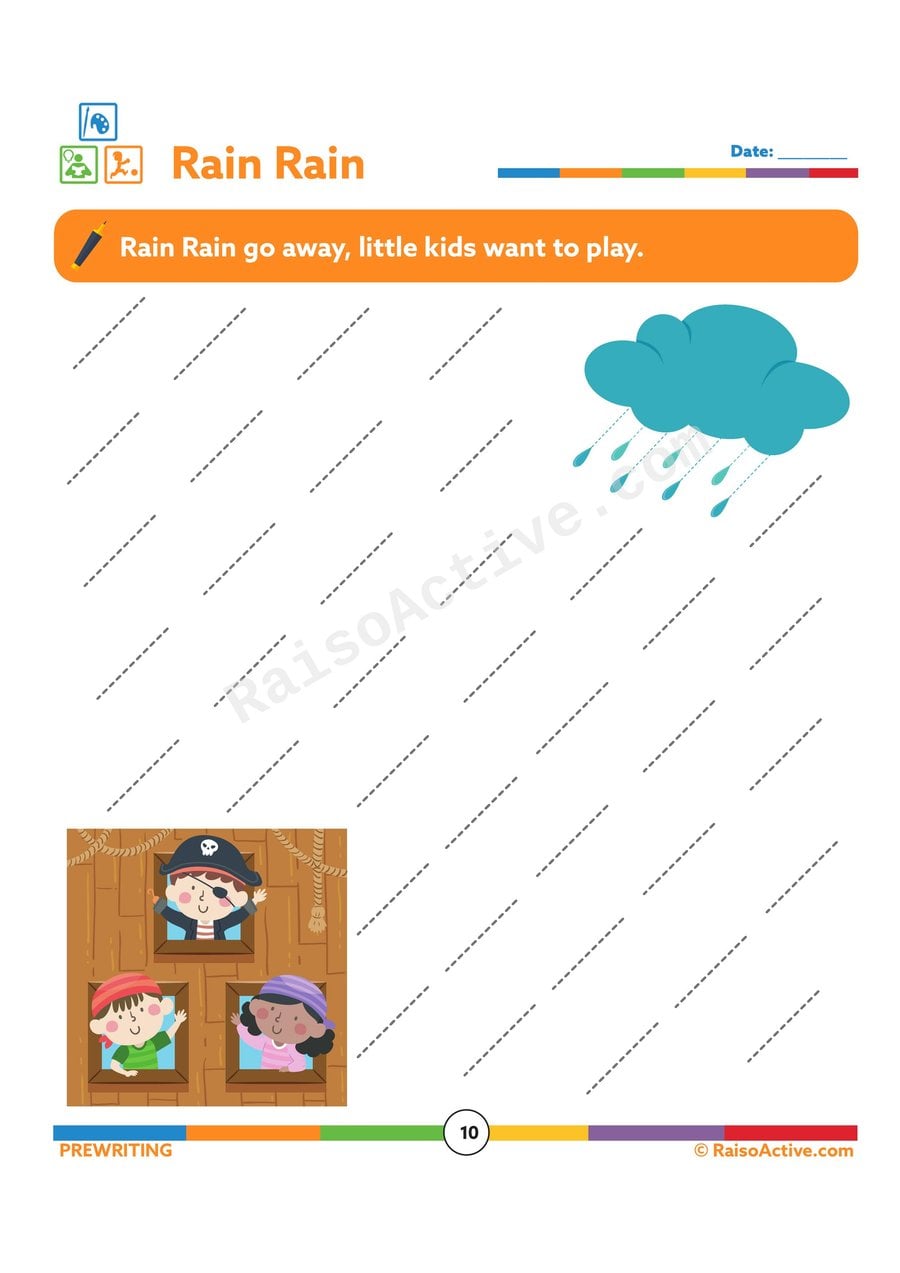
Rain Rain Tracing Worksheet for Preschoolers
Ages 3-5 · Preschool–Pre-KAges 3-5 · Nursery–ReceptionAges 3-5 · Nursery–LKGAges 3-5
Tracing rain-themed curved or drip-shaped lines gives children ages 3-5 practice with the smooth, flowing pencil motion used in curved letters, while the weather theme introduces simple vocabulary about rain and rain clouds. Tying the tracing motion to something children have actually seen, rain falling outside, helps make an abstract curved line feel like a familiar, recognizable shape.

Curve Tracing Worksheet: Trace the Fish Gills and Curved Lines!
Ages 3-5 · Preschool–Pre-KAges 3-5 · Nursery–ReceptionAges 3-5 · Nursery–LKGAges 3-5
This worksheet helps children ages 3-5 practice tracing curved lines, starting with a fish's gills and continuing with standalone curved line exercises, building the specific hand control needed before curved letters like C, S, and O become manageable. Repeated curve tracing also strengthens the small hand muscles used in nearly all handwriting.

Trace the Penguin: A Fun Pre-Writing Worksheet for Kids!
Ages 3-5 · Preschool–Pre-KAges 3-5 · Nursery–ReceptionAges 3-5 · Nursery–LKGAges 3-5
Tracing the rounded outline of a penguin gives children ages 3-5 practice with curved strokes that form a whole recognizable animal shape rather than an abstract line, which helps the tracing feel purposeful and connected to something familiar from books or videos. The cold-climate theme also introduces simple vocabulary about penguins and their environment, a small science connection layered onto the fine motor practice.

What Comes Next? Pattern Worksheet for Preschoolers
Ages 3-5 · Preschool–Pre-KAges 3-5 · Nursery–ReceptionAges 3-5 · Nursery–LKGAges 3-5
Identifying a repeating sequence of pictures and circling the one that comes next builds pattern-recognition and visual discrimination skills for children ages 3-5, an early form of logical reasoning that connects to later math concepts like skip counting and multiplication.

Climb the Ladder: Pre-Writing Practice Worksheet for Kids
Ages 3-5 · Preschool–Pre-KAges 3-5 · Nursery–ReceptionAges 3-5 · Nursery–LKGAges 3-5
Tracing the rungs of a ladder gives children ages 3-5 focused practice with horizontal and vertical straight lines, the two most basic pencil strokes and the building blocks for letters like L, T, E, F, and H. Because a ladder has repeated, evenly spaced rungs, this worksheet also builds a sense of rhythm and spacing that carries over into writing letters at a consistent size later on.

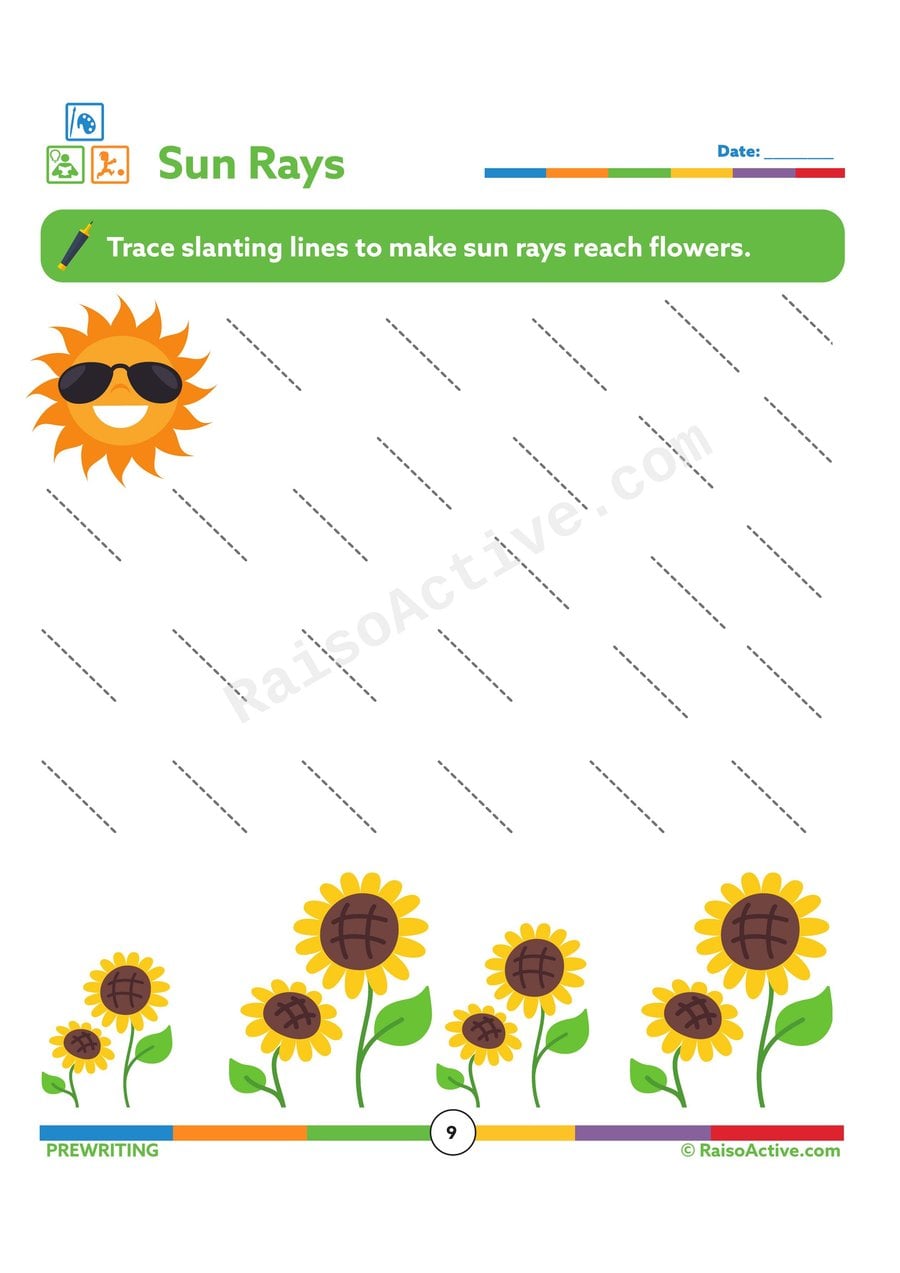
Slanting Lines Worksheet: Trace the Rain and Help the Flowers Bloom!
Ages 3-5 · Preschool–Pre-KAges 3-5 · Nursery–ReceptionAges 3-5 · Nursery–LKGAges 3-5
This worksheet gives children ages 3-5 focused practice tracing slanting lines, a pre-writing stroke that appears in letters like A, K, N, and X and in numbers like 4 and 7. Practicing diagonal strokes is typically harder than horizontal or vertical lines because it requires more precise wrist and finger control, making this a valuable stepping stone before formal letter writing begins. The rain-to-flowers storyline gives the repetitive tracing practice a clear, motivating purpose.
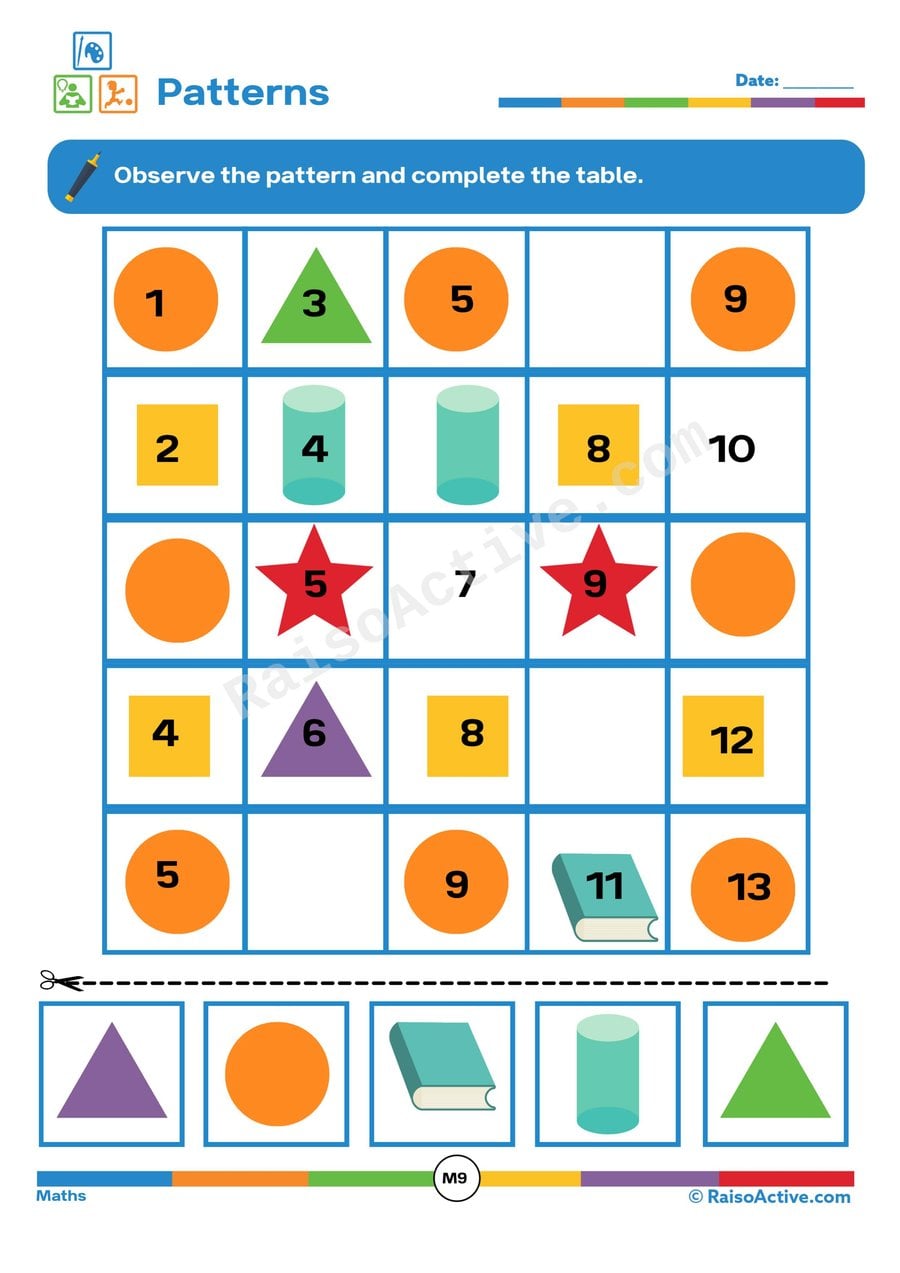
Shape Pattern Worksheet for Preschoolers
Ages 3-5 · Preschool–Pre-KAges 3-5 · Nursery–ReceptionAges 3-5 · Nursery–LKGAges 3-5
This worksheet asks children ages 3-5 to study a repeating sequence of shapes and continue the pattern by drawing the shape that logically comes next in each row. Extending a pattern rather than just identifying one requires a bit more reasoning than simple recognition, since children must hold the rule in mind and apply it to produce a new correct answer rather than choosing from options.

Move the Cars! Pre-Writing Tracing Worksheet for Preschoolers
Ages 3-5 · Preschool–Pre-KAges 3-5 · Nursery–ReceptionAges 3-5 · Nursery–LKGAges 3-5
Tracing a road-shaped path for a car gives children ages 3-5 pencil control practice disguised as a familiar, motivating theme, since most young children have pushed a toy car along an imaginary road before. The winding or straight path on this worksheet builds the same steady, controlled pencil movement needed for handwriting, while the driving theme keeps attention high through an activity that might otherwise feel repetitive.

Join the Dots: Standing Lines Worksheet for Preschoolers
Ages 3-5 · Preschool–Pre-KAges 3-5 · Nursery–ReceptionAges 3-5 · Nursery–LKGAges 3-5
This dot-to-dot worksheet asks children ages 3-5 to connect dots forming vertical lines, sometimes called 'standing lines' because they stand upright, building the bottom-to-top or top-to-bottom pencil control needed for letters like l, t, and i. Connecting dots precisely, rather than simply tracing a continuous line, adds an extra layer of accuracy practice on top of the basic straight-line motion.
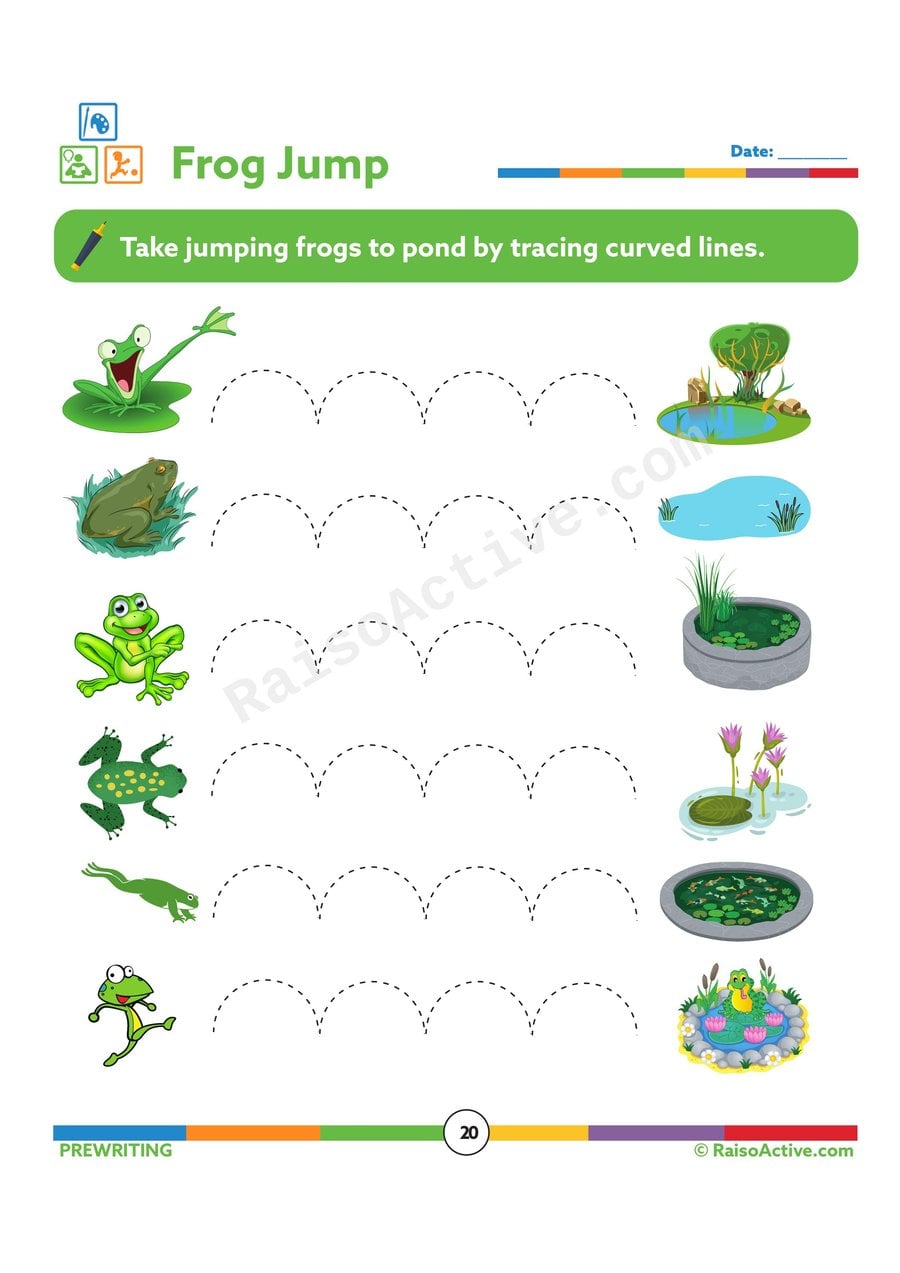
Frog Jump Tracing Worksheet for Preschoolers
Ages 3-5 · Preschool–Pre-KAges 3-5 · Nursery–ReceptionAges 3-5 · Nursery–LKGAges 3-5
Tracing the arc-shaped path of a frog's jump from one lily pad to the next gives children ages 3-5 practice with curved strokes tied to a real physical motion, a hop, which makes the abstract line feel grounded in something they've done themselves. Repeating this jump-shaped arc across several lily pads also builds consistency, helping a child produce similarly sized curves rather than arcs that vary widely from one to the next.

Shape Pattern Worksheet for Preschoolers: Color the Correct Pattern!
Ages 3-5 · Preschool–Pre-KAges 3-5 · Nursery–ReceptionAges 3-5 · Nursery–LKGAges 3-5
This worksheet asks children to study a repeating shape pattern and identify which shape logically comes next, then color the correct answer choice, combining pattern recognition with a decision-making step rather than simply continuing the pattern by hand. For ages three to five, recognizing shape patterns builds the same underlying logical reasoning skill used later in number patterns and early algebra.
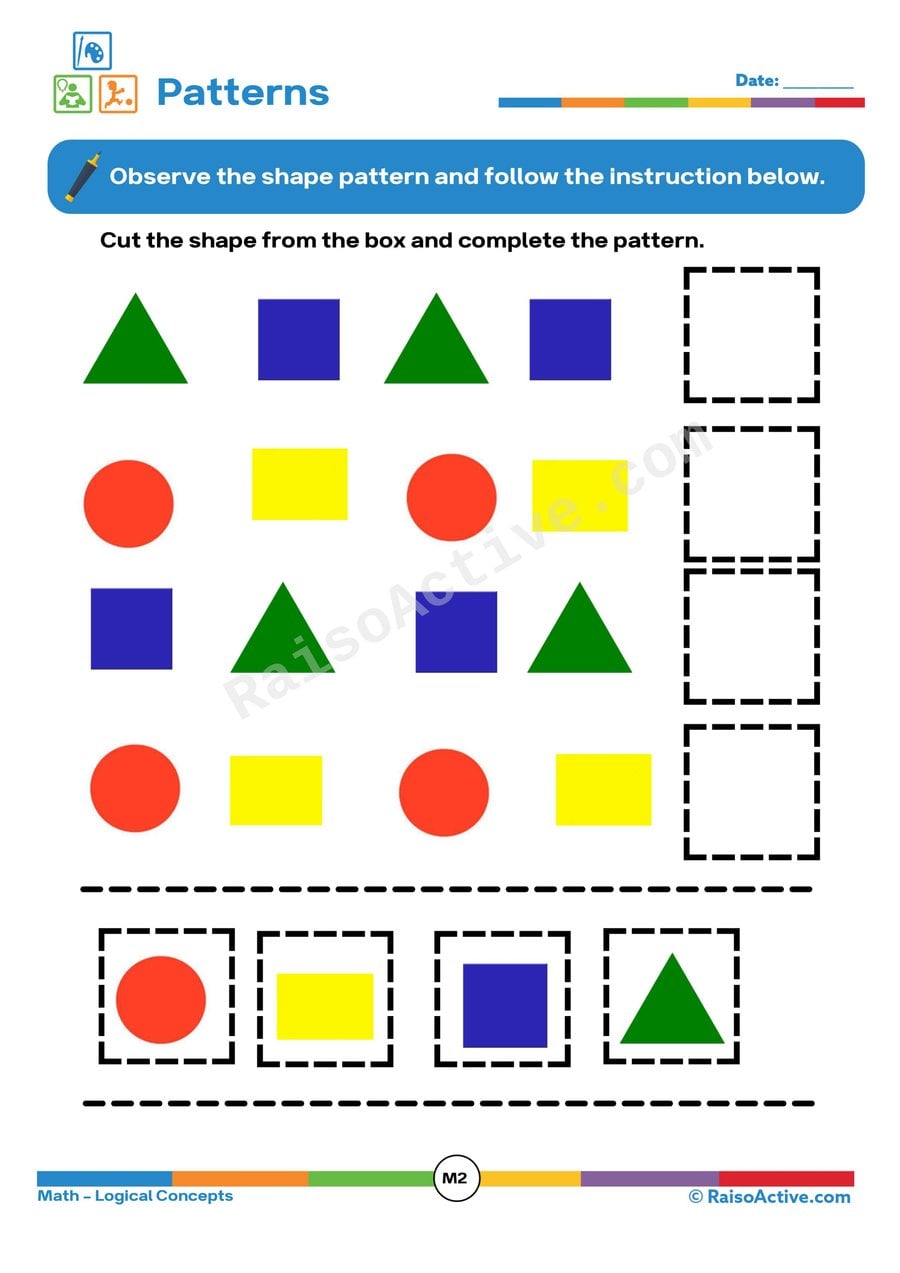
Shape Pattern Worksheet: Complete the Pattern!
Ages 3-5 · Preschool–Pre-KAges 3-5 · Nursery–ReceptionAges 3-5 · Nursery–LKGAges 3-5
Completing a repeating shape pattern asks children ages 3-5 to notice what comes next in a sequence and predict it correctly, an early form of the logical reasoning used in algebra much later on. Recognizing and continuing patterns also strengthens visual memory, since a child has to hold the beginning of the pattern in mind while figuring out what should come next.
The stroke progression from age 2 to 7
Strokes are usually taught in this order because each one adds a new movement: standing lines (top to bottom), sleeping lines (left to right), slanting lines in both directions, then curves, circles, zigzags, waves and finally loops. Two- and three-year-olds trace over dotted lines between wide guides. Four- and five-year-olds copy the stroke into an empty row, and six-year-olds join strokes into continuous cursive patterns across a full line.
- Age 2–3: finger tracing, thick crayon lines, standing and sleeping lines
- Age 3–4: slanting lines, circles, simple curves, zigzags
- Age 4–5: waves, loops, bridges (arches), cups, combined patterns
- Age 5–7: continuous cursive loops, small-scale strokes between narrow lines
Why strokes come before letters
Asking a child to write the letter "b" means asking for a standing line and a curve in one movement, with the correct starting point and direction. If either stroke is not automatic, the child draws the letter rather than writes it, often from the bottom up, and that habit is hard to undo. Stroke practice makes the parts automatic so that letter formation lessons can focus on sequence and size instead of hand control.
How to use these worksheets
Start each session with a large-arm warm-up, drawing the stroke in the air or on a whiteboard, then move to the sheet. Ask the child to say the stroke name while tracing, such as "down" for a standing line, so movement and language are linked. Five to ten minutes a day with a chunky triangular pencil or crayon is more effective than a long session, and the same sheet can be laminated and reused with a dry-erase marker.
Frequently asked questions
What is pattern writing in LKG?
In Indian Nursery and LKG classes, pattern writing is the practice of tracing and copying the basic strokes used to form letters: standing lines, sleeping lines, slanting lines, curves, zigzags and loops. It is taught before or alongside the alphabet so children have the hand control to write letters in the correct direction. UK and US schools teach the same content as pre-writing strokes or mark making.
What age should a child start pre-writing strokes?
Most children begin between 2 and 3 with scribbling, then trace deliberate vertical and horizontal lines around age 3. By 4 they can usually copy a cross, a circle and slanting lines, and by 5 most can produce curves, waves and zigzags inside narrow guides. A child who cannot yet hold a crayon with fingers rather than a fist benefits more from playdough, tearing paper and large-scale drawing than from worksheets.
What should a child be able to write by age 5?
By the end of Pre-K, Reception or LKG (age 5), a child is typically expected to copy all basic strokes with reasonable control, trace and copy most capital letters, write their first name, and hold a pencil with a tripod or near-tripod grip. Reversals and uneven sizing are still normal. Kindergarten, Year 1 and UKG then build on these strokes to teach lowercase letters and, in many Indian schools, cursive.
Which pre-writing strokes should be taught first?
Standing (vertical) lines first, because a top-to-bottom pull is the easiest controlled movement, followed by sleeping (horizontal) lines drawn left to right. Slanting lines, circles and curves come next, then zigzags, waves, bridges and loops. Teaching direction from the beginning (top to bottom, left to right) matters more than neatness, because those directions carry straight into letter formation.
Are these worksheets free to download?
Yes. After creating a free account, every pattern writing worksheet on this page can be downloaded as a watermarked PDF, up to five downloads a day. An annual subscription (₹1000 or $20) removes the watermark and the daily limit across the full library of more than 1,000 worksheets and the printable activity-book packs. Sheets are sized for A4 and US Letter.

Written by
Hemsweta Jain · Teacher Cheena
MBA and Early Childhood Educator, teaching since 2014 · Founder of RaisoActive, Mumbai
Written and reviewed by Hemsweta Jain (Teacher Cheena), who designs every RaisoActive worksheet.
Last reviewed
Printable packs for ages 3–5
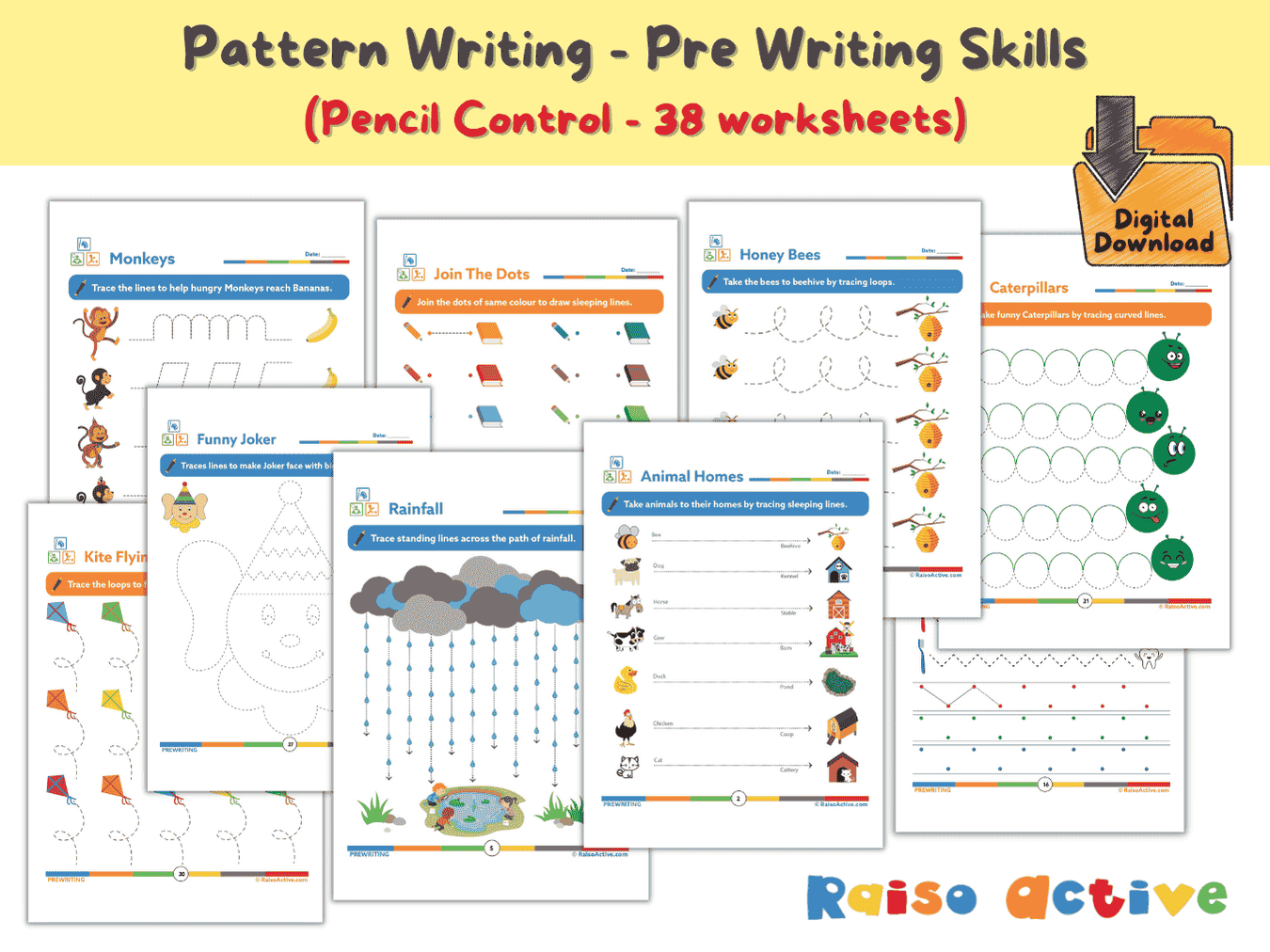

Pattern Writing Pre-writing Skills Activity Book for 3-4 Year Olds
Ages 3-4 · PreschoolAges 3-4 · NurseryAges 3-4 · 44 pages
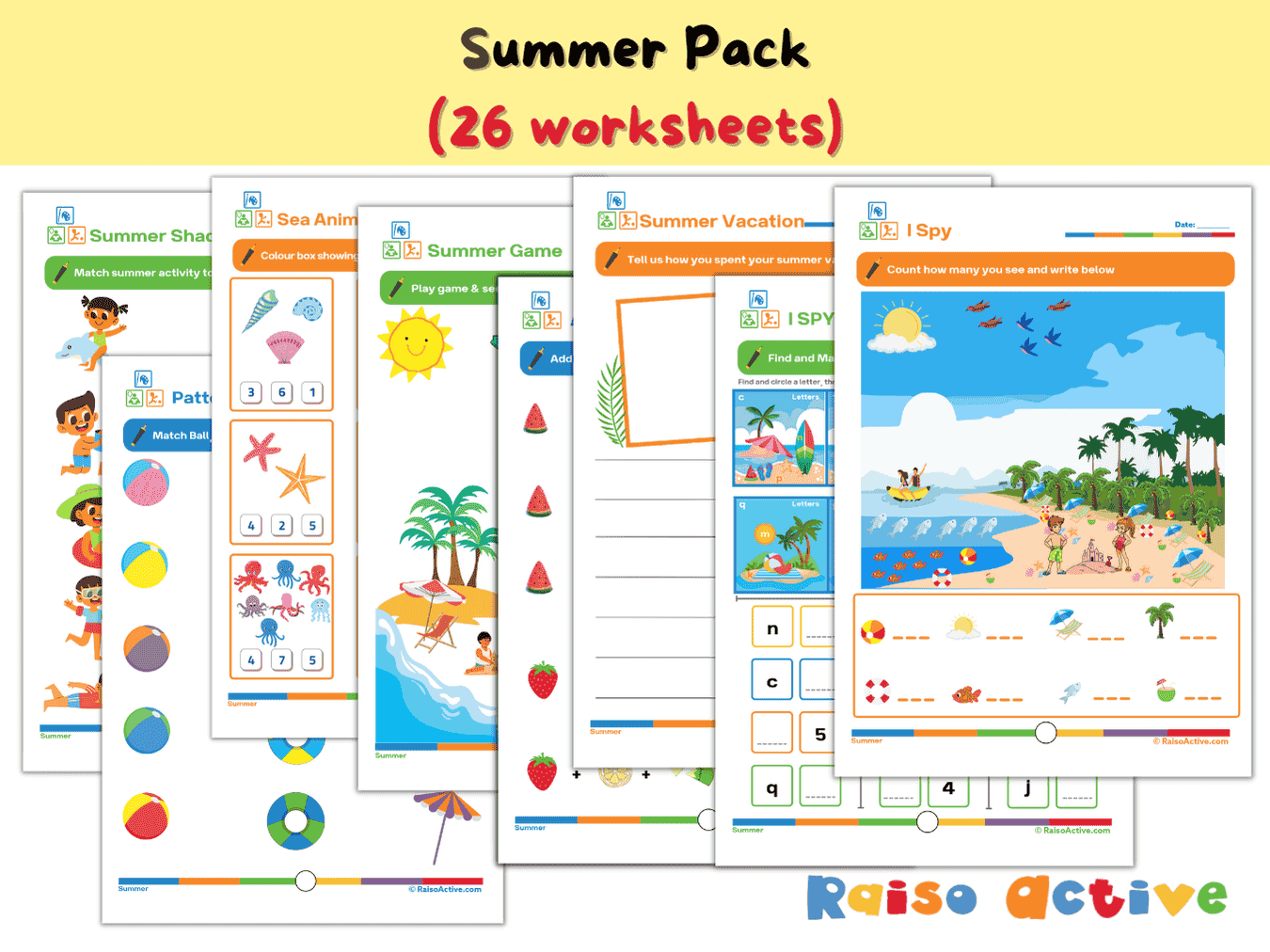

Summer Activity Pack: Math, Literacy, Puzzles & More for Preschool & Kindergarten
Ages 3-7 · Preschool–Grade 1Ages 3-7 · Nursery–Year 2Ages 3-7 · Nursery–Class 1Ages 3-7 · 26 pages
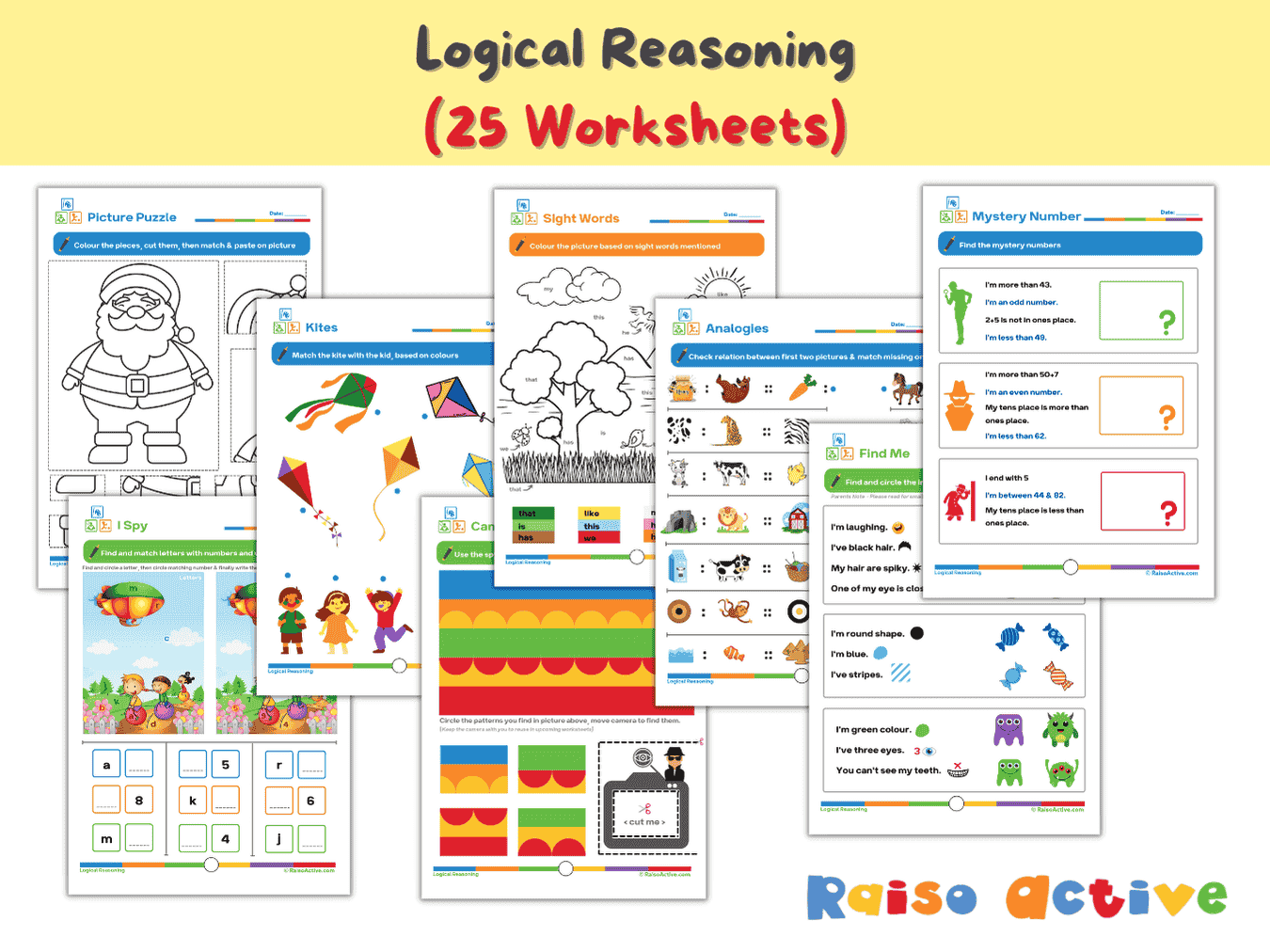

Logical Reasoning Activity Book for Preschool & Kindergarten | Patterns, Sudoku, Mazes & Coding
Ages 4-7 · Pre-K–Grade 1Ages 4-7 · Reception–Year 2Ages 4-7 · LKG–Class 1Ages 4-7 · 34 pages
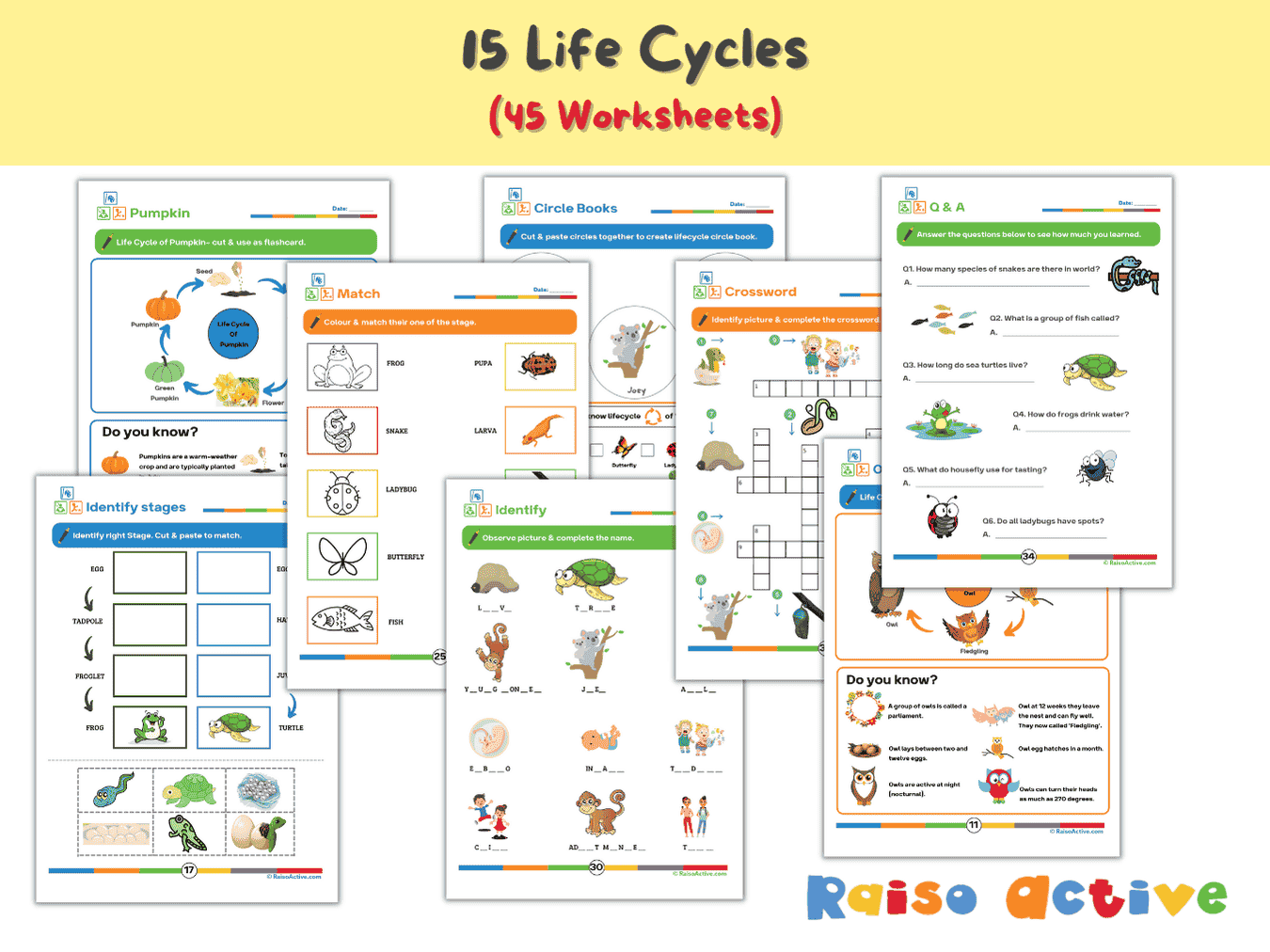

Lifecycles Activity Book & Flashcards for Preschool & Early Elementary
Ages 3-8 · Preschool–Grade 2Ages 3-8 · Nursery–Year 3Ages 3-8 · Nursery–Class 2Ages 3-8 · 46 pages
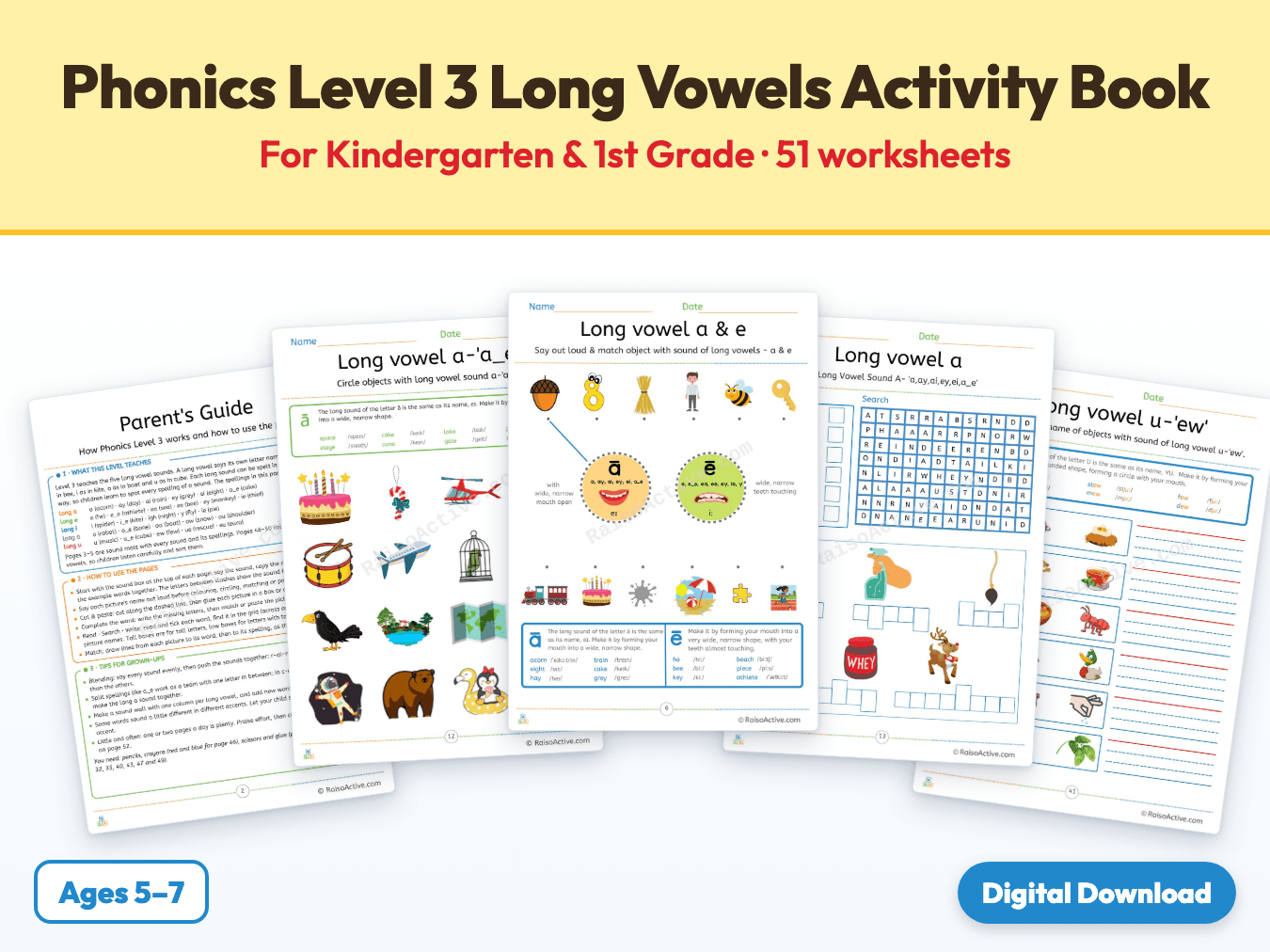

Phonics Level 3 Long Vowels Activity Book for Kindergarten & 1st Grade
Ages 5-7 · Kindergarten–Grade 1Ages 5-7 · Year 1–Year 2Ages 5-7 · UKG–Class 1Ages 5-7 · 52 pages
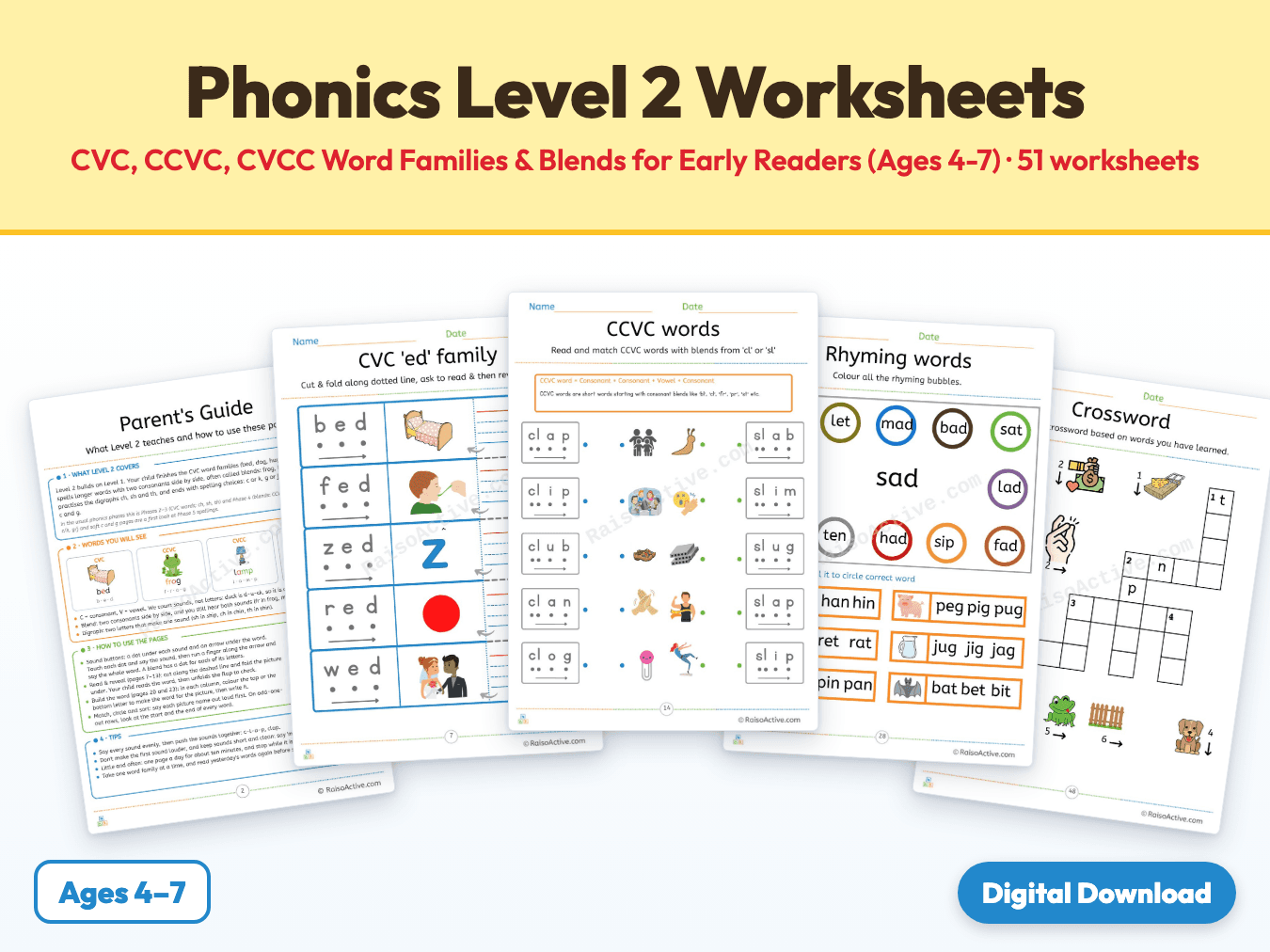
Phonics Level 2 Worksheets: CVC, CCVC, CVCC Word Families & Blends for Early Readers (Ages 4-7)
Ages 4-7 · Pre-K–Grade 1Ages 4-7 · Reception–Year 2Ages 4-7 · LKG–Class 1Ages 4-7 · 52 pages
Guides for parents and teachers
See all guides
Sight Words by Age: The First 50 Words and How to Teach Them Without Flashcard Fatigue
Which sight words to teach first and why, the heart-word method, a read-trace-write-find routine, games, and a by-age table of typical sight-word progress.

Number Formation Rhymes 0–9 and How to Fix Reversals
Original number formation rhymes for 0–9, the correct stroke order for each digit, why 3, 5 and 7 get reversed most often, and multisensory fixes that work.

Pre-Writing Strokes in Order: From Standing Lines to Loops (With Printable Patterns)
The developmental order of pre-writing strokes, from vertical lines to loops, and why practicing them in sequence makes letter formation much easier to learn.

Kindergarten Readiness Checklist: 25 Skills to Practice Before the First Day
A kindergarten readiness checklist of 25 literacy, math, motor, self-regulation and self-help skills, with an 8-week summer plan and notes on when not to worry.
Best Worksheets for 3-Year-Olds: What Works and What to Avoid
What works on worksheets for 3-year-olds: short sessions, crayons, tracing lines, matching, cutting, a free weekly plan, and signs one is too advanced.
Reception Year Explained: EYFS Learning and How to Help at Home
A teacher's plain-English guide to the Reception Year: the seven areas of learning, Early Learning Goals, Phase 2/3 phonics, the RBA and home routines.