Learn the Sight Word 'Are' Worksheet for Preschoolers
Children ages 4-5 build instant recognition of the high-frequency sight word 'are', a word that doesn't sound out phonetically and must be memorized by sight to support reading fluency. This multi-step worksheet reinforces the word through five different modes — coloring, searching a grid, tracing, writing, and a watercolor technique — giving repeated exposure that strengthens memory. Practicing 'are' in context through fill-in-the-blank sentences also helps children see how the word functions within real sentences.
Part of the pack
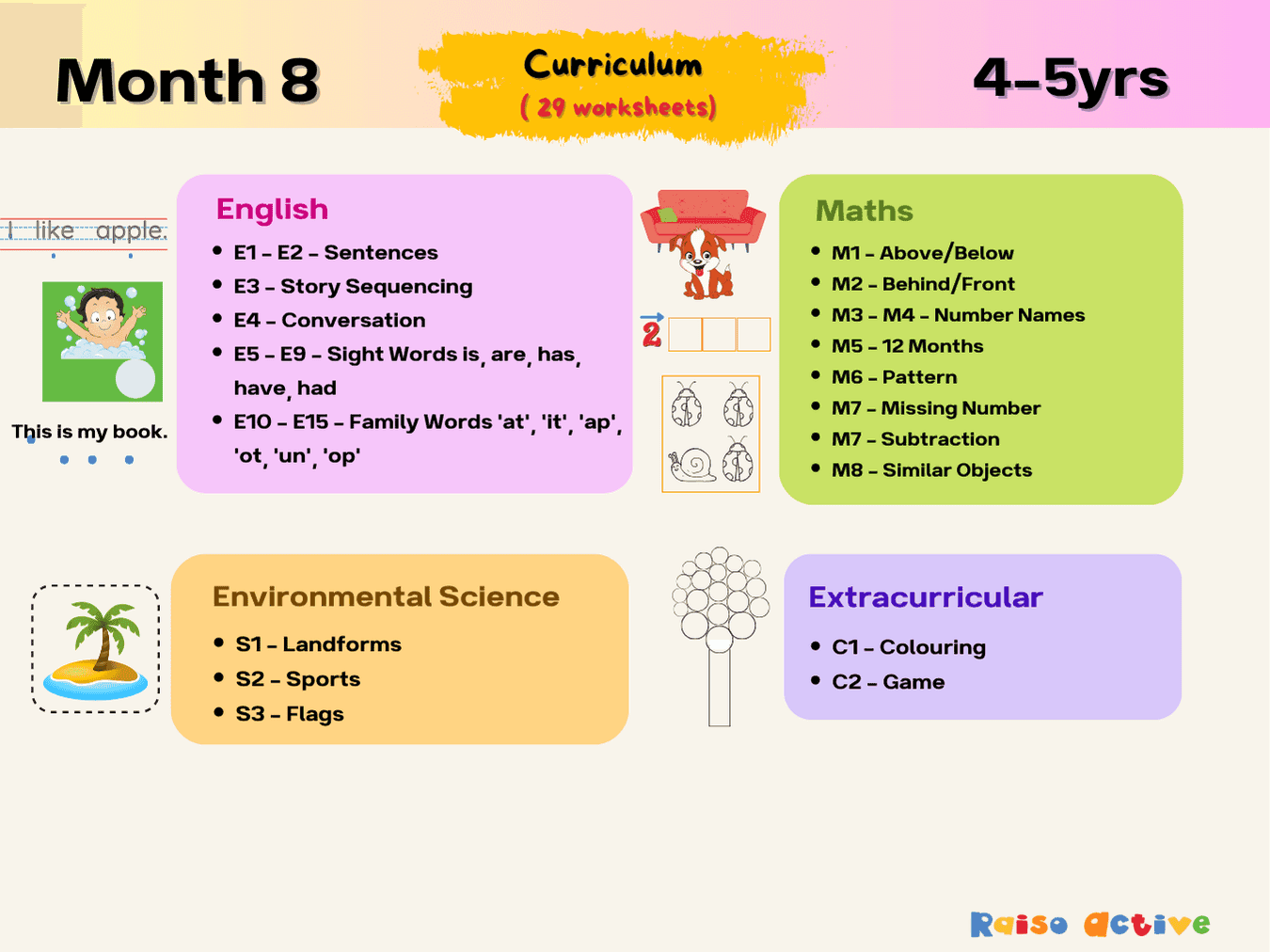
Month 8: English, Math, Science Foundations | Ages 4-5
This is page 9 of the pack. Ages 4-5 · Pre-KAges 4-5 · ReceptionAges 4-5 · LKGAges 4-5
Made for your child
Spelling practice, made for your child
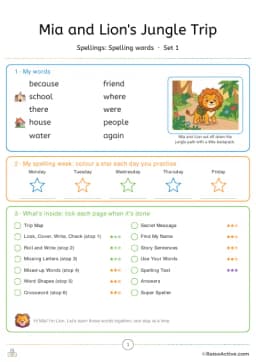
Their own spelling words turned into a pack: trace or look-cover-write-check, roll and write, a secret picture code, a word search, a crossword and a test, with their name in it.
Make a spelling packFree preview · free for members
Or start free: a word search with sight wordsCurriculum
- Fluency > Sight Words
How to use this worksheet
Start by having your child color the word 'are' at the top of the page to draw visual attention to its shape. Next, guide them to scan the letter grid and highlight every instance of 'are' they can find, which sharpens visual search skills. Move to the tracing and writing section, having them say the word aloud each time they write it. Finally, help them read the fill-in-the-blank sentences and write 'are' where it belongs, and finish with the dip-and-dab activity using a wet cotton swab and watercolor to paint over the word one more time.
Materials needed
- Pencil
- Crayons
- Ear bud
- Water color
Extension activities
- 1Create simple sentences together using the word 'are', like 'We are happy' or 'They are playing.'
- 2Search a favorite picture book together to find and point out the word 'are' on the page.
- 3Write the word 'are' multiple times using different writing tools, like markers or a paintbrush.
- 4Play a quick sight word flashcard game mixing 'are' with a few other familiar words.
- 5Make a scavenger hunt around the house for sticky notes with 'are' hidden on them.

Written by
Hemsweta Jain · Teacher Cheena
MBA and Early Childhood Educator, teaching since 2014 · Founder of RaisoActive, Mumbai
Every RaisoActive worksheet is designed and checked by the founder before publishing.
Published · Last reviewed
More from Month 8: English, Math, Science Foundations | Ages 4-5

Subtraction Game Worksheet for Kids: Fun Math Practice!
Ages 4-6 · Pre-K–KindergartenAges 4-6 · Reception–Year 1Ages 4-6 · LKG–UKGAges 4-6
This board-game style worksheet gives children ages 4-6 repeated, low-pressure practice solving subtraction problems as they move along a path with ladders and slides. Framing subtraction as a game keeps motivation high while children build fluency taking away from small numbers and reading the results instantly. The ladders and slides also add a playful lesson in following game rules and consequences.

Unlocking 'un' Words: A Fun Worksheet for Early Readers!
Ages 4-6 · Pre-K–KindergartenAges 4-6 · Reception–Year 1Ages 4-6 · LKG–UKGAges 4-6
Ages 4-6 practice decoding and spelling CVC words in the 'un' family, such as 'sun' and 'bun', by matching each picture to its written word. This picture-to-word matching strengthens the bridge between spoken vocabulary and printed text, a core early literacy skill. Writing the word afterward locks in correct letter sequencing and spelling memory.

Months of the Year Cut and Paste Worksheet for Kids
Ages 4-6 · Pre-K–KindergartenAges 4-6 · Reception–Year 1Ages 4-6 · LKG–UKGAges 4-6
This cut-and-paste activity teaches children ages 4-6 the correct sequence of the twelve months, a foundational calendar and time-concept skill. Physically cutting and placing each month name in order reinforces sequencing logic while the scissor work builds fine motor control needed for handwriting. Understanding month order also helps children later grasp seasons, birthdays, and holidays in context.

Learn the Sight Word 'Has' - Fun Tracing and Matching Worksheet!
Ages 3-5 · Preschool–Pre-KAges 3-5 · Nursery–ReceptionAges 3-5 · Nursery–LKGAges 3-5
'Has' is a high-frequency verb that children ages 3-5 encounter constantly in early sentences describing possession, like 'the dog has a bone,' making it an important addition to their sight word vocabulary. This worksheet builds recognition of the word through coloring, tracing, word searching, and sentence completion, giving repeated exposure across formats that reinforces memory more effectively than a single repetition. Practicing 'has' inside complete sentences also helps children understand its grammatical role, connecting a subject to something it possesses.
Missing Numbers Worksheet for Preschoolers
Ages 4-5 · Pre-KAges 4-5 · ReceptionAges 4-5 · LKGAges 4-5
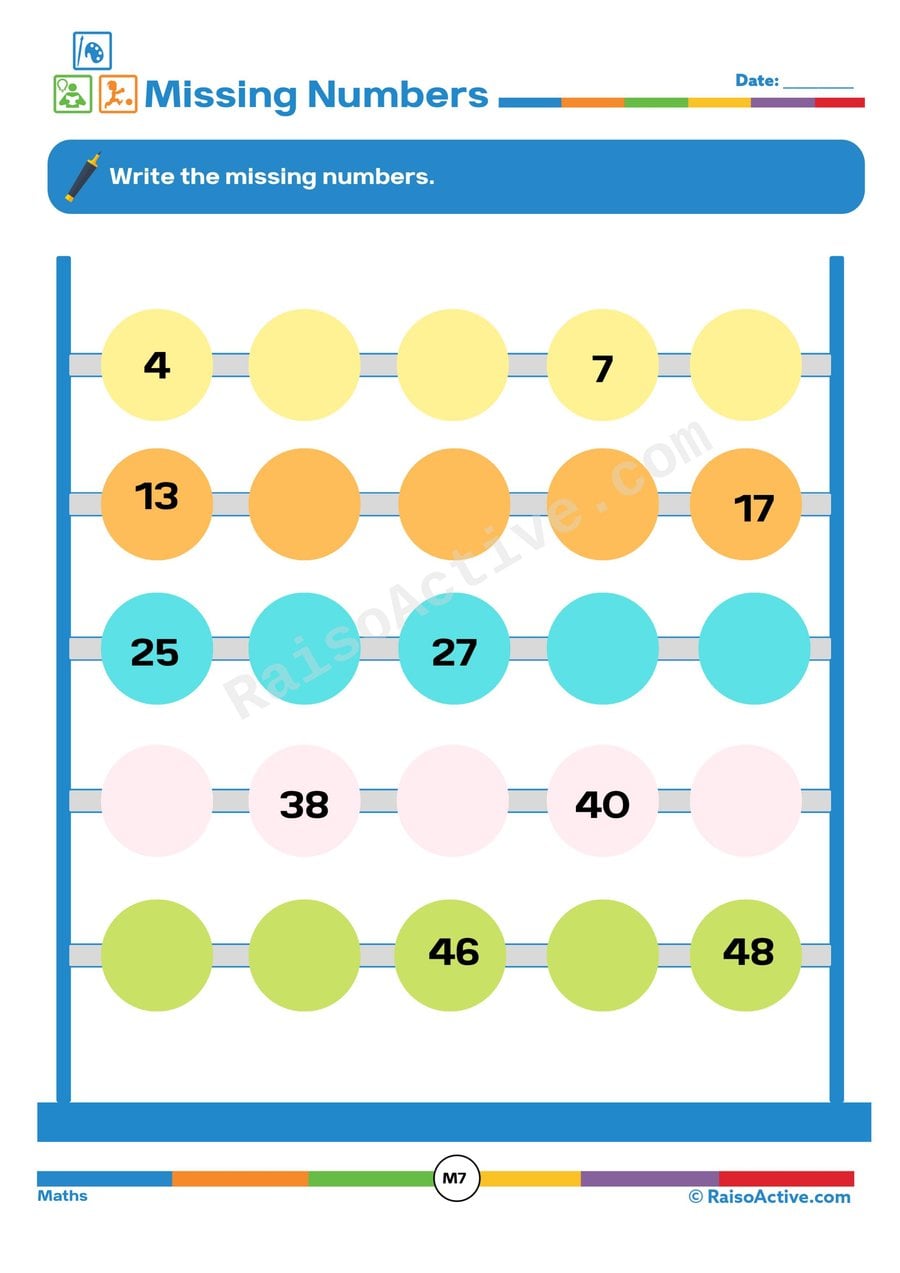
Children ages 4-5 strengthen number sequencing by identifying which numbers are missing from a given sequence and filling in the gaps. This task requires understanding the pattern of counting forward by one, rather than simply reciting memorized numbers, which builds a deeper sense of how numbers relate to each other. Successfully finding each missing number also reinforces number formation as children write the answer themselves.

Subtraction Worksheet: Practice Subtracting with Fun Pictures!
Ages 4-6 · Pre-K–KindergartenAges 4-6 · Reception–Year 1Ages 4-6 · LKG–UKGAges 4-6
Children ages 4-6 practice subtraction by looking at a set of pictured objects, crossing out or removing the indicated amount, and writing the resulting total. Seeing subtraction visually, rather than only as abstract numbers, helps children genuinely understand what 'taking away' means before relying on memorized facts. This visual approach builds a strong foundation for mental math strategies used in later grades.

Front and Behind Animals Worksheet: Identify Positions!
Ages 3-5 · Preschool–Pre-KAges 3-5 · Nursery–ReceptionAges 3-5 · Nursery–LKGAges 3-5
Preschoolers ages 3-5 build early spatial reasoning by identifying which pictured animals are positioned 'in front of' an object, a positional concept that requires comparing the relative location of two things in a scene. Understanding front-and-behind relationships lays groundwork for later concepts like map reading, following multi-step directions, and geometry. Circling only the correctly positioned animals also sharpens visual attention and careful looking.
Fun 'at' Word Worksheet for Preschoolers
Ages 4-5 · Pre-KAges 4-5 · ReceptionAges 4-5 · LKGAges 4-5
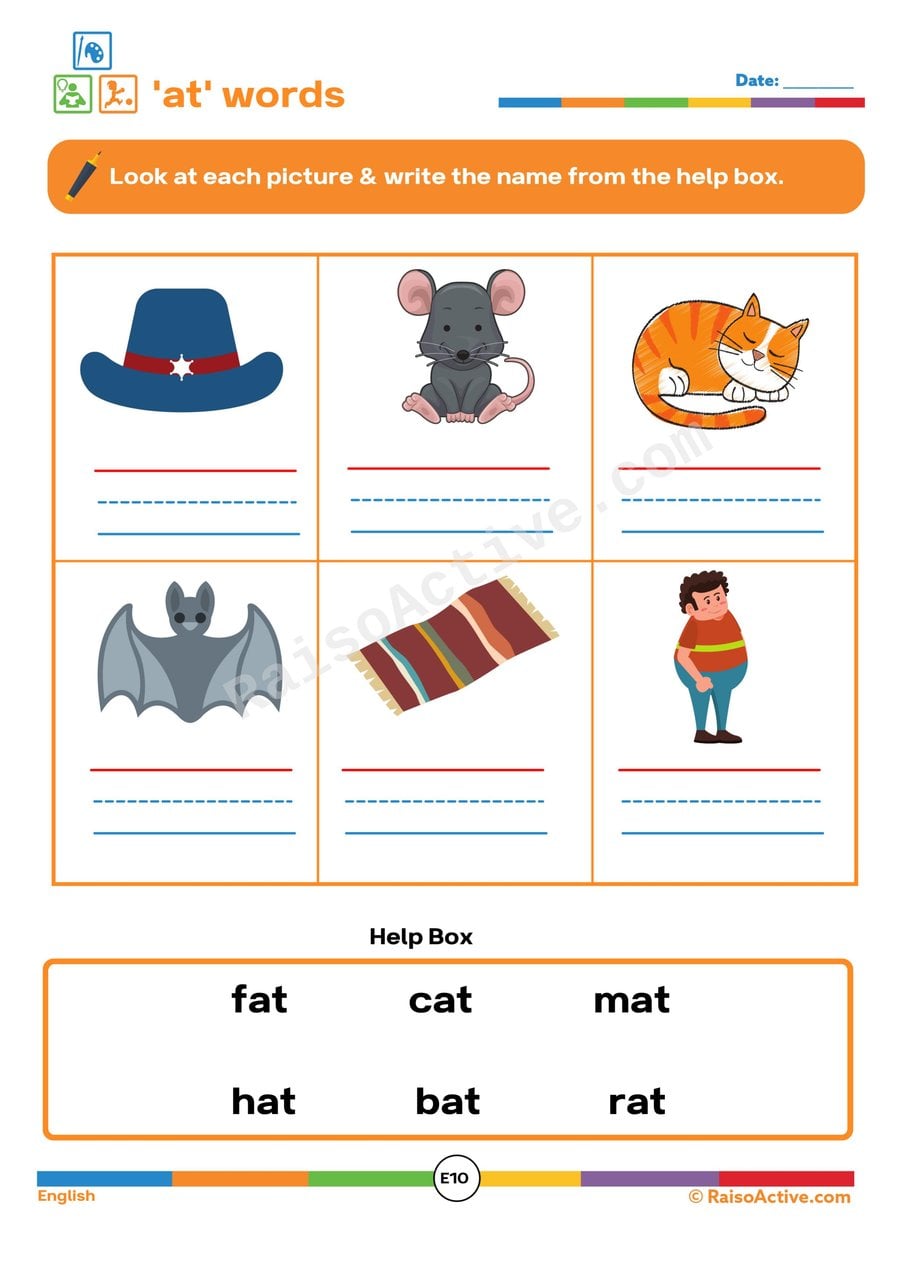
The 'at' word family (cat, hat, bat) is often one of the very first CVC patterns children ages 4-5 encounter, and this worksheet asks them to go a step further than simple reading by identifying and writing the correct word to match each picture themselves. Choosing the right word from a word bank and writing it out, rather than just reading a word that's already printed, requires children to actively recall spelling rather than passively recognize it. This active recall step is an important bridge between reading CVC words and eventually spelling them independently from memory.
Related worksheets

Little Sight Word Worksheet: Trace, Find, and Write!
Ages 3-5 · Preschool–Pre-KAges 3-5 · Nursery–ReceptionAges 3-5 · Nursery–LKGAges 3-5
The word 'little' is a common descriptive sight word that appears often in early picture books, and because it's longer than most beginner sight words, it gives children ages 3-5 valuable practice with multi-letter word recognition. This worksheet layers coloring, word-searching, tracing, and a cut-and-paste sentence completion on top of each other, which research on early literacy shows builds stronger word recall than any single repetition. Recognizing longer sight words like this also helps children start to notice smaller familiar chunks — like 'it' inside 'little' — within bigger words.
See Sight Word Worksheet: Trace, Color, and Paste!
Ages 3-5 · Preschool–Pre-KAges 3-5 · Nursery–ReceptionAges 3-5 · Nursery–LKGAges 3-5
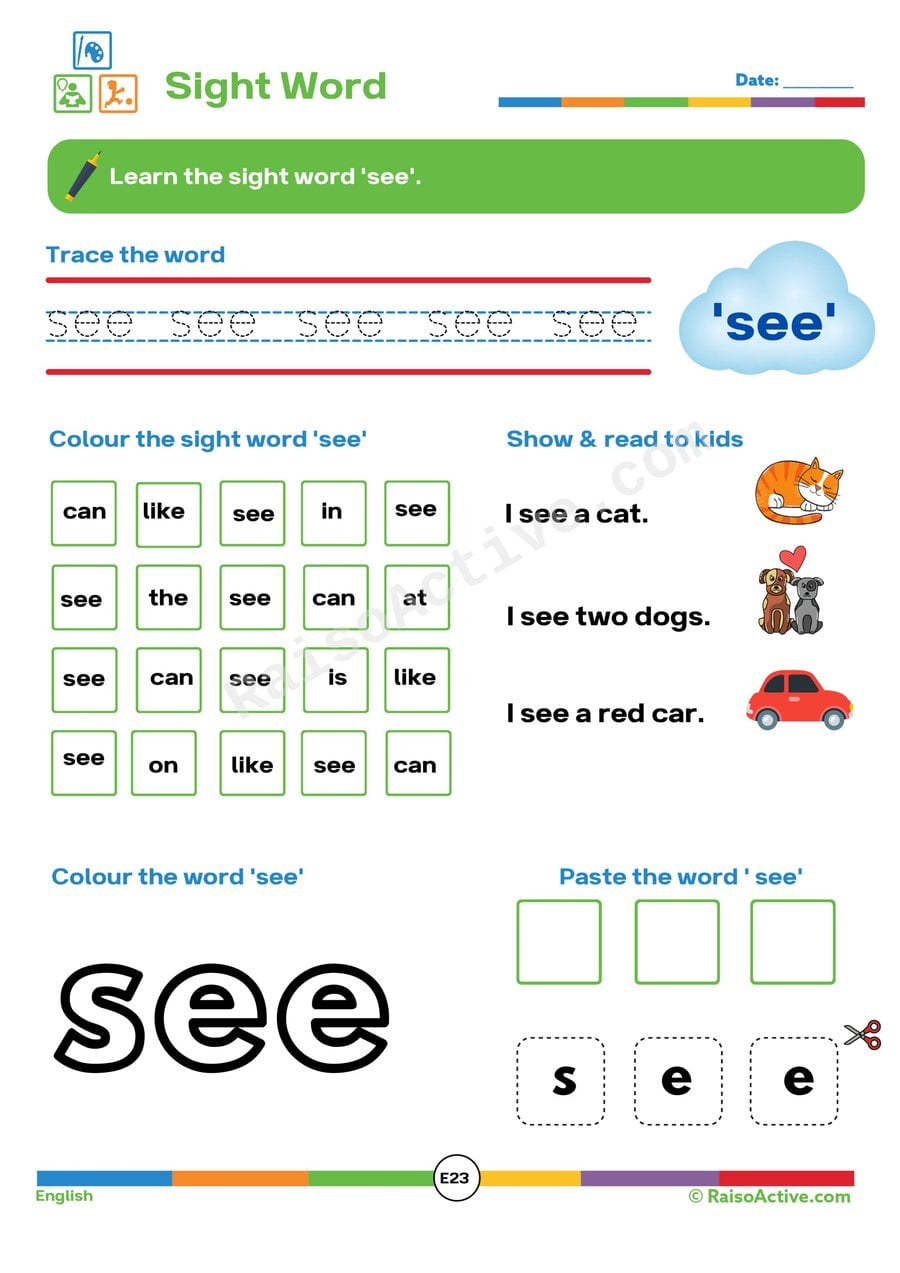
Children ages 3-5 get repeated, varied practice with the high-frequency sight word 'see' through tracing, coloring, sentence reading, and a cut-and-paste spelling activity, building the instant word recognition that fluent reading depends on. Reading the accompanying sentences also gives early exposure to how the word functions in context, not just in isolation.

Sight Word Fun: Fill-in-the-Blank Worksheet for Preschoolers
Ages 4-5 · Pre-KAges 4-5 · ReceptionAges 4-5 · LKGAges 4-5
Reading a sentence with a missing sight word and selecting the correct choice builds early reading fluency for children ages 4-5, since recognizing common sight words by sight — rather than sounding them out — speeds up overall reading comprehension.

Color the Sight Words! A Fun Sight Word Coloring Worksheet
Ages 3-5 · Preschool–Pre-KAges 3-5 · Nursery–ReceptionAges 3-5 · Nursery–LKGAges 3-5
This worksheet turns sight word recognition into a color-matching game, asking children ages 3-5 to read a sight word and then color a shape with the color that corresponds to it, which keeps repeated word exposure feeling playful rather than like drilling. Because children must actually read each word correctly before knowing which color to use, the coloring choice becomes a built-in check on whether the word was recognized accurately. Repeating this recognize-and-respond pattern across many candies or shapes gives children dozens of low-pressure reps with common sight words in a single sitting.

Make a Pancake! Sight Word 'Make' Worksheet for Preschoolers
Ages 4-5 · Pre-KAges 4-5 · ReceptionAges 4-5 · LKGAges 4-5
Children ages 4-5 build automatic recognition of the high-frequency sight word 'make', practicing it through coloring, highlighting, tracing, and sentence completion for repeated, varied exposure. Since 'make' doesn't follow standard phonics rules cleanly, memorizing its shape by sight is essential for reading fluency. Completing sentences with 'make' also shows children how the word functions naturally in everyday spoken and written language, like making a pancake.

Learn to Write the Sight Word 'I' Worksheet for Preschoolers
Ages 3-5 · Preschool–Pre-KAges 3-5 · Nursery–ReceptionAges 3-5 · Nursery–LKGAges 3-5
This worksheet gives children ages 3-5 focused, repeated practice recognizing, tracing, and writing the sight word 'I,' one of the very first words most children learn to read and write since it appears constantly in their own speech. Because 'I' is a single letter that stands for a whole word, it's also a gentle introduction to the idea that capitalization carries meaning.

Sight Word Coloring Worksheet for Preschoolers
Ages 4-7 · Pre-K–Grade 1Ages 4-7 · Reception–Year 2Ages 4-7 · LKG–Class 1Ages 4-7
This worksheet helps children recognize and read common sight words while practicing their coloring skills.

Sight Words Coloring Worksheet: 'His', 'My', and 'Her' Fun!
Ages 3-5 · Preschool–Pre-KAges 3-5 · Nursery–ReceptionAges 3-5 · Nursery–LKGAges 3-5
This coloring activity helps children ages 3-5 recognize and internalize the common sight words 'his,' 'my,' and 'her' by following a color-coded key, an approach that builds sight word memory through repeated visual association rather than isolated flashcard drilling. Because sight words like these don't sound out easily using phonics rules, repeated exposure in a fun context like coloring is one of the most effective ways for young children to memorize them. The activity also reinforces fine motor control as children carefully color within the lines of each labeled section.
Guides for this topic

Sight Words by Age: The First 50 Words and How to Teach Them Without Flashcard Fatigue
Which sight words to teach first and why, the heart-word method, a read-trace-write-find routine, games, and a by-age table of typical sight-word progress.
How to Teach CVC Blending: A Step-by-Step Method That Works in Two Weeks
A step-by-step method for teaching CVC blending, covering continuous sounds, word families, common errors, and a 14-day plan that most children finish reading CVC words.
Phase 2 Phonics at Home: Sound Order, Blending Games, Worksheets
Phase 2 phonics at home: the five sound sets in order, oral blending, tricky words, a two-week routine, common mistakes, and free worksheets.
Reviews
Every worksheet for ages 4–5, no watermark
Members download the full library of 1,000+ worksheets and every activity pack without watermarks or daily limits. One year costs ₹999 in India or $20 elsewhere.
See membership plansOr download any worksheet free with a watermark (5 a day).