Summer Fun: Find, Match, and Write Letters and Numbers Worksheet
This worksheet combines three skills in one activity for children ages 3-5: finding a target letter, matching it to a corresponding number, and then writing the letter independently. Working through find, match, and write in sequence builds sustained attention across multiple steps, which is an important readiness skill for the multi-part instructions children will encounter in kindergarten. It also reinforces both letter recognition and number recognition side by side rather than practicing them separately.
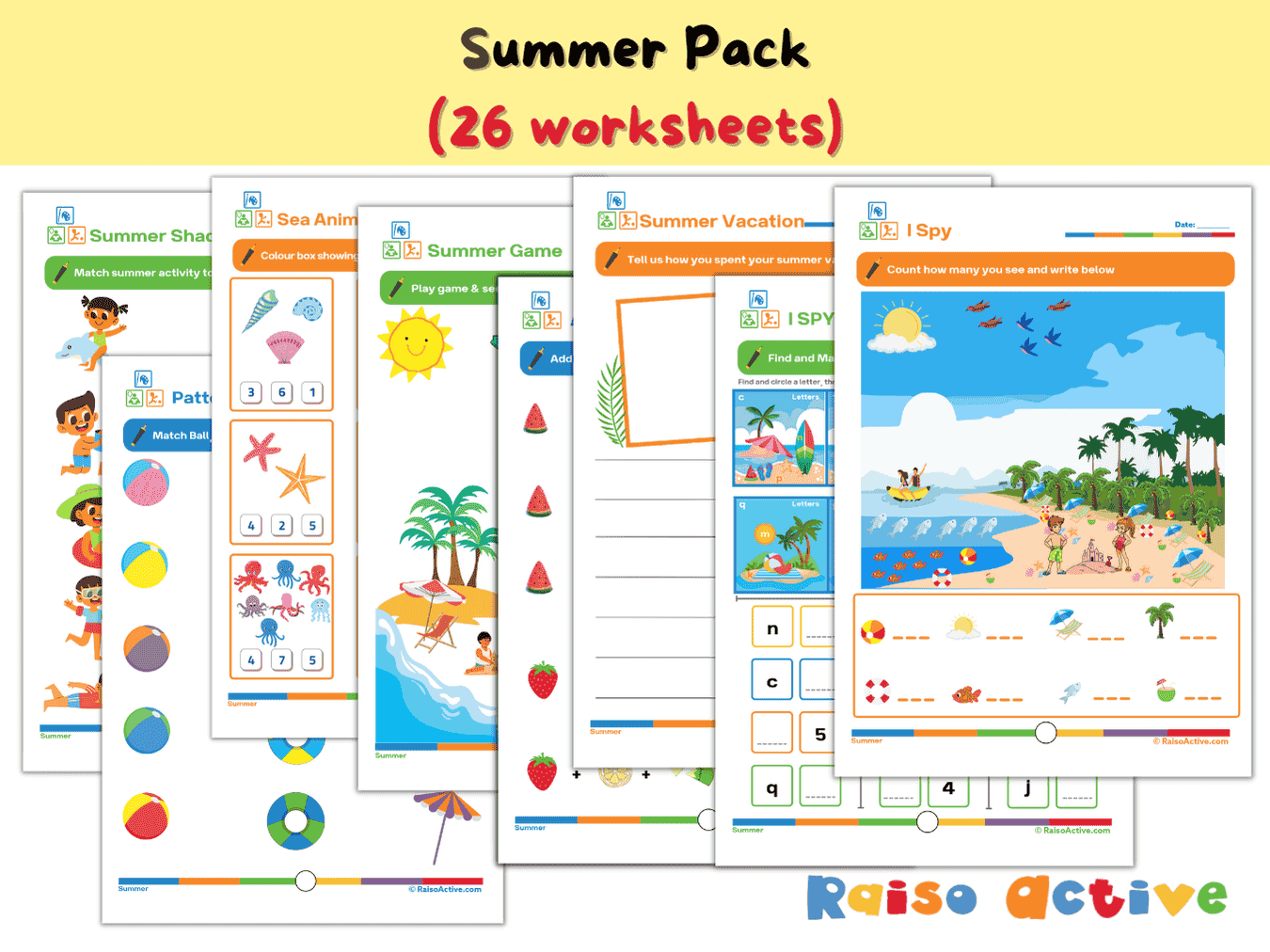
Part of the pack
Summer Activity Pack: Math, Literacy, Puzzles & More for Preschool & Kindergarten
This is page 11 of the pack. Ages 3-7 · Preschool–Grade 1Ages 3-7 · Nursery–Year 2Ages 3-7 · Nursery–Class 1Ages 3-7
Made for your child
Counting to 10, made for your child
A maths pack with your child's name in it: pictures that explain, practice at three levels, puzzles and story sums about them. Print a new set whenever they finish.
Make a maths packFree preview · free for members
Curriculum
- Writing > Letter Tracing A-Z
How to use this worksheet
Start by helping your child locate the target letter in the first section of the page, reading it aloud together. Next, guide them to the second section where they'll circle the number that matches the instructions given for that letter, checking that they understand what they're looking for before they circle it. Finally, have your child write the letter in the box provided, using the dotted guide if one is included, and celebrate completing all three steps.
Materials needed
- Pencil
- Crayons
Extension activities
- 1Draw a summer scene together and label parts of the picture with letters your child is currently learning.
- 2Practice writing the letters and numbers from the worksheet on a whiteboard or in a tray of sand for extra repetition.
- 3Play a simple scavenger hunt where you call out a letter and your child finds an object that starts with it.
- 4Make matching cards with letters on one set and numbers on another, and take turns pairing them up.

Written by
Hemsweta Jain · Teacher Cheena
MBA and Early Childhood Educator, teaching since 2014 · Founder of RaisoActive, Mumbai
Every RaisoActive worksheet is designed and checked by the founder before publishing.
Published · Last reviewed
More from Summer Activity Pack: Math, Literacy, Puzzles & More for Preschool & Kindergarten
Summer Pattern Match Worksheet for Preschoolers
Ages 3-5 · Preschool–Pre-KAges 3-5 · Nursery–ReceptionAges 3-5 · Nursery–LKGAges 3-5
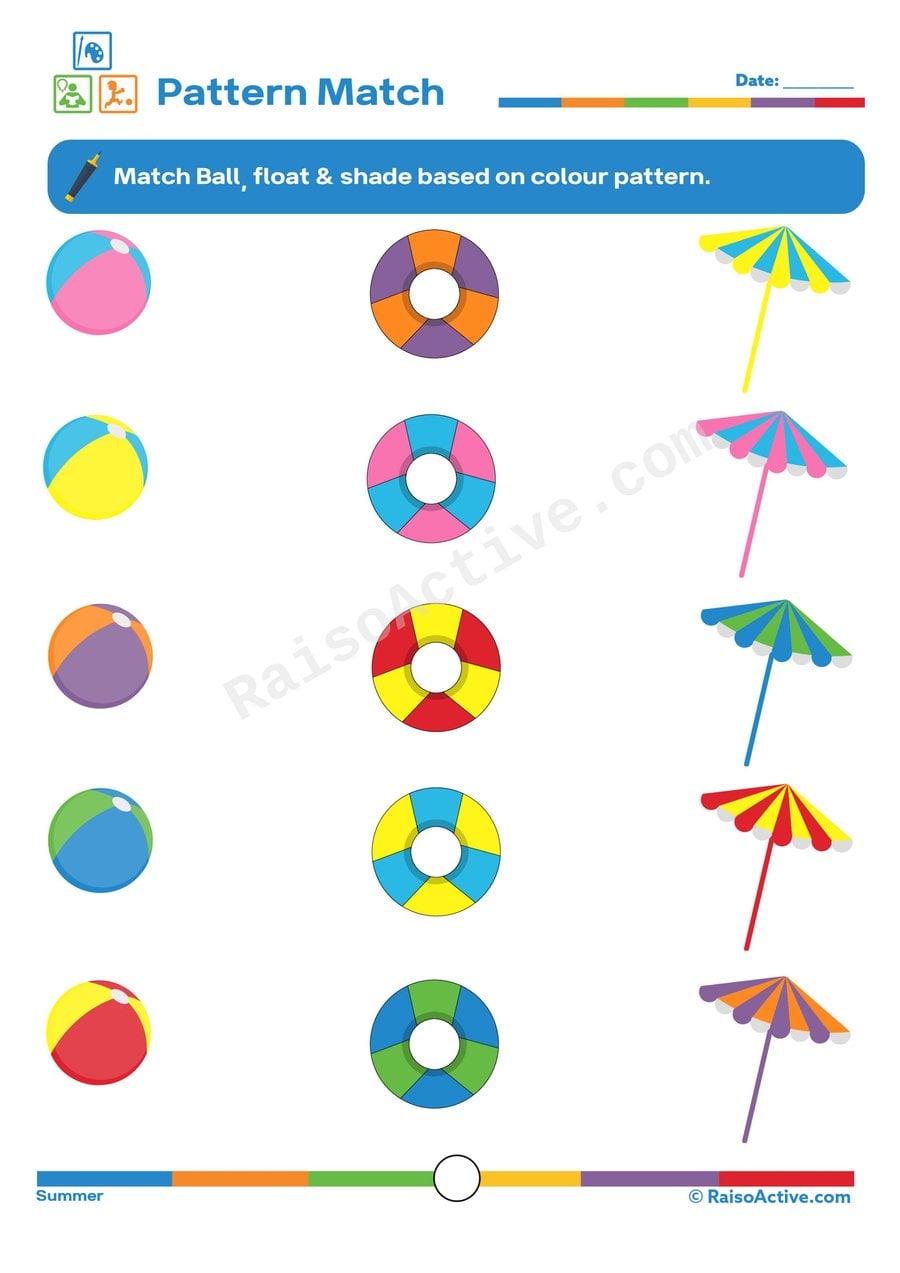
This worksheet asks children ages 3-5 to study the color pattern on a beach ball, pool float, and sun umbrella and match each item to its correctly patterned counterpart, building early pattern recognition, a foundational skill for later math concepts like sequencing and algebraic thinking. Because the match depends on noticing the order and repetition of colors rather than just matching a single color, children must compare details carefully rather than glance quickly. This strengthens visual attention alongside the pattern skill itself.
Summer Scavenger Hunt Worksheet for Kids
Ages 3-5 · Preschool–Pre-KAges 3-5 · Nursery–ReceptionAges 3-5 · Nursery–LKGAges 3-5
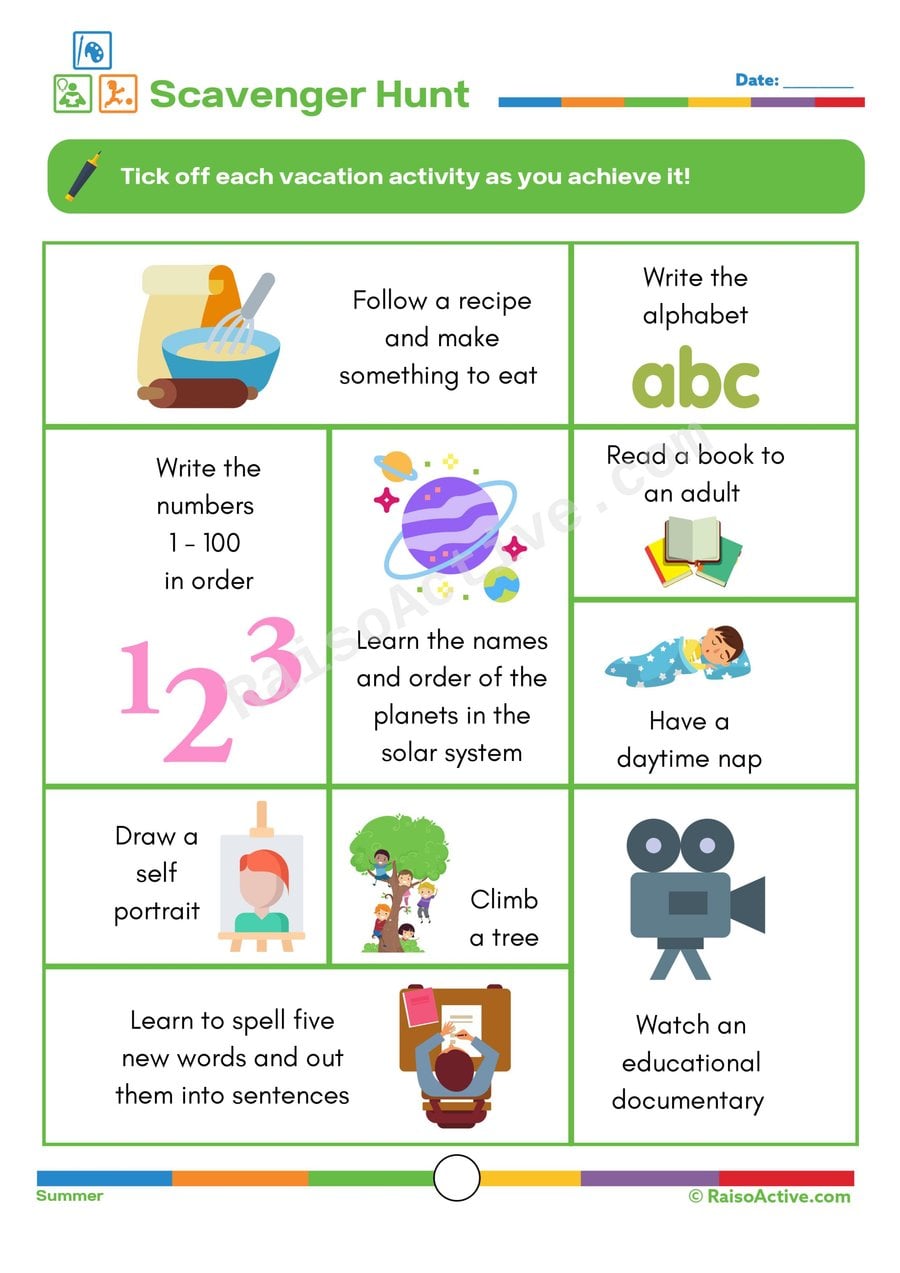
This scavenger hunt worksheet encourages children ages 3-5 to actively search their environment for specific summer sights, sounds, and objects, building observation skills and sustained attention as they look for each item on the list. Unlike a worksheet completed sitting at a table, this activity connects paper-based learning to real, physical exploration, which helps children practice following a checklist over an extended period of time. Checking off each item as it's found also introduces an early sense of tracking progress toward completing a task.

Summer Shadows Matching Worksheet for Preschoolers
Ages 3-5 · Preschool–Pre-KAges 3-5 · Nursery–ReceptionAges 3-5 · Nursery–LKGAges 3-5
This worksheet has children ages 3-5 match pictures of summer activities, like swimming or building a sandcastle, to their correct shadow silhouettes, building visual discrimination through shape recognition rather than color or detail. Because these shadows represent action scenes rather than single objects, children must recognize more complex outlines, including body positions and poses, which is a step up from matching simpler object shadows. This adds a layer of visual reasoning about how shapes and motion relate.

My Summer Vacation Worksheet: Write and Draw About Your Fun!
Ages 4-6 · Pre-K–KindergartenAges 4-6 · Reception–Year 1Ages 4-6 · LKG–UKGAges 4-6
This worksheet has children ages 4-6 write about their own summer vacation and draw a picture to match, practicing personal narrative writing, one of the earliest and most motivating forms of writing since it draws on a child's real memories rather than an assigned topic. Because children are describing something they actually experienced, this task builds both sentence-forming skills and the confidence that comes from writing about a subject they already know well. Pairing the writing with a drawing also lets children who aren't yet strong writers still fully express their ideas.

Summer Word Unscramble Worksheet for Preschoolers
Ages 3-5 · Preschool–Pre-KAges 3-5 · Nursery–ReceptionAges 3-5 · Nursery–LKGAges 3-5
This worksheet has children ages 3-5 unscramble jumbled letters to spell summer-themed words, practicing early phonics and spelling by sounding out letters and considering how they might combine into a familiar word. Because the letters are already given but out of order, children focus specifically on sequencing and sound-blending rather than recalling spelling from scratch, making this an accessible entry point into word-building. Writing the corrected word afterward reinforces handwriting alongside the phonics practice.

Summer Counting Worksheet: Count and Color Summer Objects!
Ages 3-5 · Preschool–Pre-KAges 3-5 · Nursery–ReceptionAges 3-5 · Nursery–LKGAges 3-5
This worksheet has children ages 3-5 count summer objects arranged in separate boxes and write the matching number below each group, giving repeated practice at connecting a counted quantity to its written numeral across several small sets. Working through multiple separate boxes, rather than one long row, keeps each counting task short and manageable while still building the stamina to repeat the process several times in a row. This structure also helps children generalize the skill of counting and labeling rather than memorizing a single group's answer.
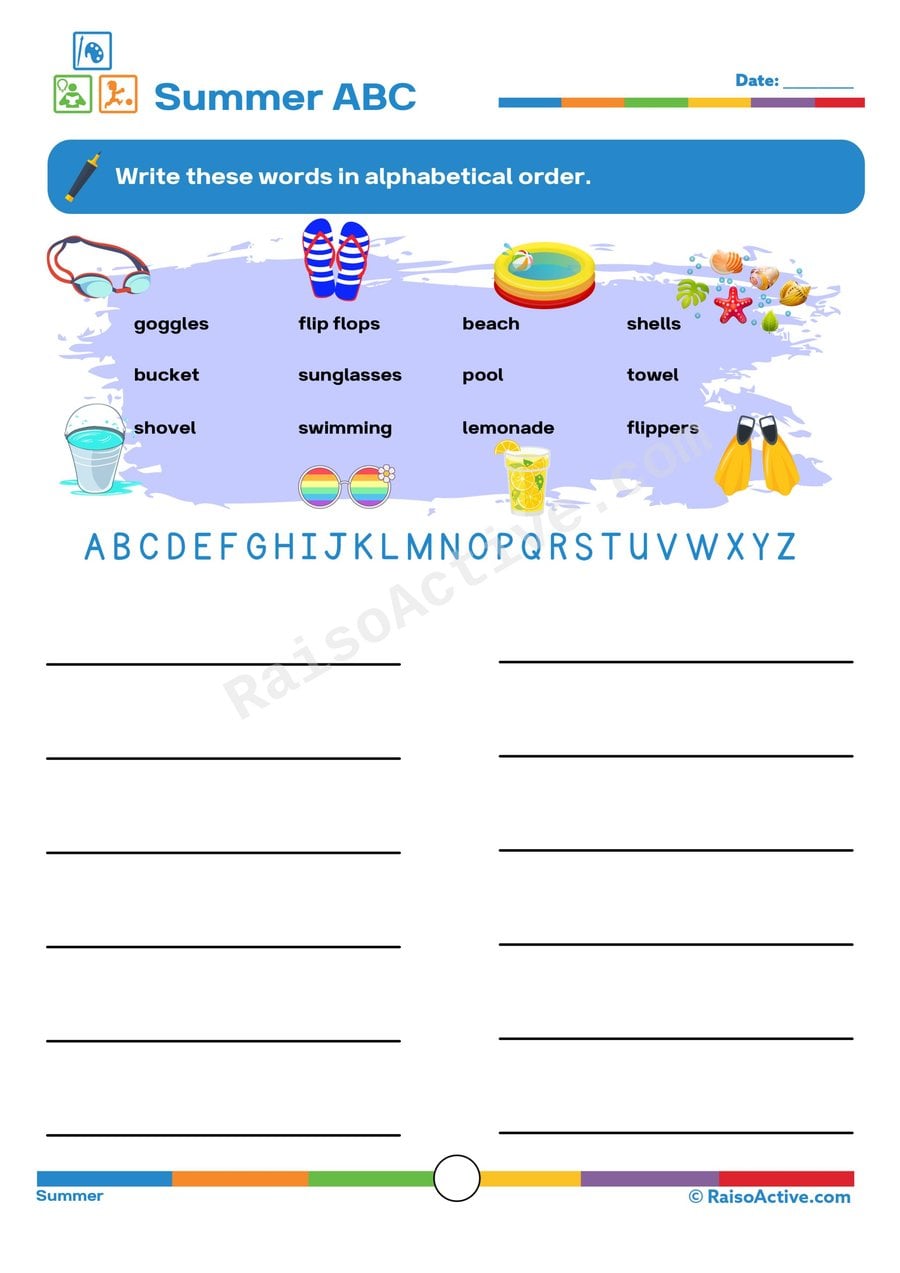
Summer ABC Worksheet: Alphabetical Order Fun!
Ages 4-6 · Pre-K–KindergartenAges 4-6 · Reception–Year 1Ages 4-6 · LKG–UKGAges 4-6
This worksheet has children ages 4-6 put a new set of summer words into alphabetical order, building on the comparison and sequencing skills involved in matching each word's first letter to its place in the alphabet. Because this task requires holding several words in mind at once and deciding their relative order, it strengthens working memory alongside letter-sequence knowledge. Repeated practice with alphabetizing across different word sets like this one helps the skill become more automatic over time.

Count the Sea Animals! A Fun Counting Worksheet for Kids
Ages 3-5 · Preschool–Pre-KAges 3-5 · Nursery–ReceptionAges 3-5 · Nursery–LKGAges 3-5
This worksheet has children ages 3-5 count different sea animals grouped in boxes and then identify the matching numeral for each group, strengthening one-to-one correspondence alongside early ocean and marine-life vocabulary. Because each box features a different sea creature, such as fish, crabs, or starfish, children also practice sorting attention between groups rather than counting one long continuous row. This variety keeps the counting task from becoming rote repetition.
Related worksheets

Alphabet U-Z Worksheet: Find the Letter and Count!
Ages 4-6 · Pre-K–KindergartenAges 4-6 · Reception–Year 1Ages 4-6 · LKG–UKGAges 4-6
This worksheet extends alphabet mastery to the less-practiced letters U through Z for children ages 4-6, combining beginning-sound identification with a counting task for each object pictured. Because letters at the end of the alphabet appear less often in early reading material, dedicated practice here helps round out full alphabet fluency, while the counting component keeps numeracy skills active alongside literacy.
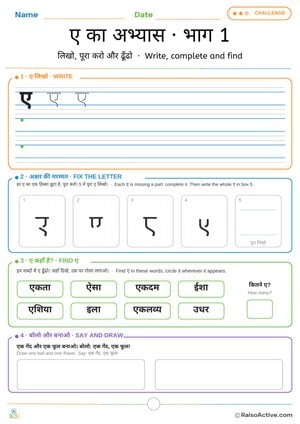
Hindi Letter ए (e) Practice 1: Write, Fix the Letter and Find | ए का अभ्यास · भाग 1
Ages 4-7 · Pre-K–Grade 1Ages 4-7 · Reception–Year 2Ages 4-7 · LKG–Class 1Ages 4-7
A challenge page: write ए between the lines, complete four letters that are each missing a part and then write the whole ए in box 5, find ए in words such as एकता, एकदम, एशिया and एकलव्य, and draw a picture. ए is not the short form of ऐ; the practice page keeps them apart.
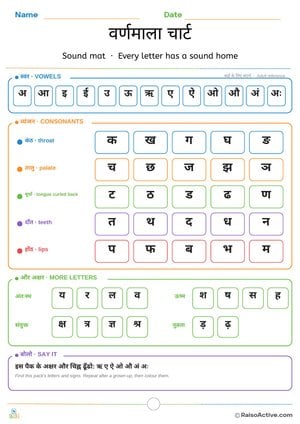
Hindi Varnmala Sound Mat – Hindi Vowels Part 2 Reference Chart | वर्णमाला चार्ट
Ages 3-7 · Preschool–Grade 1Ages 3-7 · Nursery–Year 2Ages 3-7 · Nursery–Class 1Ages 3-7
A reference chart of the vowels and consonants, grouped by where the sound is made (throat, palate, tongue curled back, teeth, lips). In this pack it is used to find and point to ऋ ए ऐ ओ औ अं अः, not to learn every letter at once.
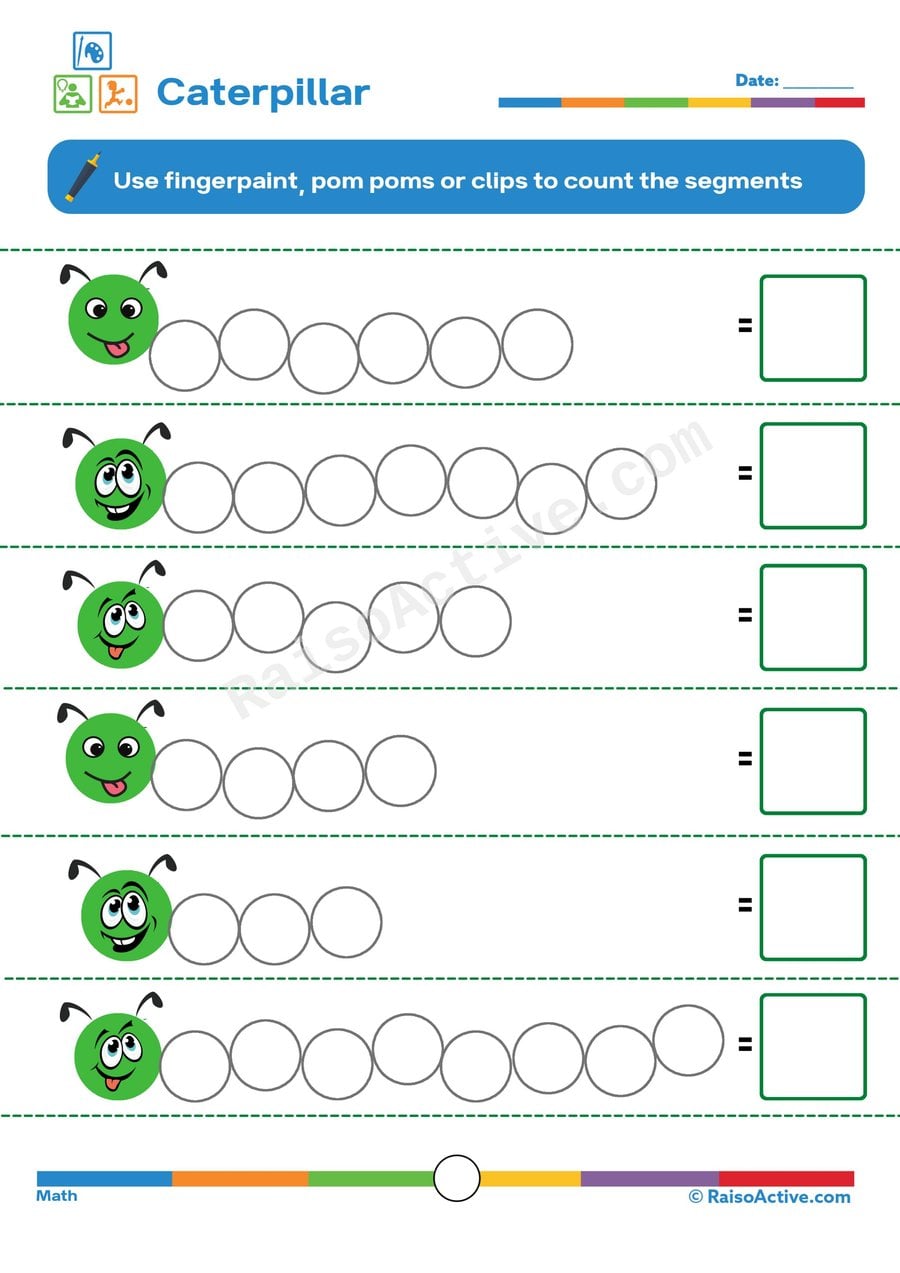
Caterpillar Counting Worksheet for Preschoolers
Ages 3-5 · Preschool–Pre-KAges 3-5 · Nursery–ReceptionAges 3-5 · Nursery–LKGAges 3-5
Counting the segments of each caterpillar teaches children ages 3-5 one-to-one correspondence — touching or marking each segment exactly once while saying a number — which is the core skill underlying accurate counting. Writing the final total in a box also connects the physical act of counting to its written numeral, reinforcing early number-writing practice.
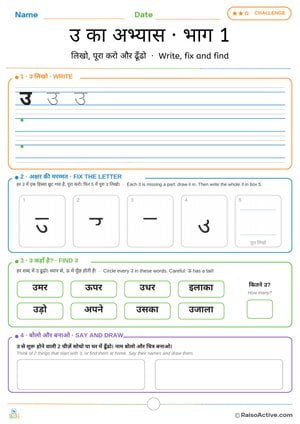
Hindi Letter उ Practice Part 1: Write, Fix and Find | उ का अभ्यास · भाग 1
Ages 3-7 · Preschool–Grade 1Ages 3-7 · Nursery–Year 2Ages 3-7 · Nursery–Class 1Ages 3-7
Children write उ on guide lines, complete four partly drawn letters, circle उ in eight words (while avoiding its look-alike ऊ), count how many they found, then think of two more words at home that start with उ and draw them.
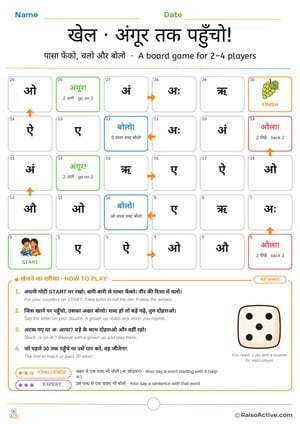
Hindi Vowels Board Game: Reach the Grapes (Part 2) | खेल – अंगूर तक पहुँचो
Ages 3-7 · Preschool–Grade 1Ages 3-7 · Nursery–Year 2Ages 3-7 · Nursery–Class 1Ages 3-7
A 30-square board game from START to the grapes (अंगूर). Players roll a die, move along the arrows and say the letter on their square, then a word that starts with it. Special squares send players forward or back, and the sign अः has its own stuck-or-अः rule.
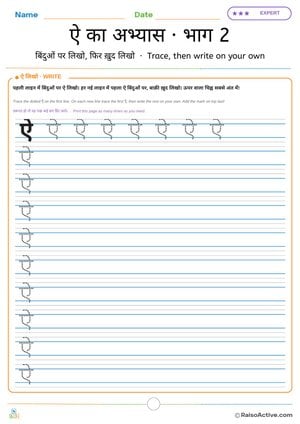
Hindi Letter ऐ (ai) Practice 2: Trace, then Write on Your Own | ऐ का अभ्यास · भाग 2
Ages 5-7 · Kindergarten–Grade 1Ages 5-7 · Year 1–Year 2Ages 5-7 · UKG–Class 1Ages 5-7
An expert page for confident writers: trace the dotted ऐ on the first line, then on each new line trace the first ऐ and write the rest on your own, adding the mark on top last.

Navratri Look Closely: Spot the Difference and Shadow Match
Ages 4-6 · Pre-K–KindergartenAges 4-6 · Reception–Year 1Ages 4-6 · LKG–UKGAges 4-6
Children compare two pictures carefully to find what is different and match objects to their shadows by looking at shape.
Guides for this topic

Number Formation Rhymes 0–9 and How to Fix Reversals
Original number formation rhymes for 0–9, the correct stroke order for each digit, why 3, 5 and 7 get reversed most often, and multisensory fixes that work.

Kindergarten Readiness Checklist: 25 Skills to Practice Before the First Day
A kindergarten readiness checklist of 25 literacy, math, motor, self-regulation and self-help skills, with an 8-week summer plan and notes on when not to worry.
Best Worksheets for 3-Year-Olds: What Works and What to Avoid
What works on worksheets for 3-year-olds: short sessions, crayons, tracing lines, matching, cutting, a free weekly plan, and signs one is too advanced.
Reviews
Every worksheet for ages 3–5, no watermark
Members download the full library of 1,000+ worksheets and every activity pack without watermarks or daily limits. One year costs ₹999 in India or $20 elsewhere.
See membership plansOr download any worksheet free with a watermark (5 a day).