
Lowercase Letter Matching Worksheet for Preschoolers
This worksheet gives children ages 4-5 practice connecting uppercase letters to their lowercase form by circling the correct match from a set of answer choices, a skill that's essential since most of the reading material children encounter is printed in lowercase. Many lowercase letters look quite different from their uppercase counterpart, so this matching task genuinely tests whether the connection has been learned rather than guessed.
Part of the pack
Month 3: Learning & Development | Ages 4-5Curriculum
How to use this worksheet
Look at the uppercase letter shown for the first item and say its name together. Show your child the row of lowercase letter choices and ask them to find the one that matches. Have them circle the correct lowercase letter. Move to the next uppercase letter and repeat, working through the whole page and reviewing all the matched pairs together at the end.
Materials needed
- Pencil
Extension activities
- •Have the child write the lowercase letters on a separate sheet of paper after matching them.
- •Use flashcards to practice letter recognition, mixing uppercase and lowercase cards together.
- •Play a memory matching game pairing uppercase and lowercase letter cards face-down.
- •Search a book together for both the uppercase and lowercase form of a chosen letter on one page.
- •Build letter pairs out of pipe cleaners, comparing the big and small versions side by side.
Tips for parents and teachers
Encourage your child and provide positive reinforcement, especially on trickier pairs like Gg or Qq that look quite different from each other. Make it fun by turning the matching into a quick game with a timer or a small reward for finishing a row. If your child confuses two lowercase letters, like b and d, point out a simple visual trick to help tell them apart.

Written by
Hemsweta Jain · Teacher Cheena
MBA and Early Childhood Educator, teaching since 2014 · Founder of RaisoActive, Mumbai
Every RaisoActive worksheet is designed and checked by the founder before publishing.
Published · Last reviewed
Related worksheets

Secret Words Worksheet: Matching Shapes and Letters!
Matching shapes to letters and then using that code to figure out a sequence of pictures teaches children ages 3-5 early symbolic reasoning, understanding that one thing, a shape, can stand in for another, a letter. This kind of code-breaking task builds logical thinking and pattern recognition beyond simple matching, since children must apply a rule consistently across multiple steps to reach a final answer. Framing the activity as uncovering a 'secret word' adds a sense of mystery and motivation that keeps children engaged through a multi-step reasoning task.

Match the Pictures: Letter Matching Worksheet for Preschoolers
Connecting pictures to their matching letters helps children ages 3-5 build the foundation of phonics, learning that a printed letter represents the beginning sound of a spoken word. Circling the animals that specifically start with the letter B adds a second layer of practice, requiring children to apply that letter-sound knowledge rather than just matching shapes. This two-step approach moves children from simple visual matching toward true letter-sound recognition, a critical pre-reading skill.

Fun Phonics Worksheet: Matching Uppercase and Lowercase Letters!
This matching worksheet teaches children ages 3-5 to recognize that uppercase and lowercase versions of the same letter — like S and s — represent one letter despite looking different, a concept that trips up many early readers. Drawing a line between the four matching pairs builds visual discrimination and letter-form memory, while the follow-up task of circling pictures that start with 'C' adds practice connecting a letter to its sound.

Alphabet Games Worksheet: Match the Letters to the Games!
This worksheet helps children ages 4-6 practice beginning-sound letter recognition by matching alphabet cards to pictures of games whose names start with that letter. Placing a letter card on its matching game picture, rather than simply circling an answer, adds a hands-on sorting element that keeps the activity active and physical rather than purely paper-based.

Matching Uppercase and Lowercase Letters: q-z Worksheet
This worksheet builds letter recognition by having children match uppercase letters from Q to Z with their corresponding lowercase forms, a pairing that can be tricky since several lowercase letters in this range, like 'q' and 'g,' don't closely resemble their capital counterparts. For four- and five-year-olds, mastering the second half of the alphabet's upper-lowercase pairs completes the foundational letter knowledge needed before reading fluently.

Circle the Correct Letter: Fun Phonics Worksheet for Kids
This phonics worksheet helps children ages 4-5 connect a picture's beginning sound to its matching letter, a key decoding skill on the path to independent reading. Circling the correct letter from a small set of choices also builds visual discrimination, since children must tell similar-looking letters apart under a bit of time pressure.

Small Letter a-h Matching Worksheet for Preschoolers
This worksheet builds lowercase letter recognition for a through h by having children match each letter to a picture whose name starts with that sound. For three- to five-year-olds, focusing on lowercase forms specifically matters because most of the text children encounter in books is written in lowercase, making this recognition more directly useful for early reading than uppercase alone.
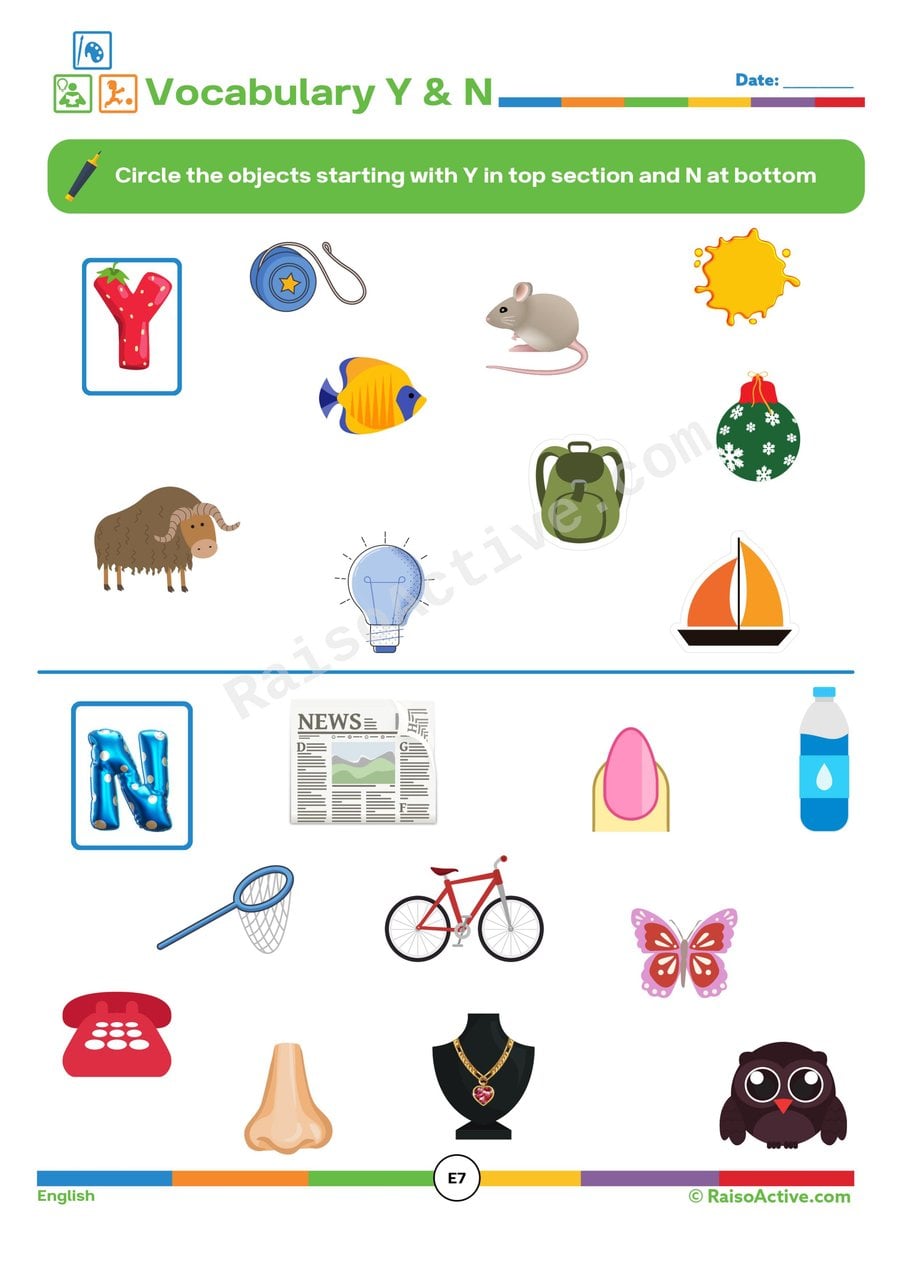
Y and N Vocabulary Worksheet: Circle the Objects!
Deciding whether a pictured object starts with Y or N helps children ages 3-5 practice initial sound discrimination between two distinct consonant sounds, building both vocabulary and listening skills. Circling in the correct top or bottom section adds a simple visual organization step that reinforces the category each object belongs to.
Guides for this topic
Best Worksheets for 3-Year-Olds: What Works and What to Avoid
What works on worksheets for 3-year-olds: short sessions, crayons, tracing lines, matching, cutting, a free weekly plan, and signs one is too advanced.
Documenting Learning Without Drowning in Data: A Practical Guide for Parents and Teachers
Learn practical ways to document your child's learning without overwhelm. Simple portfolios, observation tips, and printable trackers for ages 1-8.
When Should My Child Learn to Read? Is Kindergarten Too Early? A Complete Guide to Reading Readiness
Discover the research-backed optimal age for reading, key readiness signs, and why pushing too early can backfire. A complete guide for parents of children aged 3-8.
Reviews
Every worksheet for ages 4–5, no watermark
Members download the full library of 1,000+ worksheets and every activity pack without watermarks or daily limits. One year costs ₹1,000 in India or $20 elsewhere.
See membership plansOr download any worksheet free with a watermark (5 a day).