Small Letter Matching Worksheet: Cut and Paste Fun!
This worksheet helps children ages 3-5 recognize and match lowercase letters to their corresponding capital letters, a skill children need before they can read text that mixes both letter cases fluently. The cut-and-paste format adds fine motor practice, since children must precisely place a small paper letter next to its match.
Part of the pack
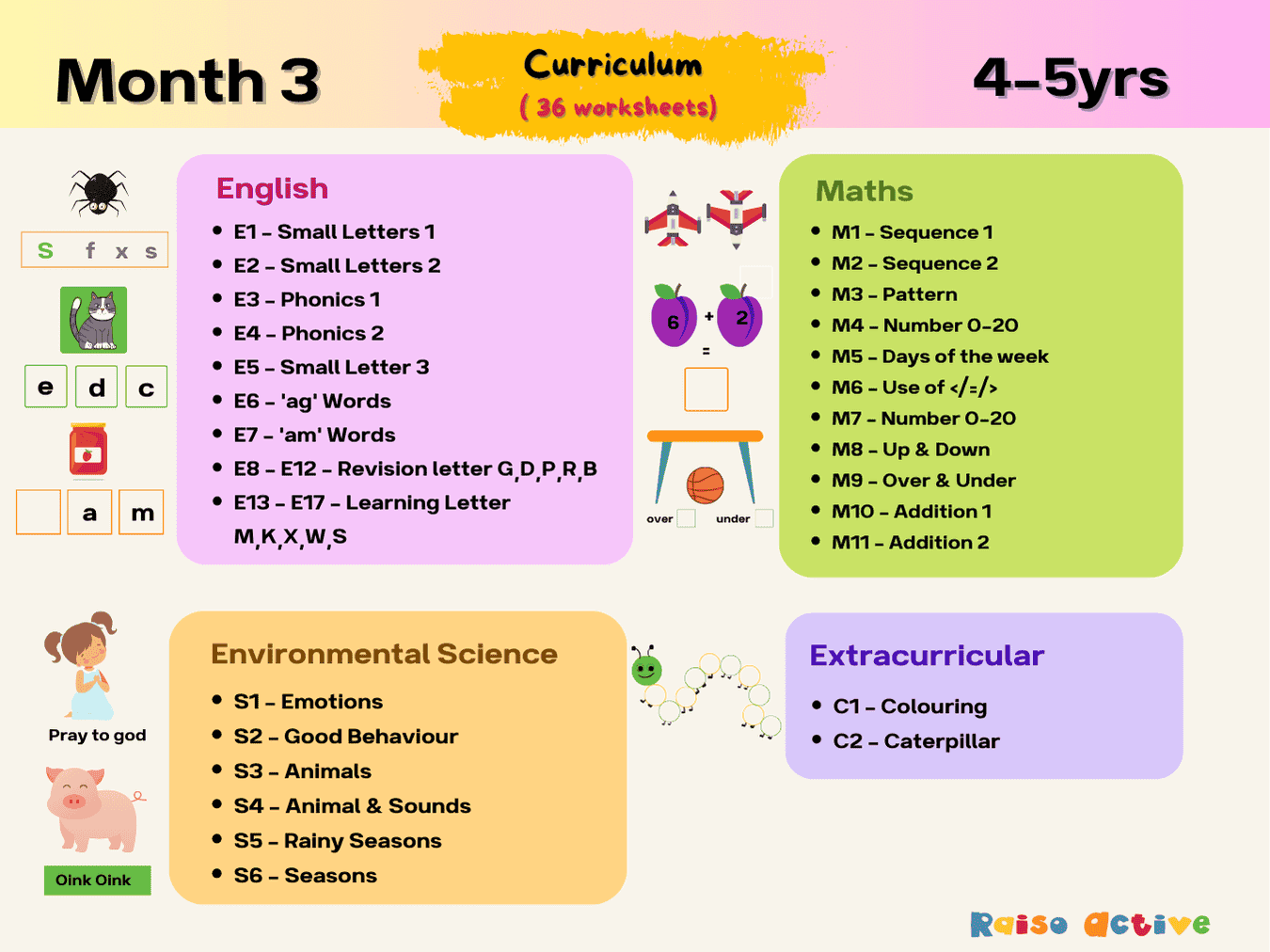
Month 3: Learning & Development | Ages 4-5
This is page 8 of the pack. Ages 4-5 · Pre-KAges 4-5 · ReceptionAges 4-5 · LKGAges 4-5
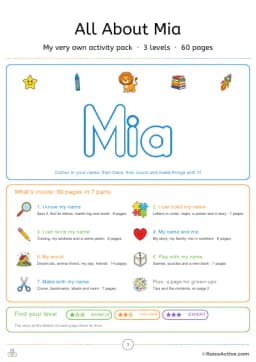
Made for your child
A whole activity pack made with their name
60 pages to spot, build, trace and write their own name, plus pages about their favourites, feelings and family. See a free preview with their name.
Make an All About Me packFree preview · free for members
Or start free: a name tracing sheet with their nameCurriculum
- Writing > Letter Tracing A-Z
How to use this worksheet
Cut out the small letters at the bottom of the page together, guiding your child's scissor hand if needed. Look at the capital letters on the cherries and say each one aloud. Have your child find the matching lowercase letter among the cut-out pieces and paste it next to its capital partner. Continue until every capital letter on the page has been matched with its lowercase pair.
Materials needed
- Scissors
- Glue
- Pencil
Extension activities
- 1Have the child write the matched letter pairs on a separate sheet of paper.
- 2Practice saying the letter sounds as they match, not just the letter names.
- 3Play a memory-style matching game with capital and lowercase letter cards face down.
- 4Sort a pile of mixed capital and lowercase magnetic letters into matching pairs.

Written by
Hemsweta Jain · Teacher Cheena
MBA and Early Childhood Educator, teaching since 2014 · Founder of RaisoActive, Mumbai
Every RaisoActive worksheet is designed and checked by the founder before publishing.
Published · Last reviewed
More from Month 3: Learning & Development | Ages 4-5

Am Words Worksheet: Read, Match, and Fill-in the Blanks!
Ages 4-5 · Pre-KAges 4-5 · ReceptionAges 4-5 · LKGAges 4-5
This worksheet builds phonics skills within the 'am' word family — words like 'ham,' 'jam,' and 'Sam' — by having children read words aloud, match them to pictures, and fill in missing letters to complete them. For four- and five-year-olds, working within a single rime family like '-am' helps children generalize a decoding pattern they can apply to many new words, rather than sounding out every word from scratch.

Animal Sounds Matching Worksheet for Preschoolers
Ages 3-5 · Preschool–Pre-KAges 3-5 · Nursery–ReceptionAges 3-5 · Nursery–LKGAges 3-5
This worksheet builds vocabulary and auditory memory by asking children to match each animal picture to the sound it makes, such as connecting a cow to 'moo' or a duck to 'quack.' For three- to five-year-olds, linking an animal's appearance to its sound strengthens both early science knowledge and the kind of associative memory that supports vocabulary growth.

Lowercase Letter Matching Worksheet for Preschoolers
Ages 4-5 · Pre-KAges 4-5 · ReceptionAges 4-5 · LKGAges 4-5
This worksheet gives children ages 4-5 practice connecting uppercase letters to their lowercase form by circling the correct match from a set of answer choices, a skill that's essential since most of the reading material children encounter is printed in lowercase. Many lowercase letters look quite different from their uppercase counterpart, so this matching task genuinely tests whether the connection has been learned rather than guessed.

Letter W Worksheet: Tracing, Coloring, and Word Recognition!
Ages 3-5 · Preschool–Pre-KAges 3-5 · Nursery–ReceptionAges 3-5 · Nursery–LKGAges 3-5
This worksheet builds recognition and formation of the letter W through tracing, writing, and identifying words that begin with it, like 'watermelon' or 'whale.' For three- to five-year-olds, practicing a letter with a more complex zigzag shape than earlier letters like O or L also develops the finer pencil control needed for more advanced handwriting.

Letter S Tracing Worksheet: Learn to Write and Identify the Letter S!
Ages 3-5 · Preschool–Pre-KAges 3-5 · Nursery–ReceptionAges 3-5 · Nursery–LKGAges 3-5
This worksheet helps children ages 3-5 learn to recognize and write the letter S, both uppercase and lowercase, using its distinctive curving stroke, while also practicing identifying words that start with the letter S. Because S makes a long, continuous hissing sound that's easy to isolate, this letter is often one of the more approachable sounds for early phonics practice.

Parent's Guide: Vocabulary Building and Emotional Development Worksheet
Ages 3-5 · Preschool–Pre-KAges 3-5 · Nursery–ReceptionAges 3-5 · Nursery–LKGAges 3-5
This multi-part parent guide walks children ages 3-5 through vocabulary sorting, making emotion faces, discussing seasons, and identifying good habits, covering both language development and emotional awareness in a single guided session. Naming emotions accurately and building vocabulary side by side helps children develop the words they need to express their feelings clearly, a skill that supports both communication and self-regulation.
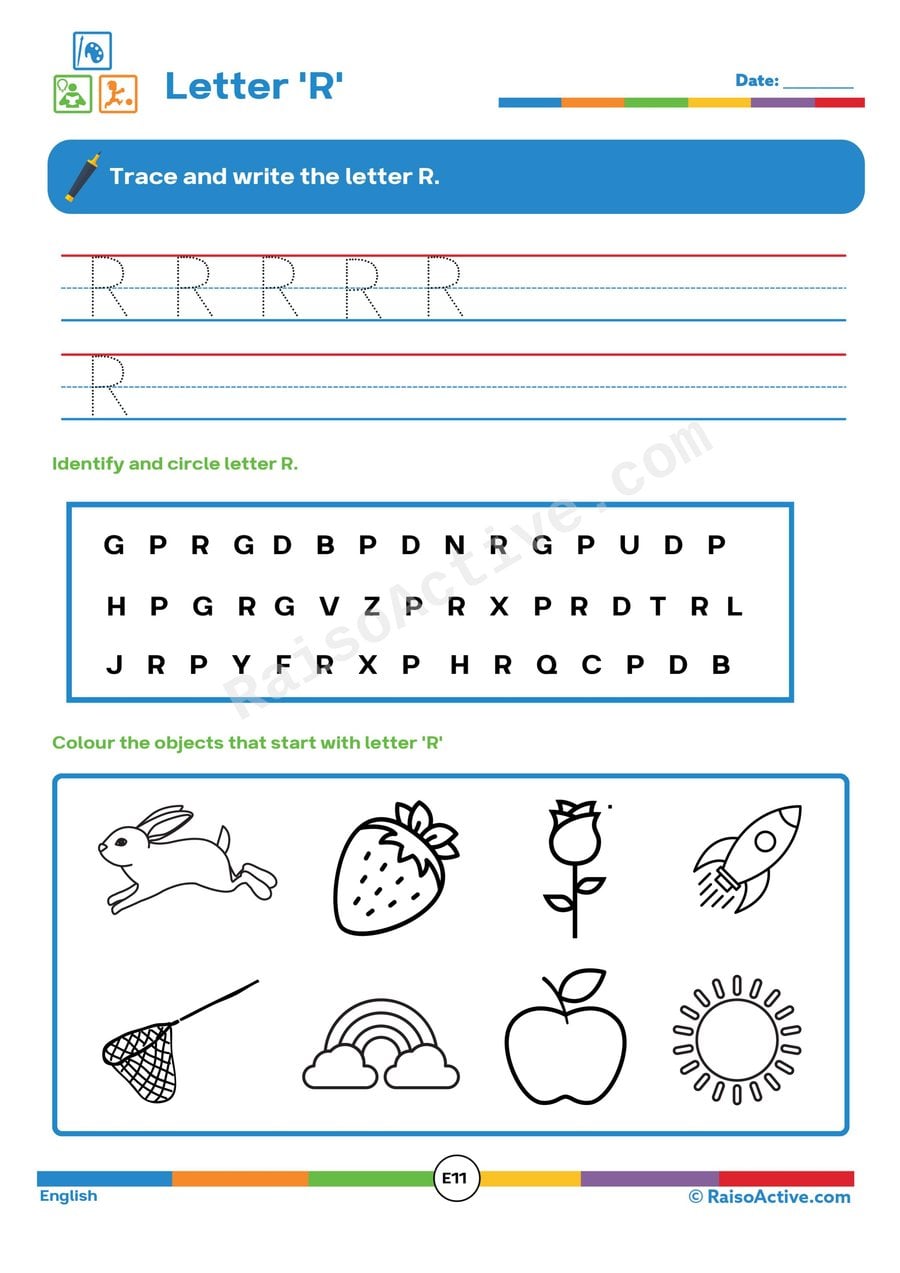
Letter R Worksheet: Trace, Identify, and Color!
Ages 4-5 · Pre-KAges 4-5 · ReceptionAges 4-5 · LKGAges 4-5
This worksheet helps children ages 4-5 practice tracing and writing the letter R, spotting it among a group of other letters, and recognizing objects that begin with the R sound. Working across three related tasks for one letter, tracing, searching, and identifying pictures, gives repeated exposure that helps the letter shape and sound become automatic.
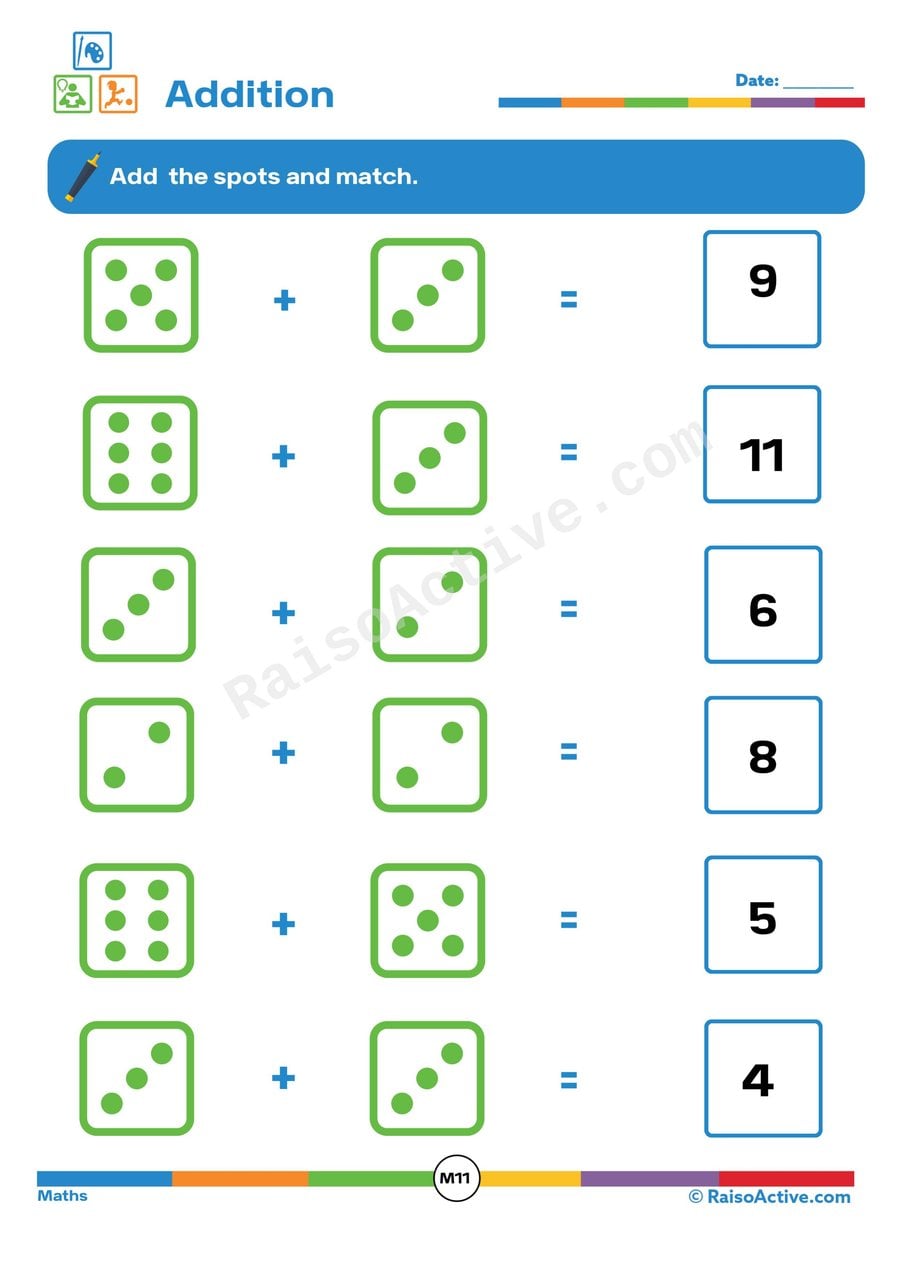
Dice Addition Worksheet: Add the Spots and Match!
Ages 4-6 · Pre-K–KindergartenAges 4-6 · Reception–Year 1Ages 4-6 · LKG–UKGAges 4-6
This worksheet builds basic addition fluency by having children count the dots on two dice, add the totals together, and match the resulting sum to the correct number. For four- to six-year-olds, using dice as the counting tool adds a layer of subitizing practice — the ability to recognize a small quantity of dots at a glance without counting one by one — which speeds up addition over time.
Related worksheets

Q and C Vocabulary Worksheet: Circle and Square the Pictures!
Ages 3-5 · Preschool–Pre-KAges 3-5 · Nursery–ReceptionAges 3-5 · Nursery–LKGAges 3-5
Distinguishing between the letters Q and C by sight and sound is a genuine phonics challenge for children ages 3-5, since both letters can look and even sound similar in casual speech. This worksheet asks children to apply a different marking — a circle for Q, a square for C — for each letter's pictures, which forces active decision-making rather than passive letter recognition. Strengthening this kind of visual and auditory discrimination helps prevent letter mix-ups that commonly appear in early reading and writing.
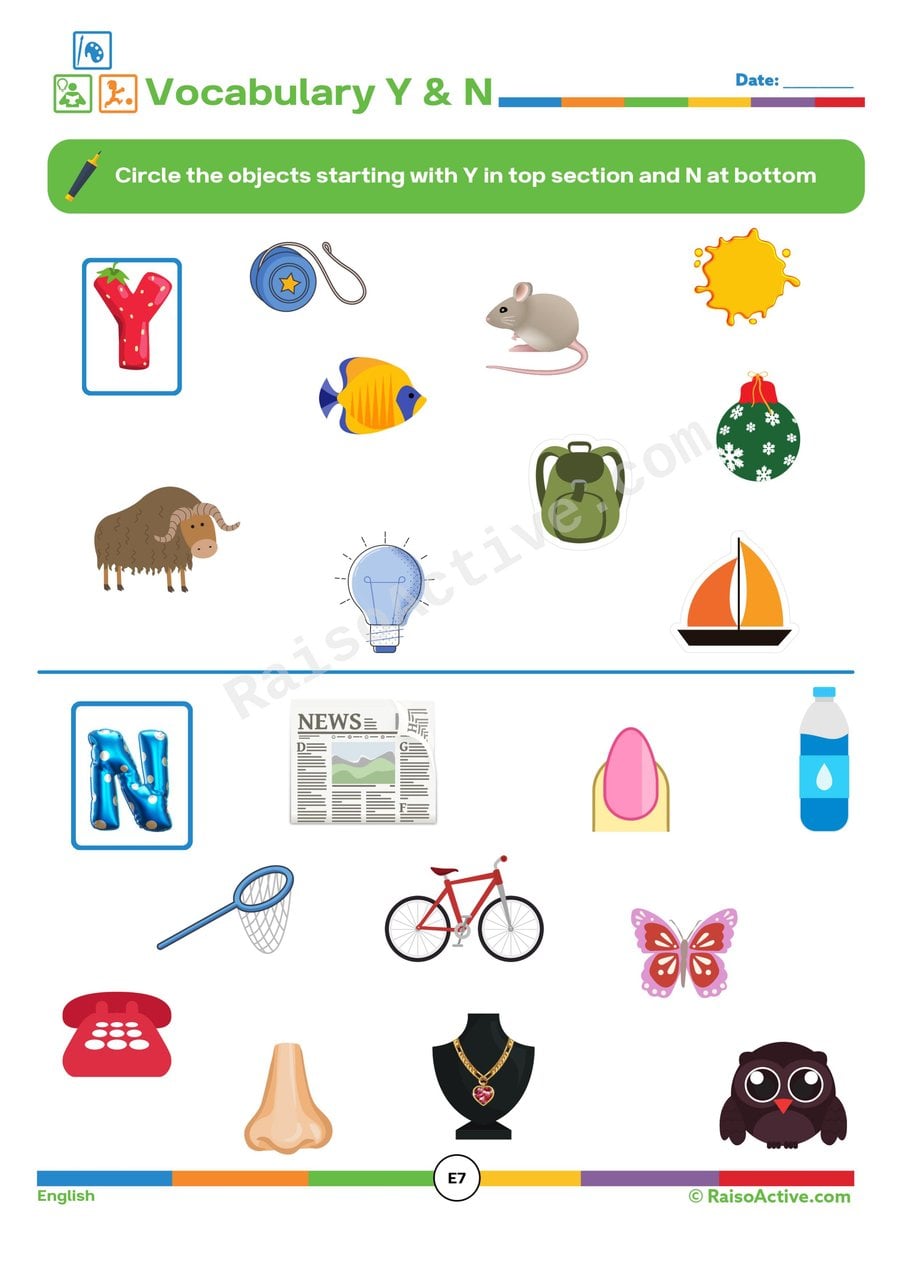
Y and N Vocabulary Worksheet: Circle the Objects!
Ages 3-5 · Preschool–Pre-KAges 3-5 · Nursery–ReceptionAges 3-5 · Nursery–LKGAges 3-5
Deciding whether a pictured object starts with Y or N helps children ages 3-5 practice initial sound discrimination between two distinct consonant sounds, building both vocabulary and listening skills. Circling in the correct top or bottom section adds a simple visual organization step that reinforces the category each object belongs to.

Matching Uppercase and Lowercase Letters: q-z Worksheet
Ages 4-5 · Pre-KAges 4-5 · ReceptionAges 4-5 · LKGAges 4-5
This worksheet builds letter recognition by having children match uppercase letters from Q to Z with their corresponding lowercase forms, a pairing that can be tricky since several lowercase letters in this range, like 'q' and 'g,' don't closely resemble their capital counterparts. For four- and five-year-olds, mastering the second half of the alphabet's upper-lowercase pairs completes the foundational letter knowledge needed before reading fluently.
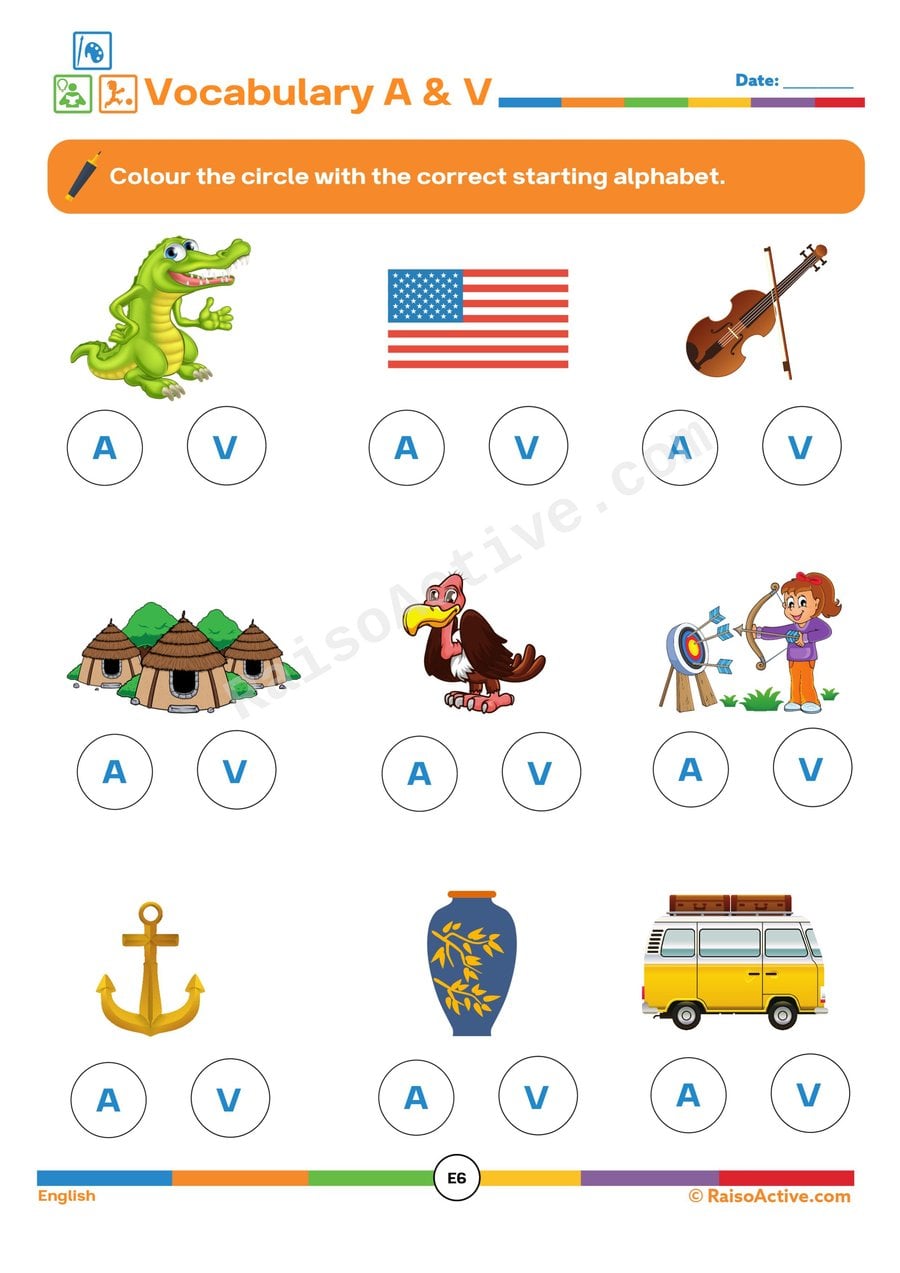
A & V Alphabet Worksheet: Color the Correct Letter!
Ages 3-5 · Preschool–Pre-KAges 3-5 · Nursery–ReceptionAges 3-5 · Nursery–LKGAges 3-5
Deciding whether a pictured word starts with A or V teaches children ages 3-5 to discriminate between two beginning sounds that can seem similar to a new listener, sharpening phonemic awareness in the process. Coloring the correct circle rather than just circling it adds an extra layer of engagement while still reinforcing the letter-sound match.

Secret Words Worksheet: Crack the Shape Code
Ages 4-7 · Pre-K–Grade 1Ages 4-7 · Reception–Year 2Ages 4-7 · LKG–Class 1Ages 4-7
This worksheet helps children practice letter recognition and matching skills by associating letters with shapes and identifying the corresponding pictures.

Coloring and Matching Fun: Heart, Fish, and Alphabet Worksheet
Ages 3-5 · Preschool–Pre-KAges 3-5 · Nursery–ReceptionAges 3-5 · Nursery–LKGAges 3-5
This multi-part worksheet asks children ages 3-5 to follow a specific coloring instruction and then match letters to objects, building both instruction-following skills and early letter-object association in a single activity. Coloring only the heart red, rather than coloring freely, practices listening comprehension and attention to detail, a skill children need for following classroom directions later on. The letter-matching portion reinforces that letters represent real objects and sounds, an important building block before formal phonics instruction takes over.

Capital and Small Letter Matching Worksheet for Preschoolers
Ages 3-5 · Preschool–Pre-KAges 3-5 · Nursery–ReceptionAges 3-5 · Nursery–LKGAges 3-5
Children ages 3-5 build letter recognition fluency by matching each uppercase letter to its corresponding lowercase form, a skill essential for reading since text uses both cases interchangeably. Recognizing that 'B' and 'b' represent the same letter sound despite looking different is a genuinely tricky early literacy milestone. Circling words that begin with a capital letter adds an extra layer of practice noticing capitalization in real context.

Alphabet Games Worksheet: Match the Letters to the Games!
Ages 4-6 · Pre-K–KindergartenAges 4-6 · Reception–Year 1Ages 4-6 · LKG–UKGAges 4-6
This worksheet helps children ages 4-6 practice beginning-sound letter recognition by matching alphabet cards to pictures of games whose names start with that letter. Placing a letter card on its matching game picture, rather than simply circling an answer, adds a hands-on sorting element that keeps the activity active and physical rather than purely paper-based.
Guides for this topic

Best Worksheets for 3-Year-Olds: What Works and What to Avoid
What works on worksheets for 3-year-olds: short sessions, crayons, tracing lines, matching, cutting, a free weekly plan, and signs one is too advanced.
Christmas and Winter Activities That Combine Fun and Learning: Creating Magical Educational Experiences
Discover Christmas and winter activities that combine festive fun with real learning. Crafts, counting, literacy, and printable worksheets for ages 2 to 8 — perfect for home and school.
Age-Appropriate Halloween Learning Activities: Balancing Spooks and Skills for Young Learners
Discover fun, age-appropriate Halloween learning activities for young children. Spooky crafts, counting games, literacy ideas, and printable worksheets for ages 2 to 8.
Reviews
Every worksheet for ages 3–5, no watermark
Members download the full library of 1,000+ worksheets and every activity pack without watermarks or daily limits. One year costs ₹999 in India or $20 elsewhere.
See membership plansOr download any worksheet free with a watermark (5 a day).