Look & Speak: Color and Repeat the Words Worksheet
This worksheet builds early vocabulary and oral language skills by having children color familiar images and then read and repeat a simple sentence describing each one aloud. For ages 3-5, the combination of coloring, reading, and speaking reinforces new words through multiple senses, helping vocabulary stick more effectively than reading alone.
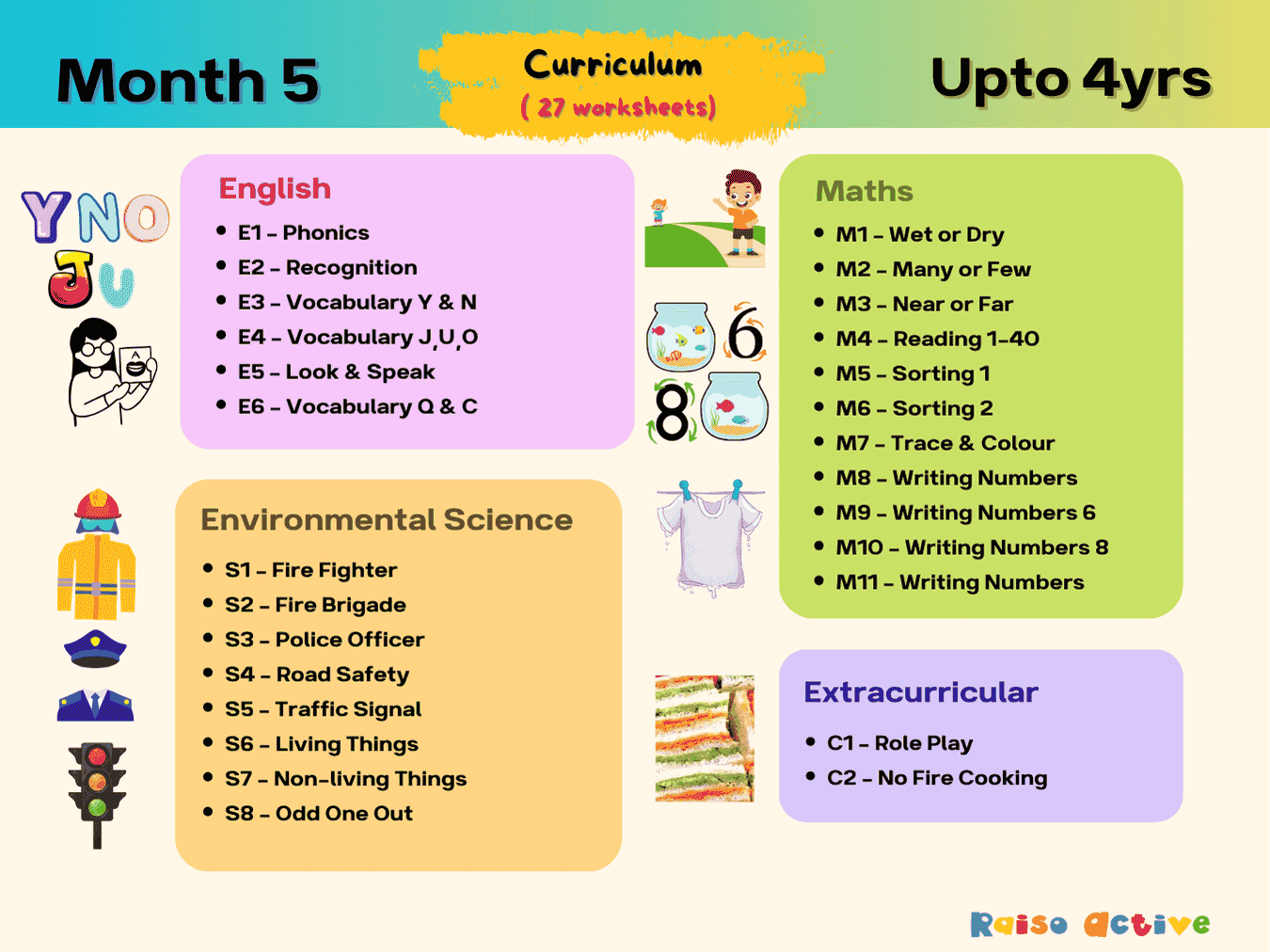
Part of the pack
Month 5: Preschool Subjects and Play | Ages Up to 4
This is page 8 of the pack. Ages 2-4 · PreschoolAges 2-4 · NurseryAges 2-4
Made for your child
Spelling practice, made for your child
Their own spelling words turned into a pack: trace or look-cover-write-check, roll and write, a secret picture code, a word search, a crossword and a test, with their name in it.
Make a spelling packFree preview · free for members
Or start free: a word search with sight wordsCurriculum
- Vocabulary > Vocabulary Building
How to use this worksheet
Look at the first picture together and name what it shows before your child begins coloring it in with crayons or colored pencils. Once colored, read the simple sentence beneath the picture aloud together, pointing to each word as you say it. Have your child repeat the sentence back to you on their own, encouraging clear pronunciation. Continue through each remaining picture and sentence the same way, coloring, reading together, and repeating independently.
Materials needed
- Crayons or colored pencils
- Pencil
Extension activities
- 1Draw an original picture and write or dictate a simple sentence to describe it, following the same pattern.
- 2Find the real objects shown in the pictures around your home and say their names aloud together.
- 3Play a simple game where you point to a colored picture and your child says the matching sentence from memory.
- 4Record your child saying each sentence aloud and play it back for them to hear their own voice.
- 5Practice the sentences again the next day without the pictures, to see how many your child remembers.

Written by
Hemsweta Jain · Teacher Cheena
MBA and Early Childhood Educator, teaching since 2014 · Founder of RaisoActive, Mumbai
Every RaisoActive worksheet is designed and checked by the founder before publishing.
Published · Last reviewed
More from Month 5: Preschool Subjects and Play | Ages Up to 4

Non-Living Things Coloring Worksheet for Preschoolers
Ages 3-5 · Preschool–Pre-KAges 3-5 · Nursery–ReceptionAges 3-5 · Nursery–LKGAges 3-5
Coloring only the non-living things on the page asks children ages 3-5 to apply a real scientific rule — that living things grow, move, breathe, and eat, while non-living things do not — rather than just naming objects. This requires them to think through each picture individually and test it against the rule, building early classification and critical thinking skills. Learning to separate living from non-living things is one of the first formal science concepts children encounter and sets up later lessons about plants, animals, and the environment.

Q and C Vocabulary Worksheet: Circle and Square the Pictures!
Ages 3-5 · Preschool–Pre-KAges 3-5 · Nursery–ReceptionAges 3-5 · Nursery–LKGAges 3-5
Distinguishing between the letters Q and C by sight and sound is a genuine phonics challenge for children ages 3-5, since both letters can look and even sound similar in casual speech. This worksheet asks children to apply a different marking — a circle for Q, a square for C — for each letter's pictures, which forces active decision-making rather than passive letter recognition. Strengthening this kind of visual and auditory discrimination helps prevent letter mix-ups that commonly appear in early reading and writing.

Police Officer Worksheet: Learn About Community Helpers!
Ages 3-5 · Preschool–Pre-KAges 3-5 · Nursery–ReceptionAges 3-5 · Nursery–LKGAges 3-5
Beyond coloring practice, this worksheet builds early community-helper knowledge by asking children to identify which specific items — a badge, a hat, handcuffs, a whistle — actually belong to a police officer's job. Circling the correct items requires visual discrimination and recall of a real-world role, which is the beginning of understanding that different jobs come with different tools and responsibilities. Drawing the officer's face afterward adds a layer of personal expression to a lesson that's otherwise about categorization.

Role Play: Color, Cut, and Create Your Neighborhood!
Ages 3-5 · Preschool–Pre-KAges 3-5 · Nursery–ReceptionAges 3-5 · Nursery–LKGAges 3-5
This hands-on activity turns community-helper knowledge into a 3D building project: children color buildings and helper figures, cut them out along the dotted lines, and assemble a small neighborhood on cardboard. That construction step is what makes this different from a typical coloring page — folding tabs and sticking pieces upright requires spatial reasoning about how a flat cutout becomes a standing structure, on top of the fine motor demands of careful cutting. It also reinforces community-helper roles by having your child literally place each helper into the neighborhood they belong in.

Firefighter Fun: Circle the Equipment & Maze Worksheet
Ages 3-5 · Preschool–Pre-KAges 3-5 · Nursery–ReceptionAges 3-5 · Nursery–LKGAges 3-5
Circling firefighter equipment builds vocabulary and visual discrimination for children ages 3-5, since they must identify which pictured items — a hose, helmet, or ladder — actually belong to a firefighter's tools versus unrelated objects. Guiding the fire truck through a maze to reach the station afterward adds a hands-on problem-solving and fine motor challenge, requiring children to plan and trace a path with a pencil. Combining a community-helper theme with a maze keeps the page varied while introducing real vocabulary about an occupation many young children find exciting.

Phonics Fun: Identify and Match Letters Worksheet
Ages 4-5 · Pre-KAges 4-5 · ReceptionAges 4-5 · LKGAges 4-5
Matching a picture to the letter that starts its name requires children ages 4-5 to isolate the very first sound in a spoken word, a phonics skill called initial sound identification that directly predicts later reading success. This worksheet turns that listening skill into a visual matching task, asking children to connect what they hear to a printed letter rather than just naming pictures aloud. Building this sound-to-letter link is one of the clearest early indicators that a child is ready to start sounding out simple words.

Number 8 Worksheet: Trace, Count, and Color Butterflies!
Ages 3-5 · Preschool–Pre-KAges 3-5 · Nursery–ReceptionAges 3-5 · Nursery–LKGAges 3-5
Tracing the number 8 while counting and coloring eight butterflies helps children ages 3-5 connect the written numeral to the actual quantity it represents, reinforcing number sense alongside handwriting. The final step, drawing any eight objects of the child's choosing, moves beyond guided practice into independent application, checking whether the concept of 'eight' has truly transferred rather than just been copied. This progression from tracing to counting to free drawing builds a complete, layered understanding of one specific number.

Community Helpers & Early Learning Activities Worksheet
Ages 3-5 · Preschool–Pre-KAges 3-5 · Nursery–ReceptionAges 3-5 · Nursery–LKGAges 3-5
This worksheet bundles several community-helper-themed activities, coloring, role-play, and object identification, to build vocabulary and social understanding around the different people who help in a community, like police officers or firefighters. For ages 3-5, learning about community helpers builds both social awareness and early classification skills as children learn to associate specific tools or uniforms with specific jobs.
Related worksheets

Fun Letter I & H Vocabulary Game Worksheet for Preschoolers
Ages 3-5 · Preschool–Pre-KAges 3-5 · Nursery–ReceptionAges 3-5 · Nursery–LKGAges 3-5
This board-game-style worksheet helps children ages 3-5 build vocabulary around the letters I and H by rolling a die, moving along a path, and generating additional words that share the same beginning sound as the picture they land on. Thinking of extra words on the spot pushes children beyond simple recognition into active word recall, a more advanced phonics skill.

Classroom Vocabulary Worksheet for Kids: Circle and Name!
Ages 3-5 · Preschool–Pre-KAges 3-5 · Nursery–ReceptionAges 3-5 · Nursery–LKGAges 3-5
Circling pictures of common classroom objects and saying their names aloud builds vocabulary and oral language skills in children ages 3-5, helping them connect familiar school items, like a desk, book, or crayon, to their spoken names. This kind of naming practice supports school readiness, since recognizing and labeling classroom objects helps children feel more comfortable and confident in a school environment. Speaking each word aloud, rather than just circling silently, also reinforces pronunciation and word retrieval.
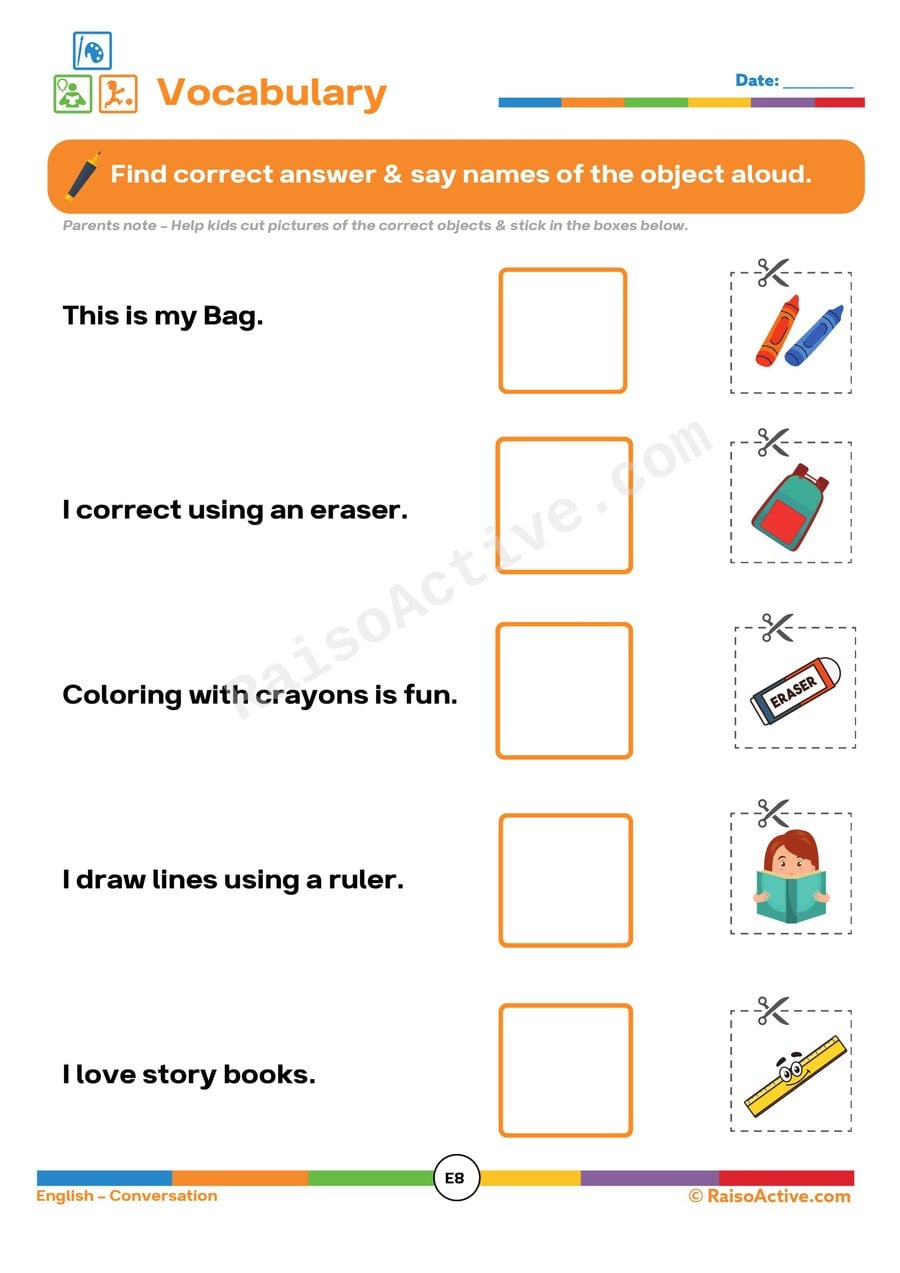
Vocabulary Fun: Match the Pictures! (Ages 3-5)
Ages 3-5 · Preschool–Pre-KAges 3-5 · Nursery–ReceptionAges 3-5 · Nursery–LKGAges 3-5
Cutting out pictures and matching them to sentences builds early reading comprehension in children ages 3-5, since they must listen to or read a sentence and connect its meaning to the correct image rather than just recognizing an isolated word. This combination of cutting, listening, and matching strengthens vocabulary retention because the word is reinforced through multiple senses at once: hearing it, seeing it in print, and seeing its picture. Pasting the correct picture into place also adds fine motor practice to the vocabulary lesson.

Cut and Paste Vocabulary Worksheet: Matching Words to Pictures
Ages 3-5 · Preschool–Pre-KAges 3-5 · Nursery–ReceptionAges 3-5 · Nursery–LKGAges 3-5
Matching printed words to their pictures asks emerging readers to connect an abstract string of letters with a real object, an essential step on the path from picture recognition to true word reading. The cutting and pasting adds a tactile, deliberate pace to the matching process, giving children extra time to look closely at each word before committing to an answer.

Christmas Fill-in-the-Blanks Worksheet for Preschoolers
Ages 3-5 · Preschool–Pre-KAges 3-5 · Nursery–ReceptionAges 3-5 · Nursery–LKGAges 3-5
Filling in missing letters of Christmas words like 'S_ _W' or 'TR_ _' helps children ages 3-5 connect letter sounds to their written form, an essential early step toward independent spelling. Using the accompanying picture as a clue also teaches them to cross-check visual and phonetic information — a strategy they'll rely on throughout early reading.
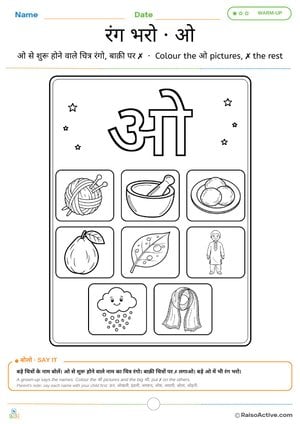
Colour the ओ Words – Hindi Letter ओ (o) Colouring Worksheet | ओ वाली चीज़ों में रंग भरो
Ages 3-7 · Preschool–Grade 1Ages 3-7 · Nursery–Year 2Ages 3-7 · Nursery–Class 1Ages 3-7
Children say each picture name aloud, decide whether it starts with ओ, colour the matching pictures (ओखली, ओस, ओला and ओढ़नी) and the big outline letter, and put a cross on the rest. Sorting by first sound trains the ear and colouring builds hand control.

Color the Reindeer! Christmas Coloring Worksheet for Kids
Ages 3-5 · Preschool–Pre-KAges 3-5 · Nursery–ReceptionAges 3-5 · Nursery–LKGAges 3-5
Coloring the reindeer and gift bag illustrations gives children ages 3-5 focused practice with crayon control and color selection, helping them build the hand strength and precision needed for later handwriting tasks. Choosing colors for a familiar character like a reindeer also encourages imaginative decision-making, since there's no single 'correct' color for a fictional animal's coat or a wrapped gift. The festive subject matter keeps a repetitive fine motor task feeling like a treat rather than a chore.
Look, Listen and Talk: Hindi Speaking Practice for Vowels Part 1 | सुनो और बोलो
Ages 3-7 · Preschool–Grade 1Ages 3-7 · Nursery–Year 2Ages 3-7 · Nursery–Class 1Ages 3-7
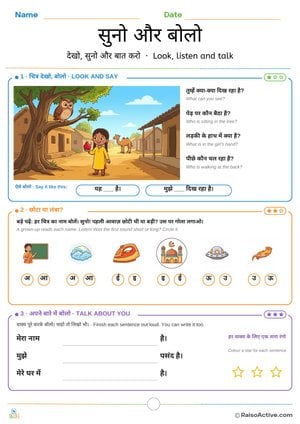
Children look at a village picture and answer questions, hear whether the first sound of each word is short or long, and say simple sentences about themselves such as मेरा नाम ___ है. It builds listening, spoken Hindi and sentence patterns with no reading needed.
Guides for this topic

Sight Words by Age: The First 50 Words and How to Teach Them Without Flashcard Fatigue
Which sight words to teach first and why, the heart-word method, a read-trace-write-find routine, games, and a by-age table of typical sight-word progress.
How to Teach CVC Blending: A Step-by-Step Method That Works in Two Weeks
A step-by-step method for teaching CVC blending, covering continuous sounds, word families, common errors, and a 14-day plan that most children finish reading CVC words.

Best Worksheets for 3-Year-Olds: What Works and What to Avoid
What works on worksheets for 3-year-olds: short sessions, crayons, tracing lines, matching, cutting, a free weekly plan, and signs one is too advanced.
Reviews
Every worksheet for ages 3–5, no watermark
Members download the full library of 1,000+ worksheets and every activity pack without watermarks or daily limits. One year costs ₹999 in India or $20 elsewhere.
See membership plansOr download any worksheet free with a watermark (5 a day).