Phonics Fun: Identify and Match Letters Worksheet
Matching a picture to the letter that starts its name requires children ages 4-5 to isolate the very first sound in a spoken word, a phonics skill called initial sound identification that directly predicts later reading success. This worksheet turns that listening skill into a visual matching task, asking children to connect what they hear to a printed letter rather than just naming pictures aloud. Building this sound-to-letter link is one of the clearest early indicators that a child is ready to start sounding out simple words.
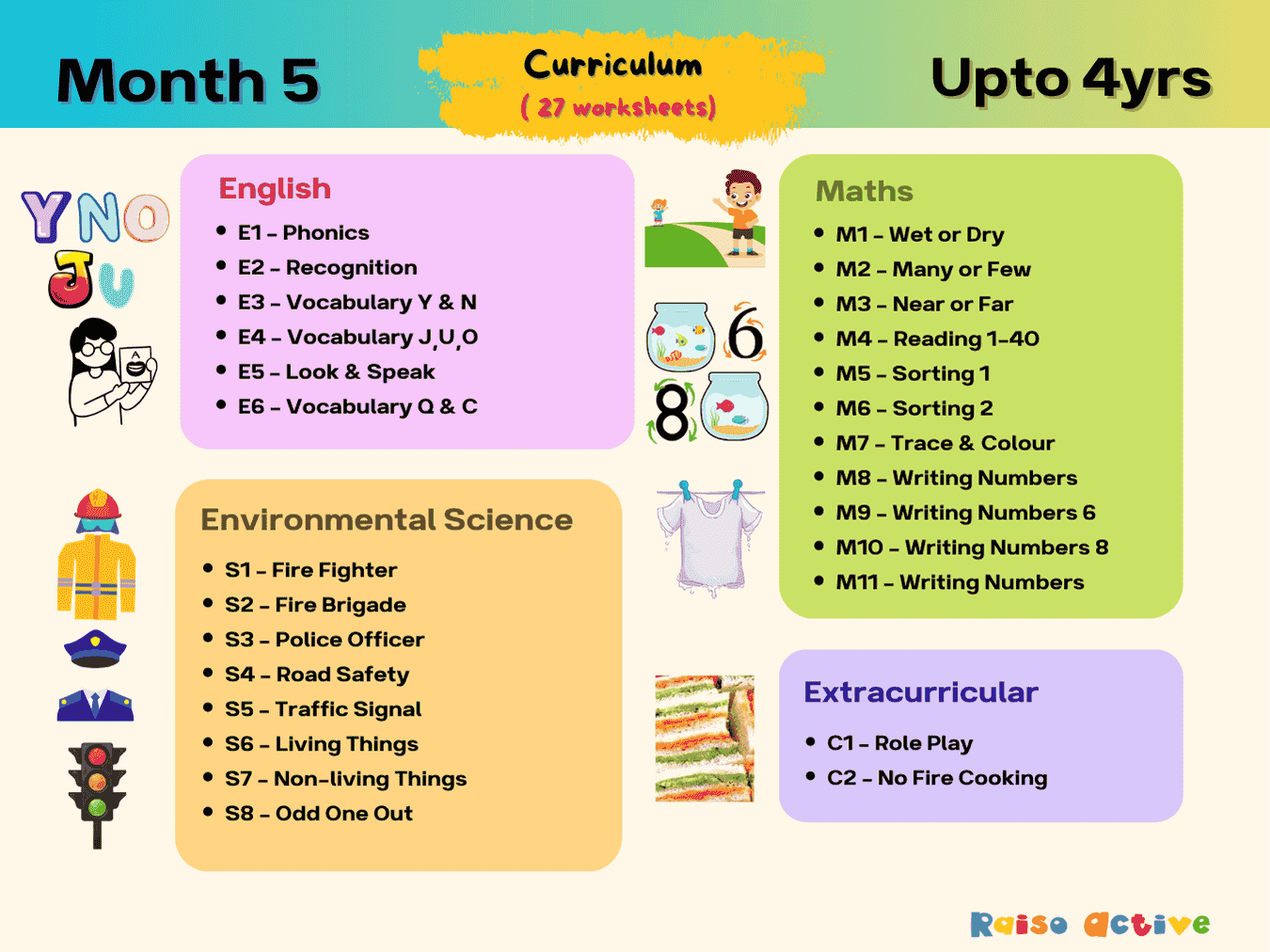
Part of the pack
Month 5: Preschool Subjects and Play | Ages Up to 4
This is page 4 of the pack. Ages 2-4 · PreschoolAges 2-4 · NurseryAges 2-4
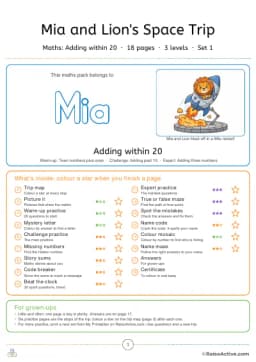
Made for your child
Numbers to 20, made for your child
A maths pack with your child's name in it: pictures that explain, practice at three levels, puzzles and story sums about them. Print a new set whenever they finish.
Make a maths packFree preview · free for members
Curriculum
- Phonics - Letter Sounds > Beginning Sounds
How to use this worksheet
Point to the first picture and say its name slowly and clearly, stretching out the beginning sound, such as 'mmm-oon' for moon. Ask your child to repeat the word and identify which sound they hear first. Have them scan the letters at the bottom of the page to find the one that matches that beginning sound, then draw a line connecting the picture to the correct letter. Work through the remaining pictures the same way, letting your child say each word independently before matching it.
Materials needed
- Pencil
- Eraser
Extension activities
- 1Search the house for objects that start with the same letter sounds as the worksheet pictures and make a list together.
- 2Play an 'I hear it first' game: say three words and have your child identify the one that starts differently.
- 3Draw a new picture of something with a beginning sound you choose and have your child write the matching letter.
- 4Sort a pile of small toys or picture cards by their beginning sound into labeled groups.
- 5Read a short picture book and pause to ask what sound the first word on each page starts with.

Written by
Hemsweta Jain · Teacher Cheena
MBA and Early Childhood Educator, teaching since 2014 · Founder of RaisoActive, Mumbai
Every RaisoActive worksheet is designed and checked by the founder before publishing.
Published · Last reviewed
More from Month 5: Preschool Subjects and Play | Ages Up to 4
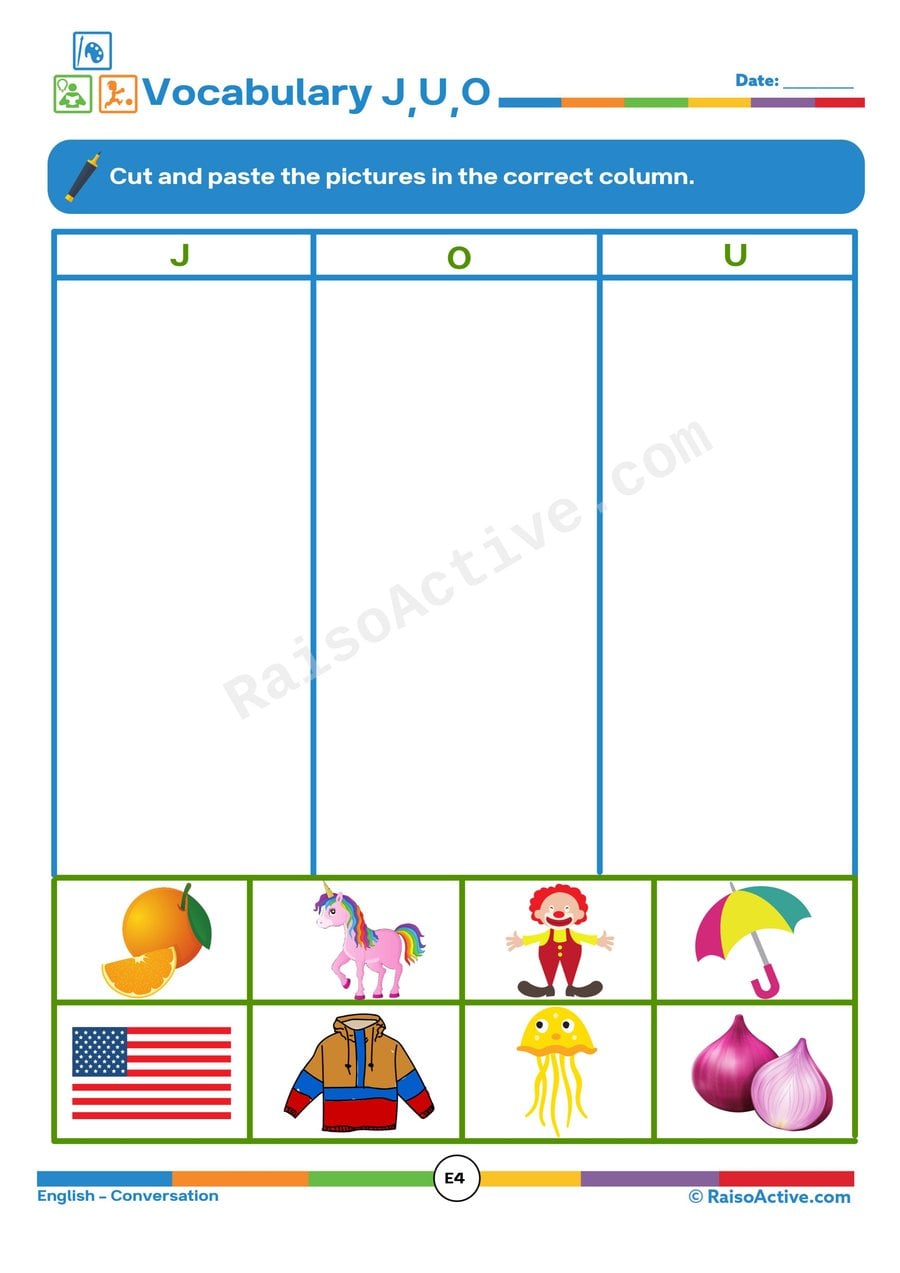
J, U, O Sorting Worksheet: Cut and Paste Pictures!
Ages 3-5 · Preschool–Pre-KAges 3-5 · Nursery–ReceptionAges 3-5 · Nursery–LKGAges 3-5
Sorting pictures by their beginning letter sound into J, U, or O columns asks children ages 3-5 to actively compare three different sounds rather than just recognizing one letter at a time, a more demanding phonics task than single-letter worksheets. This kind of three-way sorting builds sharper listening discrimination, since J, U, and O can sound similar in casual speech but are quite distinct once isolated. The cut-and-paste format also reinforces the sorting decision physically, since children must place each picture correctly rather than simply circling an answer.

Y and N Vocabulary Worksheet: Coloring and Letter Recognition Fun!
Ages 3-5 · Preschool–Pre-KAges 3-5 · Nursery–ReceptionAges 3-5 · Nursery–LKGAges 3-5
Coloring images that start with 'Y' in one color and images that start with 'N' in another asks children ages 3-5 to apply letter-sound knowledge through a coloring task rather than simply naming or tracing letters, adding an extra layer of decision-making to the activity. This color-coded sorting method makes it easy for a parent to check understanding at a glance once the page is finished. Building recognition of less commonly practiced letters like Y and N rounds out a child's broader alphabet knowledge beyond the most frequent letters.

Living Things Worksheet: Identifying Living and Non-Living Things
Ages 4-6 · Pre-K–KindergartenAges 4-6 · Reception–Year 1Ages 4-6 · LKG–UKGAges 4-6
This worksheet asks 4-6 year olds to sort images into living and non-living categories and then separately identify what living things actually need to survive — air, water, food, and space to grow — which moves beyond simple classification into understanding the defining characteristics of life. That two-part structure (sort, then reason about needs) makes this a solid introduction to basic biology concepts that children will build on in later science classes.

Number 8 Worksheet: Trace, Count, and Color Butterflies!
Ages 3-5 · Preschool–Pre-KAges 3-5 · Nursery–ReceptionAges 3-5 · Nursery–LKGAges 3-5
Tracing the number 8 while counting and coloring eight butterflies helps children ages 3-5 connect the written numeral to the actual quantity it represents, reinforcing number sense alongside handwriting. The final step, drawing any eight objects of the child's choosing, moves beyond guided practice into independent application, checking whether the concept of 'eight' has truly transferred rather than just been copied. This progression from tracing to counting to free drawing builds a complete, layered understanding of one specific number.
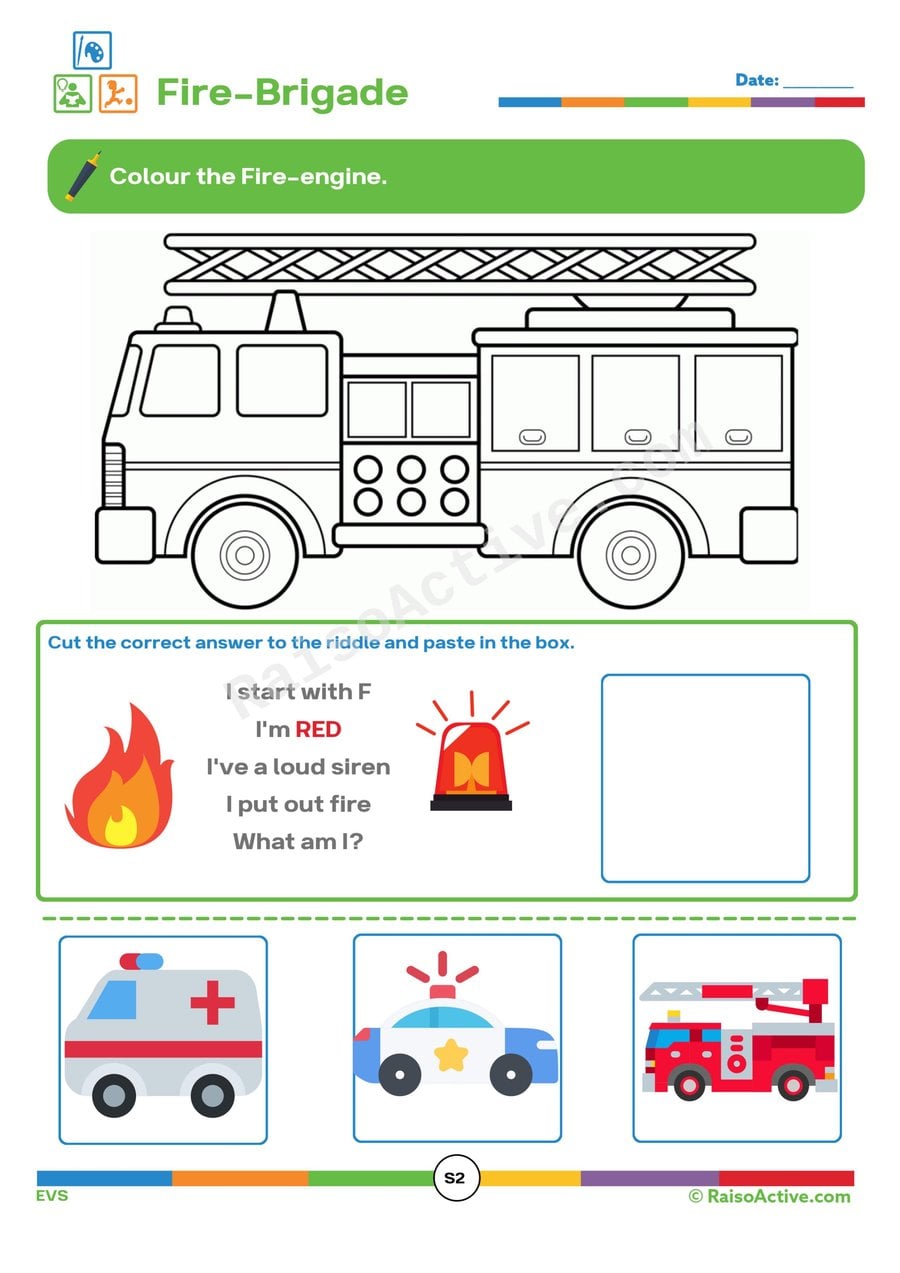
Fire Engine Fun: Color and Solve the Riddle!
Ages 3-5 · Preschool–Pre-KAges 3-5 · Nursery–ReceptionAges 3-5 · Nursery–LKGAges 3-5
This worksheet pairs creative coloring with a light dose of deductive reasoning — after coloring the fire engine, children have to solve a simple riddle and pick out the correct picture answer to paste in place. That riddle-solving step goes beyond coloring practice into comprehension and logical thinking, since your child has to listen to clues, consider a few possible answers, and choose the one that actually fits, all while learning about firefighters as community helpers.

Many or Few Fish Bowl Worksheet for Preschoolers
Ages 3-5 · Preschool–Pre-KAges 3-5 · Nursery–ReceptionAges 3-5 · Nursery–LKGAges 3-5
This worksheet builds the comparative concepts of 'many' and 'few' — an early step toward understanding quantity that comes before formal counting comparisons like greater-than and less-than. By having your child actually draw bubbles and fish into the bowls following directions, it also reinforces following multi-step instructions and one-to-one correspondence, since each fish or bubble they add has to be drawn individually. Coloring the bowl with the most fish at the end ties the abstract idea of 'more' back to a concrete, visible outcome.

Animal Homes: Cut and Paste Sorting Worksheet for Preschoolers
Ages 3-5 · Preschool–Pre-KAges 3-5 · Nursery–ReceptionAges 3-5 · Nursery–LKGAges 3-5
Matching each animal to its home using numbered cut-and-paste pieces gives children ages 3-5 practice with number-based sorting while also building early knowledge of animal habitats, like a bird's nest or a bee's hive. Using numbers as the matching key, rather than just visual similarity, adds a layer of number recognition and one-to-one matching to the classification task. Understanding that different animals live in different kinds of homes is an early building block of basic life science and habitat concepts.
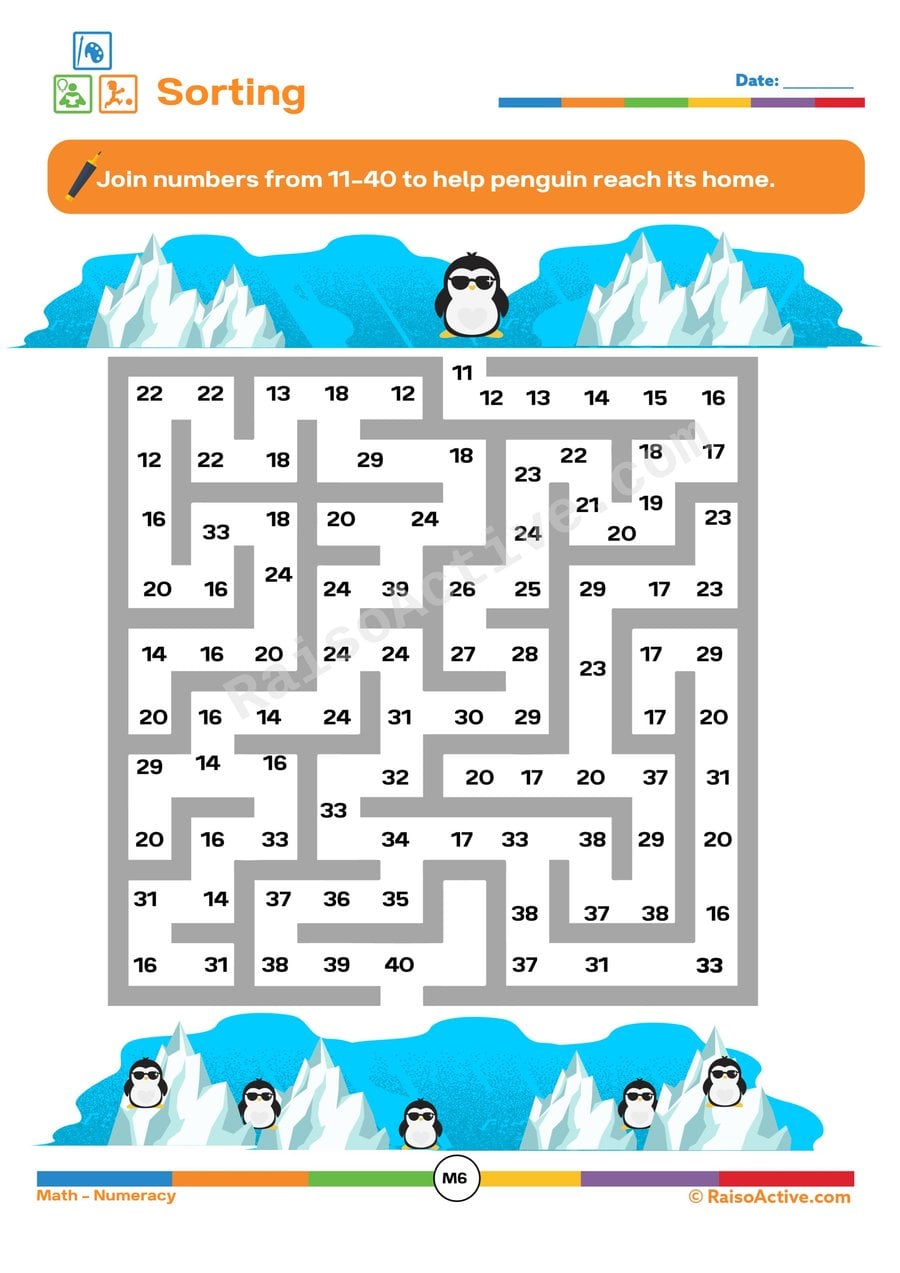
Penguin's Path: A Fun Sorting Worksheet for Kids!
Ages 4-6 · Pre-K–KindergartenAges 4-6 · Reception–Year 1Ages 4-6 · LKG–UKGAges 4-6
This maze worksheet has 4-6 year olds trace a path through numbers 11 to 40, building both number sequencing across a wider range and the fine motor control needed to draw a connected line dot to dot. Because the range spans several decades, your child gets real practice with the trickiest part of early counting — the transitions between decades (19 to 20, 29 to 30) — while the penguin's journey gives the task a clear, motivating goal.
Related worksheets

Phonic Sounds Worksheet: Circle the Picture That Starts with the Alphabet Sound!
Ages 4-5 · Pre-KAges 4-5 · ReceptionAges 4-5 · LKGAges 4-5
This worksheet reinforces beginning-sound recognition for children ages 4-5 by presenting a letter at the start of each row and asking them to find the one picture among several that begins with that same sound. Because each row contains multiple pictures, children must test several beginning sounds against the target letter before settling on the correct one, which builds more precise listening skills than simpler one-picture matching tasks. This process also strengthens the letter-sound mapping that underlies early decoding.
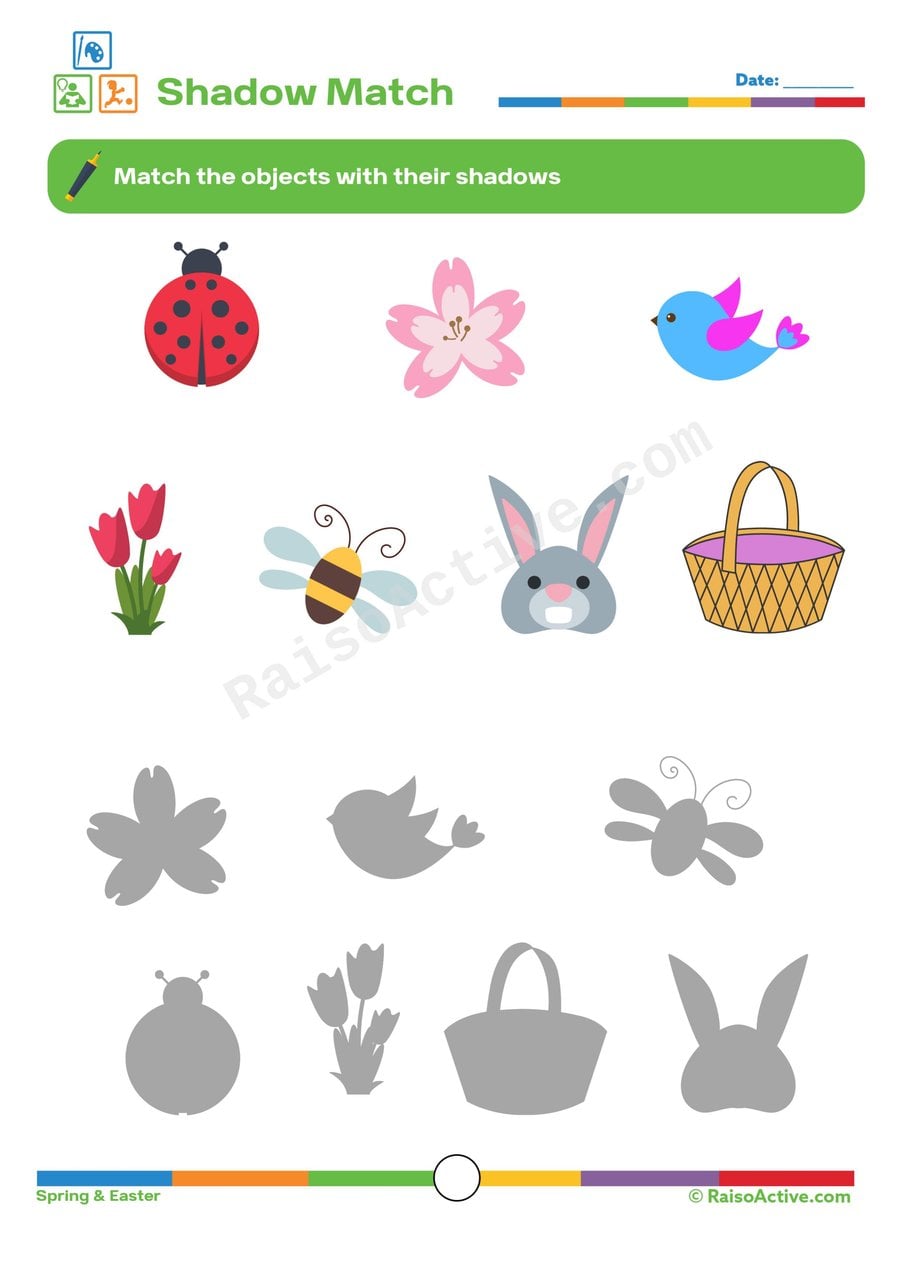
Spring Shadow Match Worksheet for Preschoolers
Ages 3-5 · Preschool–Pre-KAges 3-5 · Nursery–ReceptionAges 3-5 · Nursery–LKGAges 3-5
Children ages 3-5 practice visual discrimination by matching spring-themed objects to their correct silhouette shadows. Because shadows strip away color and detail, leaving only outline shape, this activity sharpens a child's ability to focus on form alone — a more advanced visual skill than matching by color or pattern.
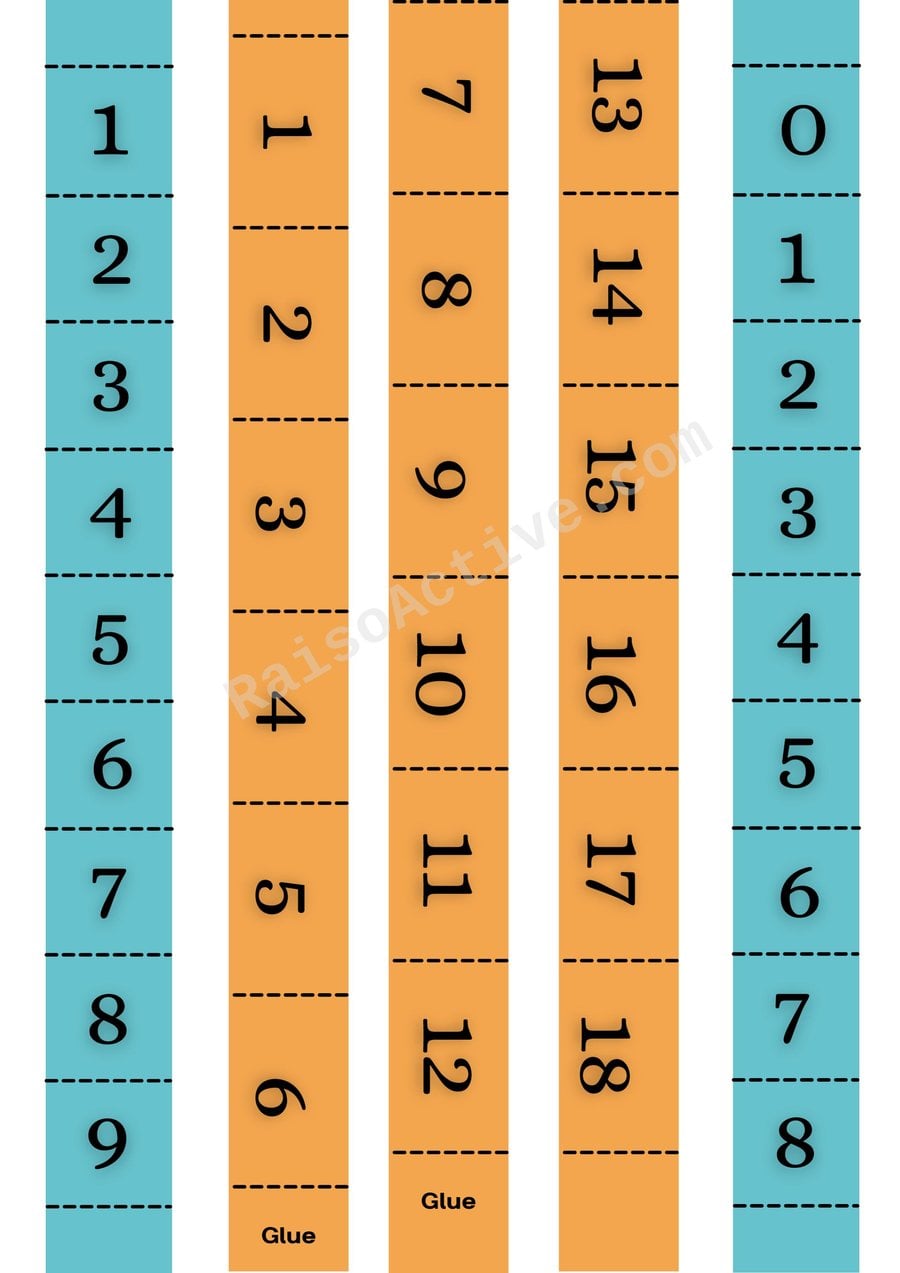
Number Matching Worksheet: 0-18
Ages 3-5 · Preschool–Pre-KAges 3-5 · Nursery–ReceptionAges 3-5 · Nursery–LKGAges 3-5
This activity strengthens numeral recognition for children ages 3-5 by having them find and pair matching numbers from 0 to 18 printed on separate strips. Because the numbers are scattered rather than in order, children must recognize each digit shape on its own rather than relying on counting sequence, which builds true number recognition instead of rote list-reciting.

Phonics Level 2 Sound Mat 3: Long Vowel and R-Influenced Vowel Sounds
Ages 4-7 · Pre-K–Grade 1Ages 4-7 · Reception–Year 2Ages 4-7 · LKG–Class 1Ages 4-7
Children see the long vowel sounds, the r-influenced vowels such as ar, er and or, and other vowel sounds such as ow, oy and oo, each with spellings and examples.

I Spy Letters and Numbers Worksheet: Find, Match, and Write!
Ages 4-5 · Pre-KAges 4-5 · ReceptionAges 4-5 · LKGAges 4-5
This worksheet blends letter and number recognition for children ages 4-5, asking them to spot a hidden letter within a picture, find its matching number, and then write both symbols down, combining visual search with early literacy and numeracy in a single activity. Working with letters and numbers side by side reinforces that both are symbols that carry specific meaning and can be found, matched, and recorded.

Phonics Level 2 Certificate of Achievement: Super Reader
Ages 4-7 · Pre-K–Grade 1Ages 4-7 · Reception–Year 2Ages 4-7 · LKG–Class 1Ages 4-7
Children celebrate reading and spelling words with blends and digraphs, and tick what they can read: CVC words, blends and digraphs.
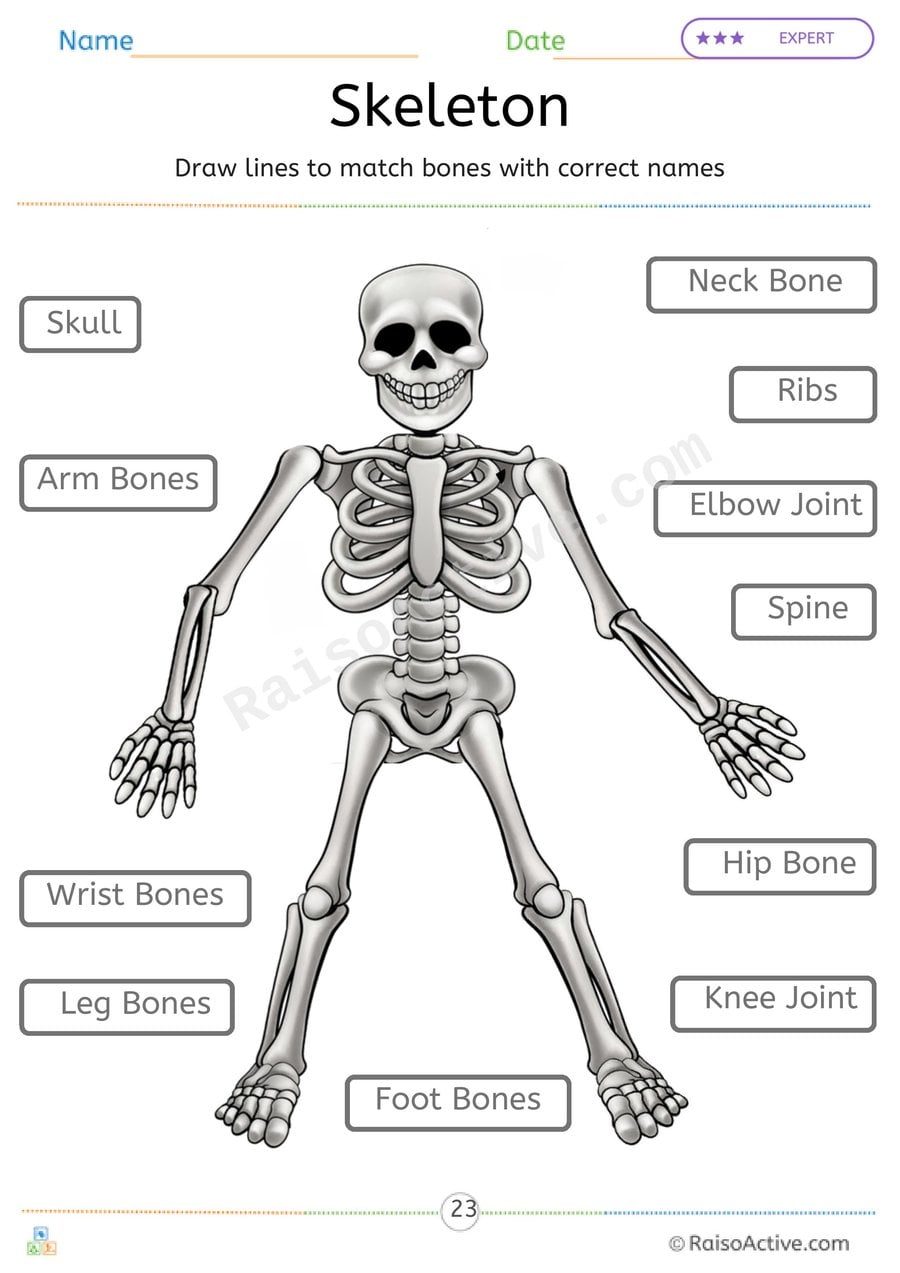
Skeleton Matching Worksheet: Learn About Bones!
Ages 4-6 · Pre-K–KindergartenAges 4-6 · Reception–Year 1Ages 4-6 · LKG–UKGAges 4-6
Drawing lines from bone names to their locations on a skeleton diagram introduces children ages 4-6 to basic human anatomy vocabulary, such as skull, ribs, or spine, while practicing left-to-right reading and matching skills. Because children must read a word and then visually locate the correct part of the body, this worksheet also strengthens the connection between written language and real-world objects, an important step toward reading comprehension. The Halloween-skeleton framing makes an otherwise academic science topic feel playful and approachable.

Halloween Shadow Match Worksheet for Preschoolers
Ages 3-5 · Preschool–Pre-KAges 3-5 · Nursery–ReceptionAges 3-5 · Nursery–LKGAges 3-5
This shadow-matching worksheet sharpens visual discrimination in children ages 3-5 as they compare the outline of each Halloween object to its silhouette and identify the correct match. Because shadows strip away color and detail, children must focus purely on shape, which builds a skill that transfers directly to letter and shape recognition later on.
Guides for this topic

How to Teach CVC Blending: A Step-by-Step Method That Works in Two Weeks
A step-by-step method for teaching CVC blending, covering continuous sounds, word families, common errors, and a 14-day plan that most children finish reading CVC words.

Best Worksheets for 3-Year-Olds: What Works and What to Avoid
What works on worksheets for 3-year-olds: short sessions, crayons, tracing lines, matching, cutting, a free weekly plan, and signs one is too advanced.
Phase 2 Phonics at Home: Sound Order, Blending Games, Worksheets
Phase 2 phonics at home: the five sound sets in order, oral blending, tricky words, a two-week routine, common mistakes, and free worksheets.
Reviews
Every worksheet for ages 4–5, no watermark
Members download the full library of 1,000+ worksheets and every activity pack without watermarks or daily limits. One year costs ₹999 in India or $20 elsewhere.
See membership plansOr download any worksheet free with a watermark (5 a day).