Many or Few Fish Bowl Worksheet for Preschoolers
This worksheet builds the comparative concepts of 'many' and 'few' — an early step toward understanding quantity that comes before formal counting comparisons like greater-than and less-than. By having your child actually draw bubbles and fish into the bowls following directions, it also reinforces following multi-step instructions and one-to-one correspondence, since each fish or bubble they add has to be drawn individually. Coloring the bowl with the most fish at the end ties the abstract idea of 'more' back to a concrete, visible outcome.
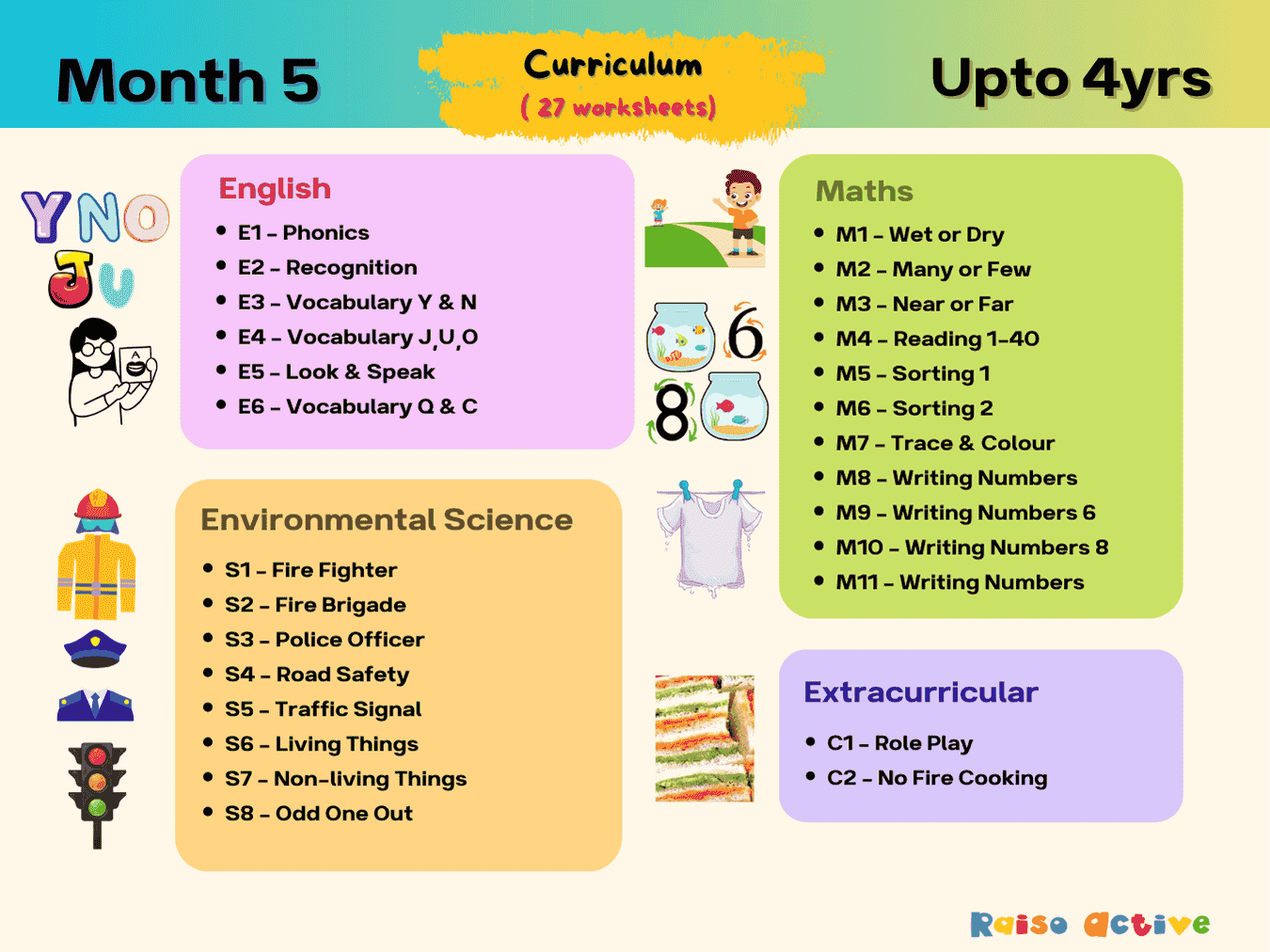
Part of the pack
Month 5: Preschool Subjects and Play | Ages Up to 4
This is page 11 of the pack. Ages 2-4 · PreschoolAges 2-4 · NurseryAges 2-4
Made for your child
Counting to 10, made for your child
A maths pack with your child's name in it: pictures that explain, practice at three levels, puzzles and story sums about them. Print a new set whenever they finish.
Make a maths packFree preview · free for members
Curriculum
- Number Sense > Comparing Numbers
How to use this worksheet
Read the drawing instructions aloud step by step rather than all at once, since your child needs to draw a specific number of bubbles and fish in each bowl. Have them count aloud as they draw each fish so the quantity stays accurate rather than approximate. Once both bowls are filled in, ask your child to point to the bowl with 'many' fish and the bowl with 'few' fish before they color. Finish by having them color the bowl with the most fish, checking together that the coloring matches their earlier answer.
Materials needed
- Pencil
- Crayons
Extension activities
- 1Scatter a pile of buttons or pom-poms on the table and ask your child to make a 'many' pile and a 'few' pile.
- 2Give your child extra blank fish bowl outlines and let them invent their own many/few scenes to draw.
- 3At snack time, put a lot of crackers on one plate and a couple on another and ask which plate has 'many' and which has 'few.'
- 4Look through a picture book together and find a page with 'many' of something and a page with 'few.'
- 5Play a quick game where you hold up two handfuls of small objects and your child says which is 'many' and which is 'few.'

Written by
Hemsweta Jain · Teacher Cheena
MBA and Early Childhood Educator, teaching since 2014 · Founder of RaisoActive, Mumbai
Every RaisoActive worksheet is designed and checked by the founder before publishing.
Published · Last reviewed
More from Month 5: Preschool Subjects and Play | Ages Up to 4
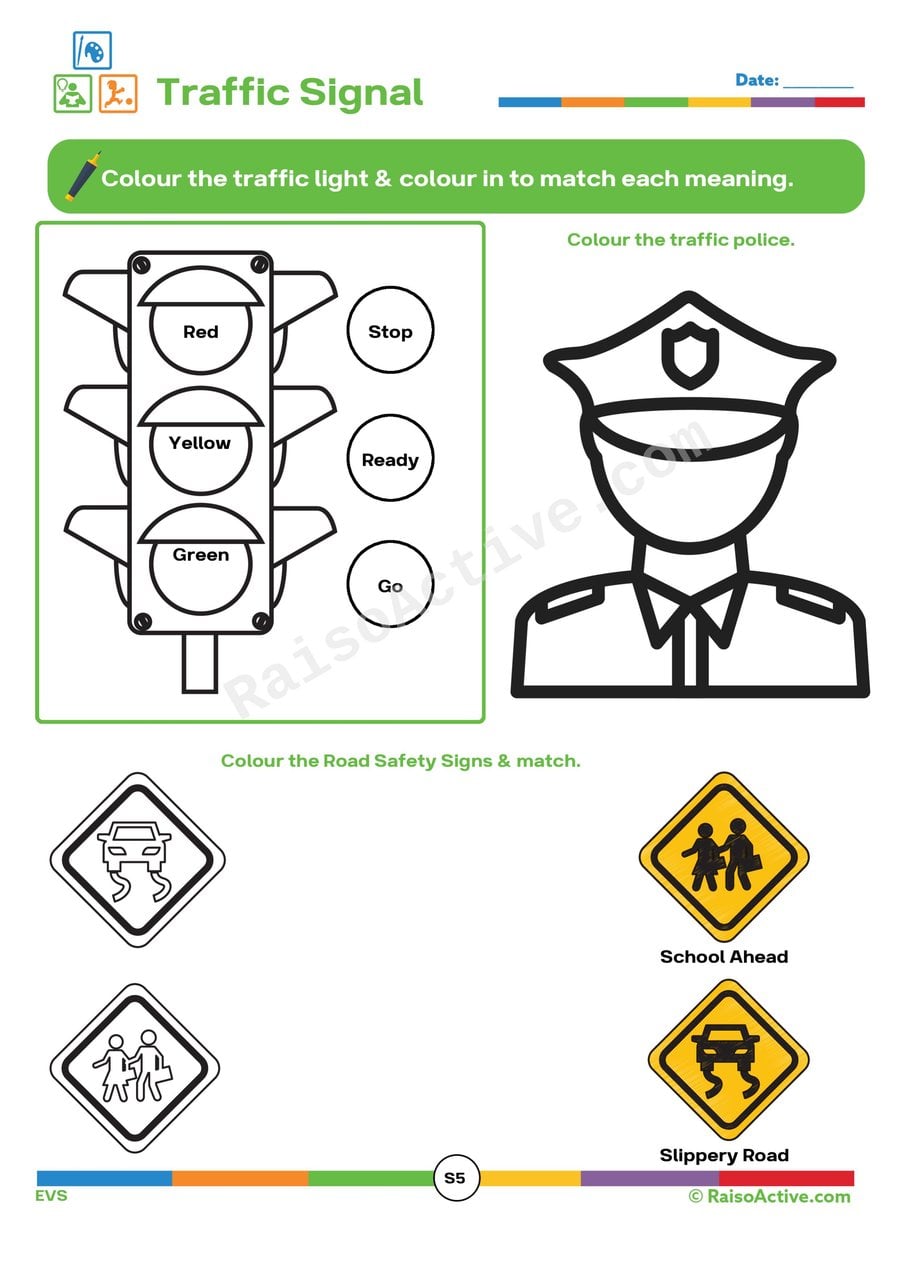
Traffic Signal Fun: Color and Match the Meanings!
Ages 3-5 · Preschool–Pre-KAges 3-5 · Nursery–ReceptionAges 3-5 · Nursery–LKGAges 3-5
Coloring traffic lights and matching words to their meanings teaches children ages 3-5 that colors carry specific, important messages in the real world, an early and practical form of symbol recognition and road safety awareness. Matching written words to the correct traffic light or road sign also reinforces early reading skills by connecting simple vocabulary to something visually familiar from everyday outings. Understanding what red, yellow, and green mean at a traffic light gives children knowledge they can apply immediately as pedestrians and future road users.

Non-Living Things Coloring Worksheet for Preschoolers
Ages 3-5 · Preschool–Pre-KAges 3-5 · Nursery–ReceptionAges 3-5 · Nursery–LKGAges 3-5
Coloring only the non-living things on the page asks children ages 3-5 to apply a real scientific rule — that living things grow, move, breathe, and eat, while non-living things do not — rather than just naming objects. This requires them to think through each picture individually and test it against the rule, building early classification and critical thinking skills. Learning to separate living from non-living things is one of the first formal science concepts children encounter and sets up later lessons about plants, animals, and the environment.
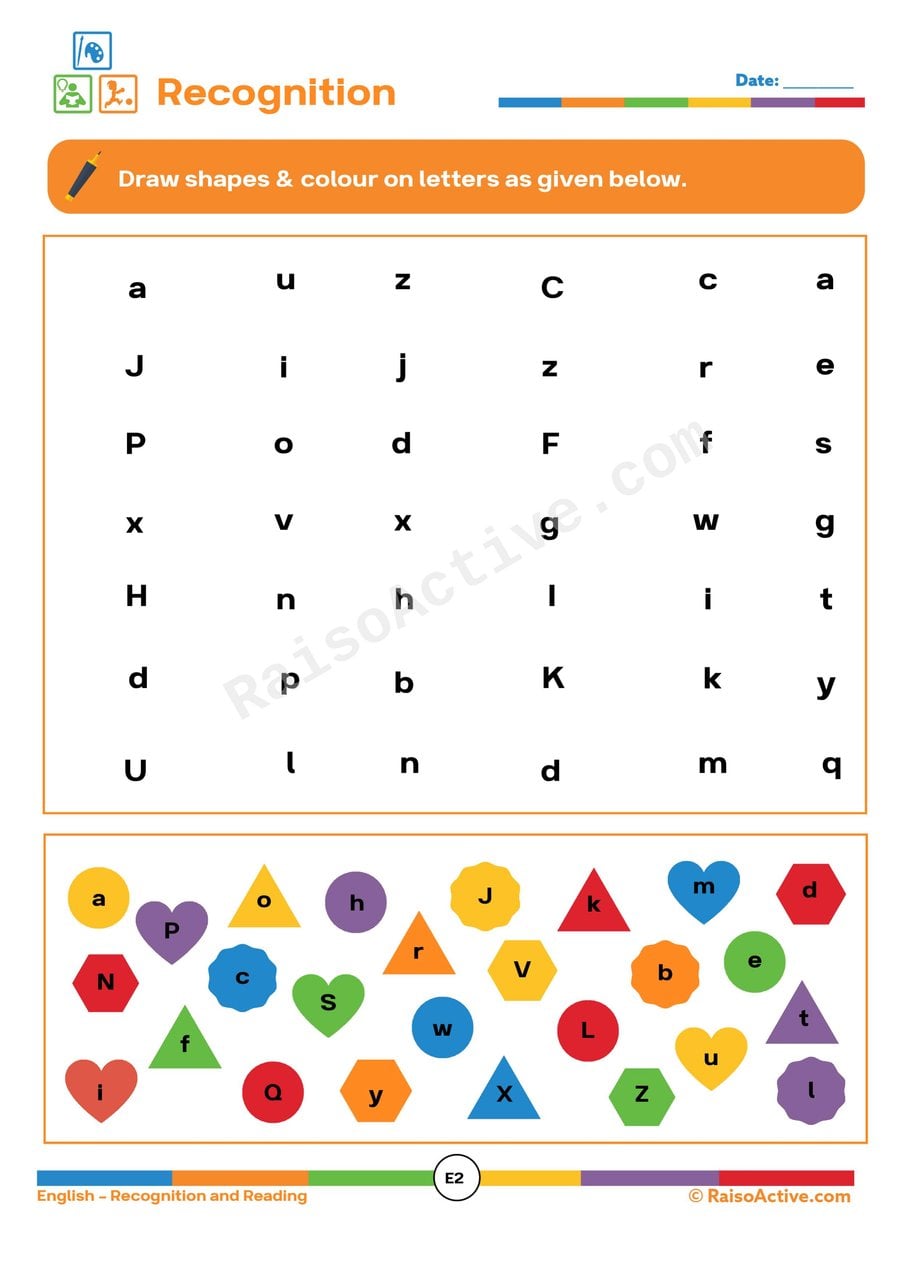
Letter Recognition Worksheet: Draw Shapes & Color!
Ages 3-5 · Preschool–Pre-KAges 3-5 · Nursery–ReceptionAges 3-5 · Nursery–LKGAges 3-5
Pairing letter recognition with drawing shapes gives children ages 3-5 practice on two skills at once: identifying printed letters by sight and following simple shape instructions with a pencil. Coloring the letters afterward reinforces the letter's visual form through repeated, focused attention rather than a quick glance, while the shape-drawing task builds the same pre-writing control needed for forming letters later. Combining these tasks keeps the page varied and engaging for a young attention span.
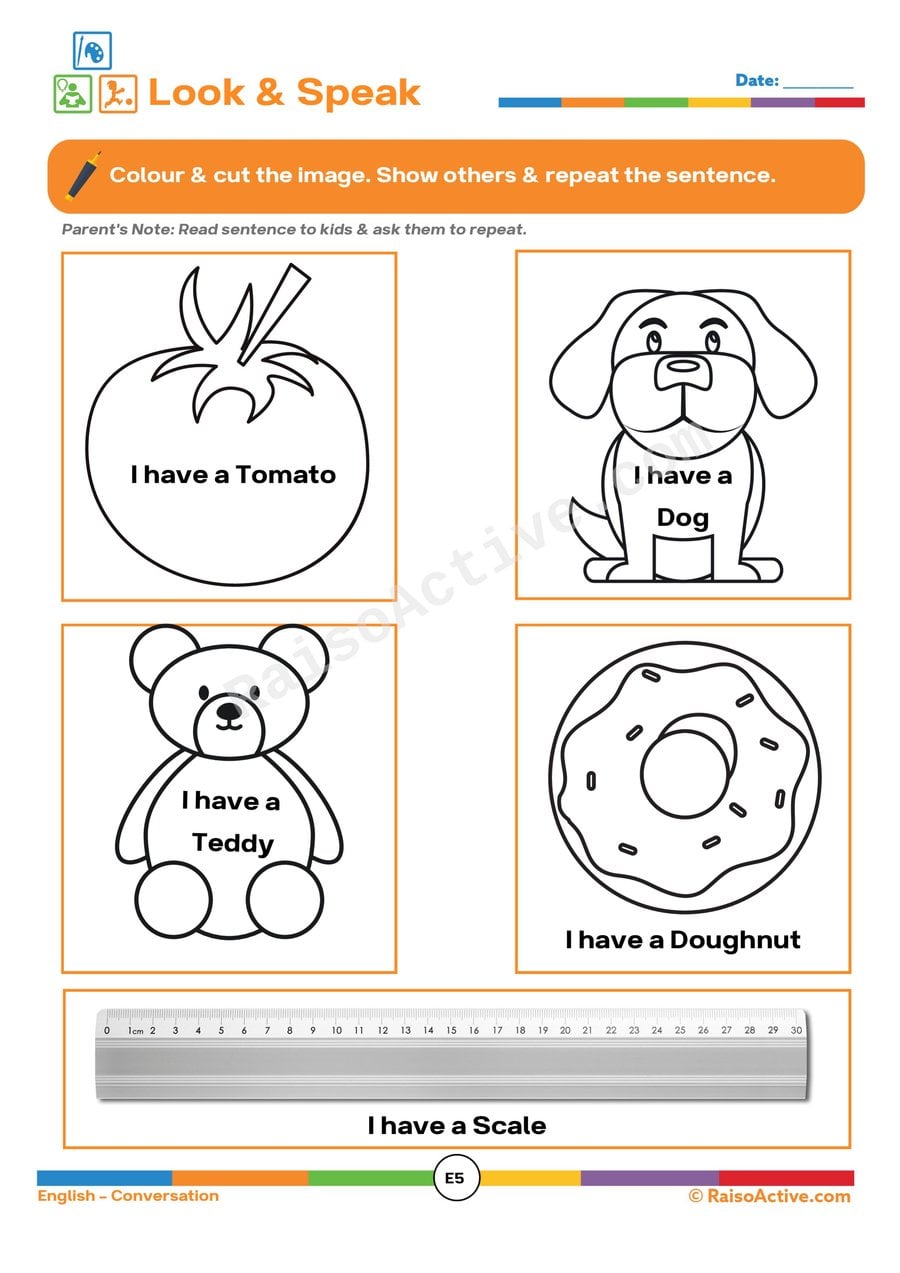
Look & Speak: Color and Repeat the Words Worksheet
Ages 3-5 · Preschool–Pre-KAges 3-5 · Nursery–ReceptionAges 3-5 · Nursery–LKGAges 3-5
This worksheet builds early vocabulary and oral language skills by having children color familiar images and then read and repeat a simple sentence describing each one aloud. For ages 3-5, the combination of coloring, reading, and speaking reinforces new words through multiple senses, helping vocabulary stick more effectively than reading alone.

Role Play: Color, Cut, and Create Your Neighborhood!
Ages 3-5 · Preschool–Pre-KAges 3-5 · Nursery–ReceptionAges 3-5 · Nursery–LKGAges 3-5
This hands-on activity turns community-helper knowledge into a 3D building project: children color buildings and helper figures, cut them out along the dotted lines, and assemble a small neighborhood on cardboard. That construction step is what makes this different from a typical coloring page — folding tabs and sticking pieces upright requires spatial reasoning about how a flat cutout becomes a standing structure, on top of the fine motor demands of careful cutting. It also reinforces community-helper roles by having your child literally place each helper into the neighborhood they belong in.
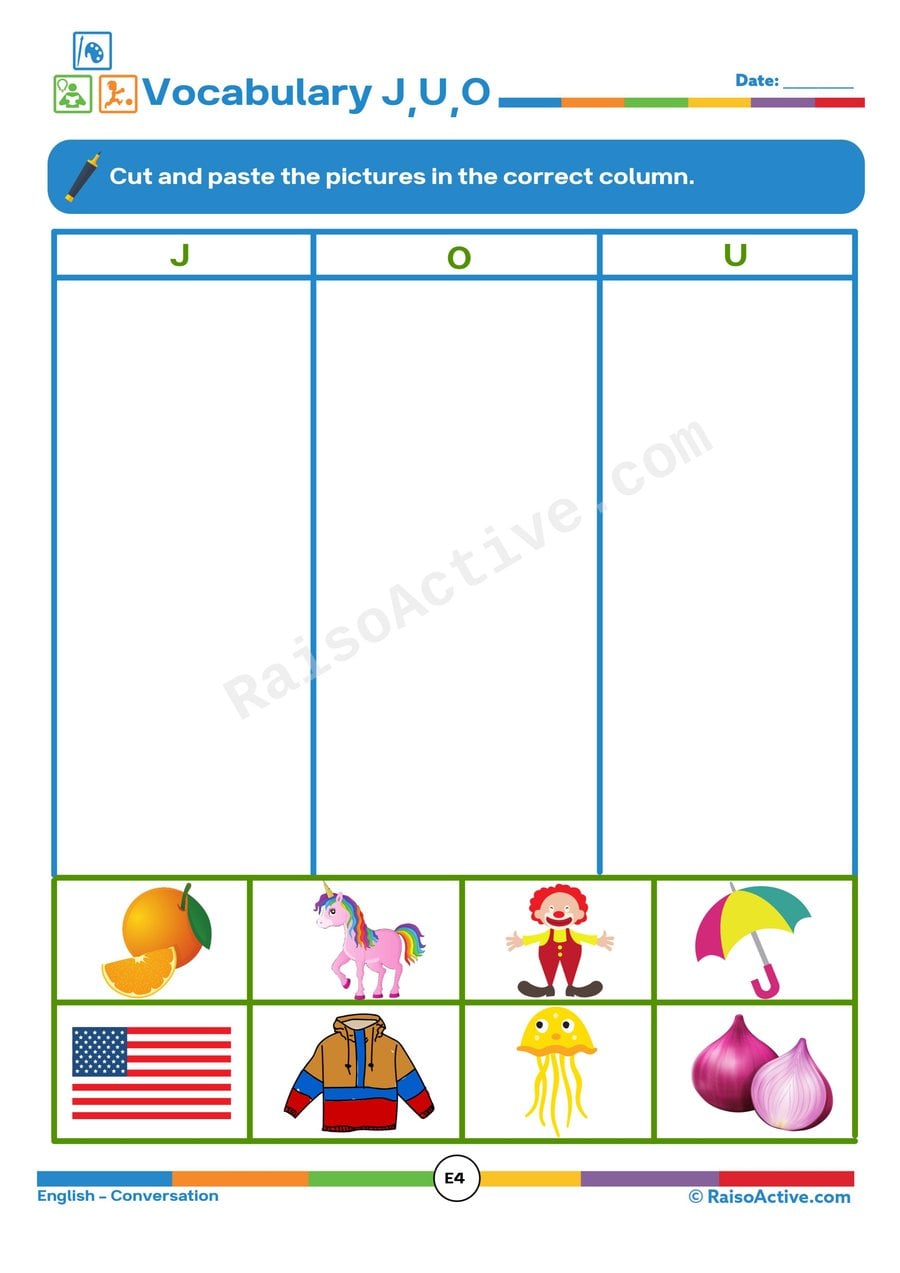
J, U, O Sorting Worksheet: Cut and Paste Pictures!
Ages 3-5 · Preschool–Pre-KAges 3-5 · Nursery–ReceptionAges 3-5 · Nursery–LKGAges 3-5
Sorting pictures by their beginning letter sound into J, U, or O columns asks children ages 3-5 to actively compare three different sounds rather than just recognizing one letter at a time, a more demanding phonics task than single-letter worksheets. This kind of three-way sorting builds sharper listening discrimination, since J, U, and O can sound similar in casual speech but are quite distinct once isolated. The cut-and-paste format also reinforces the sorting decision physically, since children must place each picture correctly rather than simply circling an answer.

Community Helpers & Early Learning Activities Worksheet
Ages 3-5 · Preschool–Pre-KAges 3-5 · Nursery–ReceptionAges 3-5 · Nursery–LKGAges 3-5
This worksheet bundles several community-helper-themed activities, coloring, role-play, and object identification, to build vocabulary and social understanding around the different people who help in a community, like police officers or firefighters. For ages 3-5, learning about community helpers builds both social awareness and early classification skills as children learn to associate specific tools or uniforms with specific jobs.

Number 8 Worksheet: Trace, Count, and Color Butterflies!
Ages 3-5 · Preschool–Pre-KAges 3-5 · Nursery–ReceptionAges 3-5 · Nursery–LKGAges 3-5
Tracing the number 8 while counting and coloring eight butterflies helps children ages 3-5 connect the written numeral to the actual quantity it represents, reinforcing number sense alongside handwriting. The final step, drawing any eight objects of the child's choosing, moves beyond guided practice into independent application, checking whether the concept of 'eight' has truly transferred rather than just been copied. This progression from tracing to counting to free drawing builds a complete, layered understanding of one specific number.
Related worksheets
Colour the ऊ Things: Hindi Letter ऊ Colouring Page | रंग भरो · ऊ
Ages 3-7 · Preschool–Grade 1Ages 3-7 · Nursery–Year 2Ages 3-7 · Nursery–Class 1Ages 3-7
Children listen for the first sound of each picture name and decide whether it starts with ऊ. They colour the ऊ pictures, cross out the others and colour the big letter.
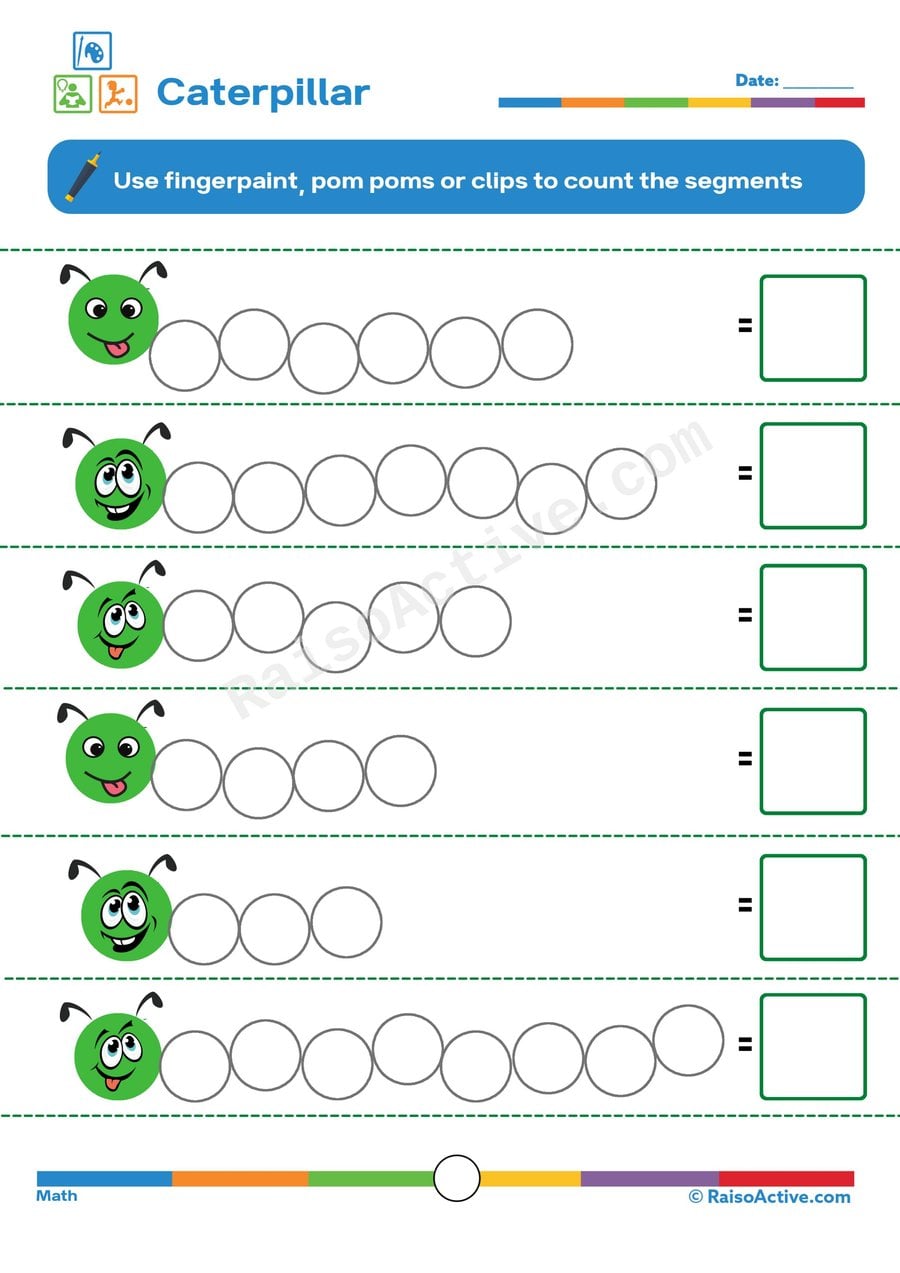
Caterpillar Counting Worksheet for Preschoolers
Ages 3-5 · Preschool–Pre-KAges 3-5 · Nursery–ReceptionAges 3-5 · Nursery–LKGAges 3-5
Counting the segments of each caterpillar teaches children ages 3-5 one-to-one correspondence — touching or marking each segment exactly once while saying a number — which is the core skill underlying accurate counting. Writing the final total in a box also connects the physical act of counting to its written numeral, reinforcing early number-writing practice.
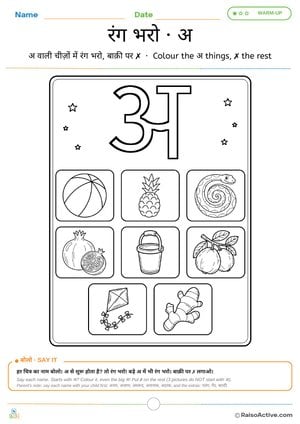
Colour the अ Things: Hindi Letter अ Colouring Page | रंग भरो · अ
Ages 3-7 · Preschool–Grade 1Ages 3-7 · Nursery–Year 2Ages 3-7 · Nursery–Class 1Ages 3-7
Children listen for the first sound of each picture name and decide whether it starts with अ. They colour the अ pictures, cross out the others and colour the big letter.
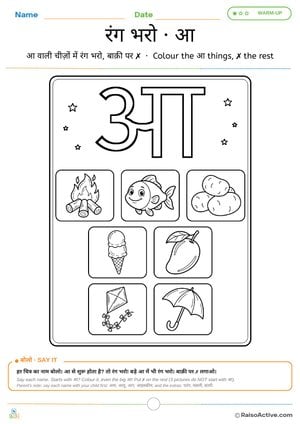
Colour the आ Things: Hindi Letter आ Colouring Page | रंग भरो · आ
Ages 3-7 · Preschool–Grade 1Ages 3-7 · Nursery–Year 2Ages 3-7 · Nursery–Class 1Ages 3-7
Children listen for the first sound of each picture name and decide whether it starts with आ. They colour the आ pictures, cross out the others and colour the big letter.
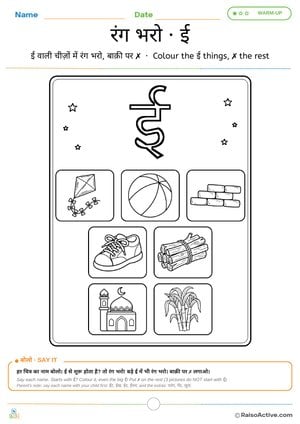
Colour the ई Things: Hindi Letter ई Colouring Page | रंग भरो · ई
Ages 3-7 · Preschool–Grade 1Ages 3-7 · Nursery–Year 2Ages 3-7 · Nursery–Class 1Ages 3-7
Children listen for the first sound of each picture name and decide whether it starts with ई. They colour the ई pictures, cross out the others and colour the big letter.
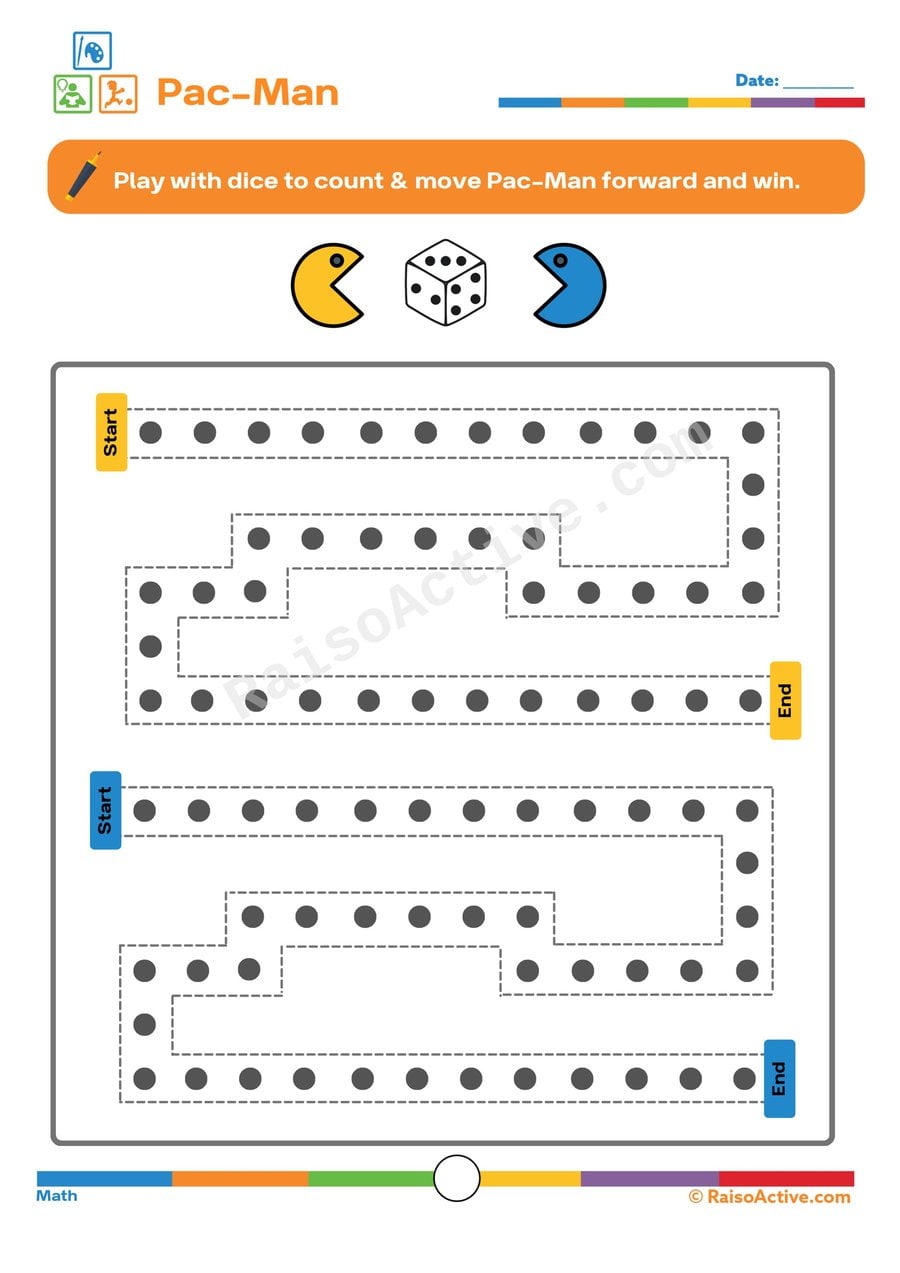
Pac-Man Maze Worksheet: Count and Move!
Ages 3-5 · Preschool–Pre-KAges 3-5 · Nursery–ReceptionAges 3-5 · Nursery–LKGAges 3-5
This dice-driven maze combines counting practice with path-following for children ages 3-5, since they must accurately count dots on a die before moving Pac-Man the matching number of spaces forward. Deciding how far to move and staying on the correct path also builds early strategic thinking, as children track their current position within the maze after each turn.
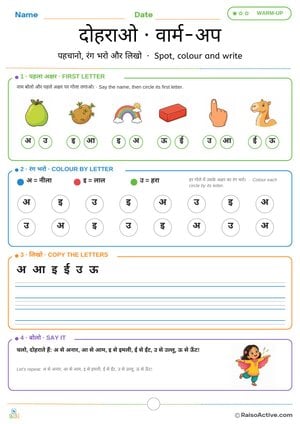
Hindi Vowels Part 1 Revision Warm-Up: First Letter, Colour by Letter and Copy | दोहराओ · वार्म-अप
Ages 3-7 · Preschool–Grade 1Ages 3-7 · Nursery–Year 2Ages 3-7 · Nursery–Class 1Ages 3-7
A mixed revision of the six vowels: circle the first letter of six pictured words, colour circles by letter code (अ blue, इ red, उ green), copy all six vowels on lines and say the revision rhyme.
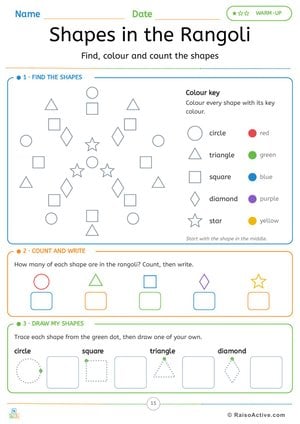
Shapes in the Rangoli: Find, Colour, Count and Trace
Ages 4-6 · Pre-K–KindergartenAges 4-6 · Reception–Year 1Ages 4-6 · LKG–UKGAges 4-6
Children colour five shapes in a rangoli using a colour key, count how many of each there are, then trace a circle, square, triangle and diamond and draw one of their own.
Guides for this topic

Number Formation Rhymes 0–9 and How to Fix Reversals
Original number formation rhymes for 0–9, the correct stroke order for each digit, why 3, 5 and 7 get reversed most often, and multisensory fixes that work.

Best Worksheets for 3-Year-Olds: What Works and What to Avoid
What works on worksheets for 3-year-olds: short sessions, crayons, tracing lines, matching, cutting, a free weekly plan, and signs one is too advanced.
Fostering Creativity in Structured Learning: The Perfect Balance for Young Minds
Learn how to blend creativity with structured learning for children ages 1-8. Practical strategies, activities, and printable worksheets for parents and teachers.
Reviews
Every worksheet for ages 3–5, no watermark
Members download the full library of 1,000+ worksheets and every activity pack without watermarks or daily limits. One year costs ₹999 in India or $20 elsewhere.
See membership plansOr download any worksheet free with a watermark (5 a day).