Free printable worksheets · India
Nursery Shapes Worksheets (Ages 3–4)
Nursery shapes worksheets are practice sheets for children aged 3–4 in Nursery in India. Shapes worksheets build recognition and naming of common two- and three-dimensional forms, and the ability to sort or match them by their features. The sheets on this page cover naming 2D shapes, matching identical shapes, sorting shapes by attribute and finding shapes in everyday objects.
Nursery marks the first year an Indian child sits at a table with a pencil rather than only playing with one. Grip is still developing, so schools expect pre-writing strokes, colouring within a bold outline, matching identical pictures and counting small groups rather than any letter writing. Attention rarely holds past a few minutes at a stretch. Three-year-olds are collecting names. Circle, square and triangle are usually secure this year, with rectangle arriving late and oval mixed up with circle for a while. A worksheet should ask the child to find every triangle on a busy page, colour all the squares one colour, trace a large shape with thick dotted lines, and say the name aloud each time. Counting sides and sorting by a rule are still ahead.
956+ worksheets · free PDF download · print on A4 or Letter
Nursery Shapes Worksheets to print
Browse all worksheets for ages 3–4
Clothing Pattern Match Worksheet for Preschoolers
This worksheet has children ages 3-5 study repeating patterns on clothing items — stripes, polka dots, or checks — and match each item to its identical twin, building visual discrimination and early pattern-sequencing skills. Distinguishing between similar-looking patterns also sharpens attention to detail, a skill that later supports letter and word recognition.

Match and Write: Fun Phonics Worksheet for Preschoolers
This worksheet combines letter-sound matching with early writing practice, asking children ages 3-5 to connect beginning letters to words and then confirm their choice by circling the matching picture. Working through both a matching and a writing step reinforces the same phonics knowledge in two different formats, which helps concepts stick more firmly than repeating the identical task once. The combination also builds fine motor control through letter writing alongside the phonemic awareness skill of hearing beginning sounds.

Letter A Tracing and Coloring Worksheet for Preschoolers
Preschoolers ages 3-5 practice the specific pencil strokes needed to form the letter A, both uppercase and lowercase, while also connecting the letter to its sound through picture recognition. Tracing before free writing builds the fine motor muscle memory that makes independent letter formation possible.

Young and Old Animals Worksheet: Circle the Correct Ones!
Distinguishing between young and old animals introduces children ages 3-5 to basic life cycle concepts and comparative observation, asking them to notice visual cues like size and features that indicate an animal's age. This worksheet has children first sort animals by age category and then match young animals to their adult counterparts, layering categorization practice on top of matching skills. Understanding that a puppy grows into a dog or a chick grows into a hen also lays early groundwork for later science topics like animal life cycles and growth.

Summer Symmetry Worksheet for Preschoolers: Complete and Color!
This worksheet introduces children ages 3-5 to the concept of symmetry by having them draw the missing half of a summer object, such as completing one side of a picture to mirror the other. This exercise builds an early sense of balance and proportion, an important visual-spatial skill that supports later geometry and art. Coloring the completed picture afterward adds fine motor practice while reinforcing the finished, whole shape they just created.

Animal Sounds Matching Worksheet for Preschoolers
This worksheet builds vocabulary and auditory memory by asking children to match each animal picture to the sound it makes, such as connecting a cow to 'moo' or a duck to 'quack.' For three- to five-year-olds, linking an animal's appearance to its sound strengthens both early science knowledge and the kind of associative memory that supports vocabulary growth.
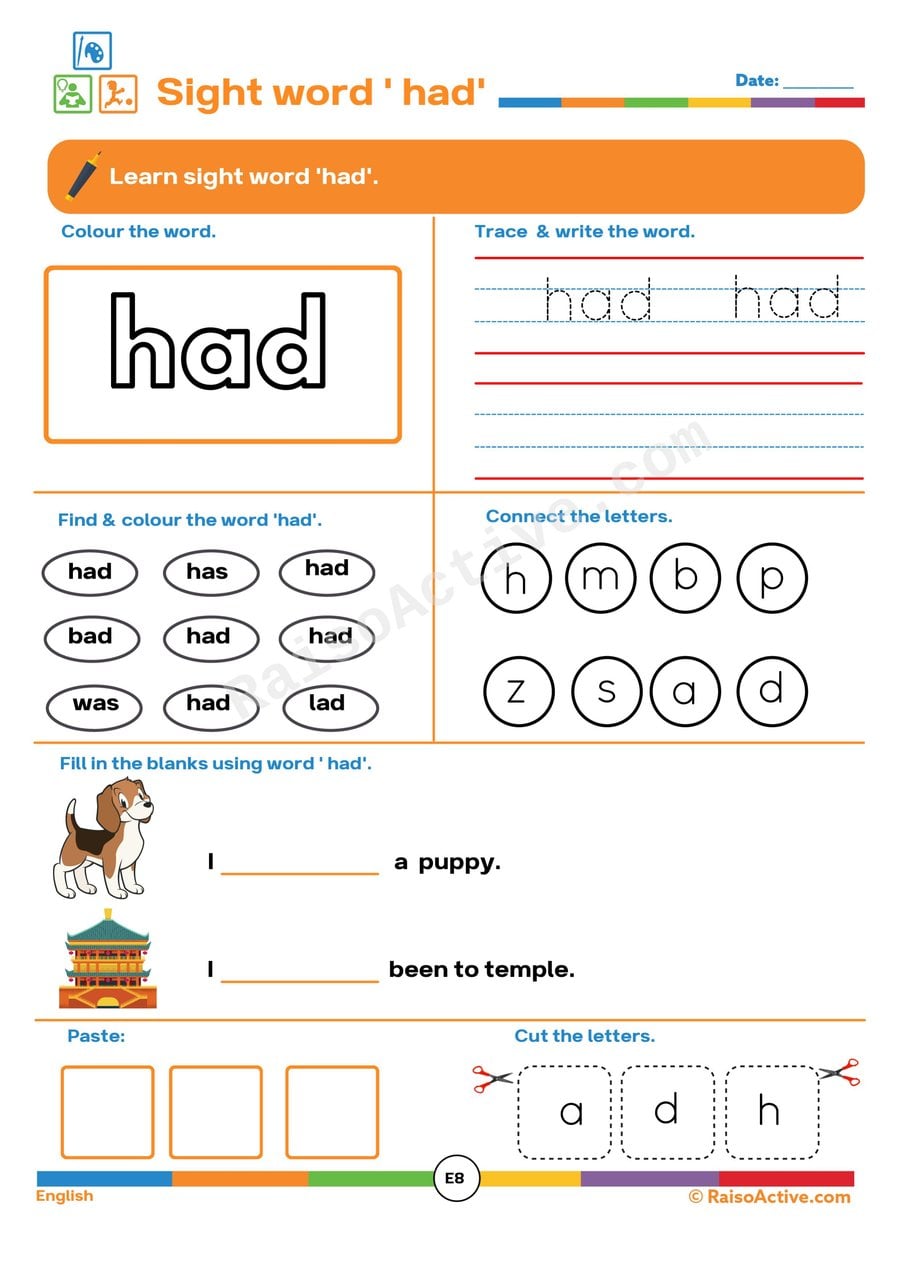
Sight Word 'had' Worksheet: Trace, Find, and Write!
This worksheet builds sight word recognition for the common word 'had' through multiple activities, tracing, finding it among similar words, connecting letters, and cutting and pasting, giving children repeated, varied exposure to the same high-frequency word. For ages 3-5, 'had' doesn't sound out in an entirely predictable way for beginning readers, so repeated whole-word recognition practice like this is especially valuable.
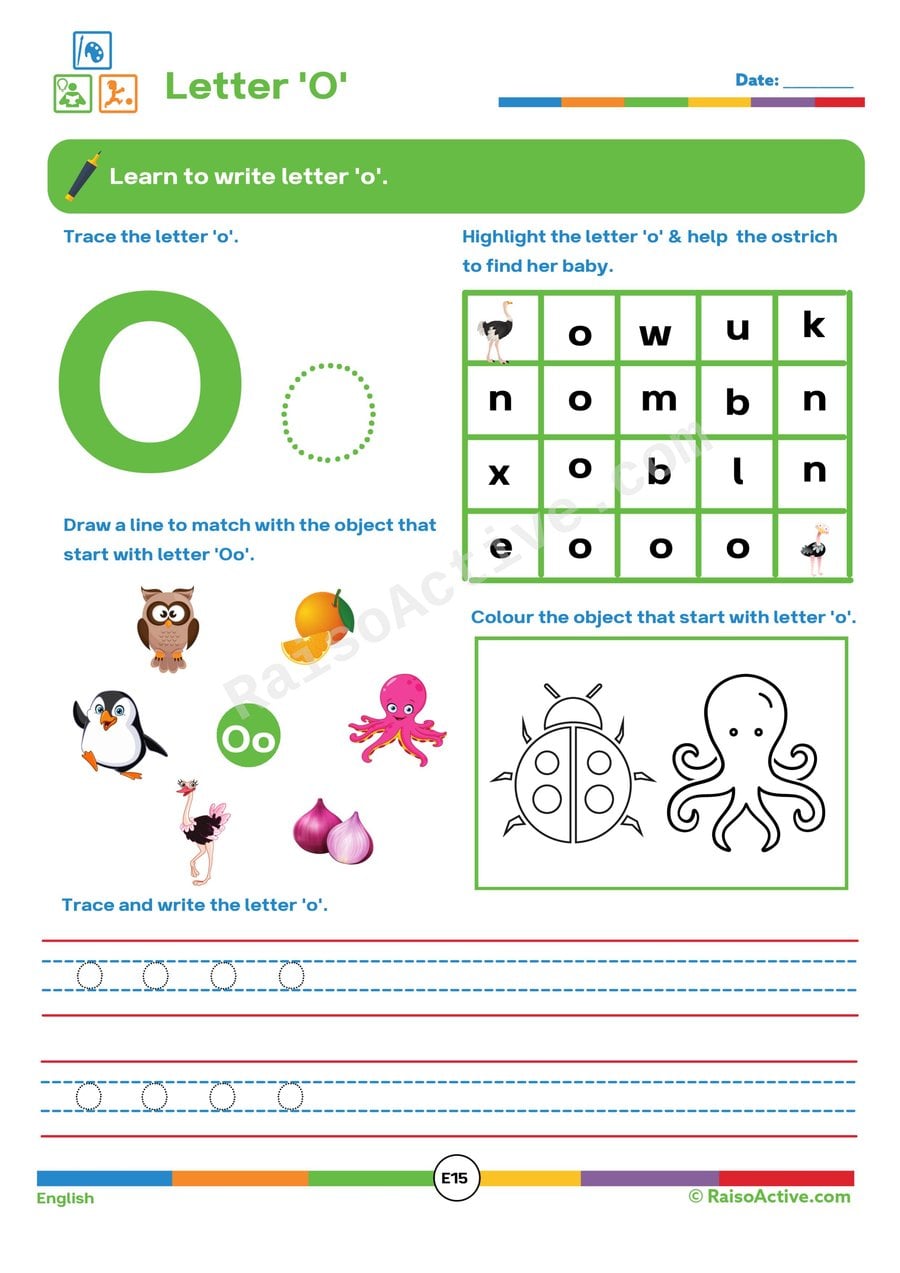
Letter 'O' Worksheet: Trace, Match, and Color!
Tracing, matching, and coloring the letter 'O' gives children ages 3-5 practice with one of the simplest letter shapes to form, making it a great confidence-building letter alongside its sound recognition value for words like 'octopus' and 'ostrich.' Matching pictures that start with 'O' to the letter reinforces the sound-symbol connection through familiar, often fun animal vocabulary. Highlighting the letter within a busy grid adds a visual search challenge that builds focus and letter discrimination beyond simple tracing.

Summer Coloring Fun: Color the Summer-Related Objects!
This worksheet builds vocabulary and category recognition for children ages 3-5 as they color a collection of objects associated with summer, like sunglasses, ice cream, or a beach ball, reinforcing that certain items belong together under a seasonal theme. Coloring within outlined shapes also continues to build the fine motor control and hand strength children need for future writing.
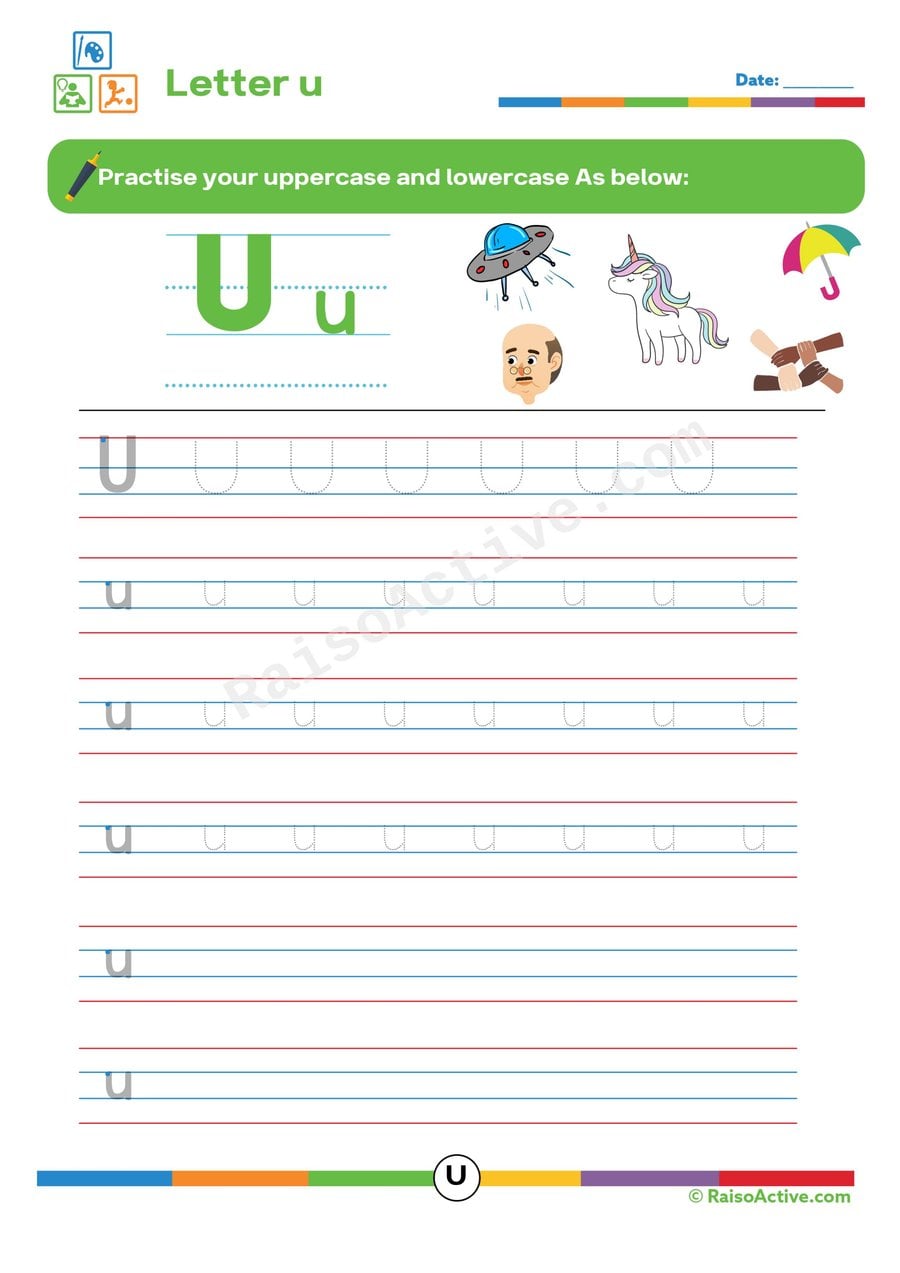
Letter U Tracing Worksheet for Preschoolers
U is a single smooth curve that dips down and back up, similar in motion to a shallow smile shape, giving 3-5 year olds continued practice with curved strokes after tackling letters like C and O. Tracing both uppercase U and lowercase u also shows children that, unlike many letters, U looks almost the same in both cases, just at a different size.

Sight Word 'Said' Worksheet for Preschoolers: Tracing, Reading, and Writing Fun!
The word 'said' appears constantly in early readers, especially in dialogue, but its spelling doesn't match how it sounds, which makes it a classic sight word that children ages 3-5 must memorize by sight rather than decode. This worksheet reinforces that memorization through multiple formats — coloring, searching, tracing, filling in blanks, and even a dot-to-dot — giving the word repeated exposure in different contexts. Building instant recognition of high-frequency words like 'said' is one of the most efficient ways to boost a young reader's fluency.

Trace and Color the Letter S Worksheet for Preschoolers
Tracing and writing the letter S gives children ages 3-5 practice with a continuous, flowing curved stroke that changes direction partway through, making it one of the more demanding letters to control smoothly compared to straight-line letters. Because the S shape doesn't lift the pencil mid-stroke, this worksheet specifically builds sustained curve control in a single motion.

Color the Beginning Sounds: G, D, and P Worksheet for Preschoolers
This worksheet strengthens phonemic awareness by asking children to distinguish between three different beginning sounds, G, D, and P, and color pictures according to which sound they start with. For ages 3-5, sorting by sound rather than simply circling reinforces both listening discrimination and the ability to hold multiple sound categories in mind at once.
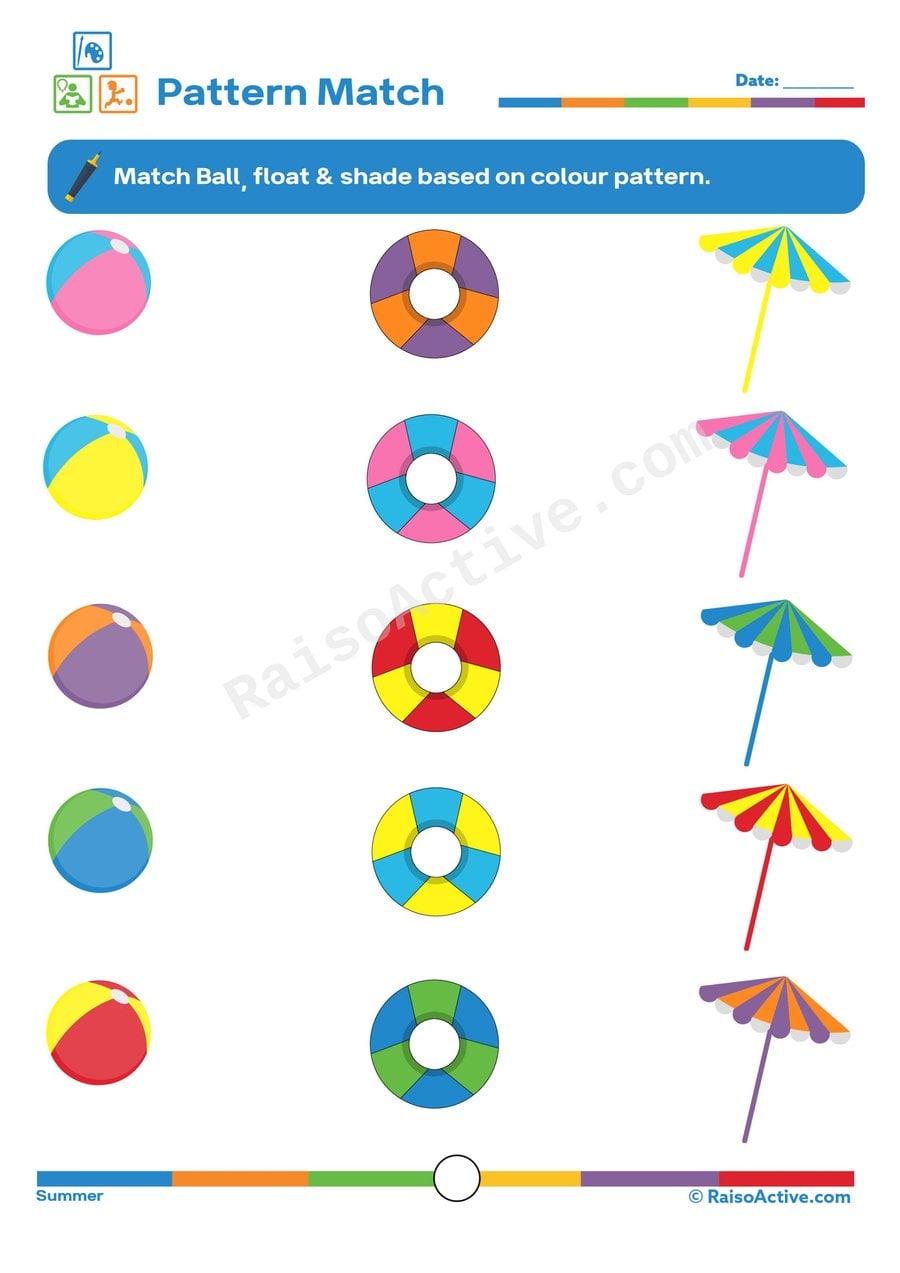
Summer Pattern Match Worksheet for Preschoolers
This worksheet asks children ages 3-5 to study the color pattern on a beach ball, pool float, and sun umbrella and match each item to its correctly patterned counterpart, building early pattern recognition, a foundational skill for later math concepts like sequencing and algebraic thinking. Because the match depends on noticing the order and repetition of colors rather than just matching a single color, children must compare details carefully rather than glance quickly. This strengthens visual attention alongside the pattern skill itself.

Sight Word Coloring Fun: 'am', 'has', 'had', and 'have' Worksheet
This worksheet helps children ages 3-5 build automatic recognition of four common sight words — am, has, had, and have — words that appear so frequently in early reading that sounding them out every time would slow a beginning reader down. Coloring by a color key also reinforces visual discrimination, since children must distinguish between similar-looking short words rather than relying on pictures.

Weather Worksheet: Match the Weather to the Number!
This matching activity asks children ages 3-5 to connect weather pictures — sun, rain, clouds, snow — to numbered labels, combining early reading of weather vocabulary with number-symbol association. Recognizing that a picture, a word, and a number can all represent the same idea builds the kind of flexible symbolic thinking children will later use in reading and math alike. Weather is also a topic children experience daily, which makes the vocabulary immediately meaningful rather than abstract.

My Body Parts Matching Worksheet for Preschoolers
Matching body part pictures to their names or functions helps children ages 3-5 build body awareness vocabulary, connecting a word like 'elbow' or 'knee' to the correct part of their own body. This kind of labeling activity also supports early self-care and safety skills, since children who can name body parts accurately can better communicate if something hurts or needs attention.

Trace and Write the Letter Z Worksheet for Preschoolers
This letter Z tracing page asks children ages 3-5 to follow a horizontal-diagonal-horizontal zigzag, a stroke pattern that's different from the curves and straight lines used in most other capital letters. Practicing this shape builds the fine motor control needed for handwriting while reinforcing that Z makes the buzzing /z/ sound heard in 'zebra,' 'zipper,' and 'zoo.' Since Z is one of the last letters children usually master, this worksheet often marks a milestone in completing the full alphabet.

Easter Egg Color Match Worksheet for Preschoolers
This worksheet builds on color recognition by asking children ages 3-5 to color a full row of eggs so they all match one another, reinforcing visual discrimination alongside color vocabulary. Rather than following a printed key, children must compare their own work egg to egg, which adds a self-checking element to the coloring task.

Role Play: Color, Cut, and Create Your Neighborhood!
This hands-on activity turns community-helper knowledge into a 3D building project: children color buildings and helper figures, cut them out along the dotted lines, and assemble a small neighborhood on cardboard. That construction step is what makes this different from a typical coloring page — folding tabs and sticking pieces upright requires spatial reasoning about how a flat cutout becomes a standing structure, on top of the fine motor demands of careful cutting. It also reinforces community-helper roles by having your child literally place each helper into the neighborhood they belong in.

Shape Match: Identify and Color 2D Shapes Worksheet
This worksheet builds shape recognition by having children match a 2D shape to its correct name, such as connecting a triangle to the word 'triangle.' Learning to pair a shape's form with its verbal label at this age strengthens both geometry vocabulary and the visual discrimination skills children need before they can distinguish similarly shaped letters like O and Q.
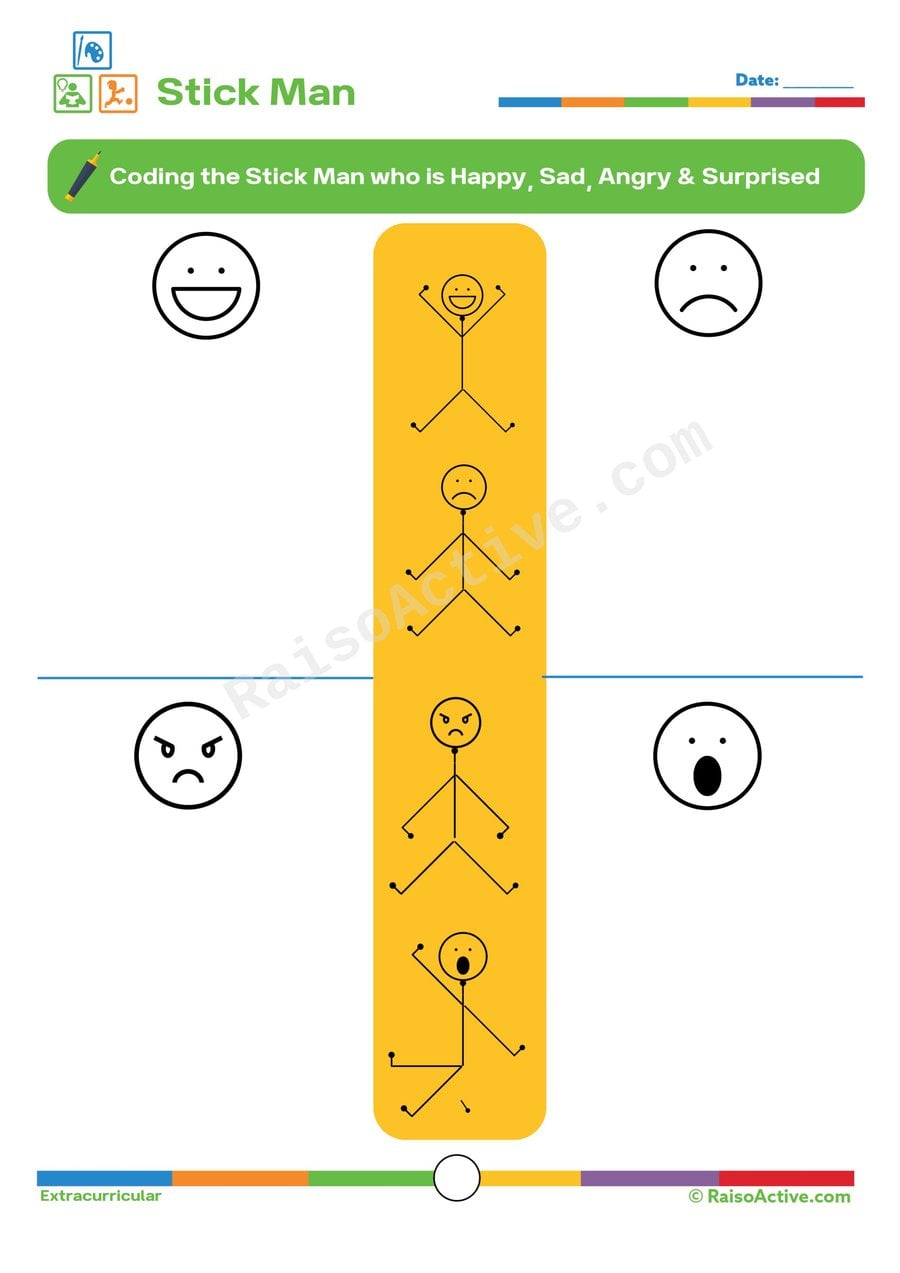
Stick Man Emotions Worksheet: Happy, Sad, Angry & Surprised!
Matching simple stick-figure faces to emotion words helps children ages 3-5 build an early emotional vocabulary, connecting facial cues like a curved mouth or raised eyebrows to specific feeling words. This kind of emotion recognition is a foundational social-emotional skill, helping children name what they and others are feeling instead of just reacting.

Read & Match Worksheet: Matching Sentences to Pictures
Matching a sentence to its picture through drawing a line or coloring builds reading comprehension for children ages 3-5, requiring them to process the sentence's full meaning rather than recognizing familiar words in isolation. Following this with coloring keeps the activity engaging while giving repeated visual exposure to each completed sentence-and-picture pair.

Material Properties Worksheet for Kids: Matching and Identifying
This early science worksheet introduces children ages 3-5 to the idea that materials have distinct physical properties — like hardness, brittleness, or elasticity — and that everyday objects can be grouped based on how they look, feel, or behave. Matching objects to their correct property builds observational and classification skills, which are foundational scientific thinking tools long before formal science instruction begins. Talking through why a rubber band stretches while a plate breaks helps children start noticing cause-and-effect patterns in the physical world around them.
What Nursery shapes worksheets cover
Three-year-olds are collecting names. Circle, square and triangle are usually secure this year, with rectangle arriving late and oval mixed up with circle for a while. A worksheet should ask the child to find every triangle on a busy page, colour all the squares one colour, trace a large shape with thick dotted lines, and say the name aloud each time. Counting sides and sorting by a rule are still ahead.
- Name circle, square and triangle when shown one at a time
- Colour every triangle on a page of mixed shapes
- Trace a big circle, square and triangle along thick dotted lines
- Find a named shape in a picture of a house or train
How to use these worksheets at home or in class
A single sheet a day, five to ten minutes, suits a three-year-old best. Sit alongside your child rather than opposite, demonstrate one stroke, then let them attempt it themselves, praising the try rather than the neatness of the line.
Start with the sheet that matches what your child can already do, then move one step up. Keep finished sheets in a folder: Nursery teachers often ask for evidence of practice, and children like seeing their own progress.
Is your child ready for Nursery shapes work?
Readiness shows up as a proper crayon grip with fingers instead of a fist, purposeful scribbling, sitting through a short task and following one spoken instruction such as pointing to a colour. Without these, stick to sticker play and large colouring pages for now.
Frequently asked questions
Should a three-year-old know the difference between a square and a rectangle?
Not reliably, and it is fine to wait. At three most children call both "square" because they look at the corners and see four of them. The difference is length of sides, which is a comparison the child can start noticing around four. Introduce rectangle as "a stretched square" when it comes up, use a door or a book as the example, and move on without drilling it.
What should a Nursery child be able to do in shapes?
Three-year-olds are collecting names. Circle, square and triangle are usually secure this year, with rectangle arriving late and oval mixed up with circle for a while. A worksheet should ask the child to find every triangle on a busy page, colour all the squares one colour, trace a large shape with thick dotted lines, and say the name aloud each time. Counting sides and sorting by a rule are still ahead. Readiness shows up as a proper crayon grip with fingers instead of a fist, purposeful scribbling, sitting through a short task and following one spoken instruction such as pointing to a colour. Without these, stick to sticker play and large colouring pages for now.
Do these worksheets follow the Nursery curriculum?
The sheets cover naming 2D shapes, matching identical shapes, sorting shapes by attribute and finding shapes in everyday objects, which sit inside the NEP 2020 Foundational Stage (NCF-FS 2022) outcomes for Nursery. Preschool (US), Nursery (UK) use the same skills at this age, so the sheets also fit families following those programmes.
Are the Nursery shapes worksheets free to download?
Yes. Every sheet on this page can be downloaded free as a watermarked PDF after creating an account, up to five downloads a day. The annual membership (₹1000) removes the watermark and the daily limit across the full library of more than 1,000 worksheets and all activity packs.

Written by
Hemsweta Jain · Teacher Cheena
MBA and Early Childhood Educator, teaching since 2014 · Founder of RaisoActive, Mumbai
Written and reviewed by Hemsweta Jain (Teacher Cheena), who designs every RaisoActive worksheet.
Last reviewed
Printable packs for ages 3–4
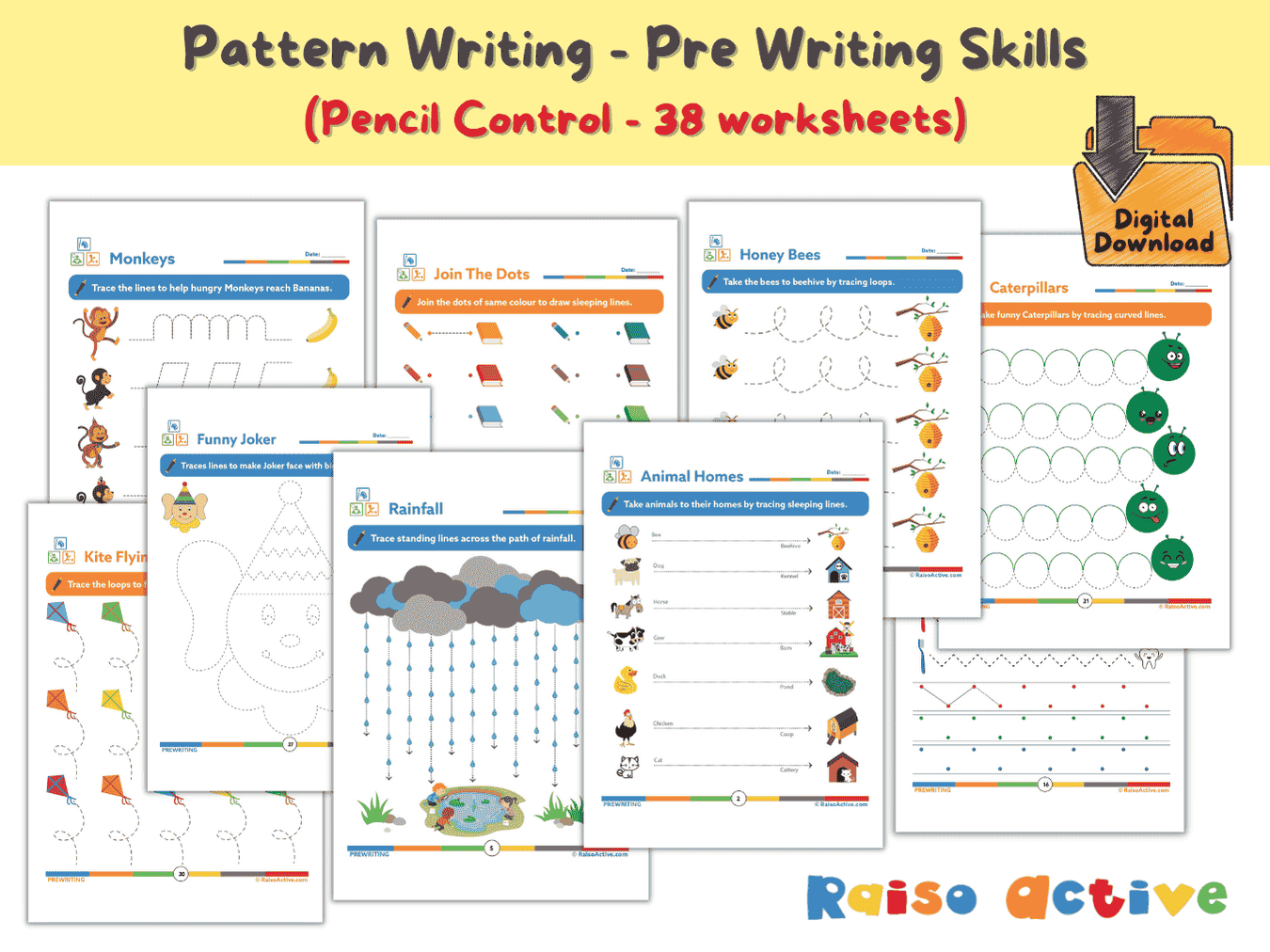
Pattern Writing Pre-writing Skills Activity Book for 3-4 Year Olds
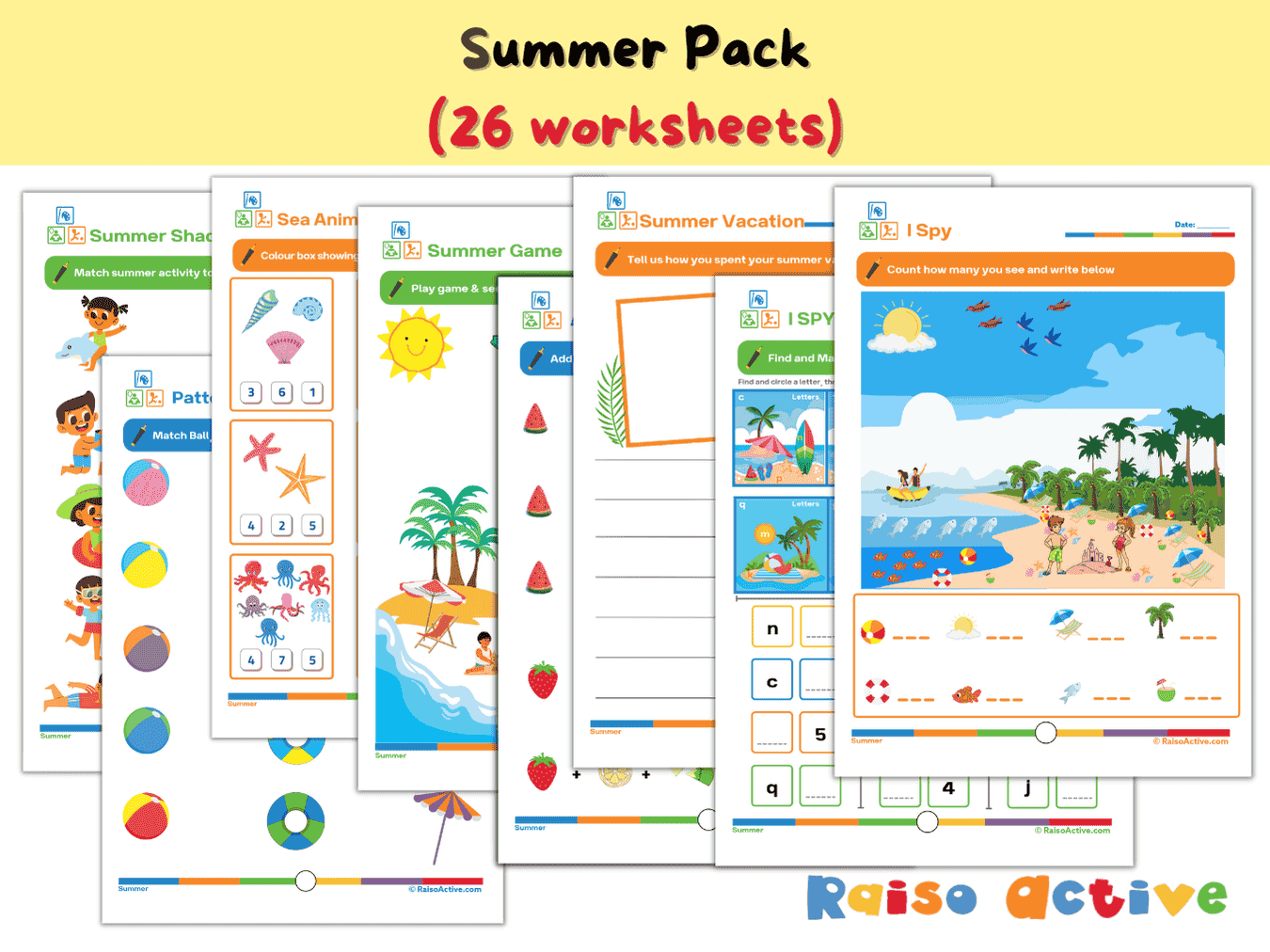
Summer Activity Pack: Math, Literacy, Puzzles & More for Preschool & Kindergarten
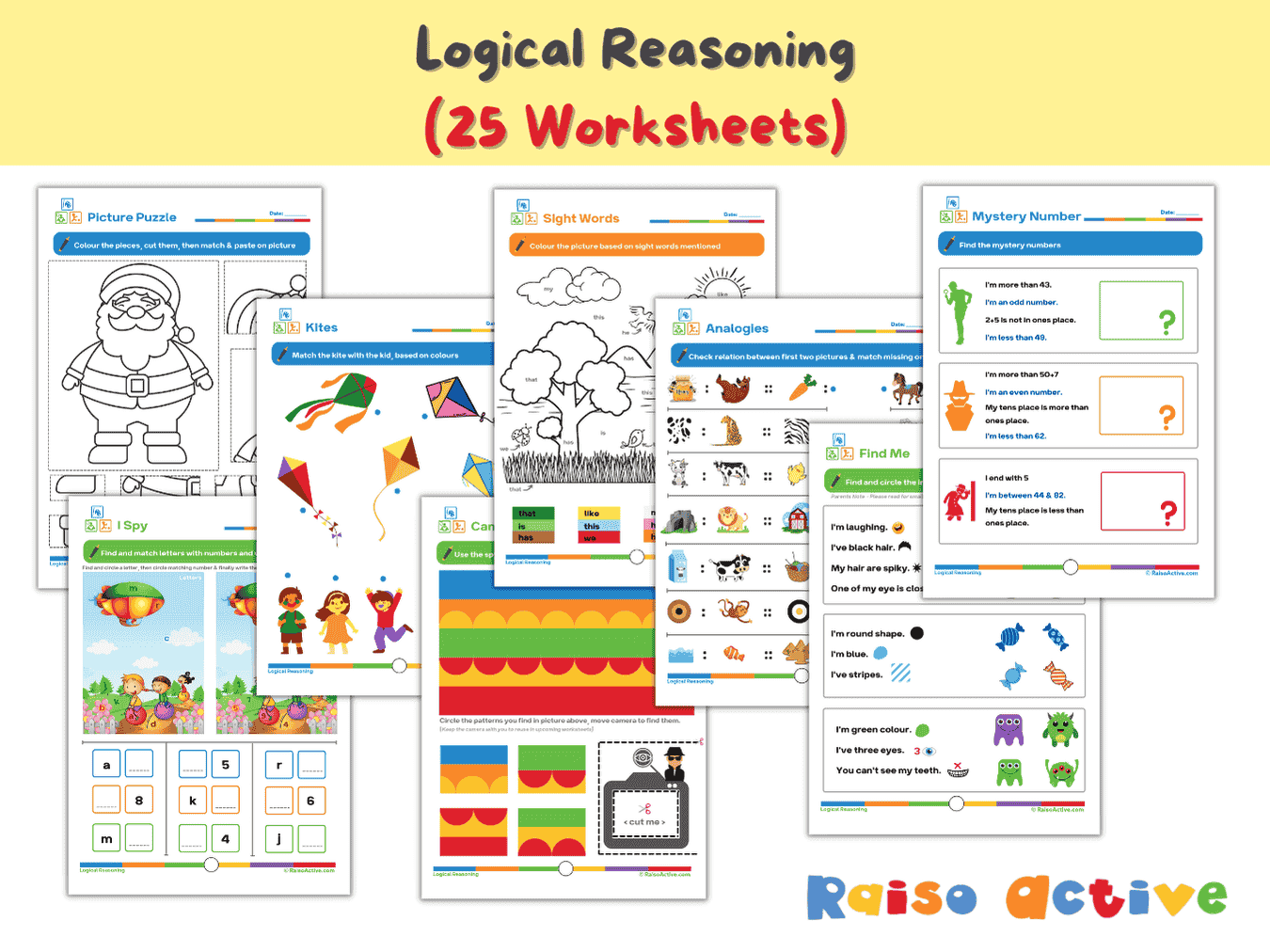
Logical Reasoning Activity Book for Preschool & Kindergarten | Patterns, Puzzles & Analogies
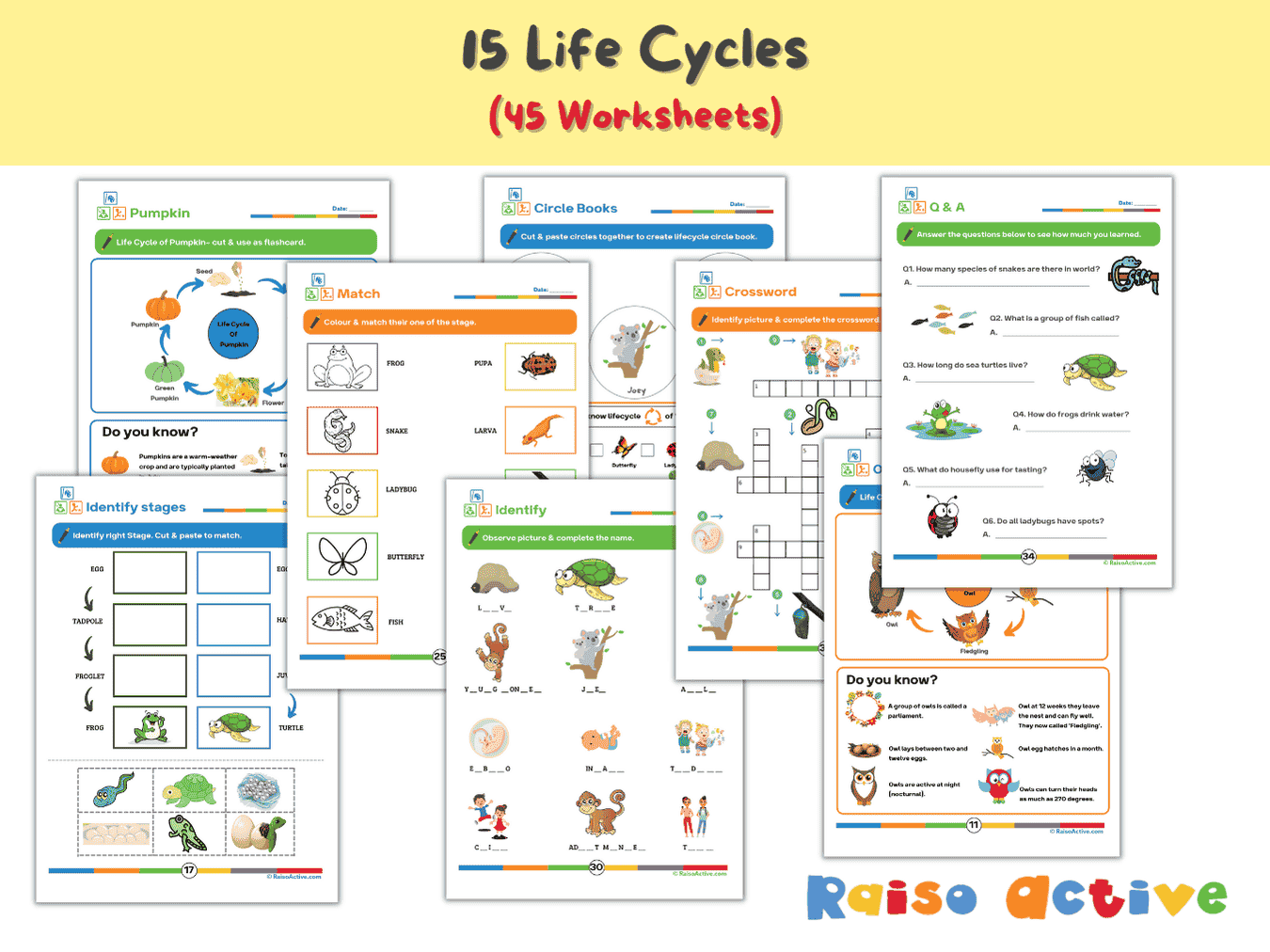
Lifecycles Activity Book & Flashcards for Preschool & Early Elementary
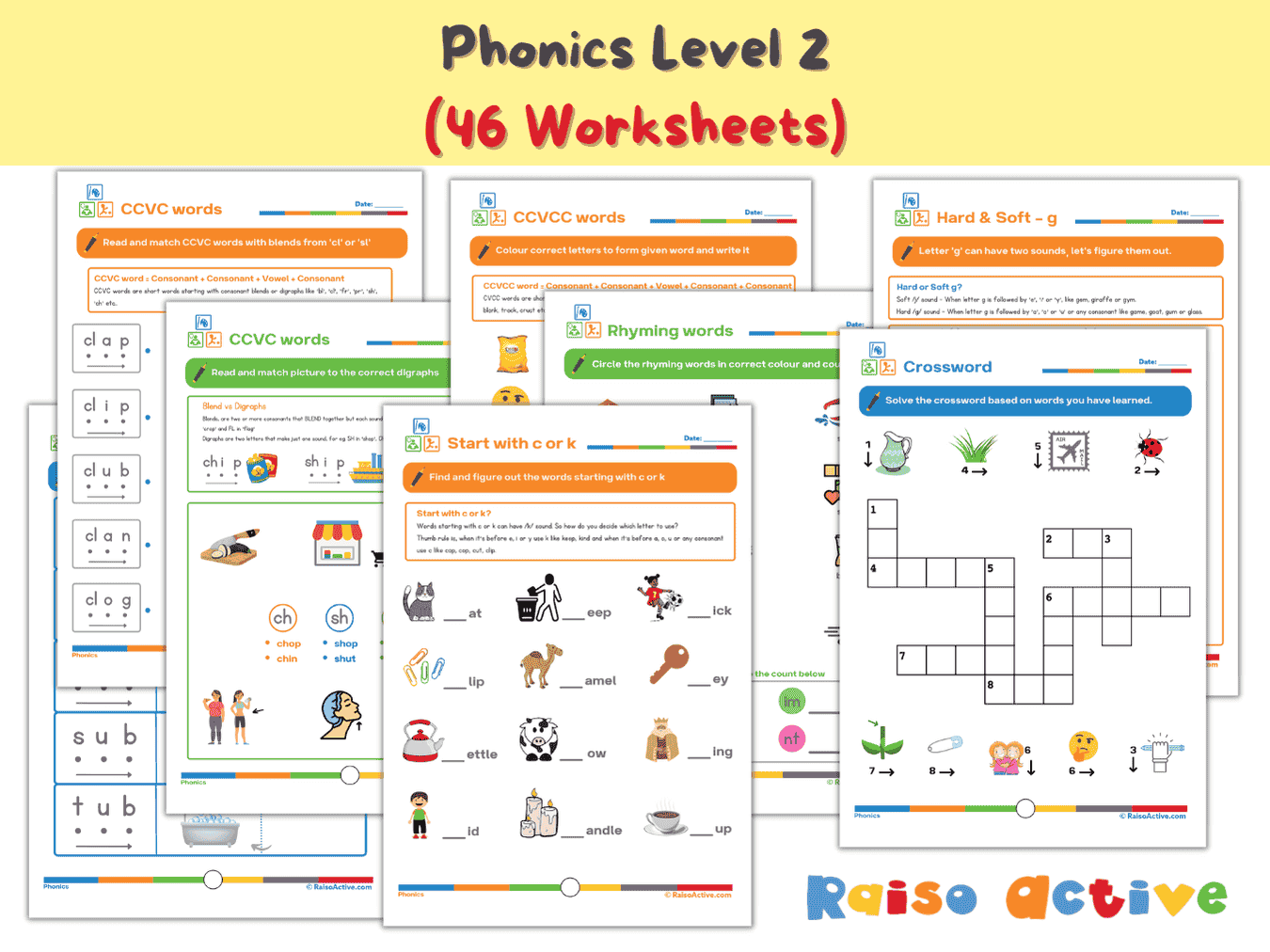
Phonics Level 2 Worksheets: CVC, CCVC, CVCC Word Families & Blends for Early Readers (Ages 4-7)
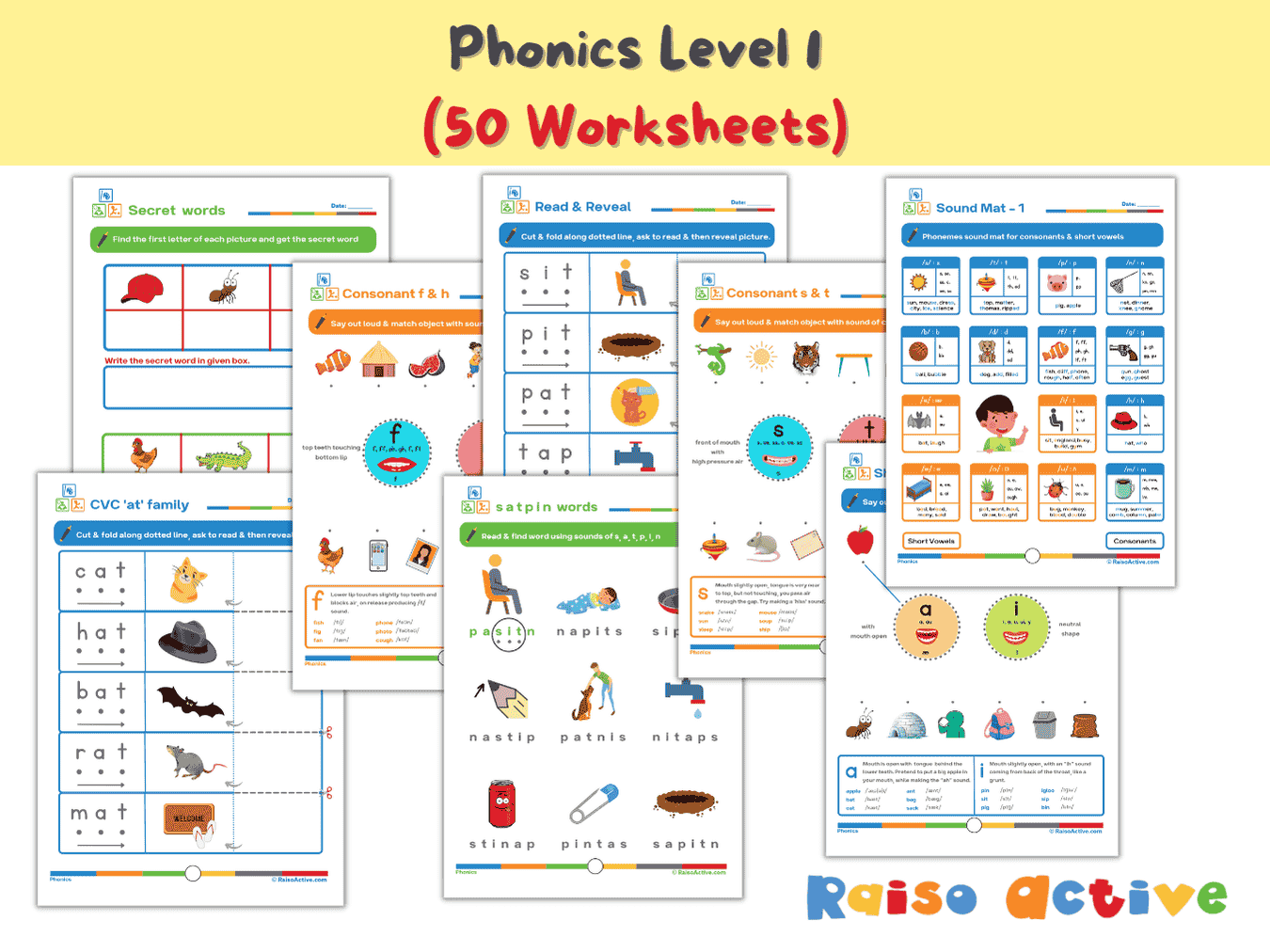
Phonics Level 1 Activity Book: Letter Sounds, Blending & CVC Words for Preschool & Kindergarten
Guides for parents and teachers
See all guides →UKG Syllabus Explained: English, Maths and EVS Month by Month
What UKG classes typically cover in English, maths and EVS, month by month, aligned to NEP 2020, with ways to support at home and signs your child is behind.
How to Teach Your 3-Year-Old to Recognise Numbers: A Parent's Complete Guide
Help your 3-year-old recognise numbers 1-10 with multi-sensory activities, everyday maths moments, and simple routines. Practical guide with Indian context included.
Canonical: https://raisoactive.com/worksheets/nursery-shapes