Free printable worksheets · India
Nursery Maths Worksheets (Ages 3–4)
Nursery maths worksheets are practice sheets for children aged 3–4 in Nursery in India. Maths covers number sense, counting, the four basic operations, shapes, measurement and patterns, taught through objects before abstract symbols. The sheets on this page cover number sense and counting, addition and subtraction, shapes and measurement and patterns and comparison.
Nursery marks the first year an Indian child sits at a table with a pencil rather than only playing with one. Grip is still developing, so schools expect pre-writing strokes, colouring within a bold outline, matching identical pictures and counting small groups rather than any letter writing. Attention rarely holds past a few minutes at a stretch. Three-year-olds count to 10 aloud, touch-count up to five objects reliably, and start to recognise the numerals 1 to 10 as symbols for those amounts. A worksheet set should cover counting pictures and circling the matching numeral, sorting by one attribute, copying and continuing a two-colour pattern, naming circle, square and triangle, and comparing big and small or more and fewer. Tracing 1 to 5 in thick dotted lines is fine; writing numerals unaided is not expected.
583+ worksheets · free PDF download · print on A4 or Letter
Nursery Maths Worksheets to print
Browse all worksheets for ages 3–4
Count and Match: A Fun Numeracy Worksheet for Preschoolers!
This worksheet combines two foundational counting skills for children ages 3-5: counting a group of objects and writing the total, and then matching that same quantity to an equivalent group elsewhere on the page. Writing the numeral after counting reinforces that a number symbol represents an actual quantity, not just a word to memorize. Matching equal groups afterward adds an extra layer of number sense, showing children that the same quantity can look different depending on what's being counted.

Penguin Addition Worksheet for Preschoolers: Counting and Circling
Counting groups of penguins, combining them, and circling the correct sum from several options builds early addition fluency for children ages 3-5, using a fun animal theme to keep counting practice engaging.
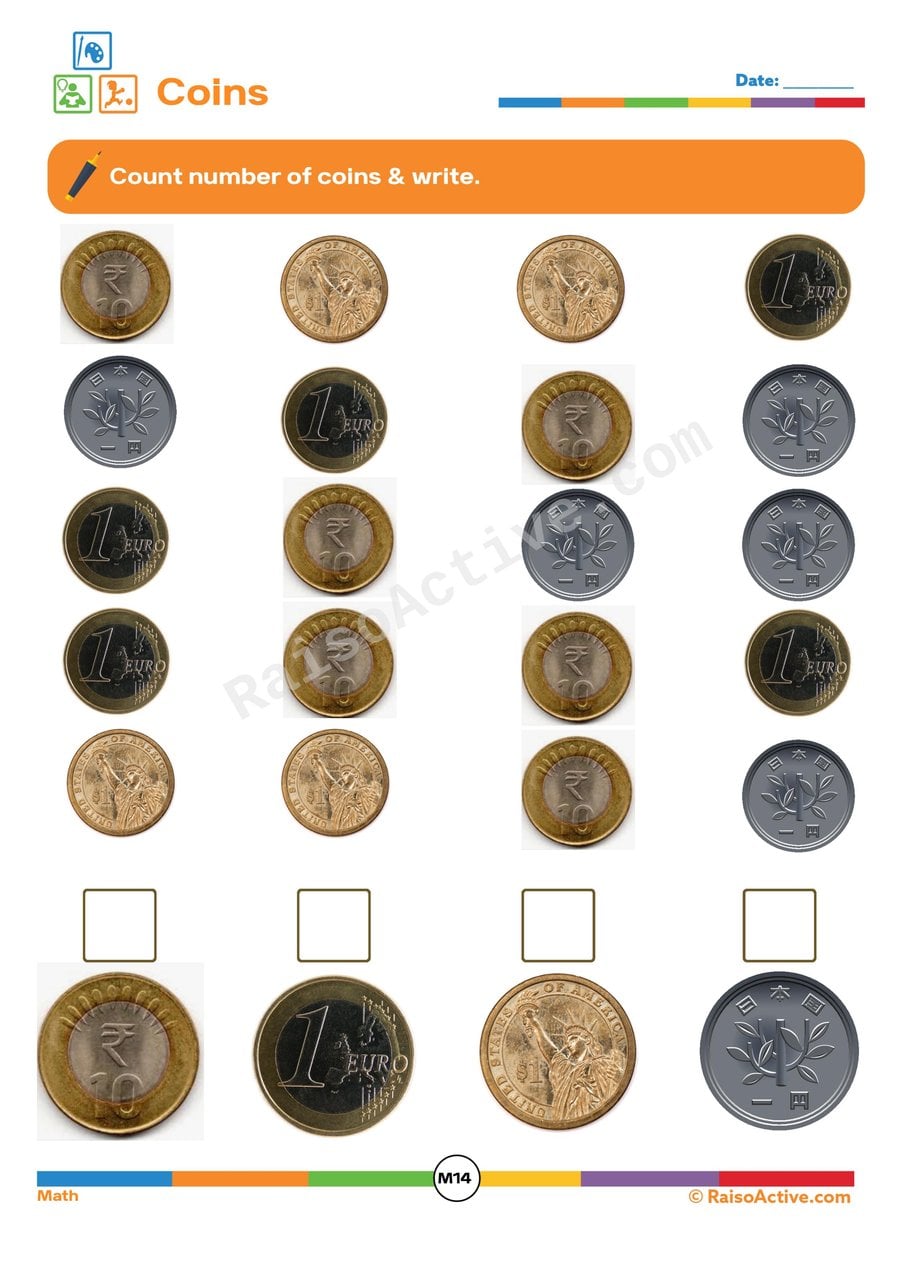
Coin Counting Worksheet for Preschoolers
Counting coins introduces children ages 3-5 to an early form of real-world numeracy, since recognizing different coin types by sight and counting how many of each appear builds both visual discrimination and one-to-one counting practice with a practical, everyday application. This worksheet keeps the task simple by having children count quantities of each coin type rather than calculating monetary value, which is developmentally appropriate for this age before formal money-math skills are introduced. It also plants the early seed of understanding that different coins look different and can be sorted by type.

Emotions Worksheet: Count, Color, and Identify Feelings!
Identifying emotions from facial expressions and then counting and coloring them builds emotional literacy, the ability to name feelings like happy, sad, or surprised, alongside basic counting practice, giving children a vocabulary for something they experience daily but may not yet know how to describe. For ages three to five, naming emotions explicitly is an important early step in self-regulation and empathy.

Counting Fun: Count and Write the Numbers Worksheet for Kids
This worksheet builds core numeracy for children ages 3-5 through the fundamental skill of one-to-one correspondence — counting a group of objects and writing the numeral that represents the total. This is one of the earliest and most essential math skills, since accurately connecting a counted quantity to a written number underlies every later arithmetic concept.

Up and Down Worksheet: Counting and Writing Practice for Preschoolers
Children ages 3-5 combine spatial reasoning with counting practice by counting steps or elements going up and down, then writing the totals. Understanding 'up' and 'down' as directional concepts supports later skills like reading graphs, climbing stairs safely, and following spatial instructions. Writing the counted numbers afterward reinforces number formation alongside the counting itself.
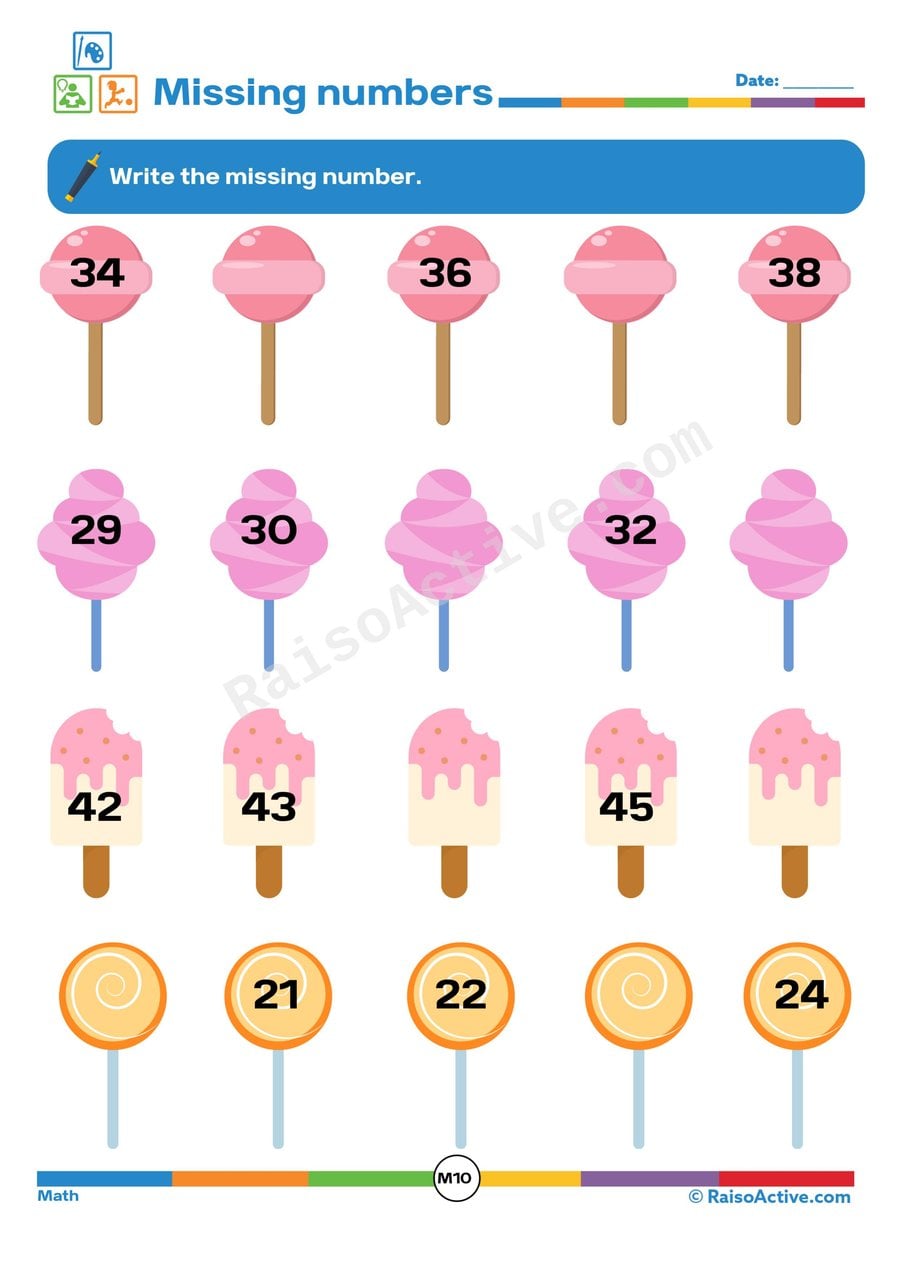
Missing Numbers Worksheet: Sweet Treats!
Set against a row of illustrated sweet treats, this worksheet gives children ages 3-5 practice with number sequencing - recognizing what comes before or after a given number in the counting order. This is a key early step toward understanding that numbers have a fixed, predictable order, which children need before they can count reliably or perform simple addition.
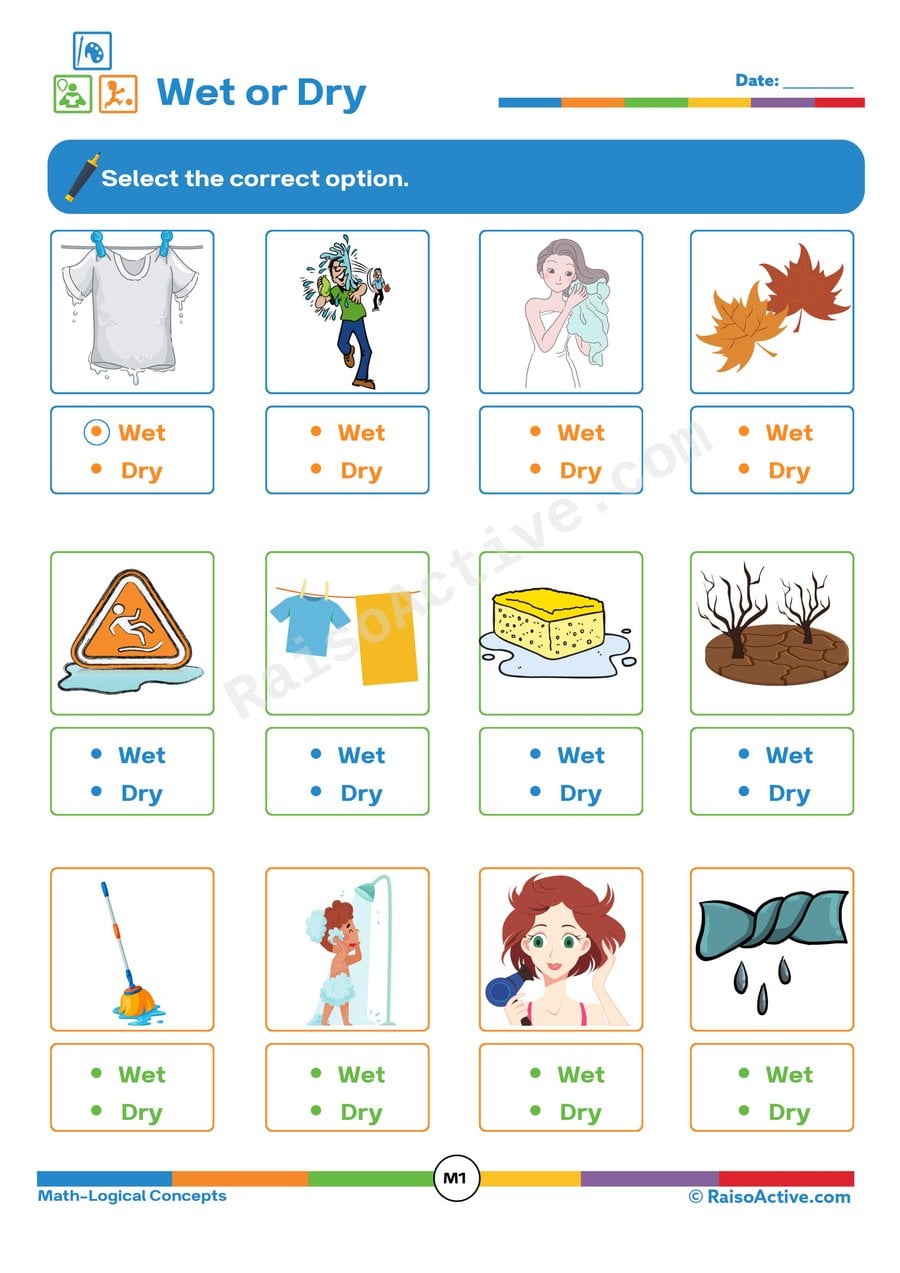
Wet or Dry Sorting Worksheet for Preschoolers
Sorting objects into 'wet' or 'dry' asks preschoolers to reach past the object's identity and notice a physical property instead — a step up from simply naming pictures. This is early scientific classification: your child has to observe a visual clue (a dripping umbrella, a puddle, a dry leaf) and reason about a quality that isn't always obvious from shape or color alone. Because some objects are genuinely tricky (a sponge can be either), the worksheet also opens the door to your child explaining their reasoning, which strengthens vocabulary around cause and state.
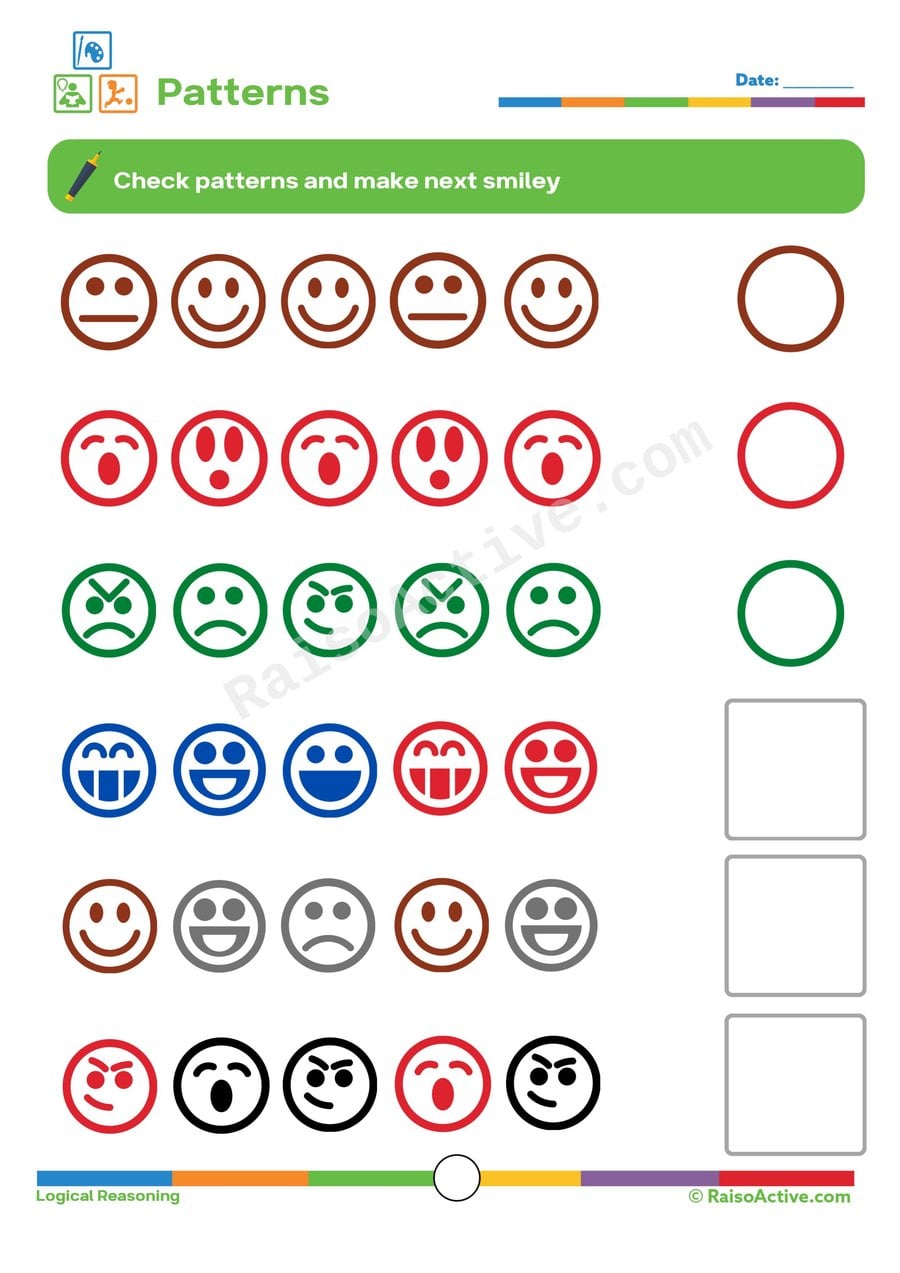
Smiley Face Patterns Worksheet for Preschoolers
This pattern worksheet has children ages 3-5 study a row of smiley faces with varying expressions or colors and determine what comes next in the repeating sequence, building foundational pattern recognition and logical reasoning skills. Recognizing and extending patterns is one of the earliest forms of mathematical thinking children encounter, laying groundwork for later work with number patterns, skip counting, and algebraic reasoning. Because the pattern uses a familiar, emotionally engaging image like a smiley face, children stay motivated through several rows of repeated practice.
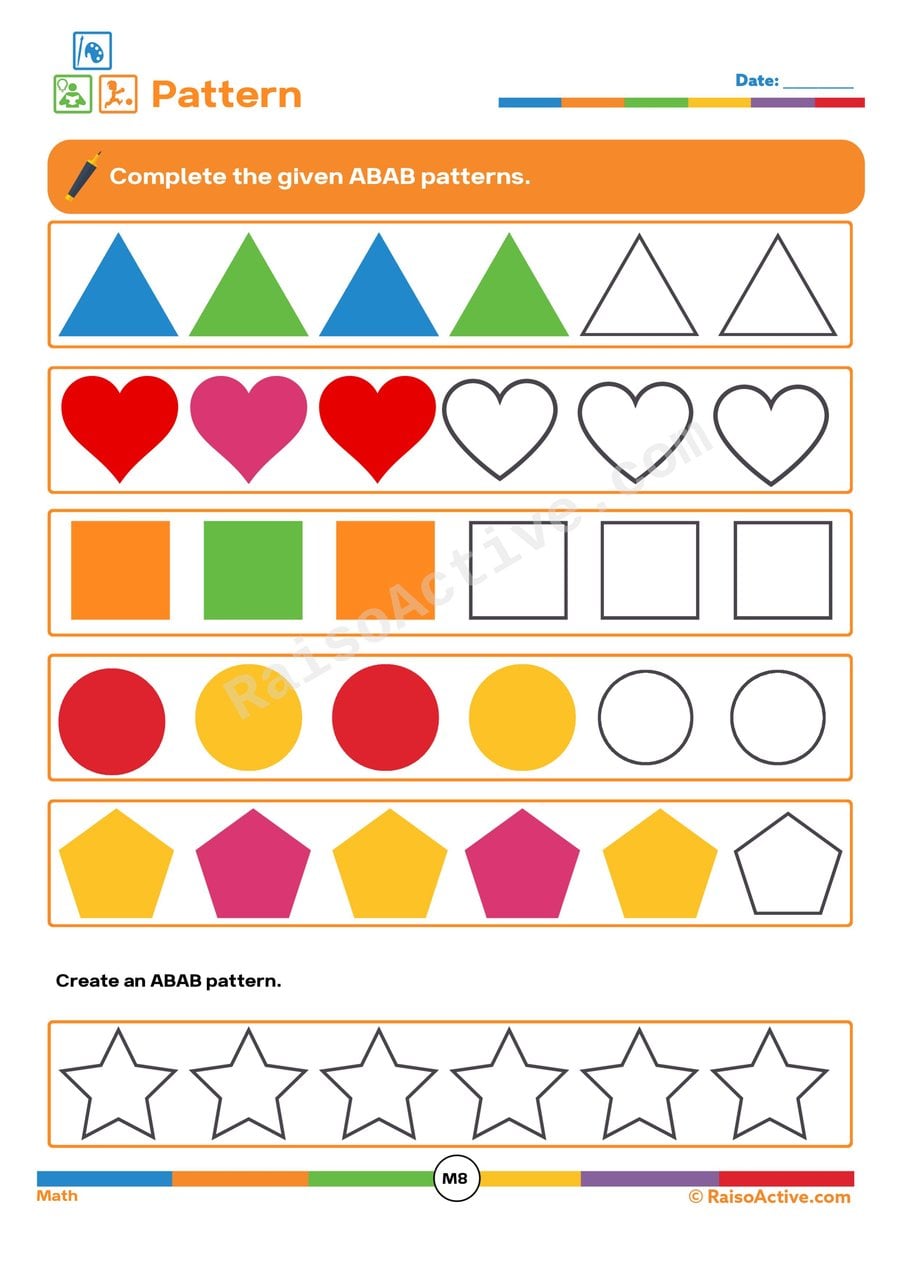
ABAB Pattern Fun: Complete the Shapes Worksheet!
This worksheet builds early algebraic thinking as children ages 3-5 identify and continue ABAB patterns using shapes and colors, then create a pattern of their own using stars. Recognizing that a pattern repeats in a predictable unit is a foundational math skill that later supports understanding sequences, multiplication, and logical prediction, making this simple shape activity more mathematically important than it might first appear.

Measuring Objects: A Fun Measurement Worksheet for Preschoolers!
Preschoolers ages 3-5 explore early measurement concepts by using a given reference item to figure out how many of that item it takes to span the length of different objects. This non-standard measurement approach — counting units rather than reading a ruler — is exactly how measurement is first introduced in early math curricula, building intuition before formal units are taught. Comparing object sizes this way also strengthens counting accuracy under a real, purposeful task.

Clean or Dirty Sorting Worksheet for Preschoolers
Sorting pictures into clean and dirty categories teaches children ages 3-5 to make observational judgments and apply reasoning about hygiene, rather than simply naming what they see. Drawing a happy or sad face for each choice also adds an element of emotional expression to what is otherwise a straightforward sorting task.
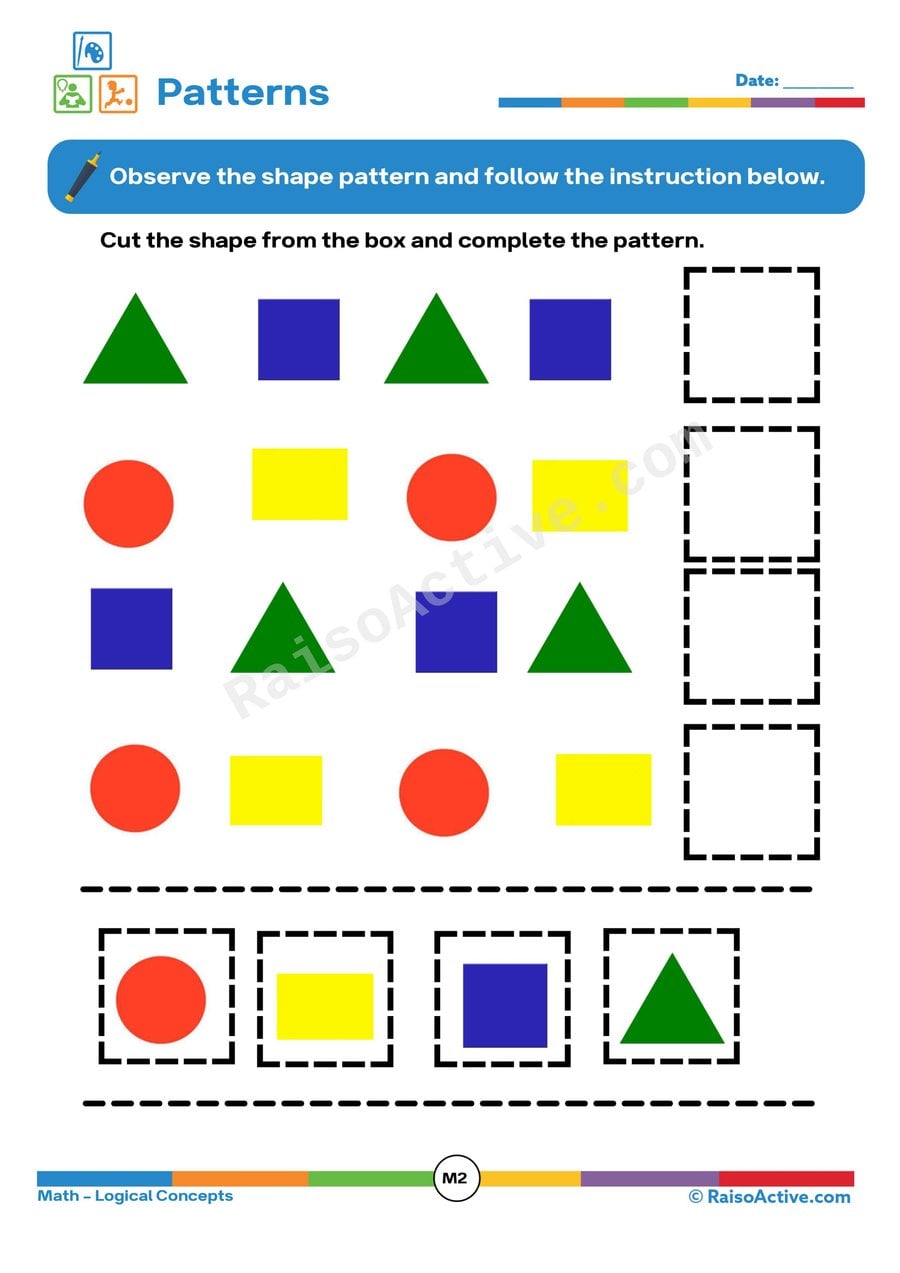
Shape Pattern Worksheet: Complete the Pattern!
Completing a repeating shape pattern asks children ages 3-5 to notice what comes next in a sequence and predict it correctly, an early form of the logical reasoning used in algebra much later on. Recognizing and continuing patterns also strengthens visual memory, since a child has to hold the beginning of the pattern in mind while figuring out what should come next.
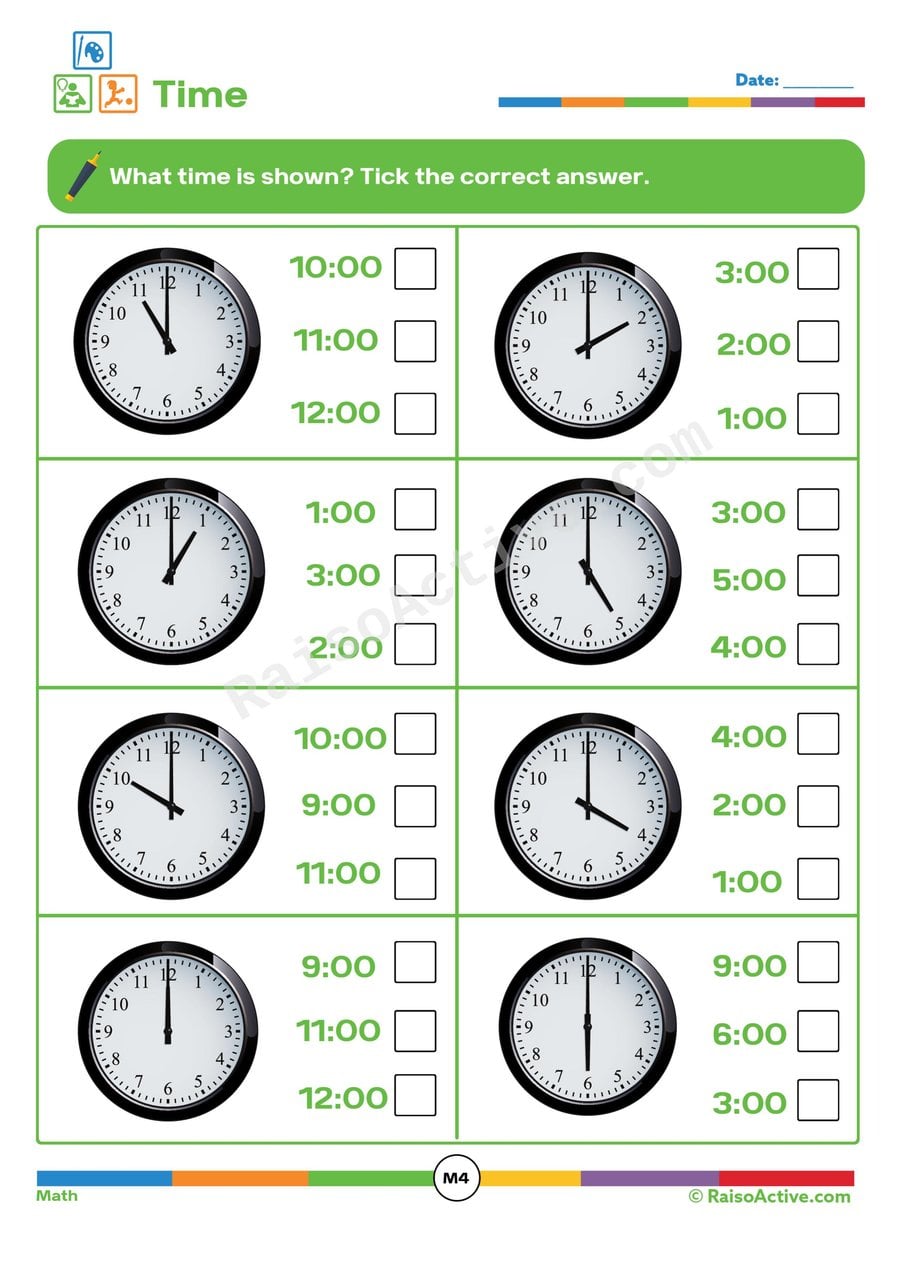
Time Telling Worksheet: What Time Is It? (3-5)
This worksheet introduces children ages 3-5 to analog clock reading at its simplest level, asking them to look at a clock face and choose the correct time from a set of answer options rather than writing it independently. Multiple-choice format lowers the barrier for this genuinely difficult skill, letting younger children build early clock familiarity before they're expected to read time unaided.

Observe and Draw: Pattern Recognition Worksheet for Preschoolers
This worksheet challenges children ages 3-5 to identify decreasing patterns — sequences where shapes shrink or reduce in a predictable way — and draw the next shape in that sequence themselves. Decreasing patterns are more demanding than simple repeating patterns because children must track a changing rule, like shapes getting smaller, rather than a fixed repeating unit. Drawing the answer, rather than choosing from options, also requires stronger visual-motor planning to reproduce the shape accurately at the right size.

Happy or Sad Teeth: Dental Sorting Worksheet for Kids
This sorting worksheet has children ages 3-5 cut out pictures of foods and place them next to either a happy or sad tooth, teaching which foods support healthy teeth (like fruits, vegetables, and dairy) and which contribute to cavities (like candy and soda). Making the effects of food choices visible through a simple happy/sad symbol helps young children connect everyday eating decisions to a health outcome they can understand.
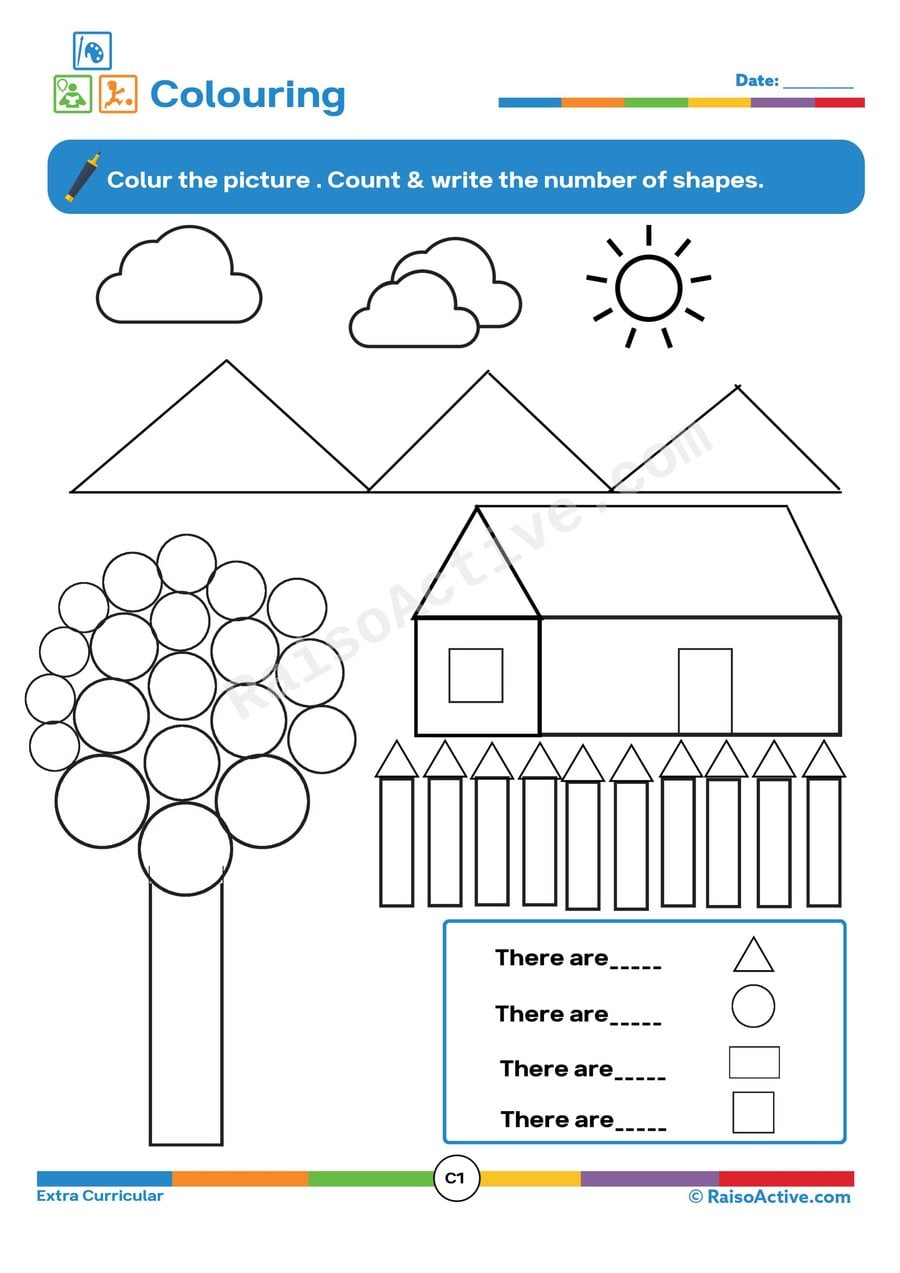
Shape Counting Fun: Count and Color the Shapes!
Preschoolers ages 3-5 combine shape recognition with counting practice by identifying different shapes within a larger picture, coloring them, and then counting how many of each shape appear. This dual task strengthens both geometry vocabulary and one-to-one correspondence as children tally shape totals. Coloring the picture first also builds sustained fine motor control before the counting portion begins.

Many vs. Few: Object Counting Worksheet for Preschoolers
This worksheet builds early quantity comparison skills as children ages 3-5 look at groups of objects and decide whether each group shows 'many' or 'few.' Beyond simple counting, this task develops relative reasoning — understanding that quantity is judged by comparison, not just a fixed number — which lays groundwork for later concepts like greater than and less than. Circling the correct group also reinforces visual scanning and attention to detail.
Practice Grid Worksheet for Early Learners
This blank practice grid gives children ages 3-5 an open space to build the pencil control that underlies all future handwriting, without the pressure of forming a specific letter or number correctly. Drawing lines, shapes, and marks within the boundaries of each grid square strengthens the small hand muscles and hand-eye coordination needed before children are ready for structured letter formation. Because the grid has no single correct answer, it also gives adults a low-stakes way to see how a child currently controls a pencil.
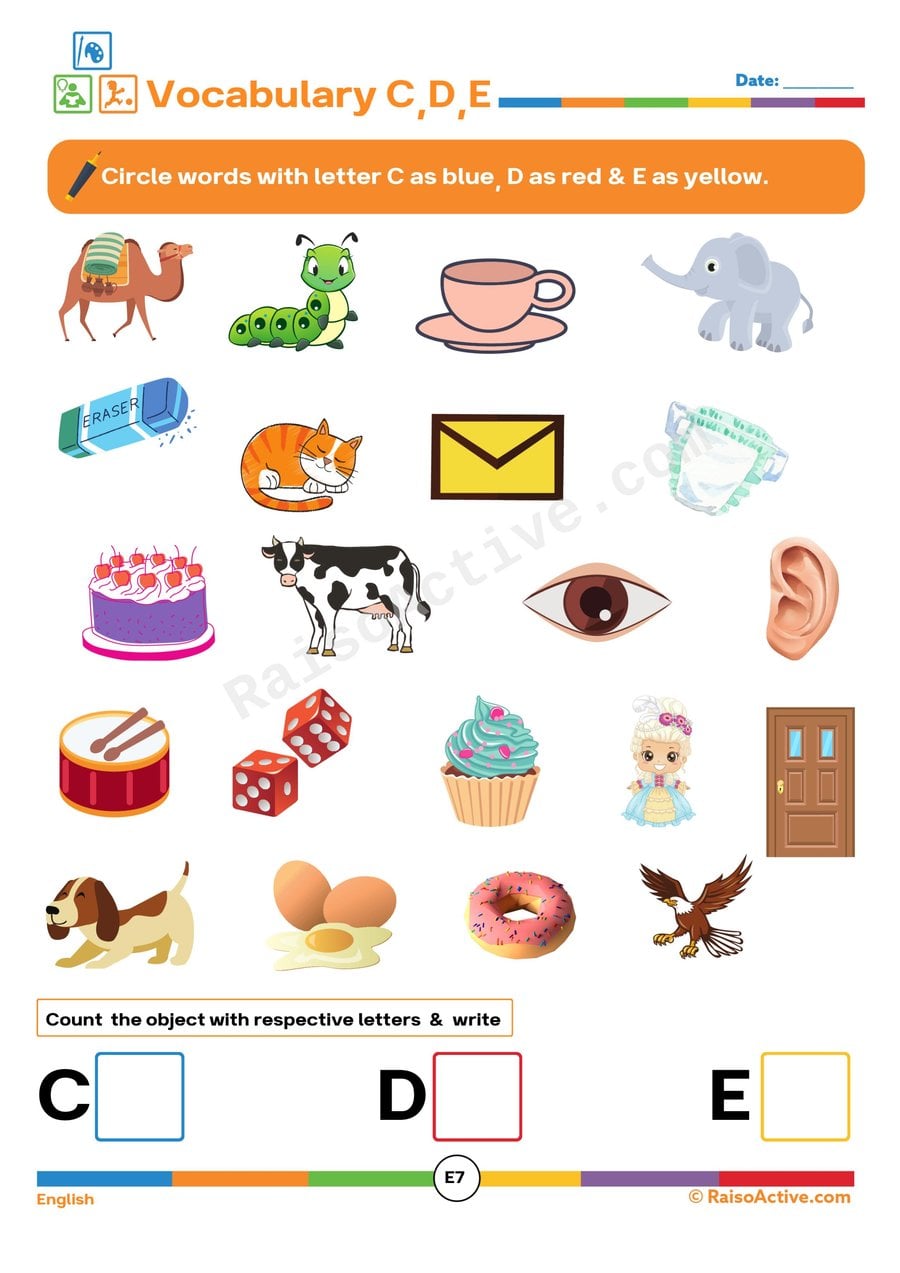
C, D, E Letter Sounds Worksheet: Circle and Count!
This activity gives children ages 3-5 focused practice recognizing the beginning sounds of the letters C, D, and E, asking them to circle matching pictures in different colors for each letter before counting the results. Combining phonics with counting means children practice two skills in one sitting: identifying initial letter sounds and recording a numeric total, both foundational for kindergarten readiness. Color-coding each letter also helps children visually organize the three sounds instead of mixing them together.
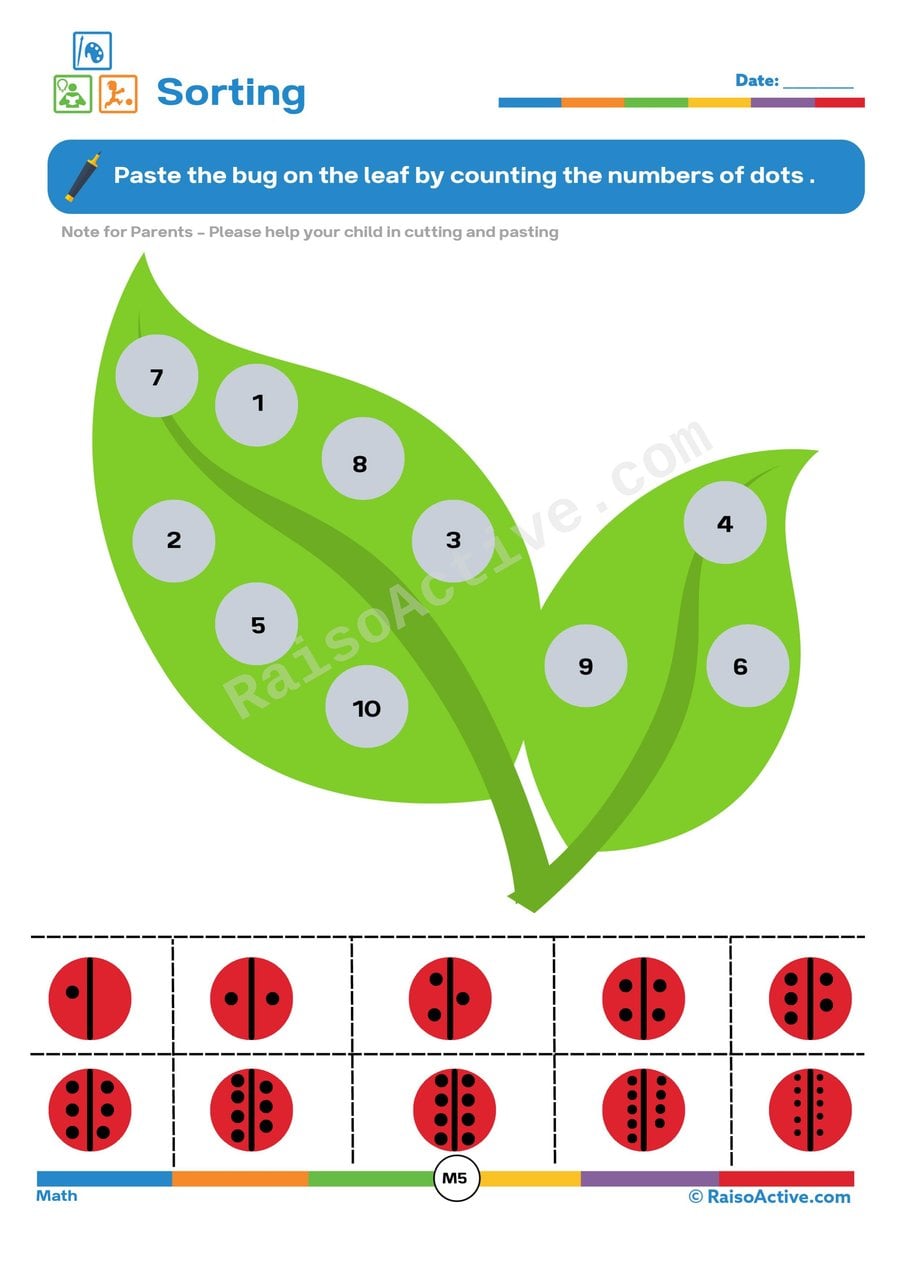
Ladybug Dot Counting Worksheet for Preschoolers
Children ages 3-5 practice one-to-one correspondence by counting the dots on each ladybug and matching that total to the correct numbered leaf, a core early numeracy skill that connects a printed number to an actual quantity. The cutting and pasting also strengthens fine motor control needed for later writing tasks.
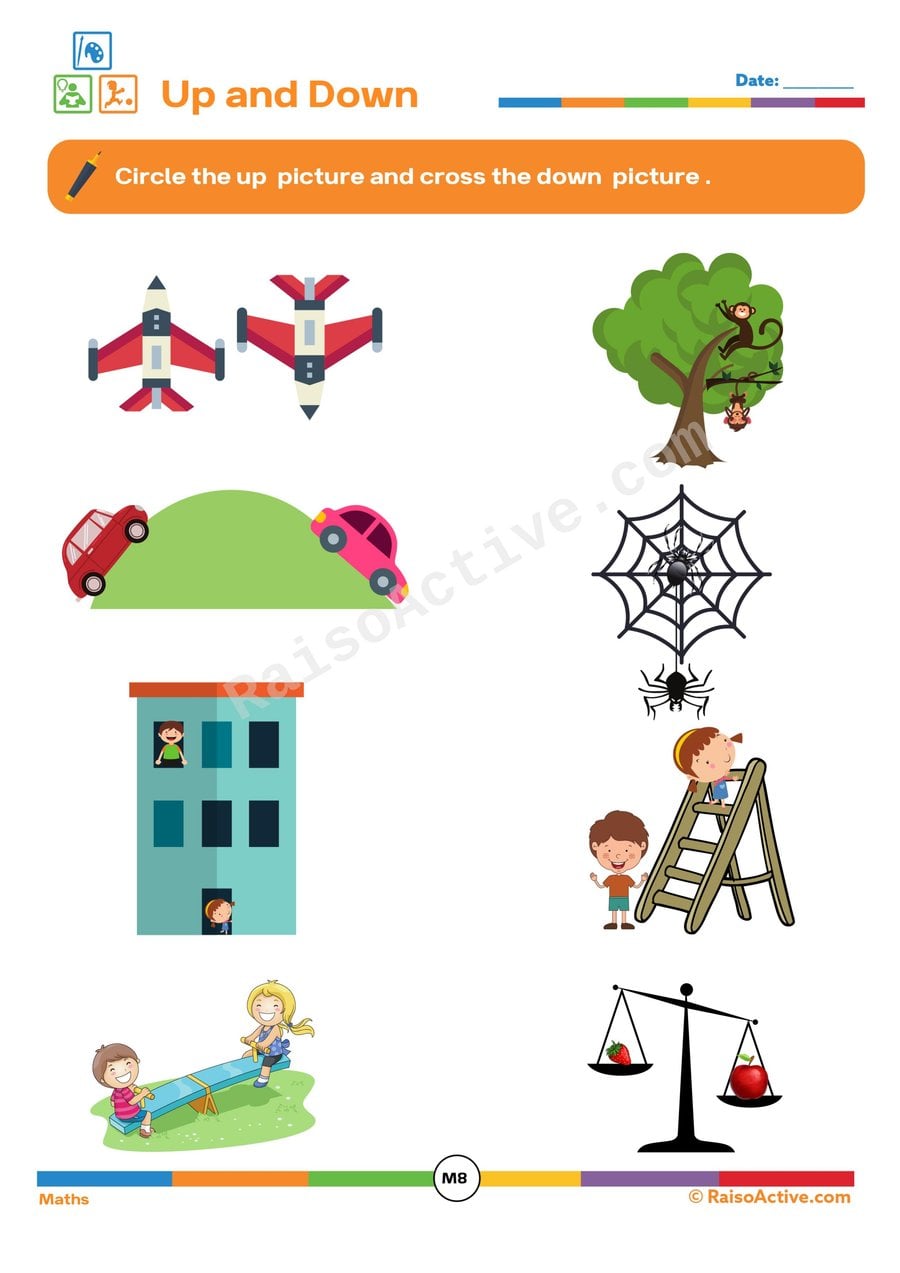
Up and Down Worksheet: Circle the Up Picture!
This worksheet helps children ages 3-5 understand the concepts of 'up' and 'down' by examining pairs of pictures and identifying which one shows something moving or positioned upward. Comparing two opposite pictures side by side also builds early skills in noticing contrast and difference, which supports later comparison-based reasoning in math and science.
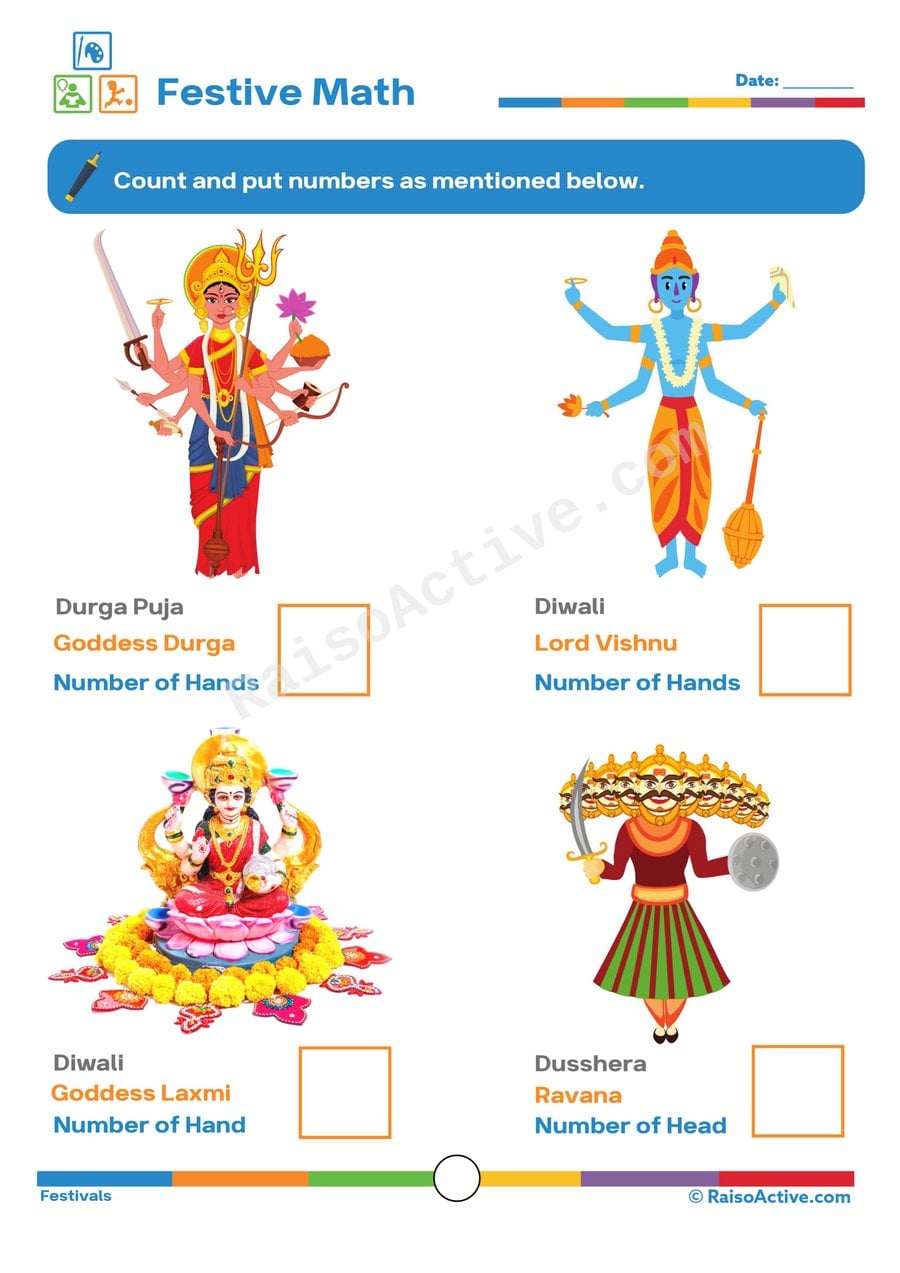
Festive Math: Counting Hands and Heads Worksheet
This worksheet uses festive character illustrations to give children ages 3-5 focused practice in one-to-one correspondence, counting each hand or head exactly once as they work through the page. Because every figure has a fixed, predictable number of hands and heads, children also start to build an early sense of number consistency. Embedding counting practice in a festival theme keeps the repetition engaging rather than rote.

Count and Write: Fun Counting Worksheet for Preschoolers
This counting worksheet has children ages 3-5 count small groups of objects and write the matching numeral in a box, directly linking the physical act of counting to the written symbol that represents a quantity. Writing the number immediately after counting — rather than just counting aloud — reinforces that numerals are a shorthand for real, countable amounts.
What Nursery maths worksheets cover
Three-year-olds count to 10 aloud, touch-count up to five objects reliably, and start to recognise the numerals 1 to 10 as symbols for those amounts. A worksheet set should cover counting pictures and circling the matching numeral, sorting by one attribute, copying and continuing a two-colour pattern, naming circle, square and triangle, and comparing big and small or more and fewer. Tracing 1 to 5 in thick dotted lines is fine; writing numerals unaided is not expected.
- Count up to 10 pictures and circle the matching numeral
- Point to the numeral an adult names, from 1 to 10
- Continue a red-blue-red-blue pattern of shapes
- Sort pictures by size or colour into two groups
- Name a circle, square and triangle by sight
How to use these worksheets at home or in class
A single sheet a day, five to ten minutes, suits a three-year-old best. Sit alongside your child rather than opposite, demonstrate one stroke, then let them attempt it themselves, praising the try rather than the neatness of the line.
Start with the sheet that matches what your child can already do, then move one step up. Keep finished sheets in a folder: Nursery teachers often ask for evidence of practice, and children like seeing their own progress.
Is your child ready for Nursery maths work?
Readiness shows up as a proper crayon grip with fingers instead of a fist, purposeful scribbling, sitting through a short task and following one spoken instruction such as pointing to a colour. Without these, stick to sticker play and large colouring pages for now.
Frequently asked questions
Should a three-year-old be writing numbers?
Recognizing numerals is the target at three; writing them is not. Tracing 1 to 5 along thick dotted lines is reasonable if the child already holds a crayon with fingers rather than a fist, but the sheet is teaching the shape, not fluent writing. Time spent counting objects and matching a numeral to a quantity pays off more, and unaided numeral writing arrives naturally between four and five.
What should a Nursery child be able to do in maths?
Three-year-olds count to 10 aloud, touch-count up to five objects reliably, and start to recognise the numerals 1 to 10 as symbols for those amounts. A worksheet set should cover counting pictures and circling the matching numeral, sorting by one attribute, copying and continuing a two-colour pattern, naming circle, square and triangle, and comparing big and small or more and fewer. Tracing 1 to 5 in thick dotted lines is fine; writing numerals unaided is not expected. Readiness shows up as a proper crayon grip with fingers instead of a fist, purposeful scribbling, sitting through a short task and following one spoken instruction such as pointing to a colour. Without these, stick to sticker play and large colouring pages for now.
Do these worksheets follow the Nursery curriculum?
The sheets cover number sense and counting, addition and subtraction, shapes and measurement and patterns and comparison, which sit inside the NEP 2020 Foundational Stage (NCF-FS 2022) outcomes for Nursery. Preschool (US), Nursery (UK) use the same skills at this age, so the sheets also fit families following those programmes.
Are the Nursery maths worksheets free to download?
Yes. Every sheet on this page can be downloaded free as a watermarked PDF after creating an account, up to five downloads a day. The annual membership (₹1000) removes the watermark and the daily limit across the full library of more than 1,000 worksheets and all activity packs.

Written by
Hemsweta Jain · Teacher Cheena
MBA and Early Childhood Educator, teaching since 2014 · Founder of RaisoActive, Mumbai
Written and reviewed by Hemsweta Jain (Teacher Cheena), who designs every RaisoActive worksheet.
Last reviewed
Printable packs for ages 3–4
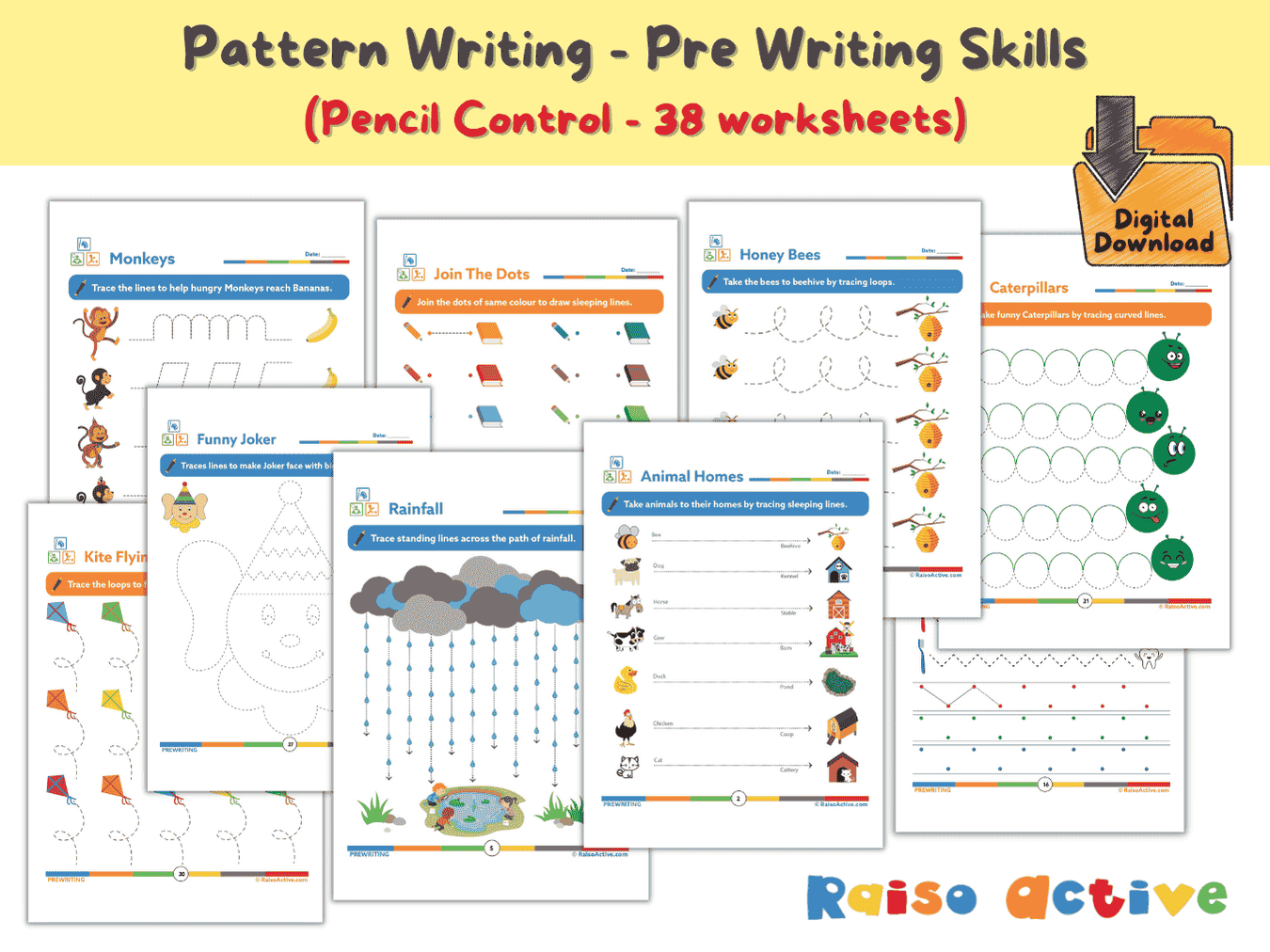
Pattern Writing Pre-writing Skills Activity Book for 3-4 Year Olds
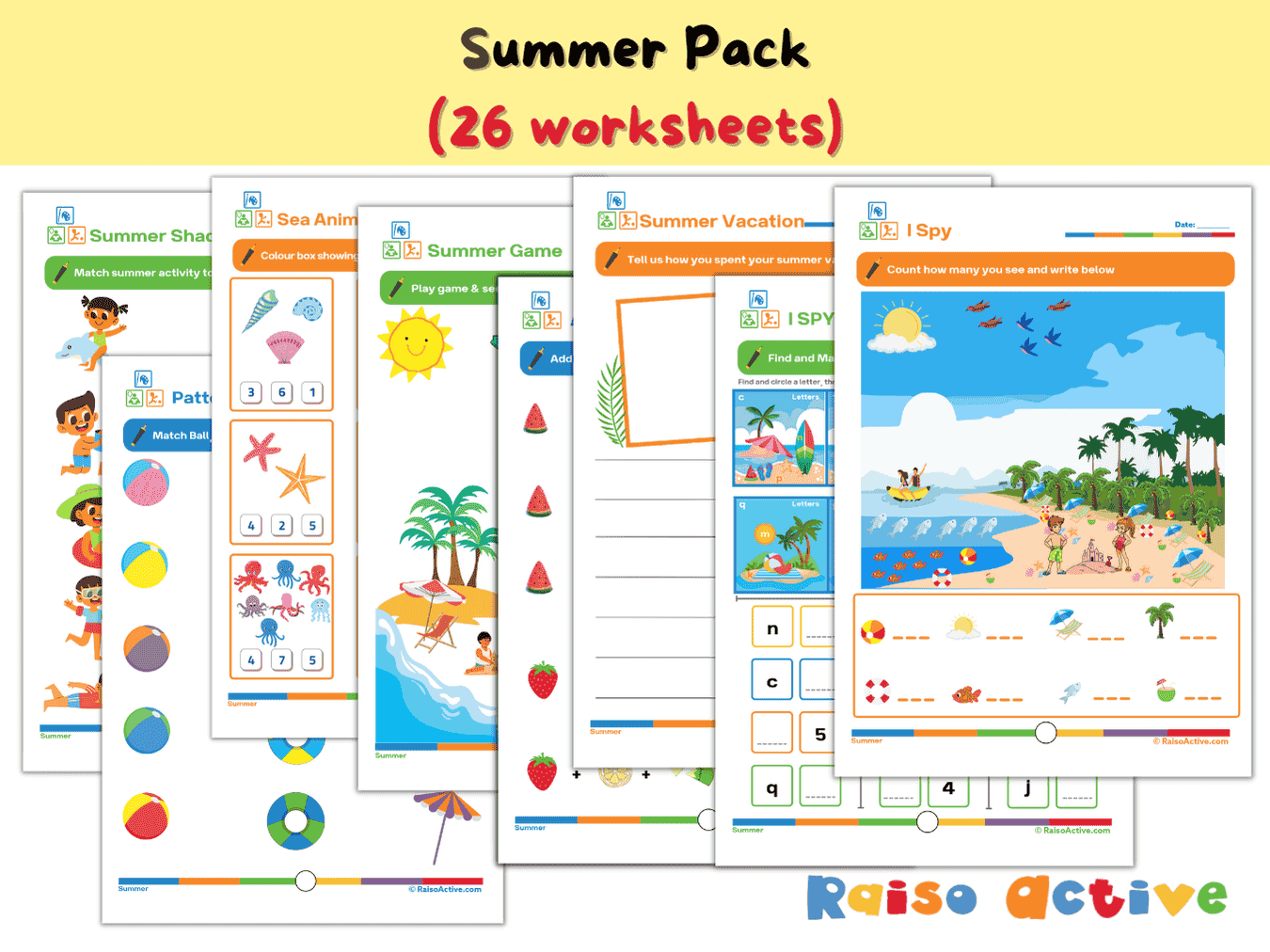
Summer Activity Pack: Math, Literacy, Puzzles & More for Preschool & Kindergarten
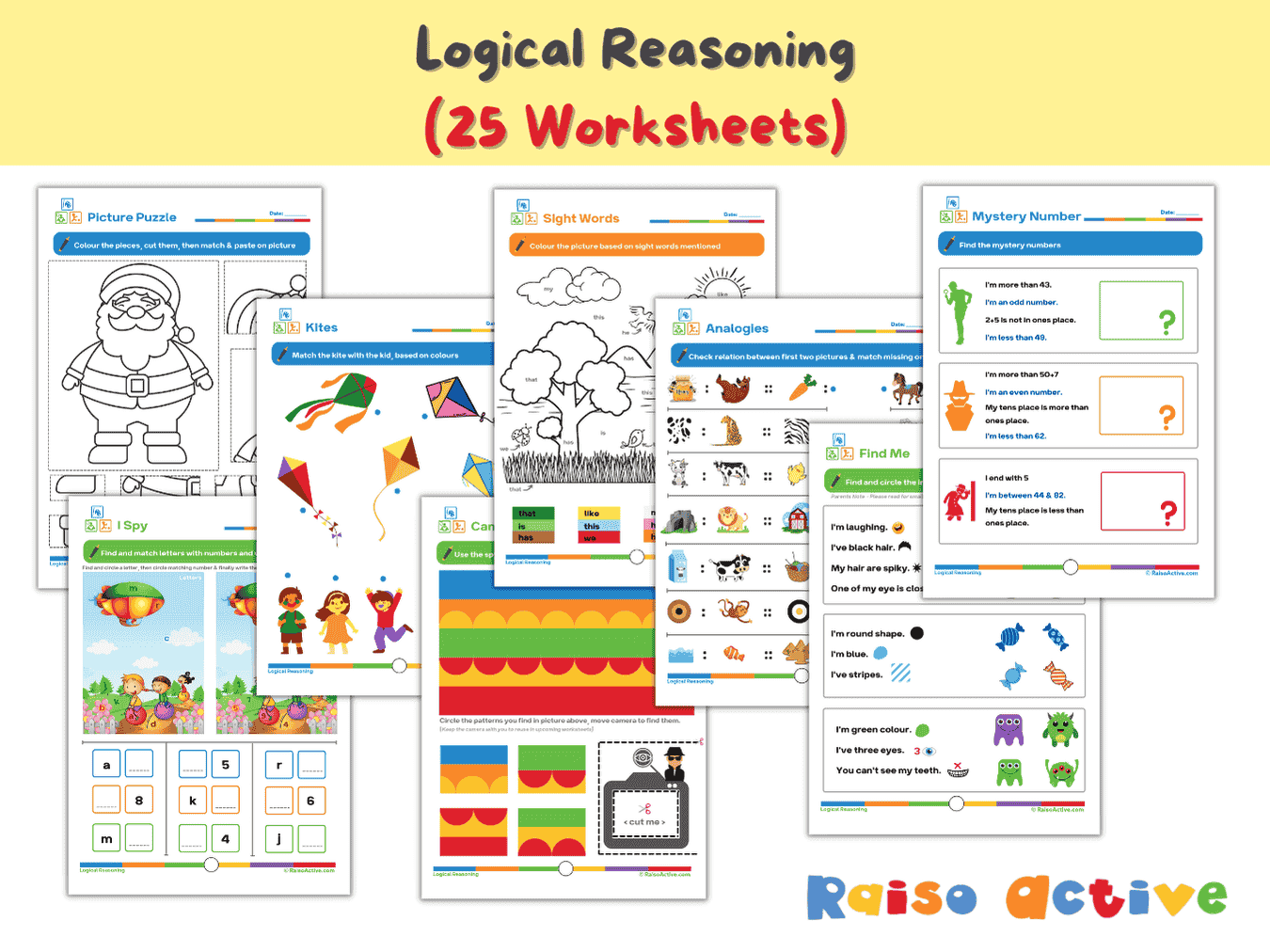
Logical Reasoning Activity Book for Preschool & Kindergarten | Patterns, Puzzles & Analogies
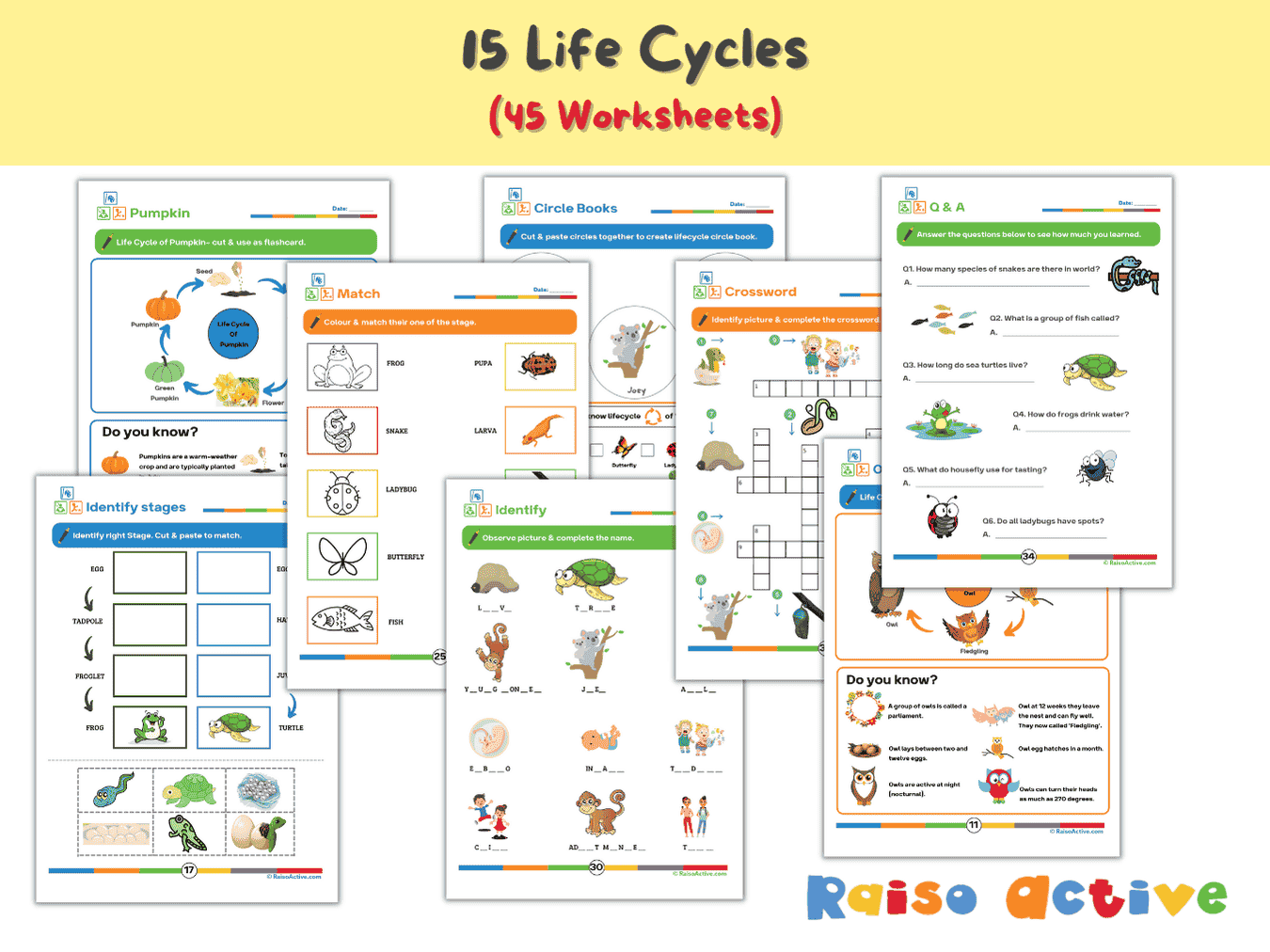
Lifecycles Activity Book & Flashcards for Preschool & Early Elementary
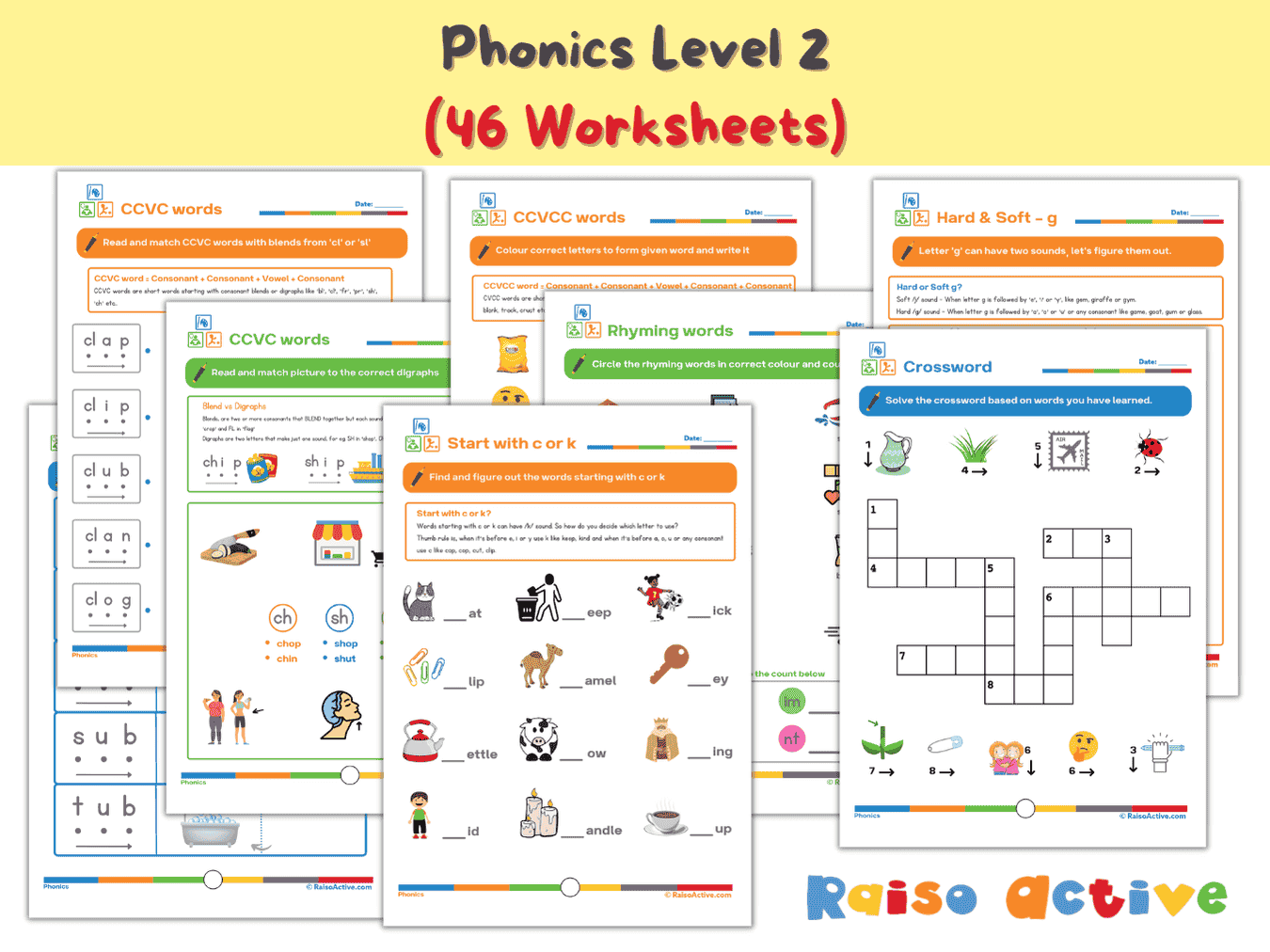
Phonics Level 2 Worksheets: CVC, CCVC, CVCC Word Families & Blends for Early Readers (Ages 4-7)
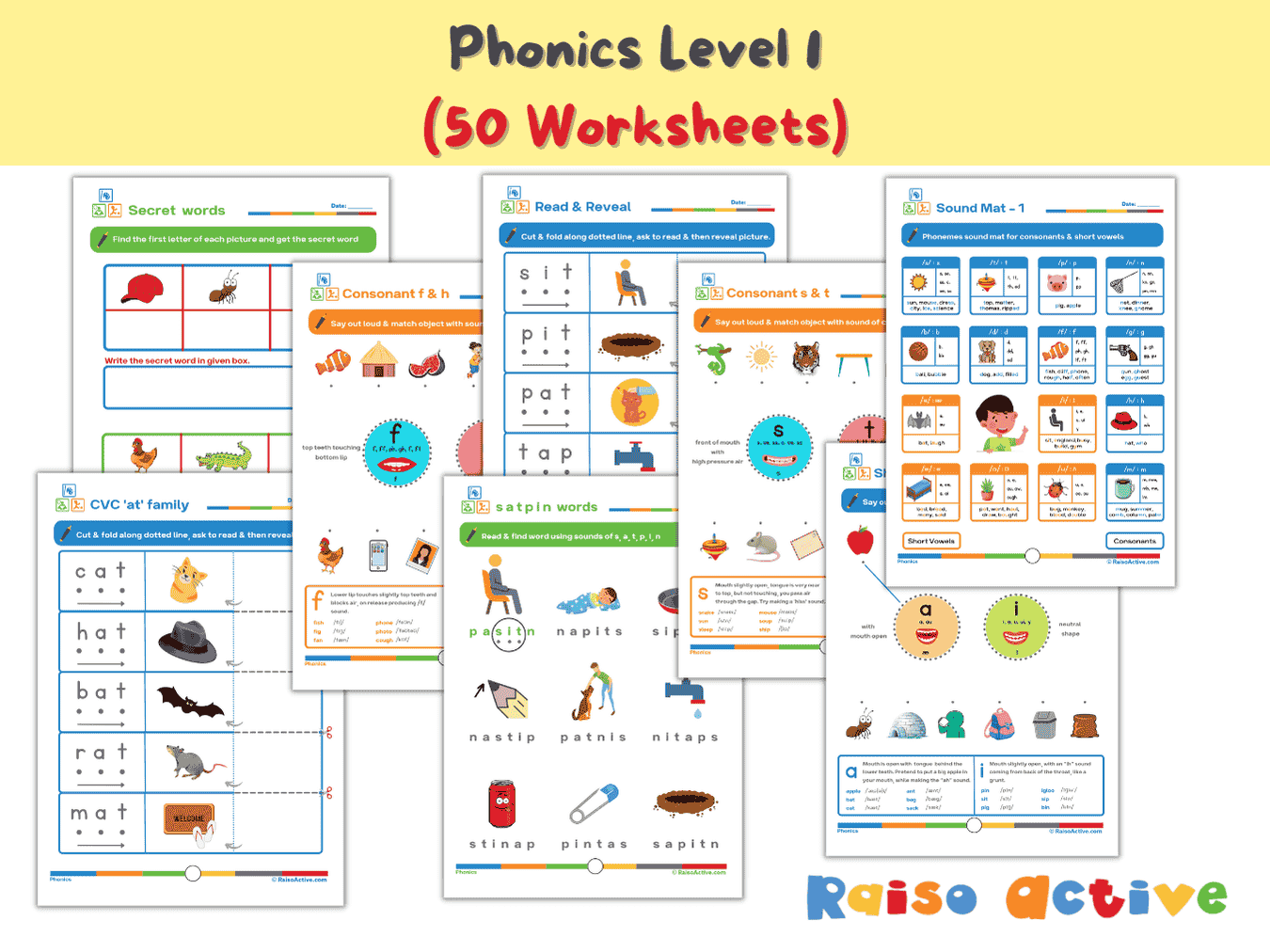
Phonics Level 1 Activity Book: Letter Sounds, Blending & CVC Words for Preschool & Kindergarten
Guides for parents and teachers
See all guides →Number Formation Rhymes 0–9 and How to Fix Reversals
Original number formation rhymes for 0–9, the correct stroke order for each digit, why 3, 5 and 7 get reversed most often, and multisensory fixes that work.
UKG Syllabus Explained: English, Maths and EVS Month by Month
What UKG classes typically cover in English, maths and EVS, month by month, aligned to NEP 2020, with ways to support at home and signs your child is behind.
Christmas and Winter Activities That Combine Fun and Learning: Creating Magical Educational Experiences
Discover Christmas and winter activities that combine festive fun with real learning. Crafts, counting, literacy, and printable worksheets for ages 2 to 8 — perfect for home and school.
Age-Appropriate Halloween Learning Activities: Balancing Spooks and Skills for Young Learners
Discover fun, age-appropriate Halloween learning activities for young children. Spooky crafts, counting games, literacy ideas, and printable worksheets for ages 2 to 8.
The Power of Music: How Musical Activities Accelerate Learning Development in Young Children
Discover how musical activities accelerate brain development, phonics, maths, and emotional regulation in children ages 1–8. Practical tips for Indian homes and classrooms.
Is Khan Academy Kids Really Free? A Parent's Complete Guide to Costs, Features, and Hidden Fees
Confirmed: Khan Academy Kids has zero subscription fees, ads, or paywalls. See what's included, age-by-age tips, and offline use for Indian families.