Free printable worksheets · India
Nursery Handwriting Worksheets (Ages 3–4)
Nursery handwriting worksheets are practice sheets for children aged 3–4 in Nursery in India. Handwriting is forming letters and numerals by hand with consistent size, spacing and shape, moving from single letters to legible sentences. The sheets on this page cover consistent letter formation, sizing and spacing letters on a line, joining letters for cursive and legible sentence writing.
Nursery marks the first year an Indian child sits at a table with a pencil rather than only playing with one. Grip is still developing, so schools expect pre-writing strokes, colouring within a bold outline, matching identical pictures and counting small groups rather than any letter writing. Attention rarely holds past a few minutes at a stretch. At three, handwriting is not letters yet; it is the strokes letters are made of. A child who has moved from a fist to holding a crayon with fingers can trace thick standing lines, sleeping lines and big circles, then copy them into an empty box. Worksheets should be wide, sparse and short. Tracing the child's own name in capitals is a fair stretch goal late in the year; forming letters from memory is not.
586+ worksheets · free PDF download · print on A4 or Letter
Nursery Handwriting Worksheets to print
Browse all worksheets for ages 3–4
Letter O Tracing Worksheet for Preschoolers: Learn to Write!
Tracing the letter 'O' gives children ages 3-5 practice with a fully rounded stroke, a foundational shape that also underlies other letters like 'a,' 'c,' and 'd,' making it valuable early motor practice beyond just this one letter. Coloring pictures that start with 'O' connects that shape and sound to real, familiar words, reinforcing beginning-sound recognition alongside handwriting.

Pattern Power! What Comes Next? Worksheet for Preschoolers
This worksheet builds pattern recognition, an early algebraic thinking skill, as children ages 3-5 study a repeating sequence of shapes, letters, or numbers and figure out what belongs next. Spotting what repeats and predicting what comes after it trains logical reasoning and attention to detail that later transfers directly to math sequences and number patterns.
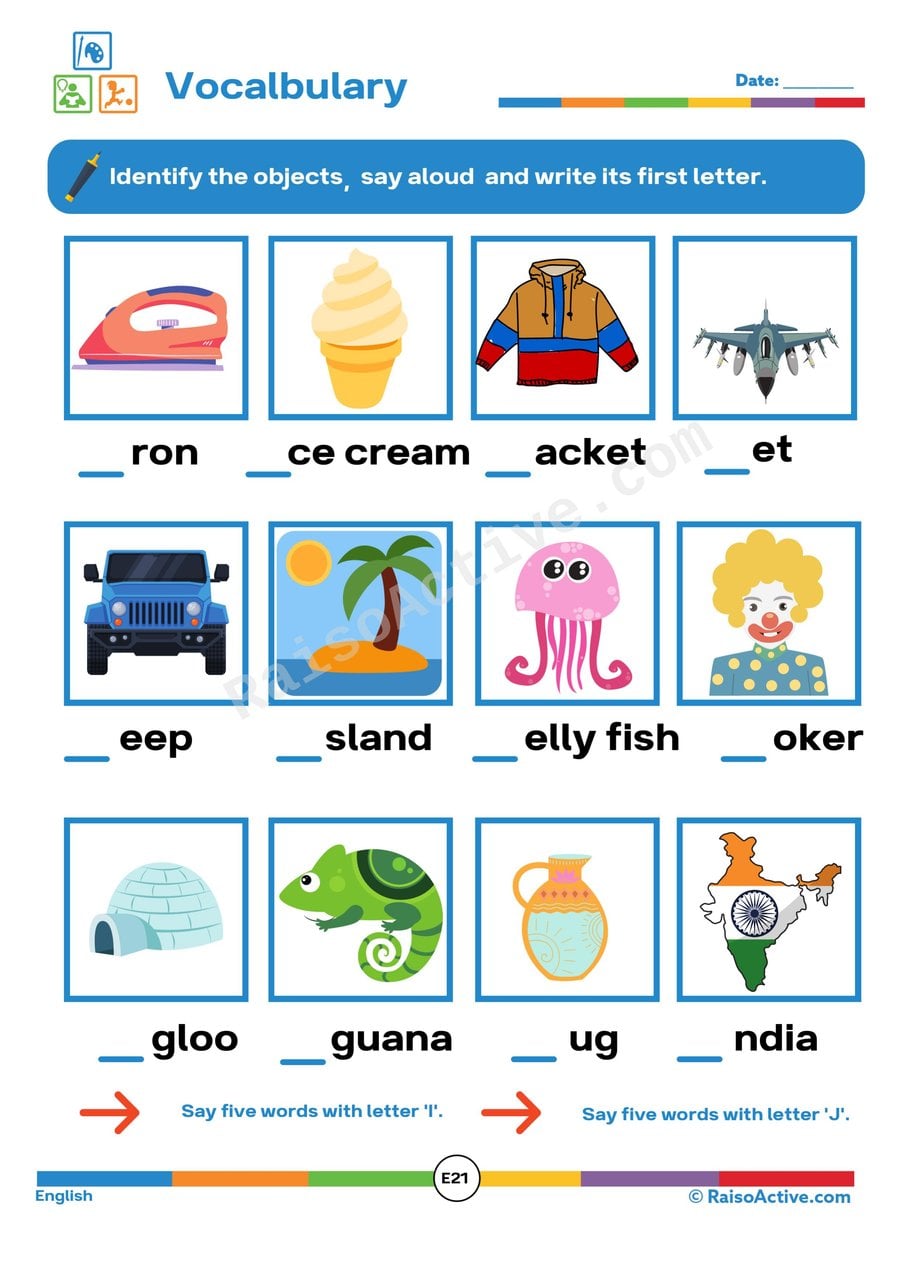
First Letter Fun: Identify and Write! (Ages 3-5)
This worksheet builds foundational alphabet knowledge for 3-5 year olds by combining picture naming with first-sound listening, giving your child practice at the exact skill that underlies early spelling: hearing a word, isolating its opening sound, and matching that sound to a written symbol. Because every picture requires a fresh listening decision, this worksheet resists rote memorization and keeps your child actively engaged with each new word.
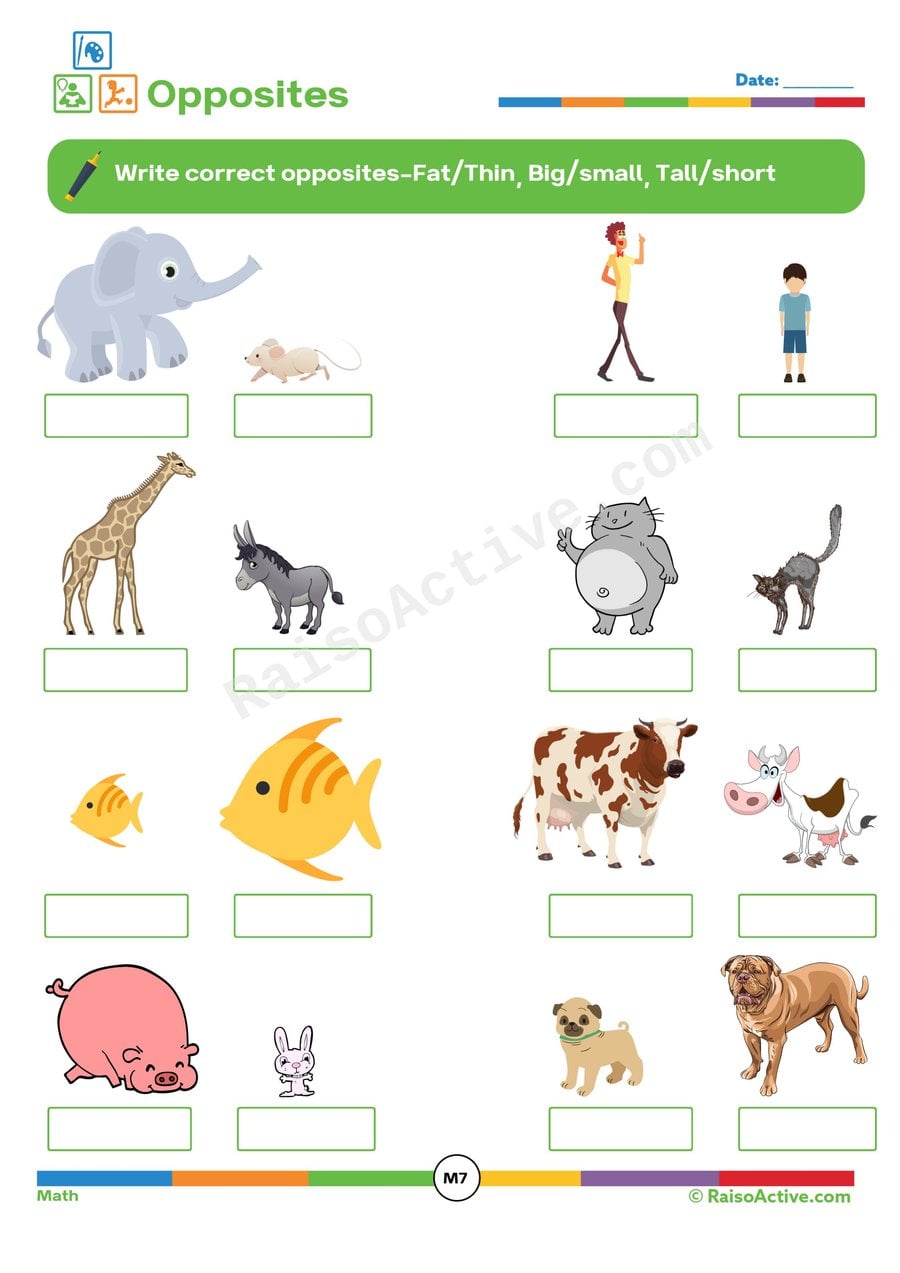
Opposites Worksheet: Fat/Thin, Big/Small, Tall/Short
Identifying opposite pairs like fat and thin, big and small, and tall and short teaches children ages 3-5 to think comparatively, recognizing that these descriptive words only make sense in relation to something else. This early vocabulary work also builds the reasoning skills needed to compare and contrast, a thinking pattern that shows up across science, math, and language throughout their schooling.

What Comes Next? Pattern Worksheet for Preschoolers
Identifying a repeating sequence of pictures and circling the one that comes next builds pattern-recognition and visual discrimination skills for children ages 3-5, an early form of logical reasoning that connects to later math concepts like skip counting and multiplication.
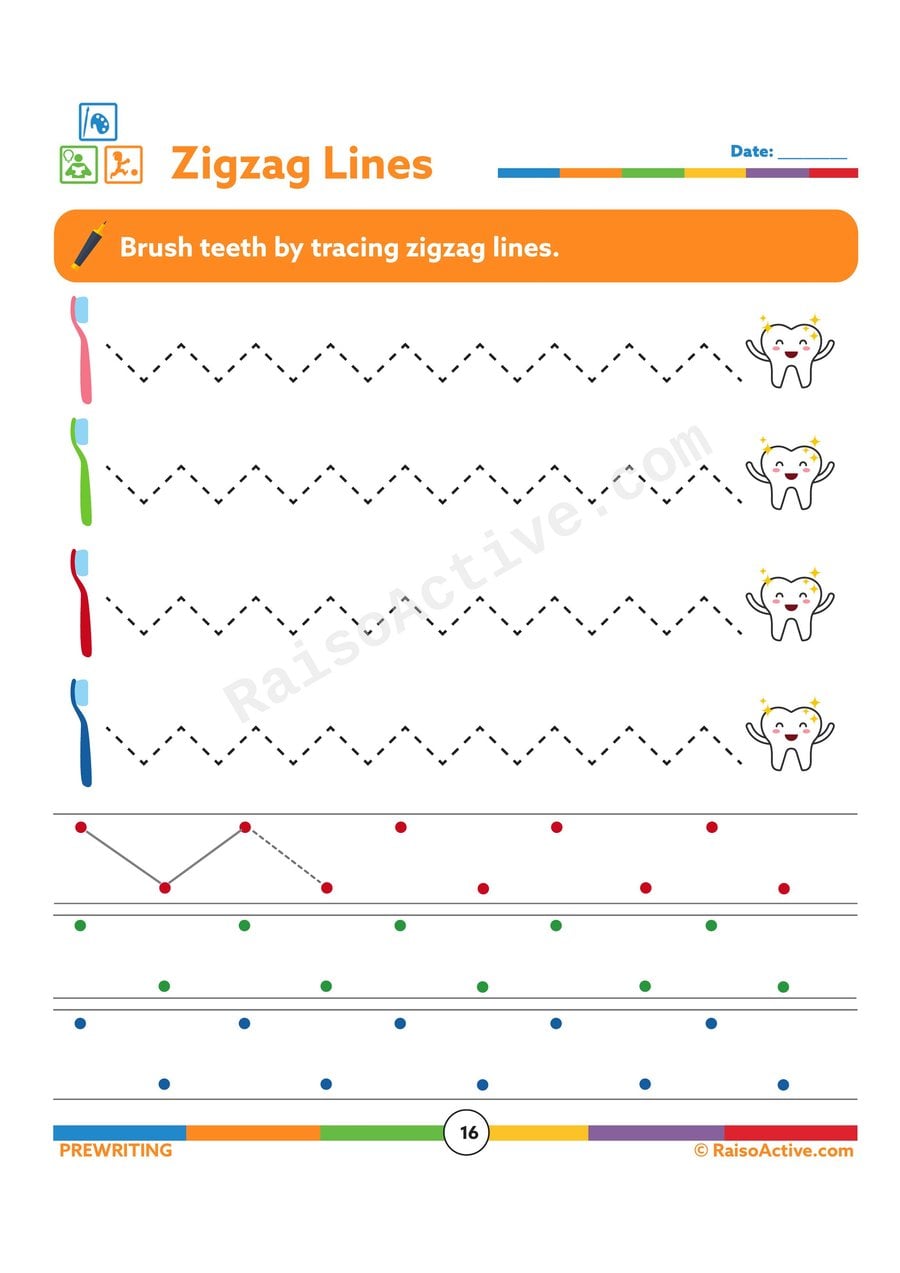
Zigzag Lines Tracing Worksheet: Brush Your Teeth!
Tracing a zigzag line representing a toothbrush's back-and-forth motion gives children ages 3-5 practice with sharp direction changes, a stroke pattern used in letters like Z, W, and M, while tying the abstract line shape to a real daily action, brushing teeth, they already understand. Zigzag lines are more demanding than smooth curves or straight lines because the pencil has to change direction abruptly and repeatedly rather than flowing continuously.

Letter E Tracing Worksheet for Preschoolers: Practice Writing the Letter 'e'
Tracing the tall, three-armed shape of uppercase E and the shorter horizontal strokes of lowercase e gives children practice with the left-to-right, top-to-bottom pencil movements that all English letters are built from. At ages 3-5, repeating this motion strengthens the finger and wrist muscles needed for a stable pencil grip, while saying the /e/ sound aloud connects the shape to a sound they'll need for reading.

Trace the Mixed Lines Worksheet: Help the Animals Find Their Babies!
This worksheet combines straight, curved, and zigzag lines on a single page, asking children ages 3-5 to trace whichever type of path connects each animal to its baby. Mixing line types in one activity is more demanding than a single-line-type worksheet because the hand has to switch motion patterns line by line, which builds flexibility in pencil control alongside early vocabulary about animal families, like cow and calf or cat and kitten.

Climb the Ladder: Pre-Writing Practice Worksheet for Kids
Tracing the rungs of a ladder gives children ages 3-5 focused practice with horizontal and vertical straight lines, the two most basic pencil strokes and the building blocks for letters like L, T, E, F, and H. Because a ladder has repeated, evenly spaced rungs, this worksheet also builds a sense of rhythm and spacing that carries over into writing letters at a consistent size later on.

Sight Word 'Away' Worksheet: Learn to Read and Write!
Like many high-frequency words, 'away' doesn't follow standard phonics rules cleanly, so children ages 3-5 need to build instant visual recognition of it as a whole sight word rather than sounding it out each time. This worksheet delivers that repetition through several varied tasks — coloring, tracing, word-hunting, sentence completion, and letter reassembly — which keeps a young learner engaged while reinforcing the same word from multiple angles. Strong sight-word recognition for common words like 'away' is one of the biggest accelerators of early reading fluency.

Beehive Tracing Worksheet: Help the Bees Find Their Home!
Tracing a path from bees to their beehive gives children ages 3-5 pencil control practice while introducing simple vocabulary about bees and where they live, building on the same kind of animal-and-home concept found in other themed tracing worksheets, but with a specific and recognizable structure, the hive. Following a winding or curved path toward a clear destination also builds visual tracking, the ability to follow a line's direction with the eyes before the pencil catches up.

My Family Worksheet: Learn About Family Members!
Writing the names of family members next to their pictures helps children ages 3-5 connect written words to real relationships in their own lives, combining early handwriting practice with meaningful, personal vocabulary. Because the content is about their own family, this worksheet tends to feel especially engaging and easy to talk about.
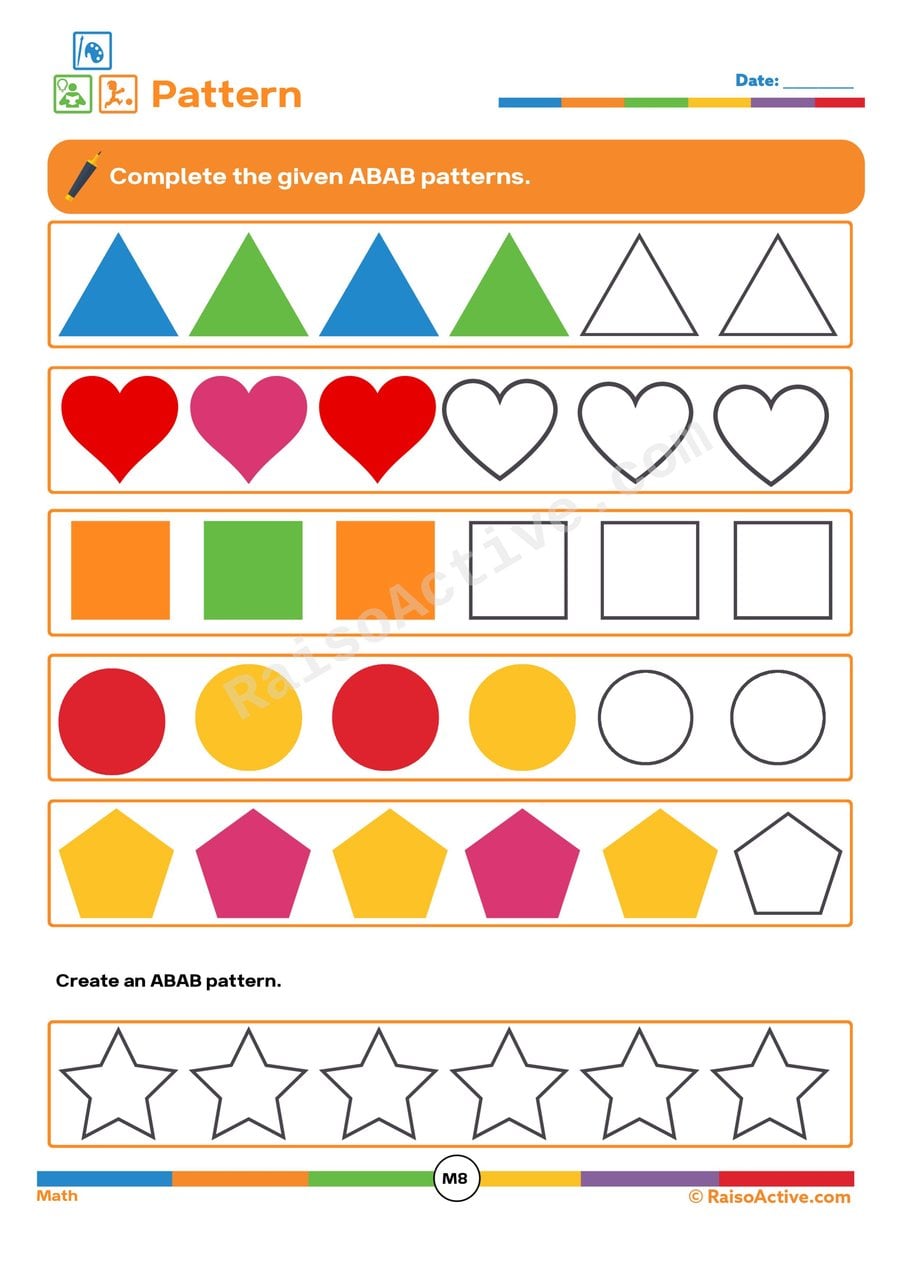
ABAB Pattern Fun: Complete the Shapes Worksheet!
This worksheet builds early algebraic thinking as children ages 3-5 identify and continue ABAB patterns using shapes and colors, then create a pattern of their own using stars. Recognizing that a pattern repeats in a predictable unit is a foundational math skill that later supports understanding sequences, multiplication, and logical prediction, making this simple shape activity more mathematically important than it might first appear.

Learn to Read: Sight Word 'Hear' Worksheet for Preschoolers
'Hear' is a sight word children ages 3-5 encounter often in early books, and its spelling doesn't clearly match its sound, so children need repeated exposure to recognize it instantly rather than sound it out each time. This worksheet reinforces the word through five different activities — coloring, searching, tracing, sentence completion, and cut-and-paste spelling — which research on early literacy shows builds much stronger retention than repeating a single format. Because 'hear' is often confused with the similar-sounding word 'here,' practicing it in full sentences also helps children start to notice the meaning difference between the two.

Letter T Tracing and Coloring Worksheet for Preschoolers
This worksheet helps children ages 3-5 build the fine motor control and directional awareness needed to form the letter T correctly, tracing both its uppercase and lowercase forms along guided dotted lines. Repeated tracing builds the muscle memory in small hand muscles that eventually allows children to write letters independently without a guide. Coloring pictures that begin with T and hunting for the letter in a grid also reinforce letter-sound and letter-shape recognition side by side.

Tracing and Counting Worksheet: Learning the Number 3!
This worksheet helps children ages 3-5 learn to recognize, trace, and write the number 3 using its correct stroke pattern, while a hands-and-ducks counting activity reinforces that the numeral 3 represents exactly three objects. Combining tracing with counting connects the written symbol to its real quantity, which is central to early number sense.
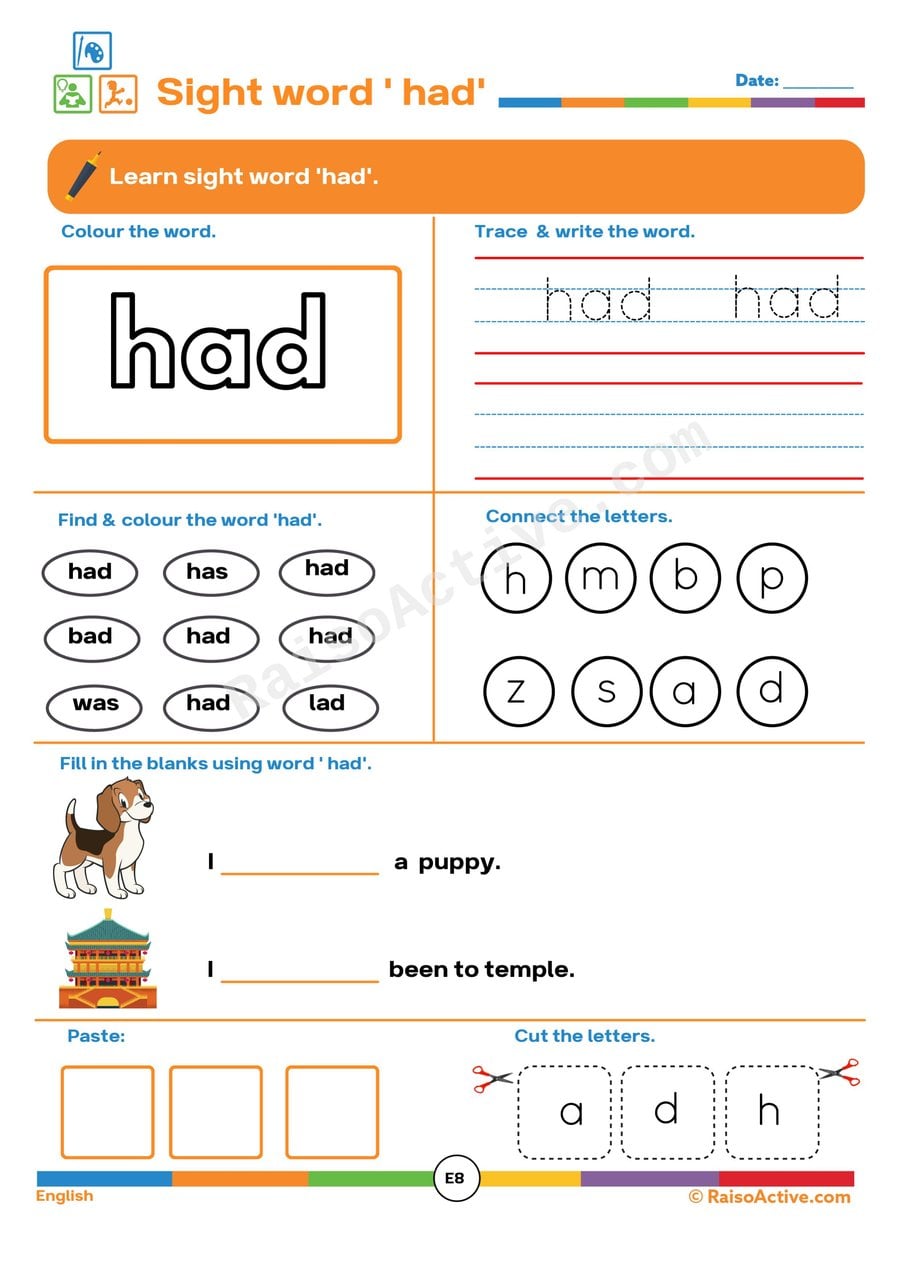
Sight Word 'had' Worksheet: Trace, Find, and Write!
This worksheet builds sight word recognition for the common word 'had' through multiple activities, tracing, finding it among similar words, connecting letters, and cutting and pasting, giving children repeated, varied exposure to the same high-frequency word. For ages 3-5, 'had' doesn't sound out in an entirely predictable way for beginning readers, so repeated whole-word recognition practice like this is especially valuable.
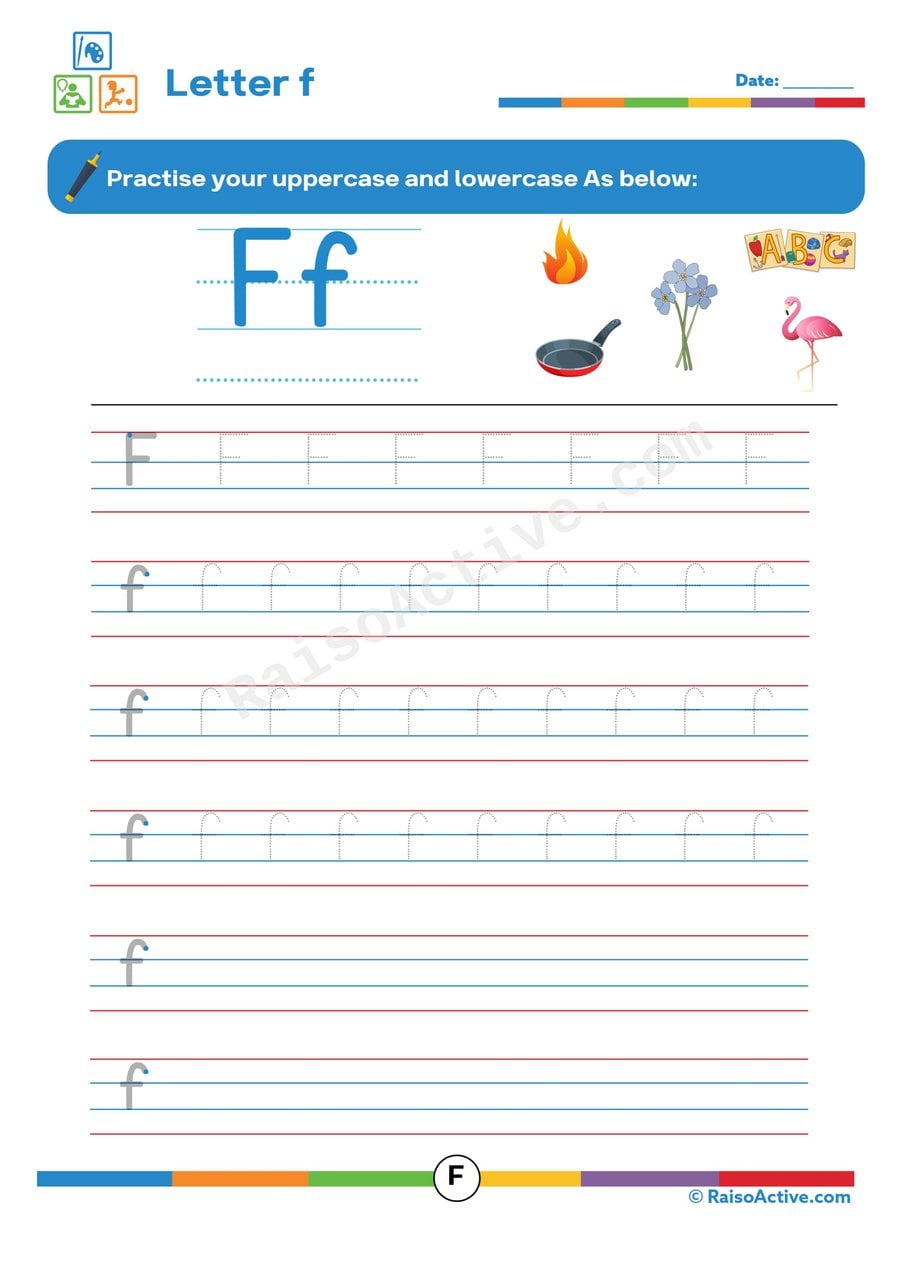
Fun Letter F Tracing Worksheet for Preschoolers
Forming the letter F asks children to draw one tall vertical line and then two separate horizontal strokes at different heights, which is a slightly more advanced motor sequence than simpler letters like L or T. Practicing both the uppercase F and lowercase f at ages 3-5 builds the stroke control and spatial judgment — knowing where the second horizontal line should sit lower than the first — that supports neat handwriting later on.
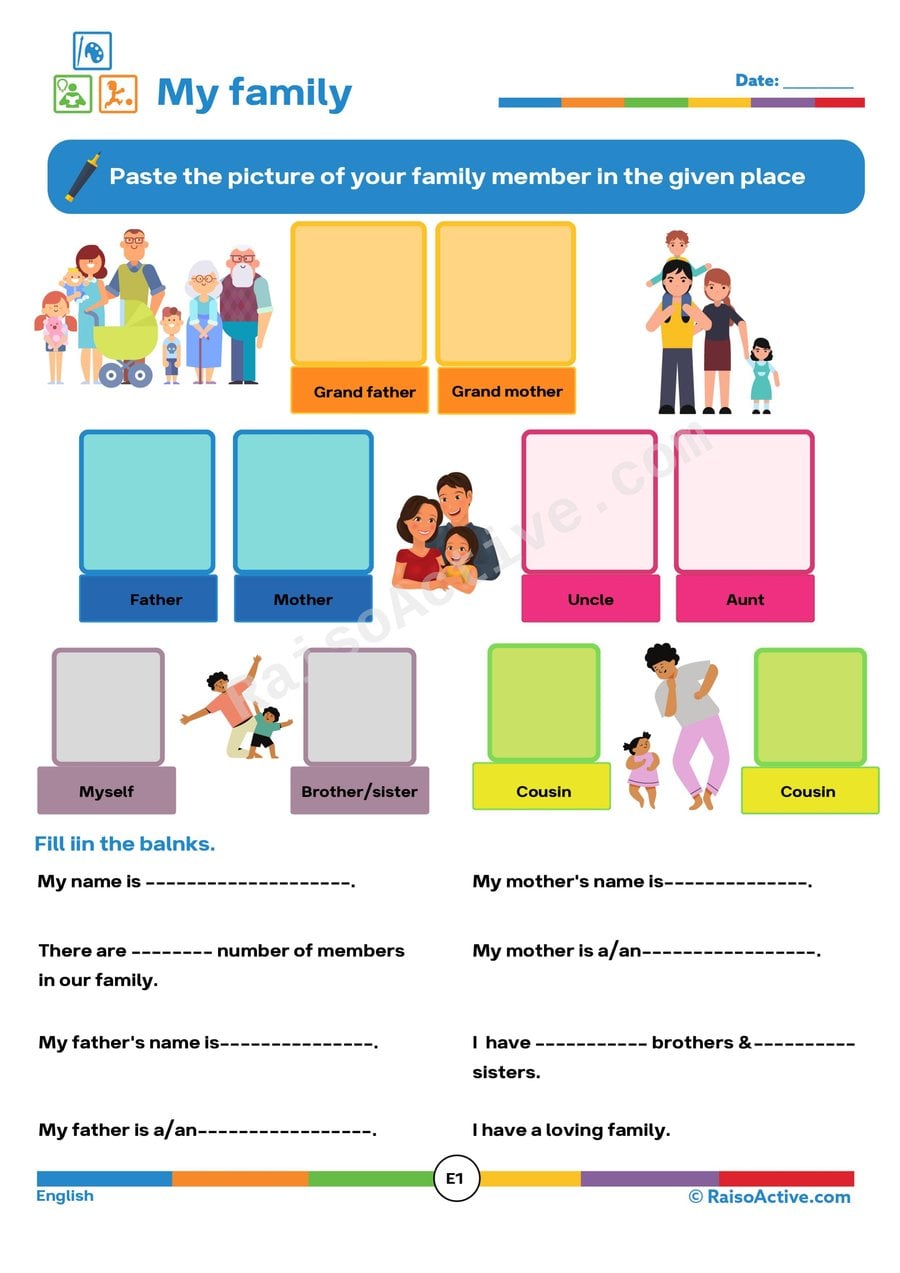
My Family Worksheet: Learn About Family Members!
Describing and pasting pictures of family members helps children practice using descriptive language about people they know well, building both vocabulary and an early sense of identity and belonging. For ages three to five, talking about family structure also introduces social-emotional vocabulary, since children learn to name relationships and describe why family matters to them.

Letter 'a' Tracing Worksheet: Practice Uppercase and Lowercase!
As the very first letter of the alphabet, lowercase a has a slightly tricky shape — a small circle with a short vertical line on the right — that looks quite different from its capital A counterpart, so tracing both forms together helps children notice that the same letter can look two different ways. Repeating this motion at ages 3-5 builds the curved-stroke control that many other lowercase letters, like d, g, and q, also depend on.

Trace and Color the Number 4 Worksheet for Preschoolers
This worksheet has children ages 3-5 trace the number 4, a shape combining two straight lines and one diagonal line meeting at a specific point, one of the more angular early numerals to master. Coloring exactly four apples afterward reinforces one-to-one correspondence and the specific quantity the numeral 4 represents. Because 4 has more distinct angles than the numbers before it, this worksheet continues building the precise pencil control needed for increasingly complex numerals.
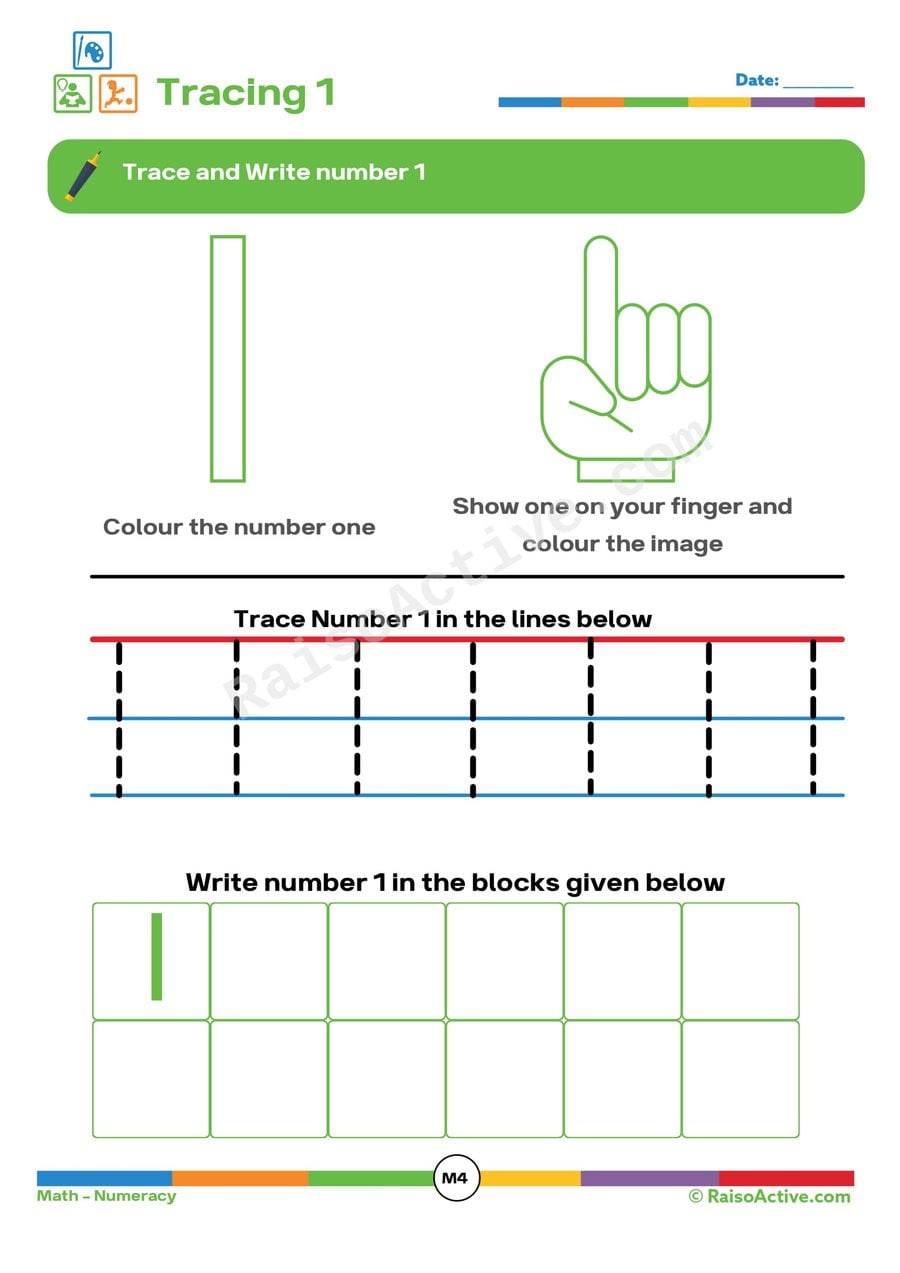
Tracing Number 1 Worksheet for Preschoolers
This tracing worksheet gives children ages 3-5 focused, repetitive practice forming the number 1 through tracing dotted lines, independent writing in provided boxes, and coloring an accompanying image, building the pencil control that precedes confident number writing. Because number 1 is typically the very first numeral children learn to write, getting the stroke direction and starting point correct here sets a strong foundation for writing higher numbers later. Repetition across multiple boxes on the page also builds the muscle memory needed for consistent, automatic number formation.

Trace the Curved Lines: Give Balloons to the Girls! Worksheet
This worksheet has children ages 3-5 trace curved balloon strings, practicing the rounded, flowing pencil motion needed later for letters like c, o, and s. Curved lines demand a different wrist and finger movement than straight lines, since the hand has to continuously adjust direction rather than pushing in one line, which makes this an important complement to straight-line tracing practice.

Trace and Write the Letter T Worksheet for Preschoolers
Tracing the uppercase letter T has children ages 3-5 practice one of the simplest two-stroke combinations in the alphabet, a vertical line crossed by a horizontal line at the top, which builds confidence with cross-stroke letters before tackling harder ones like F or X. Because T is a common letter in early reading and writing, mastering its formation supports a wide range of future words. The page also reinforces the /t/ sound heard in words like 'turtle,' 'toy,' and 'top.'
What Nursery handwriting worksheets cover
At three, handwriting is not letters yet; it is the strokes letters are made of. A child who has moved from a fist to holding a crayon with fingers can trace thick standing lines, sleeping lines and big circles, then copy them into an empty box. Worksheets should be wide, sparse and short. Tracing the child's own name in capitals is a fair stretch goal late in the year; forming letters from memory is not.
- Trace standing and sleeping lines with a thick crayon
- Copy a circle and a cross into an empty box
- Hold a short, chunky pencil with fingers rather than a fist
- Trace the first letter of own name in a large capital
How to use these worksheets at home or in class
A single sheet a day, five to ten minutes, suits a three-year-old best. Sit alongside your child rather than opposite, demonstrate one stroke, then let them attempt it themselves, praising the try rather than the neatness of the line.
Start with the sheet that matches what your child can already do, then move one step up. Keep finished sheets in a folder: Nursery teachers often ask for evidence of practice, and children like seeing their own progress.
Is your child ready for Nursery handwriting work?
Readiness shows up as a proper crayon grip with fingers instead of a fist, purposeful scribbling, sitting through a short task and following one spoken instruction such as pointing to a colour. Without these, stick to sticker play and large colouring pages for now.
Frequently asked questions
Should a three-year-old be practicing letters?
Not formally. A three-year-old's hand is still learning to steer a crayon, and letter sheets at this age tend to produce letters drawn as pictures, from the bottom up or with a cramped grip that then has to be unlearned. Strokes, shapes and the first letter of the child's name are enough. Playdough, tearing paper, threading and drawing on a vertical easel build the hand strength that letters will need at four.
What should a Nursery child be able to do in handwriting?
At three, handwriting is not letters yet; it is the strokes letters are made of. A child who has moved from a fist to holding a crayon with fingers can trace thick standing lines, sleeping lines and big circles, then copy them into an empty box. Worksheets should be wide, sparse and short. Tracing the child's own name in capitals is a fair stretch goal late in the year; forming letters from memory is not. Readiness shows up as a proper crayon grip with fingers instead of a fist, purposeful scribbling, sitting through a short task and following one spoken instruction such as pointing to a colour. Without these, stick to sticker play and large colouring pages for now.
Do these worksheets follow the Nursery curriculum?
The sheets cover consistent letter formation, sizing and spacing letters on a line, joining letters for cursive and legible sentence writing, which sit inside the NEP 2020 Foundational Stage (NCF-FS 2022) outcomes for Nursery. Preschool (US), Nursery (UK) use the same skills at this age, so the sheets also fit families following those programmes.
Are the Nursery handwriting worksheets free to download?
Yes. Every sheet on this page can be downloaded free as a watermarked PDF after creating an account, up to five downloads a day. The annual membership (₹1000) removes the watermark and the daily limit across the full library of more than 1,000 worksheets and all activity packs.

Written by
Hemsweta Jain · Teacher Cheena
MBA and Early Childhood Educator, teaching since 2014 · Founder of RaisoActive, Mumbai
Written and reviewed by Hemsweta Jain (Teacher Cheena), who designs every RaisoActive worksheet.
Last reviewed
Printable packs for ages 3–4
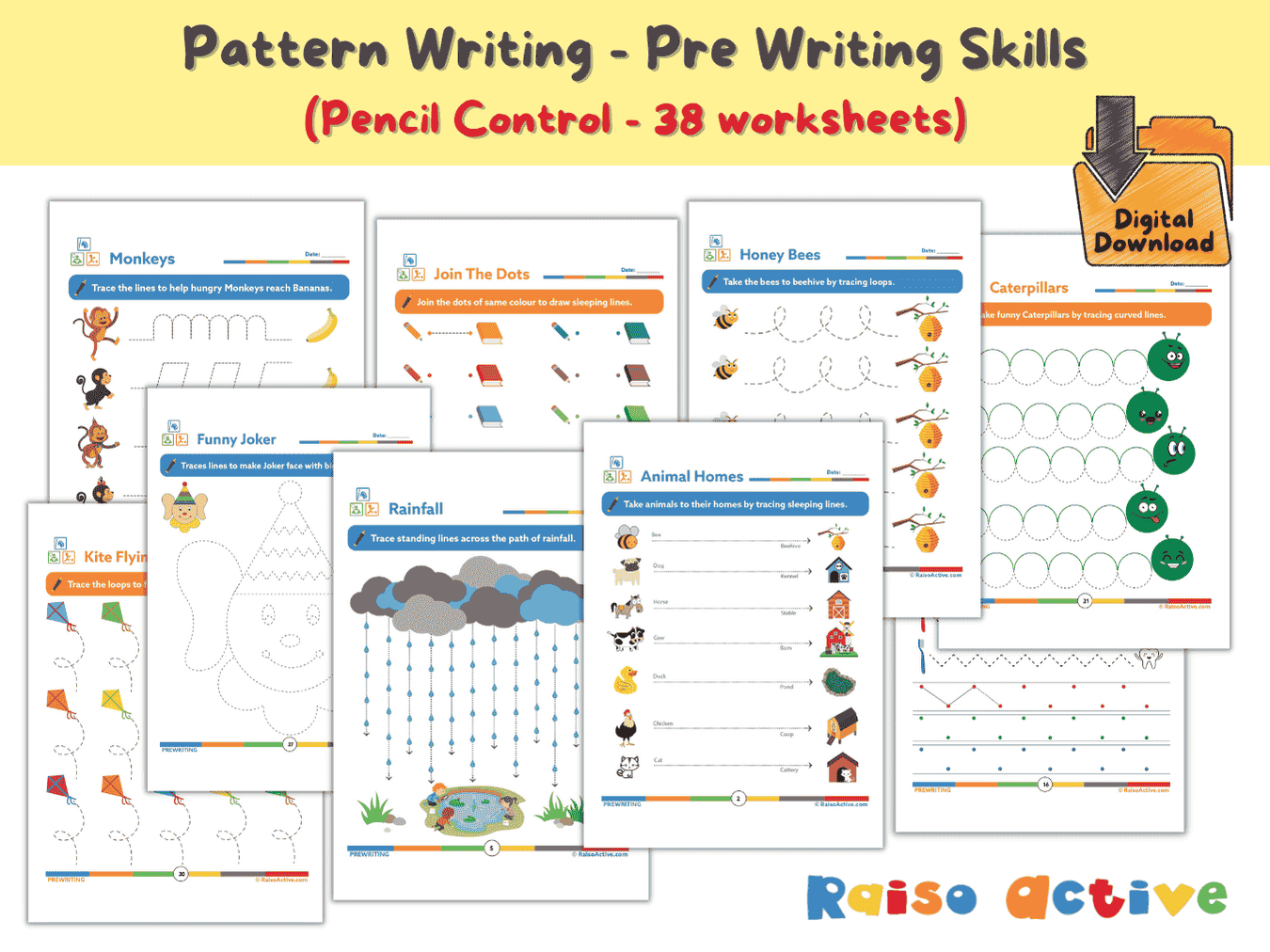
Pattern Writing Pre-writing Skills Activity Book for 3-4 Year Olds
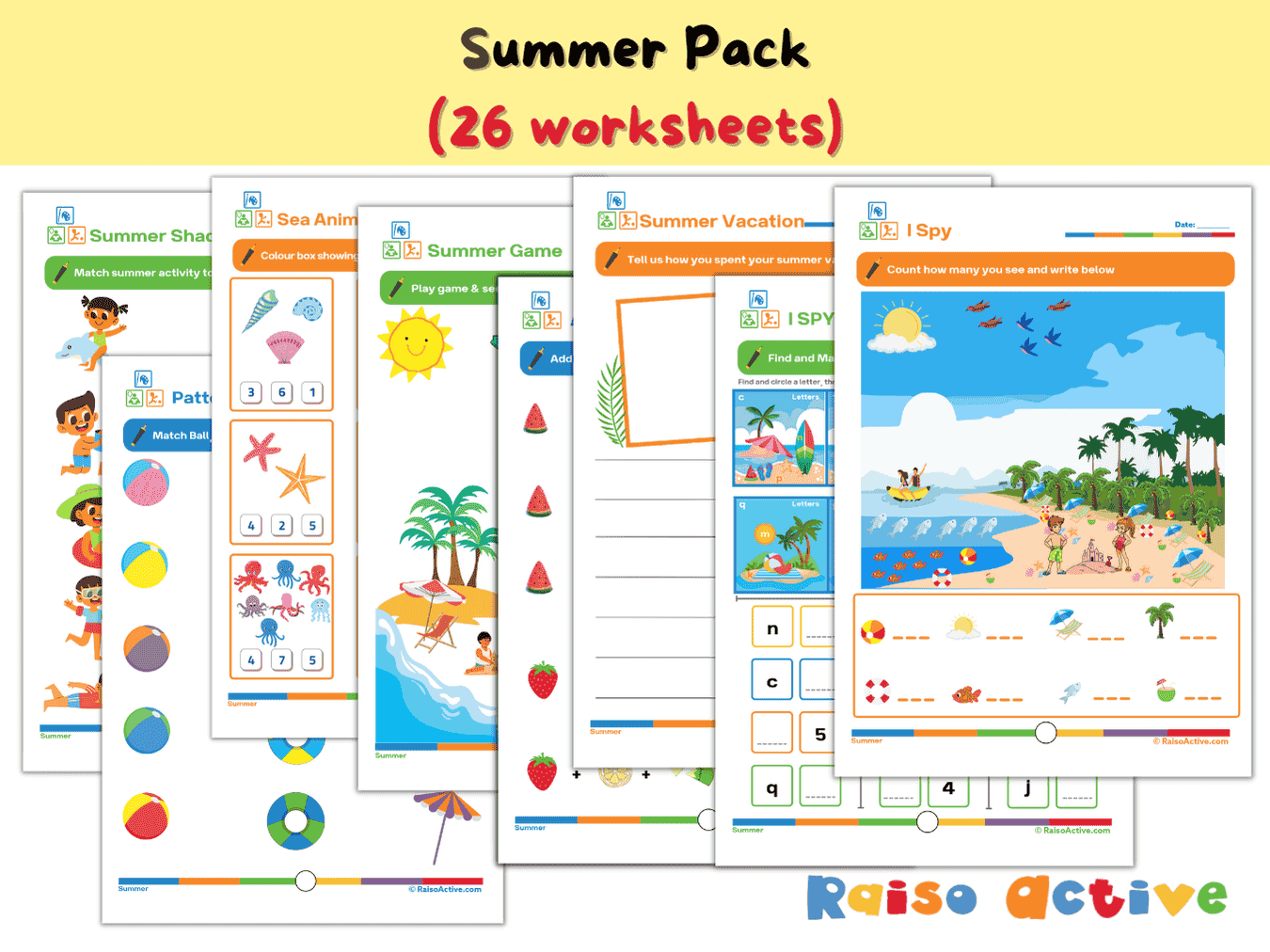
Summer Activity Pack: Math, Literacy, Puzzles & More for Preschool & Kindergarten
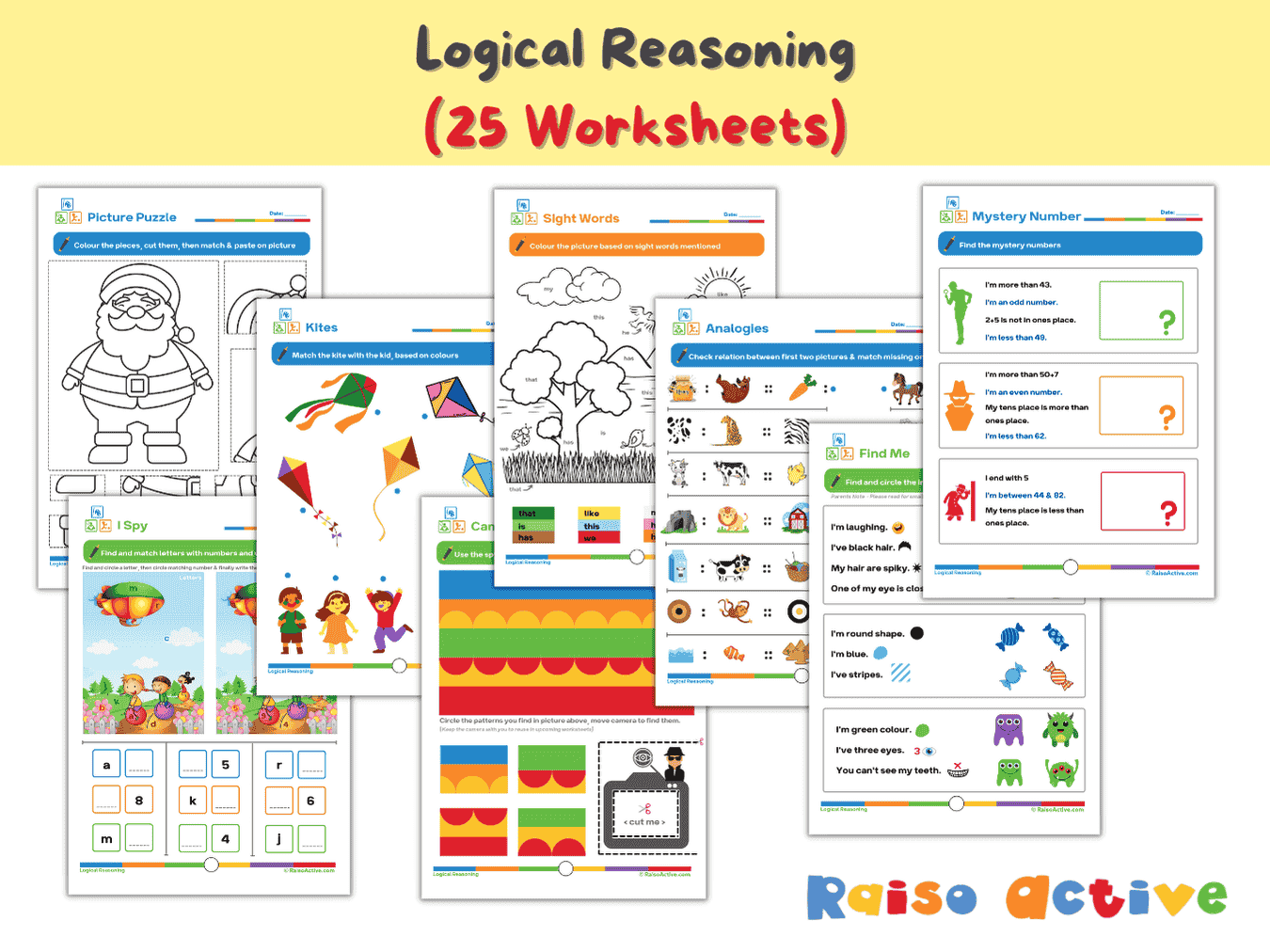
Logical Reasoning Activity Book for Preschool & Kindergarten | Patterns, Puzzles & Analogies
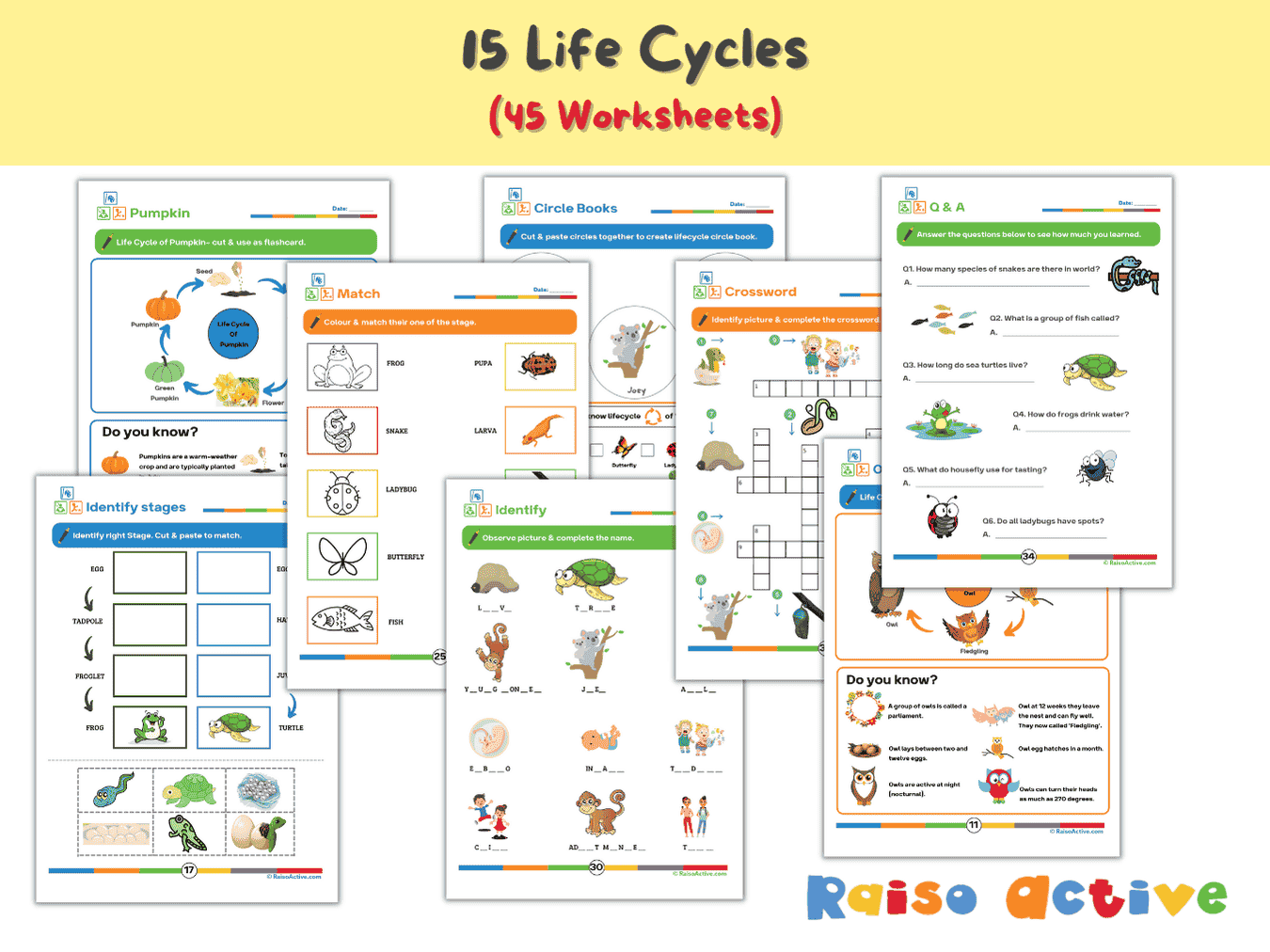
Lifecycles Activity Book & Flashcards for Preschool & Early Elementary
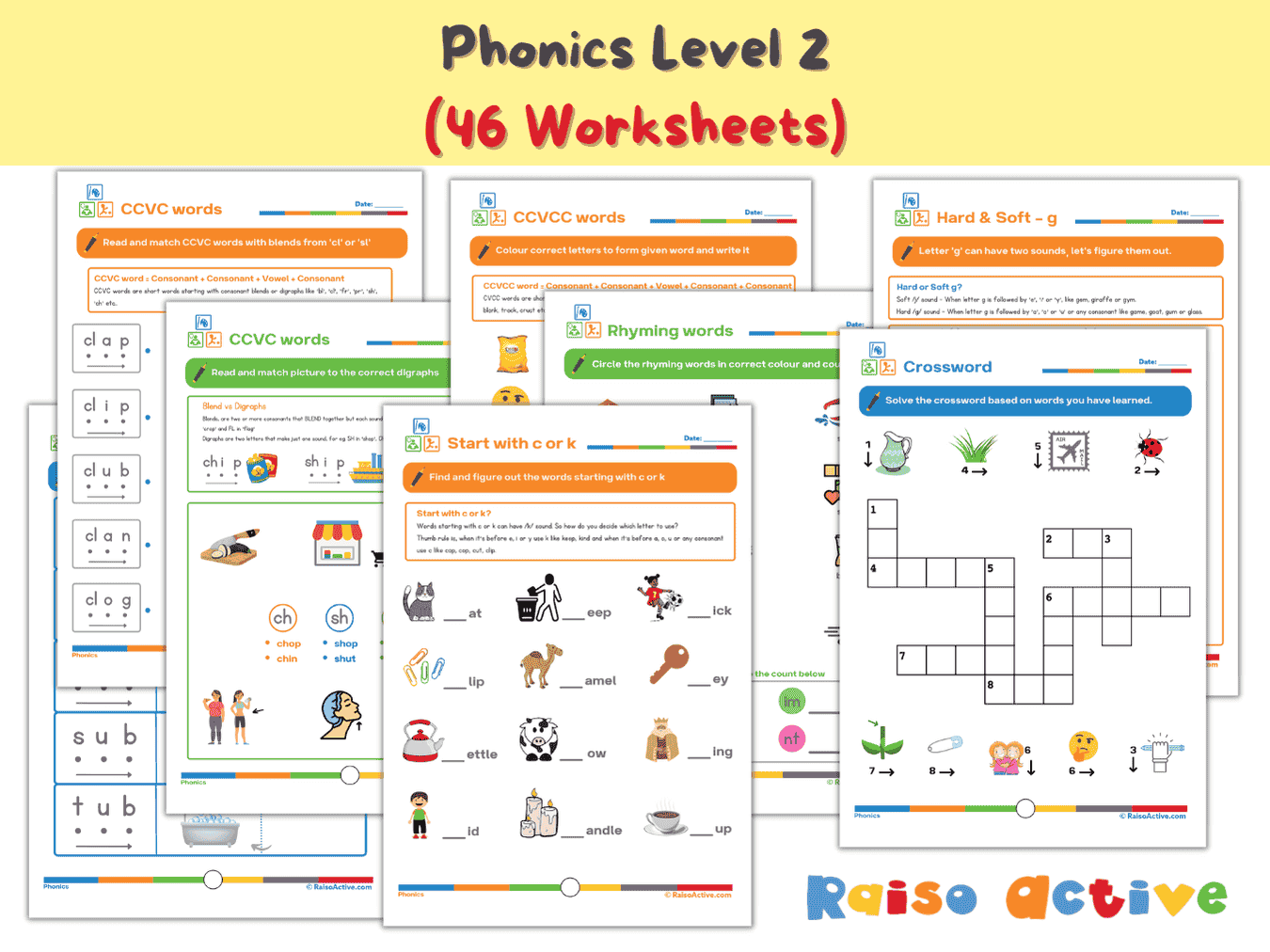
Phonics Level 2 Worksheets: CVC, CCVC, CVCC Word Families & Blends for Early Readers (Ages 4-7)
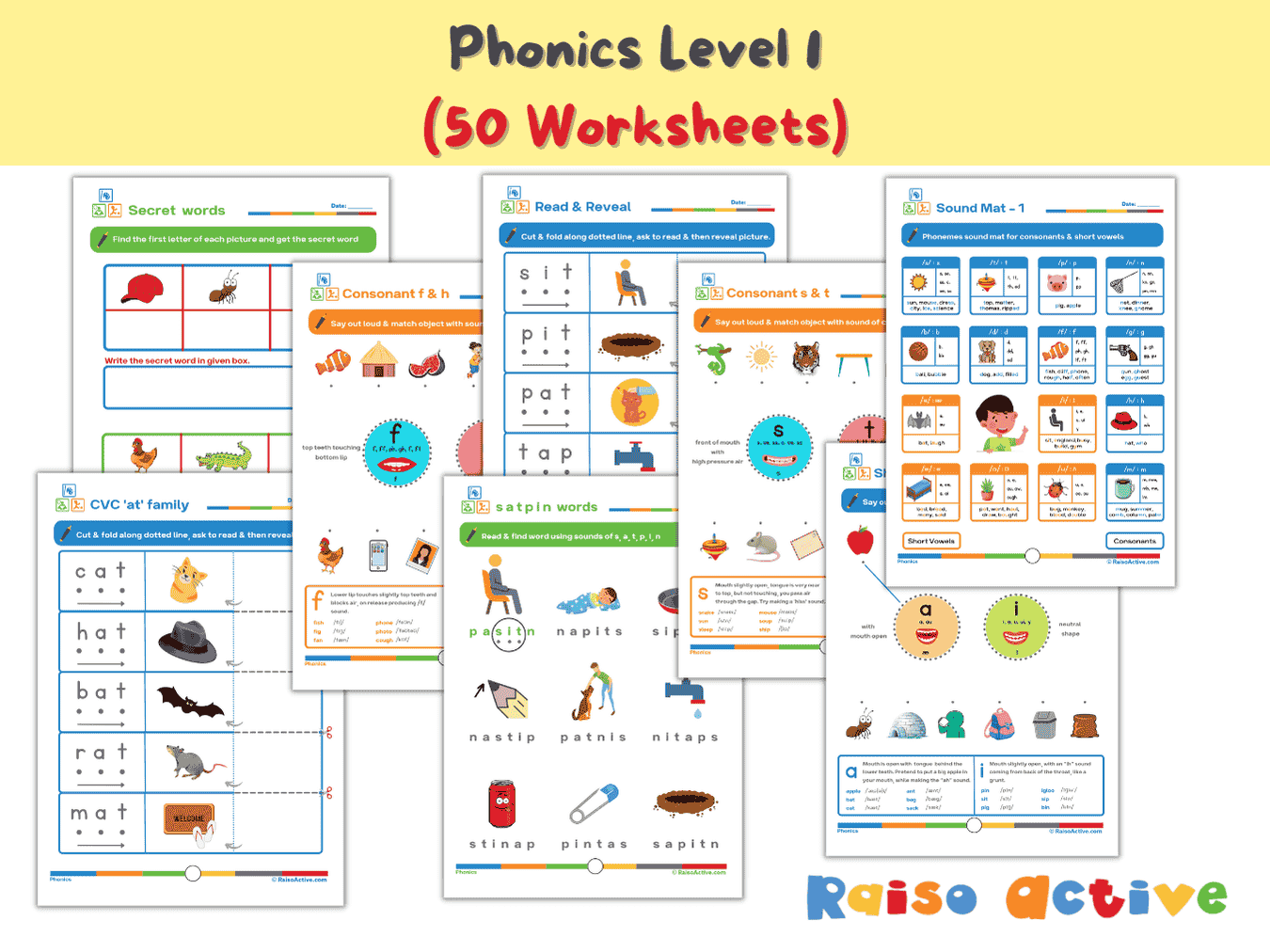
Phonics Level 1 Activity Book: Letter Sounds, Blending & CVC Words for Preschool & Kindergarten
Guides for parents and teachers
See all guides →Number Formation Rhymes 0–9 and How to Fix Reversals
Original number formation rhymes for 0–9, the correct stroke order for each digit, why 3, 5 and 7 get reversed most often, and multisensory fixes that work.
Pre-Writing Strokes in Order: From Standing Lines to Loops (With Printable Patterns)
The developmental order of pre-writing strokes, from vertical lines to loops, and why practicing them in sequence makes letter formation much easier to learn.
Kindergarten Readiness Checklist: 25 Skills to Practice Before the First Day
A kindergarten readiness checklist of 25 literacy, math, motor, self-regulation and self-help skills, with an 8-week summer plan and notes on when not to worry.
Best Worksheets for 3-Year-Olds: What Works and What to Avoid
What works on worksheets for 3-year-olds: short sessions, crayons, tracing lines, matching, cutting, a free weekly plan, and signs one is too advanced.
Reception Year Explained: EYFS Learning and How to Help at Home
A teacher's plain-English guide to the Reception Year: the seven areas of learning, Early Learning Goals, Phase 2/3 phonics, the RBA and home routines.
What Should a 4-Year-Old Know Before LKG? A Readiness Checklist
A calm, teacher-written LKG readiness checklist for 4-year-olds: language, pattern writing, numbers to 10, self-help and social skills, plus a 6-week plan.
Canonical: https://raisoactive.com/worksheets/nursery-handwriting