Number Tracing Worksheet 1-20: Practice Writing Numbers!
This worksheet gives children ages 3-5 a second full pass at tracing every number from 1 to 20, repeating the entire sequence to build the muscle memory that comes only from writing each numeral more than once. Revisiting the complete range reinforces both the shape of each number and their order in the counting sequence, helping children internalize the pattern rather than relying on the worksheet as a one-time reference. This repetition matters especially for the trickier two-digit numbers in the teens, which often need more practice than single digits.
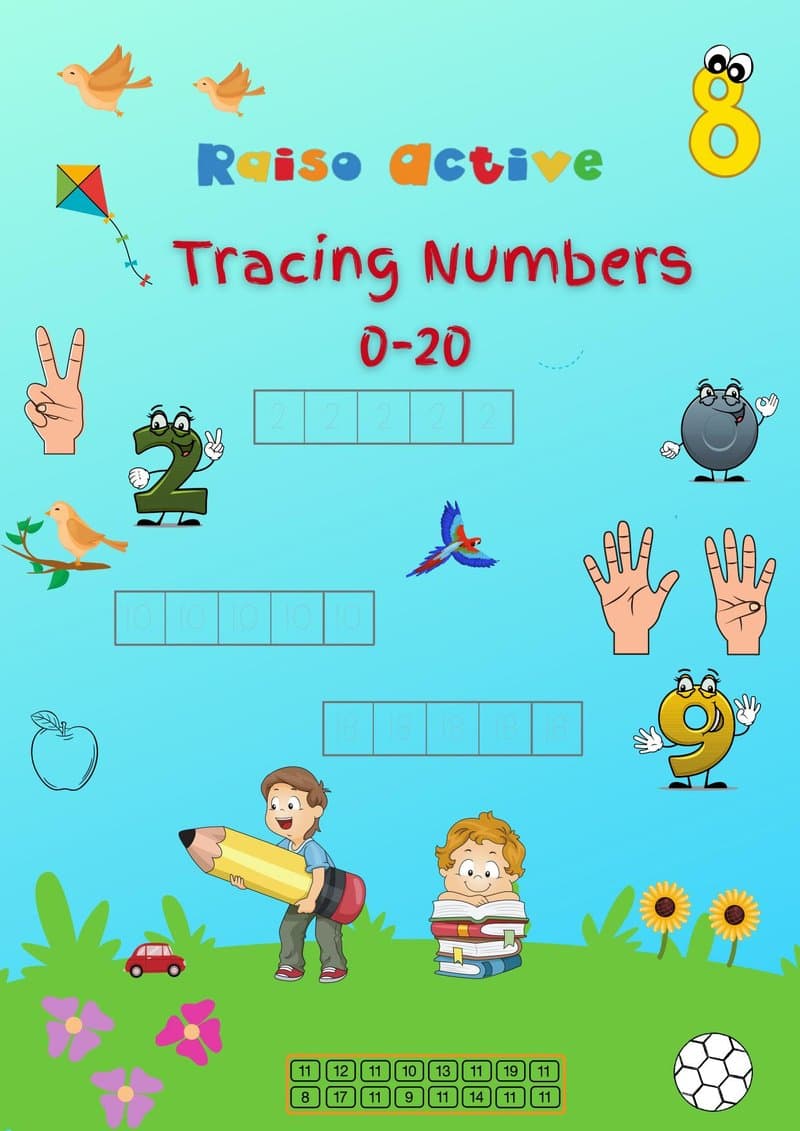
Part of the pack
Number Tracing & Counting Activity Book 0-20 for Preschool & Kindergarten
This is page 24 of the pack. Ages 3-6 · Preschool–KindergartenAges 3-6 · Nursery–Year 1Ages 3-6 · Nursery–UKGAges 3-6
Made for your child
Counting to 10, made for your child
A maths pack with your child's name in it: pictures that explain, practice at three levels, puzzles and story sums about them. Print a new set whenever they finish.
Make a maths packFree preview · free for members
Curriculum
- Number Sense > Counting 1-20
How to use this worksheet
Starting at 1, work through the boxes in order, having your child trace each dotted number while following the directional arrows for each stroke. Encourage your child to say each number aloud as they trace it, connecting the written symbol to its spoken name. If a particular number feels shaky, pause and let them trace it an extra time or two before moving on, then celebrate reaching 20 at the end of the page.
Materials needed
- Pencil
- Crayons
Extension activities
- 1Have your child write a few numbers from memory, without the dotted guide, to see how independent they're becoming.
- 2Count a set of household objects and write the matching number beside them.
- 3Play a quick game where you say a number and your child races to point to it on the page.
- 4Practice counting backward from 20 to 1 as a new challenge after finishing the tracing.

Written by
Hemsweta Jain · Teacher Cheena
MBA and Early Childhood Educator, teaching since 2014 · Founder of RaisoActive, Mumbai
Every RaisoActive worksheet is designed and checked by the founder before publishing.
Published · Last reviewed
More from Number Tracing & Counting Activity Book 0-20 for Preschool & Kindergarten

Trace the Number 3 and Color the Balls! - Number Tracing Worksheet
Ages 3-5 · Preschool–Pre-KAges 3-5 · Nursery–ReceptionAges 3-5 · Nursery–LKGAges 3-5
This worksheet has children ages 3-5 trace the number 3, a shape built from two connected curves, which is more complex than the numbers 1 and 2 and continues building fine motor precision. Coloring exactly three balls after tracing reinforces one-to-one correspondence and the specific quantity the numeral 3 represents. Practicing curved numerals like 3 also prepares children for other rounded numbers they'll encounter soon, such as 8.

Trace and Count the Number 16 Worksheet for Preschoolers
Ages 4-5 · Pre-KAges 4-5 · ReceptionAges 4-5 · LKGAges 4-5
This worksheet has children ages 4-5 trace the two-digit number 16 and then count and color a full set of sixteen squares, continuing to build counting stamina in the teens range that many children find more challenging than counting to 10. Because 16 combines a 1 and a 6, tracing it reinforces the same two-digit writing pattern practiced with numbers like 11 through 15, helping children generalize the pattern rather than treating each teen number as entirely new. Counting squares instead of round objects also quietly introduces basic shape vocabulary.

Trace and Count: Number 6 Worksheet for Preschoolers
Ages 3-5 · Preschool–Pre-KAges 3-5 · Nursery–ReceptionAges 3-5 · Nursery–LKGAges 3-5
This worksheet has children ages 3-5 trace the number 6, a shape built from a curved line ending in a small loop, and then count and circle exactly six cars from a larger group. Because the group likely contains more than six cars, children must count carefully and stop at the right quantity, building the more precise counting skill of selecting a specific amount rather than counting everything in sight. The curved, looping shape of 6 also previews the stroke pattern used in numbers like 8 and 9.

Number Tracing Worksheet 1-20: Practice Writing Numbers!
Ages 3-5 · Preschool–Pre-KAges 3-5 · Nursery–ReceptionAges 3-5 · Nursery–LKGAges 3-5
This worksheet has children ages 3-5 trace every number from 1 to 20 in sequence, giving them a single, comprehensive review of number formation across the entire range they're expected to master before kindergarten. Practicing the full sequence in one sitting, rather than one number at a time, also reinforces the order of the counting sequence itself, since children see each number in its proper place relative to the ones before and after it. Following directional arrows throughout builds the habit of starting every numeral in the correct place.

Number Tracing Worksheet: Trace and Find the Number 11!
Ages 3-5 · Preschool–Pre-KAges 3-5 · Nursery–ReceptionAges 3-5 · Nursery–LKGAges 3-5
This worksheet introduces children ages 3-5 to their first two-digit number, helping them understand that 11 is written with two number 1s placed side by side rather than as a brand-new symbol. Tracing 11 builds the pencil control needed to write two digits neatly in a row, while the search-and-find grid strengthens visual scanning skills as children pick 11 out from a field of similar-looking numbers. This combination supports both number recognition and the beginning of place-value thinking.

Number Tracing Worksheet: Trace and Count the Number 20!
Ages 4-5 · Pre-KAges 4-5 · ReceptionAges 4-5 · LKGAges 4-5
This worksheet has children ages 4-5 trace the number 20, a milestone number that marks the top of the common preschool counting range, and then count and color a full set of twenty pentagons. Reaching and confidently counting to 20 shows that a child has built solid one-to-one correspondence across an extended set, a skill they'll rely on heavily once they begin adding and subtracting in early math. Counting pentagons instead of simpler shapes also gives a light introduction to five-sided shapes.
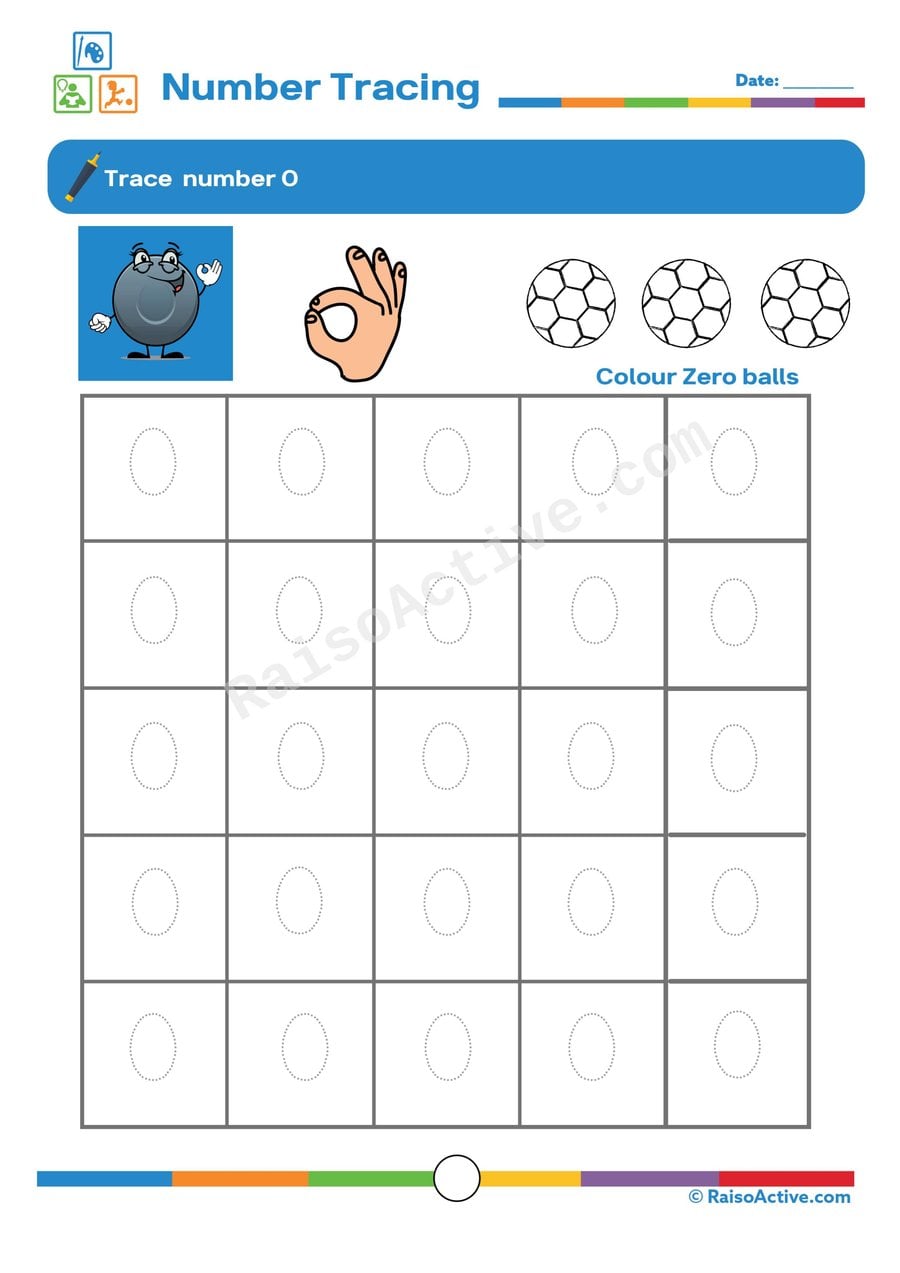
Trace the Number 0 Worksheet for Preschoolers
Ages 3-5 · Preschool–Pre-KAges 3-5 · Nursery–ReceptionAges 3-5 · Nursery–LKGAges 3-5
This worksheet introduces children ages 3-5 to the number 0, an abstract and often confusing concept since it represents the absence of a quantity rather than a countable group of objects. Tracing the closed loop of 0 builds the same round pencil control practiced with letters like O, while the coloring task, which asks children to color zero balls, gently introduces the idea that zero means none at all. This early exposure to zero as a real number lays groundwork for understanding it fully in later math.
Practice Grid Worksheet for Early Learners
Ages 3-5 · Preschool–Pre-KAges 3-5 · Nursery–ReceptionAges 3-5 · Nursery–LKGAges 3-5
This blank practice grid gives children ages 3-5 an open space to build the pencil control that underlies all future handwriting, without the pressure of forming a specific letter or number correctly. Drawing lines, shapes, and marks within the boundaries of each grid square strengthens the small hand muscles and hand-eye coordination needed before children are ready for structured letter formation. Because the grid has no single correct answer, it also gives adults a low-stakes way to see how a child currently controls a pencil.
Related worksheets
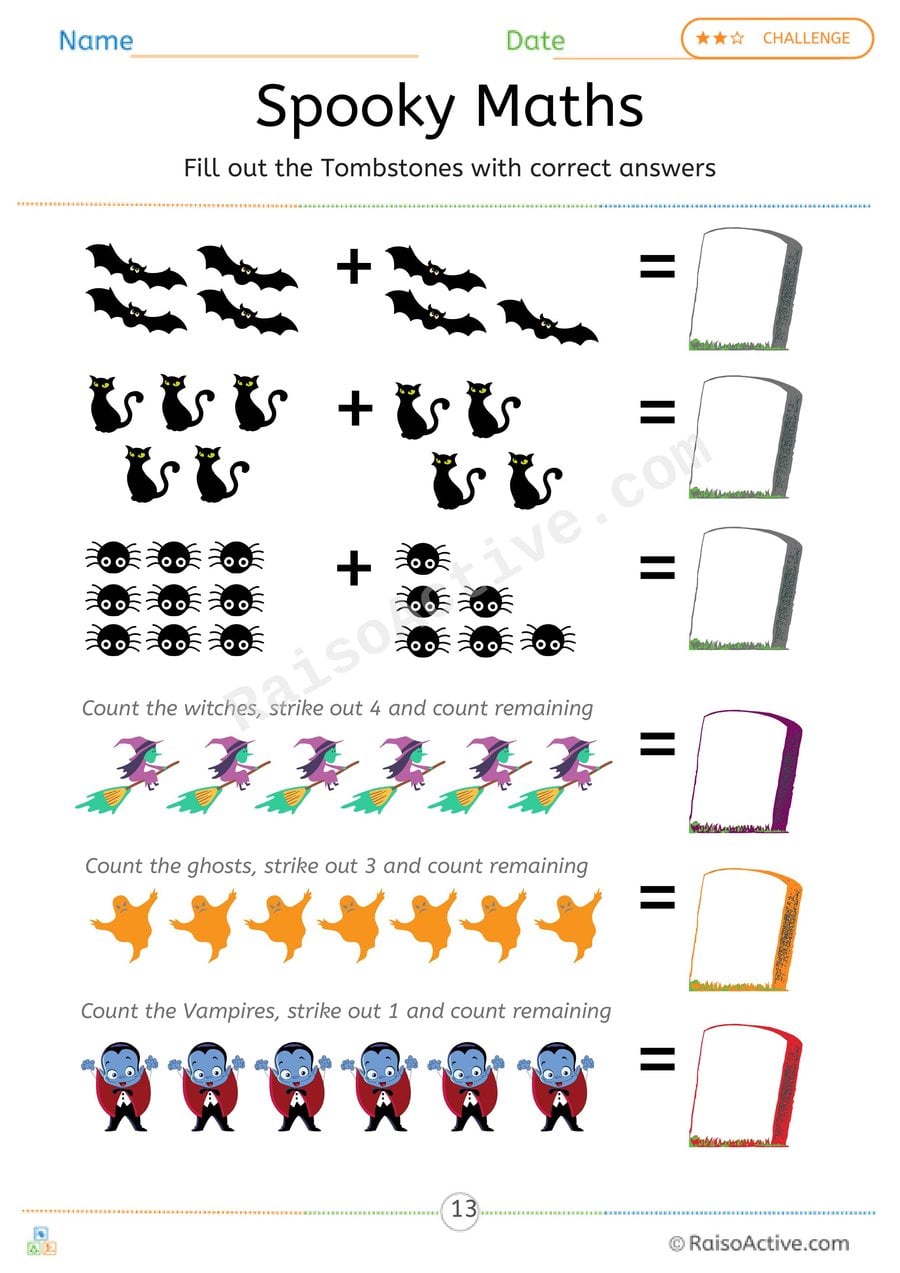
Spooky Math Worksheet: Halloween Counting Fun!
Ages 4-5 · Pre-KAges 4-5 · ReceptionAges 4-5 · LKGAges 4-5
This Halloween math worksheet has children ages 4-5 count grouped pictures and then solve simple addition and subtraction problems, moving from concrete counting toward the more abstract skill of combining or taking away quantities. Writing each answer inside a tombstone shape keeps the seasonal theme playful while practicing genuine early arithmetic.
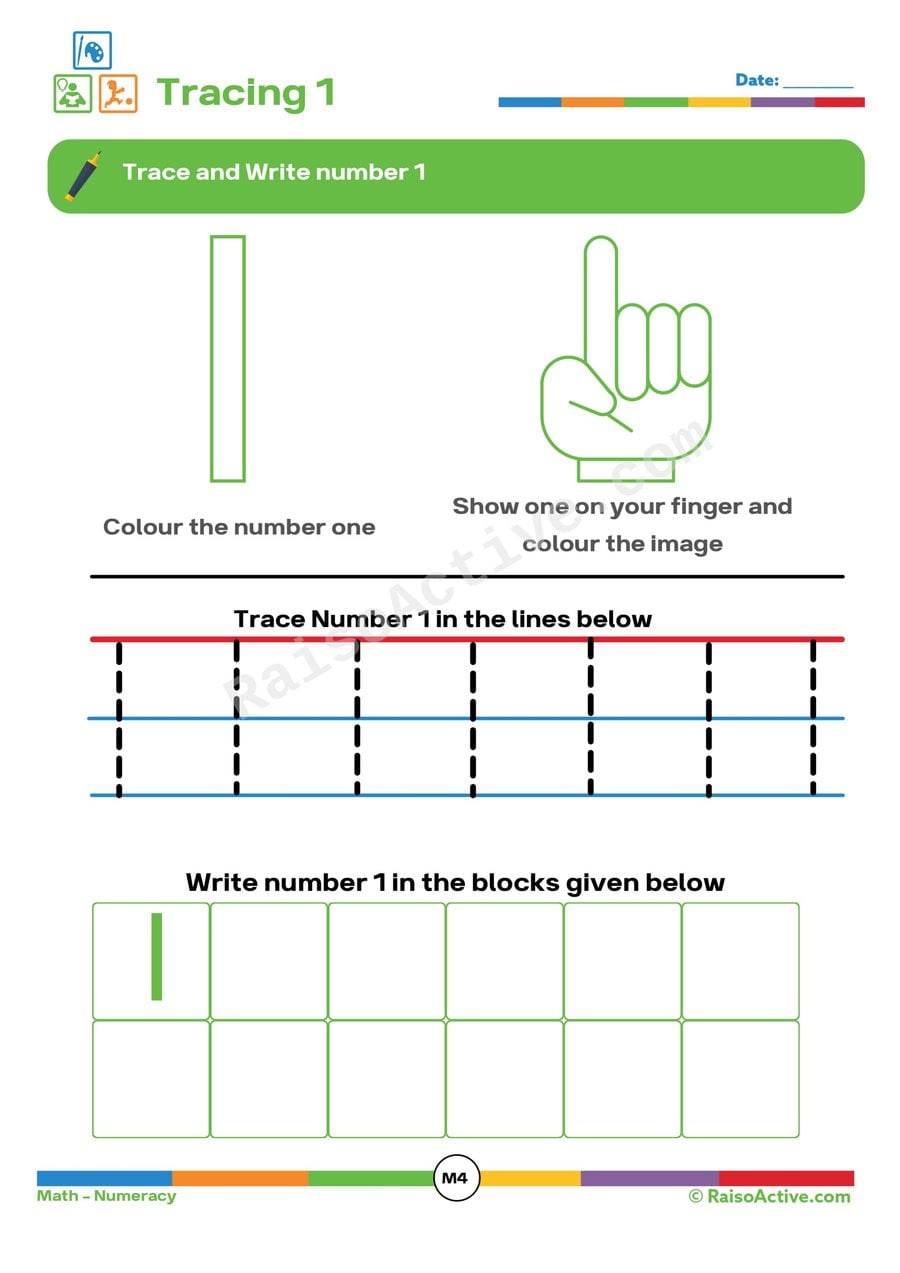
Tracing Number 1 Worksheet for Preschoolers
Ages 3-5 · Preschool–Pre-KAges 3-5 · Nursery–ReceptionAges 3-5 · Nursery–LKGAges 3-5
This tracing worksheet gives children ages 3-5 focused, repetitive practice forming the number 1 through tracing dotted lines, independent writing in provided boxes, and coloring an accompanying image, building the pencil control that precedes confident number writing. Because number 1 is typically the very first numeral children learn to write, getting the stroke direction and starting point correct here sets a strong foundation for writing higher numbers later. Repetition across multiple boxes on the page also builds the muscle memory needed for consistent, automatic number formation.

Missing Numbers: Ice Cream Fun Worksheet for Kids
Ages 3-5 · Preschool–Pre-KAges 3-5 · Nursery–ReceptionAges 3-5 · Nursery–LKGAges 3-5
This worksheet helps children ages 3-5 practice number sequencing by identifying and writing in the missing numerals within a series of ice cream cones and cars, numbers 1 through 10. Filling in a gap within an otherwise familiar sequence requires children to hold the whole counting order in mind and recognize what number logically belongs in the empty spot, which is more demanding than counting forward from the start each time. The playful ice cream and car theme keeps the repeated number practice visually engaging.

Number Names Worksheet: Addition Practice for Kids
Ages 4-6 · Pre-K–KindergartenAges 4-6 · Reception–Year 1Ages 4-6 · LKG–UKGAges 4-6
This worksheet combines addition practice with number-word writing for children ages 4-6, asking them to solve simple addition problems and then spell out the answer using its written name rather than a numeral. Requiring the answer in word form pushes children beyond calculation into applying number vocabulary correctly, reinforcing that 'seven' and '7' represent the same value. This dual task builds both math fluency and early spelling skills together.
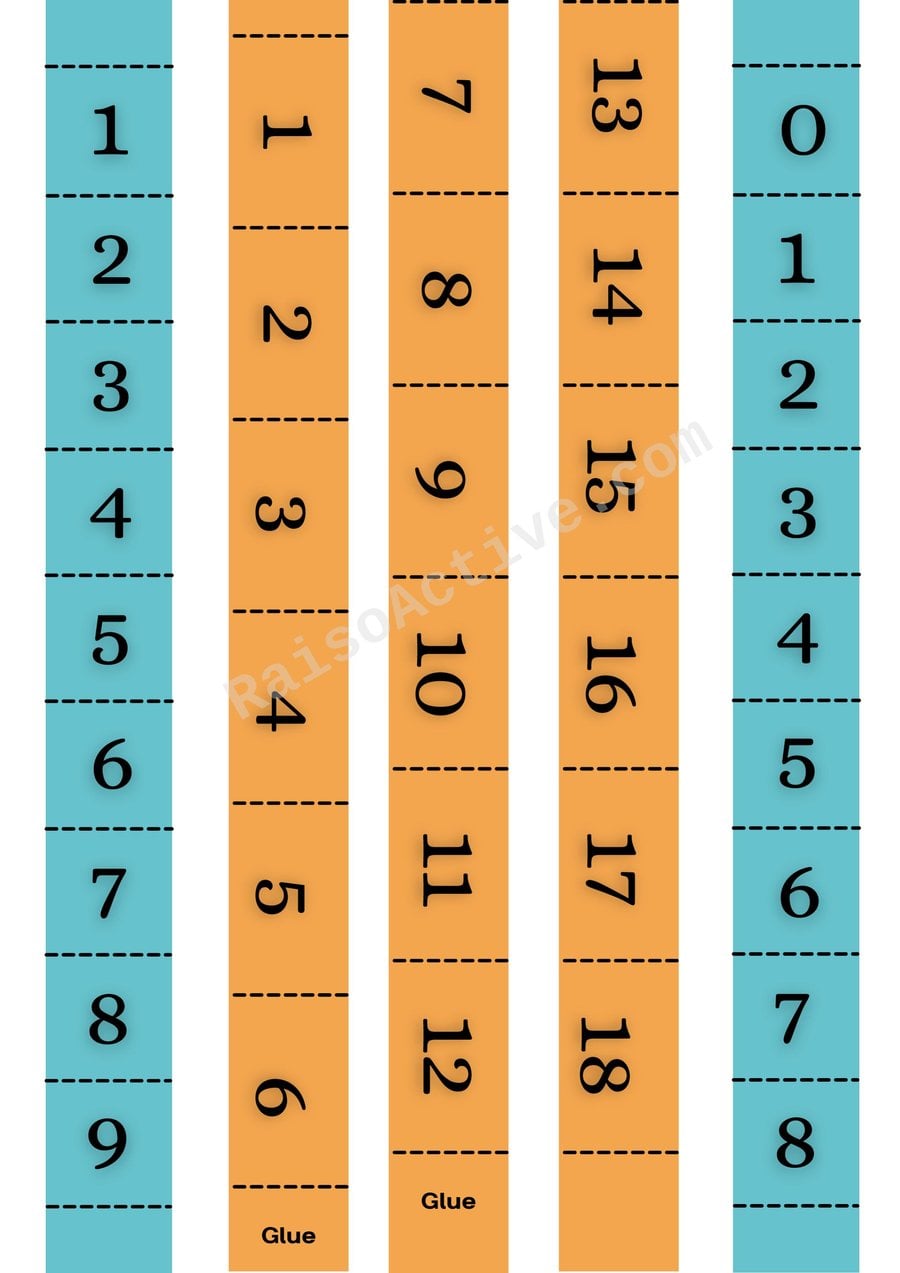
Number Matching Worksheet: 0-18
Ages 3-5 · Preschool–Pre-KAges 3-5 · Nursery–ReceptionAges 3-5 · Nursery–LKGAges 3-5
This activity strengthens numeral recognition for children ages 3-5 by having them find and pair matching numbers from 0 to 18 printed on separate strips. Because the numbers are scattered rather than in order, children must recognize each digit shape on its own rather than relying on counting sequence, which builds true number recognition instead of rote list-reciting.

Number Names Matching Worksheet for Preschoolers
Ages 3-5 · Preschool–Pre-KAges 3-5 · Nursery–ReceptionAges 3-5 · Nursery–LKGAges 3-5
This worksheet helps children ages 3-5 connect written number names, like 'three' or 'seven,' to the numeral they represent, an important step beyond simply recognizing digits since it introduces reading actual number words. Decoding a color clue to figure out and write each number name first adds an extra layer of visual attention before the matching step even begins.

Tell the Time Worksheet: Clock Reading Practice for Kids
Ages 4-6 · Pre-K–KindergartenAges 4-6 · Reception–Year 1Ages 4-6 · LKG–UKGAges 4-6
This worksheet helps children ages 4-6 practice reading an analog clock by looking at the position of the hour and minute hands and writing down the time shown. Analog clock reading is a genuinely challenging skill that combines number recognition with an understanding of two hands moving at different speeds, making repeated, varied practice like this essential before a child can read time confidently on their own.

Air Balloon Color by Sums Worksheet for Preschoolers
Ages 3-5 · Preschool–Pre-KAges 3-5 · Nursery–ReceptionAges 3-5 · Nursery–LKGAges 3-5
This color-by-sums worksheet combines basic addition practice with color-by-number skills, asking children ages 3-5 to solve simple addition problems within each section of an air balloon and then color that section according to a matching color key. Solving a math problem correctly before coloring turns each section into a small, self-checking task, since an incorrect sum would lead to the wrong color choice. This blend of math and art keeps repetitive addition practice feeling like a creative activity rather than a drill.
Guides for this topic

Number Formation Rhymes 0–9 and How to Fix Reversals
Original number formation rhymes for 0–9, the correct stroke order for each digit, why 3, 5 and 7 get reversed most often, and multisensory fixes that work.

What's the Best Alternative to ABCmouse? A Complete Parent's Guide to Free and Affordable Educational Apps
ABCmouse runs ~Rs 4,000-5,000/year with US spellings and curriculum. Compare free & affordable Indian-friendly apps like Khan Academy Kids and DIKSHA.
Is My Child Ready for Kindergarten? Essential Skills and Honest Assessment
Wondering if your child is ready for Class 1 or kindergarten? Learn the 5 domains of school readiness, what Indian schools look for, and how to support your child at home.
Reviews
Every worksheet for ages 3–5, no watermark
Members download the full library of 1,000+ worksheets and every activity pack without watermarks or daily limits. One year costs ₹999 in India or $20 elsewhere.
See membership plansOr download any worksheet free with a watermark (5 a day).