Number Tracing Worksheet: Trace and Find the Number 11!
This worksheet introduces children ages 3-5 to their first two-digit number, helping them understand that 11 is written with two number 1s placed side by side rather than as a brand-new symbol. Tracing 11 builds the pencil control needed to write two digits neatly in a row, while the search-and-find grid strengthens visual scanning skills as children pick 11 out from a field of similar-looking numbers. This combination supports both number recognition and the beginning of place-value thinking.
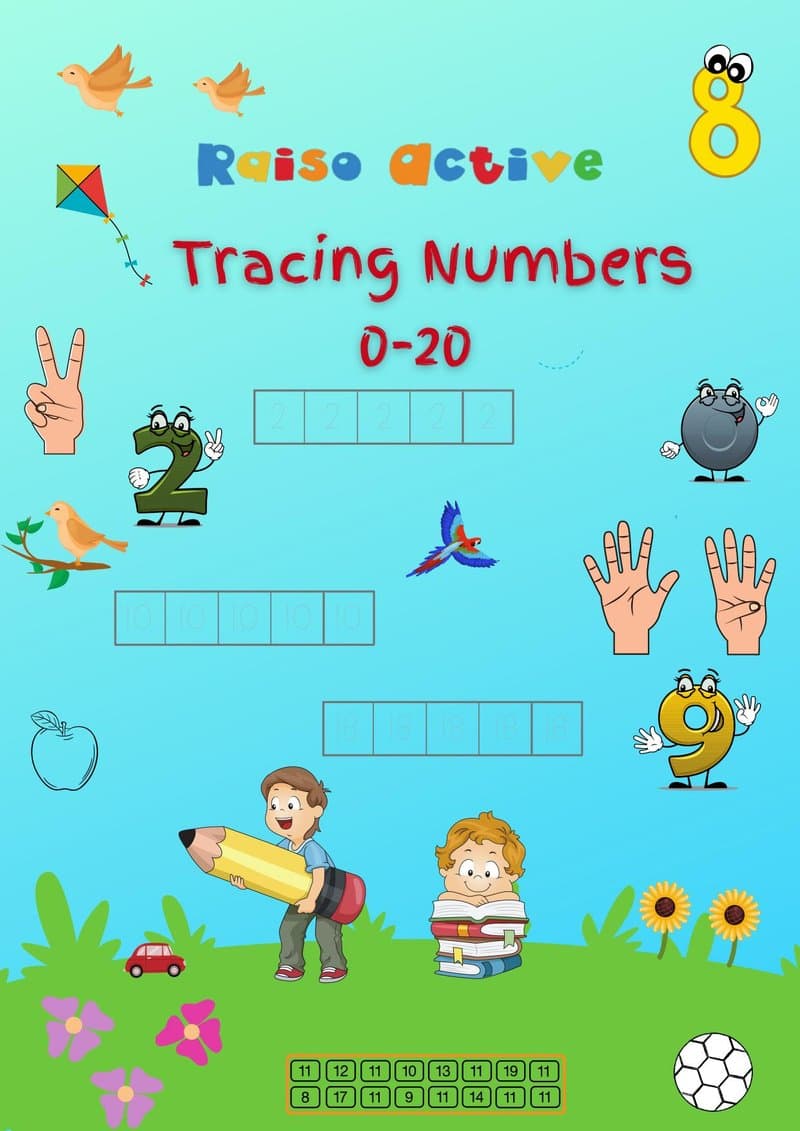
Part of the pack
Number Tracing & Counting Activity Book 0-20 for Preschool & Kindergarten
This is page 13 of the pack. Ages 3-6 · Preschool–KindergartenAges 3-6 · Nursery–Year 1Ages 3-6 · Nursery–UKGAges 3-6

Made for your child
Counting to 10, made for your child
A maths pack with your child's name in it: pictures that explain, practice at three levels, puzzles and story sums about them. Print a new set whenever they finish.
Make a maths packFree preview · free for members
Curriculum
- Number Recognition > Number Writing
How to use this worksheet
Have your child trace the number 11 in the dotted boxes first, pointing out that it's made of two matching 1s written next to each other. Then move to the grid below, where several numbers are mixed together, and ask them to scan carefully to find every 11 in the group. Give them a crayon to color in each 11 they spot, and count together how many they found once they've checked the whole grid.
Materials needed
- Pencil
- Crayons
Extension activities
- 1Count out 11 small snacks like crackers or grapes and line them up to see the quantity 11 represents.
- 2Have your child search house numbers, clocks, or calendars for the number 11 and point it out when they spot it.
- 3Clap or jump 11 times together while counting out loud.
- 4Write the number 11 in two colors, one color per digit, to reinforce that it's built from two 1s.

Written by
Hemsweta Jain · Teacher Cheena
MBA and Early Childhood Educator, teaching since 2014 · Founder of RaisoActive, Mumbai
Every RaisoActive worksheet is designed and checked by the founder before publishing.
Published · Last reviewed
More from Number Tracing & Counting Activity Book 0-20 for Preschool & Kindergarten

Trace and Count: Number 18 Worksheet for Preschoolers
Ages 4-5 · Pre-KAges 4-5 · ReceptionAges 4-5 · LKGAges 4-5
This worksheet has children ages 4-5 trace the number 18 and then count and color a full set of eighteen hearts, continuing to build stamina for counting well into the teens range. Because eighteen is close to twenty, successfully counting this many objects without losing track shows real progress in sustained attention and one-to-one correspondence. Using hearts instead of a more neutral shape also adds a small, engaging visual theme to an otherwise repetitive counting task.
Practice Grid Worksheet for Early Learners
Ages 3-5 · Preschool–Pre-KAges 3-5 · Nursery–ReceptionAges 3-5 · Nursery–LKGAges 3-5
This blank practice grid gives children ages 3-5 an open space to build the pencil control that underlies all future handwriting, without the pressure of forming a specific letter or number correctly. Drawing lines, shapes, and marks within the boundaries of each grid square strengthens the small hand muscles and hand-eye coordination needed before children are ready for structured letter formation. Because the grid has no single correct answer, it also gives adults a low-stakes way to see how a child currently controls a pencil.

Number 9 Tracing Worksheet: Learn to Trace and Count!
Ages 3-5 · Preschool–Pre-KAges 3-5 · Nursery–ReceptionAges 3-5 · Nursery–LKGAges 3-5
This worksheet has children ages 3-5 trace the number 9, formed from a small loop at the top connected to a straight or slightly curved line down, and then count and color nine circles to reinforce the specific quantity nine represents. Because 9 shares its top loop with numbers like 6, tracing it helps children notice similarities between numerals rather than treating each one as completely unrelated. This worksheet also pushes counting practice right up to the edge of the single-digit range, just before 10.

Trace and Color the Number 4 Worksheet for Preschoolers
Ages 3-5 · Preschool–Pre-KAges 3-5 · Nursery–ReceptionAges 3-5 · Nursery–LKGAges 3-5
This worksheet has children ages 3-5 trace the number 4, a shape combining two straight lines and one diagonal line meeting at a specific point, one of the more angular early numerals to master. Coloring exactly four apples afterward reinforces one-to-one correspondence and the specific quantity the numeral 4 represents. Because 4 has more distinct angles than the numbers before it, this worksheet continues building the precise pencil control needed for increasingly complex numerals.

Number Tracing Worksheet: Trace and Find the Number 12!
Ages 3-5 · Preschool–Pre-KAges 3-5 · Nursery–ReceptionAges 3-5 · Nursery–LKGAges 3-5
On this page, children ages 3-5 trace the two-digit number 12 and then hunt for it among a grid of other numbers, building both handwriting control and the visual discrimination needed to tell similar numerals apart. Recognizing 12 in different positions in the grid helps children understand that a number keeps its identity even when its neighbors change. This is an important step toward confident number recognition beyond rote counting.

Trace the Number 3 and Color the Balls! - Number Tracing Worksheet
Ages 3-5 · Preschool–Pre-KAges 3-5 · Nursery–ReceptionAges 3-5 · Nursery–LKGAges 3-5
This worksheet has children ages 3-5 trace the number 3, a shape built from two connected curves, which is more complex than the numbers 1 and 2 and continues building fine motor precision. Coloring exactly three balls after tracing reinforces one-to-one correspondence and the specific quantity the numeral 3 represents. Practicing curved numerals like 3 also prepares children for other rounded numbers they'll encounter soon, such as 8.
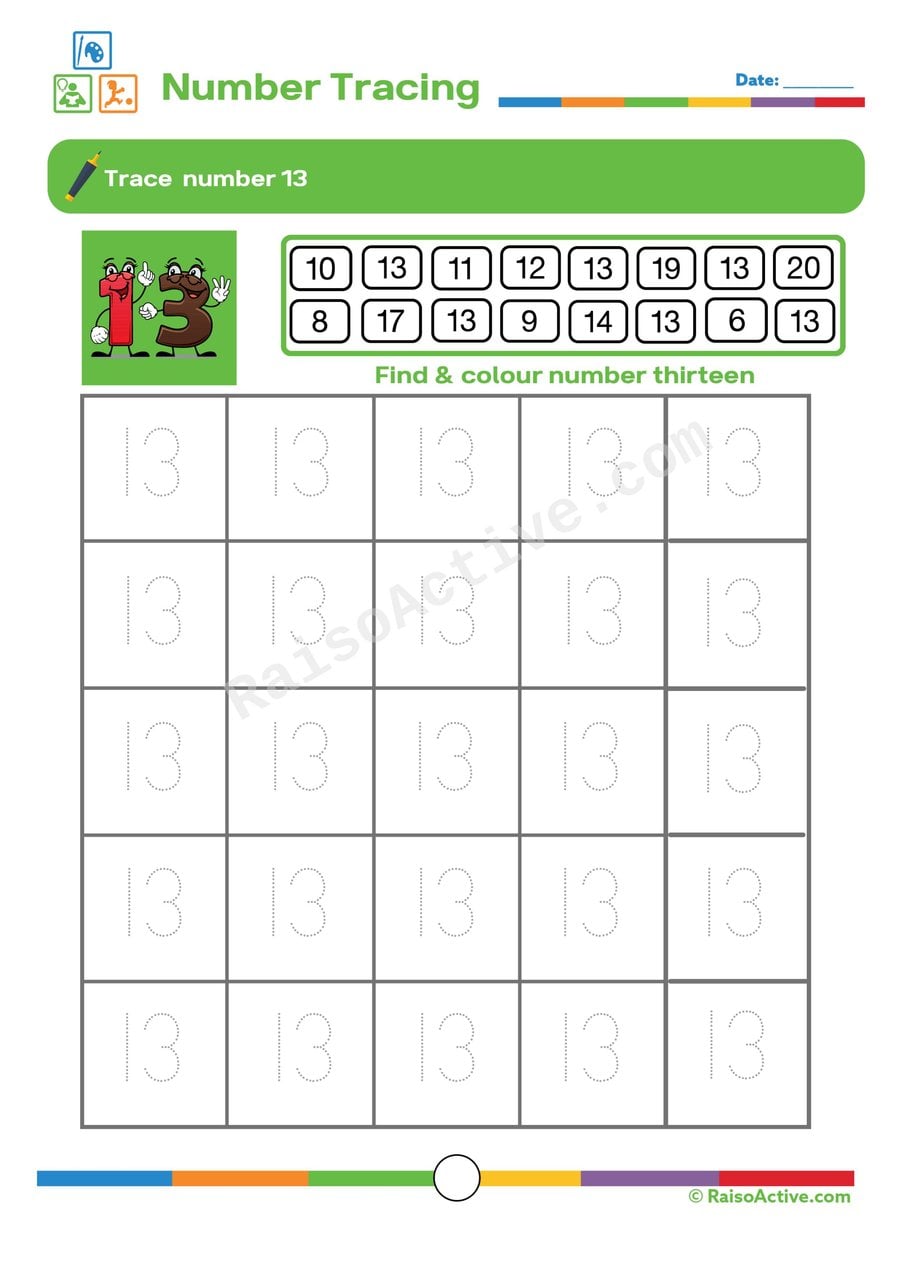
Trace Number 13 Worksheet for Preschoolers
Ages 3-5 · Preschool–Pre-KAges 3-5 · Nursery–ReceptionAges 3-5 · Nursery–LKGAges 3-5
This worksheet has children ages 3-5 trace the two-digit number 13 and then scan a grid to find and color every instance of it among other numbers, building visual discrimination alongside handwriting practice. Recognizing 13 in a mixed grid, rather than only in isolation, helps children understand that a number's identity stays the same across different positions and contexts. This searching task also strengthens sustained visual attention, since children must check each number in the grid carefully rather than glance quickly.

Number Tracing Worksheet: Trace and Count the Number 20!
Ages 4-5 · Pre-KAges 4-5 · ReceptionAges 4-5 · LKGAges 4-5
This worksheet has children ages 4-5 trace the number 20, a milestone number that marks the top of the common preschool counting range, and then count and color a full set of twenty pentagons. Reaching and confidently counting to 20 shows that a child has built solid one-to-one correspondence across an extended set, a skill they'll rely on heavily once they begin adding and subtracting in early math. Counting pentagons instead of simpler shapes also gives a light introduction to five-sided shapes.
Related worksheets

Solar System Number Matching Worksheet for Preschoolers
Ages 4-6 · Pre-K–KindergartenAges 4-6 · Reception–Year 1Ages 4-6 · LKG–UKGAges 4-6
This worksheet combines number-word recognition with a color-by-key coloring task for children ages 4-6, asking them to match number names written on planets to their corresponding numerals before coloring each planet according to a color code. Matching written number words in a space-themed context adds novelty that keeps repeated number-word practice fresh, while the color-key step reinforces careful, sequential following of visual instructions. Together, these two tasks combine literacy and numeracy practice in one engaging page.
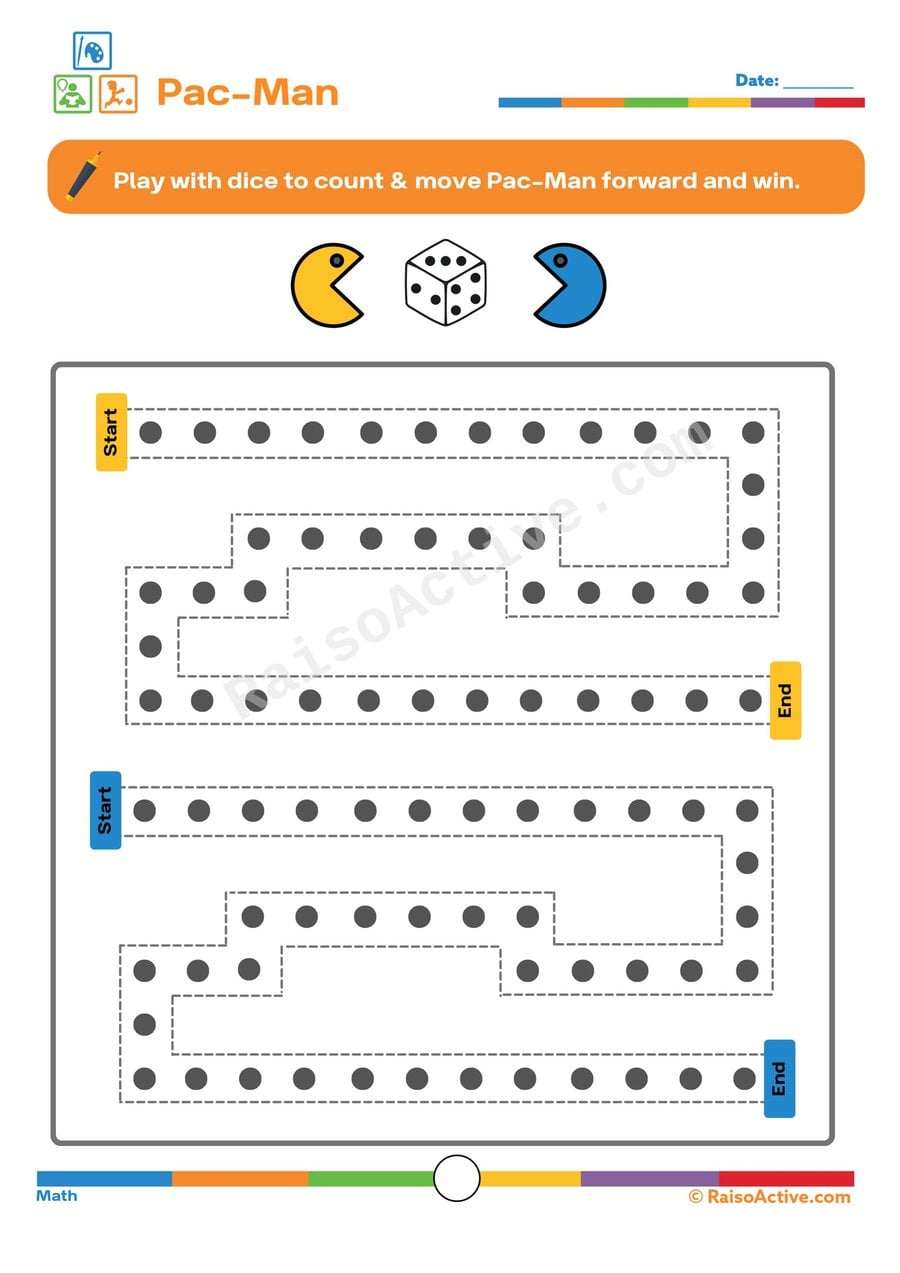
Pac-Man Maze Worksheet: Count and Move!
Ages 3-5 · Preschool–Pre-KAges 3-5 · Nursery–ReceptionAges 3-5 · Nursery–LKGAges 3-5
This dice-driven maze combines counting practice with path-following for children ages 3-5, since they must accurately count dots on a die before moving Pac-Man the matching number of spaces forward. Deciding how far to move and staying on the correct path also builds early strategic thinking, as children track their current position within the maze after each turn.
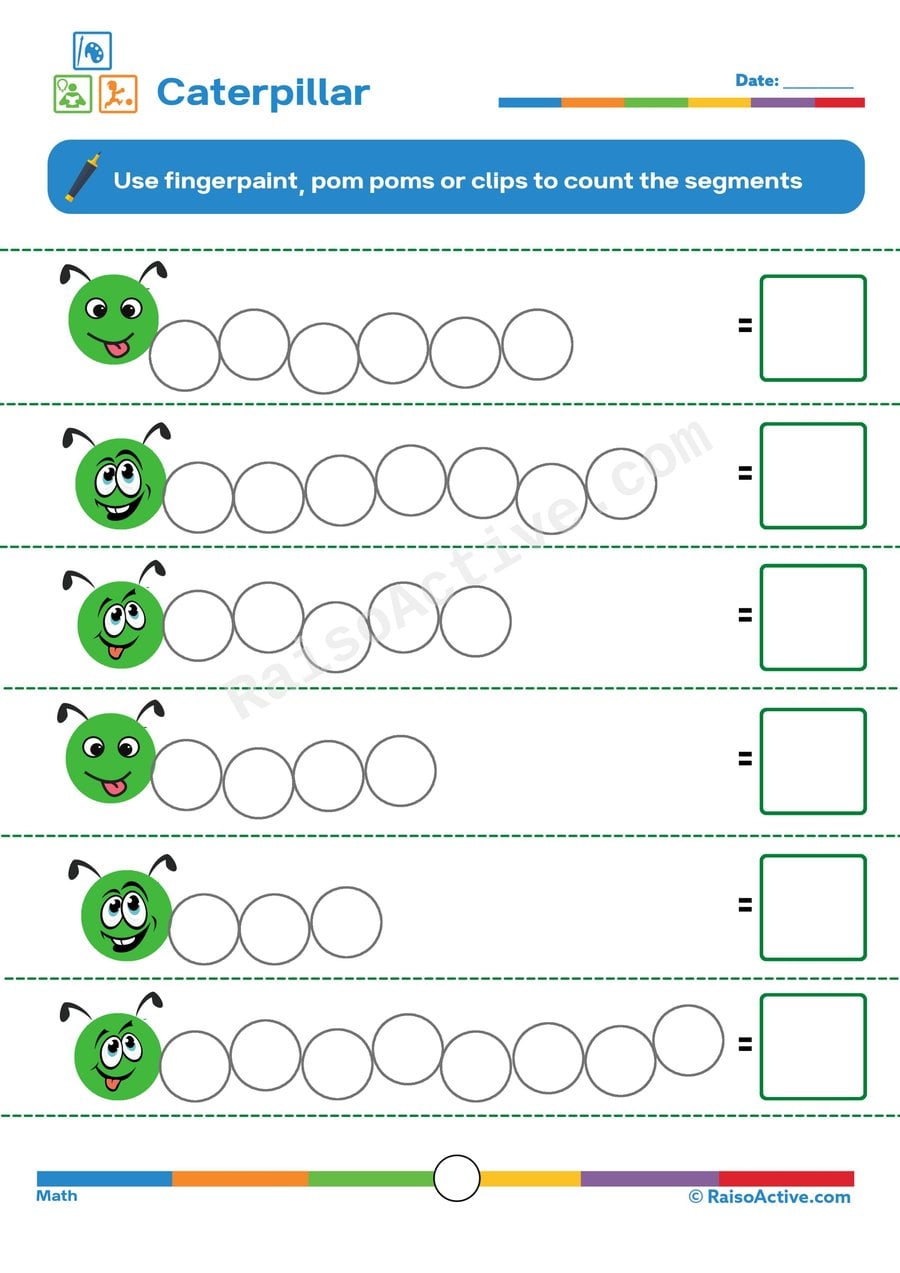
Caterpillar Counting Worksheet for Preschoolers
Ages 3-5 · Preschool–Pre-KAges 3-5 · Nursery–ReceptionAges 3-5 · Nursery–LKGAges 3-5
Counting the segments of each caterpillar teaches children ages 3-5 one-to-one correspondence — touching or marking each segment exactly once while saying a number — which is the core skill underlying accurate counting. Writing the final total in a box also connects the physical act of counting to its written numeral, reinforcing early number-writing practice.

Navratri Counting Worksheet: Count the Festival Fun
Ages 4-6 · Pre-K–KindergartenAges 4-6 · Reception–Year 1Ages 4-6 · LKG–UKGAges 4-6
Children count small groups of festival pictures and write the number, trace and write the numbers 1 to 9, compare two groups to find the one with more, and colour a set number of diyas.

Mystery Number Riddles Worksheet: Use the Clues
Ages 4-7 · Pre-K–Grade 1Ages 4-7 · Reception–Year 2Ages 4-7 · LKG–Class 1Ages 4-7
This worksheet helps children practice number recognition, following instructions, and applying logic to solve number puzzles.

Number Names Matching Worksheet for Preschoolers
Ages 3-5 · Preschool–Pre-KAges 3-5 · Nursery–ReceptionAges 3-5 · Nursery–LKGAges 3-5
This matching worksheet builds early number-word literacy for children ages 3-5 by asking them to connect each numeral with its written name. Learning that '5' and 'five' refer to the same quantity strengthens number sense and lays groundwork for reading math vocabulary later in school. The side-by-side layout also sharpens visual scanning and one-to-one matching skills.

Letter E Tracing and Coloring Worksheet for Preschoolers
Ages 3-5 · Preschool–Pre-KAges 3-5 · Nursery–ReceptionAges 3-5 · Nursery–LKGAges 3-5
This tracing and coloring worksheet teaches children ages 3-5 to recognize and write both the uppercase and lowercase letter E, while also identifying pictures of objects that begin with that letter's sound. Practicing a letter in both its capital and lowercase forms helps children see that they represent the same sound despite looking different, an important early literacy concept. Circling matching pictures alongside the tracing also connects the visual letter shape to its corresponding beginning sound in spoken words.

Festive Math: Counting Hands and Heads Worksheet
Ages 4-8 · Pre-K–Grade 2Ages 4-8 · Reception–Year 3Ages 4-8 · LKG–Class 2Ages 4-8
Children count the hands of Goddess Durga, Goddess Laxmi and Lord Ram and the heads of Ravana, and learn which festival each one belongs to.
Guides for this topic

Number Formation Rhymes 0–9 and How to Fix Reversals
Original number formation rhymes for 0–9, the correct stroke order for each digit, why 3, 5 and 7 get reversed most often, and multisensory fixes that work.

What's the Best Alternative to ABCmouse? A Complete Parent's Guide to Free and Affordable Educational Apps
ABCmouse runs ~Rs 4,000-5,000/year with US spellings and curriculum. Compare free & affordable Indian-friendly apps like Khan Academy Kids and DIKSHA.
Is My Child Ready for Kindergarten? Essential Skills and Honest Assessment
Wondering if your child is ready for Class 1 or kindergarten? Learn the 5 domains of school readiness, what Indian schools look for, and how to support your child at home.
Reviews
Every worksheet for ages 3–5, no watermark
Members download the full library of 1,000+ worksheets and every activity pack without watermarks or daily limits. One year costs ₹999 in India or $20 elsewhere.
See membership plansOr download any worksheet free with a watermark (5 a day).