Trace Number 13 Worksheet for Preschoolers
This worksheet has children ages 3-5 trace the two-digit number 13 and then scan a grid to find and color every instance of it among other numbers, building visual discrimination alongside handwriting practice. Recognizing 13 in a mixed grid, rather than only in isolation, helps children understand that a number's identity stays the same across different positions and contexts. This searching task also strengthens sustained visual attention, since children must check each number in the grid carefully rather than glance quickly.
Part of the pack
Number Tracing & Counting Activity Book 0-20 for Preschool & Kindergarten
This is page 15 of the pack. Ages 3-6 · Preschool–KindergartenAges 3-6 · Nursery–Year 1Ages 3-6 · Nursery–UKGAges 3-6

Made for your child
Counting to 10, made for your child
A maths pack with your child's name in it: pictures that explain, practice at three levels, puzzles and story sums about them. Print a new set whenever they finish.
Make a maths packFree preview · free for members
Curriculum
- Number Recognition > Number Writing
How to use this worksheet
Have your child trace the number 13 in the boxes provided, noticing that it's built from a 1 followed by a 3. Then move to the grid below, where numbers are mixed together, and ask your child to search carefully for every 13, coloring each one they find with a crayon. Count together how many 13s were found once the whole grid has been checked.
Materials needed
- Pencil
- Crayons
Extension activities
- 1Have your child find 13 small objects, like buttons or coins, and count them out into a small pile.
- 2Practice writing the number 13 on a whiteboard or piece of paper several times.
- 3Look for the number 13 on a calendar and talk about what day of the month it represents.
- 4Play a simple search game where you hide 13 small items around a room for your child to find and count.

Written by
Hemsweta Jain · Teacher Cheena
MBA and Early Childhood Educator, teaching since 2014 · Founder of RaisoActive, Mumbai
Every RaisoActive worksheet is designed and checked by the founder before publishing.
Published · Last reviewed
More from Number Tracing & Counting Activity Book 0-20 for Preschool & Kindergarten

Number 1 Tracing Worksheet: Trace, Count, and Color!
Ages 3-5 · Preschool–Pre-KAges 3-5 · Nursery–ReceptionAges 3-5 · Nursery–LKGAges 3-5
This worksheet gives children ages 3-5 their very first structured practice tracing a numeral, using the simplest number shape, a single straight line, to build early pencil control before moving on to curvier numbers. Counting and coloring exactly one object reinforces that the numeral 1 represents a single item, an essential first step in connecting written symbols to real quantities. Because this is often a child's introduction to number writing, it sets the pattern for how they'll approach every number worksheet that follows.

Number Tracing Worksheet 1-20: Practice Writing Numbers!
Ages 3-5 · Preschool–Pre-KAges 3-5 · Nursery–ReceptionAges 3-5 · Nursery–LKGAges 3-5
This worksheet gives children ages 3-5 a second full pass at tracing every number from 1 to 20, repeating the entire sequence to build the muscle memory that comes only from writing each numeral more than once. Revisiting the complete range reinforces both the shape of each number and their order in the counting sequence, helping children internalize the pattern rather than relying on the worksheet as a one-time reference. This repetition matters especially for the trickier two-digit numbers in the teens, which often need more practice than single digits.

Number Tracing Worksheet 1-20: Practice Writing Numbers!
Ages 3-5 · Preschool–Pre-KAges 3-5 · Nursery–ReceptionAges 3-5 · Nursery–LKGAges 3-5
This worksheet has children ages 3-5 trace every number from 1 to 20 in sequence, giving them a single, comprehensive review of number formation across the entire range they're expected to master before kindergarten. Practicing the full sequence in one sitting, rather than one number at a time, also reinforces the order of the counting sequence itself, since children see each number in its proper place relative to the ones before and after it. Following directional arrows throughout builds the habit of starting every numeral in the correct place.
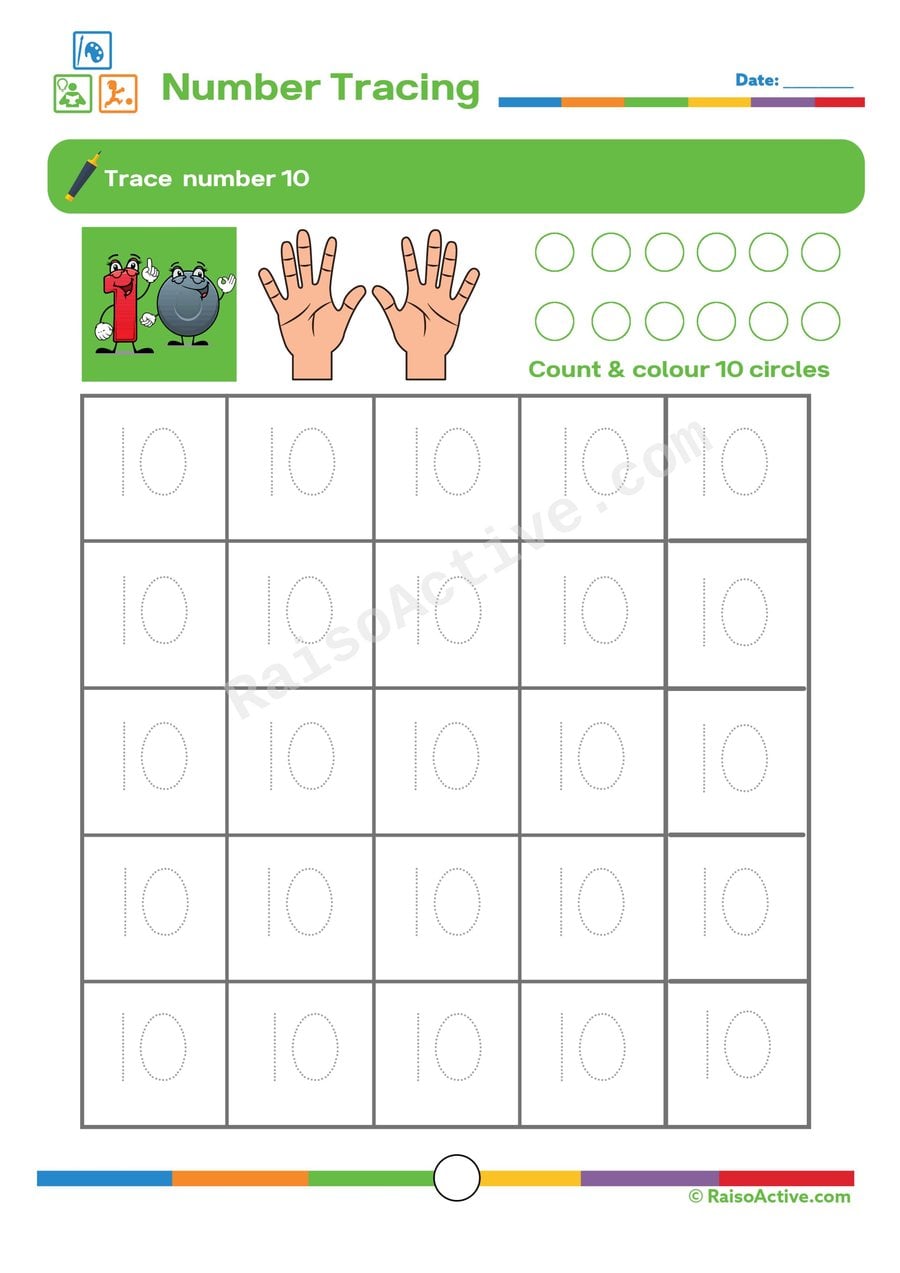
Trace and Count to 10! Number Tracing Worksheet
Ages 4-5 · Pre-KAges 4-5 · ReceptionAges 4-5 · LKGAges 4-5
This worksheet has children ages 4-5 trace the number 10, their first two-digit number in a structured sequence, and then count and color a full set of ten circles, reinforcing that 10 represents a complete group of two fives or one full set of fingers on both hands. Practicing 10 also marks an important transition point, since children who can confidently count, write, and represent 10 are ready to begin extending their counting into the teens. This combination of tracing and counting to a meaningful benchmark number builds solid number sense.

Trace and Color the Number 4 Worksheet for Preschoolers
Ages 3-5 · Preschool–Pre-KAges 3-5 · Nursery–ReceptionAges 3-5 · Nursery–LKGAges 3-5
This worksheet has children ages 3-5 trace the number 4, a shape combining two straight lines and one diagonal line meeting at a specific point, one of the more angular early numerals to master. Coloring exactly four apples afterward reinforces one-to-one correspondence and the specific quantity the numeral 4 represents. Because 4 has more distinct angles than the numbers before it, this worksheet continues building the precise pencil control needed for increasingly complex numerals.

Trace and Count the Number 16 Worksheet for Preschoolers
Ages 4-5 · Pre-KAges 4-5 · ReceptionAges 4-5 · LKGAges 4-5
This worksheet has children ages 4-5 trace the two-digit number 16 and then count and color a full set of sixteen squares, continuing to build counting stamina in the teens range that many children find more challenging than counting to 10. Because 16 combines a 1 and a 6, tracing it reinforces the same two-digit writing pattern practiced with numbers like 11 through 15, helping children generalize the pattern rather than treating each teen number as entirely new. Counting squares instead of round objects also quietly introduces basic shape vocabulary.

Trace and Count: Number 8 Worksheet for Preschoolers
Ages 3-5 · Preschool–Pre-KAges 3-5 · Nursery–ReceptionAges 3-5 · Nursery–LKGAges 3-5
This worksheet has children ages 3-5 trace the number 8, a shape made of two connected loops stacked on top of each other, one of the most visually complex early numerals to write neatly. Circling exactly eight cars from a larger group builds on the precise counting skill of stopping at the right quantity rather than counting everything shown. Because 8 shares the double-loop structure with letters like B, practicing this stroke also supports future handwriting beyond just numbers.

Trace and Count the Number 17 Worksheet for Preschoolers
Ages 3-5 · Preschool–Pre-KAges 3-5 · Nursery–ReceptionAges 3-5 · Nursery–LKGAges 3-5
This worksheet challenges children ages 3-5 to trace the two-digit number 17 and then count out a matching set of seventeen rectangles, linking the written numeral to an actual quantity they can see and touch. Counting all the way to 17 pushes children past the more familiar 1-10 range and builds stamina for extended counting sequences. It also reinforces one-to-one correspondence, the skill of matching each number word to exactly one object as they count.
Related worksheets

Color the Numbers: Sorting Worksheet for Preschoolers
Ages 3-5 · Preschool–Pre-KAges 3-5 · Nursery–ReceptionAges 3-5 · Nursery–LKGAges 3-5
This worksheet helps children ages 3-5 practice number recognition by reading a color key and coloring each numeral in the circle below according to its assigned color, combining early sorting logic with numeral identification. Applying a symbolic rule — 'this number means this color' — across a whole page trains children to hold and consistently apply an instruction, a skill that carries over into following multi-step directions elsewhere.

Navaratri Dance Count: A Fun Counting Worksheet for Kids!
Ages 4-8 · Pre-K–Grade 2Ages 4-8 · Reception–Year 3Ages 4-8 · LKG–Class 2Ages 4-8
Children learn that Navratri honours Goddess Durga and that people dance garba and dandiya for nine nights, then count matching dance poses.
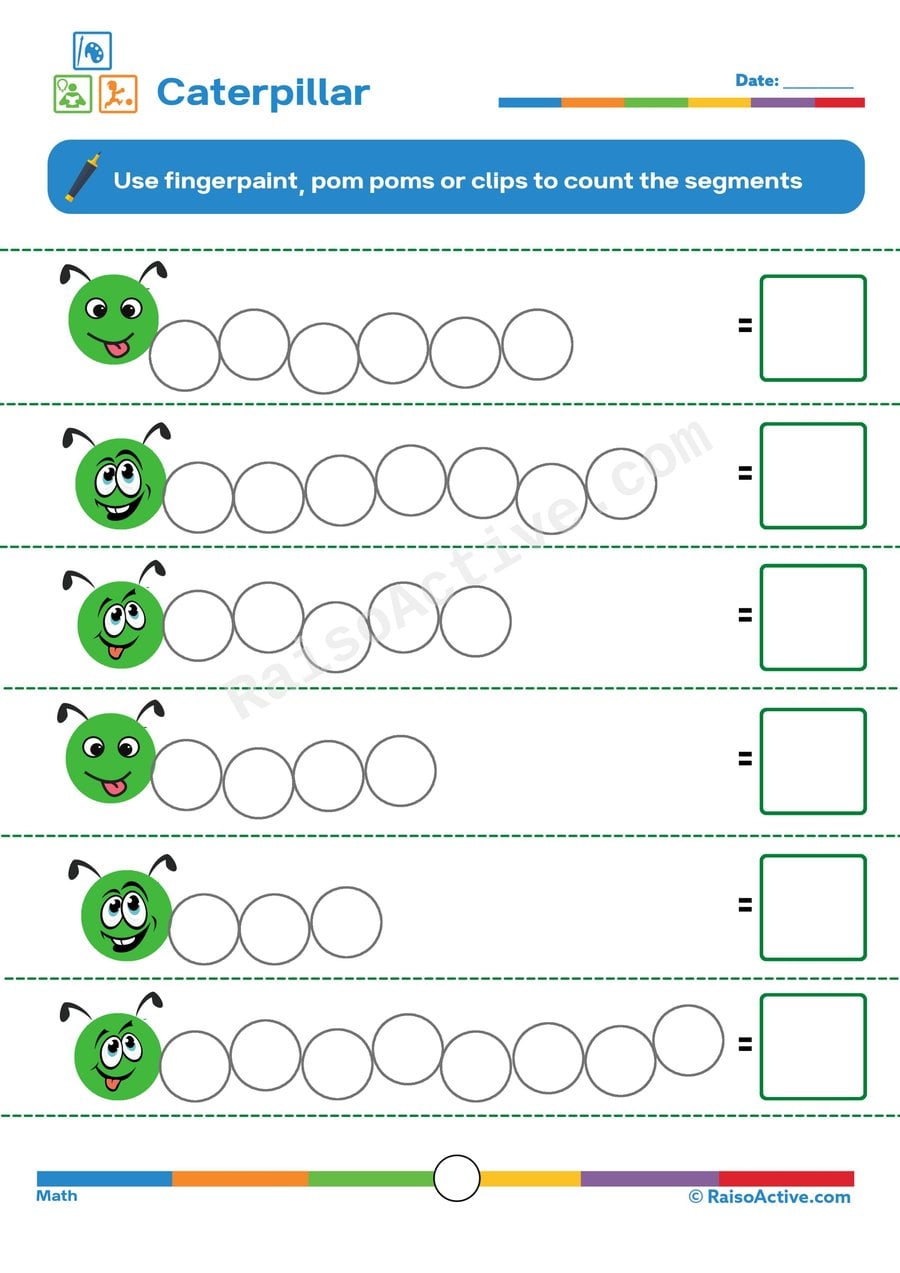
Caterpillar Counting Worksheet for Preschoolers
Ages 3-5 · Preschool–Pre-KAges 3-5 · Nursery–ReceptionAges 3-5 · Nursery–LKGAges 3-5
Counting the segments of each caterpillar teaches children ages 3-5 one-to-one correspondence — touching or marking each segment exactly once while saying a number — which is the core skill underlying accurate counting. Writing the final total in a box also connects the physical act of counting to its written numeral, reinforcing early number-writing practice.

Breathe With Me: Wave, Flower and Candle Breathing Tracing
Ages 4-6 · Pre-K–KindergartenAges 4-6 · Reception–Year 1Ages 4-6 · LKG–UKGAges 4-6
Children trace a wave and a mountain path while breathing slowly, practise 'smell the flower, blow the candle', and colour a bubble after each breath. They check in with how they feel afterwards.

Animal Babies Tracing Worksheet: Help the Babies Find Their Mothers!
Ages 3-5 · Preschool–Pre-KAges 3-5 · Nursery–ReceptionAges 3-5 · Nursery–LKGAges 3-5
This tracing worksheet has children ages 3-5 trace dotted lines to connect each baby animal to its correct mother, combining pencil control practice with early science knowledge about animal families. Learning which baby belongs to which adult animal — like a calf to a cow, or a cub to a lion — builds vocabulary and categorization skills that go beyond the tracing itself. Because the correct line only makes sense if the child recognizes the right animal pairing first, this activity blends fine motor practice with genuine content knowledge.

Mickey Mouse Number Sequence Worksheet: Paste the Missing Numbers!
Ages 4-5 · Pre-KAges 4-5 · ReceptionAges 4-5 · LKGAges 4-5
This cut-and-paste worksheet uses a Mickey Mouse theme to give children ages 4-5 practice recognizing and completing number sequences by identifying missing numbers within numbered frames and pasting them into place. Because the missing numbers appear in the middle of a sequence rather than only at the end, children must think about both the number before and after a gap, a more demanding skill than simple 'what comes next' counting. The familiar character theme adds motivation to a task that is fundamentally about numerical reasoning.
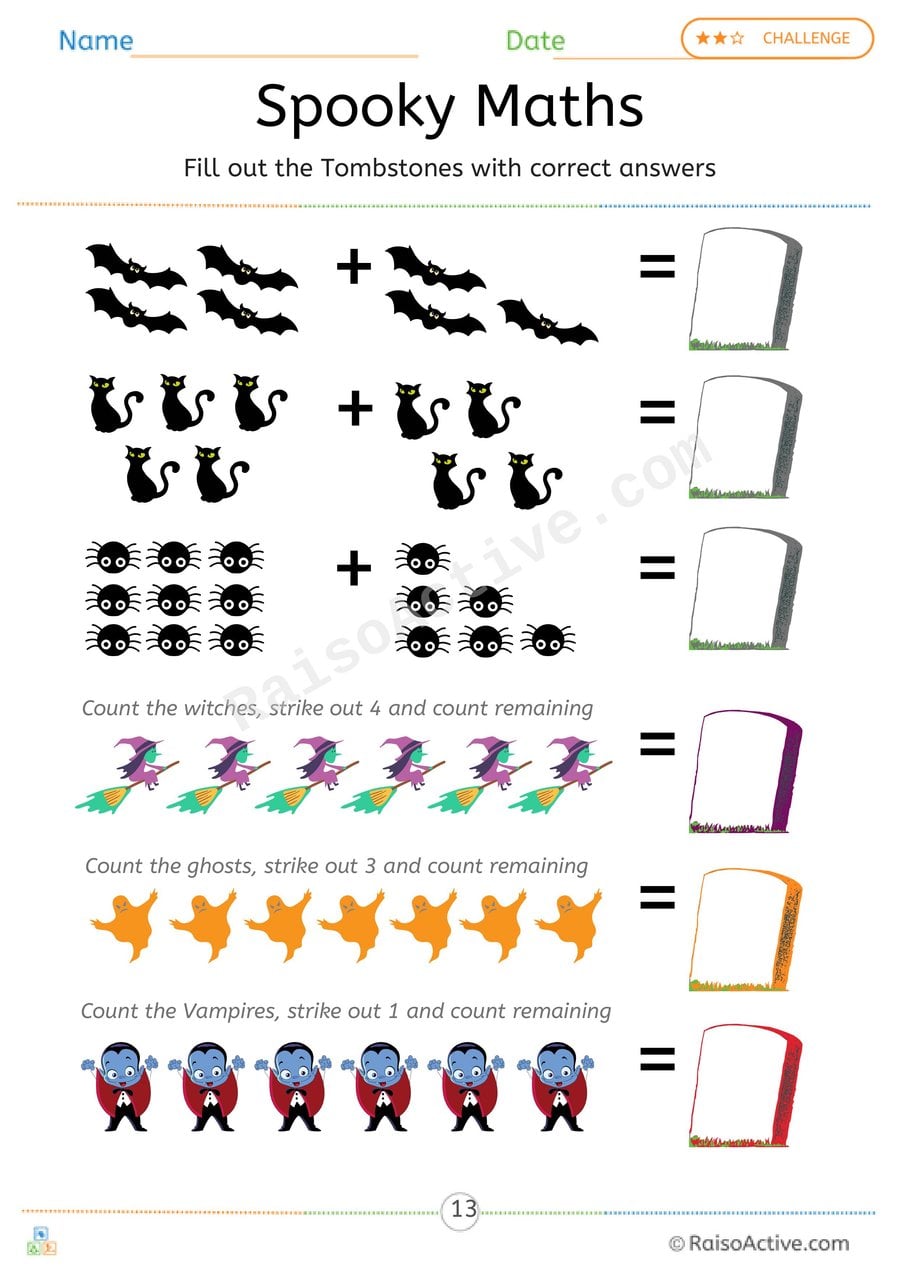
Spooky Math Worksheet: Halloween Counting Fun!
Ages 4-5 · Pre-KAges 4-5 · ReceptionAges 4-5 · LKGAges 4-5
This Halloween math worksheet has children ages 4-5 count grouped pictures and then solve simple addition and subtraction problems, moving from concrete counting toward the more abstract skill of combining or taking away quantities. Writing each answer inside a tombstone shape keeps the seasonal theme playful while practicing genuine early arithmetic.
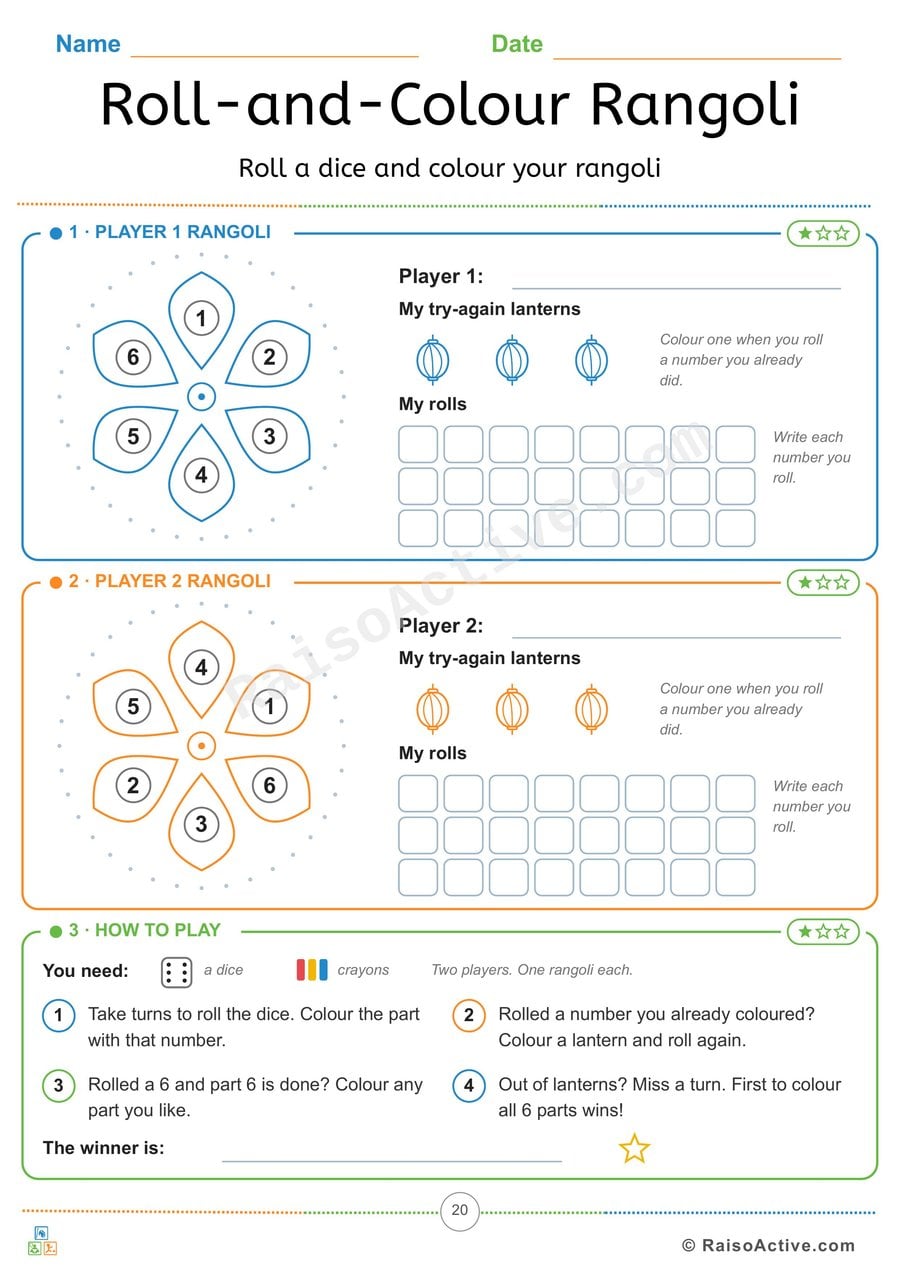
Roll-and-Colour Rangoli: Two-Player Dice Game
Ages 4-6 · Pre-K–KindergartenAges 4-6 · Reception–Year 1Ages 4-6 · LKG–UKGAges 4-6
Two players take turns rolling a dice and colouring the rangoli part with that number. They practise number recognition, turn-taking and handling a try-again rule, and write each roll in a record box.
Guides for this topic

Number Formation Rhymes 0–9 and How to Fix Reversals
Original number formation rhymes for 0–9, the correct stroke order for each digit, why 3, 5 and 7 get reversed most often, and multisensory fixes that work.

What's the Best Alternative to ABCmouse? A Complete Parent's Guide to Free and Affordable Educational Apps
ABCmouse runs ~Rs 4,000-5,000/year with US spellings and curriculum. Compare free & affordable Indian-friendly apps like Khan Academy Kids and DIKSHA.
Is My Child Ready for Kindergarten? Essential Skills and Honest Assessment
Wondering if your child is ready for Class 1 or kindergarten? Learn the 5 domains of school readiness, what Indian schools look for, and how to support your child at home.
Reviews
Every worksheet for ages 3–5, no watermark
Members download the full library of 1,000+ worksheets and every activity pack without watermarks or daily limits. One year costs ₹999 in India or $20 elsewhere.
See membership plansOr download any worksheet free with a watermark (5 a day).