Trace and Count to 10! Number Tracing Worksheet
This worksheet has children ages 4-5 trace the number 10, their first two-digit number in a structured sequence, and then count and color a full set of ten circles, reinforcing that 10 represents a complete group of two fives or one full set of fingers on both hands. Practicing 10 also marks an important transition point, since children who can confidently count, write, and represent 10 are ready to begin extending their counting into the teens. This combination of tracing and counting to a meaningful benchmark number builds solid number sense.
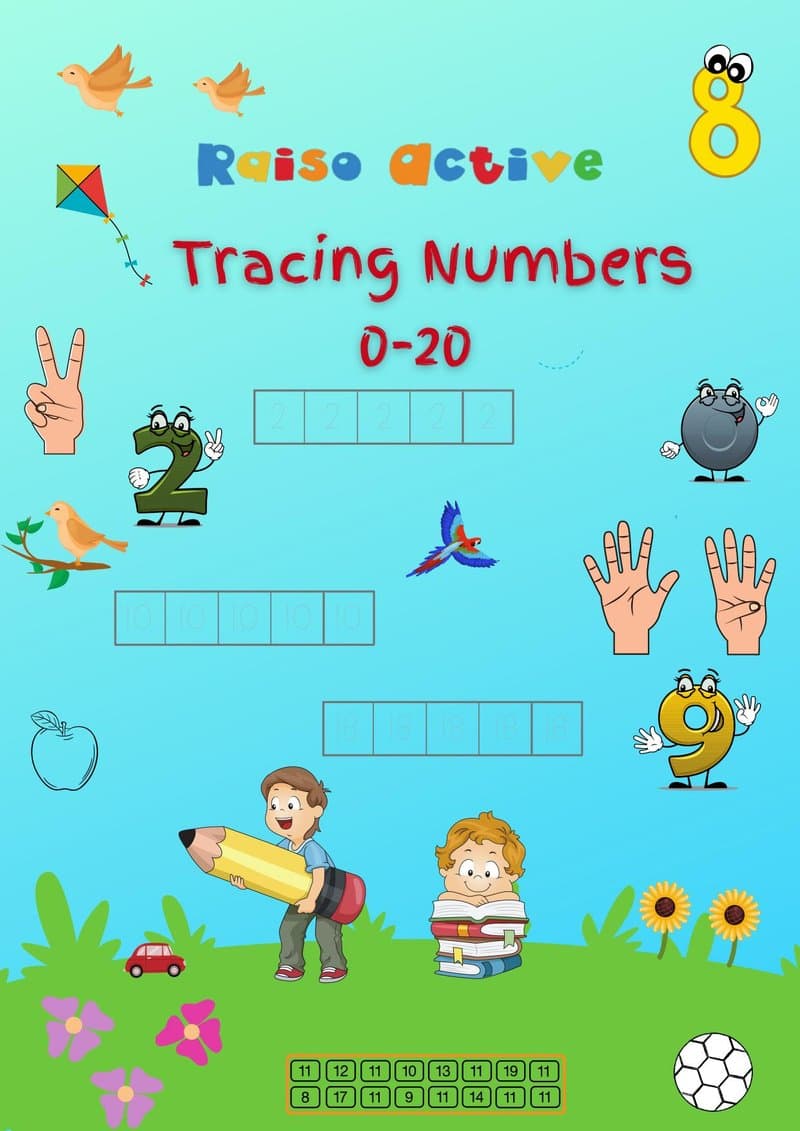
Part of the pack
Number Tracing & Counting Activity Book 0-20 for Preschool & Kindergarten
This is page 12 of the pack. Ages 3-6 · Preschool–KindergartenAges 3-6 · Nursery–Year 1Ages 3-6 · Nursery–UKGAges 3-6

Made for your child
Counting to 10, made for your child
A maths pack with your child's name in it: pictures that explain, practice at three levels, puzzles and story sums about them. Print a new set whenever they finish.
Make a maths packFree preview · free for members
Curriculum
- Number Recognition > Number Tracing 1-10
How to use this worksheet
Show your child the dotted number 10 and point out that it's made of a 1 and a 0 written together, tracing each digit slowly so they see both parts. Have them trace several guided 10s, then count the row of circles together out loud, touching each one as they count all the way to ten. Have your child color all ten circles with a crayon, recounting at the end to confirm the total.
Materials needed
- Pencil
- Crayons
Extension activities
- 1Hold up both hands together and count all ten fingers, connecting the number to something your child can see on their body.
- 2Have your child find 10 objects around the house and count them out loud together.
- 3Draw a picture together that includes exactly 10 items, like 10 balloons or 10 stars.
- 4Practice counting from 1 to 10 and then backward from 10 to 1.

Written by
Hemsweta Jain · Teacher Cheena
MBA and Early Childhood Educator, teaching since 2014 · Founder of RaisoActive, Mumbai
Every RaisoActive worksheet is designed and checked by the founder before publishing.
Published · Last reviewed
More from Number Tracing & Counting Activity Book 0-20 for Preschool & Kindergarten

Trace and Count the Number 16 Worksheet for Preschoolers
Ages 4-5 · Pre-KAges 4-5 · ReceptionAges 4-5 · LKGAges 4-5
This worksheet has children ages 4-5 trace the two-digit number 16 and then count and color a full set of sixteen squares, continuing to build counting stamina in the teens range that many children find more challenging than counting to 10. Because 16 combines a 1 and a 6, tracing it reinforces the same two-digit writing pattern practiced with numbers like 11 through 15, helping children generalize the pattern rather than treating each teen number as entirely new. Counting squares instead of round objects also quietly introduces basic shape vocabulary.

Number Tracing Worksheet 1-20: Practice Writing Numbers!
Ages 3-5 · Preschool–Pre-KAges 3-5 · Nursery–ReceptionAges 3-5 · Nursery–LKGAges 3-5
This worksheet has children ages 3-5 trace every number from 1 to 20 in sequence, giving them a single, comprehensive review of number formation across the entire range they're expected to master before kindergarten. Practicing the full sequence in one sitting, rather than one number at a time, also reinforces the order of the counting sequence itself, since children see each number in its proper place relative to the ones before and after it. Following directional arrows throughout builds the habit of starting every numeral in the correct place.
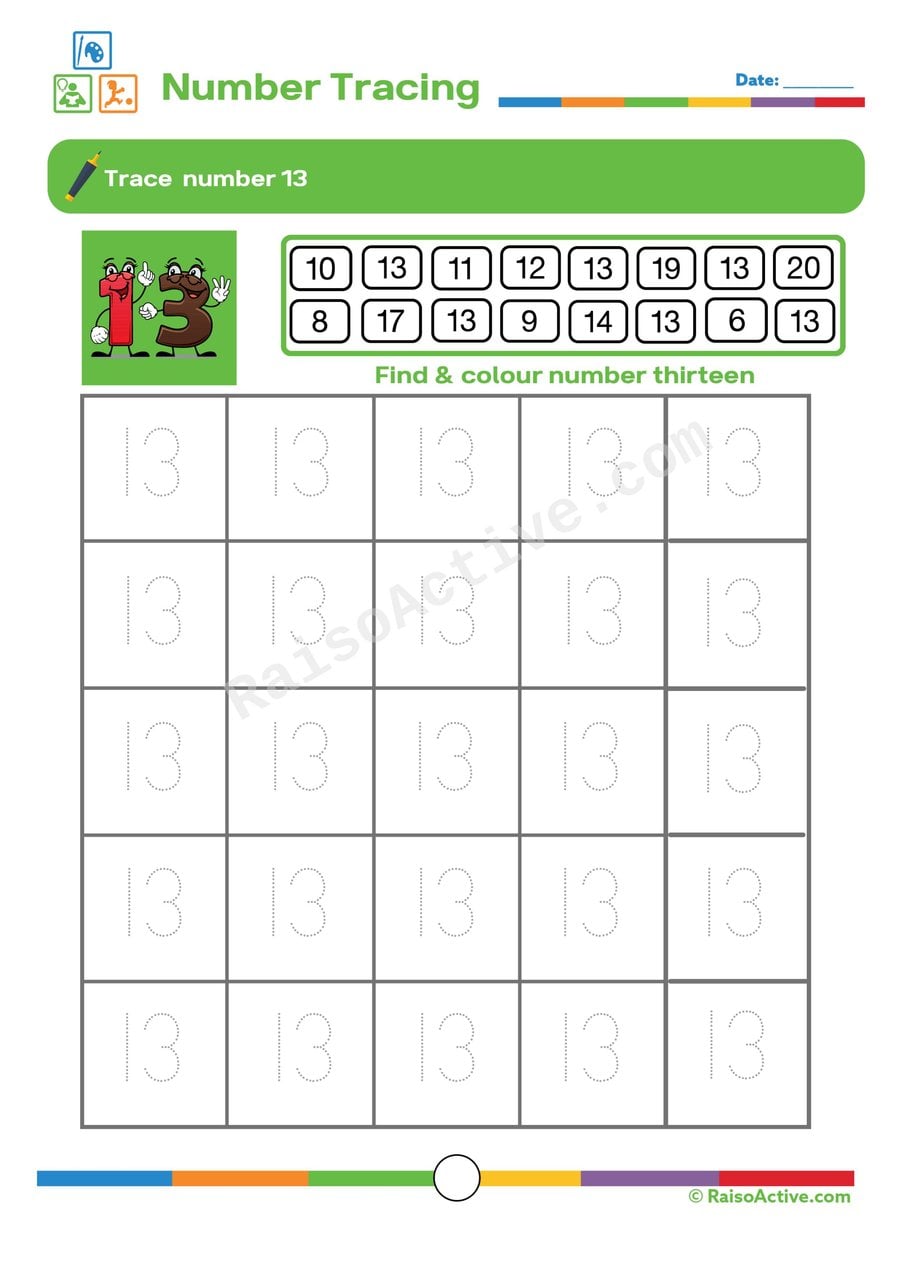
Trace Number 13 Worksheet for Preschoolers
Ages 3-5 · Preschool–Pre-KAges 3-5 · Nursery–ReceptionAges 3-5 · Nursery–LKGAges 3-5
This worksheet has children ages 3-5 trace the two-digit number 13 and then scan a grid to find and color every instance of it among other numbers, building visual discrimination alongside handwriting practice. Recognizing 13 in a mixed grid, rather than only in isolation, helps children understand that a number's identity stays the same across different positions and contexts. This searching task also strengthens sustained visual attention, since children must check each number in the grid carefully rather than glance quickly.

Number 1 Tracing Worksheet: Trace, Count, and Color!
Ages 3-5 · Preschool–Pre-KAges 3-5 · Nursery–ReceptionAges 3-5 · Nursery–LKGAges 3-5
This worksheet gives children ages 3-5 their very first structured practice tracing a numeral, using the simplest number shape, a single straight line, to build early pencil control before moving on to curvier numbers. Counting and coloring exactly one object reinforces that the numeral 1 represents a single item, an essential first step in connecting written symbols to real quantities. Because this is often a child's introduction to number writing, it sets the pattern for how they'll approach every number worksheet that follows.

Trace and Count: Number 7 Worksheet for Preschoolers
Ages 3-5 · Preschool–Pre-KAges 3-5 · Nursery–ReceptionAges 3-5 · Nursery–LKGAges 3-5
This worksheet has children ages 3-5 trace the number 7, formed from a straight horizontal line followed by a diagonal line down, and then count out seven cars from a larger group, an important step up from earlier worksheets that show only the exact quantity needed. Because the page includes more cars than the number seven, children must count carefully and stop at the right point rather than simply circling everything shown. This distinction between 'how many are here' and 'find exactly this many' builds a more precise counting skill.

Trace the Number 3 and Color the Balls! - Number Tracing Worksheet
Ages 3-5 · Preschool–Pre-KAges 3-5 · Nursery–ReceptionAges 3-5 · Nursery–LKGAges 3-5
This worksheet has children ages 3-5 trace the number 3, a shape built from two connected curves, which is more complex than the numbers 1 and 2 and continues building fine motor precision. Coloring exactly three balls after tracing reinforces one-to-one correspondence and the specific quantity the numeral 3 represents. Practicing curved numerals like 3 also prepares children for other rounded numbers they'll encounter soon, such as 8.

Trace and Color the Number 4 Worksheet for Preschoolers
Ages 3-5 · Preschool–Pre-KAges 3-5 · Nursery–ReceptionAges 3-5 · Nursery–LKGAges 3-5
This worksheet has children ages 3-5 trace the number 4, a shape combining two straight lines and one diagonal line meeting at a specific point, one of the more angular early numerals to master. Coloring exactly four apples afterward reinforces one-to-one correspondence and the specific quantity the numeral 4 represents. Because 4 has more distinct angles than the numbers before it, this worksheet continues building the precise pencil control needed for increasingly complex numerals.

Number Tracing Worksheet: Trace and Find the Number 12!
Ages 3-5 · Preschool–Pre-KAges 3-5 · Nursery–ReceptionAges 3-5 · Nursery–LKGAges 3-5
On this page, children ages 3-5 trace the two-digit number 12 and then hunt for it among a grid of other numbers, building both handwriting control and the visual discrimination needed to tell similar numerals apart. Recognizing 12 in different positions in the grid helps children understand that a number keeps its identity even when its neighbors change. This is an important step toward confident number recognition beyond rote counting.
Related worksheets
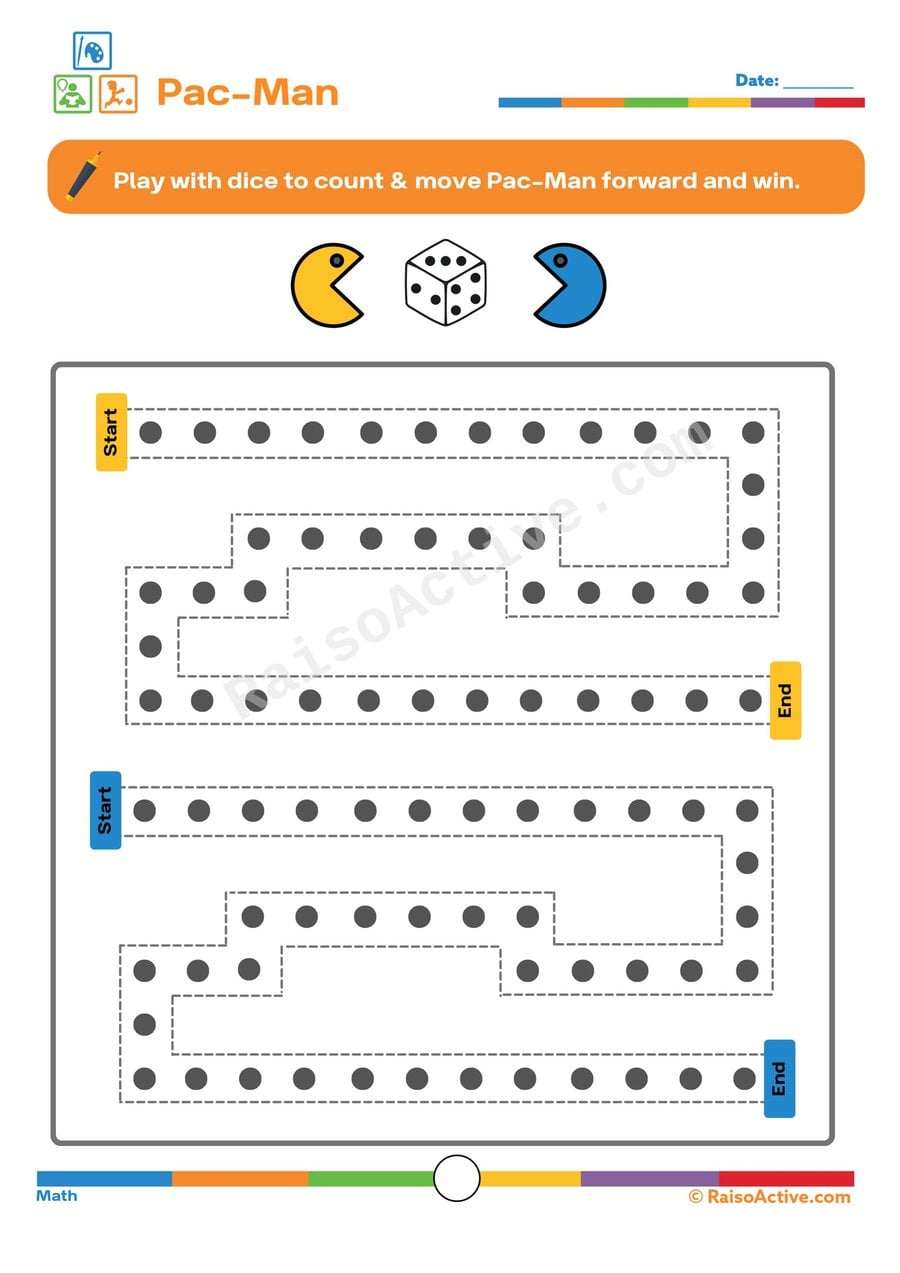
Pac-Man Maze Worksheet: Count and Move!
Ages 3-5 · Preschool–Pre-KAges 3-5 · Nursery–ReceptionAges 3-5 · Nursery–LKGAges 3-5
This dice-driven maze combines counting practice with path-following for children ages 3-5, since they must accurately count dots on a die before moving Pac-Man the matching number of spaces forward. Deciding how far to move and staying on the correct path also builds early strategic thinking, as children track their current position within the maze after each turn.

Air Balloon Color by Sums Worksheet for Preschoolers
Ages 3-5 · Preschool–Pre-KAges 3-5 · Nursery–ReceptionAges 3-5 · Nursery–LKGAges 3-5
This color-by-sums worksheet combines basic addition practice with color-by-number skills, asking children ages 3-5 to solve simple addition problems within each section of an air balloon and then color that section according to a matching color key. Solving a math problem correctly before coloring turns each section into a small, self-checking task, since an incorrect sum would lead to the wrong color choice. This blend of math and art keeps repetitive addition practice feeling like a creative activity rather than a drill.

Mickey Mouse Number Sequence Worksheet: Paste the Missing Numbers!
Ages 4-5 · Pre-KAges 4-5 · ReceptionAges 4-5 · LKGAges 4-5
This cut-and-paste worksheet uses a Mickey Mouse theme to give children ages 4-5 practice recognizing and completing number sequences by identifying missing numbers within numbered frames and pasting them into place. Because the missing numbers appear in the middle of a sequence rather than only at the end, children must think about both the number before and after a gap, a more demanding skill than simple 'what comes next' counting. The familiar character theme adds motivation to a task that is fundamentally about numerical reasoning.
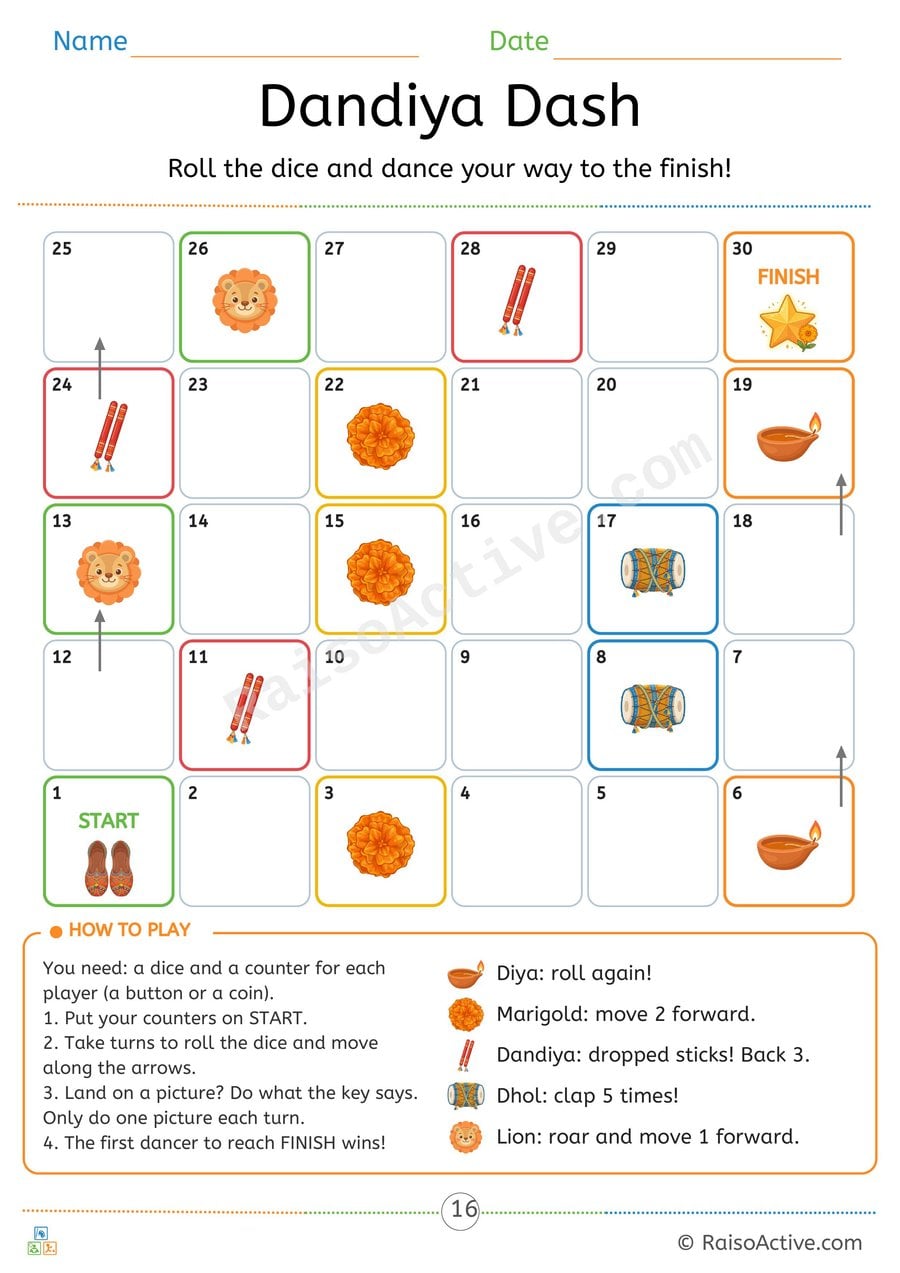
Dandiya Dash: Navratri Board Game for Kids
Ages 4-6 · Pre-K–KindergartenAges 4-6 · Reception–Year 1Ages 4-6 · LKG–UKGAges 4-6
Children count dots on a dice, count on along a number track to 30, take turns and follow simple game rules.

Big and Small Fish Counting Worksheet for Preschoolers
Ages 3-5 · Preschool–Pre-KAges 3-5 · Nursery–ReceptionAges 3-5 · Nursery–LKGAges 3-5
This counting worksheet gives children ages 3-5 practice with one-to-one correspondence — touching and counting each fish exactly once — while also comparing two groups by size. Splitting the fish into 'big' and 'small' groups before counting adds a light classification step that sharpens observation skills alongside basic numeracy. Recording each total as a written numeral also connects counting aloud to number formation.
I Spy Spring Worksheet: Count and Write!
Ages 3-5 · Preschool–Pre-KAges 3-5 · Nursery–ReceptionAges 3-5 · Nursery–LKGAges 3-5
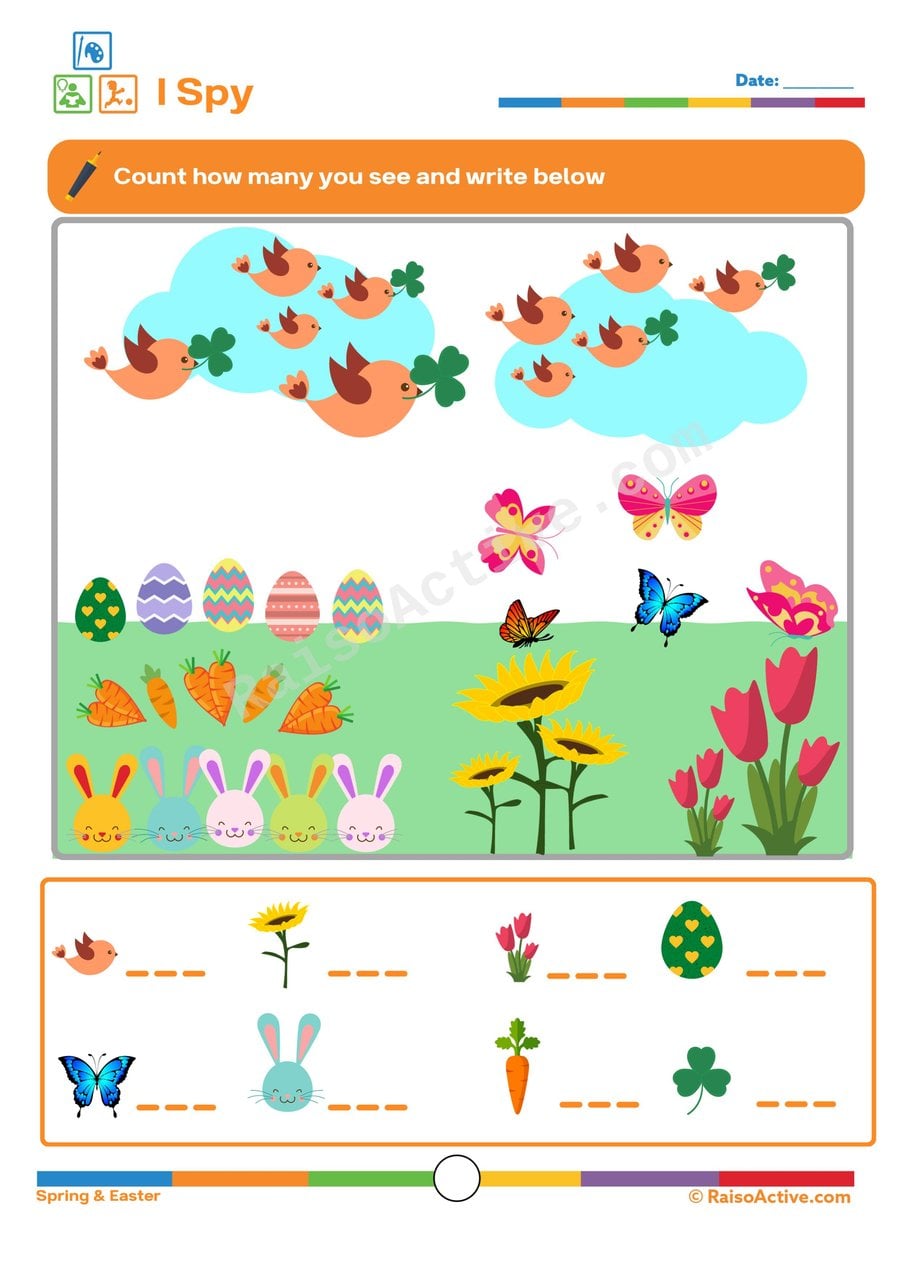
Spotting and tallying spring-themed pictures, like flowers, bees, or raindrops, gives children ages 3-5 practice with one-to-one counting and then translating that count into a written numeral. Because the items are scattered across the page rather than lined up neatly, children also build visual scanning skills as they search each section carefully before counting. Writing the final number afterward connects the physical act of counting to abstract number symbols, a key early numeracy milestone.

Ordinal Numbers Coloring Worksheet for Preschoolers
Ages 3-5 · Preschool–Pre-KAges 3-5 · Nursery–ReceptionAges 3-5 · Nursery–LKGAges 3-5
This coloring worksheet introduces children ages 3-5 to ordinal numbers — 1st, 2nd, 3rd, 4th, 5th — by having them identify and color the picture in a row that matches a given ordinal position. Ordinal numbers describe order and rank rather than quantity, which is a meaningfully different concept from the cardinal counting children usually practice first. This distinction is an important step toward understanding sequences, rankings, and everyday language like 'first place' or 'third in line.'

Festive Math: Counting Hands and Heads Worksheet
Ages 4-8 · Pre-K–Grade 2Ages 4-8 · Reception–Year 3Ages 4-8 · LKG–Class 2Ages 4-8
Children count the hands of Goddess Durga, Goddess Laxmi and Lord Ram and the heads of Ravana, and learn which festival each one belongs to.
Guides for this topic

Number Formation Rhymes 0–9 and How to Fix Reversals
Original number formation rhymes for 0–9, the correct stroke order for each digit, why 3, 5 and 7 get reversed most often, and multisensory fixes that work.

Kindergarten Readiness Checklist: 25 Skills to Practice Before the First Day
A kindergarten readiness checklist of 25 literacy, math, motor, self-regulation and self-help skills, with an 8-week summer plan and notes on when not to worry.
What Should a 4-Year-Old Know Before LKG? A Readiness Checklist
A calm, teacher-written LKG readiness checklist for 4-year-olds: language, pattern writing, numbers to 10, self-help and social skills, plus a 6-week plan.
Reviews
Every worksheet for ages 4–5, no watermark
Members download the full library of 1,000+ worksheets and every activity pack without watermarks or daily limits. One year costs ₹999 in India or $20 elsewhere.
See membership plansOr download any worksheet free with a watermark (5 a day).