Trace the Number 3 and Color the Balls! - Number Tracing Worksheet
This worksheet has children ages 3-5 trace the number 3, a shape built from two connected curves, which is more complex than the numbers 1 and 2 and continues building fine motor precision. Coloring exactly three balls after tracing reinforces one-to-one correspondence and the specific quantity the numeral 3 represents. Practicing curved numerals like 3 also prepares children for other rounded numbers they'll encounter soon, such as 8.
Part of the pack
Number Tracing & Counting Activity Book 0-20 for Preschool & Kindergarten
This is page 5 of the pack. Ages 3-6 · Preschool–KindergartenAges 3-6 · Nursery–Year 1Ages 3-6 · Nursery–UKGAges 3-6

Made for your child
Counting to 10, made for your child
A maths pack with your child's name in it: pictures that explain, practice at three levels, puzzles and story sums about them. Print a new set whenever they finish.
Make a maths packFree preview · free for members
Curriculum
- Number Recognition > Number Tracing 1-10
How to use this worksheet
Point to the dotted number 3 in each box and show your child how the two curves connect in the middle without a break, tracing slowly to demonstrate the motion. Have them trace several guided 3s, then count the balls shown on the page together out loud. Have your child color exactly three balls with a crayon, double-checking the count once they've finished coloring.
Materials needed
- Pencil
- Crayons
Extension activities
- 1Count other objects around the house in groups of three, like three books or three crayons.
- 2Have your child draw three of their favorite things on a blank sheet of paper.
- 3Practice tracing the number 3 with a finger in a tray of sand, rice, or shaving cream.
- 4Stack three blocks into a small tower together, counting each one as it's placed.

Written by
Hemsweta Jain · Teacher Cheena
MBA and Early Childhood Educator, teaching since 2014 · Founder of RaisoActive, Mumbai
Every RaisoActive worksheet is designed and checked by the founder before publishing.
Published · Last reviewed
More from Number Tracing & Counting Activity Book 0-20 for Preschool & Kindergarten
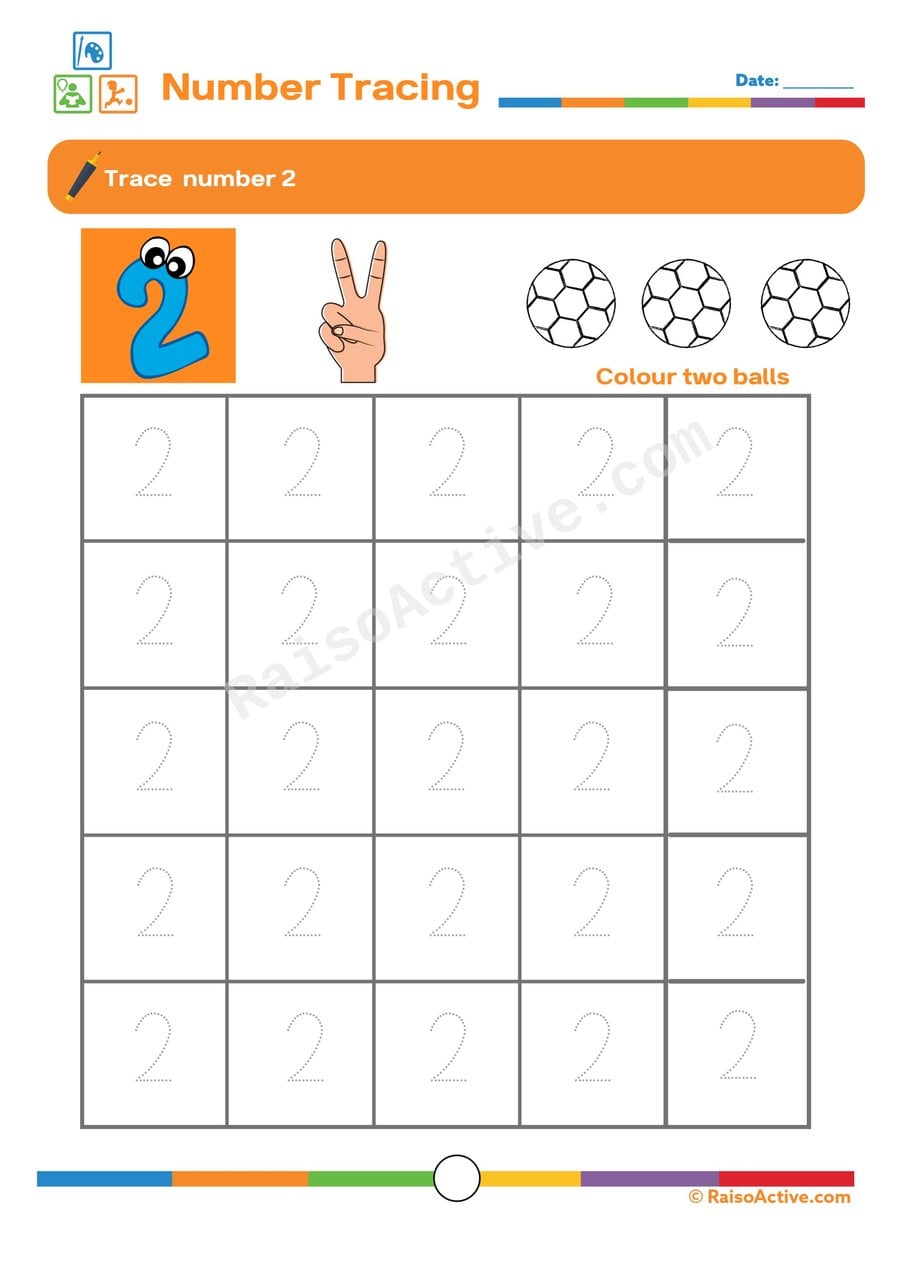
Trace and Color the Number 2 Worksheet
Ages 3-5 · Preschool–Pre-KAges 3-5 · Nursery–ReceptionAges 3-5 · Nursery–LKGAges 3-5
Tracing the number 2 introduces children ages 3-5 to a curved-then-straight stroke pattern, different from the single line of number 1, which builds more complex pencil control. Coloring exactly two soccer balls after tracing reinforces that the numeral 2 represents a specific quantity of two items, not just a shape to copy. This early pairing of writing a number with counting a matching set builds the number sense children will rely on throughout math.
Practice Sheet for Kids: Blank Grid Worksheet
Ages 3-5 · Preschool–Pre-KAges 3-5 · Nursery–ReceptionAges 3-5 · Nursery–LKGAges 3-5
This open blank grid gives children ages 3-5 a flexible space to practice handwriting readiness, drawing, or early patterning, without a fixed correct answer to work toward. Because the grid can be used for letters, numbers, drawings, or patterns depending on what a child is currently learning, it builds the general pencil control and spatial awareness of staying within a defined square, a skill that transfers to nearly every future handwriting task. This flexibility also makes it a useful tool adults can return to repeatedly as a child's skills grow.

Number Tracing Worksheet: Trace and Find Number 14!
Ages 3-5 · Preschool–Pre-KAges 3-5 · Nursery–ReceptionAges 3-5 · Nursery–LKGAges 3-5
This worksheet has children ages 3-5 trace the two-digit number 14 and then scan a grid to find and color every instance of it among other numbers, building visual discrimination alongside handwriting practice. Searching for 14 in a busy grid, rather than seeing it in isolation, helps children recognize that a number keeps its identity across different positions on a page. This kind of visual search also builds the sustained attention needed for later classroom worksheets with similar find-and-circle tasks.

Number 1 Tracing Worksheet: Trace, Count, and Color!
Ages 3-5 · Preschool–Pre-KAges 3-5 · Nursery–ReceptionAges 3-5 · Nursery–LKGAges 3-5
This worksheet gives children ages 3-5 their very first structured practice tracing a numeral, using the simplest number shape, a single straight line, to build early pencil control before moving on to curvier numbers. Counting and coloring exactly one object reinforces that the numeral 1 represents a single item, an essential first step in connecting written symbols to real quantities. Because this is often a child's introduction to number writing, it sets the pattern for how they'll approach every number worksheet that follows.
Practice Grid Worksheet for Early Learners
Ages 3-5 · Preschool–Pre-KAges 3-5 · Nursery–ReceptionAges 3-5 · Nursery–LKGAges 3-5
This blank practice grid gives children ages 3-5 an open space to build the pencil control that underlies all future handwriting, without the pressure of forming a specific letter or number correctly. Drawing lines, shapes, and marks within the boundaries of each grid square strengthens the small hand muscles and hand-eye coordination needed before children are ready for structured letter formation. Because the grid has no single correct answer, it also gives adults a low-stakes way to see how a child currently controls a pencil.

Number 5 Tracing Worksheet for Preschoolers: Trace, Count, and Color!
Ages 3-5 · Preschool–Pre-KAges 3-5 · Nursery–ReceptionAges 3-5 · Nursery–LKGAges 3-5
This worksheet has children ages 3-5 trace the number 5, a shape combining a straight line, a curve, and a short horizontal stroke, one of the more complex early numerals to form correctly. Counting and coloring exactly five apples reinforces the specific quantity the numeral 5 represents while also introducing the idea of counting a full hand's worth of objects, since five matches the fingers on one hand. This worksheet's trace-count-trace structure also builds the habit of returning to check work after a counting task.

Trace and Color the Number 4 Worksheet for Preschoolers
Ages 3-5 · Preschool–Pre-KAges 3-5 · Nursery–ReceptionAges 3-5 · Nursery–LKGAges 3-5
This worksheet has children ages 3-5 trace the number 4, a shape combining two straight lines and one diagonal line meeting at a specific point, one of the more angular early numerals to master. Coloring exactly four apples afterward reinforces one-to-one correspondence and the specific quantity the numeral 4 represents. Because 4 has more distinct angles than the numbers before it, this worksheet continues building the precise pencil control needed for increasingly complex numerals.
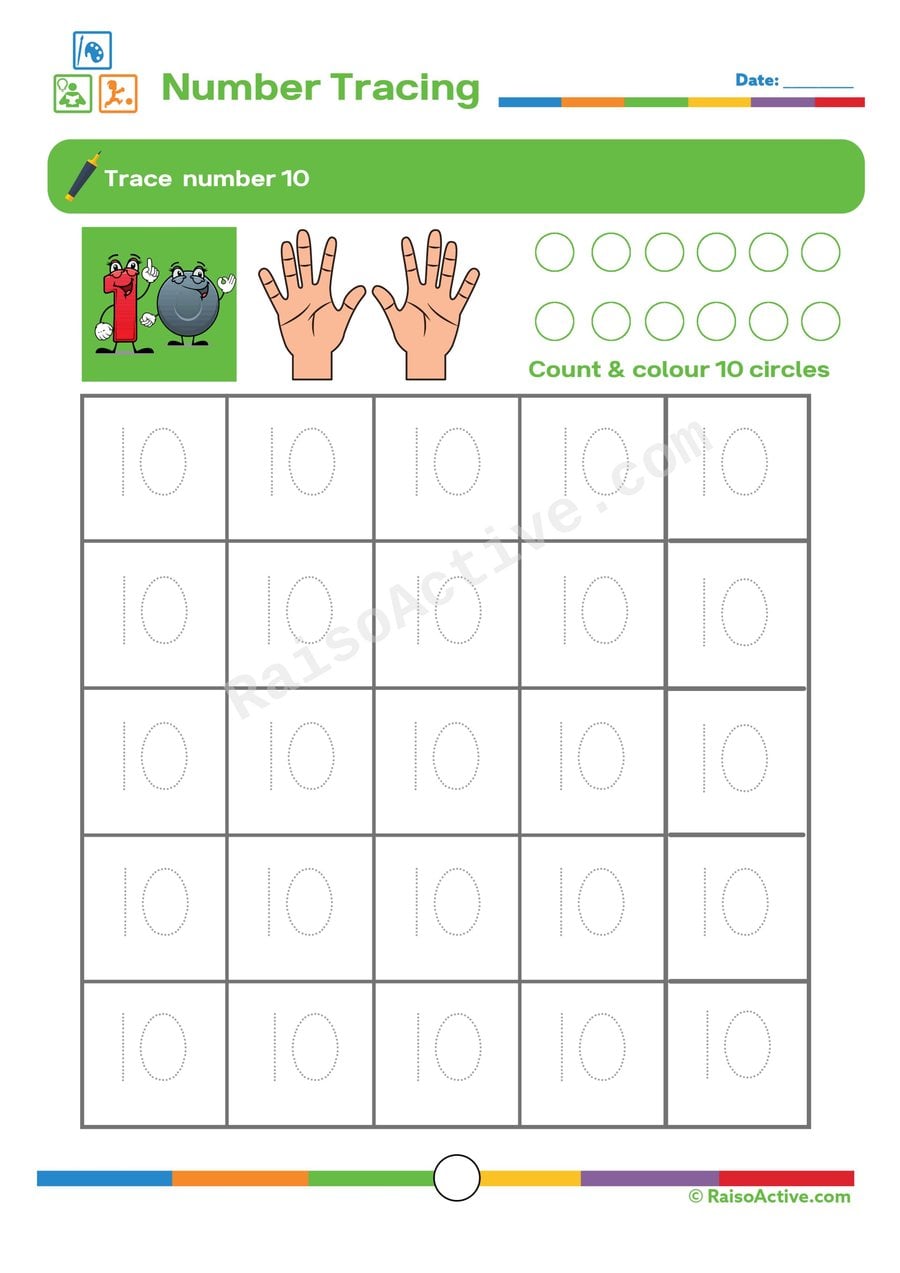
Trace and Count to 10! Number Tracing Worksheet
Ages 4-5 · Pre-KAges 4-5 · ReceptionAges 4-5 · LKGAges 4-5
This worksheet has children ages 4-5 trace the number 10, their first two-digit number in a structured sequence, and then count and color a full set of ten circles, reinforcing that 10 represents a complete group of two fives or one full set of fingers on both hands. Practicing 10 also marks an important transition point, since children who can confidently count, write, and represent 10 are ready to begin extending their counting into the teens. This combination of tracing and counting to a meaningful benchmark number builds solid number sense.
Related worksheets

Meet My Feelings: Eight Feelings Faces and Feelings Weather for Little Stars
Ages 4-6 · Pre-K–KindergartenAges 4-6 · Reception–Year 1Ages 4-6 · LKG–UKGAges 4-6
Children meet eight feelings (happy, sad, angry, scared, worried, surprised, excited and calm), each paired with a weather picture. They learn that all feelings are OK and say how they feel today.

Easter Egg Color Code Worksheet for Preschoolers
Ages 3-5 · Preschool–Pre-KAges 3-5 · Nursery–ReceptionAges 3-5 · Nursery–LKGAges 3-5
Matching numbers on each Easter egg section to a color key builds number recognition and color-word association in children ages 3-5, since they must hold both a numeral and its assigned color in mind while coloring. This kind of coded coloring activity also strengthens visual scanning, as children need to locate the small numbers printed inside each egg section before choosing the right crayon. Completing the code correctly gives an immediate, visible reward when a colorful, patterned egg emerges from the numbered outline.

My Feelings Garden: A Week of Feelings Flowers and Calm Sentences
Ages 4-6 · Pre-K–KindergartenAges 4-6 · Reception–Year 1Ages 4-6 · LKG–UKGAges 4-6
Children track a week of feelings with a flower for each day, choosing a feeling colour for the petals. They trace and write three kind sentences and record the weather.
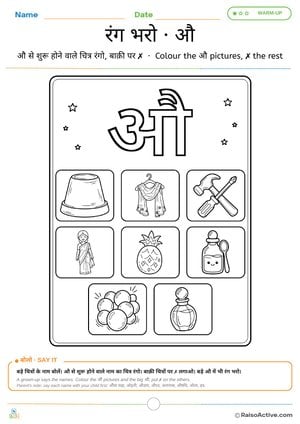
Colour the औ Words – Hindi Letter औ (au) Colouring Worksheet | औ वाली चीज़ों में रंग भरो
Ages 3-7 · Preschool–Grade 1Ages 3-7 · Nursery–Year 2Ages 3-7 · Nursery–Class 1Ages 3-7
Children say each picture name aloud, decide whether it starts with औ, colour the matching pictures (औंधा घड़ा, औज़ार, औरत and औषधि) and the big outline letter, and put a cross on the rest. Sorting by first sound trains the ear and colouring builds hand control.

Navratri Rangoli Colour by Number and Symmetry Diya
Ages 4-6 · Pre-K–KindergartenAges 4-6 · Reception–Year 1Ages 4-6 · LKG–UKGAges 4-6
Children match numbers to colours using a key, colour a rangoli pattern carefully and draw the other half of a shape so both sides match.

Symmetry Fun Worksheet for Kids: Complete and Color!
Ages 3-5 · Preschool–Pre-KAges 3-5 · Nursery–ReceptionAges 3-5 · Nursery–LKGAges 3-5
This symmetry worksheet challenges children ages 3-5 to study a half-drawn Christmas picture and draw the missing mirror-image half, introducing the early geometry concept that two sides of a shape can match exactly. Completing and then coloring the picture also builds visual comparison skills, since children must check their drawn half against the original before filling it in with color.
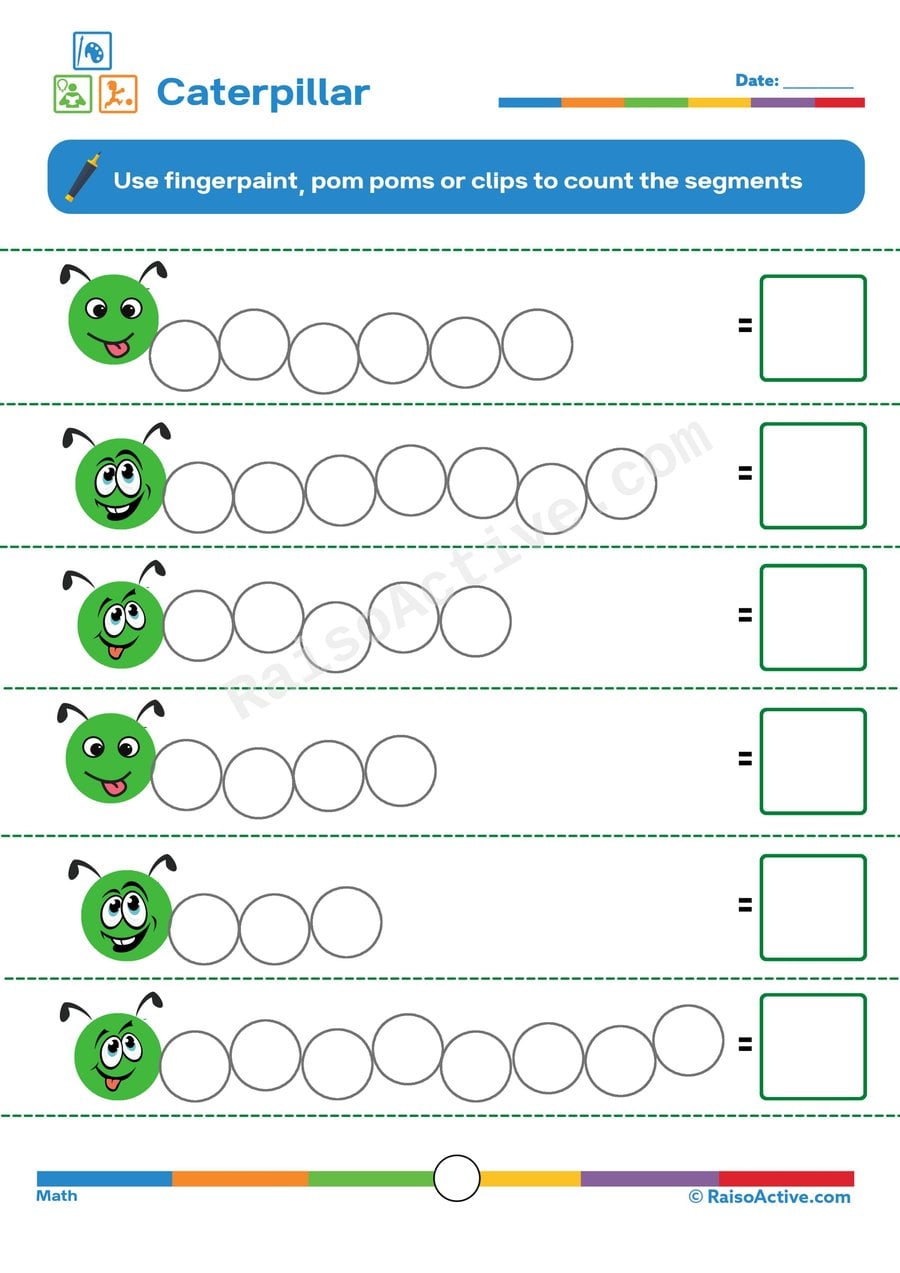
Caterpillar Counting Worksheet for Preschoolers
Ages 3-5 · Preschool–Pre-KAges 3-5 · Nursery–ReceptionAges 3-5 · Nursery–LKGAges 3-5
Counting the segments of each caterpillar teaches children ages 3-5 one-to-one correspondence — touching or marking each segment exactly once while saying a number — which is the core skill underlying accurate counting. Writing the final total in a box also connects the physical act of counting to its written numeral, reinforcing early number-writing practice.
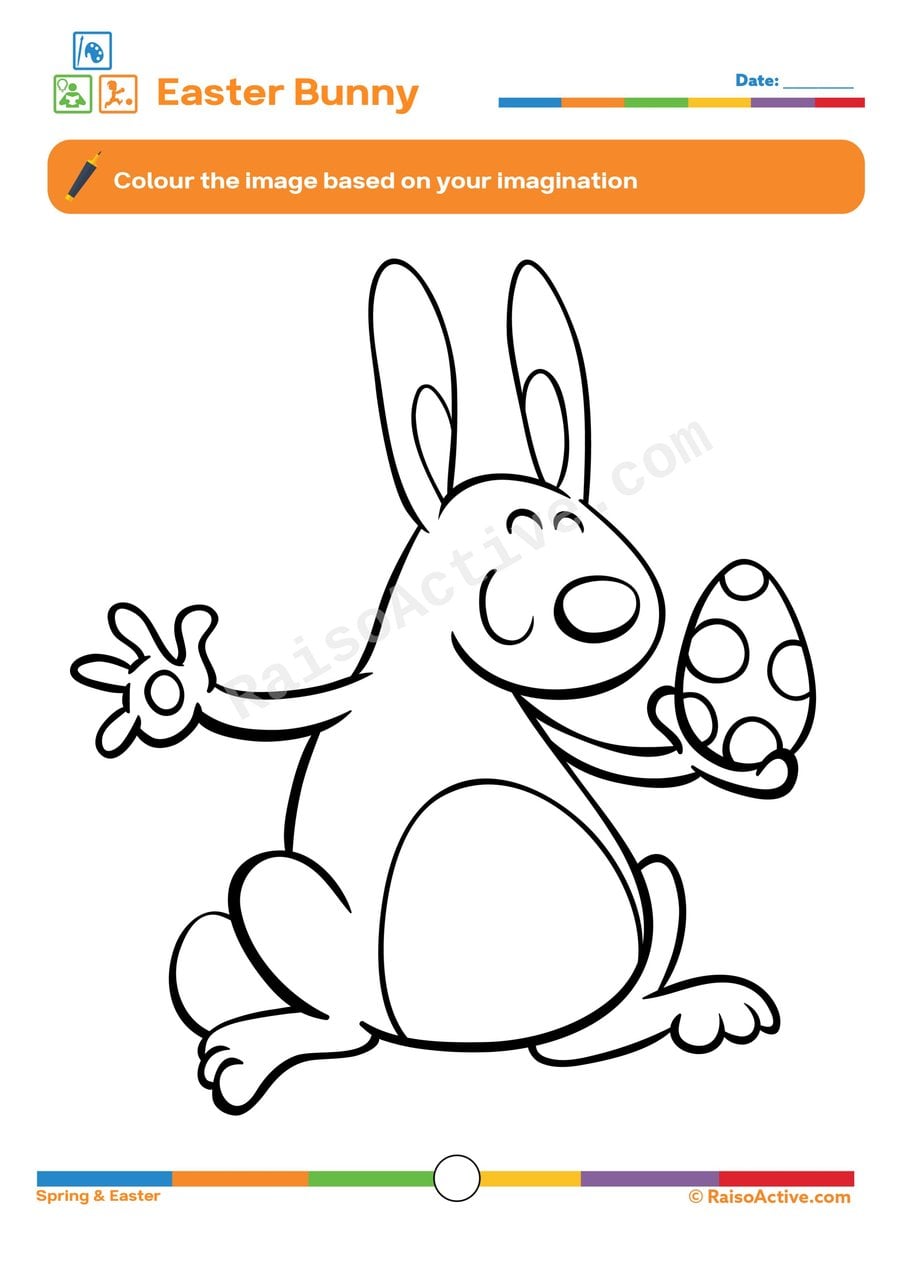
Easter Bunny Coloring Worksheet for Kids
Ages 3-5 · Preschool–Pre-KAges 3-5 · Nursery–ReceptionAges 3-5 · Nursery–LKGAges 3-5
Children ages 3-5 build fine motor control and creative expression while coloring an Easter bunny and egg using crayons or colored pencils. Open-ended coloring tasks like this one, without a strict color code, give children room to make independent choices while still practicing the pencil grip and control needed for later writing.
Guides for this topic

Number Formation Rhymes 0–9 and How to Fix Reversals
Original number formation rhymes for 0–9, the correct stroke order for each digit, why 3, 5 and 7 get reversed most often, and multisensory fixes that work.

Best Worksheets for 3-Year-Olds: What Works and What to Avoid
What works on worksheets for 3-year-olds: short sessions, crayons, tracing lines, matching, cutting, a free weekly plan, and signs one is too advanced.
Fostering Creativity in Structured Learning: The Perfect Balance for Young Minds
Learn how to blend creativity with structured learning for children ages 1-8. Practical strategies, activities, and printable worksheets for parents and teachers.
Reviews
Every worksheet for ages 3–5, no watermark
Members download the full library of 1,000+ worksheets and every activity pack without watermarks or daily limits. One year costs ₹999 in India or $20 elsewhere.
See membership plansOr download any worksheet free with a watermark (5 a day).