Trace and Color the Number 2 Worksheet
Tracing the number 2 introduces children ages 3-5 to a curved-then-straight stroke pattern, different from the single line of number 1, which builds more complex pencil control. Coloring exactly two soccer balls after tracing reinforces that the numeral 2 represents a specific quantity of two items, not just a shape to copy. This early pairing of writing a number with counting a matching set builds the number sense children will rely on throughout math.
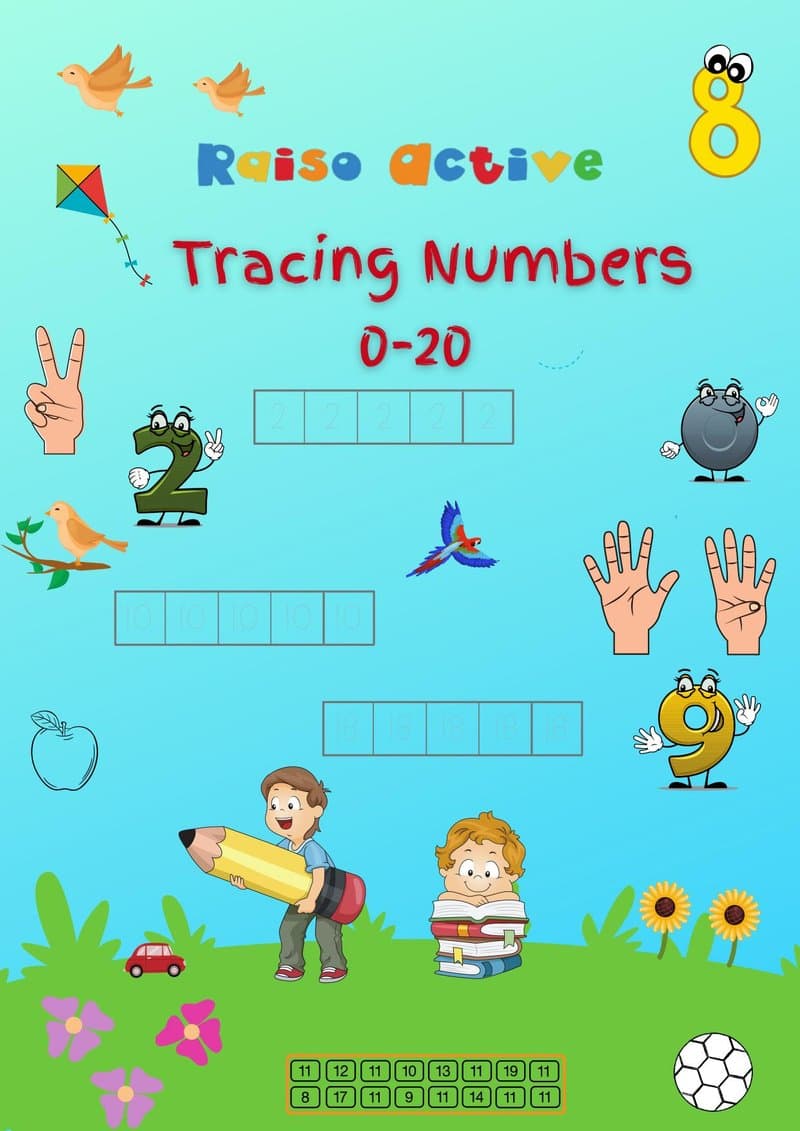
Part of the pack
Number Tracing & Counting Activity Book 0-20 for Preschool & Kindergarten
This is page 4 of the pack. Ages 3-6 · Preschool–KindergartenAges 3-6 · Nursery–Year 1Ages 3-6 · Nursery–UKGAges 3-6

Made for your child
Counting to 10, made for your child
A maths pack with your child's name in it: pictures that explain, practice at three levels, puzzles and story sums about them. Print a new set whenever they finish.
Make a maths packFree preview · free for members
Curriculum
- Number Recognition > Number Tracing 1-10
How to use this worksheet
Show your child the dotted number 2 in the boxes and demonstrate the curve at the top followed by the straight line along the bottom, tracing slowly so they can see the two-part motion. Have them trace several guided 2s, then look at the row of soccer balls and count out loud together to find exactly two. Have your child color those two soccer balls with a crayon, leaving the rest uncolored to reinforce the specific quantity.
Materials needed
- Pencil
- Crayons
Extension activities
- 1Have your child find pairs of objects around the house, like two shoes or two socks, and count them together.
- 2Practice writing the number 2 on a whiteboard or in a notebook for extra repetition.
- 3Kick a ball back and forth exactly two times and count out loud together.
- 4Draw two of your child's favorite things on a blank piece of paper.

Written by
Hemsweta Jain · Teacher Cheena
MBA and Early Childhood Educator, teaching since 2014 · Founder of RaisoActive, Mumbai
Every RaisoActive worksheet is designed and checked by the founder before publishing.
Published · Last reviewed
More from Number Tracing & Counting Activity Book 0-20 for Preschool & Kindergarten
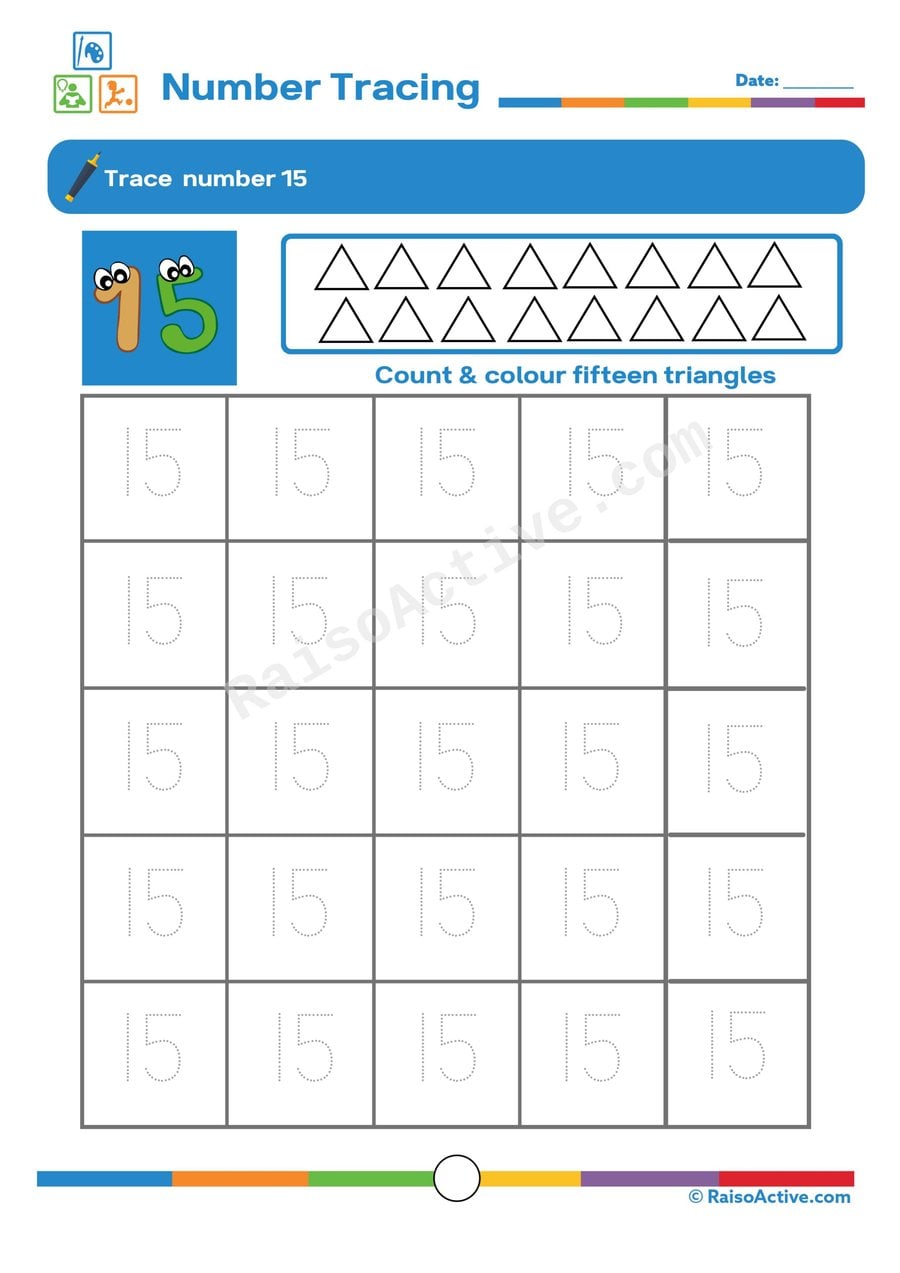
Number Tracing Worksheet: Trace and Count to 15!
Ages 4-6 · Pre-K–KindergartenAges 4-6 · Reception–Year 1Ages 4-6 · LKG–UKGAges 4-6
This worksheet has children ages 4-6 trace the number 15 and then count and color a full set of fifteen triangles, extending their counting range further into the teens than many earlier worksheets. Counting all the way to fifteen requires children to keep track across a larger set without losing their place, building the working memory and sustained attention needed for extended counting. Introducing triangles instead of circles or balls also lets this worksheet quietly reinforce basic shape recognition alongside the counting task.

Trace and Count: Number 18 Worksheet for Preschoolers
Ages 4-5 · Pre-KAges 4-5 · ReceptionAges 4-5 · LKGAges 4-5
This worksheet has children ages 4-5 trace the number 18 and then count and color a full set of eighteen hearts, continuing to build stamina for counting well into the teens range. Because eighteen is close to twenty, successfully counting this many objects without losing track shows real progress in sustained attention and one-to-one correspondence. Using hearts instead of a more neutral shape also adds a small, engaging visual theme to an otherwise repetitive counting task.

Number Tracing Worksheet: Trace and Find the Number 11!
Ages 3-5 · Preschool–Pre-KAges 3-5 · Nursery–ReceptionAges 3-5 · Nursery–LKGAges 3-5
This worksheet introduces children ages 3-5 to their first two-digit number, helping them understand that 11 is written with two number 1s placed side by side rather than as a brand-new symbol. Tracing 11 builds the pencil control needed to write two digits neatly in a row, while the search-and-find grid strengthens visual scanning skills as children pick 11 out from a field of similar-looking numbers. This combination supports both number recognition and the beginning of place-value thinking.

Trace and Count the Number 17 Worksheet for Preschoolers
Ages 3-5 · Preschool–Pre-KAges 3-5 · Nursery–ReceptionAges 3-5 · Nursery–LKGAges 3-5
This worksheet challenges children ages 3-5 to trace the two-digit number 17 and then count out a matching set of seventeen rectangles, linking the written numeral to an actual quantity they can see and touch. Counting all the way to 17 pushes children past the more familiar 1-10 range and builds stamina for extended counting sequences. It also reinforces one-to-one correspondence, the skill of matching each number word to exactly one object as they count.

Trace the Number 3 and Color the Balls! - Number Tracing Worksheet
Ages 3-5 · Preschool–Pre-KAges 3-5 · Nursery–ReceptionAges 3-5 · Nursery–LKGAges 3-5
This worksheet has children ages 3-5 trace the number 3, a shape built from two connected curves, which is more complex than the numbers 1 and 2 and continues building fine motor precision. Coloring exactly three balls after tracing reinforces one-to-one correspondence and the specific quantity the numeral 3 represents. Practicing curved numerals like 3 also prepares children for other rounded numbers they'll encounter soon, such as 8.

Trace and Count the Number 16 Worksheet for Preschoolers
Ages 4-5 · Pre-KAges 4-5 · ReceptionAges 4-5 · LKGAges 4-5
This worksheet has children ages 4-5 trace the two-digit number 16 and then count and color a full set of sixteen squares, continuing to build counting stamina in the teens range that many children find more challenging than counting to 10. Because 16 combines a 1 and a 6, tracing it reinforces the same two-digit writing pattern practiced with numbers like 11 through 15, helping children generalize the pattern rather than treating each teen number as entirely new. Counting squares instead of round objects also quietly introduces basic shape vocabulary.
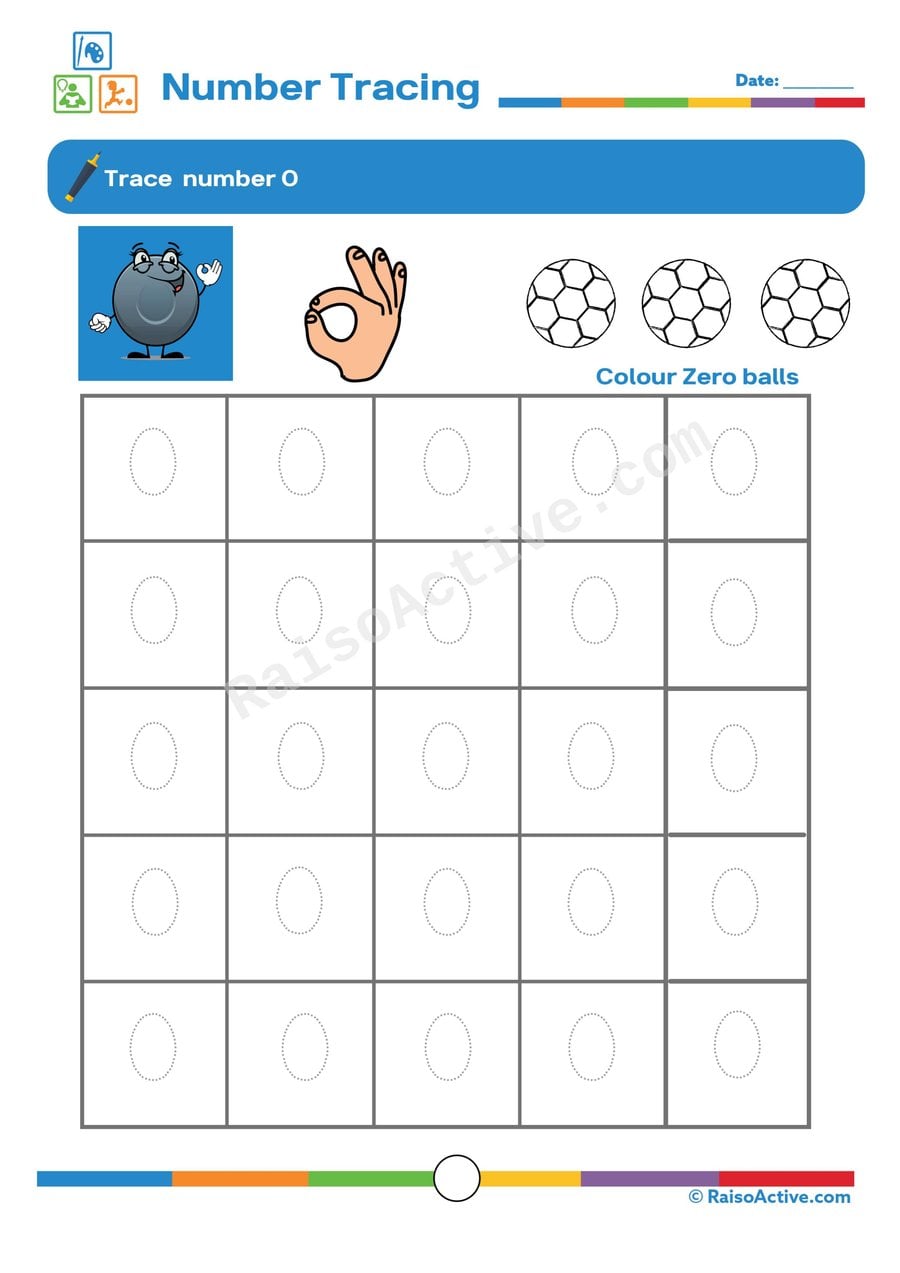
Trace the Number 0 Worksheet for Preschoolers
Ages 3-5 · Preschool–Pre-KAges 3-5 · Nursery–ReceptionAges 3-5 · Nursery–LKGAges 3-5
This worksheet introduces children ages 3-5 to the number 0, an abstract and often confusing concept since it represents the absence of a quantity rather than a countable group of objects. Tracing the closed loop of 0 builds the same round pencil control practiced with letters like O, while the coloring task, which asks children to color zero balls, gently introduces the idea that zero means none at all. This early exposure to zero as a real number lays groundwork for understanding it fully in later math.

Trace and Count: Number 7 Worksheet for Preschoolers
Ages 3-5 · Preschool–Pre-KAges 3-5 · Nursery–ReceptionAges 3-5 · Nursery–LKGAges 3-5
This worksheet has children ages 3-5 trace the number 7, formed from a straight horizontal line followed by a diagonal line down, and then count out seven cars from a larger group, an important step up from earlier worksheets that show only the exact quantity needed. Because the page includes more cars than the number seven, children must count carefully and stop at the right point rather than simply circling everything shown. This distinction between 'how many are here' and 'find exactly this many' builds a more precise counting skill.
Related worksheets
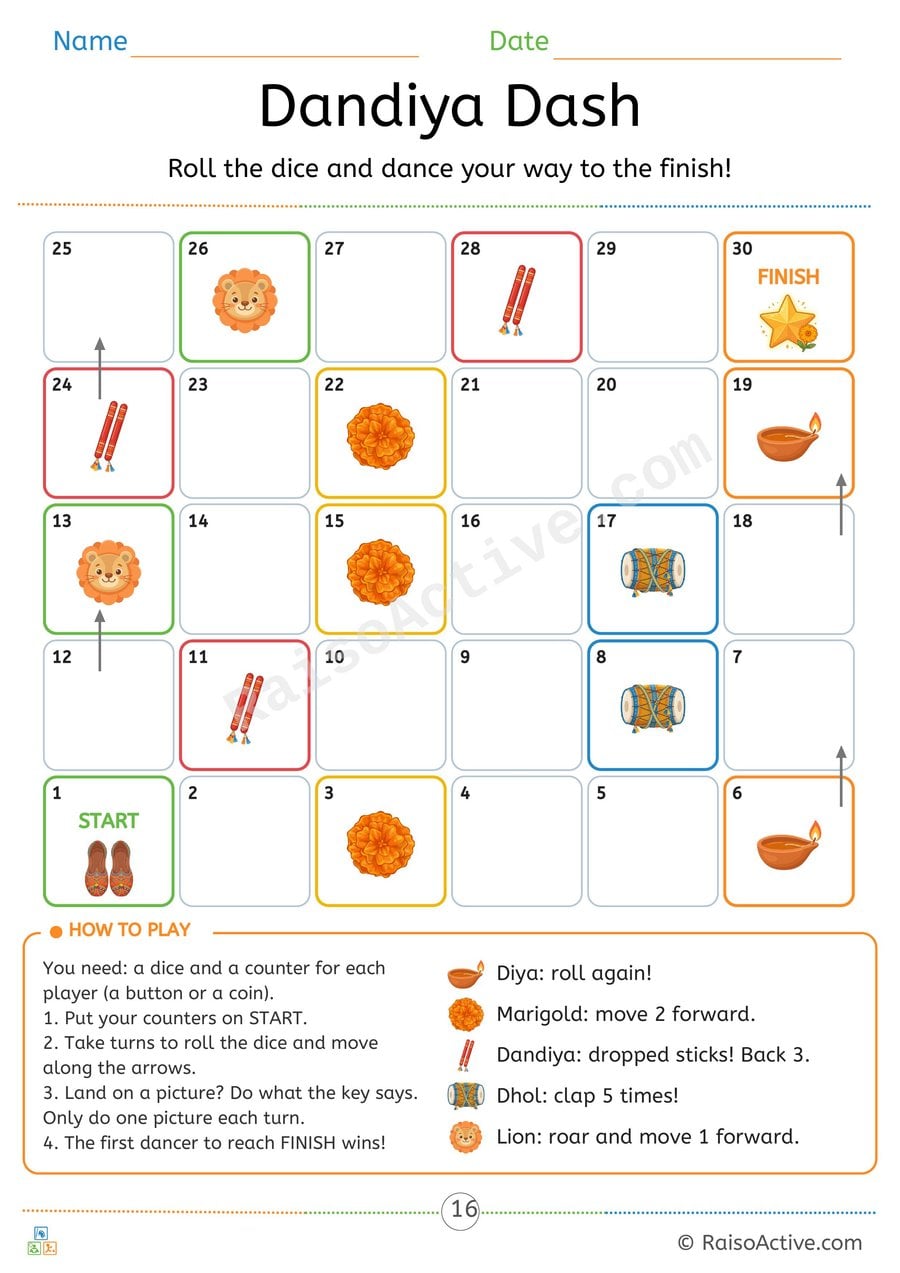
Dandiya Dash: Navratri Board Game for Kids
Ages 4-6 · Pre-K–KindergartenAges 4-6 · Reception–Year 1Ages 4-6 · LKG–UKGAges 4-6
Children count dots on a dice, count on along a number track to 30, take turns and follow simple game rules.
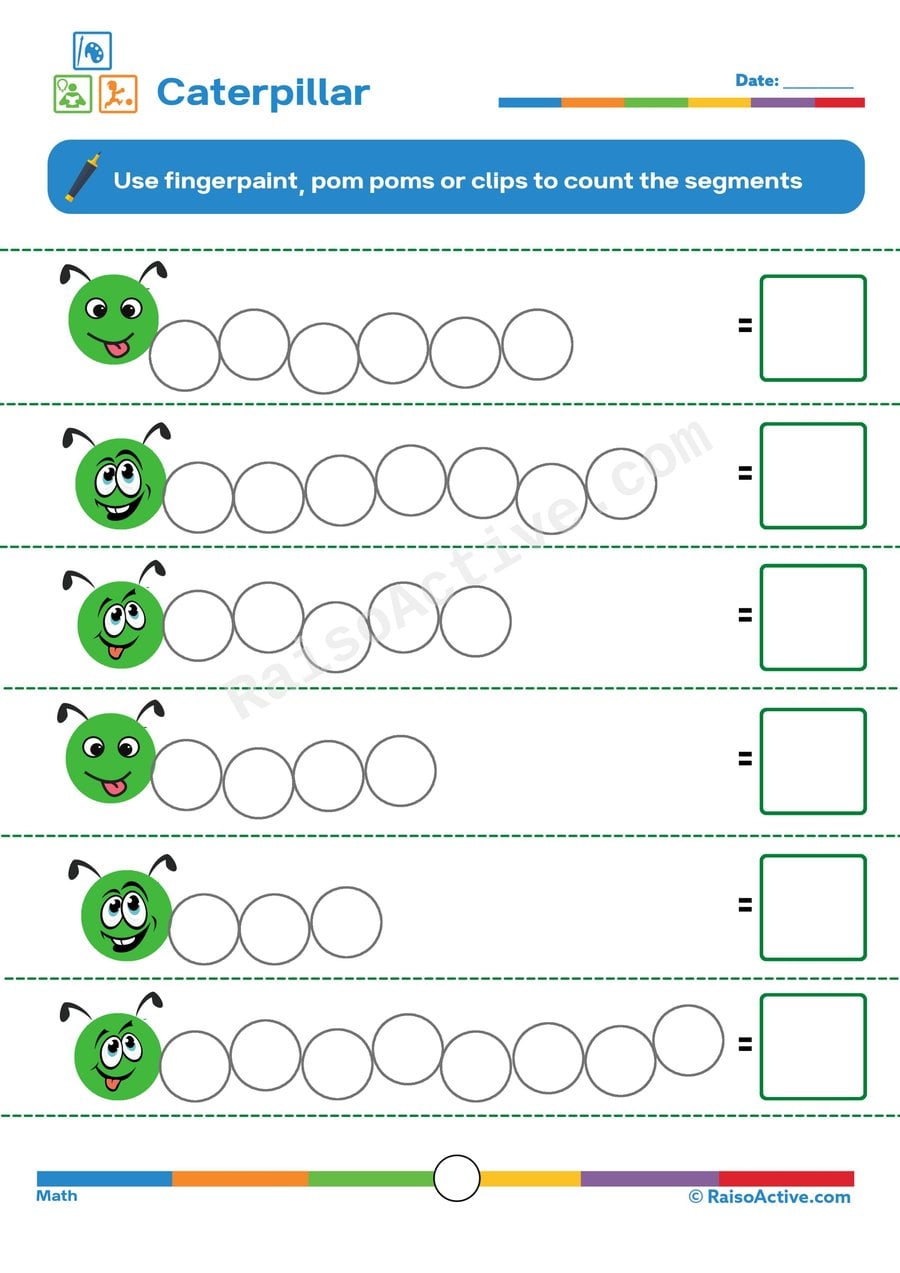
Caterpillar Counting Worksheet for Preschoolers
Ages 3-5 · Preschool–Pre-KAges 3-5 · Nursery–ReceptionAges 3-5 · Nursery–LKGAges 3-5
Counting the segments of each caterpillar teaches children ages 3-5 one-to-one correspondence — touching or marking each segment exactly once while saying a number — which is the core skill underlying accurate counting. Writing the final total in a box also connects the physical act of counting to its written numeral, reinforcing early number-writing practice.

Trace the Numbers 1-9 Worksheet for Preschoolers
Ages 3-5 · Preschool–Pre-KAges 3-5 · Nursery–ReceptionAges 3-5 · Nursery–LKGAges 3-5
Tracing the numerals 1 through 9 gives children ages 3-5 repeated, guided practice with the specific pencil strokes each number requires, building the fine motor control and muscle memory needed for independent number writing. Because tracing follows a fixed, correct path, it also reinforces accurate numeral recognition, helping children tell visually similar digits apart.
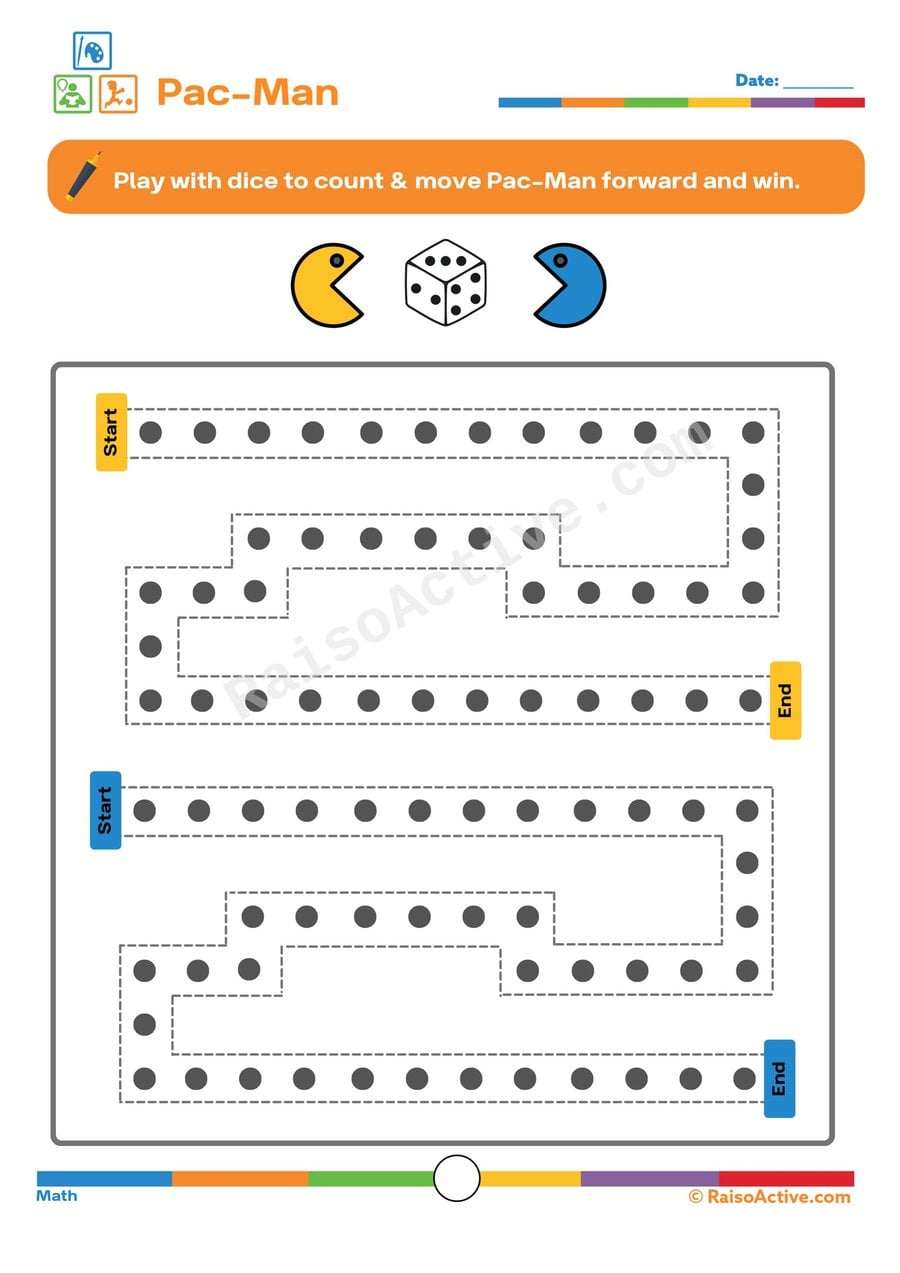
Pac-Man Maze Worksheet: Count and Move!
Ages 3-5 · Preschool–Pre-KAges 3-5 · Nursery–ReceptionAges 3-5 · Nursery–LKGAges 3-5
This dice-driven maze combines counting practice with path-following for children ages 3-5, since they must accurately count dots on a die before moving Pac-Man the matching number of spaces forward. Deciding how far to move and staying on the correct path also builds early strategic thinking, as children track their current position within the maze after each turn.
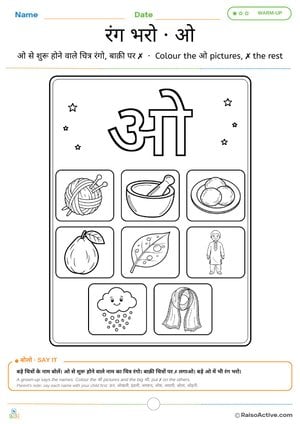
Colour the ओ Words – Hindi Letter ओ (o) Colouring Worksheet | ओ वाली चीज़ों में रंग भरो
Ages 3-7 · Preschool–Grade 1Ages 3-7 · Nursery–Year 2Ages 3-7 · Nursery–Class 1Ages 3-7
Children say each picture name aloud, decide whether it starts with ओ, colour the matching pictures (ओखली, ओस, ओला and ओढ़नी) and the big outline letter, and put a cross on the rest. Sorting by first sound trains the ear and colouring builds hand control.

Dussehra and First Letters: Vidyarambham Tracing and Letter Hunt
Ages 4-6 · Pre-K–KindergartenAges 4-6 · Reception–Year 1Ages 4-6 · LKG–UKGAges 4-6
Children learn about Vidyarambham, when little children write their first letters in rice on Vijayadashami, and about Dussehra, when Rama won against Ravana. They trace letters, sort things we use to learn, count to 10 and match letters to beginning sounds.

Meet My Feelings: Eight Feelings Faces and Feelings Weather for Little Stars
Ages 4-6 · Pre-K–KindergartenAges 4-6 · Reception–Year 1Ages 4-6 · LKG–UKGAges 4-6
Children meet eight feelings (happy, sad, angry, scared, worried, surprised, excited and calm), each paired with a weather picture. They learn that all feelings are OK and say how they feel today.
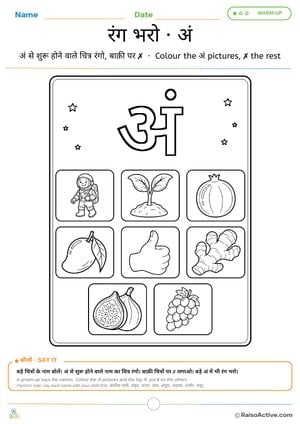
Colour the अं Words – Hindi Letter अं (am) Colouring Worksheet | अं वाली चीज़ों में रंग भरो
Ages 3-7 · Preschool–Grade 1Ages 3-7 · Nursery–Year 2Ages 3-7 · Nursery–Class 1Ages 3-7
Children say each picture name aloud, decide whether it starts with अं, colour the matching pictures (अंकुर, अंतरिक्ष यात्री, अंजीर, अंगूठा and अंगूर) and the big outline letter, and put a cross on the rest. Sorting by first sound trains the ear and colouring builds hand control.
Guides for this topic

Number Formation Rhymes 0–9 and How to Fix Reversals
Original number formation rhymes for 0–9, the correct stroke order for each digit, why 3, 5 and 7 get reversed most often, and multisensory fixes that work.

Best Worksheets for 3-Year-Olds: What Works and What to Avoid
What works on worksheets for 3-year-olds: short sessions, crayons, tracing lines, matching, cutting, a free weekly plan, and signs one is too advanced.
Fostering Creativity in Structured Learning: The Perfect Balance for Young Minds
Learn how to blend creativity with structured learning for children ages 1-8. Practical strategies, activities, and printable worksheets for parents and teachers.
Reviews
Every worksheet for ages 3–5, no watermark
Members download the full library of 1,000+ worksheets and every activity pack without watermarks or daily limits. One year costs ₹999 in India or $20 elsewhere.
See membership plansOr download any worksheet free with a watermark (5 a day).