Trace and Count: Number 6 Worksheet for Preschoolers
This worksheet has children ages 3-5 trace the number 6, a shape built from a curved line ending in a small loop, and then count and circle exactly six cars from a larger group. Because the group likely contains more than six cars, children must count carefully and stop at the right quantity, building the more precise counting skill of selecting a specific amount rather than counting everything in sight. The curved, looping shape of 6 also previews the stroke pattern used in numbers like 8 and 9.
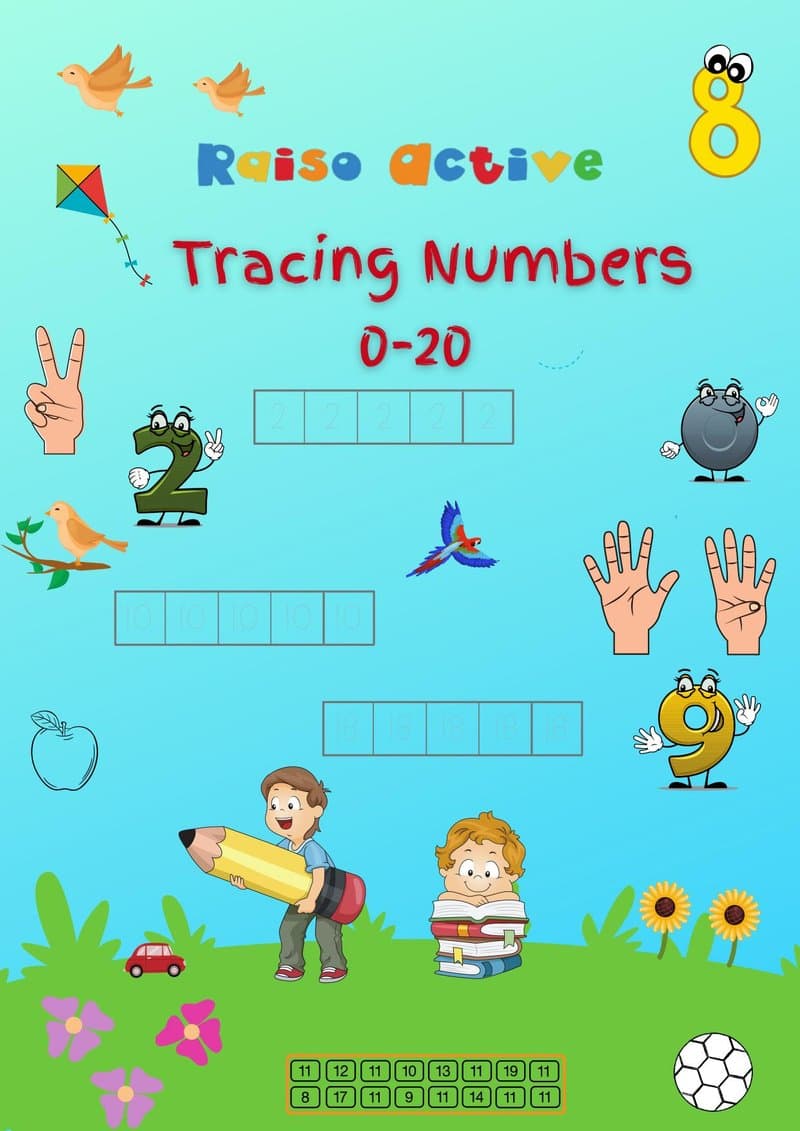
Part of the pack
Number Tracing & Counting Activity Book 0-20 for Preschool & Kindergarten
This is page 8 of the pack. Ages 3-6 · Preschool–KindergartenAges 3-6 · Nursery–Year 1Ages 3-6 · Nursery–UKGAges 3-6

Made for your child
Counting to 10, made for your child
A maths pack with your child's name in it: pictures that explain, practice at three levels, puzzles and story sums about them. Print a new set whenever they finish.
Make a maths packFree preview · free for members
Curriculum
- Number Recognition > Number Tracing 1-10
How to use this worksheet
Show your child the dotted number 6 and demonstrate tracing the curve down and around into the small loop at the bottom, moving in one continuous motion. Have them trace several guided 6s, then count the row of cars together out loud, circling exactly six with a crayon or pencil. Recount the circled cars at the end to confirm the total matches six.
Materials needed
- Pencil
- Crayons
Extension activities
- 1Have your child find 6 objects around the house, like toy cars or blocks, and count them together.
- 2Practice writing the number 6 on a whiteboard or piece of paper for extra repetition.
- 3Encourage your child to draw six of their favorite things on a blank sheet of paper.
- 4Play a clapping or jumping game where your child counts out loud to six while moving.

Written by
Hemsweta Jain · Teacher Cheena
MBA and Early Childhood Educator, teaching since 2014 · Founder of RaisoActive, Mumbai
Every RaisoActive worksheet is designed and checked by the founder before publishing.
Published · Last reviewed
More from Number Tracing & Counting Activity Book 0-20 for Preschool & Kindergarten

Trace the Number 3 and Color the Balls! - Number Tracing Worksheet
Ages 3-5 · Preschool–Pre-KAges 3-5 · Nursery–ReceptionAges 3-5 · Nursery–LKGAges 3-5
This worksheet has children ages 3-5 trace the number 3, a shape built from two connected curves, which is more complex than the numbers 1 and 2 and continues building fine motor precision. Coloring exactly three balls after tracing reinforces one-to-one correspondence and the specific quantity the numeral 3 represents. Practicing curved numerals like 3 also prepares children for other rounded numbers they'll encounter soon, such as 8.
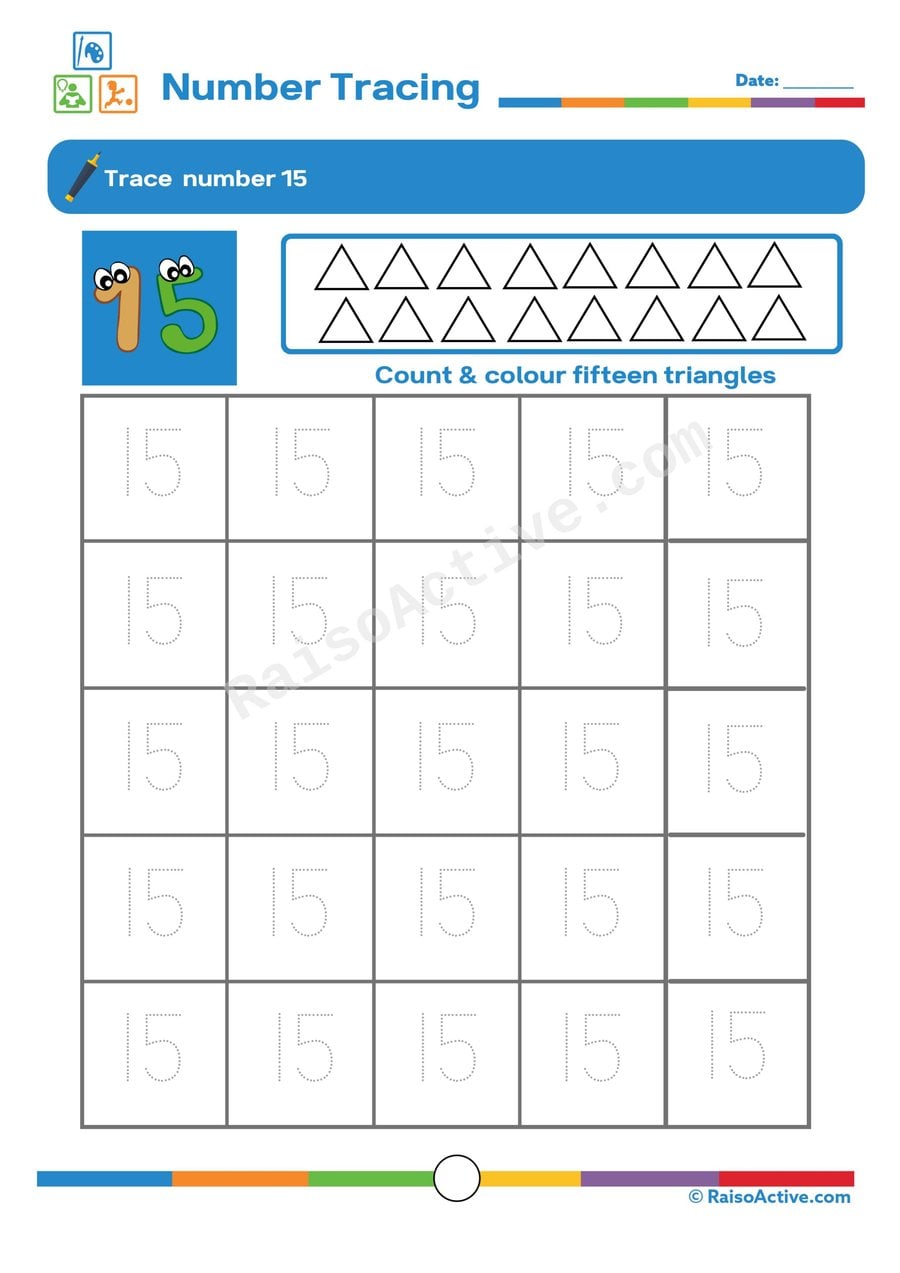
Number Tracing Worksheet: Trace and Count to 15!
Ages 4-6 · Pre-K–KindergartenAges 4-6 · Reception–Year 1Ages 4-6 · LKG–UKGAges 4-6
This worksheet has children ages 4-6 trace the number 15 and then count and color a full set of fifteen triangles, extending their counting range further into the teens than many earlier worksheets. Counting all the way to fifteen requires children to keep track across a larger set without losing their place, building the working memory and sustained attention needed for extended counting. Introducing triangles instead of circles or balls also lets this worksheet quietly reinforce basic shape recognition alongside the counting task.

Number Tracing Worksheet 1-20: Practice Writing Numbers!
Ages 3-5 · Preschool–Pre-KAges 3-5 · Nursery–ReceptionAges 3-5 · Nursery–LKGAges 3-5
This worksheet gives children ages 3-5 a second full pass at tracing every number from 1 to 20, repeating the entire sequence to build the muscle memory that comes only from writing each numeral more than once. Revisiting the complete range reinforces both the shape of each number and their order in the counting sequence, helping children internalize the pattern rather than relying on the worksheet as a one-time reference. This repetition matters especially for the trickier two-digit numbers in the teens, which often need more practice than single digits.
Practice Grid Worksheet for Early Learners
Ages 3-5 · Preschool–Pre-KAges 3-5 · Nursery–ReceptionAges 3-5 · Nursery–LKGAges 3-5
This blank practice grid gives children ages 3-5 an open space to build the pencil control that underlies all future handwriting, without the pressure of forming a specific letter or number correctly. Drawing lines, shapes, and marks within the boundaries of each grid square strengthens the small hand muscles and hand-eye coordination needed before children are ready for structured letter formation. Because the grid has no single correct answer, it also gives adults a low-stakes way to see how a child currently controls a pencil.

Number Tracing Worksheet 1-20: Practice Writing Numbers!
Ages 3-5 · Preschool–Pre-KAges 3-5 · Nursery–ReceptionAges 3-5 · Nursery–LKGAges 3-5
This worksheet has children ages 3-5 trace every number from 1 to 20 in sequence, giving them a single, comprehensive review of number formation across the entire range they're expected to master before kindergarten. Practicing the full sequence in one sitting, rather than one number at a time, also reinforces the order of the counting sequence itself, since children see each number in its proper place relative to the ones before and after it. Following directional arrows throughout builds the habit of starting every numeral in the correct place.

Number Tracing Worksheet: Trace and Find the Number 11!
Ages 3-5 · Preschool–Pre-KAges 3-5 · Nursery–ReceptionAges 3-5 · Nursery–LKGAges 3-5
This worksheet introduces children ages 3-5 to their first two-digit number, helping them understand that 11 is written with two number 1s placed side by side rather than as a brand-new symbol. Tracing 11 builds the pencil control needed to write two digits neatly in a row, while the search-and-find grid strengthens visual scanning skills as children pick 11 out from a field of similar-looking numbers. This combination supports both number recognition and the beginning of place-value thinking.
Practice Sheet for Kids: Blank Grid Worksheet
Ages 3-5 · Preschool–Pre-KAges 3-5 · Nursery–ReceptionAges 3-5 · Nursery–LKGAges 3-5
This open blank grid gives children ages 3-5 a flexible space to practice handwriting readiness, drawing, or early patterning, without a fixed correct answer to work toward. Because the grid can be used for letters, numbers, drawings, or patterns depending on what a child is currently learning, it builds the general pencil control and spatial awareness of staying within a defined square, a skill that transfers to nearly every future handwriting task. This flexibility also makes it a useful tool adults can return to repeatedly as a child's skills grow.

Trace and Color the Number 4 Worksheet for Preschoolers
Ages 3-5 · Preschool–Pre-KAges 3-5 · Nursery–ReceptionAges 3-5 · Nursery–LKGAges 3-5
This worksheet has children ages 3-5 trace the number 4, a shape combining two straight lines and one diagonal line meeting at a specific point, one of the more angular early numerals to master. Coloring exactly four apples afterward reinforces one-to-one correspondence and the specific quantity the numeral 4 represents. Because 4 has more distinct angles than the numbers before it, this worksheet continues building the precise pencil control needed for increasingly complex numerals.
Related worksheets

I Spy Letters and Numbers Worksheet: Find, Match, and Write!
Ages 4-5 · Pre-KAges 4-5 · ReceptionAges 4-5 · LKGAges 4-5
This worksheet blends letter and number recognition for children ages 4-5, asking them to spot a hidden letter within a picture, find its matching number, and then write both symbols down, combining visual search with early literacy and numeracy in a single activity. Working with letters and numbers side by side reinforces that both are symbols that carry specific meaning and can be found, matched, and recorded.

Modak and Mouse Counting Worksheet for Ganesh Chaturthi
Ages 4-8 · Pre-K–Grade 2Ages 4-8 · Reception–Year 3Ages 4-8 · LKG–Class 2Ages 4-8
Children count the modaks in each row and match every mouse to the row with the same number, practising counting to 7 and one-to-one matching.

Spot the Spots! Spring Coloring Worksheet for Preschoolers
Ages 3-5 · Preschool–Pre-KAges 3-5 · Nursery–ReceptionAges 3-5 · Nursery–LKGAges 3-5
This worksheet pairs counting practice with coloring as children ages 3-5 look at a number written beside each picture and color exactly that many spots onto it, reinforcing one-to-one correspondence between a numeral and a matching quantity. Because the target number changes from picture to picture, children must check the number freshly each time rather than coloring on autopilot.
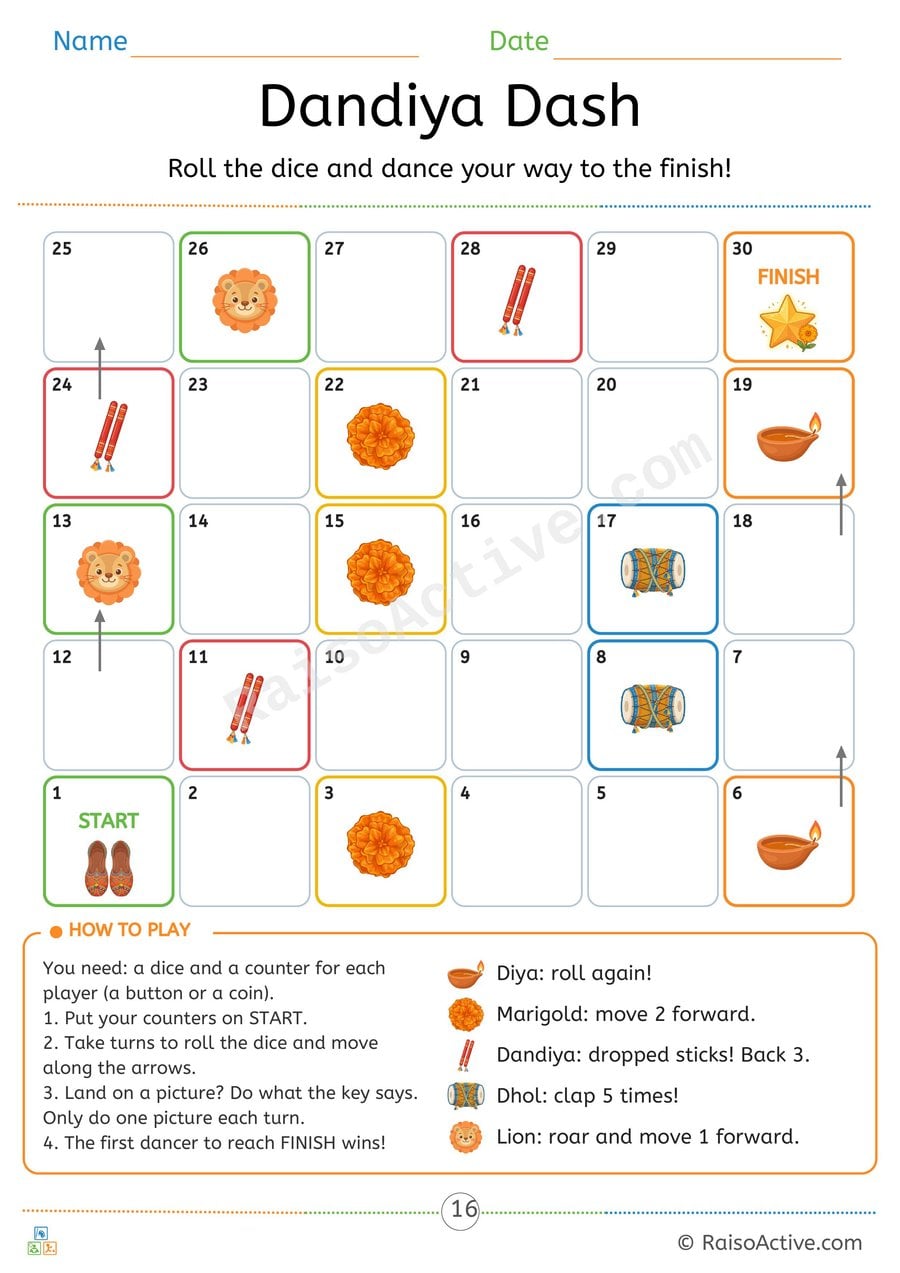
Dandiya Dash: Navratri Board Game for Kids
Ages 4-6 · Pre-K–KindergartenAges 4-6 · Reception–Year 1Ages 4-6 · LKG–UKGAges 4-6
Children count dots on a dice, count on along a number track to 30, take turns and follow simple game rules.

I Spy Letter and Number Matching Worksheet for Preschoolers
Ages 4-7 · Pre-K–Grade 1Ages 4-7 · Reception–Year 2Ages 4-7 · LKG–Class 1Ages 4-7
This worksheet helps children practice matching letters to numbers and improve their early literacy and numeracy skills.
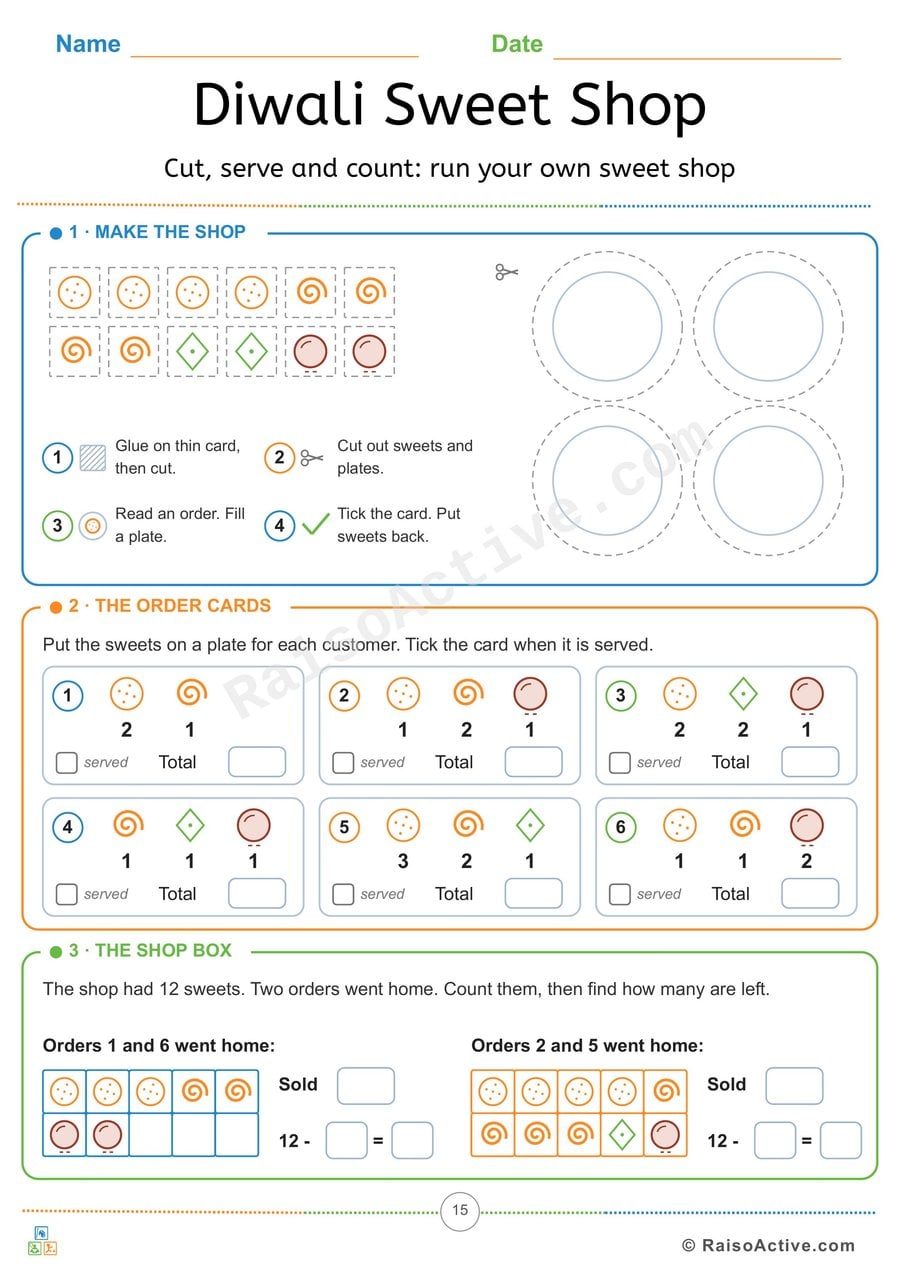
Diwali Sweet Shop Game: Cut, Serve and Count Orders
Ages 4-6 · Pre-K–KindergartenAges 4-6 · Reception–Year 1Ages 4-6 · LKG–UKGAges 4-6
Children cut out sweets and plates, then read six order cards and serve each customer the right number of sweets. They write the total, tick each served order and work out how many are left in the shop box.

Shape Count Worksheet: Count and Decorate the Crown!
Ages 3-5 · Preschool–Pre-KAges 3-5 · Nursery–ReceptionAges 3-5 · Nursery–LKGAges 3-5
Counting diamond shapes and matching each group to its correct number builds one-to-one correspondence and numeral recognition in children ages 3-5, while identifying the shape itself reinforces basic geometry vocabulary. Coloring, cutting, and gluing the diamonds onto a crown afterward adds a craft element that rewards accurate counting with a wearable, decorative result. Combining counting, shape recognition, and a craft project gives this worksheet several layers of skill practice within one engaging activity.

Navaratri Dance Count: A Fun Counting Worksheet for Kids!
Ages 4-8 · Pre-K–Grade 2Ages 4-8 · Reception–Year 3Ages 4-8 · LKG–Class 2Ages 4-8
Children learn that Navratri honours Goddess Durga and that people dance garba and dandiya for nine nights, then count matching dance poses.
Guides for this topic

Number Formation Rhymes 0–9 and How to Fix Reversals
Original number formation rhymes for 0–9, the correct stroke order for each digit, why 3, 5 and 7 get reversed most often, and multisensory fixes that work.

Christmas and Winter Activities That Combine Fun and Learning: Creating Magical Educational Experiences
Discover Christmas and winter activities that combine festive fun with real learning. Crafts, counting, literacy, and printable worksheets for ages 2 to 8 — perfect for home and school.
Age-Appropriate Halloween Learning Activities: Balancing Spooks and Skills for Young Learners
Discover fun, age-appropriate Halloween learning activities for young children. Spooky crafts, counting games, literacy ideas, and printable worksheets for ages 2 to 8.
Reviews
Every worksheet for ages 3–5, no watermark
Members download the full library of 1,000+ worksheets and every activity pack without watermarks or daily limits. One year costs ₹999 in India or $20 elsewhere.
See membership plansOr download any worksheet free with a watermark (5 a day).