Number Names Matching Worksheet for Preschoolers
Matching numerals to their written number-word form, like connecting '5' to the word 'five,' teaches children ages 3-5 that numbers can be represented two different ways: as a symbol and as a spelled-out word. Searching for the correct number name within a word search grid also builds visual scanning and early sight-word recognition, since number words like 'one' or 'seven' don't always follow predictable spelling patterns. This dual practice strengthens both numeracy and literacy at the same time.
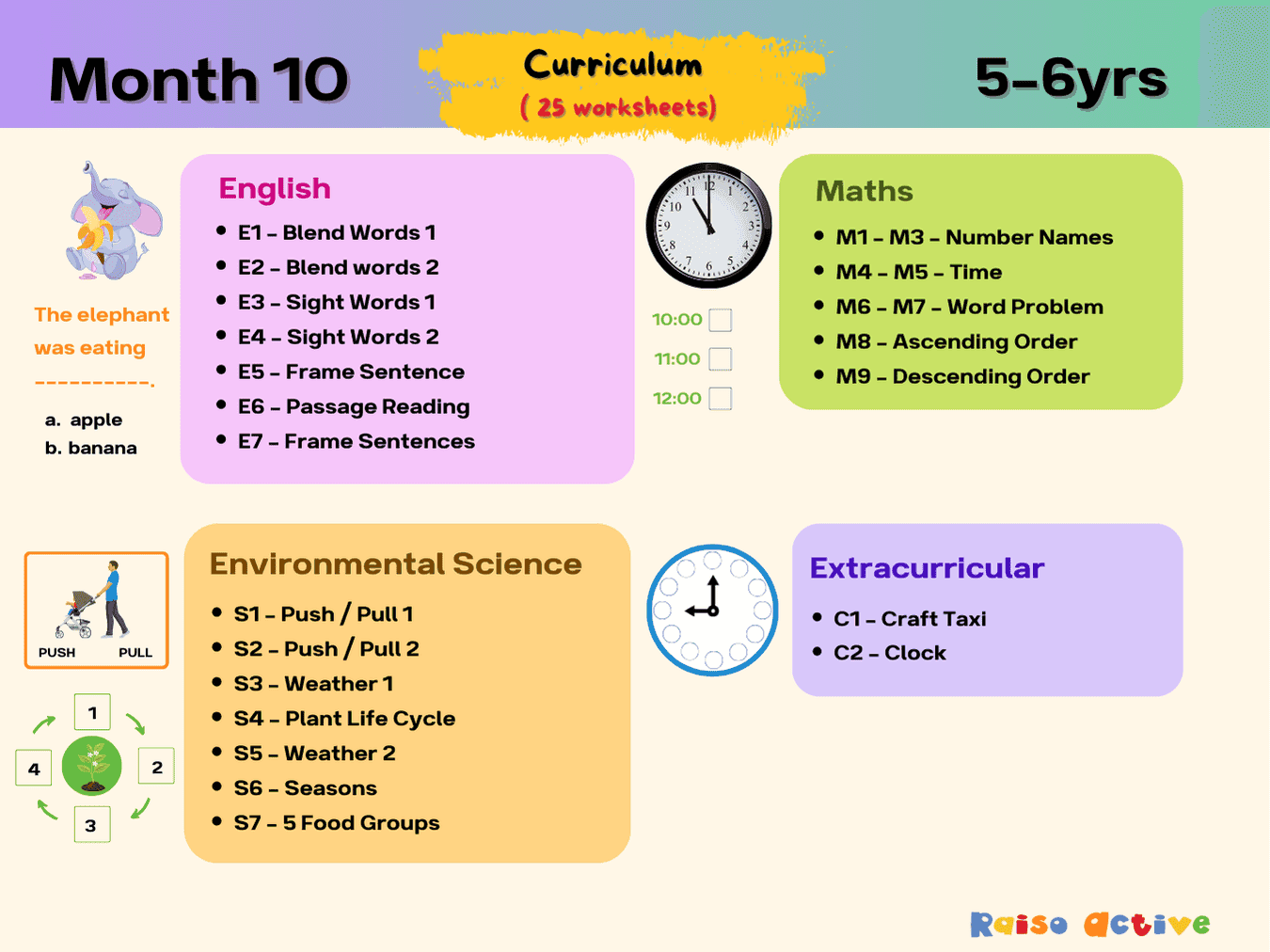
Part of the pack
Month 10: Learning & Development | Ages 5-6
This is page 11 of the pack. Ages 5-6 · KindergartenAges 5-6 · Year 1Ages 5-6 · UKGAges 5-6

Made for your child
Counting to 10, made for your child
A maths pack with your child's name in it: pictures that explain, practice at three levels, puzzles and story sums about them. Print a new set whenever they finish.
Make a maths packFree preview · free for members
Curriculum
- Number Recognition > Number Names
How to use this worksheet
Look at the numerals listed at the bottom of the page together and say each number aloud. Ask your child to think about how that number would be spelled as a word, then search the grid for that spelled-out number name, scanning row by row. Once they find a match, have them circle it and connect it back to the correct numeral. Continue through each number, reviewing the full list of matched number names together at the end.
Materials needed
- Pencil
- Crayons
Extension activities
- 1Make number-word flashcards pairing each numeral with its spelled-out name for quick daily practice.
- 2Count a group of household objects and then write out the number word instead of the numeral.
- 3Play a matching card game using homemade cards with numerals on one set and number words on another.
- 4Practice writing each number word neatly on a blank sheet after finding it in the word search.
- 5Read a counting book together and pause to point out any spelled-out number words in the text.

Written by
Hemsweta Jain · Teacher Cheena
MBA and Early Childhood Educator, teaching since 2014 · Founder of RaisoActive, Mumbai
Every RaisoActive worksheet is designed and checked by the founder before publishing.
Published · Last reviewed
More from Month 10: Learning & Development | Ages 5-6
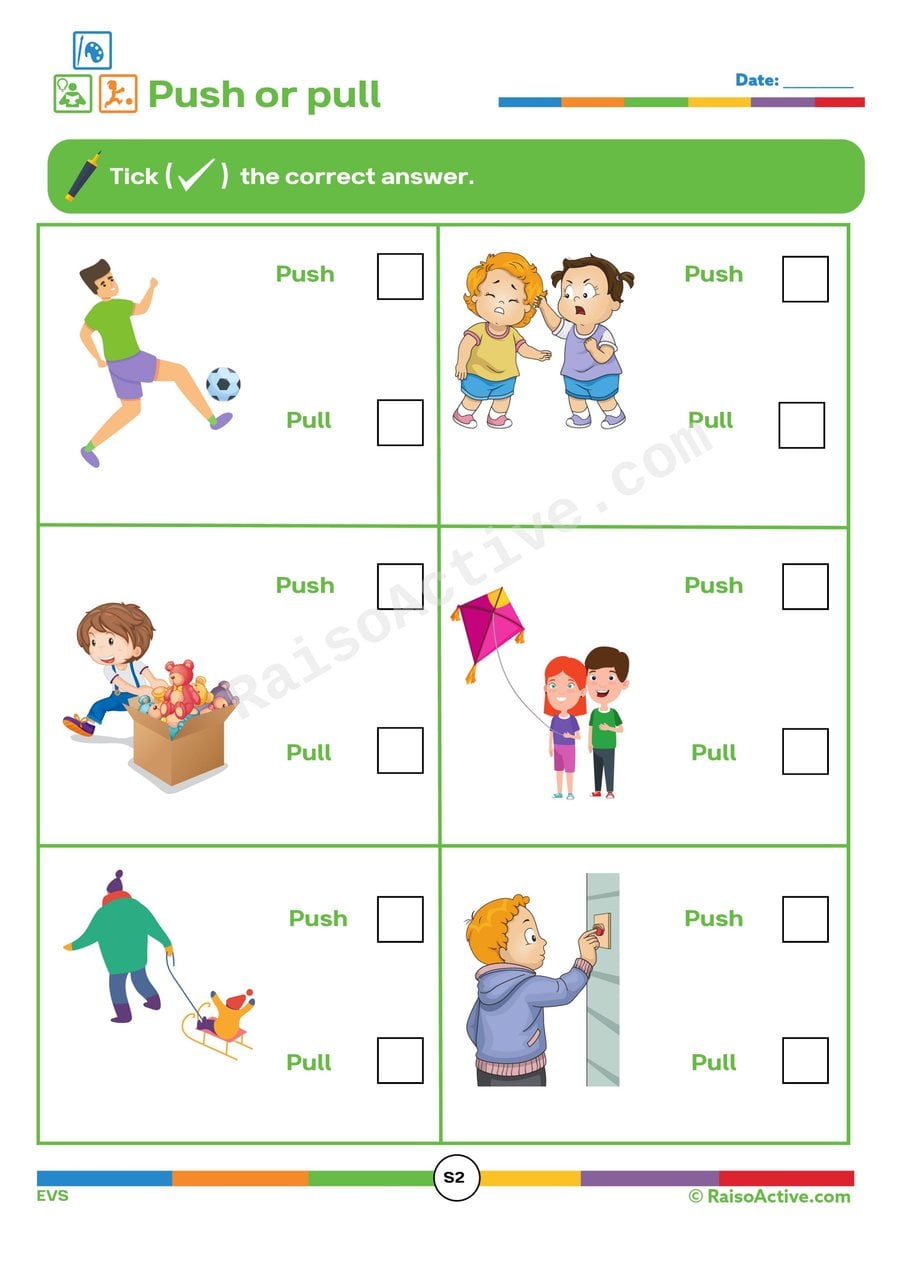
Push or Pull Worksheet: Identify Actions!
Ages 3-5 · Preschool–Pre-KAges 3-5 · Nursery–ReceptionAges 3-5 · Nursery–LKGAges 3-5
Deciding whether an action shown in a picture is a push or a pull introduces children ages 3-5 to a basic physics concept, force and motion, by having them classify everyday actions like opening a door or pulling a wagon. This early science reasoning requires children to picture the direction an object is moving relative to the person acting on it, which builds spatial thinking alongside scientific vocabulary. Learning to categorize actions this way is a first step toward understanding cause and effect in the physical world.

Plant Life Cycle Worksheet: Cut and Paste the Stages!
Ages 4-6 · Pre-K–KindergartenAges 4-6 · Reception–Year 1Ages 4-6 · LKG–UKGAges 4-6
Children ages 4-6 learn the sequential stages of a plant's life cycle — from seed to sprout to full-grown flower — by cutting out and correctly ordering picture cards. Understanding that living things grow through a fixed, predictable sequence is an early science concept that also reinforces sequencing and ordering skills useful well beyond biology.
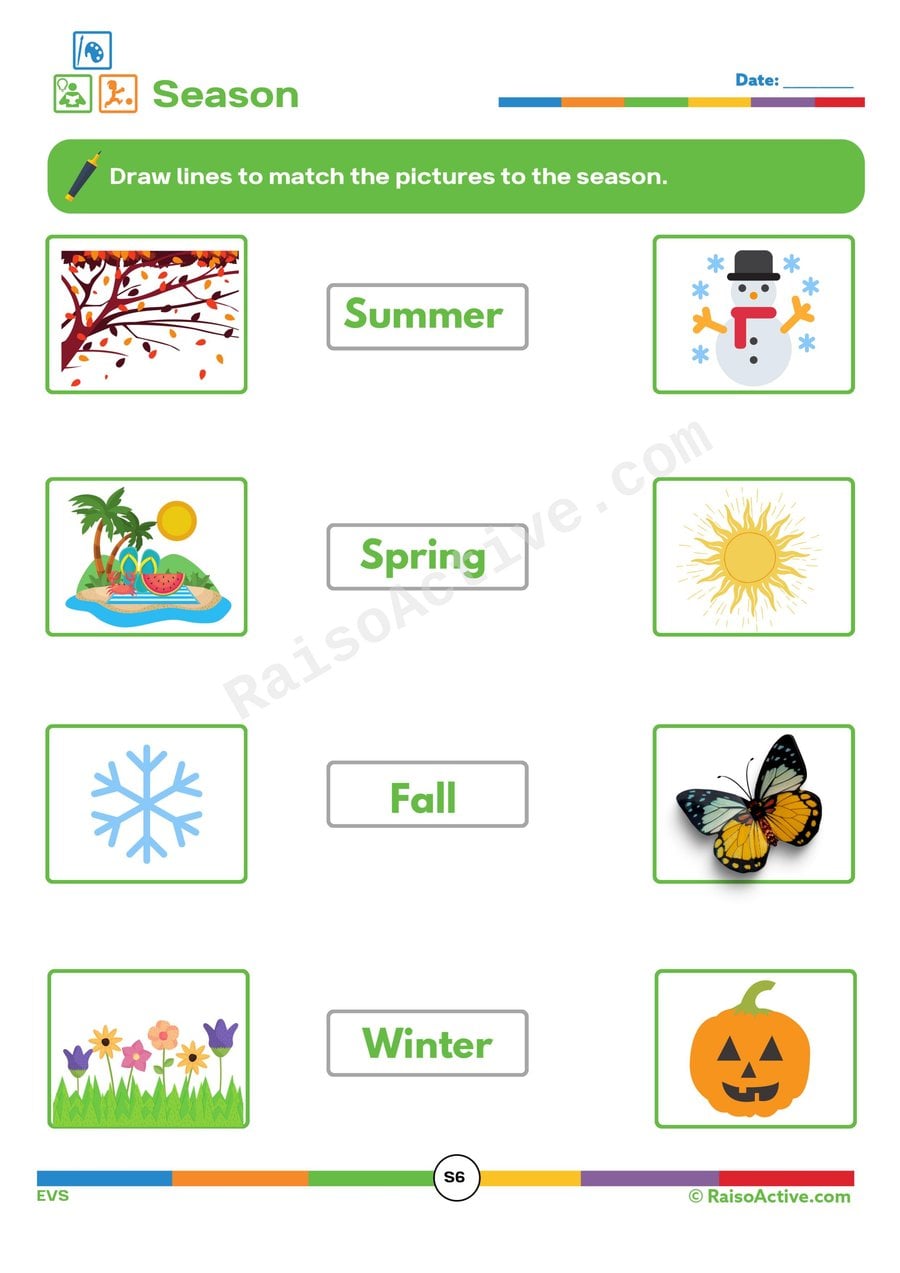
Seasons Matching Worksheet for Preschoolers
Ages 3-5 · Preschool–Pre-KAges 3-5 · Nursery–ReceptionAges 3-5 · Nursery–LKGAges 3-5
This worksheet helps children ages 3-5 learn to recognize the four seasons — summer, fall, winter, and spring — and match seasonal pictures, like snow or falling leaves, to the correct season name. Understanding that weather and nature change in a predictable yearly cycle is an early science concept that also connects naturally to a child's own experience of holidays and clothing changes throughout the year.
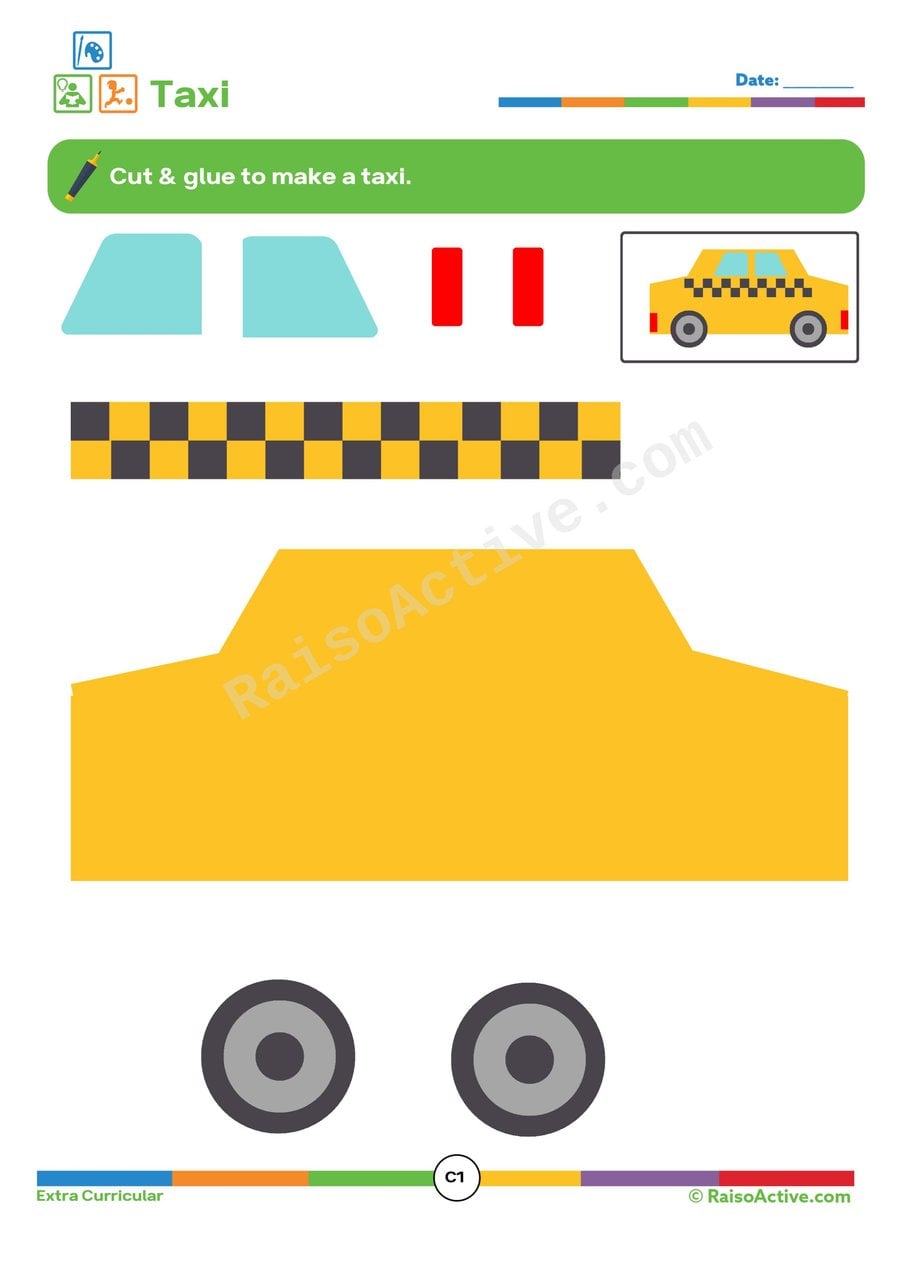
Taxi Cut and Paste Worksheet for Preschoolers
Ages 3-5 · Preschool–Pre-KAges 3-5 · Nursery–ReceptionAges 3-5 · Nursery–LKGAges 3-5
This craft-style worksheet gives children ages 3-5 focused practice with cutting along both straight and curved lines and assembling several separate pieces into one recognizable picture — a taxi. Building an image from multiple cut-out parts requires spatial planning, since children must figure out where each piece belongs relative to the others before gluing. The community-helper theme also introduces vocabulary around transportation and the people who drive it.
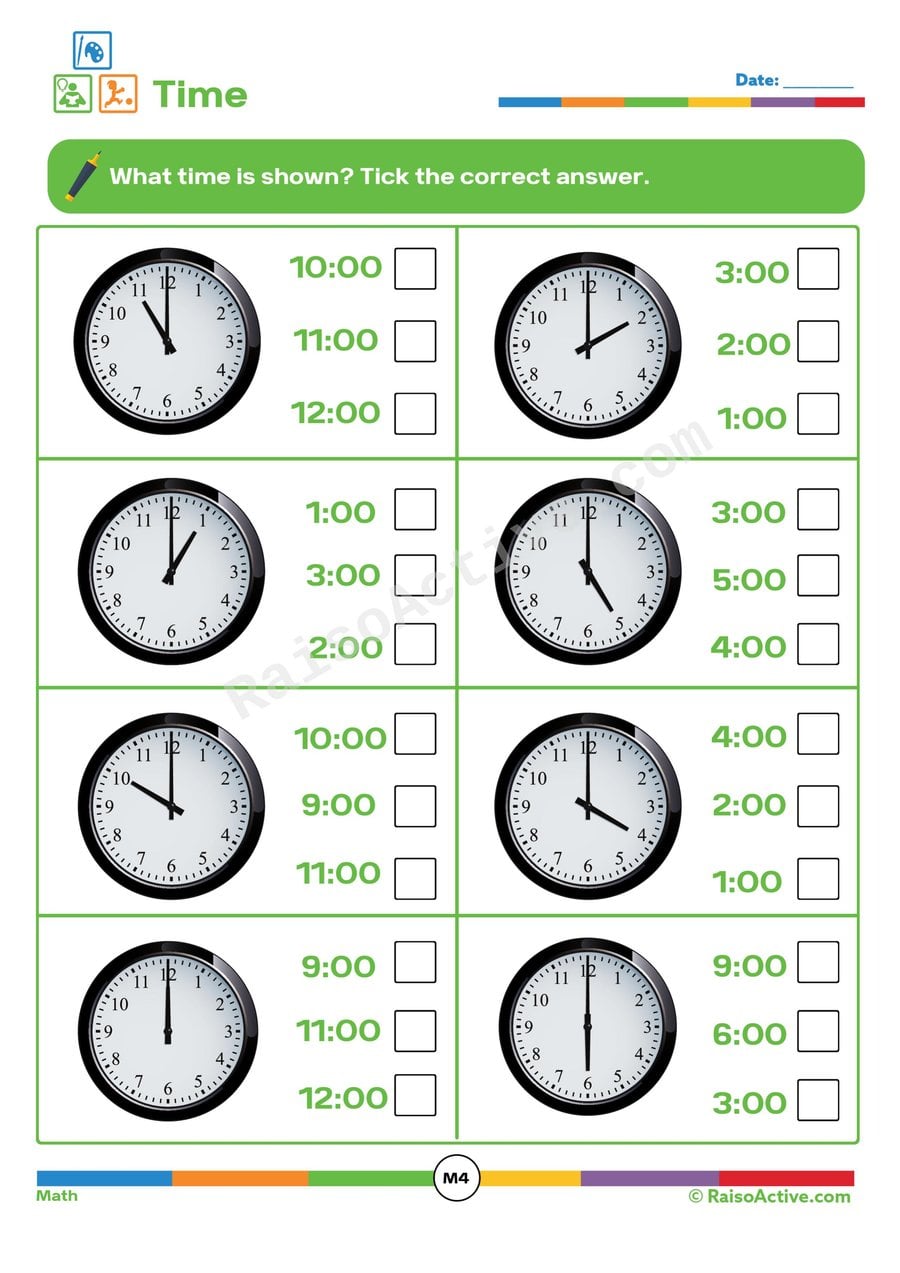
Time Telling Worksheet: What Time Is It? (3-5)
Ages 3-5 · Preschool–Pre-KAges 3-5 · Nursery–ReceptionAges 3-5 · Nursery–LKGAges 3-5
This worksheet introduces children ages 3-5 to analog clock reading at its simplest level, asking them to look at a clock face and choose the correct time from a set of answer options rather than writing it independently. Multiple-choice format lowers the barrier for this genuinely difficult skill, letting younger children build early clock familiarity before they're expected to read time unaided.
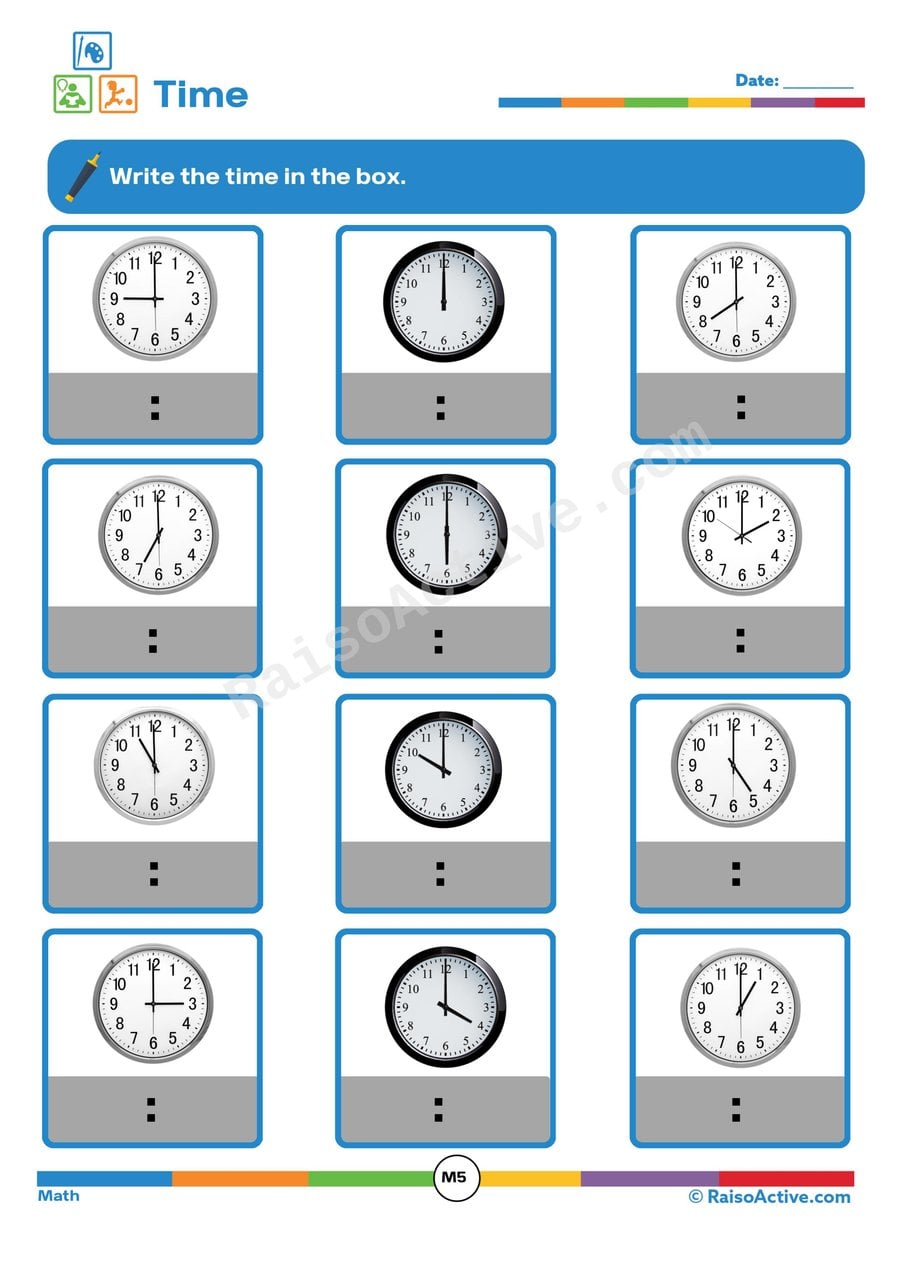
Time Telling Worksheet for Kids: Write the Time!
Ages 4-6 · Pre-K–KindergartenAges 4-6 · Reception–Year 1Ages 4-6 · LKG–UKGAges 4-6
Reading the position of the hour and minute hands on an analog clock and writing the matching digital time teaches children ages 4-6 an important real-world math skill that connects visual, spatial reasoning with numeral writing. Because analog clocks require understanding both where the short hour hand and long minute hand point, this worksheet builds a more advanced skill than simple number recognition, introducing the idea that two hands work together to tell one time. Regular practice with clock reading also supports growing independence, as children begin to understand daily routines in terms of actual clock times.

Number Names Worksheet: Addition Practice for Kids
Ages 4-6 · Pre-K–KindergartenAges 4-6 · Reception–Year 1Ages 4-6 · LKG–UKGAges 4-6
This worksheet combines addition practice with number-word writing for children ages 4-6, asking them to solve simple addition problems and then spell out the answer using its written name rather than a numeral. Requiring the answer in word form pushes children beyond calculation into applying number vocabulary correctly, reinforcing that 'seven' and '7' represent the same value. This dual task builds both math fluency and early spelling skills together.

Zoo Adventure: Reading Comprehension Worksheet for Preschoolers
Ages 4-5 · Pre-KAges 4-5 · ReceptionAges 4-5 · LKGAges 4-5
Reading a short passage about a zoo and then answering multiple-choice questions builds early reading comprehension in children ages 4-5, teaching them to hold information in mind after reading rather than just decoding words on a page. Choosing answers from provided options also introduces test-taking skills like eliminating wrong choices and rereading for clarification, both useful habits for later school assessments. Zoo animals as the subject matter keep the reading engaging enough to sustain focus through the full passage and question set.
Related worksheets

Number Names Worksheet: Writing and Matching Numbers 51-60!
Ages 4-6 · Pre-K–KindergartenAges 4-6 · Reception–Year 1Ages 4-6 · LKG–UKGAges 4-6
Writing out number names like 'fifty-one' or 'fifty-eight' next to their numerals helps children ages 4-6 connect the spoken word for a number to both its written word form and its digit form, a three-way link that strengthens overall number sense in the 51-60 range. This worksheet also revisits missing-number sequencing and color-coding, giving repeated exposure to the same number range through several different tasks. Building fluency with two-digit number names prepares children for reading numbers in books, on clocks, and in everyday life.

Number Names Worksheet: Trace, Count, and Match Numbers 1-5!
Ages 3-5 · Preschool–Pre-KAges 3-5 · Nursery–ReceptionAges 3-5 · Nursery–LKGAges 3-5
Tracing, counting, and matching number names for 1 through 5 helps children ages 3-5 connect three different representations of the same quantity — the written word, the numeral, and a countable group of objects. Building this three-way connection early strengthens overall number sense and makes it easier to recognize numbers in whatever form they appear later, whether written as words or digits.
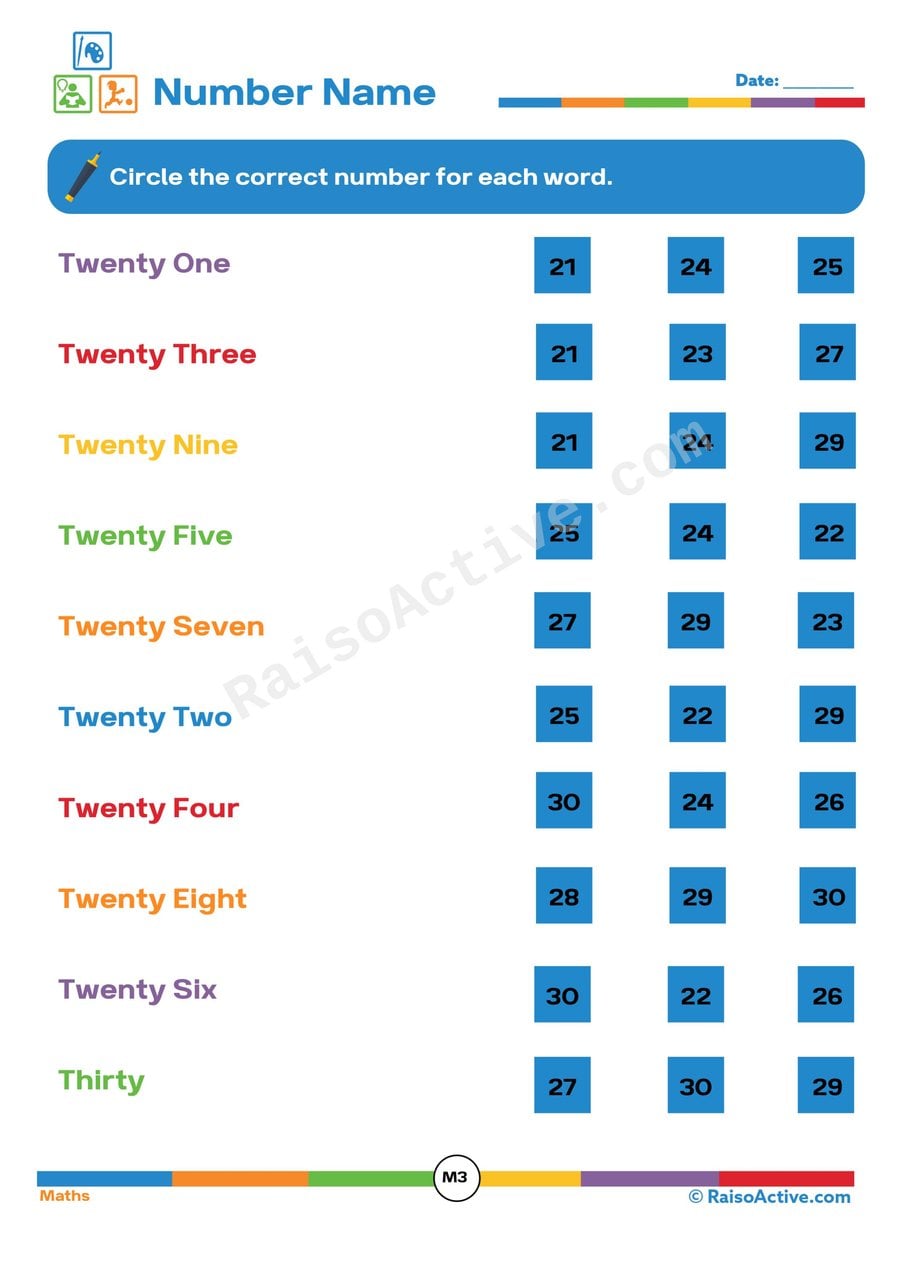
Number Names Matching Worksheet for Kids
Ages 4-6 · Pre-K–KindergartenAges 4-6 · Reception–Year 1Ages 4-6 · LKG–UKGAges 4-6
This worksheet helps children ages 4-6 connect written number words, like 'five' or 'nine,' to their numeral form by reading each word and circling the matching digit. Recognizing number names in text is a skill separate from counting objects, and it becomes important as soon as children start encountering numbers written out in books, signs, or math word problems.

Number Names Matching Worksheet for Preschoolers
Ages 3-5 · Preschool–Pre-KAges 3-5 · Nursery–ReceptionAges 3-5 · Nursery–LKGAges 3-5
This matching worksheet builds early number-word literacy for children ages 3-5 by asking them to connect each numeral with its written name. Learning that '5' and 'five' refer to the same quantity strengthens number sense and lays groundwork for reading math vocabulary later in school. The side-by-side layout also sharpens visual scanning and one-to-one matching skills.

Number Matching and Counting Worksheet for Preschoolers
Ages 3-5 · Preschool–Pre-KAges 3-5 · Nursery–ReceptionAges 3-5 · Nursery–LKGAges 3-5
This worksheet combines counting, cutting and pasting, and a targeted number-recognition task, finding circles with '5' in the ones place, giving children practice with quantity, fine motor coordination, and number pattern spotting all in one page. For ages three to five, recognizing a specific digit within a larger number, like the '5' in '15' or '25', is early groundwork for understanding place value.
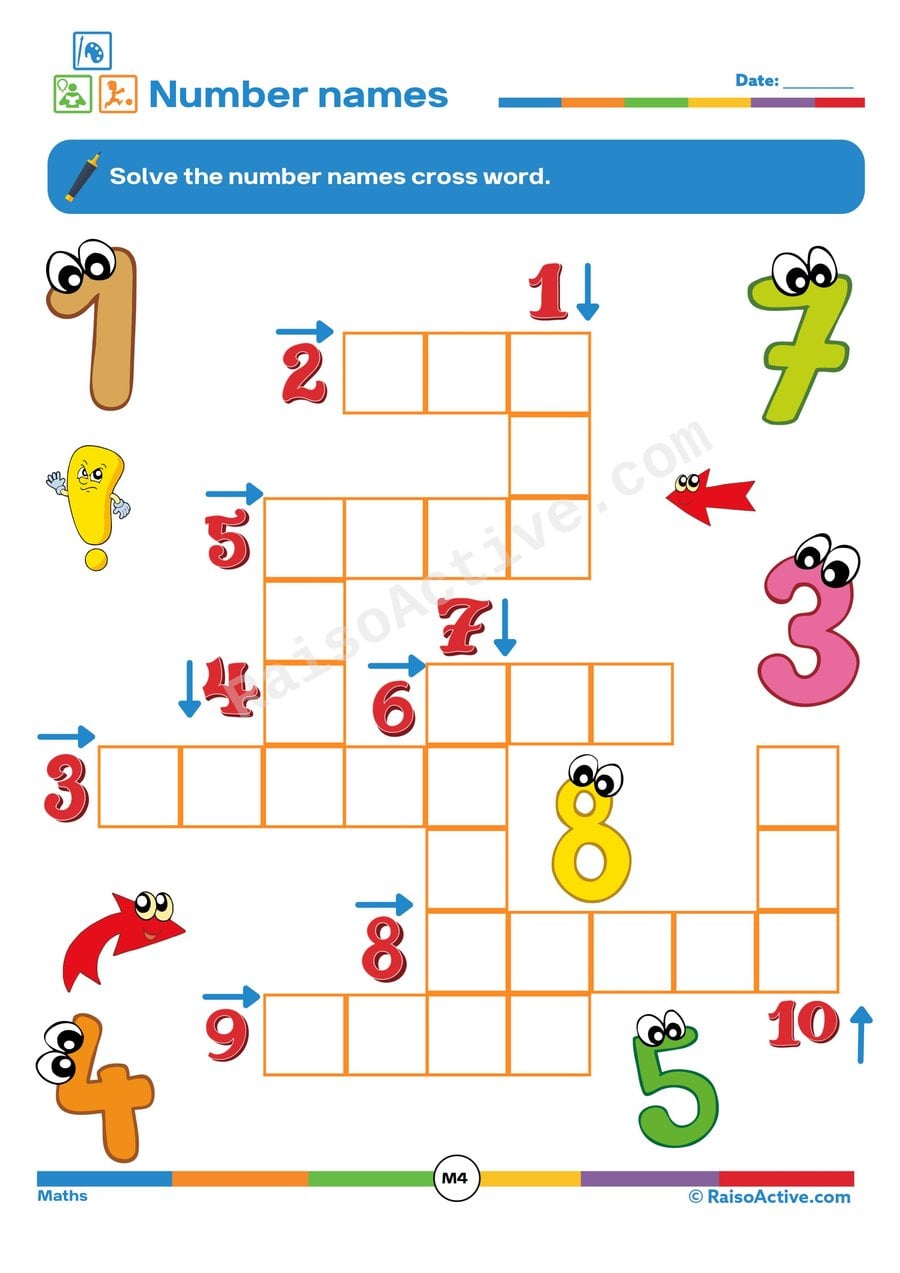
Number Names Crossword Worksheet for Kids
Ages 4-6 · Pre-K–KindergartenAges 4-6 · Reception–Year 1Ages 4-6 · LKG–UKGAges 4-6
Children ages 4-6 practice spelling number names — like 'five', 'twelve', or 'twenty' — by using numeral clues to fill in a crossword grid. This task bridges numeral recognition with word spelling, requiring children to think about both quantity and written vocabulary simultaneously. Fitting letters into the fixed crossword boxes also builds spatial planning and careful letter counting.
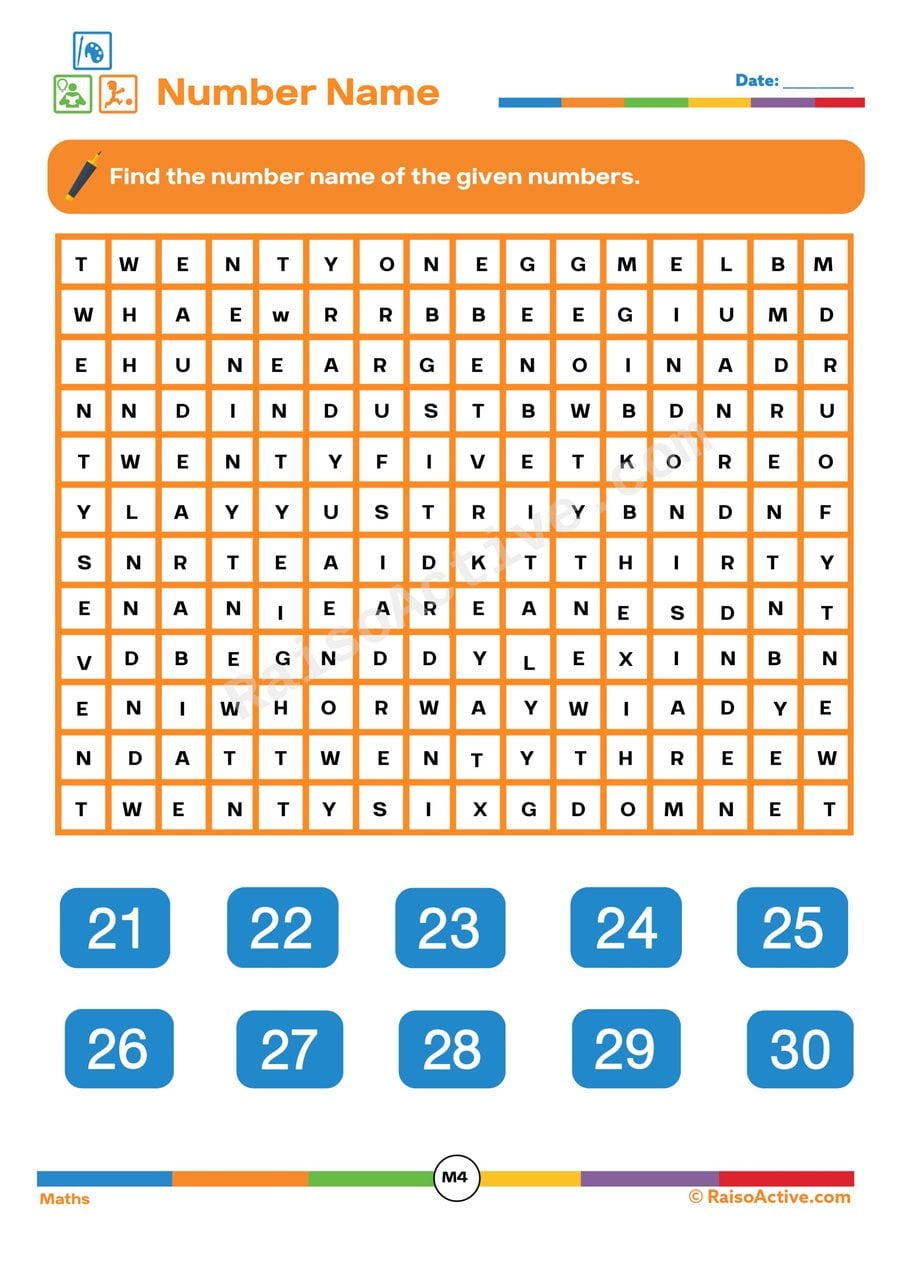
Number Name Word Search Worksheet for Kids
Ages 4-6 · Pre-K–KindergartenAges 4-6 · Reception–Year 1Ages 4-6 · LKG–UKGAges 4-6
This word search worksheet asks children ages 4-6 to visually scan a letter grid to find hidden number names, then match each found word to its numeral — combining spelling recognition, visual scanning, and number sense in one activity. Searching for whole words rather than single letters is a step up in difficulty that pushes early readers to recognize letter patterns quickly.
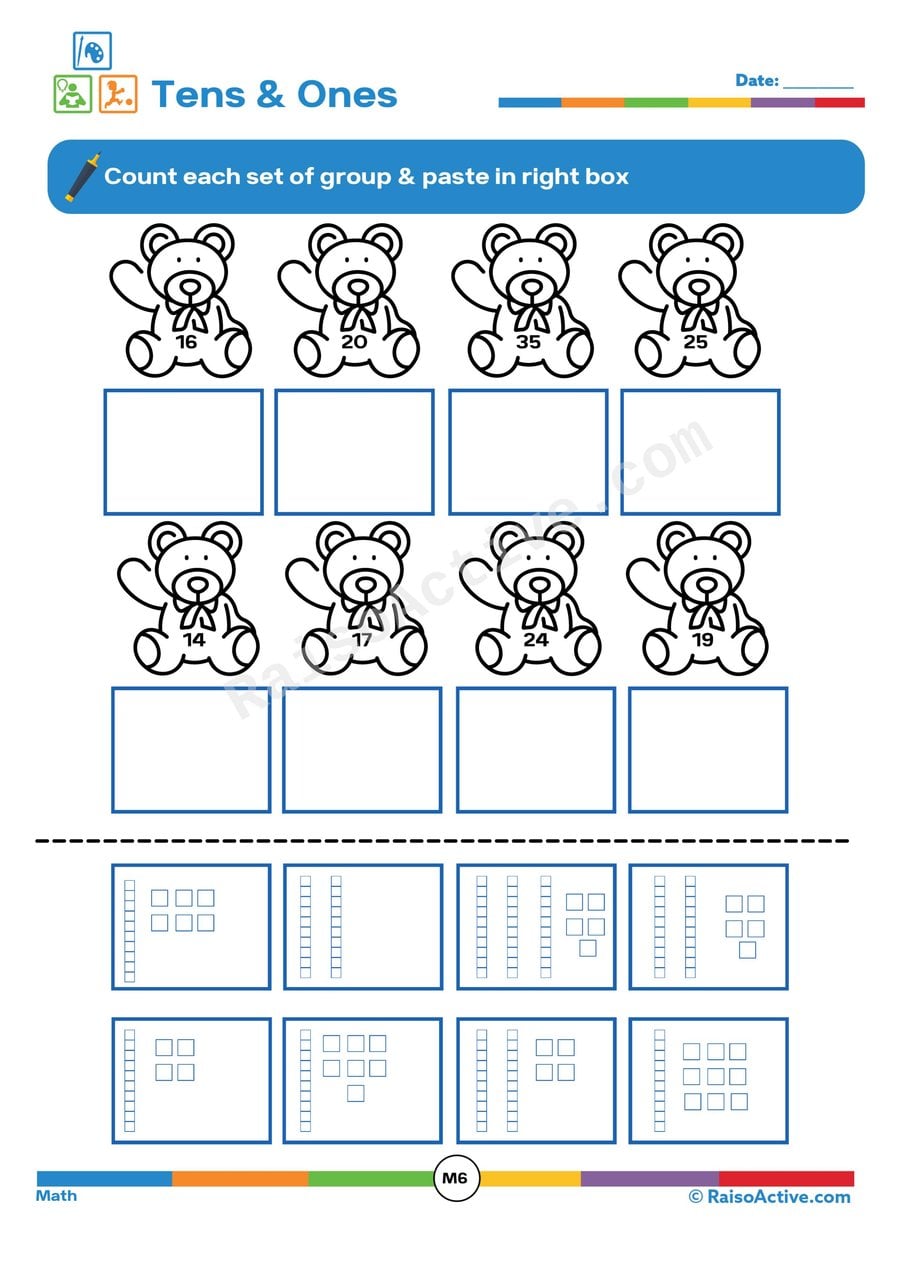
Count and Paste! Tens and Ones Worksheet
Ages 4-6 · Pre-K–KindergartenAges 4-6 · Reception–Year 1Ages 4-6 · LKG–UKGAges 4-6
Counting groups of teddy bears and then matching each total to its tens-and-ones representation teaches children ages 4-6 to connect a counted quantity with its place value breakdown, reinforcing that numbers can be represented in more than one way. Cutting and pasting the matching representation adds fine motor practice to the counting and place value work.
Guides for this topic

Number Formation Rhymes 0–9 and How to Fix Reversals
Original number formation rhymes for 0–9, the correct stroke order for each digit, why 3, 5 and 7 get reversed most often, and multisensory fixes that work.

Best Worksheets for 3-Year-Olds: What Works and What to Avoid
What works on worksheets for 3-year-olds: short sessions, crayons, tracing lines, matching, cutting, a free weekly plan, and signs one is too advanced.
What's the Best Alternative to ABCmouse? A Complete Parent's Guide to Free and Affordable Educational Apps
ABCmouse runs ~Rs 4,000-5,000/year with US spellings and curriculum. Compare free & affordable Indian-friendly apps like Khan Academy Kids and DIKSHA.
Reviews
Every worksheet for ages 3–5, no watermark
Members download the full library of 1,000+ worksheets and every activity pack without watermarks or daily limits. One year costs ₹999 in India or $20 elsewhere.
See membership plansOr download any worksheet free with a watermark (5 a day).