Free printable worksheets · US · UK · India
Grade 1 / Class 1 Matching Worksheets (Ages 6–7)
Grade 1 / Class 1 matching worksheets are practice sheets for children aged 6–7 in Grade 1 in the US and Class 1 in India. Matching is finding and pairing items that are identical, related or belong to the same category, from among several printed options. The sheets on this page cover identifying identical pairs, matching an object to its category and matching uppercase letters to lowercase.
Grade 1, known as Class 1 in India and Year 2 in the UK, is where a child works through a full page independently: place value with tens and ones, addition and subtraction within 20, and short reading passages followed by comprehension questions replace picture-supported counting sheets. Between six and seven, matching sheets carry the new content of the year: an analog clock to the digital time it shows, a fraction to the shaded picture, a word to its short definition, a contraction to the two words it shortens, a sum or difference within 20 to its answer. The child reads every item on both sides, so a ten-pair sheet is a lot of quiet reading and checking. Precision of the lines no longer matters.
127+ worksheets · free PDF download · print on A4 or Letter
Grade 1 / Class 1 Matching Worksheets to print
Browse all worksheets for ages 6–7
Noun, Pronoun, or Adjective? Match the Words! Worksheet for Kids
This worksheet introduces children ages 4-6 to three foundational parts of speech — nouns, pronouns, and adjectives — by asking them to sort individual words into the correct grammatical category. Learning to tell these word types apart early gives children a vocabulary for talking about language itself, which supports both reading comprehension and their own sentence writing later on. Matching words to pictures also keeps an abstract grammar concept grounded in something concrete and visual.

Life Cycle Stages Worksheet: Identify and Sequence!
This worksheet asks children ages 4-6 to identify what life-cycle stage is shown in each individual picture and then number a whole set of pictures into the correct growth sequence, moving beyond simple matching into independent ordering and logical reasoning. Because the worksheet likely mixes several different animals' or plants' stages, it also asks children to recognize what type of life cycle a picture belongs to before sequencing it.

Phonics Fun: Connect the Letters S-X with Starting Sounds Worksheet
Connecting pictures to their correct beginning letter across the range S through X helps children ages 4-6 extend their phonics practice beyond the most common early letters, building broader letter-sound matching skills. This wider range also introduces children to less frequently practiced sounds, rounding out their overall phonemic awareness.
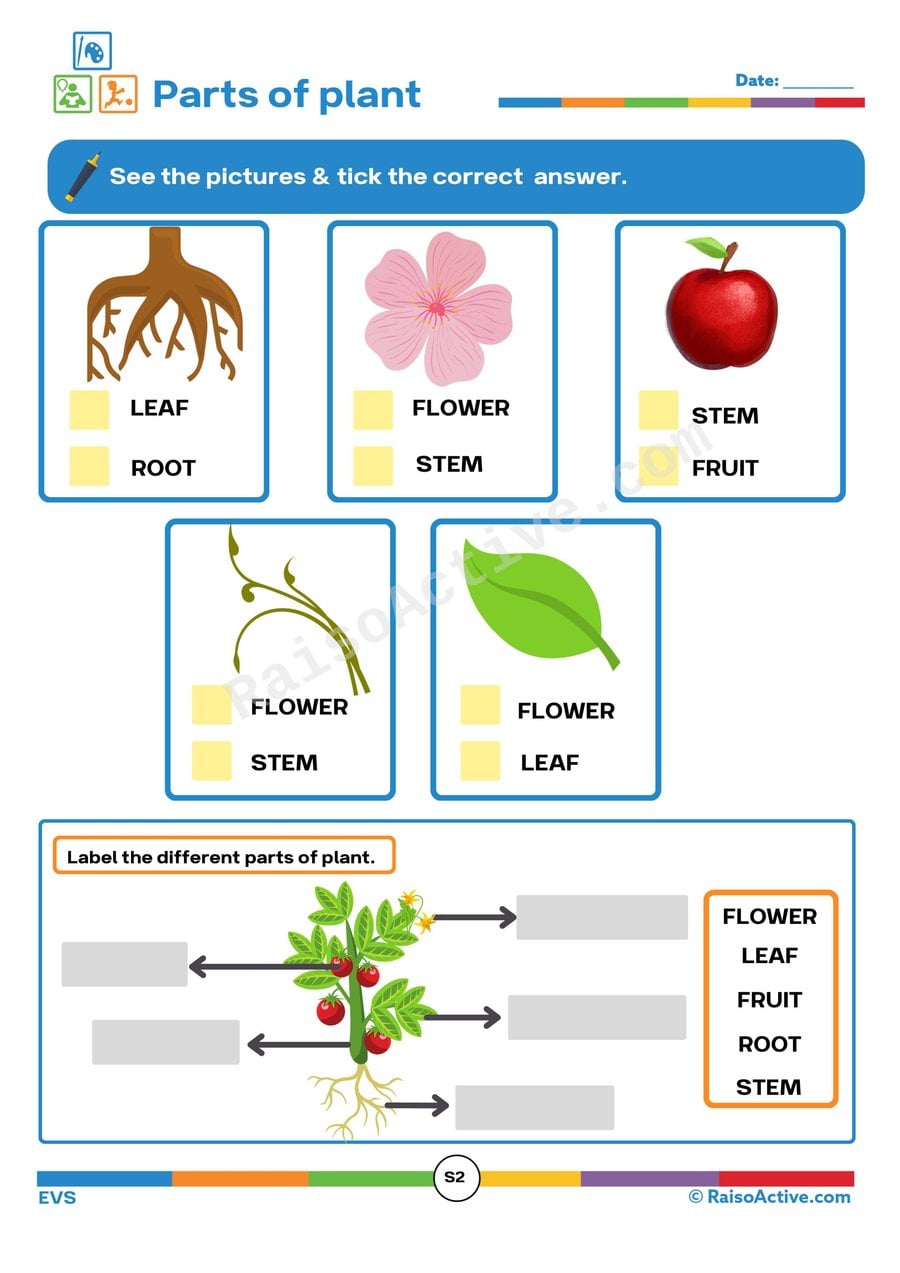
Parts of a Plant Worksheet for Kids
This worksheet helps children ages 4-6 identify and label the main parts of a plant — roots, stem, leaves, flower, and fruit — building foundational botany knowledge. Learning to associate each part with its picture and location on a plant diagram develops both vocabulary and an early understanding of plant structure, which supports later lessons on how plants grow and survive.

CCVC Word Matching Worksheet: Read and Match 'cl' and 'sl' Blends
This worksheet gives children ages 4-6 focused practice reading and matching CCVC words that begin with the 'cl' and 'sl' consonant blends, like 'clap' and 'slide'. Practicing two specific, similarly structured blends side by side sharpens a child's ability to hear the subtle difference between them, a skill that becomes increasingly important as vocabulary and reading material grow more complex.

Adjective Adventure: Matching Sentences Worksheet for Kids
This worksheet teaches 4-6 year olds that adjectives are the words that describe nouns, asking them to fill in a missing adjective in a sentence and then physically mark the noun and adjective separately by underlining and circling. That separation step — telling apart which word names a thing and which word describes it — is a genuinely useful grammar distinction that most children haven't consciously noticed before, even though they use adjectives constantly in speech.

Consonant Sounds: Match the Objects! L & R Sounds Worksheet
Distinguishing between 'l' and 'r' is one of the trickier auditory discriminations in early phonics, since the two sounds are formed with similar tongue positions and are frequently confused by young English learners. This worksheet gives children ages 4-6 focused practice listening for the difference at the start of familiar object names, then matching each picture to its correct consonant. Strengthening this specific sound contrast supports both clearer speech and more accurate spelling later on.

Family Words Cut and Paste Worksheet for Early Readers
Reading a simple CVC word and matching it to its picture teaches children ages 4-6 to blend individual sounds into a whole word and then connect that word to its meaning, a core decoding skill for early readers. Because CVC words follow a consistent consonant-vowel-consonant pattern, practicing them builds a reliable phonics foundation that transfers to reading many other simple words.

Match the Countries with Their Symbols Worksheet
Children ages 4-6 build early social studies awareness by matching country flags to their well-known national symbols, connecting visual recognition with basic geography and cultural knowledge. This kind of matching exercise strengthens careful observation, since children must compare colors, shapes, and details across both the flag and the symbol image. It also plants the seed for understanding that different countries have distinct identities and traditions.
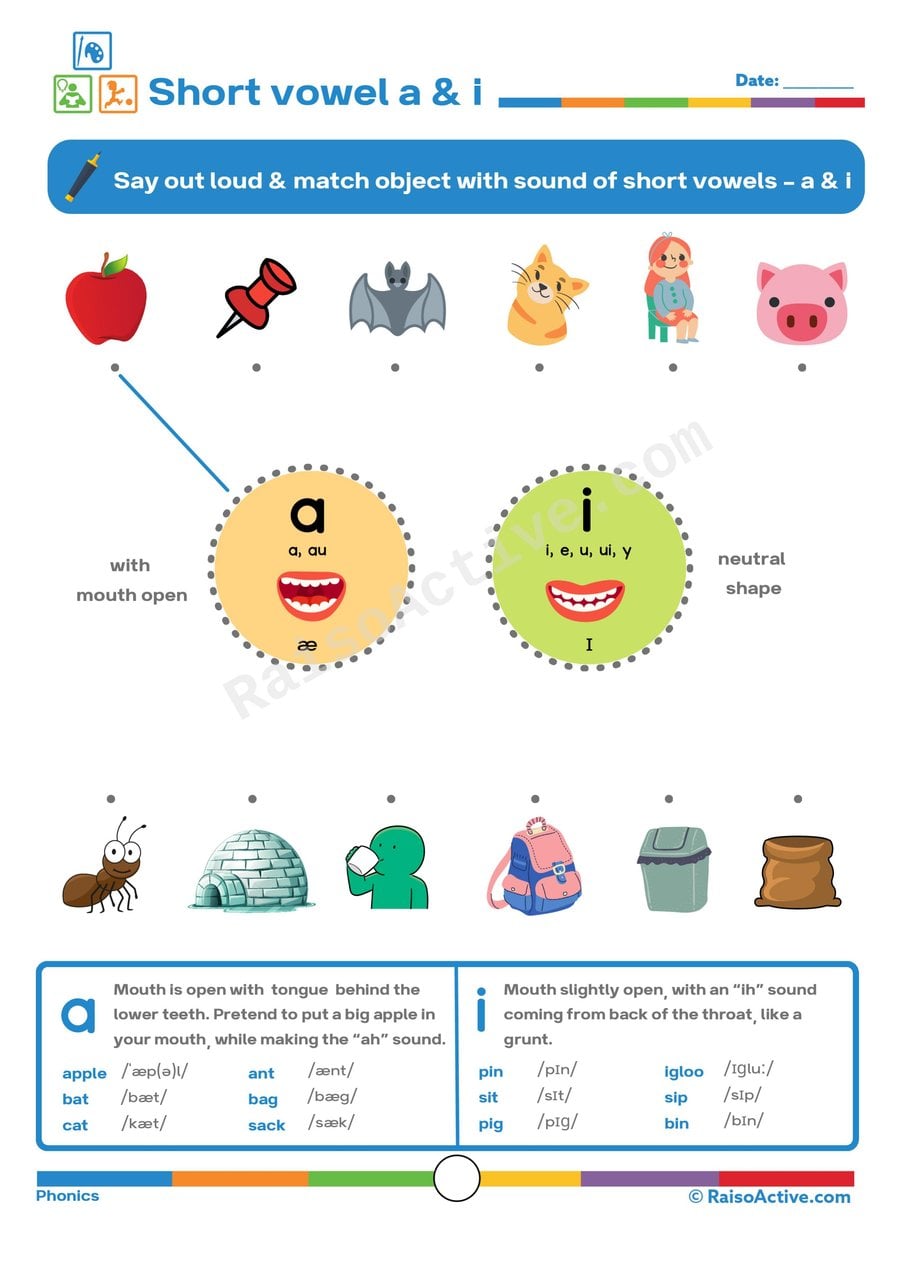
Short Vowel Sounds: Match the Pictures Worksheet
Distinguishing between the short 'a' and short 'i' sounds is a foundational listening skill for children ages 4-6, since these two vowel sounds are easy to confuse and appear constantly in early reading words. This worksheet has children say a word aloud, listen for its vowel sound, and match the picture to the correct sound category, training their ear before they're expected to read or spell independently. Strong auditory discrimination between short vowels directly predicts success decoding CVC words like 'cat' and 'sit' later on.
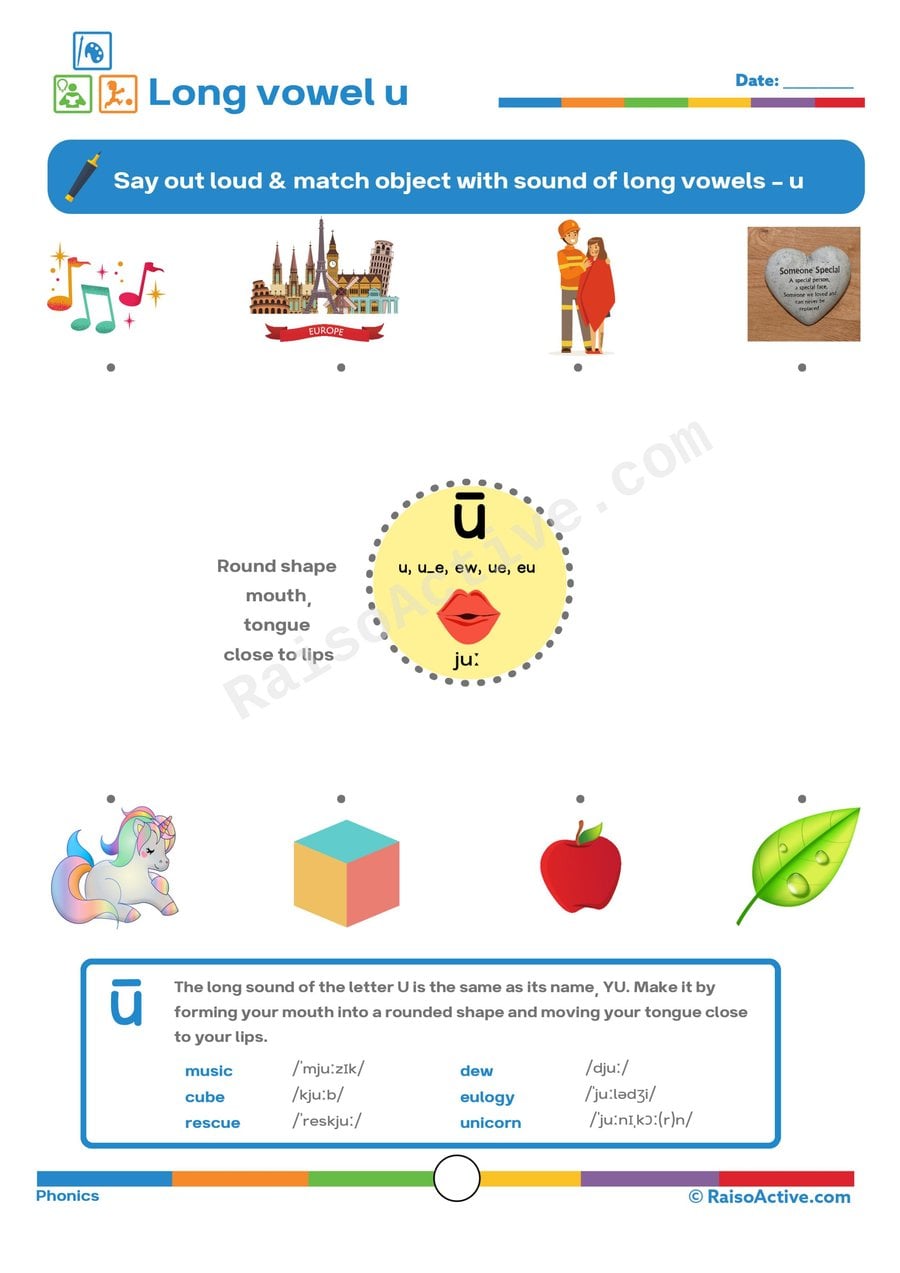
Long Vowel U Worksheet: Say the Sound and Match!
This matching worksheet gives children ages 4-6 focused practice hearing and identifying the long 'u' sound (as in 'cube' and 'mule') inside real words, then connecting that sound to its written form. Matching pictures to words strengthens the sound-symbol link that underlies fluent reading, while distinguishing long 'u' from other vowel sounds sharpens phonemic awareness — a strong predictor of later reading success.
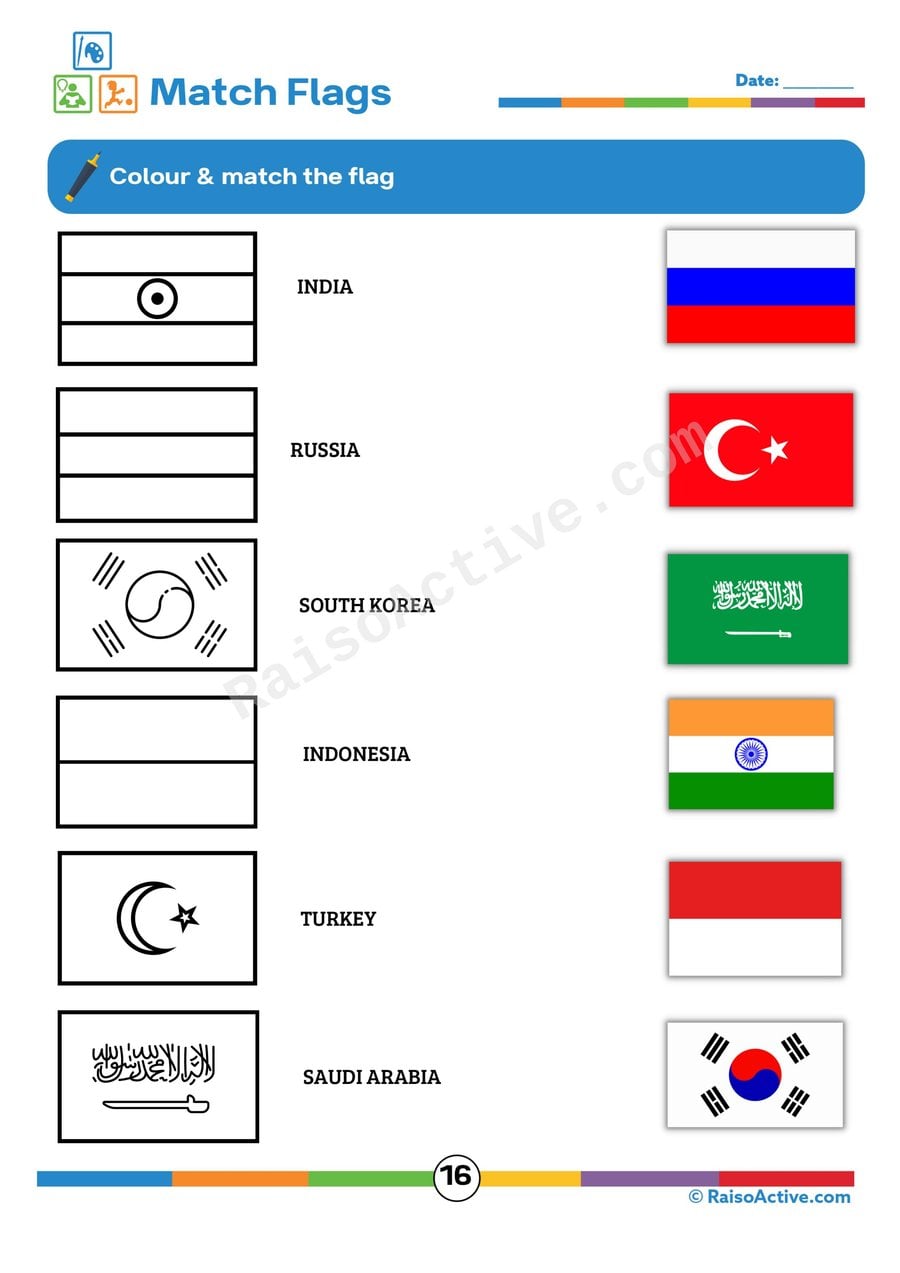
Match the Flags Worksheet for Kids
Children ages 4-6 build flag recognition by matching a set of country flags to their correct names, continuing to strengthen geography vocabulary and visual discrimination through this final flag-focused worksheet. Working with flags is an especially effective way to build visual memory in young children, since each one is a distinct, colorful pattern they can learn to recognize quickly.
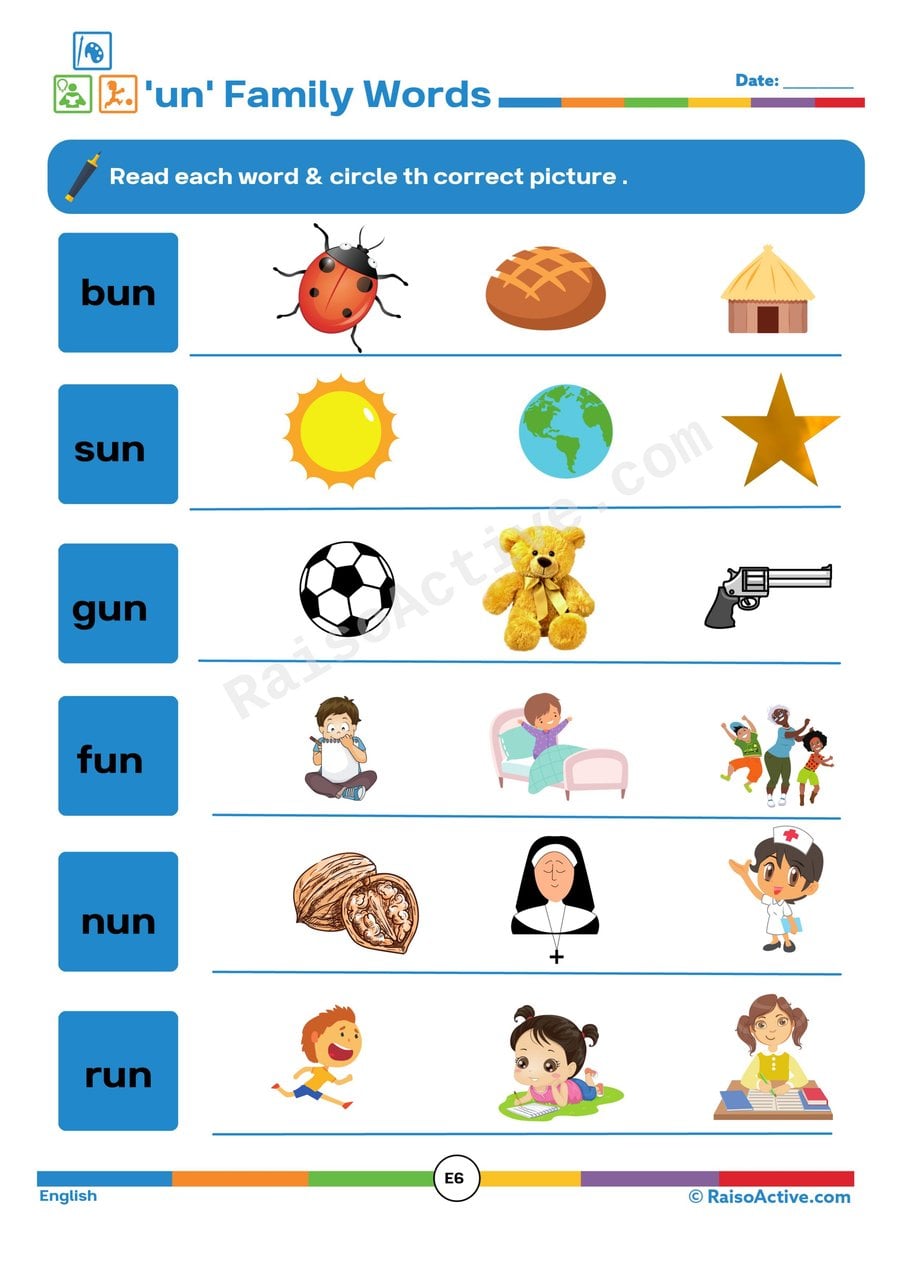
Fun 'un' Family Words Worksheet for Kids
Reading and matching words from the 'un' family, like fun, run, and sun, teaches children ages 4-6 to recognize a shared spelling pattern and use it to decode new words more quickly. Because this word family relies on consistent rhyming sounds, practicing it strengthens the connection between letter patterns and pronunciation that underlies early reading fluency.

Color Mixing Worksheet for Preschoolers: Learn Primary and Secondary Colors!
Identifying primary colors and predicting which two combine to create each secondary color introduces children ages 4-6 to basic color theory, an early scientific concept about how colors interact. This worksheet builds the vocabulary and reasoning skills needed to understand color mixing before testing it out with real paint or crayons.

CVC 'an' Family Matching Worksheet for Early Readers
This worksheet strengthens phonics skills in children ages 4-6 by having them read, color, and match CVC words from the 'an' family, such as 'can', 'man', and 'fan'. Practicing an entire word family together helps children notice the shared 'an' pattern, an efficient shortcut that lets them decode a whole group of new words once they master just one.

S and T Sounds Worksheet: Matching Sounds to Objects
This matching worksheet helps children ages 4-6 build beginning-sound awareness for the letters 's' and 't' by listening to each sound and connecting it to the correct object. Distinguishing between these two common consonant sounds strengthens the foundational skill of linking a spoken sound to its written letter, which is essential before children can spell or decode independently. Matching by sound, rather than by sight alone, keeps the focus on auditory phonics rather than memorized shapes.
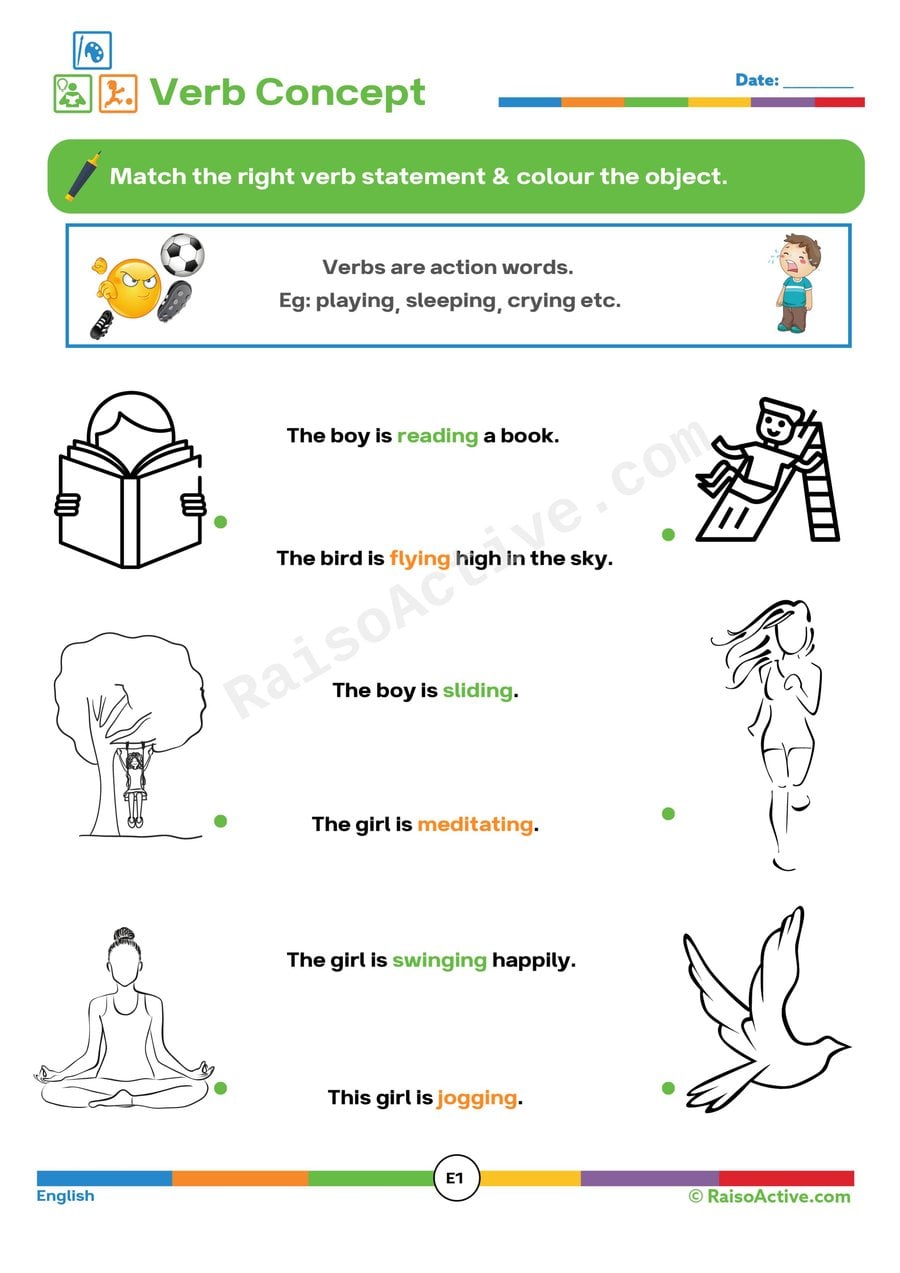
Action Verbs Worksheet: Match and Color!
This worksheet has 4-6 year olds read a short sentence, pick out the action word inside it, and match that sentence to the picture showing the action happening — a skill that bridges early reading with grammar. Identifying the verb specifically (rather than just understanding the sentence generally) is a more advanced task than simple picture-word matching, since children have to isolate one word's job within a whole sentence. Coloring the matched picture afterward gives an easy, low-pressure way to confirm the match was correct.

Vowel i Matching Worksheet: Long and Short Sounds
In this worksheet, children ages 4-6 train their ears to tell apart the short 'i' sound (as in 'pig') from the long 'i' sound (as in 'kite'), then sort pictures into the correct category. This side-by-side comparison is a key phonics milestone, because confusing short and long vowels is one of the most common early reading errors, and deliberate practice like this builds the auditory discrimination needed to read unfamiliar words accurately.

Internal Organs Worksheet: Find and Match the Body Parts!
Finding organ names hidden in a word search and then cutting and pasting the organs onto the correct spot on a body diagram teaches children ages 4-6 the names and general locations of internal organs, like the heart, lungs, and stomach, introducing basic human biology. Searching the word grid builds visual scanning and word recognition, while the cut-and-paste placement step reinforces spatial understanding of where each organ sits inside the body. Combining a word search with a hands-on placement task gives this worksheet both a literacy and a science learning goal.

CVC 'in' Family Matching Worksheet: Read, Color, and Match!
This worksheet extends word-family practice to the 'in' pattern (pin, bin, win, tin), giving children ages 4-6 another opportunity to apply the analogy strategy of recognizing a shared ending and swapping only the first letter to read new words quickly. Practicing several word families over time — 'ad,' 'ag,' 'it,' and now 'in' — helps children generalize the underlying reading strategy rather than memorizing isolated words, which is exactly the kind of transferable skill that speeds up reading development. Coloring and matching each word to its picture adds a multisensory layer that helps the pattern stick.
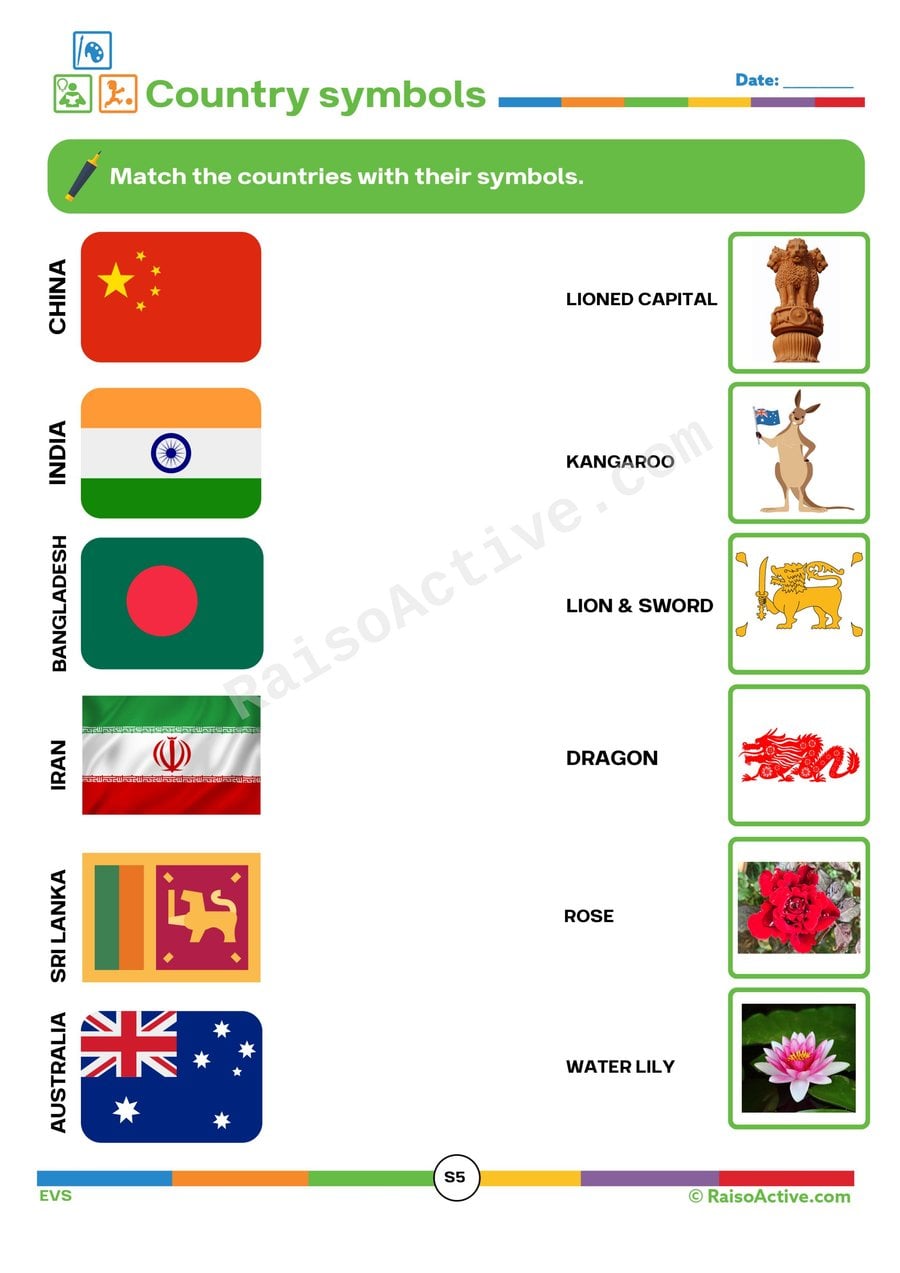
Match the Country Symbols Worksheet for Kids
Matching country flags to their national symbols introduces children ages 4-6 to the idea that countries have their own distinct visual identities, an early and engaging entry point into geography and cultural awareness. This matching task builds visual discrimination, since flags and symbols can share similar colors or shapes that require careful comparison. Learning to associate a flag with a symbol also plants early vocabulary for talking about different countries and cultures around the world.

Vowel Sounds Worksheet: Identify and Circle the Correct Vowel!
Children ages 4-6 practice identifying vowel sounds within words by looking at a picture, saying its name aloud, and figuring out which vowel they hear, a specific phonics skill that builds toward independent reading and spelling. Isolating the vowel sound in a word is often trickier for children than identifying beginning consonant sounds, making this a meaningful next step in phonics.

Alphabet Games Worksheet: Match the Letters to the Games!
This worksheet helps children ages 4-6 practice beginning-sound letter recognition by matching alphabet cards to pictures of games whose names start with that letter. Placing a letter card on its matching game picture, rather than simply circling an answer, adds a hands-on sorting element that keeps the activity active and physical rather than purely paper-based.

Sentence Matching Worksheet: Read and Match the Sentences!
Reading a short sentence and pasting it beneath its matching picture builds reading comprehension for children ages 4-6, requiring them to understand the full meaning of a sentence rather than recognizing isolated words. This task also reinforces fine motor precision as children position and glue a small strip of text accurately within a defined space.
What Grade 1 / Class 1 matching worksheets cover
Between six and seven, matching sheets carry the new content of the year: an analog clock to the digital time it shows, a fraction to the shaded picture, a word to its short definition, a contraction to the two words it shortens, a sum or difference within 20 to its answer. The child reads every item on both sides, so a ten-pair sheet is a lot of quiet reading and checking. Precision of the lines no longer matters.
- Match analog clocks to digital times on the hour and half hour
- Pair a fraction with the picture that shows it shaded
- Draw a line from each word to its short meaning
- Match sums and differences within 20 to their answers
- Connect contractions such as "don't" to the words they shorten
How to use these worksheets at home or in class
About twenty minutes a day, split between one math page and one reading page on alternating days, matches what most first grade teachers assign as homework. Have your child read every instruction aloud before starting, since that doubles as reading practice.
Start with the sheet that matches what your child can already do, then move one step up. Keep finished sheets in a folder: Grade 1 / Class 1 teachers often ask for evidence of practice, and children like seeing their own progress.
Is your child ready for Grade 1 / Class 1 matching work?
A child ready for this stage reads and writes numerals fluently to 20, blends simple words into sentences, follows a written instruction without help, and can explain out loud how they solved a problem rather than only stating the answer.
Frequently asked questions
Can matching worksheets help a six-year-old who reads slowly?
They can, because a word-to-picture or word-to-meaning sheet gives many short reads with an immediate check, and the child rereads each word while scanning for its partner. Keep the sheet to eight or ten pairs, ask the child to say each word aloud before drawing the line, and leave the timer out of it. Speed comes from repeated correct reads, which is what the format quietly provides.
What should a Grade 1 / Class 1 child be able to do in matching?
Between six and seven, matching sheets carry the new content of the year: an analog clock to the digital time it shows, a fraction to the shaded picture, a word to its short definition, a contraction to the two words it shortens, a sum or difference within 20 to its answer. The child reads every item on both sides, so a ten-pair sheet is a lot of quiet reading and checking. Precision of the lines no longer matters. A child ready for this stage reads and writes numerals fluently to 20, blends simple words into sentences, follows a written instruction without help, and can explain out loud how they solved a problem rather than only stating the answer.
Do these worksheets follow the Grade 1 / Class 1 curriculum?
The sheets cover identifying identical pairs, matching an object to its category, matching uppercase letters to lowercase and matching a numeral to a quantity, which sit inside the Common Core Grade 1 (1.OA, 1.NBT, RF.1.3); NEP 2020 Foundational Stage Class 1; National Curriculum KS1 (Year 2) outcomes for Grade 1 / Class 1. Class 1 (India), Year 2 (UK) use the same skills at this age, so the sheets also fit families following those programmes.
Are these Grade 1 / Class 1 matching worksheets free?
Yes. Each worksheet downloads free as a watermarked PDF once you create an account, with a limit of five a day. An annual membership ($20) removes the watermark and the limit for the whole library of over 1,000 worksheets and every printable pack.

Written by
Hemsweta Jain · Teacher Cheena
MBA and Early Childhood Educator, teaching since 2014 · Founder of RaisoActive, Mumbai
Written and reviewed by Hemsweta Jain (Teacher Cheena), who designs every RaisoActive worksheet.
Last reviewed
Printable packs for ages 6–7
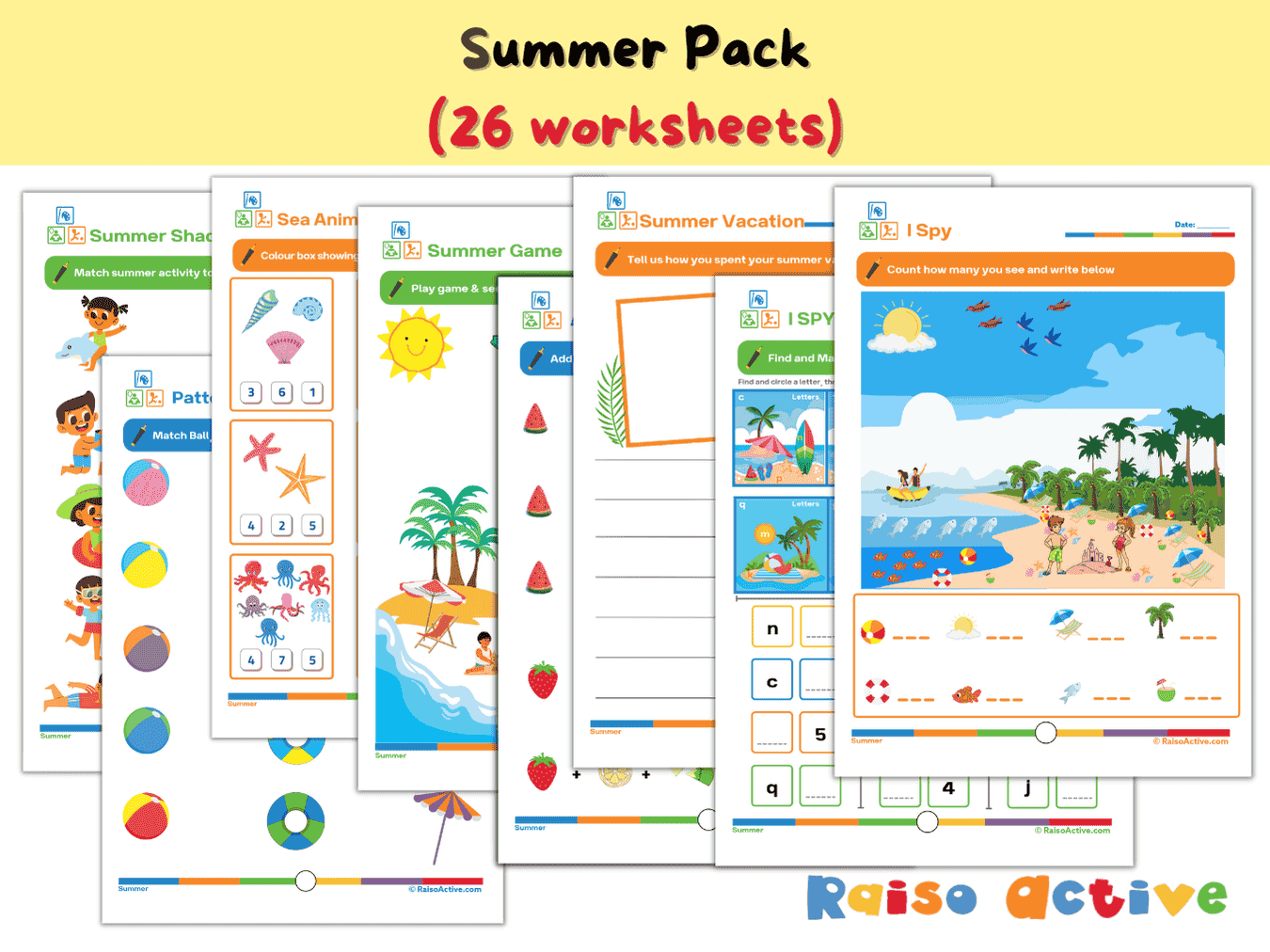
Summer Activity Pack: Math, Literacy, Puzzles & More for Preschool & Kindergarten
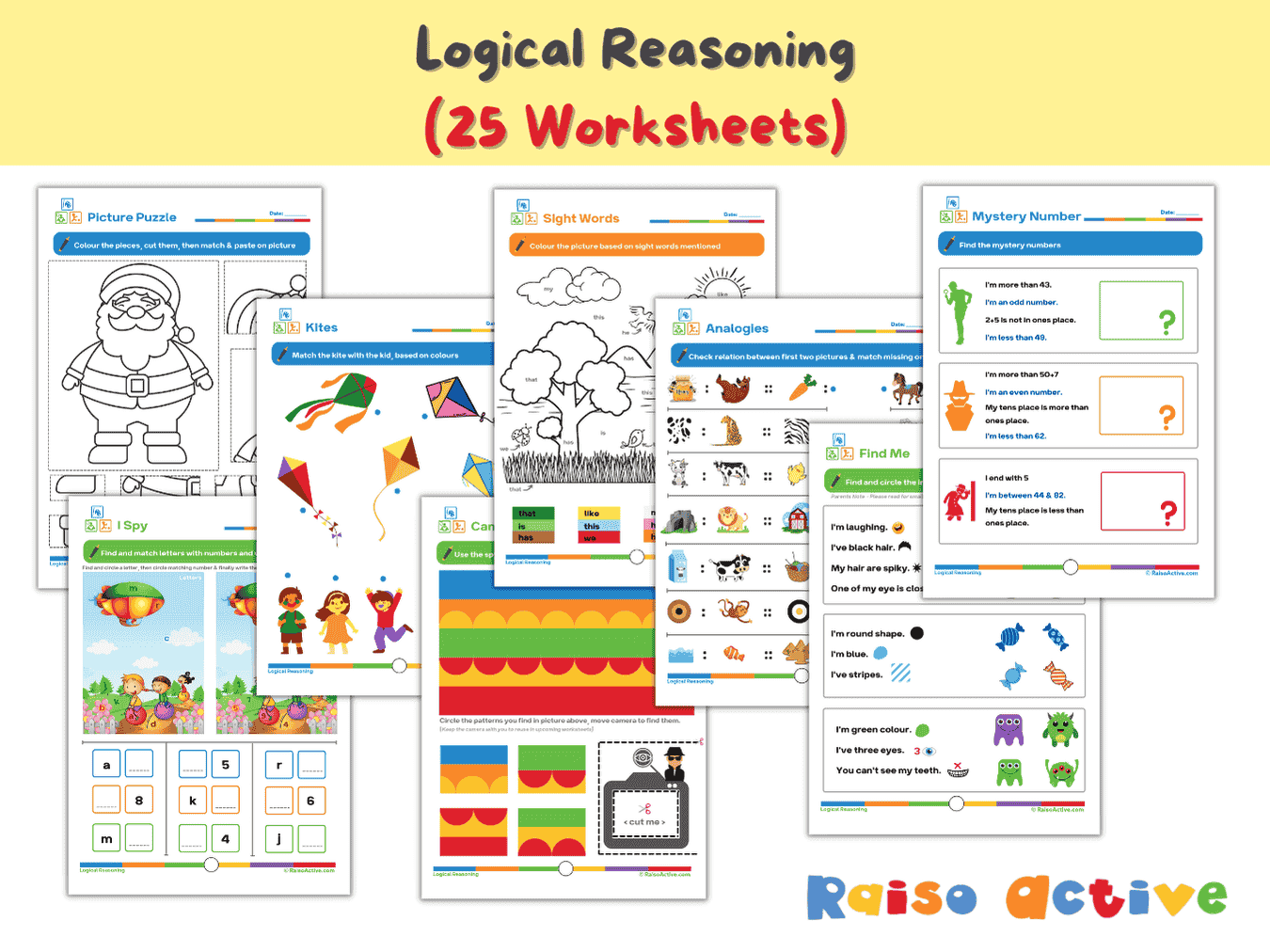
Logical Reasoning Activity Book for Preschool & Kindergarten | Patterns, Puzzles & Analogies
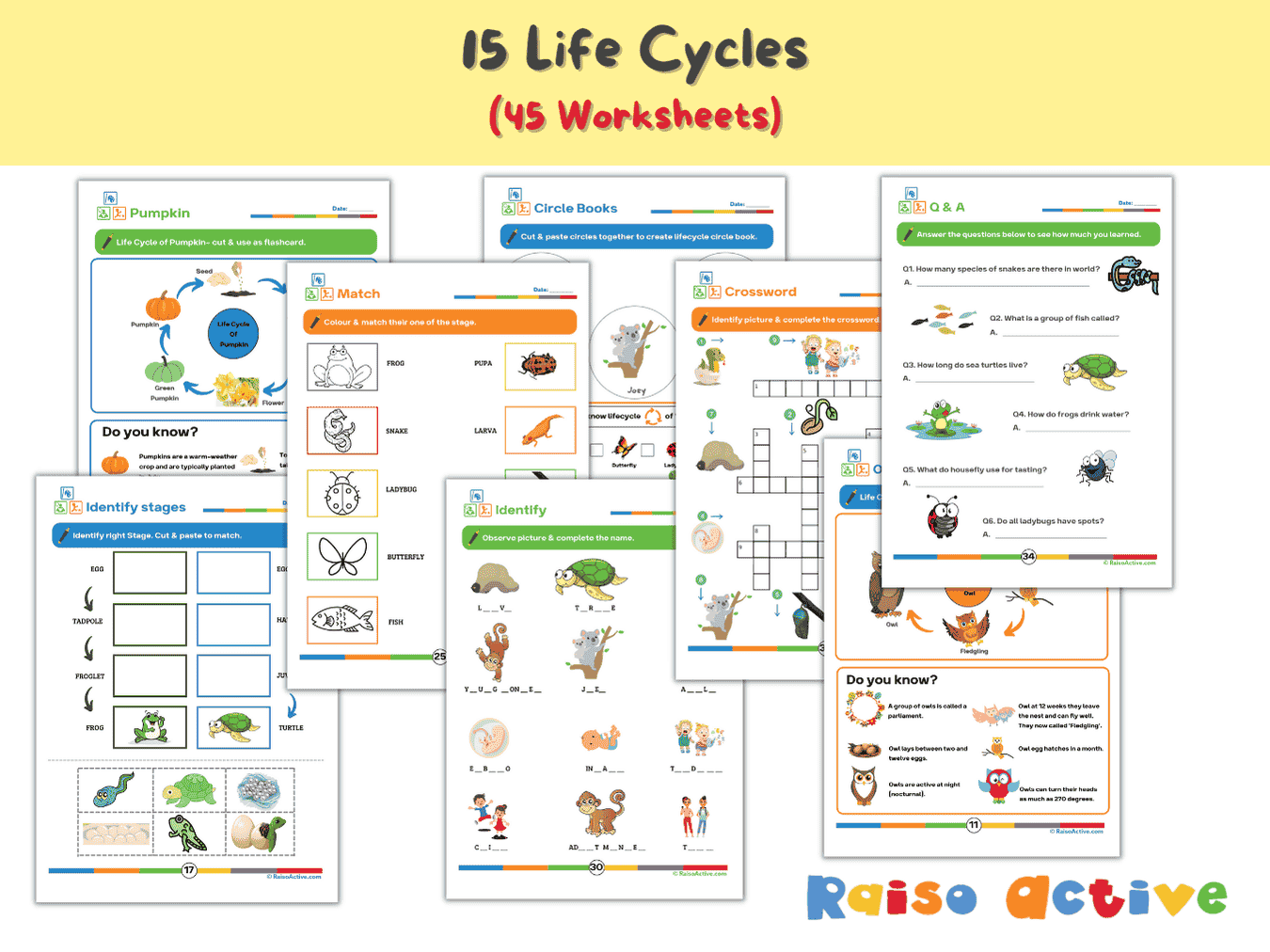
Lifecycles Activity Book & Flashcards for Preschool & Early Elementary
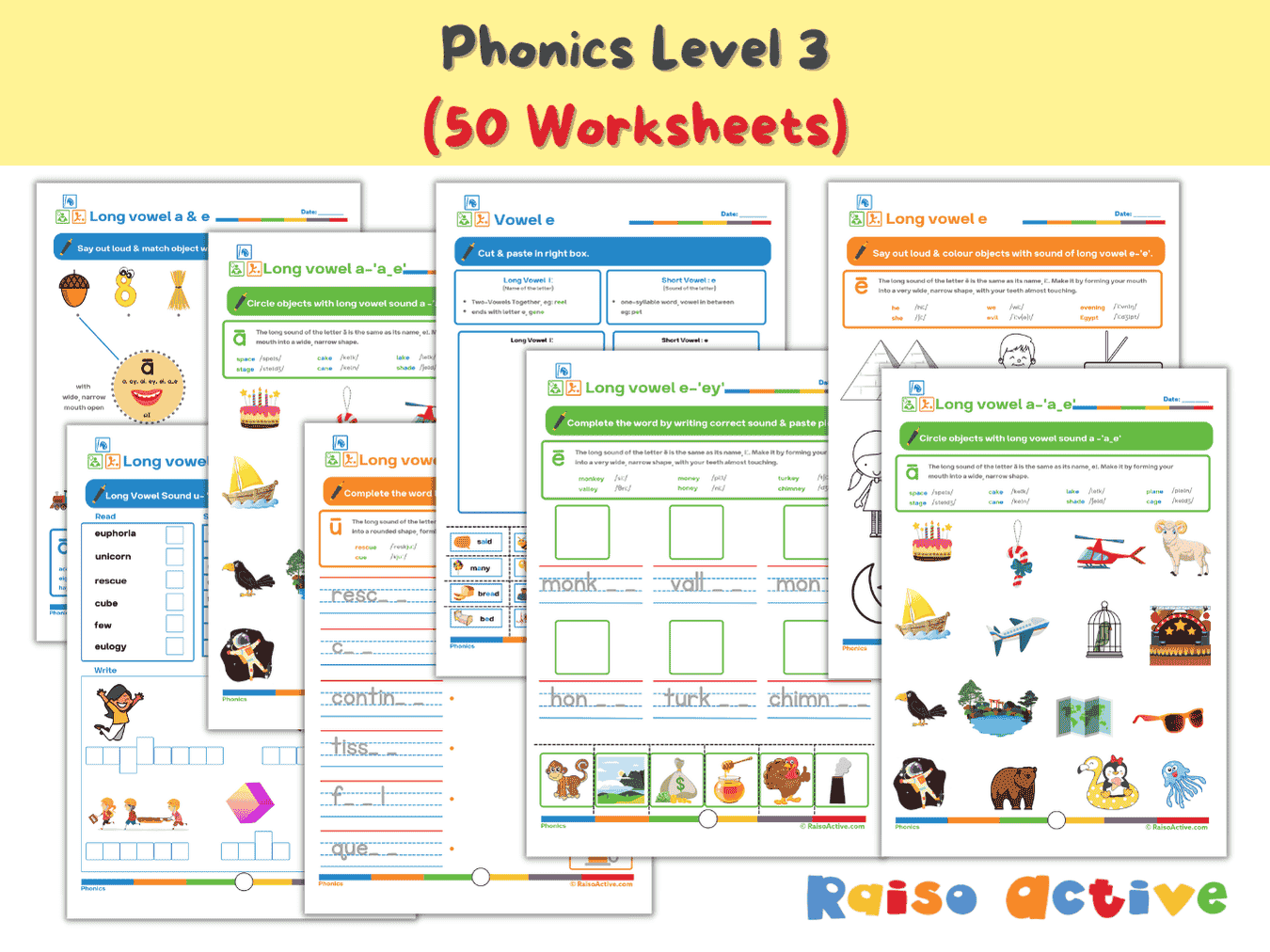
Phonics Level 3 Long Vowels Activity Book for Kindergarten & 1st Grade
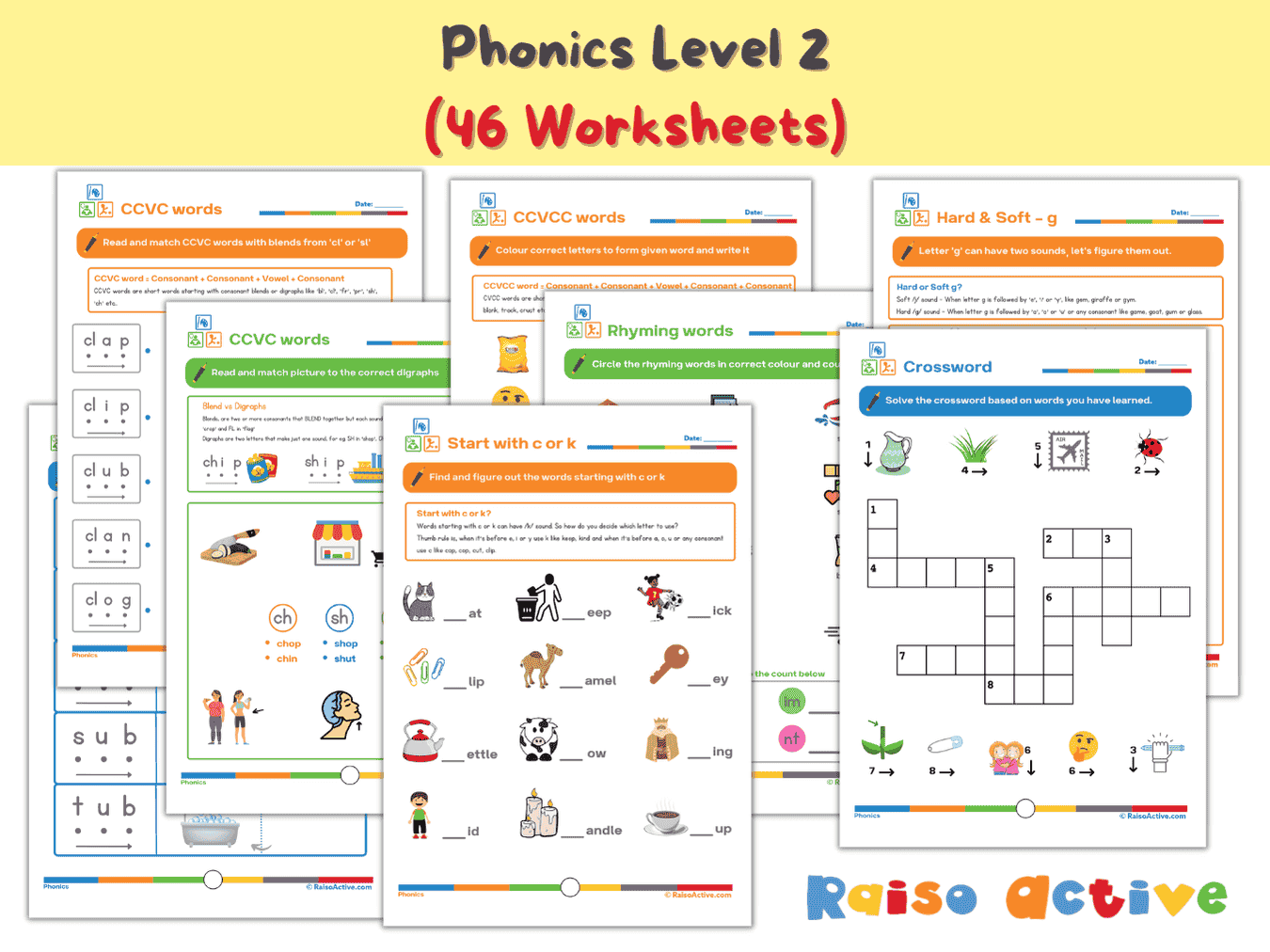
Phonics Level 2 Worksheets: CVC, CCVC, CVCC Word Families & Blends for Early Readers (Ages 4-7)
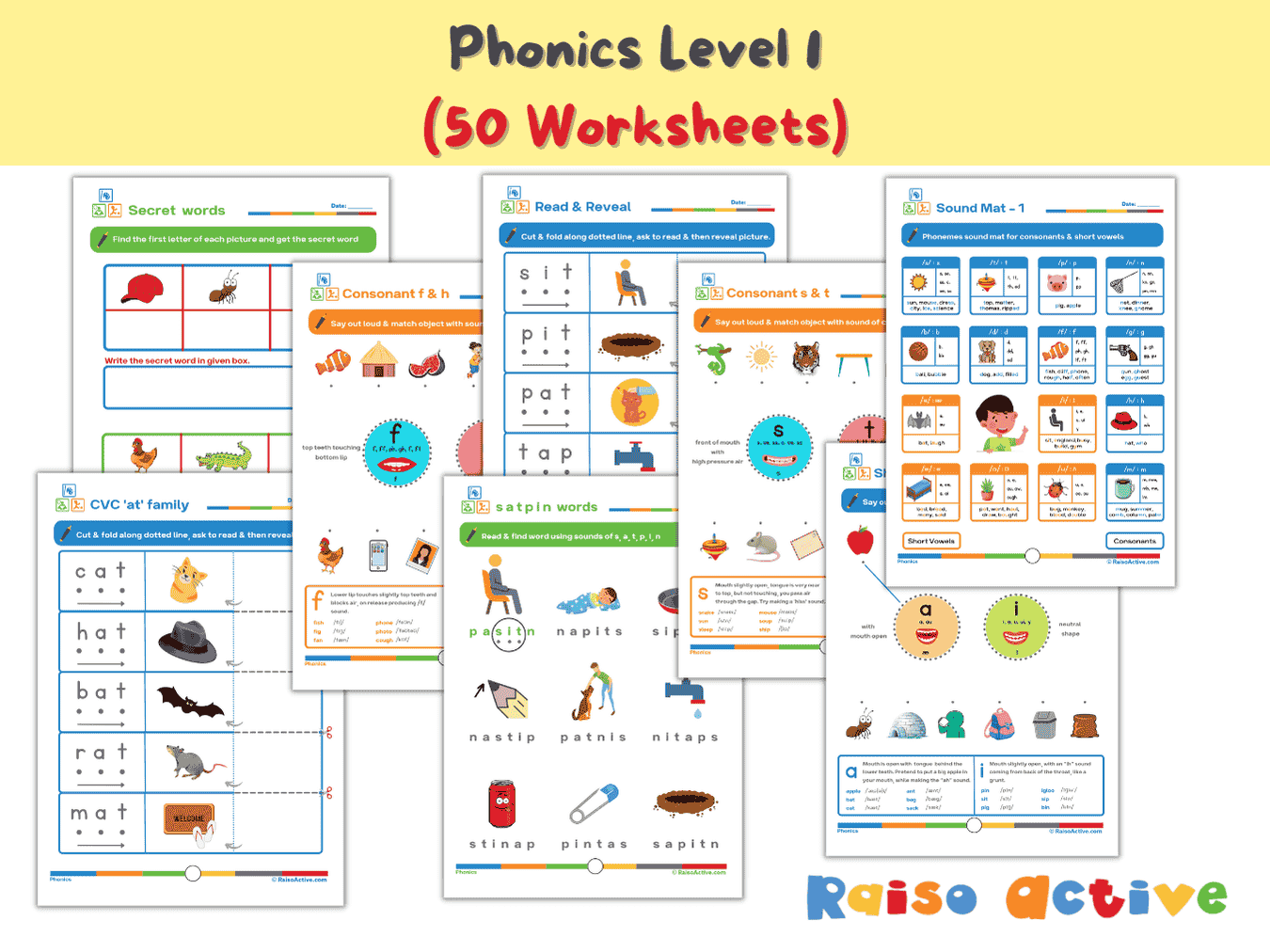
Phonics Level 1 Activity Book: Letter Sounds, Blending & CVC Words for Preschool & Kindergarten
Guides for parents and teachers
See all guides →Best Worksheets for 3-Year-Olds: What Works and What to Avoid
What works on worksheets for 3-year-olds: short sessions, crayons, tracing lines, matching, cutting, a free weekly plan, and signs one is too advanced.
Age-Appropriate Problem-Solving Activities: Building Critical Thinkers from the Ground Up
Discover fun, age-appropriate problem-solving activities for children ages 1-8. Build critical thinking, logic, and reasoning skills through play-based learning.
Critical Thinking Activities That Actually Work for Young Children: Building Tomorrow's Thinkers Today
Discover proven critical thinking activities for young children. Age-wise logic games, questioning techniques, and hands-on ideas to build thinking skills at home.
Coding Activities for Preschoolers: Building Tomorrow's Thinkers Today
Discover 15+ unplugged and screen-based coding activities for preschoolers that build sequencing, logic, and problem-solving skills through play. NEP 2020 aligned.
Canonical: https://raisoactive.com/worksheets/grade-1-matching