Long Vowel a and e Say and Match Worksheet
Children hear and say the long a and long e sounds and match each picture to the right sound circle (long a: acorn, eight, hay, train, cake and grey; long e: he, bee, key, beach, piece and athlete).
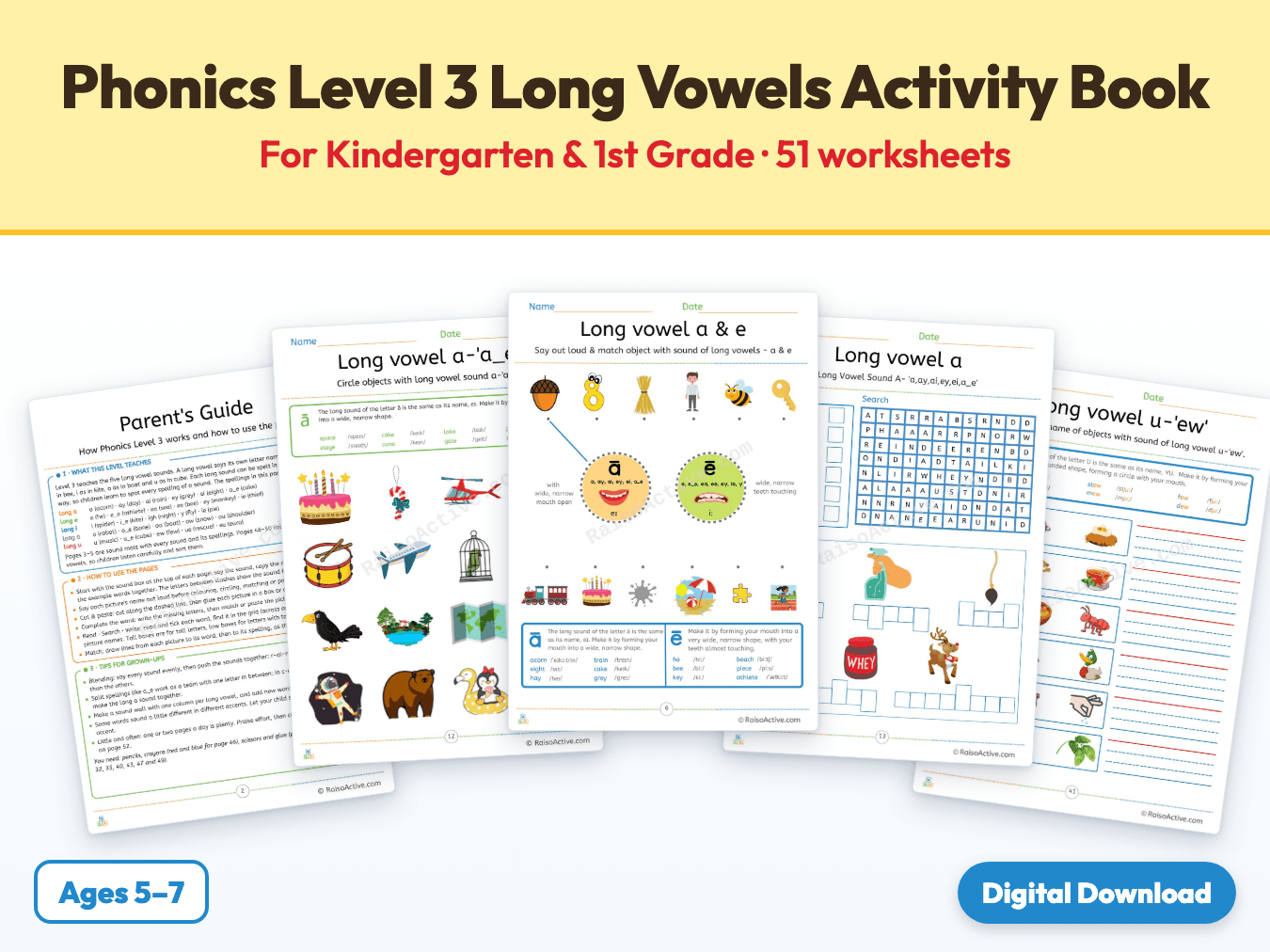
Part of the pack
Phonics Level 3 Long Vowels Activity Book for Kindergarten & 1st Grade
This is page 6 of the pack. Ages 5-7 · Kindergarten–Grade 1Ages 5-7 · Year 1–Year 2Ages 5-7 · UKG–Class 1Ages 5-7
Made for your child
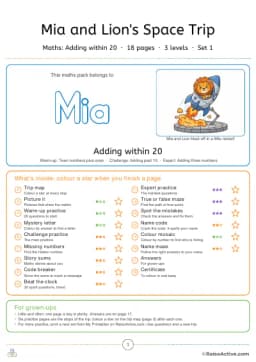
Adding within 10, made for your child
A maths pack with your child's name in it: pictures that explain, practice at three levels, puzzles and story sums about them. Print a new set whenever they finish.
Make a maths packFree preview · free for members
Curriculum
- Phonics - Long Vowels > Long Vowel A
- Phonics - Long Vowels > Long Vowel E
How to use this worksheet
Say each picture's name slowly and listen for the vowel sound. Draw a line from the picture's dot to the matching sound circle, as the example shows. The sound boxes at the bottom show the mouth shape and example words.
Materials needed
- Pencil or coloured pencil
Extension activities
- 1Find objects at home with the same vowel sounds
- 2Draw one more picture for each sound circle

Written by
Hemsweta Jain · Teacher Cheena
MBA and Early Childhood Educator, teaching since 2014 · Founder of RaisoActive, Mumbai
Every RaisoActive worksheet is designed and checked by the founder before publishing.
Published · Last reviewed
More from Phonics Level 3 Long Vowels Activity Book for Kindergarten & 1st Grade

Phonics Level 3 Parent's Guide: Long Vowel Sounds and Spellings
Ages 5-7 · Kindergarten–Grade 1Ages 5-7 · Year 1–Year 2Ages 5-7 · UKG–Class 1Ages 5-7
Grown-ups see what Phonics Level 3 teaches: the five long vowel sounds and their spellings, such as ay, ai, a_e, ee, ea, igh, oa, ow, ew and ue, and how the pages build from one spelling to long-or-short sorting.

Phonics Level 3 Long Vowels Certificate of Achievement
Ages 5-7 · Kindergarten–Grade 1Ages 5-7 · Year 1–Year 2Ages 5-7 · UKG–Class 1Ages 5-7
Children celebrate finishing Phonics Level 3 and look back at the five long vowel sounds they can now read: long a, e, i, o and u.

Long Vowel a 'ay' Cut and Paste Worksheet
Ages 5-7 · Kindergarten–Grade 1Ages 5-7 · Year 1–Year 2Ages 5-7 · UKG–Class 1Ages 5-7
Children practise the long a spelling 'ay' by finding the six pictures that have it: pray, tray, pay, play, day and clay.

Long Vowel e 'ee' Complete the Word and Match Worksheet
Ages 5-7 · Kindergarten–Grade 1Ages 5-7 · Year 1–Year 2Ages 5-7 · UKG–Class 1Ages 5-7
Children finish six long e words by writing the 'ee' letters (see, three, peel, knee, cheese and sweet) and match each word to its picture.

Long Vowel e Spellings Match Worksheet: e, e_e, ea, ee, ey, ie
Ages 5-7 · Kindergarten–Grade 1Ages 5-7 · Year 1–Year 2Ages 5-7 · UKG–Class 1Ages 5-7
Children link each picture to its word and then to its long e spelling (Egypt: e; athlete: e_e; jeans: ea; cheese: ee; honey: ey; thief: ie).

Long Vowel u 'eu' Complete the Word and Paste Worksheet
Ages 5-7 · Kindergarten–Grade 1Ages 5-7 · Year 1–Year 2Ages 5-7 · UKG–Class 1Ages 5-7
Children write the missing 'eu' letters to finish six long u words (euro, feud, eucalyptus, Europe, Eugene and eureka) and paste the matching picture above each word.
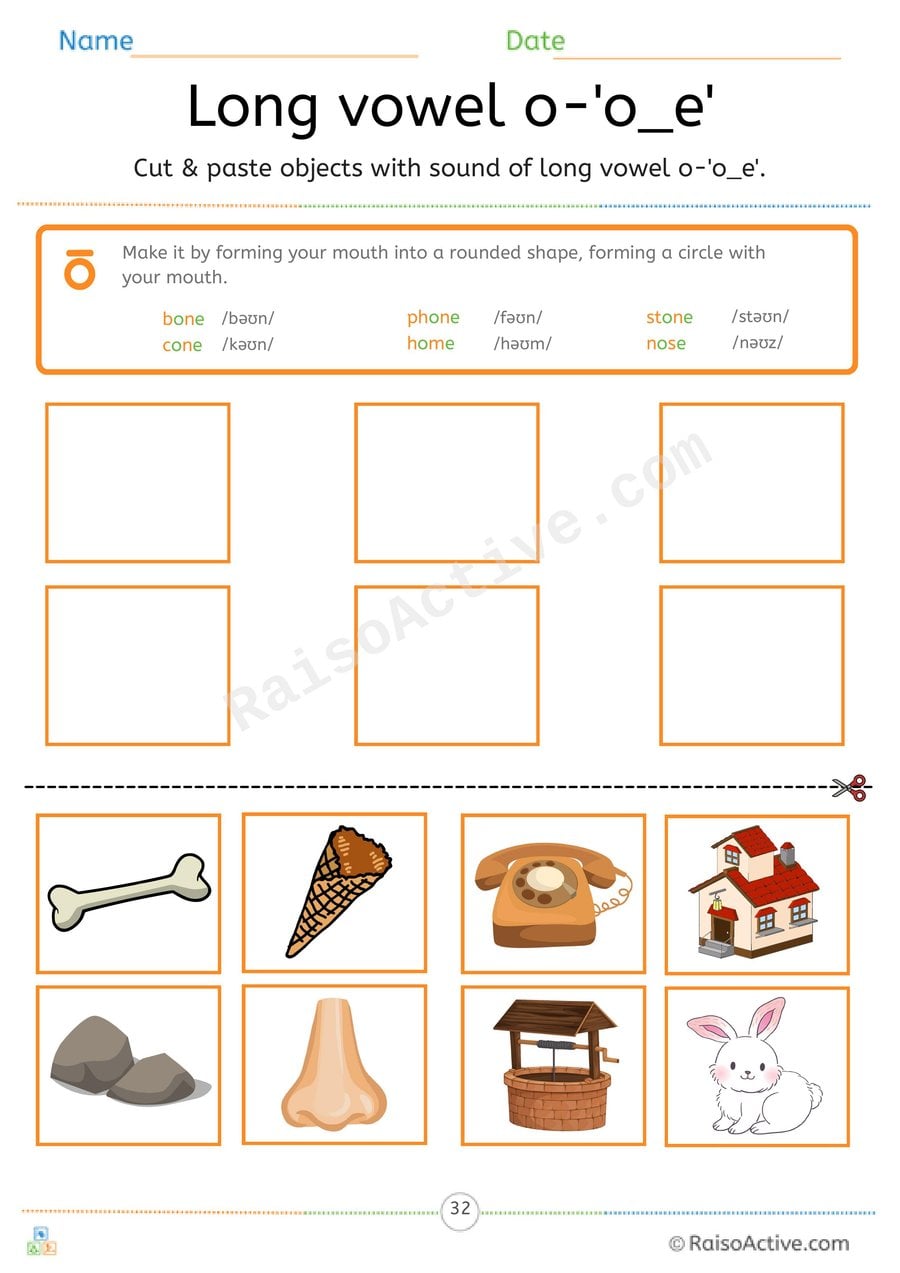
Long Vowel o 'o_e' Cut and Paste Worksheet
Ages 5-7 · Kindergarten–Grade 1Ages 5-7 · Year 1–Year 2Ages 5-7 · UKG–Class 1Ages 5-7
Children practise the long o spelling 'o_e' by finding the six pictures that have it: bone, cone, phone, home, stones and nose.

Long Vowel a 'ai' Circle and Write Worksheet
Ages 5-7 · Kindergarten–Grade 1Ages 5-7 · Year 1–Year 2Ages 5-7 · UKG–Class 1Ages 5-7
Children spot the long a 'ai' word in each row of three pictures, then spell it: snail, rain, train, grain, paint and nail.
Related worksheets
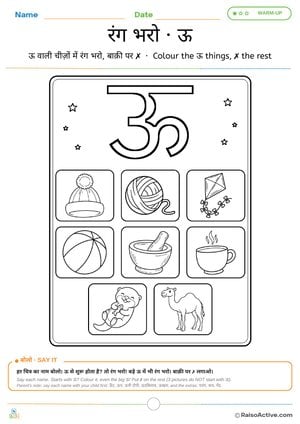
Colour the ऊ Things: Hindi Letter ऊ Colouring Page | रंग भरो · ऊ
Ages 3-7 · Preschool–Grade 1Ages 3-7 · Nursery–Year 2Ages 3-7 · Nursery–Class 1Ages 3-7
Children listen for the first sound of each picture name and decide whether it starts with ऊ. They colour the ऊ pictures, cross out the others and colour the big letter.
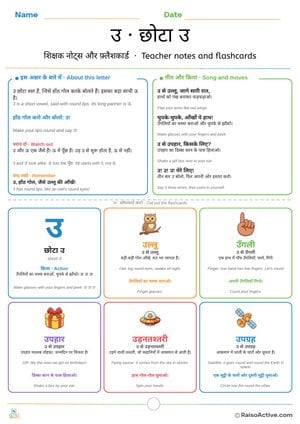
Hindi Letter उ (u) Teacher Notes and Flashcards | उ · छोटा उ
Ages 3-7 · Preschool–Grade 1Ages 3-7 · Nursery–Year 2Ages 3-7 · Nursery–Class 1Ages 3-7
Children meet the short vowel उ with a short note for adults, a song with actions and cut-out flashcards for उल्लू (owl), उँगली (finger), उपहार (gift), उड़नतश्तरी (flying saucer), उपग्रह (satellite). They hear the sound at the start of real words and link it to a hand action.
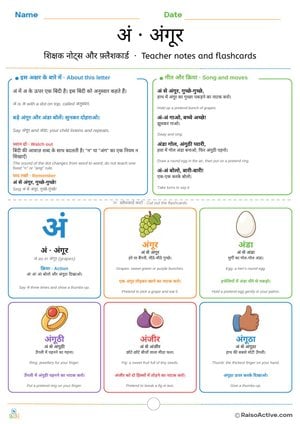
Hindi Letter अं (am) Teacher Notes and Flashcards | अं शिक्षक नोट्स और फ़्लैशकार्ड
Ages 3-7 · Preschool–Grade 1Ages 3-7 · Nursery–Year 2Ages 3-7 · Nursery–Class 1Ages 3-7
Teacher notes and six cut-out flashcards for अं (am) with the words अंगूर, अंडा, अंगूठी, अंजीर and अंगूठा. Each card has a sentence and a small action, and the page ends with a short song to sing and move to.
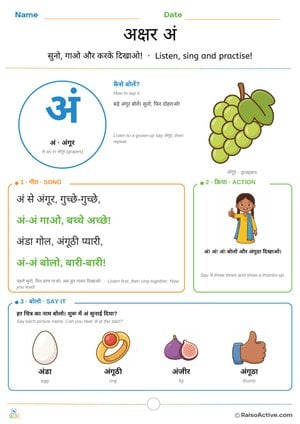
Hindi Letter अं (am) Song and Action Worksheet | अक्षर अं गीत और क्रिया
Ages 3-7 · Preschool–Grade 1Ages 3-7 · Nursery–Year 2Ages 3-7 · Nursery–Class 1Ages 3-7
Children meet the Hindi vowel अं (am) through a four-line song, a body action and picture words such as अंगूर, अंडा, अंगूठी, अंजीर, अंगूठा and अंकुर. Hearing, saying and moving together helps the sound stick before any writing begins.
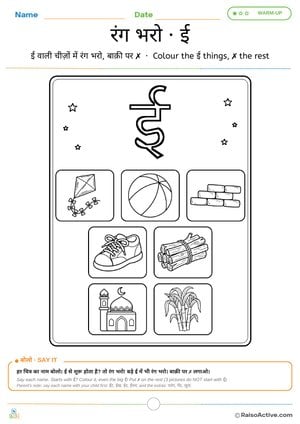
Colour the ई Things: Hindi Letter ई Colouring Page | रंग भरो · ई
Ages 3-7 · Preschool–Grade 1Ages 3-7 · Nursery–Year 2Ages 3-7 · Nursery–Class 1Ages 3-7
Children listen for the first sound of each picture name and decide whether it starts with ई. They colour the ई pictures, cross out the others and colour the big letter.

Harvests & New Years: One Harvest, Many Names Across India
Ages 4-8 · Pre-K–Grade 2Ages 4-8 · Reception–Year 3Ages 4-8 · LKG–Class 2Ages 4-8
Children learn that the same winter harvest is celebrated with different names across India, and that many states have their own New Year festival.

Festivals of Many Faiths: Places of Worship and Greetings
Ages 4-8 · Pre-K–Grade 2Ages 4-8 · Reception–Year 3Ages 4-8 · LKG–Class 2Ages 4-8
Children learn that India is home to many faiths, each with its own festivals, places of worship and festival greetings.
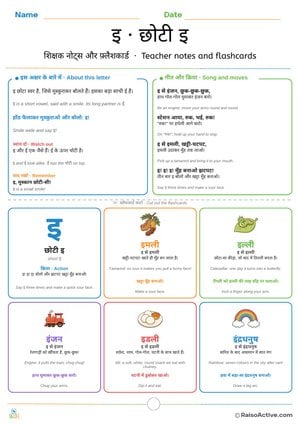
Hindi Letter इ (i) Teacher Notes and Flashcards | इ · छोटी इ
Ages 3-7 · Preschool–Grade 1Ages 3-7 · Nursery–Year 2Ages 3-7 · Nursery–Class 1Ages 3-7
Children meet the short vowel इ with a short note for adults, a song with actions and cut-out flashcards for इमली (tamarind), इल्ली (caterpillar), इंजन (engine), इडली (idli), इंद्रधनुष (rainbow). They hear the sound at the start of real words and link it to a hand action.
Guides for this topic

How to Teach CVC Blending: A Step-by-Step Method That Works in Two Weeks
A step-by-step method for teaching CVC blending, covering continuous sounds, word families, common errors, and a 14-day plan that most children finish reading CVC words.

Best Worksheets for 3-Year-Olds: What Works and What to Avoid
What works on worksheets for 3-year-olds: short sessions, crayons, tracing lines, matching, cutting, a free weekly plan, and signs one is too advanced.
Phase 2 Phonics at Home: Sound Order, Blending Games, Worksheets
Phase 2 phonics at home: the five sound sets in order, oral blending, tricky words, a two-week routine, common mistakes, and free worksheets.
Reviews
Every worksheet for ages 5–7, no watermark
Members download the full library of 1,000+ worksheets and every activity pack without watermarks or daily limits. One year costs ₹999 in India or $20 elsewhere.
See membership plansOr download any worksheet free with a watermark (5 a day).