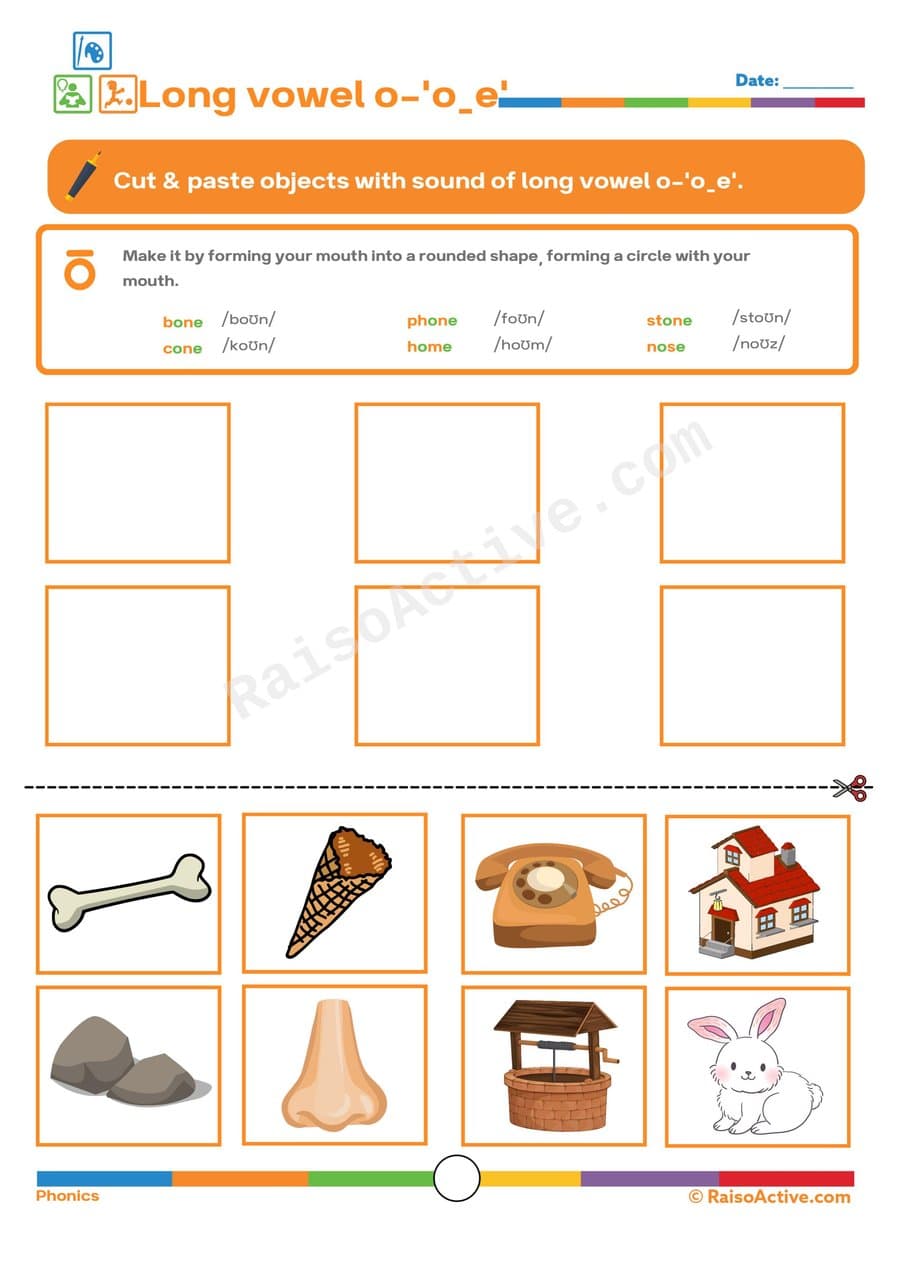
Long Vowel 'o' Cut and Paste Worksheet for Kids
This cut-and-paste worksheet has children ages 4-5 identify which pictured objects contain the long 'o' sound, as in 'boat' or 'rose,' and sort them by cutting and gluing only the matching pictures into the correct box. Categorizing by sound rather than by written spelling keeps the focus on listening skills, an important step before children are expected to connect that sound to its various written forms.
Curriculum
How to use this worksheet
Look at the row of pictures to be cut out and say each object's name aloud together, listening carefully for the long 'o' sound. Have your child cut out each picture, and before pasting, ask them to decide whether the word has a long 'o' sound or not. If it does, guide them to paste it into the correct box on the page; if it doesn't, set it aside or paste it into a separate box if the worksheet includes one. Once finished, review all the pictures pasted in the long 'o' box together, saying each word aloud to confirm they share the sound.
Materials needed
- Scissors
- Glue
- Pencil
Extension activities
- •Go on a listening walk around the house, naming objects and deciding together if each one has a long 'o' sound.
- •Play a sorting game with toy props, separating them into 'long o sound' and 'not long o sound' piles.
- •Sing a simple song or rhyme repeating long 'o' words, like 'boat,' 'coat,' and 'goat.'
- •Draw a picture of an object with a long 'o' sound and label it together.
- •Make up a silly sentence using three long 'o' words from the worksheet.
Tips for parents and teachers
If your child struggles to hear the long 'o' sound in the middle of a word, exaggerate it by stretching the sound out slowly, like 'booooat.' Some pictures may have a short 'o' sound instead, like 'box,' so use any mismatches as a chance to compare the two sounds side by side. Supervise cutting closely and offer to start tricky cuts, since the goal here is the listening and sorting, not scissor perfection.

Written by
Hemsweta Jain · Teacher Cheena
MBA and Early Childhood Educator, teaching since 2014 · Founder of RaisoActive, Mumbai
Every RaisoActive worksheet is designed and checked by the founder before publishing.
Published · Last reviewed
Related worksheets
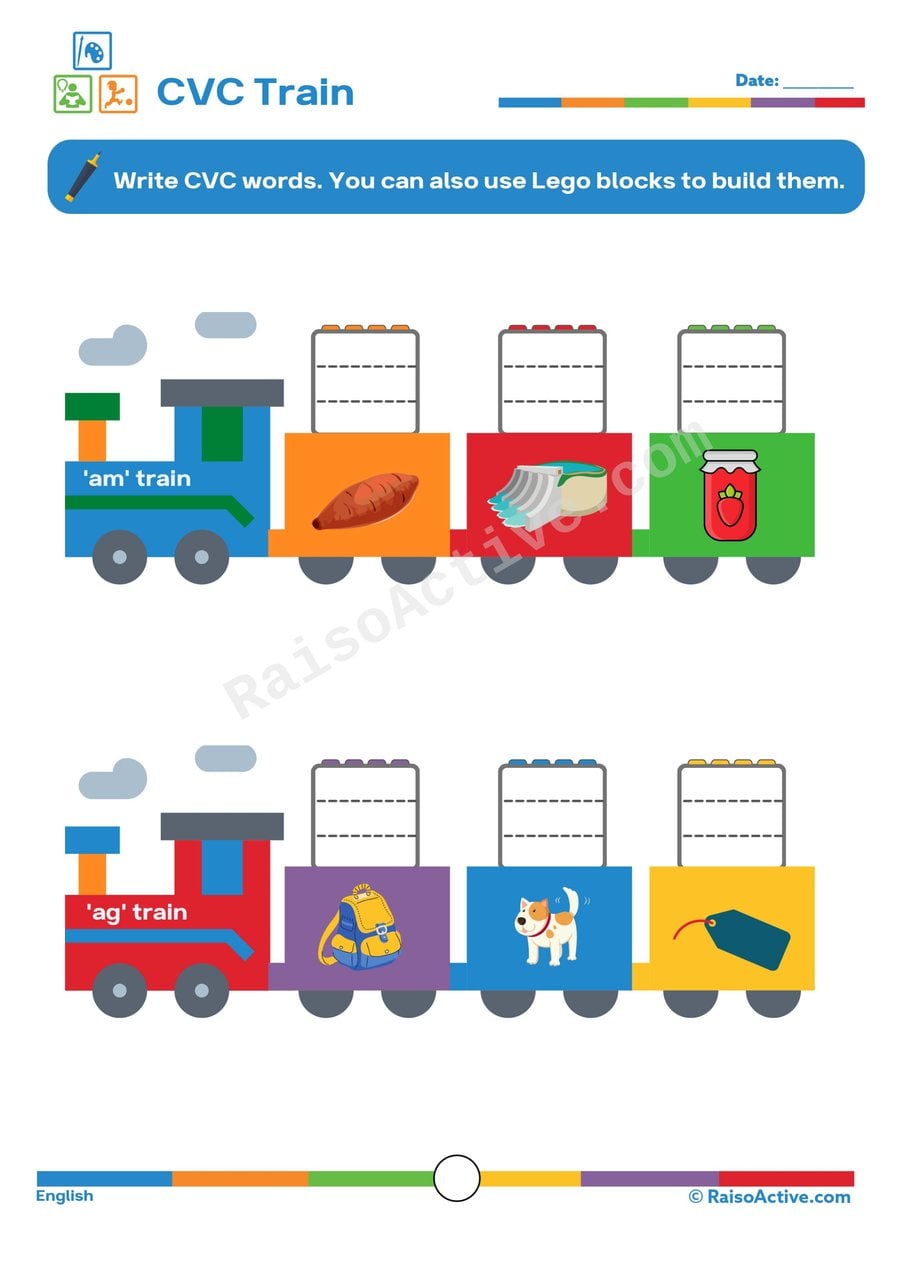
CVC Train Worksheet: Write and Build CVC Words!
This worksheet gives children ages 4-6 focused practice blending letter sounds into consonant-vowel-consonant words, using train-car pictures as clues for words like 'dog,' 'hen,' or 'cup.' Because children both write the word and can optionally build it with Lego blocks, this worksheet reinforces the same phonics skill through two different physical actions — handwriting and hands-on construction — which helps the spelling patterns stick.
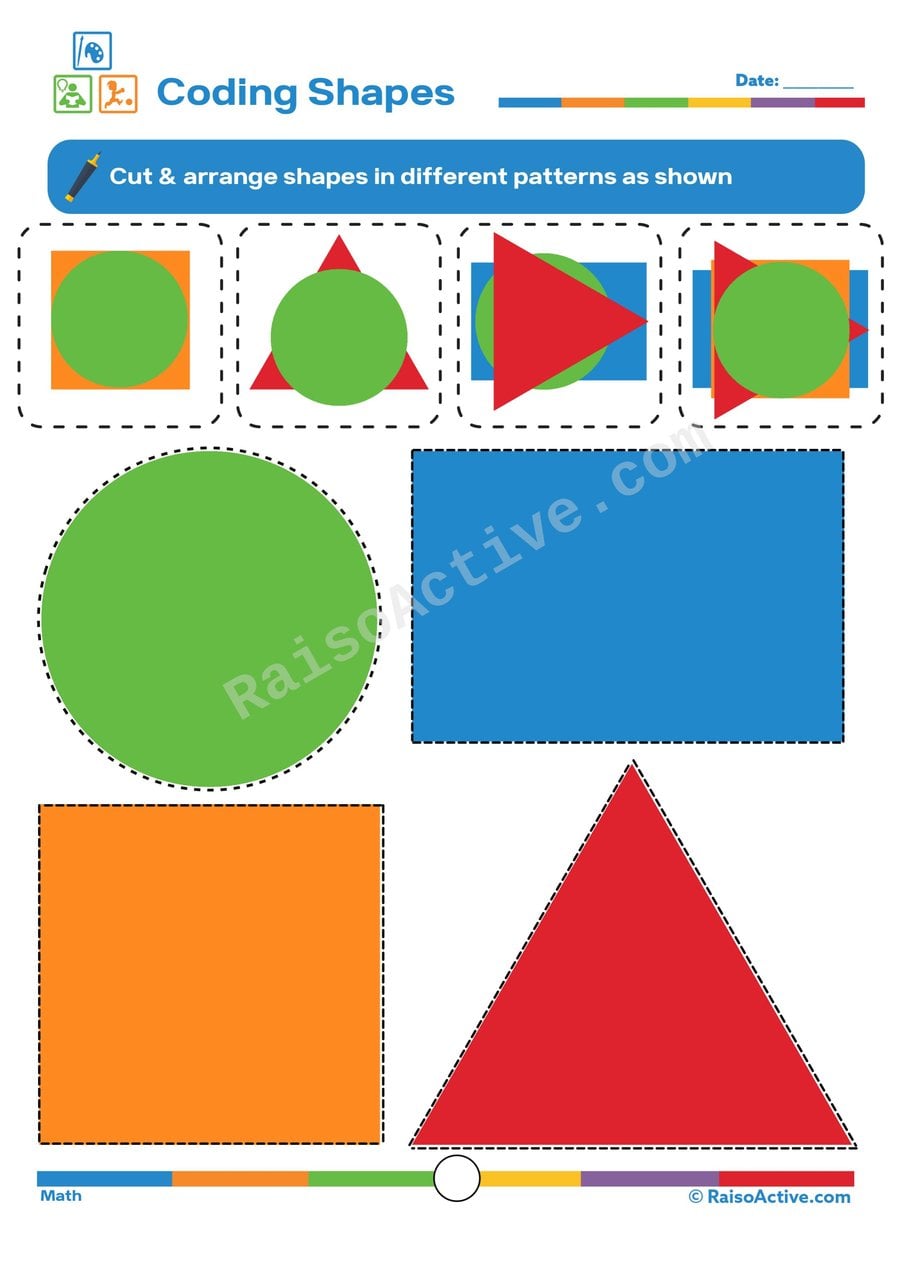
Coding Shapes Worksheet: Cut and Arrange Shapes!
This cut-and-paste worksheet has children ages 3-5 recreate example shape sequences by cutting out individual pieces and arranging them to match, combining shape recognition with the ordered, step-by-step thinking used in early coding and pattern logic. The physical act of cutting and precisely placing each piece also strengthens fine motor control and spatial planning.
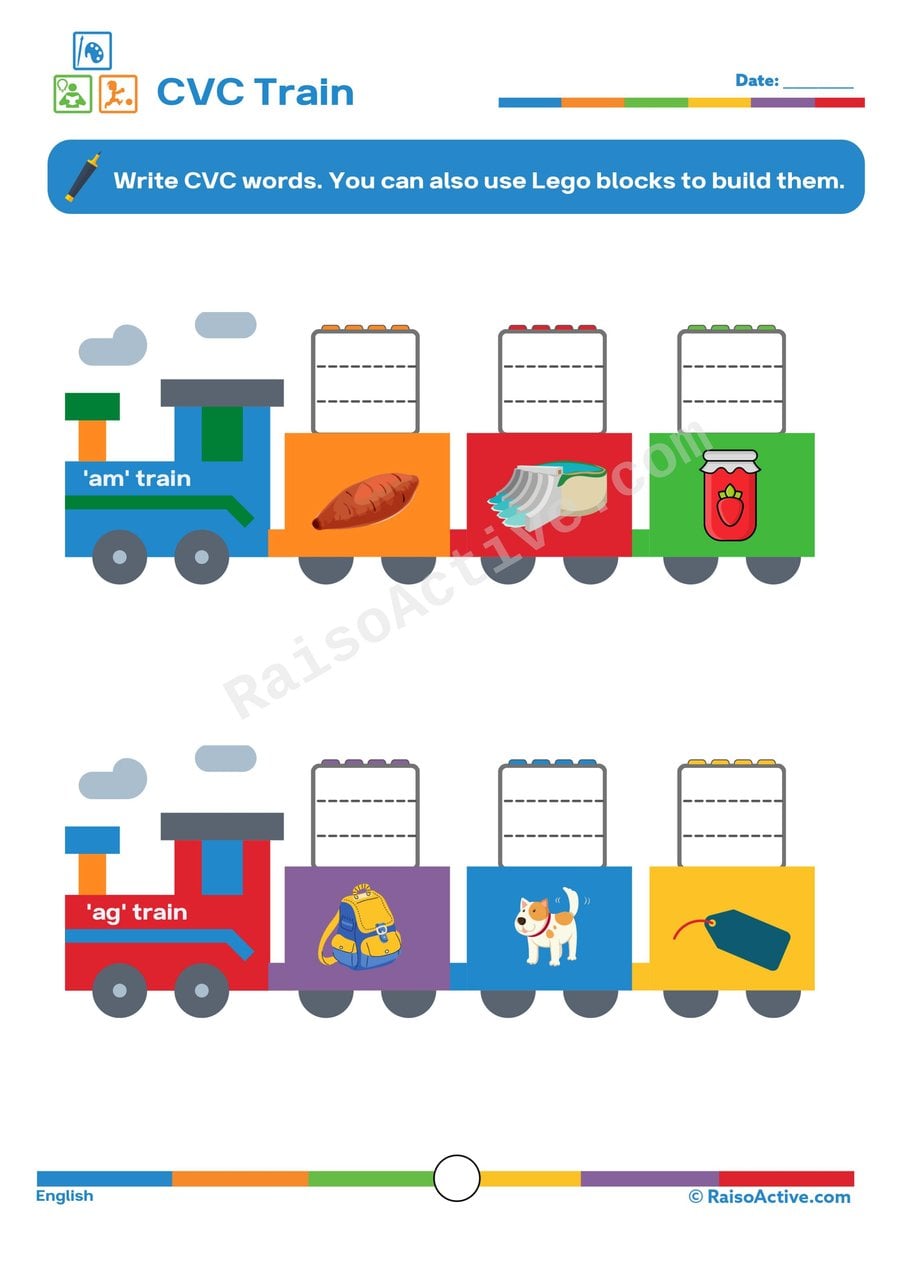
CVC Train Worksheet: Write CVC Words!
Writing consonant-vowel-consonant words like 'cat,' 'sun,' or 'pig' under matching pictures gives children ages 4-6 direct practice with letter-sound blending, a core phonics skill that underpins independent reading. Because each train car pairs a picture clue with a blank space, children also practice translating a spoken word they can sound out into its correctly spelled written form.

Coding Shapes Worksheet for Preschoolers: Cut and Paste Patterns
This cut-and-paste activity has children ages 3-5 recreate shape sequences shown in sample boxes, combining shape recognition with the same ordered, step-by-step thinking used in beginner coding concepts. Cutting out individual shapes and arranging them in the correct sequence also builds fine motor precision and spatial planning.

Christmas Cut and Paste Worksheet for Preschoolers
Cutting out a moon, snowman, gifts, and trees and arranging them inside a circle builds scissor precision and compositional thinking in children ages 3-5. Because there's no single 'correct' layout, children also practice early creative decision-making — choosing where each element belongs within a bordered space, which supports spatial awareness.

Rocking Santa Card Craft Worksheet for Preschoolers
This rocking Santa card craft has children ages 3-5 cut out individual shape pieces and assemble them onto a folded card base, combining scissor control with an early understanding of how folding creates movement, since the 'rocking' effect comes from the card's fold. Following the assembly steps in order also reinforces sequencing and attention to visual instructions.
Shape Elves Worksheet: Cut, Paste, and Create!
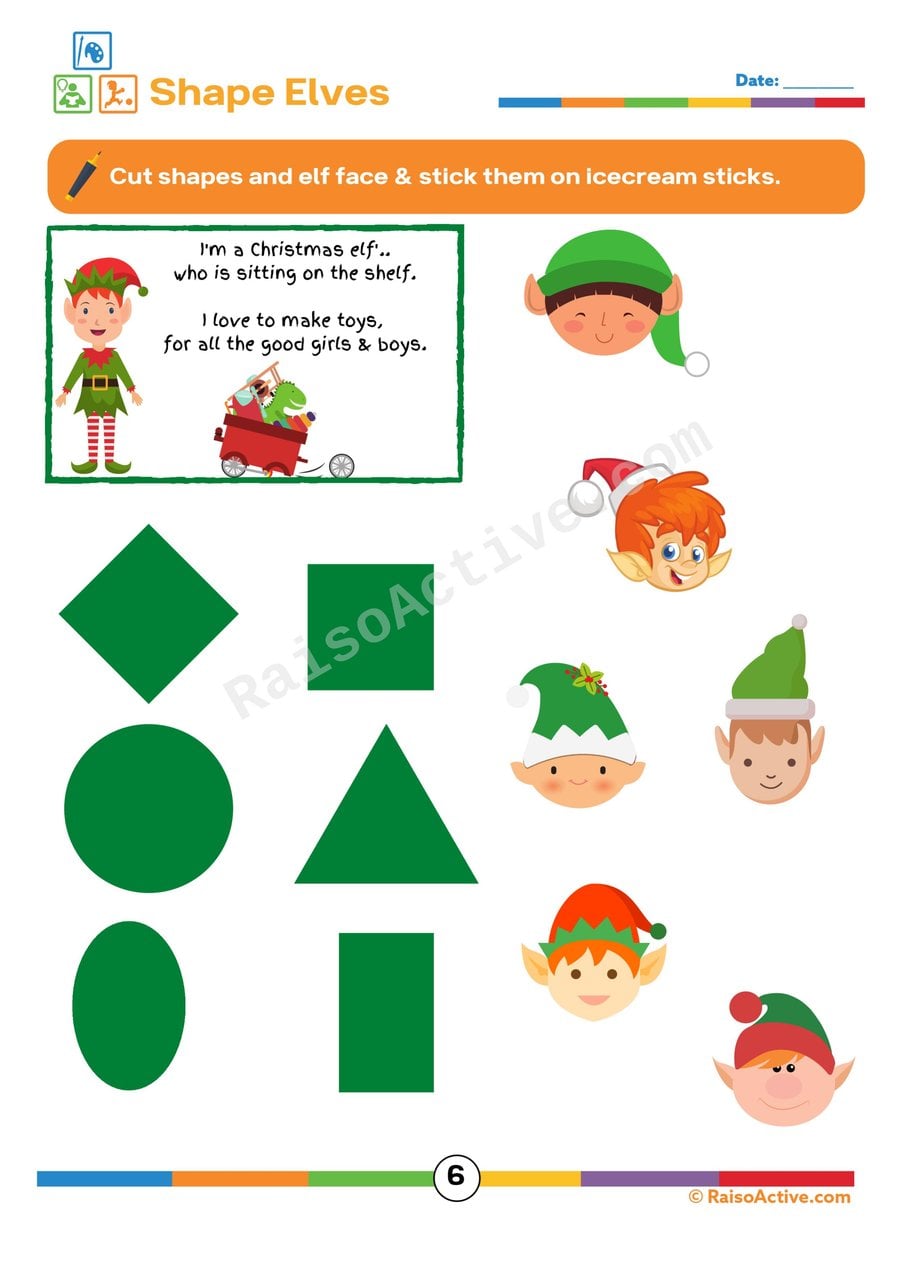
Cutting out circles, triangles, and rectangles to assemble an elf face teaches children ages 3-5 to recognize and name basic 2D shapes while practicing scissor control along both straight and curved lines. Because each shape has to go in a specific spot to form a recognizable face, children also build spatial reasoning as they figure out which shape works as eyes, a nose, or a hat. Turning geometry into a craft project makes an abstract math concept feel like creative play.

Decorate the Christmas Tree! Cut and Paste Worksheet
This cut-and-paste activity builds scissor control and hand strength in children ages 3-5 as they snip out ornaments, stars, and lights to decorate their own Christmas tree. Deciding where each decoration goes also develops spatial planning and following a visual guide, since children compare their tree to the sample image while placing pieces.
Guides for this topic
How to Teach CVC Blending: A Step-by-Step Method That Works in Two Weeks
A step-by-step method for teaching CVC blending, covering continuous sounds, word families, common errors, and a 14-day plan that most children finish reading CVC words.
Phase 2 Phonics at Home: Sound Order, Blending Games, Worksheets
Phase 2 phonics at home: the five sound sets in order, oral blending, tricky words, a two-week routine, common mistakes, and free worksheets.
Reception Year Explained: EYFS Learning and How to Help at Home
A teacher's plain-English guide to the Reception Year: the seven areas of learning, Early Learning Goals, Phase 2/3 phonics, the RBA and home routines.
Reviews
Every worksheet for ages 4–5, no watermark
Members download the full library of 1,000+ worksheets and every activity pack without watermarks or daily limits. One year costs ₹1,000 in India or $20 elsewhere.
See membership plansOr download any worksheet free with a watermark (5 a day).